Adhyaya 7
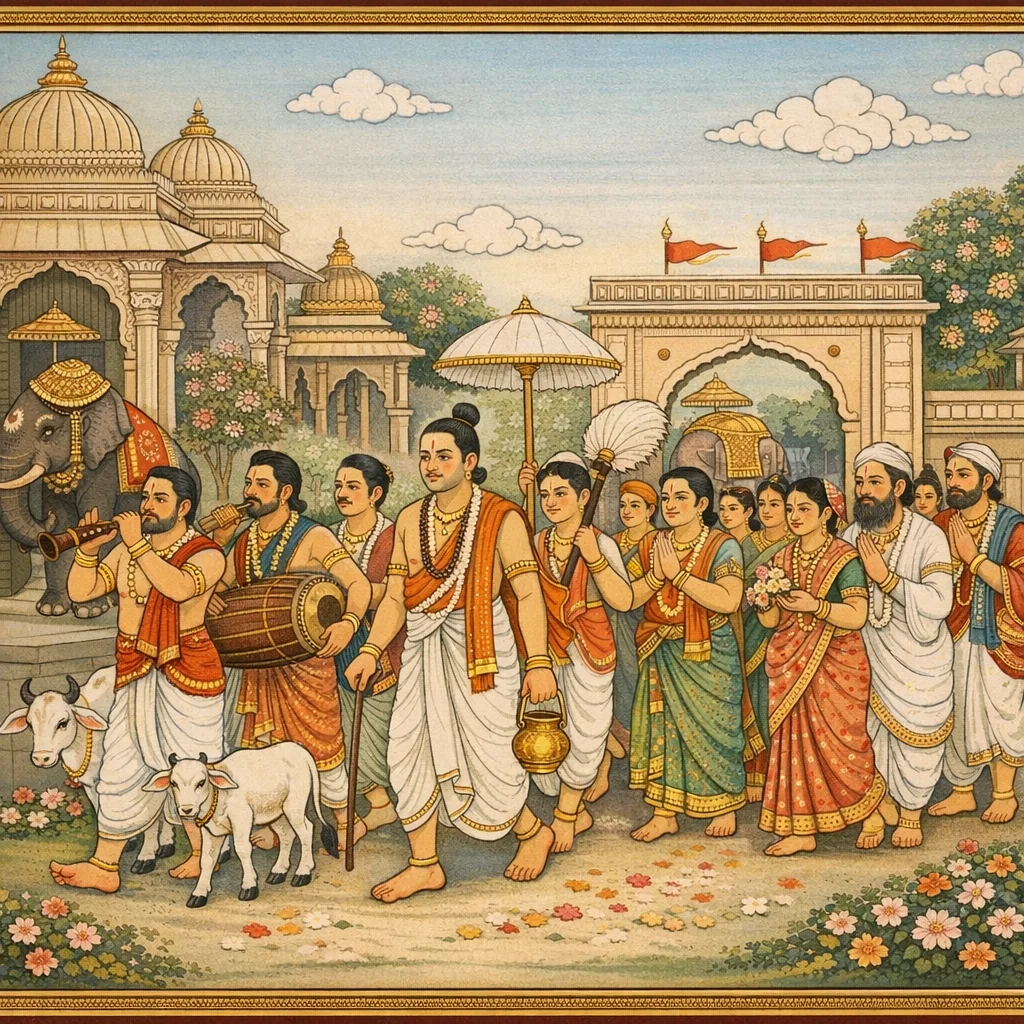
Agastya introduces a learned brāhmaṇa of Mathurā and his son Śivaśarmā, who masters a wide range of sacred and practical disciplines—Vedas and auxiliaries, Dharmaśāstras, Purāṇas, logic, Mīmāṃsā, medicine, arts, statecraft, and languages. Though prosperous and socially accomplished, Śivaśarmā is seized by inner anxiety when he recognizes aging and the limits of accumulated learning. He undertakes a severe ethical self-audit, confessing neglected duties of devotion and service: inadequate worship of Śiva, Viṣṇu, Gaṇeśa, Sūrya, and the Devī; neglect of yajñas, hospitality, feeding brāhmaṇas, planting trees, aiding women with clothing and ornaments, and giving gifts of land, gold, and cows. He also laments not building water-reservoirs, helping travelers, supporting marriages, performing purificatory vows, or establishing temples and liṅgas. Concluding that only pilgrimage to tīrthas can turn his life toward the highest good, he departs on an auspicious day after preliminary rites. He visits major tīrthas such as Ayodhyā and especially Prayāga, whose confluence is praised as a multi-dimensional tīrtha granting dharma/artha/kāma/mokṣa and powerful purification. After staying there he reaches Vārāṇasī, worships Dehalivināyaka at the threshold, bathes at Maṇikarṇikā, offers to gods and ancestors, and venerates Viśveśvara, marveling at Kāśī’s incomparable greatness. Yet, even while acknowledging Kāśī’s glory, he continues on to Mahākālapurī (Ujjayinī), described as repelling pollution and Yama’s power, filled with many liṅgas, and saving those who merely remember Mahākāla. The closing lines hint at intense distress followed by a divine, aerial resolution.
Shlokas
Verse 1
अगस्तिरुवाच । मथुरायां द्विजः कश्चिदभूद्भूदेवसत्तमः । तस्य पुत्रो महातेजाः शिवशर्मेति विश्रुतः
Agastya said: In Mathurā there lived a certain twice-born, the finest among the ‘gods on earth’, a venerable Brāhmaṇa. His son, of great splendor, was renowned by the name Śivaśarmā.
Verse 2
अधीत्यवेदान्विधिवदर्थं विज्ञाय तत्त्वतः । पठित्वा धर्मशास्त्राणि पुराणान्यधिगम्य च
Having duly studied the Vedas and truly understood their meaning, and having read the Dharmaśāstras and mastered the Purāṇas as well,
Verse 3
अंगान्यभ्यस्य तर्कांश्च परिलोड्य समंततः । मीमांसाद्वयमालोक्य धनुर्वेदं विगाह्य च
And having practiced the Vedāṅgas, thoroughly examined the systems of reasoning on every side, surveyed both Mīmāṃsās, and also entered into the knowledge of Dhanurveda,
Verse 4
आयुर्वेदं विचार्यापि नाट्यवेदे कृतश्रमः । अर्थशास्त्राण्यनेकानि प्राप्याश्वगजचेष्टितम्
Having reflected on Āyurveda, labored in the Nāṭyaveda, acquired many Arthaśāstras, and learned the handling and training of horses and elephants,
Verse 5
कलासु च कृताभ्यासो मन्त्रशास्त्रविचक्षणः । भाषाश्च नाना देशानां लिपीर्ज्ञात्वा विदेशजाः
Practiced in the arts, expert in the sciences of mantra, and—having learned the languages of many regions—knowing even scripts that came from foreign lands,
Verse 6
अर्थानुपार्ज्य धर्मेण भुक्त्वा भोगान्यदृच्छया । उत्पाद्य पुत्रान्सुगुणांस्तेभ्यो ह्यर्थं विभज्य च
Having acquired wealth by righteous means, enjoyed pleasures without undue striving, fathered virtuous sons, and apportioned wealth to them as their share,
Verse 7
यौवनं गत्वरं ज्ञात्वा जरां दृष्ट्वाश्रितां श्रुतिम् । चिन्तामवाप महती शिवशर्मा द्विजोत्तमः
Knowing youth to be fleeting, and seeing old age settle in as taught by śruti, the excellent twice-born Śivaśarmā fell into deep reflection and great concern.
Verse 8
पठतो मे गतः कालस्तथोपार्जयतो धनम् । नाराधितो महेशानः कर्मनिर्मूलनक्षमः
My time has passed in study, and likewise in the gaining of wealth; yet Maheśāna, who can uproot karma, has not been worshiped by me.
Verse 9
न मया तोषितो विष्णुः सर्वपापहरो हरिः । सर्वकामप्रदो नृणां गणेशो नार्चितो मया
By me, Viṣṇu—Hari, the remover of all sins—has not been propitiated; and Gaṇeśa, the granter of all desired aims to human beings, has not been worshiped by me.
Verse 10
तमस्तोमहरः सूर्यो नार्चि तो वै मया क्वचित् । महामाया जगद्धात्री न ध्याता भवबंधहृत्
The Sun, who destroys masses of darkness, has never been worshiped by me at any time; and Mahāmāyā, the Mother who upholds the worlds and severs the bonds of worldly becoming, has not been meditated upon by me.
Verse 11
न प्रीणिता मया देवा यज्ञैः सर्वैः समृद्धिदाः । तुलसीवन शुश्रूषा न कृता पापशांतये
By me, the gods—bestowers of prosperity—have not been satisfied through any sacrifices; nor have I rendered service to the grove of Tulasī for the pacification of sins.
Verse 12
न मया तर्पिता विप्रा मृष्टान्नैर्मधुरै रसैः । इहापि च परत्रापि विपदामनुतारकाः
By me, the brāhmaṇas have not been gratified with fine foods and sweet delicacies—those acts which, both here and hereafter, help one to cross over misfortunes.
Verse 13
बहुपुष्पफलोपेताः सुच्छायाः स्निग्धपल्लवाः । पथि नारोपिता वृक्षा इहामुत्रफलप्रदाः
Trees abundant in many flowers and fruits—offering fine shade and bearing tender, glossy leaves—I have not planted along the road, though they bestow fruits and merit in this world and the next.
Verse 14
दुकूलैः स्वानुकूलैश्च चोलैः प्रत्यंगभूषणैः । नालंकृताः सुवासिन्य इहामुत्रसुवासदाः
Women of good conduct (suvāsinīs) I have not adorned with fine garments, fitting cloths, and ornaments for the limbs—gifts that grant good dwelling and comfort here and hereafter.
Verse 15
द्विजाय नोर्वरा दत्ता यमलोकनिवारिणी । सुवर्णं न सुवर्णाय दत्तं दुरितहृत्परम्
To a twice-born (dvija, brāhmaṇa) I have not given fertile land that wards off the realm of Yama; nor have I given gold to the worthy recipient—gold that supremely removes wrongdoing.
Verse 16
नालंकृता सवत्सा गौः पात्राय प्रतिपादिता । इह पापापहंत्र्याशु सप्तजन्मसुखावहा
An adorned cow with her calf I have not presented to a worthy recipient—a gift that swiftly destroys sins here and brings happiness for seven births.
Verse 17
ऋणापनुत्तये मातुः कारितो न जलाशयः । नातिथिस्तोषितः क्वापि स्वर्गमार्गप्रदर्शकः
To repay my debt to my mother, I have not had a water-reservoir built; nor have I ever satisfied a guest—though hospitality points out the path to heaven.
Verse 18
छत्रोपानत्कुंडिकाश्च नाध्वगाय समर्पिताः । यास्यतः संयमिन्यां हि स्वर्गमार्गसुखप्रदाः
I have not offered an umbrella, footwear, or a water-pot to a traveler—gifts that truly grant comfort on the road to heaven for one journeying to Saṃyamanī, Yama’s city.
Verse 19
न च कन्याविवाहार्थं वसु क्वापि मयार्पितम् । इह सौख्यसमृद्ध्यर्थं दिव्यकन्यार्पकं दिवि
Nor have I ever offered wealth anywhere to arrange a maiden’s marriage. In this life, seeking comfort and prosperity, I did not perform that gift whose heavenly fruit is as though one had offered a celestial maiden.
Verse 20
न वाजपेयावभृथे स्नातो लोभवशादहम् । इह जन्मनि चान्यस्मिन्बहुमृष्टान्नपानदे
Driven by greed, I did not bathe in the concluding ablution of the Vājapeya rite; and in this birth—or in any other—I did not become a generous giver of abundant refined food and drink.
Verse 21
न मया स्थापितं लिंगं कृत्वा देवालयं शुभम । यस्मिन्संस्थापिते लिंगो विश्वं संस्थापितं भवेत्
I did not install a liṅga after building a sacred, auspicious temple—though when a liṅga is duly installed, it is as if the very universe is firmly established.
Verse 22
विष्णोरायतनं नैव कृतं सर्वसमृद्धिदम् । न च सूर्यगणेशानां प्रतिमाः कारिता मया
I did not build a shrine of Viṣṇu, the giver of all prosperity; nor did I have images made of Sūrya and Gaṇeśa.
Verse 23
न गौरी न महालक्ष्मीश्चित्रेपि परिलेखिते । प्रतिमाकरणे चैषां न कुरूपो न दुर्भगः
I did not even have Gaurī or Mahālakṣmī depicted in paintings. By making their images, one becomes neither ugly nor ill-fated.
Verse 24
सुसूक्ष्माणि विचित्राणि नोज्ज्वलान्यंबराण्यपि । समर्पितानि विप्रेभ्यो दिव्यांबर समृद्धये
Nor did I offer the brāhmaṇas garments exceedingly fine, wondrously patterned, and radiant—gifts that bestow the abundance and splendor of divine clothing.
Verse 25
न तिलाश्च घृतेनाक्ताः सुसमिद्धे हुताशने । हुता वै मन्त्रपूताश्च सर्वपापापनुत्तये
Nor did I offer sesame seeds anointed with ghee into the well-kindled sacred fire—oblations purified by mantra—for the removal of all sins.
Verse 26
श्रीसूक्तं पावमानी च ब्राह्मणो मंडलानि च । जप्तं पुरुषसूक्तं न पापारि शतरुद्रियम्
I did not recite the Śrīsūkta, the Pāvamānī, the Brāhmaṇa-maṇḍalas, or the Puruṣasūkta; nor did I chant the sin-destroying Śatarudriya.
Verse 27
अश्वत्थ सेवा न कृता त्यक्त्वा चार्कं त्रयोदशीम् । सद्यः पापहरा सा हि न रात्रौ न भृगोर्दिने
I did not perform service to the aśvattha (the sacred fig), and I also neglected the Arka-trayodaśī observance. That practice truly removes sins at once—yet I did it neither at night nor on Bhṛgu’s day (Friday).
Verse 28
शयनीयं न चोत्सृष्टं मृदुला च प्रतूलिका । दीपीदर्पणसंयु्क्तं सर्वभोगसमृद्धिदम्
Nor did I bestow in charity a bed, nor a soft pillow—together with a lamp and a mirror—such a gift as grants abundance of every enjoyment.
Verse 29
अजाश्वमहिषी मेषी दासी कृष्णाजिनं तिलाः । सकरंभास्तोयकुंभा नासनं मृदुपादुके
“(One should give in charity) a goat, a horse, a buffalo, a ram, a maidservant, a black antelope-skin, and sesame; also rice-gruel with condiments, water-pots, a seat, and soft sandals.”
Verse 30
पादाभ्यंगं दीपदानं प्रपादानं विशेषतः । व्यजनं वस्त्रतांबूलं तथान्यन्मुखवासकृत
“Foot-massage, the gifting of lamps, and especially the gift of water-stations; also fans, garments, betel, and other acts that provide comfort and refreshment for travelers.”
Verse 31
नित्यश्राद्धं भूतबलिं तथाऽतिथि समर्चनम् । विशन्त्यन्यानि दत्त्वा च प्रशस्यानि यमालये
“Daily śrāddha, offerings to beings (bhūta-bali), and the honoring of guests—having given these and other praiseworthy gifts—such merits are acclaimed even in Yama’s abode.”
Verse 32
न यमं यमदूतांश्च नयामीरपि यातनाः । पश्यन्ति ते पुणयभाजो नैतच्चापि कृतं मया
“Those who partake of merit behold neither Yama nor Yama’s messengers, nor the torments of the infernal paths—yet even this merit was not performed by me.”
Verse 33
कृच्छ्रचांद्रायणादीनि तथा नक्तव्रतानि च । शरीरशुद्धिकारीणि न कृतानि क्वचिन्मया
Austerities such as the Kṛcchra and the Cāndrāyaṇa, and vows like the Naktavrata—purifiers of the body—were never performed by me at any time.
Verse 34
गवाह्निकं च नोदत्तं कोकंडूतिर्न वै कृता । नोद्धृता पंकमग्ना गौर्गोलोकसुखदायिनी
Nor did I give the cow’s daily due (service or feeding); nor did I perform the act of relieving the cow’s distress; nor did I lift up a cow sunk in mire—she who bestows the joys of Goloka.
Verse 35
नार्थिनः प्रार्थितैरर्थैः कृतार्था हि मया कृताः । देहिदेहीति जल्पाको भविष्याम्यन्यजन्मनि
I did not fulfill the needy with the things they begged for. In another birth I shall become one who keeps crying, ‘Give, give!’
Verse 36
न वेदा न च शास्त्राणि नार्धो दारा न नो सुतः । न क्षेत्रं न च हर्म्यादि मायांतमनुयास्यति
Neither the Vedas nor the treatises, neither wealth, nor wife, nor son; neither fields nor mansions and the like will follow one to the end of life.
Verse 37
शिवशर्मेति संचिंत्य बुद्धिं संधाय सर्वतः । निश्चिकाय मनस्येवं भवेत्क्षेमतरं मम
Reflecting on ‘Śiva’s protection and welfare,’ and gathering my mind from every side, I resolved within: ‘Thus it will be safer and more auspicious for me.’
Verse 38
यावत्स्वस्थोस्ति मे देहो यावन्नेंद्रियविक्लवः । तावत्स्वश्रेयसां हेतुं तीर्थयात्रां करोम्यहम्
So long as my body is sound and my senses are not enfeebled, so long shall I undertake pilgrimage to the sacred tīrthas, making it the cause of my highest good.
Verse 39
दिनानि पंचपाण्येवमतिवाह्य गृहो द्विजः । शुभे तिथौ शुभे वारे शुभलग्नबले द्विजः
After passing five days thus at home, the twice-born man—choosing an auspicious tithi, an auspicious weekday, and a strong, favorable lagna—made ready to depart at a propitious time.
Verse 40
उपोष्य रजनीमेकां प्रातः श्राद्धं विधाय च । गणेशान्ब्राह्मणान्नत्वा भुक्त्वा प्रस्थितवान्सुधीः
Fasting for a single night and performing the śrāddha at dawn, the wise man bowed to Gaṇeśa and to the brāhmaṇas; then, having taken his meal, he set forth on his journey.
Verse 41
इति निश्चित्य निर्वाणपदनिःश्रेणिकां पराम् । सर्वेषामेव जंतूनां तत्र संस्थितिकारिणाम्
Thus he resolved upon that supreme “stairway” leading to the state of liberation—meant for all beings who take their abiding support there—and fixed his intention on the highest good.
Verse 42
अथ पंथानमाक्रम्य कियंतमपि स द्विजः । मुहूर्तं पथि विश्रम्याचिंतयत्प्राक्क्व याम्यहम्
Then, setting foot upon the road and traveling some distance, the twice-born man rested awhile along the way and pondered: “First—where shall I go?”
Verse 43
भुवि तीर्थान्यनेकानि लोलमायुश्चलं मनः । ततः सप्तपुरीर्यायां सर्वतीर्थानि तत्र यत्
Upon the earth there are many sacred fords; life is unsteady and the mind is fickle. Therefore I should go to the Seven Sacred Cities, for there indeed are gathered all tīrthas.
Verse 44
अयोध्यां च पुरीं गत्वा सरयूमवगाह्य च । तत्तत्तीर्थेषु संतर्प्य पितॄन्पिंडप्रदानतः
He went to the city of Ayodhyā and bathed in the Sarayū; at the various tīrthas there, he satisfied the ancestors by offering piṇḍas.
Verse 45
पंचरात्रमुषित्वा तु ब्राह्मणान्परिभोज्य च । प्रयागमगमद्विप्रस्तीर्थराजं सुहृष्टवत्
After staying for five nights and duly feeding the brāhmaṇas, the twice-born man went to Prayāga—the king of tīrthas—rejoicing greatly.
Verse 46
सिताऽसिते सरिच्छ्रेष्ठे यत्रास्तां सुरदुर्लभे । यत्राप्लुतो नरः पापः परं ब्रह्माधिगच्छति
There, where the excellent rivers Sitā and Asitā abide—rare even for the gods—any sinful person who bathes attains the Supreme Brahman.
Verse 47
क्षेत्रं प्रजापतेः पुण्यं सर्वेषामेव दुर्लभम् । लभ्यते पुण्यसंभारैर्नान्यथार्थस्य राशिभिः
This holy field of Prajāpati is indeed difficult for all to obtain; it is gained only by accumulated stores of merit—not by heaps of mere wealth.
Verse 48
दमयंतीं कलिं कालं कलिंदतनयां शुभाम् । आगत्य मिलिता यत्र पुण्या स्वर्गतरंगिणी
There the holy Svarga-taraṅgiṇī—the river that flows from heaven—comes and unites with Damayantī, Kalī, Kāla, and the auspicious daughter of Kaliṃda (Yamunā).
Verse 49
प्रकृष्टं सर्वयागेभ्यः प्रयागमिति गीयते । यज्वनां पुनरावृत्तिर्न प्रयागार्द्रवर्ष्मणाम्
Prayāga is praised as surpassing all sacrifices. For those sacrificers whose bodies are moistened by (the holy bath at) Prayāga, there is no return again to saṃsāra.
Verse 50
यत्र स्थितः स्वयं साक्षाच्छूलटंको महेश्वरः । तत्राप्लुतानां जंतूनां मोक्षवर्त्मोपदेशकः
Where Mahādeva himself abides, manifest as Śūlaṭaṅka, there he instructs beings who have bathed (there) in the path that leads to liberation (mokṣa).
Verse 51
तत्राऽक्षय्यवटोऽप्यस्ति सप्तपातालमूलवान् । प्रलयेपि यमारुह्य मृकंडतनयोऽवसत्
There too is the Akṣaya-vaṭa, the Imperishable Banyan, whose roots reach down to the seven pātālas. Even at the cosmic dissolution (pralaya), the son of Mṛkaṇḍa climbed upon it and dwelt secure.
Verse 52
हिरण्यगर्भो विज्ञेयः स साक्षाद्वटरूपधृक् । तत्समीपे द्विजान्भक्त्या संभोज्याक्षय पुण्यभाक्
Know that Hiraṇyagarbha is truly manifest there, taking the very form of the banyan. Feeding the dvijas (the twice-born) with devotion near it, one becomes a recipient of imperishable merit (puṇya).
Verse 53
यत्र लक्ष्मीपतिः साक्षाद्वैकुंठादेत्य मानवान् । श्रीमाधवस्वरूपेण नयेद्विष्णोः परं पदम्
There the Lord of Lakṣmī comes directly from Vaikuṇṭha; in the form of Śrī Mādhava he leads human beings to Viṣṇu’s supreme abode.
Verse 54
श्रुतिभिः परिपठ्येते सिताऽसित सरिद्वरे । तत्राप्लुतां गाह्यमृतं भवंतीति विनिश्चितम्
The Śrutis themselves proclaim the excellent rivers as “the White” and “the Dark.” It is firmly concluded that those who bathe there partake of ambrosial immortality.
Verse 56
शिवलोकाद्ब्रह्मलोकादुमालोकवरात्पुनः । कुमारलोकाद्वैकुंठात्सत्यलोकात्समंततः । तपोजनमहर्भ्यश्च सर्वे स्वर्लोकवासिनः । भुवोलोकाच्च भूर्लोकान्नागलोकात्तथाऽखिलात्
From Śivaloka, from Brahmaloka, and again from the excellent realm of Umā; from Kumāra’s realm, from Vaikuṇṭha, and from Satyaloka on every side; from Tapoloka, Janaloka, and Maharloka; and all the dwellers of Svarga; also from Bhuvarloka and Bhūloka, and from Nāgaloka as well—from every region, they all come.
Verse 57
अचला हिमवन्मुख्याः कल्पवृक्षादयो नगाः । स्नातुं माघे समायांति प्रयागमरुणोदये
The immovable sacred ones—the great mountains headed by Himavān, and even the Kalpavṛkṣa and others—come to Prayāga at dawn in the month of Māgha to bathe.
Verse 58
दिगंगनाः प्रार्थयंति यत्प्रयागानिलानपि । तेपि नः पावयिष्यंति किं कुर्मः पंगवो वयम्
The maidens of the directions even beseech the very winds of Prayāga: “Even they will purify us—what are we to do, we who are crippled?” thus they lament.
Verse 59
अश्वमेधादियागाश्च प्रयागस्य रजः पुनः । तुलितं ब्रह्मणा पूर्वं न ते तद्रजसा समाः
Sacrifices beginning with the Aśvamedha were once weighed by Brahmā against the dust of Prayāga; they were not equal to that dust.
Verse 60
मज्जागतानि पापानि बहुजन्मार्जितान्यपि । प्रयागनामश्रवणात्क्षीयंतेऽतीव विह्वलम्
Even sins sunk deep within—accumulated over many births—waste away, utterly shaken, merely by hearing the name of Prayāga.
Verse 61
धर्मतीर्थमिदं सम्यगर्थतीर्थमिदं परम् । कामिकं तीर्थमेतच्च मोक्षतीर्थमिदं ध्रुवम्
This is truly a Dharma-tīrtha; this is the supreme Artha-tīrtha. This very place is also a Kāma-fulfilling tīrtha—and assuredly, it is a Mokṣa-tīrtha.
Verse 62
ब्रह्महत्यादि पापानि तावद्गर्जंति देहिषु । यावन्मज्जंति नो माघे प्रयागे पापहारिणि
Sins such as brahmahatyā roar within embodied beings only so long as they do not bathe in Prayāga during the month of Māgha—the remover of sin.
Verse 63
तद्विष्णोः परमं पदं सदा पश्यंति सूरयः । एतद्यत्पठ्यते वेदे तत्प्रयागं पुनः पुनः
That supreme station of Viṣṇu the illumined seers ever behold. That very reality which is recited in the Veda—this, again and again, is Prayāga.
Verse 64
सरस्वती रजो रूपा तमोरूपा कलिंदजा । सत्त्वरूपा च गंगात्र नयंति ब्रह्मनिर्गुणम्
Here, Sarasvatī is of the nature of rajas; the Kalindajā (Yamunā) is of the nature of tamas; and Gaṅgā is of the nature of sattva—together they lead one to the attributeless Brahman.
Verse 65
इयं वेणीहि निःश्रेणी ब्रह्मणो वर्त्मयास्यतः । जंतोर्विशुद्धदेहस्य श्रद्धाऽश्रद्धाप्लुतस्य च
This Veṇī indeed is the ladder to Brahman—the path for the traveler. It serves the embodied being whose body is purified, whether he is filled with faith or even without faith.
Verse 66
काशीति काचिदबला भुवनेषु रूढा लोलार्क केशवविलोलविलोचना । तद्दोर्युगं च वरणासिरियं तदीया वेणीति याऽत्र गदिताऽक्षयशर्मभूमिः
There is a certain maiden famed in all the worlds as ‘Kāśī’, with restless eyes like Lōlārka and Keśava. Her two arms are Varaṇā and Asī; and her ‘braid’ is called Veṇī here—this is the ground of imperishable peace and welfare.
Verse 67
अगस्तिरुवाच । सुधर्मिणि गुणांस्तस्य कोत्र वर्णयितुं क्षमः । तीर्थराजप्रयागस्य तीर्थैः संसेवितस्य च
Agastya said: O righteous one, who here is capable of describing his qualities—of Prayāga, the king of tīrthas, attended and served by other holy places as well?
Verse 68
पापिनां यानि पापानि प्रसह्य क्षालितान्यहो । तच्छुद्ध्यै सेव्यते तीर्थैः प्रयागमधिकं ततः
Ah! The sins of sinners are forcibly washed away; for that very purification other tīrthas resort to Prayāga—therefore Prayāga is greater than them.
Verse 69
प्रयागस्य गुणान्ज्ञात्वा शिवशर्मा द्विजः सुधीः । तत्र माघमुष्त्वाऽथ प्राप वाराणसीं पुरीम्
Having understood the excellences of Prayāga, the wise brāhmaṇa Śivaśarmā stayed there for the month of Māgha; thereafter he reached the city of Vārāṇasī.
Verse 70
प्रवेश एव संवीक्ष्य स देहलिविनायकम् । अन्वलिंपत्ततो भक्त्या साज्यसिंदूरकर्दमैः
At the very entrance, seeing Dehalī-Vināyaka, he reverently anointed him with devotion, using a paste of ghee mixed with red sindūra.
Verse 71
निवेद्यमोदकान्पंच वंचयंतं निजं जनम् । महोपसर्गवर्गेभ्यस्ततोंऽतः क्षेत्रमाविशत्
Offering five modakas as naivedya, and thus warding off great clusters of calamities from his own people, he then entered the holy sacred field of Kāśī-kṣetra.
Verse 72
आगत्य दृष्ट्वा मणिकर्णिकायामुदग्वहां स्वर्गतरंगिणीं सः । संक्षीणपुण्येतरपुण्यकर्मणां नृणां गणैः स्थाणुगणैरिवावृताम्
Arriving there, he beheld at Maṇikarṇikā the heaven-bearing river, whose waves were as of heaven, surrounded by crowds of men whose mixed merits and demerits had been exhausted—like hosts of Śiva’s gaṇas gathered around.
Verse 73
सचैलमाप्लुत्य जलेऽमलेऽमलेऽविलंबमालंबित शुद्धबुद्धिः । संतर्प्य देर्वीषमनुष्यदिव्यपितॄन्पितॄन्स्वान्सहि कर्मकांडवित्
Bathing without delay in the spotless, immaculate waters—still clothed—his mind purified, that knower of ritual duties satisfied the devas, the ṛṣis, humans, the divine ancestors, and his own forefathers through tarpaṇa.
Verse 74
विधाय च द्राक्स हि पंचतीर्थिकां विश्वेशमाराध्य ततो यथास्वम् । पुनःपुनर्वीक्ष्यपुरीं पुरारेरिदं मयालोकिनवेति विस्मितः
Quickly completing the pañca-tīrtha observance, he then worshiped Viśveśvara as enjoined; and again and again he gazed upon the city of the Foe of Tripura (Śiva), astonished, thinking, “Have I truly beheld this?”
Verse 75
न स्वः पुरी सा त्वनया पुरासमं समंजसापि प्रतिसाम्यमावहेत । प्रबंधभेदाद्व्यतिरिक्तपुस्तकप्रतिर्यथा सल्लिपिभेदभंगतः
The city of heaven cannot, even by fair reasoning, attain equality with this most ancient city; for just as a copy of a different book cannot match the original because the composition differs—and even fine script varies—so it is here.
Verse 76
पयोपि यत्रत्यमचिंत्यवैभवं दिविस्थिता साधुसुधाप्यतोमुधा । तथा प्रसूतेस्तु पयोधरे पयो न पीयते पीतमिदं यदि क्वचित्
Even the ‘milk’ found there bears an inconceivable splendor; thus the nectar of heaven, by comparison, is of little account. So too, once this is tasted, the milk in a nursing mother’s breast is not drunk—if it is ever tasted at all.
Verse 77
अनामयाश्चिंतनया न येशितुर्जनामनाग्यत्र विना पिनाकिना । न कर्मसत्कर्मकृतोपि कुर्वतेऽनुकुर्वते शर्वगणांश्च सर्वतः
There, without the Bearer of the Pināka (Śiva), people do not attain mastery even through sound and undisturbed intention. Even those who have done good deeds do not ‘act’ as independent agents; on every side they move in accord with the hosts of Śarva (Śiva).
Verse 78
न वर्ण्यते कैः किल काशिकेयं जंतोः स्थितस्यात्र यतोंतकाले । पचेलिमैः प्राक्कृतपुण्यभारैरोंकारमोंकारयतींदुमौलिः
Indeed, who can describe this greatness of Kāśī for a being who remains here at the time of death? For, through the ripened weight of merits gathered in former lives, the Moon-crested Lord (Śiva) makes him utter the sacred Oṃkāra.
Verse 79
संसारिचिंतामणिरत्र यस्मात्तं तारकं सज्जनकर्णिकायाम् । शिवोभिधत्ते सहसांऽतकाले तद्गीयतेसौ मणि कर्णिकेति
Because here, at Sajjana-karṇikā, Śiva suddenly utters the Tāraka— the wish-fulfilling jewel for those bound in saṃsāra—at the time of death; therefore this place is renowned by the name “Maṇikarṇikā”.
Verse 80
मुक्तिलक्ष्मी महापीठ मणिस्तच्चरणाब्जयोः । कर्णिकेयं ततः प्राहुर्यां जना मणिकर्णिकाम्
At His lotus-feet stands the great seat of Liberation—Muktilakṣmī; and there too is the jewel (maṇi). Therefore people declare that place to be the “ear-ornament” (karṇikā), and thus they call it Maṇikarṇikā.
Verse 81
जरायुजांडजोद्भिज्जाः स्वेदजाह्यत्र वासिनः । न समा मोक्षभाजस्ते त्रिदशैर्मुक्तिदुर्दशैः
Those who dwell here—whether womb-born, egg-born, sprout-born, or sweat-born—are all entitled to mokṣa; they are not equal even to the gods, for the gods attain liberation only with great difficulty.
Verse 82
मम जन्म वृथाजातं दुर्वृत्तस्य जडात्मनः । नाद्ययावन्मयै क्षिष्ट काशिका मुक्तिकाशिका
“My birth has been in vain—of evil conduct and dull mind—so long as I have not gone to Kāśikā, to Kāśī that bestows liberation.”
Verse 83
पुनःपुनश्च तत्क्षेत्रमतिथीकृत्यनेत्रयोः । विचित्रं च पवित्रं च तृप्तिं नाधिजगाम ह
Again and again he made that sacred kṣetra a “guest” of his eyes, beholding it repeatedly; though it was wondrous and purifying, he still did not attain satisfaction.
Verse 84
सप्तानां च पुरीणां हि धुरी णामवयाम्यहम् । वाराणसीं सुनिर्वाणविश्राणनविचक्षणाम्
Among the seven sacred cities, I declare Vārāṇasī the foremost—skilled in bestowing the supreme Nirvāṇa, the final release.
Verse 85
तथापि न चतस्रोन्या मया दृग्गोचरीकृताः । तासां प्रभावं विज्ञायाप्यागमिष्याम्य हं पुनः
Even so, the other four sacred cities have not yet come within my sight. Having understood their power as well, I shall go again to behold them.
Verse 86
तीर्थयात्रां प्रतिदिनं कुर्वन्नूनं सवत्सरम् । न प्राप सर्वतीर्थानि तीर्थं काश्यां तिलेतिले
Even if one undertakes pilgrimage each day for a full year, one still cannot reach all the tīrthas—for in Kāśī a tīrtha exists in every speck, in every particle.
Verse 87
अगस्तिरुवाच । जानन्न पि गुणान्देवि क्षेत्रस्यास्य परान्द्विजः । नाना प्रमाणैः प्रवणो निरगात्स तथाप्यहो
Agastya said: “O Goddess, though that twice-born one knew the supreme excellences of this sacred field, and though he was inclined by many proofs and authorities, still—alas—he departed.”
Verse 88
किं कुर्वंति हि शास्त्राणि सप्रमाणानि सुंदरि । महामायां भवित्री तां को निवारयितुं क्षमः
What can the śāstras truly do, even with all their proofs, O fair one? When Great Māyā is about to arise, who is able to restrain her?
Verse 89
कः समुच्चलितं चेतस्तोयंवा संप्रतीपयेत् । प्रोच्चथानस्थितमपि स्वभावोयच्चलस्तयोः
Who can still a mind that has surged up—any more than one can make water stand motionless? Even when held in a vessel, their nature remains restless.
Verse 90
शिवशर्मा व्रजन्सोथ देशाद्देशांतरं क्रमात् । महाकाल पुरीं प्राप कलिकालविवर्जिताम्
Then Śivaśarmā, journeying step by step from one land to another, reached the city of Mahākāla—a sacred abode untouched by the age of Kali.
Verse 91
कल्पेकल्पेखिलंविश्वं कालयेद्यः स्वलीलया । तं कालं कलयित्वा यो महाकालो भवत्किल
He who, in every aeon, dissolves the entire universe by His own divine play—having mastered Time itself—indeed becomes known as Mahākāla, the Great Time.
Verse 92
पापादवंती सा विश्वमवंतीति निगद्यते । युगेयुगेन्यनाम्नी सा कलावुज्जयिनीति च
Because she protects the world from sin, she is called Avantī. In each age she bears different names; and in the Kali age she is also known as Ujjayinī.
Verse 93
विपन्नो यत्र वै जंतुः प्राप्यापि शवतां स्फुटम् । न पूतिगंधमाप्नो ति समुच्छ्रयति न क्वचित्
In that place, even when a creature dies and clearly becomes a corpse, it does not acquire a foul stench, nor does it decay and swell anywhere.
Verse 94
यमदूता न यस्यां हि प्रविशंति कदाचन । परःकोटीनि लिंगानि तस्यां संति पदेपदे
Into that holy city Yama’s messengers never enter at any time; and there, at every step, abide innumerable liṅgas—countless beyond measure.
Verse 95
हाटकेशो महाकालस्तारके शस्तथैव च । एकलिंगं त्रिधा भूत्वा त्रिलोकीं व्याप्य संस्थितम्
Hāṭakeśa, Mahākāla, and likewise Tārakeśa—one single Liṅga became threefold and remains established, pervading the three worlds.
Verse 96
ज्योतिः सिद्धवटे ज्योतिस्ते पश्यंतीह ये द्विजाः । अथवाश्रीमहाकालद्रष्टारः पुण्यराशयः
The divine Light abides at Siddhavaṭa; those twice-born who behold that Light here—indeed, those who gain the darśana of venerable Mahākāla—become heaps of merit.
Verse 97
महाकालस्य तल्लिंगं यैर्दृष्टं कष्टिभिः क्वचित । न स्पृष्टास्ते महापापैर्न दृष्टास्ते यमोद्भटैः
Those who, with great difficulty, have at some time beheld that Liṅga of Mahākāla—such people are not touched by great sins, nor are they seen by Yama’s fierce attendants.
Verse 98
महाकालपताकाग्रैः स्पृष्टपृष्ठास्तुरंगमाः । अरुणस्य कशाघातं क्षणं विश्रमयंति खे
Horses whose backs are touched by the tips of Mahākāla’s banners rest for a moment in the sky from the lash-strokes of Aruṇa.
Verse 99
महाकालमहाकालमहाकालेतिसंततम् । स्मरतःस्मरतो नित्यं स्मरकर्तृस्मरांतकौ
Continually repeating, “Mahākāla, Mahākāla, Mahākāla,” and remembering Him again and again each day, one recalls both the creator of Kāma and the destroyer of Kāma.
Verse 100
एवमाराध्य भूतेशं महाकालं ततो द्विजः । जगाम नगरीं कांतीं कांतां त्रिभुवनादपि
Having thus worshipped Bhūteśa—Mahākāla—the brāhmaṇa then went to that radiant city, so lovely that it surpasses even the beauty of the three worlds.
Verse 110
युगेयुगे द्वारवत्या रत्नानि परितो मुषन् । अब्धीरत्नाकरोद्यापि लोकेषु परिगीयते
Age after age, plundering the jewels all around Dvāravatī, he is even today sung of in the worlds as “the ocean—mine of jewels”.
Verse 120
चिंतार्णवे निमग्नोभूत्त्यक्ताशो जीविते धने । सांयात्रिक इवागाधे भिन्नपोतो महार्णवे
He sank into an ocean of anxiety, abandoning hope for both life and wealth—like a merchant-voyager whose ship has broken apart in the deep, vast sea.
Verse 130
एवं चिंतयतस्तस्य पीडासीदतिदारुणा । कोटि वृश्चिकदष्टस्य यावस्था तामवाप सः
As he brooded in this way, a most dreadful torment seized him; he came to the condition of one stung by ten million scorpions.
Verse 135
तद्विमानमथारुह्य पीतवासाश्चतुर्भुजः । अलंचक्रे नभोवर्त्म स द्विजो दिव्यभूषणः
Then, mounting that celestial vimāna, the brāhmaṇa—clad in yellow garments, four-armed, and adorned with divine ornaments—set forth upon the path of the sky.