Adhyaya 49
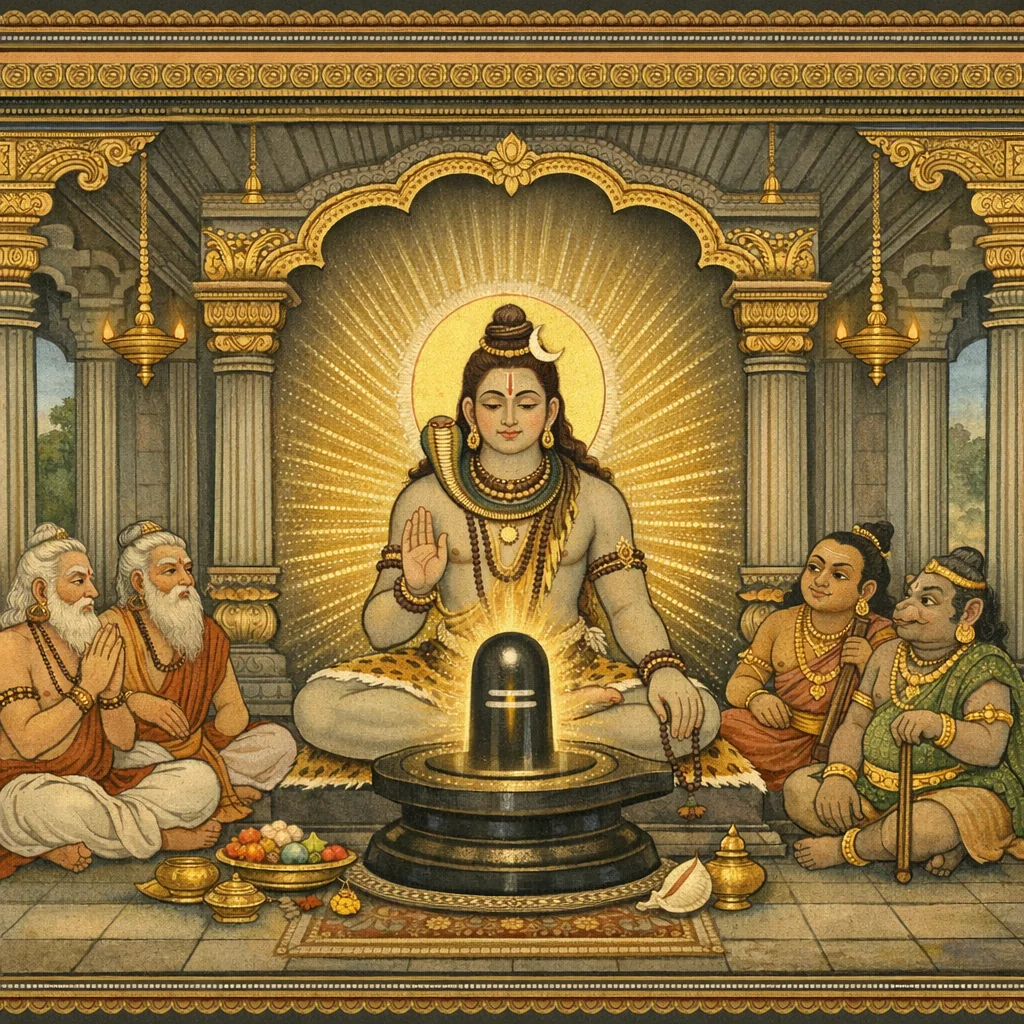
The chapter begins within a layered narration (Sūta–Vyāsa–Skanda) and offers a theological reading of epic history: the Pāṇḍavas are portrayed as Rudra-embodied agents who restore order, while Nārāyaṇa assumes Kṛṣṇa-form as the stabilizer of dharma. In a time of hardship, Draupadī performs intense devotion to Sūrya (Bradhna/Savitr) and receives the akṣaya-sthālikā, an inexhaustible vessel, as a practical grace for scarcity and the demands of hospitality. The blessing is then anchored in Kāśī’s sacred landscape, where Sūrya promises that worship and darśana south of Viśveśvara bring relief from hunger and affliction, dispel the darkness of sorrow, and protect from fear, disease, and separation. A second movement recounts Sūrya’s severe tapas at Pañcanada tīrtha, the स्थापना of the Gabhastīśvara liṅga, and devotion to the Goddess as Maṅgalā/Gaurī. Śiva appears, praises the austerity, receives Śiva-stotras and the Maṅgalā-Gaurī stuti, and grants programmatic instruction: reciting the “sixty-four-name” aṣṭaka and the Maṅgalā-Gaurī aṣṭaka is taught as a purificatory regimen that washes daily sin and leads to the rare privilege of access to Kāśī. The chapter also details the Maṅgalā-vrata (notably on Caitra śukla tṛtīyā)—fasting, night vigil, offerings, feeding maidens, homa, and gifting—promising well-being and protection from misfortune. It concludes with the naming of Mayūkhāditya (rays seen while the body is unseen), the fruits of worship—freedom from disease and poverty, especially on Sundays—and a phalaśruti that hearing these accounts prevents descent into hell.
Shlokas
Verse 1
सूत उवाच । पाराशर्यमुने व्यास कुमारः कुंभजन्मने । यदावदत्कथामेतां तदा क्व द्रुपदात्मजा
Sūta said: When Vyāsa, the son of Parāśara, narrated this account to Kumāra (Skanda), the son of the pot-born sage (Agastya), where was Drupada’s daughter Draupadī at that time?
Verse 2
व्यास उवाच । पुराणसंहितां सूत ब्रूते त्रैकालिकीं कथाम् । संदेहो नात्र कर्तव्यो यतस्तद्गोचरोखिलम्
Vyāsa said: O Sūta, the Purāṇic compendium conveys a narrative spanning the three times—past, present, and future. No doubt should be raised here, for all this lies within its scope.
Verse 3
स्कंद उवाच । आकर्णय मुने पूर्वं पंचवक्त्रो हरः स्वयम् । पृथिव्यां पंचधा भूत्वा प्रादुरासीज्जगद्धितः
Skanda said: Hear, O sage, what happened in former times. Hara himself, the five-faced Lord, manifested on earth in five forms for the welfare of the world.
Verse 4
उमापि च जगद्धात्री द्रुपदस्य महीभुजः । यजतो वह्निकुंडाच्च प्रादुश्चक्रेति सुंदरी
And Umā too, the sustainer of the world: while King Drupada was performing the yajña, she caused the beautiful maiden to appear from the sacrificial fire-pit.
Verse 5
पंचापि पांडुतनयाः साक्षाद्रुद्रवपुर्धराः । अवतेरुरिह स्वर्गाद्दुष्टसंहारकारकाः
All five sons of Pāṇḍu, bearing bodies that were truly Rudra’s own, descended here from heaven to bring about the destruction of the wicked.
Verse 6
नारायणोपि कृष्णत्वं प्राप्य तत्साहचर्यकृत् । उद्वृत्तवृत्तशमनः सद्वृत्तस्थितिकारकः
Nārāyaṇa too, having attained the state of Kṛṣṇa and becoming their companion, subdued corrupt conduct and established the steadiness of righteous conduct.
Verse 7
प्रतपंतः पृथिव्यां ते पार्थाश्चेरुः पृथक्पृथक् । उदयानुदयौ तस्मिन्संपदां विपदामपि
Radiant in prowess, the sons of Pṛthā moved about the earth, each in his own way. In their course there were both rise and decline—prosperities as well as adversities.
Verse 8
कदाचित्ते महावीरा भ्रातृव्यप्रतिपादिताम् । विपत्तिमाप्य महतीं बभूवुः काननौकसः
At one time, those great heroes, driven into misfortune by rival kinsmen, met with a great calamity and became dwellers of the forest.
Verse 9
पांचाल्यपि च तत्पत्नी पतिव्यसनतापिता । धर्मज्ञा प्राप्य तन्वंगी ब्रध्नमाराधयद्भृशम्
Pāñcālī too—his wife—tormented by her husband’s misfortune, though slender-limbed and steadfast in dharma, came (to Kāśī) and fervently worshipped Bradhna, the Sun.
Verse 10
आराधितोथ सविता तया द्रुपदकन्यया । सदर्वी सपिधानां च स्थालिकामक्षयां ददौ
When Savitṛ (the Sun) had thus been worshipped by Drupada’s daughter, he granted her an inexhaustible serving-bowl (sthālī), together with a ladle and a fitting lid.
Verse 11
आराधयंतीं भावेन सर्वत्र शुचिमानसाम्
She worshipped with heartfelt devotion, maintaining a pure mind in all circumstances.
Verse 12
स्थाल्यैतया महाभागे यावंतोऽन्नार्थिनो जनाः । तावंतस्तृप्तिमाप्स्यंति यावच्च त्वं न भोक्ष्यसे
‘O noble lady, by means of this bowl, as many people as come seeking food—so many will attain satisfaction, so long as you yourself have not eaten.’
Verse 13
भुक्तायां त्वयि रिक्तैषा पूर्णभक्ता भविप्यति । रसवद्व्यंजननिधिरिच्छाभक्ष्यप्रदायिनी
“But once you have eaten, this (bowl) will become empty; and when it is full again, it will be filled with excellent rice and a treasury of flavorful dishes—granting whatever foods are desired.”
Verse 14
इत्थं वरस्तया लब्धः काश्यामादित्यतो मुने । अपरश्च वरो दत्तस्तस्यै देवेन भास्वता
Thus, O sage, she obtained this boon from Āditya (the Sun) in Kāśī; and the radiant god granted her yet another boon as well.
Verse 15
रविरुवाच । विश्वेशाद्दक्षिणेभागे यो मां त्वत्पुरतः स्थितम् । आराधयिष्यति नरः क्षुद्बाधा तस्य नश्यति
The Sun said: “To the southern side of Viśveśvara, whoever worships me as I stand before you—his affliction of hunger is destroyed.”
Verse 16
अन्यश्च मे वरो दत्तो विश्वेशेन पतिव्रते । तपसा परितुष्टेन तं निशामय वच्मि ते
“And another boon has been granted to me by Viśveśvara—who was pleased by your austerity, O faithful wife. Listen; I shall tell it to you.”
Verse 17
प्राग्रवे त्वां समाराध्य यो मां द्रक्ष्यति मानवः । तस्य त्वं दुःखतिमिरमपानुद निजैः करैः
“Whoever, after duly worshipping you at dawn, beholds me—do you, with your own rays, drive away for him the darkness of sorrow.”
Verse 18
अतो धर्माप्रिये नित्यं प्राप्य विश्वेश्वराद्वरम् । काशीस्थितानां जंतूनां नाशयाम्यघसंचयम्
Therefore, O beloved of dharma, having received this boon from Viśveśvara, I continually destroy the accumulated sins of the beings who dwell in Kāśī.
Verse 19
ये मामत्र भजिष्यंति मानवाः श्रद्धयान्विताः । त्वद्वरोद्यतपाणिं च तेषां दास्यामि चिंतितम्
Those who, here in this sacred place, worship me with faith—and who also worship you, O giver of boons, with uplifted hands in reverence—to them I shall grant whatever their hearts desire.
Verse 20
भवतीं मत्समीपस्थां युधिष्ठिरपतिव्रताम् । विश्वेशाद्दक्षिणेभागे दंडपाणेः समीपतः
You—steadfast as a pativratā, devoted to Yudhiṣṭhira—shall remain near me, on the southern side of Viśveśa, close to Daṇḍapāṇi.
Verse 21
येर्चयिष्यंति भावेन पुरुषा वास्त्रियोपि वा । तेषां कदाचिन्नो भावि भयं प्रियवियोगजम्
Men or women who worship here with heartfelt devotion—never at any time shall they face the fear that arises from separation from what is dear.
Verse 22
न व्याधिजं भयं क्वापि न क्षुत्तृड्दोषसंभवम् । द्रौपदीक्षणतः काश्यां तव धर्मप्रियेनघे
No fear born of disease shall arise anywhere, nor any trouble caused by hunger and thirst—through the auspicious sight and blessing of Draupadī in Kāśī, O sinless one who loves dharma.
Verse 23
उवाच च प्रसन्नात्मा भास्करो द्रुपदात्मजाम्
Then Bhāskara (the Sun), serene in heart, spoke to Drupada’s daughter, Draupadī.
Verse 24
आदित्यस्य कथामेतां द्रौपद्याराधितस्य वै । यः श्रोष्यति नरो भक्त्या तस्यैनः क्षयमेष्यति
“Whoever, with devotion, listens to this account of Āditya as worshipped by Draupadī—his sins shall be brought to destruction.”
Verse 25
स्कंद उव ।च । द्रौपदादित्यमाहात्म्यं संक्षेपात्कथितं मया । मयूखादित्यमाहात्म्यं शृण्विदानीं घटोद्भव
Skanda said: “I have briefly related the greatness of Draupadā-Āditya. Now hear the greatness of Mayūkha-Āditya, O Agastya, born from the pot.”
Verse 26
पुरा पंचनदे तीर्थे त्रिषुलोकेषु विश्रुते । सहस्ररश्मिर्भगवांस्तपस्तेपे सुदारुणम्
“Formerly, at the Pañcanada tīrtha—famed throughout the three worlds—the Blessed Lord of a thousand rays (the Sun) performed exceedingly austere tapas.”
Verse 27
प्रतिष्ठाप्य महालिंगं गभस्तीश्वर संज्ञितम् । गौरीं च मंगला नाम्नीं भक्तमंगलदां सदा
“Having installed a great Liṅga known as Gabhastīśvara, and having established Gaurī named Maṅgalā—ever bestowing auspiciousness upon devotees—…”
Verse 28
दिव्यवर्षसहस्रं तु शतेन गुणितं मुने । आराधयञ्शिवं सोमं सोमार्धकृतशेखरम्
For a thousand divine years, multiplied a hundredfold, O sage, he worshipped Śiva—the Lord who bears the Moon as his crest, the crescent adorning his crown.
Verse 29
स्वरूपतस्तु तपनस्त्रिलोकीतापनक्षमः । ततोतितीव्र तपसा जज्वाल नितरां मुने
By his very nature the Sun can scorch the three worlds. Then, through exceedingly intense austerity, he blazed forth all the more, O sage.
Verse 30
मयूखैस्तत्र सवितुस्त्रैलोक्यदहनक्षमैः । ततं समस्तं तत्काले द्यावाभूम्योर्यदंतरम्
There, by the Sun’s rays—able to burn the three worlds—the entire expanse at that time, the space between heaven and earth, was filled through and through.
Verse 31
वैमानिकैर्विष्णुपदे तत्यजे च गतागतम् । तीव्रे पतंगमहसि पतंगत्वभयादिव
Even the celestial beings in Viṣṇu’s realm abandoned their comings and goings; in that fierce brilliance of the Sun, it was as though they feared becoming moths drawn into flame.
Verse 32
मयूखा एव दृश्यंते तिर्यगूर्ध्वमधोपि च । आदित्यस्य न चादित्यो नीपपुष्पस्थितेरिव
Only the rays were seen—horizontally, upward, and downward too; of the Sun himself the Sun was not seen, like a nīpa blossom hidden in its setting.
Verse 33
तस्यवै महसां राशेस्तपोराशेस्तपोर्चिषाम् । चकंपे साध्वसात्तीव्रा त्रैलोक्यं सचराचरम्
From that massed splendor—those piled-up austerities and their fiery radiance—the three worlds, with all that moves and all that does not, trembled in intense dread.
Verse 34
सूर्य आत्मास्य जगतो वेदेषु परिपठ्यते । स एव चेज्वालयिता को नस्त्राता भवेदिह
In the Vedas the Sun is recited as the very Self of this world. If he himself becomes the one who sets everything ablaze, then who here could be our protector?
Verse 35
जगच्चक्षुरसौ सूर्यो जगदात्मैष भास्करः । जगद्योयन्मृतप्रायं प्रातःप्रातः प्रबोधयेत्
That Sun is the eye of the world; this Bhāskara is the very soul of the world—he who, morning after morning, awakens the world that is as good as dead.
Verse 36
तमोंधकूपपतितमुद्यन्नेष दिनेदिने । प्रसार्य परितः पाणीन्प्राणिजातं समुद्धरेत्
Rising day after day, he lifts up the multitude of living beings that have fallen into the blind well of darkness, as though stretching out his hands on every side.
Verse 37
उदितेऽत्रोदिमो नित्यमस्तं यात्यस्तमाप्नुमः । उदयेऽनुदये तस्मादस्माकं कारणं रविः
When he rises, we here rise each day; when he sets, we too go to setting and reach our end. Therefore, in rising and not rising, Ravi is the very cause for us.
Verse 38
इति व्याकुलितं विश्वं पश्यन्विश्वेश्वरः स्वयम् । विश्वत्राता वरं दातुं संजग्मे तिग्मरश्मये
Seeing the universe thus distressed, Viśveśvara himself—the savior of the world—went to the sharp-rayed Sun to grant him a boon.
Verse 39
मयूखमालिनं शंभुरालोक्याति सुनिश्चलम् । समाधि विस्मृतात्मानं विसिस्माय तपः प्रति
Seeing Śambhu, wreathed in rays and standing utterly unmoving, the Sun—self-forgetful in samādhi—marvelled at that austerity.
Verse 40
उवाच च प्रसन्नात्मा श्रीकंठः प्रणतार्तिहृत् । अलं तप्त्वा वरं ब्रूहि द्युमणे महसां निधे
Then Śrīkaṇṭha, serene in heart, remover of the afflicted who bow to him, spoke: “Enough of austerity—O radiant one, treasury of splendors, ask a boon.”
Verse 41
निरुद्धेंद्रियवृत्तित्वाद्ब्रध्नो ध्यानसमाधिना । न जग्राह वचः शंभोर्द्वित्रिरुक्तोप्यकर्णवत्
Because Bradhna (the Sun) had restrained the movements of his senses through meditative samādhi, he did not grasp Śambhu’s words—even when spoken twice or thrice—remaining as though without ears.
Verse 42
काष्ठीभूतं तु तं ज्ञात्वा शिवः पस्पर्श पाणिना । महातपः समुद्भूत संतापामृतवर्षिणा
Knowing him to have become like a log of wood—motionless and insensible—Śiva touched him with his hand, which showered nectar upon the heat born of great austerity.
Verse 43
तत उन्मीलयांचक्रे लोचने विश्वलोचनः । तस्योदयमिव प्राप्य प्रगे पंकजिनीवनी
Then Viśvalocana, the All-seeing Lord, caused him to open his eyes—like a lotus-pond at dawn, receiving the Sun’s rising.
Verse 44
परिव्यपेतसंतापस्तपनः स्पर्शनाद्विभोः । अवग्रहितसस्यश्रीरुल्ललास यथांबुदात्
The Sun, his burning heat dispelled by the Lord’s touch, shone forth—like the prosperity of crops that blossoms after the rain-cloud’s shower.
Verse 45
मित्रो नेत्रातिथीकृत्य त्र्यक्षं प्रत्यक्षमग्रतः । दंडवत्प्रणनामोच्चैस्तुष्टाव च पिनाकिनम्
Mitra (the Sun), making his eyes ‘guests’—opening them fully—beheld the Three-eyed Lord directly before him; he bowed like a staff and loudly praised Pinākin (Śiva, bearer of the bow).
Verse 46
रविरुवाच । देवदेव जगतांपते विभो भर्ग भीम भव चंद्रभूषण । भूतनाथ भवभीतिहारक त्वां नतोस्मि नतवांछितप्रद
Ravi said: “O God of gods, Lord of the worlds, all-pervading Master; O Bharga, O Terrible One, O Bhava adorned with the moon; O Lord of beings, remover of the fear of worldly becoming—I bow to you, giver of the desired wishes of those who bow.”
Verse 47
चंद्रचूडमृड धूर्जटे हर त्र्यक्ष दक्ष शततंतुशातन । शांतशाश्वत शिवापते शिव त्वां नतोस्मि नतवांछितप्रद
“O Moon-crested One, O Mṛḍa, O matted-haired Dhūrjaṭi; O Hara, Three-eyed Lord; O skillful One, destroyer of the hundred-threaded bondage; O peaceful and eternal One, Lord of Śivā—O Śiva, I bow to you, granter of the desired wishes of those who bow.”
Verse 48
नीललोहित समीहितार्थ दहे द्व्येकलोचन विरूपलोचन । व्योमकेशपशुपाशनाशन त्वां नतोस्मि नतवांछितप्रद
O Nīlalohita, fulfiller of cherished aims; O Dahana, the Burning One; O Lord of two eyes and the single Eye, O wondrous-eyed One; O Vyomakeśa, destroyer of Paśu’s noose that binds beings—I bow to You, granter of the desired wishes of those who bow.
Verse 49
वामदेवशितिकंठशूलभृच्चंद्रशेखर फणींद्रभूषण । कामकृत्पशुपते महेश्वर त्वां नतोस्मि नतवांछितप्रद
O Vāmadeva; O blue-throated bearer of the trident; O Moon-crested One adorned with the serpent-king; O subduer of Kāma; O Paśupati, Great Lord—I bow to You. Grant the desired boons to those who bow.
Verse 50
त्र्यंबक त्रिपुरसूदनेश्वर त्राणकृत्त्रिनयनत्रयीमय । कालकूट दलनांतकांतक त्वां नतोस्मि नतवांछितप्रद
O Tryambaka, Three-eyed Lord; O ruler who destroyed Tripura; O protector whose three eyes embody the triad; O crusher of the Kālakūṭa poison; O slayer of the slayer of Death—I bow to You. Grant the desired boons to those who bow.
Verse 51
शर्वरीरहितशर्वसर्वगस्वर्गमार्गसुखदापवर्गद । अंधकासुररिपो कपर्दभृत्त्वां नतोस्मि नतवांछितप्रद
O Śarva, untouched by darkness; all-pervading; giver of the joy of the path to heaven and giver of liberation; O foe of the asura Andhaka; O wearer of matted locks—I bow to You. Grant the desired boons to those who bow.
Verse 52
शंकरोग्रगिरिजापते पते विश्वनाथविधिविष्णु संस्तुत । वेदवेद्यविदिताऽखिलेंगि तत्वां नतोस्मि नतवांछितप्रद
O Śaṅkara; O mighty Lord, consort of Girijā; O Master—Viśvanātha—praised by Brahmā and Viṣṇu; known through what the Vedas can truly know, the essence within all—I bow to You. Grant the desired boons to those who bow.
Verse 53
विश्वरूपपररूप वर्जितब्रह्मजिह्मरहितामृतप्रद । वाङमनोविषयदूरदूरगत्वां नतोस्मि नतवांछितप्रद
O giver of nectar-like immortality; free from the crookedness of conditioned notions of “Brahman”; beyond both universal form and transcendent form; far, far beyond the reach of speech and mind—I bow to You. Grant the desired boons to those who bow.
Verse 54
इत्थं परीत्य मार्तंडो मृडं देवं मृडानिकाम् । अथ तुष्टाव प्रीतात्मा शिववामार्धहारिणीम्
Thus, having circumambulated Mṛḍa (Śiva), the god, and the gentle goddess, Mārtaṇḍa (the Sun) then, with a delighted heart, praised her who shares Śiva’s left half—the Divine Consort.
Verse 55
रविरुवाच । देवि त्वदीयचरणांबुजरेणुगौरीं भालस्थलीं वहति यः प्रणतिप्रवीणः । जन्मांतरेपि रजनीकरचारुलेखा तां गौरयत्यतितरां किल तस्य पुंसः
Ravi (the Sun) said: O Goddess, the man skilled in reverent bowing bears upon his forehead the whiteness born of the dust of Your lotus-feet. Even in another birth, the lovely streak of the moon upon his brow makes that mark shine all the more.
Verse 56
श्रीमंगले सकलमंगलजन्मभूमे श्रीमंगले सकलकल्मषतूलवह्ने । श्रीमंगले सकलदानवदर्पहंत्रि श्रीमंगलेऽखिलमिदं परिपाहि विश्वम्
O Auspicious One, source-ground of all auspiciousness! O Auspicious One, fire that burns up all cotton-like heaps of sin! O Auspicious One, destroyer of the pride of all demons! O Auspicious One—protect this entire universe.
Verse 57
विश्वेश्वरि त्वमसि विश्वजनस्य कर्त्री त्वं पालयित्र्यसि तथा प्रलयेपिहंत्री । त्वन्नामकीर्तनसमुल्लसदच्छपुण्या स्रोतस्विनी हरति पातककूलवृक्षान्
O Sovereign Lady of the universe, You are the creator of all beings; You are their protector, and at dissolution You are also the destroyer. The pure and radiant river of merit, made to surge by the chanting of Your name, uproots the forest of trees that are masses of sins.
Verse 58
मातर्भवानि भवती भवतीव्रदुःखसंभारहारिणि शरण्यमिहास्ति नान्या । धन्यास्त एव भुवनेषु त एव मान्या येषु स्फुरेत्तवशुभः करुणाकटाक्षः
O Mother Bhavānī—you alone remove the heavy burden of intense suffering. Here there is no refuge other than You. Truly blessed in the worlds, truly worthy of honor, are those upon whom Your auspicious, compassionate glance shines forth.
Verse 59
ये त्वा स्मरंति सततं सहजप्रकाशां काशीपुरीस्थितिमतीं नतमोक्षलक्ष्मीम् । तान्संस्मरेत्स्मरहरो धृतशुद्धबुद्धीन्निर्वाणरक्षणविचक्षणपात्रभूतान्
Those who constantly remember You—self-effulgent, abiding in the city of Kāśī, and the very fortune of liberation for those who bow—Smara-hara (Śiva, the destroyer of Kāma) remembers them in return, as people whose intellect has become purified, fit vessels, wise in the safeguarding of nirvāṇa.
Verse 60
मातस्तवांघ्रियुगलं विमलं हृदिस्थं यस्यास्ति तस्य भुवनं सकलं करस्थम् । यो नामतेज एति मंगलगौरि नित्यं सिद्ध्यष्टकं न परिमुंचति तस्य गेहम्
Mother—whoever holds Your stainless pair of feet within the heart, for that person the entire world is as though resting in the palm of the hand. And, O Maṅgalāgaurī, whoever daily approaches the splendor of Your Name, the eight attainments (siddhis) do not abandon that person’s home.
Verse 61
त्वं देवि वेदजननी प्रणवस्वरूपा गायत्र्यसि त्वमसि वै द्विजकामधेनुः । त्वं व्याहृतित्रयमिहाऽखिलकर्मसिद्ध्यै स्वाहास्वधासि सुमनः पितृतृप्तिहेतुः
Goddess, You are the mother of the Vedas, the very form of Praṇava (Oṃ). You are Gāyatrī, indeed the wish-fulfilling cow for the twice-born. You are the three vyāhṛtis (bhūḥ, bhuvaḥ, svaḥ) for the accomplishment of all rites; You are ‘svāhā’ and ‘svadhā’, the cause of the satisfaction of gods and ancestors, O gracious one.
Verse 62
गौरि त्वमेव शशिमौलिनि वेधसि त्वं सावित्र्यसि त्वमसि चक्रिणि चारुलक्ष्मीः । काश्यां त्वमस्यमलरूपिणि मोक्षलक्ष्मीस्त्वं मे शरण्यमिह मंगलगौरि मातः
O Gaurī—you alone are with the moon-crested Lord (Śiva); You are also with Vedhas (Brahmā); You are Sāvitrī; and with the discus-bearing Lord (Viṣṇu) You are radiant Lakṣmī. In Kāśī, O spotless-formed one, You are the very Lakṣmī of liberation. You are my refuge here, O Mother Maṅgalāgaurī.
Verse 63
स्तुत्वेति तां स्मरहरार्धशरीरशोभां श्रीमंगलाष्टक महास्तवनेन भानुः । देवीं च देवमसकृत्परितः प्रणम्य तूष्णीं बभूव सविता शिवयोः पुरस्तात्
Having praised her—she who shines as the half-body of Smara-hara (Śiva)—with the great hymn called the auspicious Maṅgalāṣṭaka, Bhānu (the Sun) repeatedly bowed all around to the Goddess and the God, and then stood silent before Śiva and Śivā.
Verse 64
देवदेव उवाच । उत्तिष्ठोत्तिष्ठ भद्रं ते प्रसन्नोस्मि महामते । मित्रमन्नेत्रगो नित्यं प्रपश्ये तच्चराचरम्
Devadeva (Śiva) said: “Rise, rise—may good befall you, O great-minded one. I am pleased. As your friend, dwelling in your eye, I ever behold that entire moving and unmoving world.”
Verse 65
मम मूर्तिर्भवान्सूर्य सर्वज्ञो भव सर्वगः । सर्वेषां महसां राशिः सर्वेषां सर्वकर्मवित्
“O Sūrya, you are my very embodiment. Be all-knowing; be all-pervading. Be the massed treasury of light for all, and the knower of the actions of all.”
Verse 66
सर्वेषां सर्वदुःखानि भक्तानां त्वं निराकुरु । त्वया नाम्नां चतुःषष्ट्या यदष्टकमुदीरितम्
“Remove all sorrows of all devotees. And because you have proclaimed an eight-versed hymn by means of sixty-four Names…”
Verse 67
अनेन मां परिष्टुत्य नरो मद्भक्तिमाप्स्यति । अष्टकं मंगलागौर्या मंगलाष्टकसंज्ञकम्
“By praising me with this, a person will attain devotion to me. This is the eight-verse hymn to Maṅgalāgaurī, known as the ‘Maṅgalāṣṭaka’.”
Verse 68
अनेन मंगलागौरीं स्तुत्वा मंगलमाप्स्यति । चतुःषष्ट्यष्टकं स्तोत्रं मंगलाष्टकमेव च
By praising Maṅgalāgaurī with this, one attains auspiciousness. This hymn is the “catuḥṣaṣṭy-aṣṭaka” (the aṣṭaka formed from sixty-four Names), and it is indeed the Maṅgalāṣṭaka.
Verse 69
एतत्स्तोत्रवरं पुण्यं सर्वपातकनाशनम् । दूरदेशांतरस्थोपि जपन्नित्यं नरोत्तमः
This excellent and holy hymn destroys all sins. Even if a noble person dwells in a far-off land, by chanting it daily he gains its purifying power.
Verse 70
त्रिसंध्यं परिशुद्धात्मा काशीं प्राप्स्यति दुर्लभाम् । अनेन स्तोत्रयुग्मेन जप्तेन प्रत्यहं नृभिः
By chanting this pair of hymns every day, and performing the practice at the three sandhyās, a person of purified mind attains the hard-to-obtain Kāśī.
Verse 71
ध्रुवदैनंदिनं पापं क्षालितं नात्र संशयः । न तस्य देहिनो देहे जातु चित्किल्बिषस्थितिः
The constant, day-to-day sin is washed away—there is no doubt of it. In the body of such a person, no stain of wrongdoing ever remains.
Verse 72
त्रिकालं योजयेन्नित्यमेतत्स्तोत्रद्वयंशुभम् । किंजप्तैर्बहुभिः स्तोत्रैश्चंचलश्रीप्रदैर्नृणाम्
One should regularly employ this auspicious pair of hymns at the three times of day. What is the use, for people, of chanting many other hymns that grant only fickle and unstable prosperity?
Verse 73
एतत्स्तोत्रद्वयं दद्यात्काश्यां नैःश्रेयसीं श्रियम् । तस्मात्सर्वप्रयत्नेन मानवैर्मोक्षकांक्षिभिः
This pair of hymns, when bestowed in Kāśī, grants the supreme prosperity that leads to liberation. Therefore, those who yearn for mokṣa should uphold it with every effort.
Verse 74
एतत्स्तोत्रद्वयं जप्यं त्यक्त्वा स्तोत्राण्यनेकशः । प्रपंच आवयोरेव सर्व एष चराचरः
This pair of hymns should be chanted, setting aside countless other hymns. For all this universe, moving and unmoving, is indeed the manifestation of the Two to whom these praises are addressed.
Verse 75
तदावयोःस्तवादस्मान्निष्प्रपंचो जनो भवेत् । समृद्धिमाप्य महतीं पुत्रपौत्रवतीमिह
By this hymn in praise of the Two, a person becomes free from entanglement in worldly proliferation. And, having attained great prosperity here—rich with sons and grandsons—he is uplifted beyond it.
Verse 76
अंते निर्वाणमाप्नोति जपन्स्तोत्रमिदं नरः । अन्यच्च शृणु सप्ताश्व ग्रहराज दिवाकर
In the end, the man who chants this hymn attains nirvāṇa. And further—listen, O Seven-horsed one, O king of planets, O Sun!
Verse 77
त्वया प्रतिष्ठितं लिंगं गभस्तीश्वरसंज्ञितम् । सेवितं भक्तिभावेन सर्वसिद्धिसमर्पकम्
The liṅga established by you, known as Gabhastīśvara, is worshipped with devotion and bestows every siddhi, attainment, and success.
Verse 78
त्वया गभस्तिमालाभिश्चांपेयांबुजकांतिभिः । यदर्चित्वैश्वरं लिंगं सर्वभावेन भास्कर
O Bhāskara, you worshipped the Lord’s liṅga with garlands of your rays, radiant like golden campaka and lotus blossoms, offering your whole being in devotion.
Verse 79
गभस्तीश्वर इत्याख्यां ततो लिंगमवाप्स्यति । अर्चयित्वा गभस्तीशं स्नात्वा पंचनदे नरः
Thereafter, the liṅga will become renowned by the name “Gabhastīśvara.” Having worshipped Lord Gabhastīśa and bathed at Pañcanada, a devotee attains the promised merit.
Verse 80
न जातु जायते मातुर्जठरे धूतकल्मषः । इमां च मंगलागौरीं नारी वा पुरुषोपि वा
One whose sins have been washed away is never again born in a mother’s womb. And this observance of Maṅgalāgaurī may be undertaken—whether by a woman or even by a man.
Verse 81
चैत्रशुक्लतृतीयायामुपोषणपरायणः । महोपचारैः संपूज्य दुकूलाभरणादिभिः
On the bright third day of the month of Caitra, devoted to fasting, one should worship (Maṅgalāgaurī) with great offerings—fine garments, ornaments, and the like.
Verse 82
रात्रौ जागरणं कृत्वा गीतनृत्यकथादिभिः । प्रातः कुमारीः संपूज्य द्वादशाच्छादनादिभिः
Keeping vigil at night with singing, dancing, recitation, and the like, and then in the morning duly worshipping young maidens—offering them twelve coverings/garments and other gifts—one completes the observance.
Verse 83
संभोज्यपरमान्नाद्यैर्दत्त्वान्येभ्योपि दक्षिणाम् । होमं कृत्वा विधानेन जातवेदस इत्यृचा
After feeding the honored guests with excellent foods and giving dakṣiṇā to others as well, one should perform the homa according to rule, with the Ṛgvedic verse beginning “Jātavedasa….”
Verse 84
अष्टोत्तरशताभिश्च तिलाज्याहुतिभिः प्रगे । एकं गोमिथुनं दत्त्वा ब्राह्मणाय कुटुंबिने
At dawn, with 108 oblations of sesame and ghee, and by gifting a pair of cows to a householder brāhmaṇa, the rite becomes fully accomplished.
Verse 85
श्रद्धया समलंकृत्य भूषणैर्द्विजदंपती । भोजयित्वा महार्हान्नैः प्रीयेतां मंगलेश्वरौ
Adorning a brāhmaṇa couple with ornaments in a spirit of faith, and feeding them with choice foods—by this, the divine pair Maṅgaleśvara and Maṅgalā are pleased.
Verse 86
इति मंत्रं समुच्चार्य प्रातः कृत्वाथ पारणम् । न दुर्भगत्वमाप्नोति न दारिद्र्यं कदाचन
Having thus recited the mantra and then, in the morning, performed the pāraṇa—the concluding meal—one never meets with ill-fortune, nor does poverty ever befall one.
Verse 87
न वै संतानविच्छित्तिं भोगोच्छित्तिं न जातुचित् । स्त्री वैधव्यं न चाप्नोति न नायोषिद्वियोगभाक्
There is no break in progeny, nor any loss of enjoyments at any time. A woman does not attain widowhood, nor does a man become one who is separated from his wife.
Verse 88
पापानि विलयं यांति पुण्यराशिश्च लभ्यते । अपि वंध्या प्रसूयेत कृत्वैतन्मंगलाव्रतम्
Sins dissolve away and a heap of merit is obtained. Even a barren woman may give birth by performing this auspicious vow, the Maṅgalā-vrata.
Verse 89
एतद्व्रतस्य करणात्कुरूपत्वं न जातुचित् । कुमारी विंदतेत्यंतं गुणरूपयुतं पतिम्
By performing this vow, ugliness never arises at any time. A maiden thereby attains an excellent husband, endowed with outstanding virtues and pleasing form.
Verse 90
कुमारोपि व्रतं कृत्वा विंदति स्त्रियमुत्तमाम् । संति व्रतानि बहुशो धनकामप्रदानि च
Even a young man, having performed the vow, obtains an excellent wife. Indeed, there are many vows that grant wealth and desired enjoyments.
Verse 91
नाप्नुयुर्जातुचित्तानि मंगलाव्रततुल्यताम् । कर्तव्या चाब्दिकी यात्रा मधौ तस्यां तिथौ नरैः
Those other vows never attain equality with the Maṅgala-vrata. And on that lunar date in the month of Madhu, men should undertake the annual pilgrimage observance.
Verse 92
सर्वविघ्नप्रशांत्यर्थं सदा काशीनिवासिभिः । अपरं द्युमणे वच्मि तव चात्र तपस्यतः
For the sake of pacifying all obstacles, this is to be done always by the residents of Kāśī. Further, O Dyumaṇi, I shall tell you something more—especially for you who are practising austerity here.
Verse 93
मयूखा एव खे दृष्टा न च दृष्टं कलेवरम् । मयूखादित्य इत्याख्या ततस्ते दितिनंदन
Only rays were seen in the sky, and no bodily form was beheld. Therefore the name “Mayūkhāditya” arose, O son of Diti.
Verse 94
त्वदर्चनान्नृणां कश्चिन्न व्याधिः प्रभविष्यति । भविष्यति न दारिद्र्यं रविवारे त्वदीक्षणात्
From worship of you, no disease will afflict people. And from beholding you on Sunday, poverty will not arise.
Verse 95
इत्थं मयूखादित्यस्य शिवो दत्त्वा बहून्वरान् । तत्रैवांतर्हितो भूतो रविस्तत्रैव तस्थिवान्
Thus, Śiva, having granted many boons to Mayūkhāditya, vanished there itself; and Ravi (the Sun) remained established in that very place.
Verse 96
श्रुत्वाख्यानमिदं पुण्यं मयूखादित्यसंश्रयम् । द्रौपदादित्यसहितं नरो न निरयं व्रजेत्
Having heard this meritorious account connected with Mayūkhāditya—together with the account of Draupadāditya—a man does not go to hell.