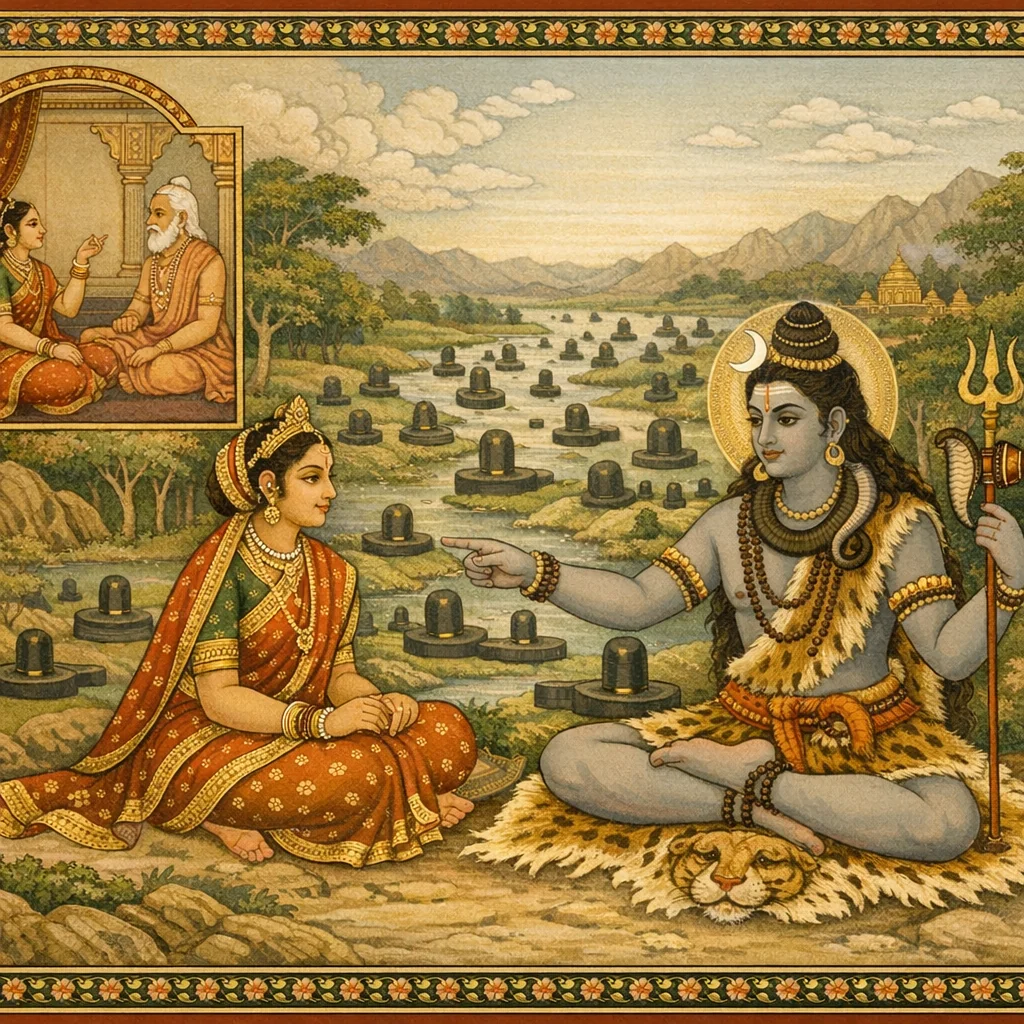
Adhyaya 40
Adhyāya 40 unfolds as a question-led theological dialogue. Agastya asks Skanda to explain more fully the māhātmya of Avimukteśa and how one should properly “attain” or approach the Avimukteśvara-liṅga and the sacred Avimukta-kṣetra. Skanda answers by moving from praise to prescription, laying down a normative ethic for seekers of spiritual benefit within the kṣetra. The chapter lists prohibited foods and improper modes of eating, and weighs the moral gravity of hiṃsā (violence), especially regarding meat-eating and the limited exceptions allowed in constrained ritual settings. Dharma is framed as the source of sukha and of higher human ends. It then expands into household order: rules for dāna (right giving), duties toward dependents and guests, the pañca-yajña pattern, and daily obligations. Themes of social and ritual purity are also addressed—marital propriety, the status of women within purity discourse, and restraints on harmful speech or exploitative economic conduct. The chapter closes by reaffirming that disciplined life in Kāśī is a complete religious path, with Kāśī-sevā presented as the crowning merit.
Shlokas
Verse 1
स्कंद उवाच । अविमुक्तेश माहात्म्यं वर्णितं तेग्रतो मया । अथो किमसि शुश्रूषुः कथयिष्यामि तत्पुनः
Skanda said: I have already described to you, in your presence, the greatness of Avimukteśa. Still, what more do you wish to hear? I shall recount it again.
Verse 2
अगस्त्य उवाच । अविमुक्तेश माहात्म्यं श्रावं श्रावं श्रुती मम । अतीव सुश्रुते जाते तथापि न धिनोम्यहम्
Agastya said: Again and again I have heard the greatness of Avimukteśa; my hearing has become exceedingly well-trained, yet even so I am not satisfied.
Verse 3
अविमुक्तेश्वरं लिंगं क्षेत्रं चाप्यविमुक्तकम् । एतयोस्तु कथं प्राप्तिर्भवेत्षण्मुख तद्वद
The Liṅga of Avimukteśvara and the sacred kṣetra called Avimukta—tell me, O Ṣaṇmukha, how may one attain the grace of these two?
Verse 4
स्कंद उवाच । शृणु कुं भज वक्ष्यामि यथा प्राप्तिर्भवेदिह । स्वश्रेयो दातुरेतस्या विमुक्तस्य महामते
Skanda said: Listen and worship; I shall explain how attainment is gained here. For this Avimukta is bestowed for the giver’s own highest good, O great-minded one.
Verse 5
समीहितार्थ संसिद्धिर्लभ्यते पुण्यभारतः । तच्च पुण्यं भवेद्विप्र श्रुतिवर्त्मसभाजनात्
Success in one’s desired aims is obtained through accumulated merit. And that merit, O Brāhmaṇa, arises from honoring the path laid down by the Śruti (the Vedas).
Verse 6
श्रुतिवर्त्मजुषः पुंसः संस्पर्शान्नश्यतो मुने । कलिकालावपि सदा छिद्रं प्राप्य जिघांसतः
O sage, even in the age of Kali, harms that seek a weakness to destroy a person devoted to the Vedic path are dispelled merely by contact with such a person.
Verse 7
वर्जितस्य विधानेन प्रोक्तस्याकरणेन वै । कलिकालावपि हतो ब्राह्मणं रंध्रदर्शनात्
Indeed, even in the age of Kali, a Brāhmaṇa is brought to ruin by “seeking loopholes”—by doing what is forbidden and by failing to do what is enjoined.
Verse 8
निषिद्धाचरणं तस्मात्कथयिष्ये तवाग्रतः । तद्दूरतः परित्यज्य नरो न निरयी भवेत्
Therefore I shall declare before you the acts that are prohibited. By abandoning them completely, a person does not become destined for hell.
Verse 9
पलांडुं विड्वराहं च शेलुं लशुन गृंजने । गोपीयूषं तंडुलीयं वर्ज्यं च कवकं सदा
One should always avoid onion, the boar that feeds on filth, śelu, garlic, and gṛṃjana; also gopīyūṣa, taṇḍulīya, and kavaka are to be avoided at all times.
Verse 10
व्रश्चनान्वृक्षनिर्यासान्पायसापूपशष्कुलीः । अदेवपित्र्यं पललमवत्सागोपयस्त्यजेत्
One should give up vraścana, tree-exudations (gums/resins), sweet rice (pāyasa), cakes (āpūpa), and fried pastries (śaṣkulī); likewise one should avoid foods/offerings not meant for the gods and ancestors, sesame-preparations (palala), and milk from a cow without a calf.
Verse 11
पय ऐकशफं हेयं तथा क्रामेलकाविकम् । रात्रौ न दधि भोक्तव्यं दिवा न नवनीतकम्
Milk from single-hoofed animals is to be avoided, and likewise that of the camel. Curd should not be eaten at night, and fresh butter should not be eaten in the daytime.
Verse 12
टिट्टिभं कलविंकं च हंसं चक्रं प्लवंबकम् । त्यजेन्मांसाशिनः सर्वान्सारसं कुक्कुटं शुकम्
One should avoid the ṭiṭṭibha, kalaviṃka, haṃsa, cakra, and plavaṃbaka; indeed, one should avoid all flesh-eating birds—also the sārasa (crane), the rooster, and the parrot.
Verse 13
जालपादान्खंजरीटान्बुडित्वा मत्स्यभक्षकान् । मत्स्याशी सर्वमांसाशी तन्मत्स्यान्सर्वथा त्यजेत्
One should avoid net-footed birds, khaṃjarīṭa-birds, divers, and those that eat fish. For one who eats fish becomes an eater of all flesh; therefore such fish are to be abandoned in every way.
Verse 14
हव्यकव्यनियुक्तौ तु भक्ष्यौ पाठीनरोहितौ । मांसाशिभिस्त्वमी भक्ष्याः शश शल्लक कच्छपाः
But pāṭhīna and rohita fish are edible when duly appointed for offerings to the gods and the ancestors. For meat-eaters, these are considered edible: hare, porcupine, and tortoise.
Verse 15
श्वाविद्गोधे प्रशस्ते च ज्ञाताश्च मृगपक्षिणः । आयुष्कामैः स्वर्गकामैस्त्याज्यं मांसं प्रयत्नतः
Though porcupine and iguana are spoken of as commendable (for some), and various beasts and birds are known (as edible), those who desire long life and those who desire heaven should carefully renounce meat.
Verse 16
यज्ञार्थं पशुहिंसा या सा स्वर्ग्या नेतरा क्वचित् । त्यजेत्पर्युषितं सर्वमखंडस्नेह वर्जितम्
The killing of an animal for the sake of sacrifice (yajña) is said to lead to heaven; other killing is never so. One should abandon all stale food, and anything lacking unbroken, wholesome richness (deprived of proper fat).
Verse 17
प्राणात्यये क्रतौ श्राद्धे भैषजे विप्रकाम्यया । अलौल्यमित्थं पललं भक्षयन्नैव दोषभाक्
In peril of life, in a sacrifice, in śrāddha, as medicine, or to please a brāhmaṇa—if done without greed—one who thus eats palala incurs no fault.
Verse 18
न तादृशं भवेत्पापं मृगयावृत्तिकांक्षिणः । यादृशं भवति प्रेत्य लौल्यान्मांसोपसेविनः
The sin of one who seeks a livelihood by hunting is not as great as the sin that, after death, befalls the person who indulges in eating meat out of sheer greed and craving.
Verse 19
मखार्थं ब्रह्मणा सृष्टाः पशु द्रुम मृगौषधीः । निघ्नन्नहिंसको विप्रस्तासामपि शुभा गतिः
For the sake of makha (sacrifice), Brahmā created beasts, trees, deer, and medicinal plants. A brāhmaṇa who kills for that sacrificial purpose is said to be non-violent; and for those beings too there is an auspicious destiny.
Verse 20
पितृदेवक्रतुकृते मधुपर्कार्थमेव च । तत्र हिंसाप्यहिंसा स्याद्धिंसान्यत्र सुदुस्तरा
For rites to the ancestors, the gods, and for sacrifices—and also for the offering of madhuparka—violence there is regarded as non-violence. But violence elsewhere is exceedingly difficult to justify or cross over.
Verse 21
यो जंतूनात्मपुष्ट्यर्थं हिनस्ति ज्ञानदुर्बलः । दुराचारस्य तस्येह नामुत्रापि सुखं क्वचित्
One who, weak in discernment, harms living beings merely to nourish his own body—such a person of evil conduct finds happiness neither here nor in the world beyond, at any time.
Verse 22
भोक्तानुमंता संस्कर्ता क्रयिविक्रयि हिंसकाः । उपहर्ता घातयिता हिंसकाश्चाष्टधा स्मृताः
The violent are remembered as eightfold: the eater, the approver, the preparer, the buyer, the seller, the provider or offerer, the one who causes the killing, and the killer.
Verse 23
प्रत्यब्दमश्वमेधेन शतं वर्षाणि यो यजेत् । अमांसभक्षको यश्च तयोरंत्यो विशिष्यते
Even if one were to perform an Aśvamedha every year for a hundred years, between the two the one who does not eat meat is superior.
Verse 24
यथैवात्मा परस्तद्वद्द्रष्टव्यः सुखमिच्छता । सुखदुःखानि तुल्यानि यथात्मनि तथा परे
Just as one regards oneself, so should one regard another, if one desires happiness; for pleasures and pains are alike—what is in oneself is also in others.
Verse 25
सुखं वा यदि वा चान्यद्यत्किंचित्क्रियते परे । तत्कृतं हि पुनः पश्चात्सर्वमात्मनि संभवेत्
Whatever—whether happiness or otherwise—one does to another, that very deed later comes to be experienced in one’s own self in every way.
Verse 26
न क्लेशेन विना द्रव्यमर्थहीने कुतः क्रियाः । क्रियाहीने कुतो धर्मो धर्महीने कुतः सुखम्
Without effort there is no wealth; without resources, how can there be religious acts? Without religious acts, where is dharma? And without dharma, where is happiness?
Verse 27
सुखं हि सर्वैराकांक्ष्यं तच्च धर्मसमुद्भवम् । तस्माद्धर्मोत्र कर्तव्यश्चातुर्वर्ण्येन यत्नतः
Happiness is truly desired by all, and it arises from dharma. Therefore, in this world, dharma should be practiced with earnest effort by all the four varṇas.
Verse 28
न्यायागतेन द्रव्येण कर्तव्यं पारलौकिकम् । दानं च विधिना देयं काले पात्रे च भावतः
With wealth acquired through righteous means, one should perform deeds that bear fruit beyond this world. Charity (dāna), too, should be given according to proper rule—at the right time, to a worthy recipient, and with sincere intention.
Verse 29
विधिहीनं तथाऽपात्रे यो ददाति प्रतिग्रहम् । न केवलं हि तद्याति शेषं तस्य च नश्यति
Whoever gives a gift without proper rule, and likewise to an unworthy recipient, does not merely lose that very gift; what remains of his merit and wealth is also diminished.
Verse 30
व्यसनार्थे कुटुंबार्थे यदृणार्थे च दीयते । तदक्षयं भवेदत्र परत्र च न संशयः
Whatever is given to relieve calamity, to support one’s family, or to discharge a debt—such giving becomes imperishable, here and hereafter, without doubt.
Verse 31
मातापितृविहीनं यो मौंजीपाणिग्रहादिभिः । संस्कारयेन्निजैरर्थैस्तस्य श्रेयस्त्वनंतकम्
Whoever, using his own resources, performs the rites (saṃskāras)—such as investiture with the sacred thread and marriage—for one who is without mother and father, for him the spiritual good is endless.
Verse 32
अग्निहोत्रैर्न तच्छ्रेयो नाग्निष्टोमादिभिर्मखैः । यच्छ्रेयः प्राप्यते मर्त्यैर्द्विजे चैके प्रतिष्ठिते
That same spiritual excellence is not attained by Agnihotra rites, nor even by sacrifices such as the Agniṣṭoma; for greater is the good that mortals gain by establishing and supporting even a single twice-born (dvija).
Verse 33
यो ह्यनाथस्य विप्रस्य पाणिं ग्राहयते कृती । इह सौख्यमवाप्नोति सोक्षयं स्वर्गमाप्नुयात्
The capable person who arranges the marriage—the taking of the hand—of a helpless brāhmaṇa gains happiness in this world and attains a heaven that does not diminish.
Verse 34
पितृगेहे तु या कन्या रजः पश्येदसंस्कृता । भ्रूणहा तत्पिता ज्ञेयो वृषली सापि कन्यका
If a maiden, still uninitiated by the proper rites (that is, unmarried), begins menstruation while in her father’s house, her father is to be regarded as one who destroys an embryo; and that girl, too, is deemed fallen from proper status.
Verse 35
यस्तां परिणयेन्मोहात्स भवेद्वृषलीपतिः । तेन संभाषणं त्याज्यमपाङ्क्तेयेन सर्वदा
He who, out of delusion, marries her becomes the husband of one deemed fallen; conversation with such a person—considered unfit for communal rites—should always be avoided.
Verse 36
विज्ञाय दोषमुभयोः कन्यायाश्च वरस्य च । संबंधं रचयेत्पश्चादन्यथा दोषभाक्पिता
Only after ascertaining the faults (and suitability) of both—the bride and the groom—should a father arrange the alliance; otherwise, the father becomes a sharer in the fault.
Verse 37
स्त्रियः पवित्राः सततं नैता दुष्यंति केनचित् । मासिमासि रजस्तासां दुष्कृतान्यपकर्षति
Women are ever pure; nothing can defile them. Month after month, their menstruation draws away and removes their misdeeds.
Verse 38
पूर्वं स्त्रियः सुरैर्भुक्ताः सोमगंधर्व वह्निभिः । भुंजते मानुषाः पश्चान्नैतादुष्यं ति केनचित्
Women were first mystically ‘claimed’ by the Devas—Soma, the Gandharvas, and Agni; only afterward do humans partake of them in marriage. Therefore, in this matter, no impurity is incurred by anyone.
Verse 39
स्त्रीणां शौचं ददौ सोमः पावकः सर्वमेध्यताम् । कल्याणवाणीं गंधर्वास्तेन मेध्याः सदा स्त्रियः
Soma bestowed purity upon women; Pāvaka (Agni) bestowed complete ritual auspiciousness; and the Gandharvas bestowed auspicious speech. Therefore, women are always regarded as ritually pure.
Verse 40
कन्यां भुंक्ते रजःकालेऽग्निः शशी लोमदर्शने । स्तनोद्भेदेषु गंधर्वास्तत्प्रागेव प्रदीयते
It is said that Agni ‘partakes’ of a maiden at the time of menstruation; the Moon at the first appearance of body-hair; and the Gandharvas at the budding of the breasts—thus she is considered already ‘given’ beforehand in these natural stages.
Verse 41
दृश्यरोमात्वपत्यघ्नी कुलघ्न्युद्गतयौवना । पितृघ्न्याविष्कतरजास्ततस्ताः परिवर्जयेत्
Therefore, for marriage one should avoid those maidens who show body-hair, who are called ‘destroyers of offspring’ and ‘ruiners of the family’, whose youth has already arisen, who are said to ‘harm the father’, and whose menses has manifested.
Verse 42
कन्यादानफलप्रेप्सुस्तस्माद्द द्यादनग्निकाम् । अन्यथा न फलं दातुः प्रतिग्राही पतेदधः
Therefore, one who longs for the fruit of kanyādāna should give a maiden not yet “claimed by Agni”; otherwise the giver gains no merit, and the recipient falls downward into demerit.
Verse 43
कन्यामभुक्तां सोमाद्यैर्ददद्दानफलं लभेत् । देवभुक्तां ददद्दाता न स्वर्गमधिगच्छति
By giving a maiden not yet “enjoyed” by Soma and the others, one attains the fruit of the gift; but the giver who offers a maiden already “enjoyed by the Devas” does not reach heaven.
Verse 44
शयनासनयानानि कुणपं स्त्रीमुखं कुशाः । यज्ञपात्राणि सर्वाणि न दुष्यंति बुधाः क्वचित्
Beds, seats, and conveyances; a corpse; a woman’s mouth; kuśa-grass; and all vessels used in sacrifice—none of these, say the wise, are ever deemed impure in the dharmic sense.
Verse 45
अजाश्वयोर्मुखं मेध्यं गावो मेध्यास्तु पृष्ठतः । पादतो ब्राह्मणा मेध्याः स्त्रियो मेध्यास्तु सर्वतः
For goats and horses, the mouth is ritually pure; for cows, the back is pure; for Brāhmaṇas, the feet are pure; but women are ritually pure in every respect.
Verse 46
अहोरात्रोषितो भूत्वा पंचगव्येन शुध्यति
After remaining so for a day and a night, one becomes purified by taking pañcagavya.
Verse 47
बलात्कारोपभुक्ता वा चोरहस्तगतापि वा । न त्याज्या दयिता नारी नास्यास्त्यागो विधीयते
Even if a beloved woman has been violated by force, or even if she has fallen into the hands of thieves, she should not be abandoned; abandonment of her is not enjoined.
Verse 48
आम्लेन ताम्रशुद्धिः स्याच्छुद्धिः कांस्यस्य भस्मना । संशुद्धी रजसा नार्यास्तटिन्या वेगतः शुचिः
Copper is purified by acid; bronze is purified by ash. A woman becomes purified after her menstrual period; and a river is considered pure by the force of its flowing current.
Verse 49
मनसापि हि या नेह चिंतयेत्पुरुषांतरम् । सोमया सह सौख्यानि भुंक्ते चात्रापि कीर्तिभाक्
Indeed, a woman who does not even in her mind think of another man enjoys happiness together with Somā, and in this very world also becomes a bearer of good fame.
Verse 50
पिता पितामहो भ्राता सकुल्यो जननी तथा । कन्याप्रदः पूर्वनाशे प्रकृतिस्थः परःपरः
The father, grandfather, brother, clan-kinsman, and also the mother are (each) authorities for giving a maiden in marriage. If the earlier one is unavailable or has ceased (to be able to act), the next—remaining in proper order—becomes the appropriate authority.
Verse 51
अप्रयच्छन्समाप्नोति भूणहत्यामृतावृतौ । स्वयं त्वभावे दातॄणां कन्या कुर्यात्स्वयं वरम्
One who withholds (the maiden, i.e., refuses to give her in due course) incurs the sin akin to foeticide, again and again as the proper season passes. But if there are no eligible givers/guardians, the maiden herself may choose (a husband) by svayaṃvara.
Verse 52
हृताधिकारां मलिनां पिंडमात्रोपजीविनीम् । परिभूतामधःशय्यां वासयेद्व्यभिचारिणीम्
An adulterous woman should be made to live bereft of her privileges, in a degraded state, subsisting only on scant morsels; dishonored, she should be made to lie upon a low bed.
Verse 53
व्यभिचारादृतौ शुद्धिर्गर्भे त्यागो विधीयते । गर्भभर्तृवधादौ तु महत्यपि च कल्मषे
After adultery, purification is possible when the proper period arrives; but if there is pregnancy, abandonment is enjoined. Yet in cases such as the killing of the embryo or the husband, even though the sin is great…
Verse 54
शूद्रस्य भार्या शूद्रैव सा च स्वा च विशः स्मृते । ते च स्वा चैव राज्ञस्तु ताश्च स्वाचाग्रजन्मनः
A Śūdra’s wife is only a Śūdra woman; she alone is proper to him. For a Vaiśya, a Vaiśya woman is remembered as his own rightful wife. Those same women are likewise proper for a king (Kṣatriya); and women of these classes are also proper for one of higher birth (a Brāhmaṇa).
Verse 55
आरोप्य शूद्रां शयने विप्रो गच्छेदधोगतिम् । उत्पाद्य पुत्रं शूद्रायां ब्राह्मण्यादेव हीयते
If a Brāhmaṇa places a Śūdra woman upon his bed, he goes to a lower state. And by begetting a son on a Śūdra woman, he falls away from his very brāhmaṇa-status.
Verse 56
दैवपित्र्यातिथेयानि तत्प्रधानानि यस्य तु । देवाद्यास्तन्न चाश्नंति स च स्वर्गं न गच्छति
But for one who does not treat as foremost the offerings to the gods, the ancestors, and the guests, the gods and the rest do not partake of his offering, and he does not go to heaven.
Verse 57
जामयो यानि गेहानि शपंत्यप्रतिपूजिताः । कृत्याभिर्निहतानीव नश्येयुस्तान्यसंशयम्
The houses that sisters-in-law or women related by marriage curse, because they are not duly honored—those houses will surely perish, as though struck down by malignant rites.
Verse 58
तदभ्यर्च्याः सुवासिन्यो भूषणाच्छादनाशनैः । भूतिकामैर्नरैर्नित्यं सत्कारेषूत्सवेषु च
Therefore, married women (suvāsinīs) should be honored with ornaments, clothing, and food—always by men who seek prosperity—especially during hospitality and on festive occasions.
Verse 59
यत्र नार्यः प्रमुदिता भूषणाच्छादनाशनैः । रमंते देवतास्तत्र स्युस्तत्र सफलाः क्रियाः
Where women are made joyful with ornaments, clothing, and food, the deities delight there—and the sacred acts performed there become fruitful.
Verse 60
यत्र तुष्यति भर्त्रा स्त्री स्त्रिया भर्ता च तुष्यति । तत्र वेश्मनि कल्याणं संपद्येत पदे पदे
In the home where the wife is content with her husband and the husband is content with his wife, welfare and auspiciousness arise at every step.
Verse 61
अहुतं च हुतं चैव प्रहुतं प्राशितं तथा । ब्राह्मं हुतं पंचमं च पंचयज्ञा इमे शुभाः
Ahuta, Huta, Prahuta, Prāśita, and the fifth—Brāhma-huta: these are the five auspicious daily sacrifices (pañcayajñas).
Verse 62
जपोऽहुतोहुतो होमः प्रहुतो भौतिको बलिः । प्राशितं पितृसंतृप्तिर्हुतं ब्राह्मं द्विजार्चनम्
Japa is called Ahuta; Huta is the homa, the offering into fire; Prahuta is the bali, an oblation made to living beings; Prāśita is the satisfaction of the ancestors; and Brāhma-huta is the honoring of the dvija, the twice-born and learned.
Verse 63
पंचयज्ञानिमान्कुर्वन्ब्राह्मणो नावसीदति । एतेषामननुष्ठानात्पंचसूना अवाप्नुयात्
A Brāhmaṇa who performs these five sacrifices does not fall into decline; but by failing to perform them, one incurs the five ‘slaughter-sins’ (pañcasūnā).
Verse 64
ब्राह्मणं कुशलं पृच्छेद्बाहुजातमनामयम् । वैश्यं सुखं समागम्य शूद्रं संतोषमेव च
One should ask a Brāhmaṇa of his well-being; a Kṣatriya (born of the arm) of his health; upon meeting a Vaiśya, of his comfort; and a Śūdra, of his contentment.
Verse 65
जातमात्रः शिशुस्तावद्यावदष्टौ समाः स्मृताः । भक्ष्याभक्ष्येषु नो दु्ष्येद्यावन्नैवोपनीयते
A child is said to be regarded as ‘newborn’ up to eight years; and until the upanayana has been performed, he is not held blameworthy regarding what is edible and inedible.
Verse 66
भरणं पोष्यवर्गस्य दृष्टादृष्टफलोदयम् । प्रत्यवायो ह्यभरणे भर्तव्यस्तत्प्रयत्नतः
Supporting those who must be maintained brings forth both visible and unseen rewards; but failure to support them incurs sin—therefore they must be maintained with earnest effort.
Verse 67
मातापितागुरुपत्नीः त्वपत्यानि समाश्रिताः । अभ्यागतोतिथिश्चाग्निः पोष्यवर्गा अमी नव
These nine are to be supported: mother, father, the teacher’s wife, one’s own children, those who have sought refuge, the arriving guest, and the sacred fire.
Verse 68
स जीवति पुमान्योऽत्र बहुभिश्चोपजीव्यते । जीवन्मृतोथ विज्ञेयः पुरुषः स्वोदरंभरिः
In this world, that man truly lives who becomes a support for many. But the person who lives only to fill his own belly should be understood as dead even while alive.
Verse 69
दीनानाथविशिष्टेभ्यो दातव्यं भूतिकाम्यया । अदत्तदाना जायंते परभाग्योपजीविनः
With the wish for prosperity, one should give especially to the poor and the protectorless. Those who do not give in charity come to live dependent on the fortunes of others.
Verse 70
विभागशीलसंयुक्तो दयावांश्च क्षमायुतः । देवतातिथिभक्तस्तु गृहस्थो धार्मिकः स्मृतः
A householder is called righteous when he is devoted to fair sharing, is compassionate, endowed with forgiveness, and devoted to the gods and to guests.
Verse 71
शर्वरीमध्य यामौ यौ हुतशेषं च यद्धविः । तत्र स्वपंस्तदश्नंश्च ब्राह्मणो नावसीदति
The two middle watches of the night, and whatever oblation-remnant (havis) remains after offering—by sleeping then and by eating that sanctified remainder, a brāhmaṇa does not fall into misfortune.
Verse 72
नवैतानि गृहस्थस्य कार्याण्यभ्यागते सदा । सुधा व्ययानि यत्सौम्यं वाक्यं चक्षुर्मनोमुखम्
These nine acts should always be performed by a householder when a guest arrives. They are “expenditures of nectar”: gentle speech, and a welcoming presence shown through one’s eyes, mind, and face.
Verse 73
अभ्युत्थानमिहायात सस्नेहं पूर्वभाषणम् । उपासनमनुव्रज्या गृहस्थोन्नति हेतवे
For the householder’s uplift one should rise to greet the arriving guest, speak first with affection, attend with reverence, and accompany the guest as he departs.
Verse 74
तथेषद्व्यययुक्तानि कार्याण्येतानि वै नव । आसनं पादशौचं च यथाशक्त्याशनं क्षितिः
Likewise, these are the nine duties that involve some material expense: offering a seat, washing the feet, providing food according to one’s means, and preparing a place to rest (on the ground or on a bed).
Verse 75
शय्यातृणजलाभ्यंग दीपा गार्हस्थ्य सिद्धिदाः । तथा नव विकर्माणि त्याज्यानि गृहमेधिनाम्
A bed, grass (for sitting or lying), water, an oil-massage, and a lamp bring fulfillment to household life. Likewise, those devoted to the householder’s path should abandon nine forbidden practices.
Verse 76
पैशुन्यं परदाराश्च द्रोहः क्रोधानृताप्रियम् । द्वेषो दंभश्च माया च स्वर्गमार्गार्गलानि हि
Slander, desire for another’s spouse, treachery, anger, falsehood, harsh speech, hatred, hypocrisy, and deceit—these indeed are the bolts that bar the path to heaven.
Verse 77
नवावश्यककर्माणि कार्याणि प्रतिवासरम् । स्नानं संध्या जपो होमः स्वाध्यायो देवतार्चनम्
Each day the nine obligatory acts are to be performed: bathing, the sandhyā worship at dawn and dusk, mantra-recitation (japa), the fire-offering (homa), sacred self-study (svādhyāya), and the worship of the deities.
Verse 78
वेश्वदेवं तथातिथ्यं नवमं पितृतर्पणम् । नव गोप्यानि यान्यत्र मुने तानि निशामय
Hear, O sage: here are nine matters to be kept confidential—among them the Vaiśvadeva offering, the honoring of guests, and as the ninth, the libations offered to the Pitṛs, the ancestors.
Verse 79
जन्मर्क्षं मैथुनं मंत्रो गृहच्छिद्रं च वंचनम् । आयुर्धनापमानं स्त्री न प्रकाश्यानि सर्वथा
One should never disclose: one’s birth-star, sexual union, one’s mantra, the vulnerabilities of one’s household, one’s stratagems, one’s lifespan, wealth, humiliations, and one’s wife—none of these are to be revealed at all.
Verse 80
नवैतानि प्रकाश्यानि रहः पापमकुत्सितम् । प्रायोग्यमृणशुद्धिश्च सान्वयः क्रयविक्रयौ । कन्यादानं गुणोत्कर्षो नान्यत्केनापि कुत्रचित्
These nine should not be publicized: private sin (even if not socially censured), one’s practical methods, the clearing of debts, one’s lineage, buying and selling, the giving of a daughter in marriage (kanyādāna), and one’s superiority in qualities—none of these should be disclosed to anyone anywhere.
Verse 81
पात्र मित्र विनीतेषु दीनानाथोपकारिषु । मातापितुगुरूष्वेतन्नवकं दत्तमक्षयम्
When this ‘ninefold’ giving is offered to worthy recipients—friends, the disciplined, helpers of the poor and helpless, and to mother, father, and teachers—its merit becomes inexhaustible.
Verse 82
निष्फलं नवसूत्सृष्टं चाटचारणतस्करे । कुवैद्ये कितवे धूर्ते शठे मल्ले च बंदिनि
The “ninefold giving” becomes fruitless when offered to flatterers, bards, thieves, quack-physicians, gamblers, rogues, deceivers, fighters, and jailers.
Verse 83
आपस्त्वपि न देयानि नववस्तूनि सर्वथा । अन्वये सति सर्वस्वं दारांश्च शरणागतान्
Even in distress, these nine things should never be given away. While one’s family line continues, one should not give away everything, nor one’s wife, nor those who have sought refuge.
Verse 84
न्यासाधीकुलवृत्तिं च निक्षेपं स्त्रीधनं सुतम् । यो ददाति स मूढात्मा प्रायश्चित्तैर्विशुध्यति
He who gives away what is held in trust, the livelihood of one’s family, a deposit, a woman’s property, or one’s son—such a person is foolish-minded and must be purified through expiations.
Verse 85
एतन्नवानां नवकं ज्ञात्वा प्रियमवाप्नुयात् । अन्यच्च नवकं वच्मि सर्वेषां स्वर्गमार्गदम्
Knowing this ninefold set concerning the “nines”, one attains what is dear and beneficial. Now I shall speak another ninefold set, which grants all people the path to heaven.
Verse 86
सत्यं शौचमहिंसा च क्षांतिर्दानं दया दमः । अस्तेयमिंद्रियाकोचः सर्वेषां धर्मसाधनम्
Truthfulness, purity, non-violence, forbearance, charity, compassion, self-restraint, non-stealing, and the curbing of the senses—these are the means of dharma for all.
Verse 87
अभ्यस्य नवतिं चैतां स्वर्गमार्गप्रदीपिकाम् । सतामभिमतां पुण्यां गृहस्थो नावसीदति
By practicing this set of nine—the lamp that illumines the path to heaven, holy and cherished by the good—a householder does not fall into decline.
Verse 88
जिह्वा भार्या सुतो भ्राता मित्र दास समाश्रिताः । यस्यैते विनयाढ्याश्च तस्य सर्वत्र गौरवम्
He whose tongue, wife, son, brother, friends, servants, and dependents are all rich in humility and discipline—such a person is honored everywhere.
Verse 89
पानं दुर्जन संसर्गः पत्या च विरहोटनम् । स्वप्नोन्यगृहवासश्च नारीणां दूषणानि षट्
Drinking intoxicants, keeping company with the wicked, separation from one’s husband, and sleeping in another’s house—these are counted among the six disgraces of women.
Verse 90
समर्घं धान्यमुद्धत्य महर्घं यः प्रयच्छति । स हि वार्धुषिको नाम तस्यान्नं नैव भक्षयेत्
One who hoards grain at a fair price and then sells it at an excessive price is called a vārdhuṣika (profiteering usurer); one should not eat that person’s food.
Verse 91
अग्रे माहिषिकं दृष्ट्वा मध्ये च वृषलीपतिम् । अंते वार्धुषिकं चैव निराशाः पितरो गताः
Seeing a māhiṣika at the beginning, a husband of a vṛṣalī in the middle, and a vārdhuṣika at the end, the Pitṛs depart disappointed.
Verse 92
महिषीत्युच्यते नारी या च स्याद्व्यभिचारिणी । तां दुष्टां कामयेद्यस्तु स वै माहिषिकः स्मृतः
A woman who is adulterous is here called “mahiṣī”; but he who desires that corrupt woman is remembered as a māhiṣika.
Verse 93
स्व वृषं या परित्यज्य परवृषे वृषायते । वृषली सा हि विज्ञेया न शूद्री वृषली भवेत्
She who abandons her own husband and consorts with another man is to be known as a vṛṣalī; a Śūdra woman is not, by birth alone, a vṛṣalī.
Verse 94
यावदुष्णं भवत्यन्नं यावन्मौनेन भुज्यते । तावदश्नंति पितरो यावन्नोक्ता हविर्गुणाः
So long as the food remains warm and is eaten in silence, the Pitṛs partake of it—until the praises (qualities) of the offering are spoken aloud.
Verse 95
विद्याविनयसंपन्ने श्रोत्रिये गृहमागते । क्रीडंत्यौषधयः सर्वा यास्यामः परमां गतिम्
When a learned and humble śrotriya arrives at one’s home, all medicinal herbs rejoice, thinking, ‘Now we shall attain the highest end.’
Verse 96
भ्रष्टशौचवताचारे विप्रे वेदविवर्जिते । रोदित्यन्नं दीयमानं किं मया दुष्कृतं कृतम्
When food is being given to a brāhmaṇa who has fallen from purity, vows, and right conduct, and is devoid of Vedic study, the food itself ‘weeps’: ‘What sinful deed have I committed?’
Verse 97
यस्य कोष्ठगतं चान्नं वेदाभ्यासेन जीर्यति । स तारयति दातारं दशपूर्वान्दशापरान्
He in whose belly the food is “digested” through Vedic recitation and study—such a one delivers the giver, saving ten generations before and ten generations after.
Verse 98
न स्त्रीणां वपनं कार्यं न च गाः समनुव्रजेत् । न च रात्रौ वसेद्गोष्ठे न कुर्याद्वैदिकीं श्रुतिम्
One should not perform shaving for women, nor should one follow after cows; one should not stay in a cowshed at night, and one should not recite Vedic passages there.
Verse 99
सर्वान्केशान्समुद्धृत्य च्छेदयेदंगुलद्वयम् । एवमेव तु नारीणां शिरसो मुंडनं भवेत्
Having gathered up all the hair, one should cut off only two finger-breadths; in this manner alone should the ‘tonsure’ of women’s heads be done.
Verse 100
राजा वा राजपुत्रो वा ब्राह्मणो वा बहुश्रुतः । अकारयित्वा वपनं प्रायश्चित्तं विनिर्दिशेत्
Whether a king, a prince, or a learned Brāhmaṇa—if he has caused shaving to be done improperly, he should prescribe an expiation.
Verse 110
माक्षिकं फाणितं शाकं गोरसं लवणं घृतम् । हस्तदत्तानि भुक्तानि दिनमेकमभोजनम्
Honey, sugarcane jaggery, vegetables, cow’s produce, salt, and ghee—if these have been eaten after being given by hand in an improper context, then one should fast for a single day.
Verse 120
मा देहीति च यो ब्रूयाद्गवाग्निब्राह्मणेषु च । तिर्यग्योनिशतं गत्वा चांडालेष्वभिजायते
Whoever says, “Do not give!” with regard to cows, the sacred fire, and Brāhmaṇas—after passing through a hundred births in animal wombs, is born among the Caṇḍālas.
Verse 130
चैत्यवृक्षं चितिं यूपं शिवनिर्माल्यभोजिनम् । वेदविक्रयिणं स्पृष्ट्वा सचैलो जलमाविशेत्
After touching a sacred tree, a funeral pyre, a sacrificial post, one who eats Śiva’s offered remnants, or one who sells the Veda—one should enter water for purification while still clothed.
Verse 140
फाणितं गोरसं तोयं लवणं मधुकांजिकम् । हस्तेन ब्राह्मणो दत्त्वा कृच्छ्रं चांद्रायणं चरेत्
If a Brāhmaṇa, by his own hand (in a censured context), gives molasses, cow’s produce, water, salt, or sweet-sour gruel, he should undertake the Kṛcchra penance and also observe the Cāndrāyaṇa vow.
Verse 150
व्यवहारानुरूपेण न्यायेन तु यदर्जनम् । क्षत्रियस्य पयस्तेन प्रजापालनतो भवेत्
Whatever a Kṣatriya earns by lawful means, in accordance with proper dealings—by that his “milk,” his rightful sustenance, arises from the protection of the people.
Verse 160
न शब्दशास्त्राभिरतस्य मोक्षो न चैव रम्या वसथप्रियस्य । न भोजनाच्छादन तत्परस्य न लोकवित्त ग्रहणे रतस्य
There is no liberation for one absorbed merely in verbal scholarship; nor for one attached to pleasant dwellings; nor for one devoted to food and clothing; nor for one delighting in the acquisition of worldly wealth.
Verse 167
स सर्वतीर्थसुस्नातः स सर्वक्रतुदीक्षितः । स दत्तसर्वदानस्तु काशी येन निषेविता
He has bathed in purity at all tīrthas; he has received initiation for every sacrifice; he has bestowed every kind of dāna—indeed, whoever duly resorts to Kāśī gains all these merits.