Adhyaya 4
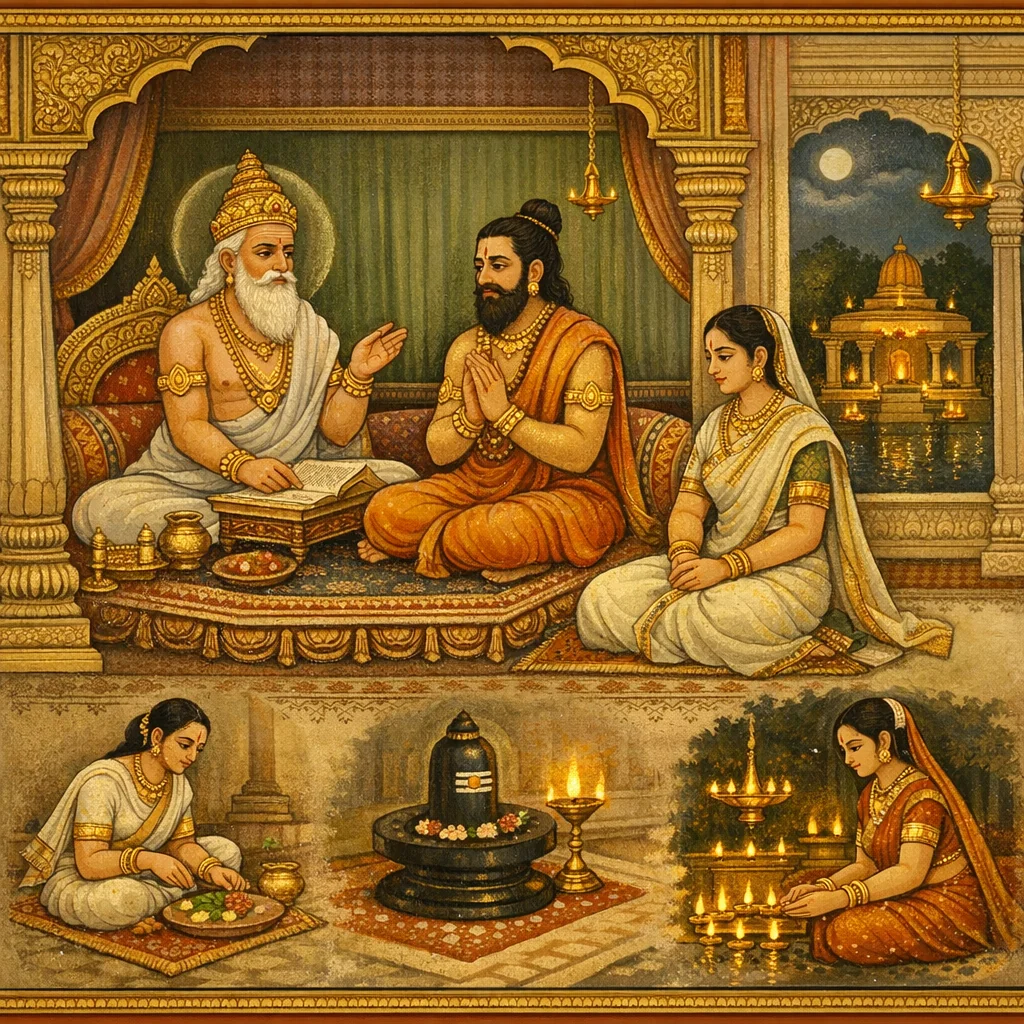
Chapter 4 is taught as a dialogue within the Sūta–Vyāsa narrative frame. Prompted by Agastya, the devas first honor him with reverent praise and then set forth an extensive ethical and ritual portrait of the ideal pativratā—an wife of disciplined fidelity and household virtue—holding up Lopāmudrā as the exemplary model. The teaching lists norms of conduct: careful attention to the husband’s needs, restraint in speech and social association, avoidance of certain public entertainments, austerities undertaken only with permission, and an overall ethic of service treated as religious practice. The discourse then turns strongly to results (phala), asserting the protective spiritual power of pativratā conduct—even fearlessness before the messengers of death—and describing merit that benefits multiple generations. In contrast, transgressions are presented as cautionary types linked with unfavorable rebirth. A later section prescribes disciplines for widowhood—dietary restraint, austerities, daily offerings, and Viṣṇu-pūjā with the husband as the focus of devotion—followed by seasonal observances (notably in Vaiśākha, Kārtika, and Māgha) involving bathing, gifts, lamps, and regulated abstentions. The chapter closes with a phalaśruti declaring that hearing this teaching removes sin and leads toward an auspicious afterlife in Śakra-loka.
Shlokas
Verse 1
सूत उवाच । मुनिपृष्टास्तदा देवा भगवंस्ते किमब्रुवन् । सर्वलोकहितार्थाय तदाख्याहि महामुने
Sūta said: When the sage questioned the gods, what did those venerable ones reply? For the welfare of all worlds, O great sage, please relate that.
Verse 2
श्रीव्यास उवाच । अगस्तिवचनं श्रुत्वा बहुमानपुरस्सरम् । धिषणाधिपतेरास्यं विबुधा व्यालुलोकिरे
Śrī Vyāsa said: Having heard Agastya’s words, spoken with great reverence, the gods turned their gaze toward the face of the lord of wisdom, Bṛhaspati.
Verse 3
वाक्पतिरुवाच । शृण्वगस्ते महाभाग देवागमनकारणम् । धन्योसि कृतकृत्योसि मान्योसि महता मपि
Vākpati (Bṛhaspati) said: Hear, O fortunate Agastya, the cause of the gods’ coming. Blessed are you; your task is fulfilled; you are worthy of honor—even from me, the great one.
Verse 4
प्रत्याश्रमं प्रतिनगं प्रत्यरण्यं तपोधनाः । किं न संति मुनिश्रेष्ठ काचिदन्यैव ते स्थितिः
O best of sages, rich in austerity—are there not hermitages, mountains, and forests everywhere? Why, then, is your dwelling fixed in this one place alone, as though it were uniquely your chosen station?
Verse 5
तपोलक्ष्मीस्त्वयीहास्ति ब्राह्मतेजस्त्वयि स्थिरम् । पुण्यलक्ष्मीस्त्वयि परा त्वय्यौदार्यं मनस्त्वयि
In you dwells the prosperity born of austerity; in you stands firm the radiance of brahminical splendor. In you is the supreme fortune of merit, and in you abide generosity and noble-mindedness.
Verse 6
पतिव्रतेयं कल्याणी लोपामुद्रा सधर्मिणी । तवांगच्छायया तुल्या यत्कथापुण्यकारिणी
This auspicious Lopāmudrā is a pativratā, devoted to her husband, and with you she walks the path of dharma. She is like the very shadow of your body, and even her story is a maker of puṇya, sacred merit.
Verse 7
पतिव्रतास्वरुंधत्या सावित्र्याप्यनसूयया । शांडिल्यया च सत्या च लक्ष्म्या च शतरूपया
Among the famed devoted wives (pativratās)—Arundhatī, Sāvitrī, Anasūyā, Śāṇḍilyā, Satyā, Lakṣmī, and Śatarūpā—
Verse 8
मेनया च सुनीत्या च संज्ञया स्वाहया तथा । यथैषा वर्ण्यते श्रेष्ठा न तथान्येति निश्चितम
—and likewise Menā, Sunīti, Saṃjñā, and Svāhā: as this one (Lopāmudrā) is praised as the best, so are not the others—this is the settled conclusion.
Verse 9
भुंक्ते भुक्ते त्वयि मुने तिष्ठति त्वयि तिष्ठति । विनिद्रिते च निद्राति प्रथमं प्रतिबुध्यते
When you eat, O sage, she eats; when you stand, she stands. When you sleep, she sleeps—and she is the first to awaken.
Verse 10
अनलंकृतमात्मानं तव नो दर्शयेत्क्वचित् । कार्यार्थं प्रोषिते क्वापि सर्वमंडनवर्जिता
She would never show herself to you at any time without adorning herself. Even when you are away somewhere on account of duties, she remains free of all ornamentation.
Verse 11
न च ते नाम गृह्णीयात्तवायुष्यविवृद्धये । पुरुषांतरनामापि न गृह्णाति कदाचन
And she would not even utter your name, for the increase of your lifespan. Nor does she ever take up the name of any other man at all.
Verse 12
आक्रुष्टापि न चाक्रोशेत्ताडितापि प्रसीदति । इदं कुरु कृतं स्वामिन्मन्यतामिति वक्ति च
Even if scolded, she does not scold back; even if struck, she remains calm. She says, ‘Do this, my lord—consider it done,’ and speaks only to please.
Verse 13
आहूता गृहकार्याणि त्यक्त्वा गच्छति सत्वरम् । किमर्थं व्याहृता नाथ सप्रसादो विधीयताम्
When called, she leaves the household duties and comes at once. “For what purpose have I been summoned, my lord? Please command me with gracious favor,” thus she speaks.
Verse 14
न चिरं तिष्ठति द्वारि न द्वारमुपसेवते । अदापितं त्वया किंचित्कस्मैचिन्न ददात्यपि
She does not linger long at the doorway, nor does she loiter about the threshold. And unless you have given it to her, she does not give away even the slightest thing to anyone.
Verse 15
पूजोपकरणं सर्वमनुक्ता साधयेत्स्वयम् । नियमोदकबर्हींषि पत्रपुप्पाक्षतादिकम्
Without being told, she should herself arrange all the requisites for worship—pure water for rites, sacred kuśa grass, leaves, flowers, grains of rice, and the like.
Verse 16
प्रतीक्षमाणावसरं यथाकालोचितं हि यत् । तदुपस्थापयेत्सर्वमनुद्विग्नातिहृष्टवत्
Watching for the proper occasion, and whatever is fitting to the time, she should present and arrange it all—without anxiety and without excessive excitement.
Verse 17
सेवते भर्त्तुरुच्छिष्टमिष्टमन्नं फलादिकम् । महाप्रसाद इत्युक्त्वा परिदत्तं प्रतीच्छति
She partakes of what remains from her husband—beloved food, fruits, and the like—receiving what is handed to her, saying, “This is great prasāda.”
Verse 18
अविभज्य न चाश्नीयाद्देवपित्रतिथिष्वपि । परिचारकवर्गेषु गोषु भिक्षुकुलेषु च
She should not eat without first dividing and distributing the food—even for the gods, the ancestors, and guests; and also among attendants and servants, cows, and the households of mendicants.
Verse 19
संयतोपस्करादक्षा हृष्टा व्यय पराङ्मुखी । कुर्यात्त्वयाननुज्ञाता नोपवासव्रतादिकम्
Skilled in keeping the household goods in order, cheerful, and averse to wasteful expense, she should not undertake fasts, vows, and the like without your permission.
Verse 20
दूरतो वर्जयेदेषा समाजोत्सवदर्शनम् । न गच्छेत्तीर्थयात्रादि विवाहप्रेक्षणादिषु
She should keep far from viewing public gatherings and festivities. She should not go to pilgrimages and the like, nor to wedding-spectacles and similar occasions.
Verse 21
सुखसुप्तं सुखासीनं रममाणं यदृच्छया । आंतरेष्वपि कार्येषु पतिं नोत्थापयेत्क्वचित्
If her husband is sleeping comfortably, seated at ease, or enjoying himself as he pleases, she should never rouse him—even for intervening tasks.
Verse 22
स्त्रीधर्मिणी त्रिरात्रं तु स्वमुखं नैव दर्श येत् । स्ववाक्यं श्रावयेन्नापि यावत्स्नाता न शुद्धितः
When she is in her monthly state, for three nights she should not show her face, nor even let her words be heard—until she has bathed and is purified.
Verse 23
सुस्नाता भर्तृवदनमीहतेन्यस्य न क्वचित् । अथवा मनसि ध्यात्वा पतिं भानुं विलोकयेत्
After bathing well, she should seek her husband’s face and never that of another. Or else, having meditated upon her husband in her mind, she should look upon the Sun.
Verse 24
हरिद्रां कुंकुमं चैव सिंदूर कज्जलं तथा । कूर्पासकं च तांबूलं मांगल्याभरणं शुभम्
Turmeric, kunkuma, sindūra, and kajjala; also the hair-ornament (kūrpāsaka), betel, and auspicious bridal ornaments—these are held to be sacred and propitious for a devoted wife.
Verse 25
केशसंस्कारकबरी करकर्णादिभूषणम् । भर्त्तुरायुष्यमिच्छंती दूरये न्न पतिव्रता
A devoted wife—desiring her husband’s long life—does not cast away proper grooming of her hair and braid, nor her ornaments for hands, ears, and the like.
Verse 26
न रजक्या न हैतुक्या तथा श्रमणया न च । न च दुर्भगया क्वापि सखित्वं कुरुते सती
A virtuous woman does not form intimate friendship with a washerwoman, with a merely self-interested woman, with an ascetic woman (śramaṇī), nor anywhere with an ill-fated or immoral companion.
Verse 27
भर्तृविद्वेषिणीं नारीं नैषा संभाषते क्वचित् । नैकाकिनी क्वचिद्भूयान्न नग्ना स्नाति च क्वचित्
She does not, at any time, converse with a woman who hates her husband. Nor should she remain alone anywhere; and she should not bathe naked at any place.
Verse 28
नोलूखले न मुसले न वर्द्धन्यां दृषद्यपि । न यंत्रकेन देहल्यां सती चोपविशेत्क्वचित्
A virtuous woman should not sit upon a mortar, a pestle, a winnowing vessel, or even a grinding stone; nor upon a loom-implement, nor upon a threshold—at any time.
Verse 29
विना व्यवायसमयं प्रागल्भ्यं न क्वचिच्चरेत् । यत्रयत्ररुचिर्भर्त्तुस्तत्र प्रेमवती सदा
Except at the proper time for conjugal union, she should not behave with forwardness anywhere. Wherever her husband’s liking inclines, there she remains ever affectionate and devoted.
Verse 30
इदमेव व्रतं स्त्रीणामयमेवपरो वृषः । इयमेको देवपूजा भर्त्तुर्वाक्यं न लंघयेत
This alone is the vow for women; this alone is their highest righteousness. This alone is their worship of the gods: she should not transgress her husband’s word.
Verse 31
क्लीबं वा दुरवस्थंवा व्याधितं वृद्धमेव वा । सुस्थितं दुःस्थितं वापि पतिमेकं न लंघयेत
Whether the husband is impotent, in misfortune, diseased, or aged—whether well-placed or distressed—she should not forsake or violate her one husband.
Verse 32
हृष्टाहृष्टेविषण्णास्या विषण्णास्ये प्रिये सदा । एकरूपा भवेत्पुण्या संपत्सु च विपत्सु च
When her beloved is joyful, she should be joyful; when he is downcast, she should be downcast. The virtuous woman remains of one temper—steady in both prosperity and adversity.
Verse 33
सर्पिर्लवणतैलादि क्षयेपि च पतिव्रता । पतिं नास्तीति न ब्रूयादायासेषु न योजयेत्
Even when ghee, salt, oil, and the like are exhausted, the devoted wife should not say, “There is no husband.” Nor should she press her husband into burdensome exertions.
Verse 34
तीर्थस्नानार्थिनी नारी पतिपादोदकं पिबेत् । शंकरादपि विष्णोर्वा पतिरेकोधिकः स्त्रियाः
A woman who longs for the merit of bathing at a sacred ford should drink the water that has washed her husband’s feet. For a woman, her husband is held to be even more paramount—within the discipline of household dharma—than Śaṅkara or even Viṣṇu.
Verse 35
व्रतोपवासनियमं पतिमुल्लंघ्य या चरेत् । आयुष्यं हरते भर्त्तुर्मृता निरयमृच्छति
She who undertakes vows, fasts, or observances while transgressing her husband’s authority is said to diminish her husband’s lifespan; and when she dies, she goes to hell.
Verse 36
उक्ता प्रत्युत्तरं दद्याद्या नारी क्रोधतत्परा । सरमा जायते ग्रामे सृगाली निर्जने वने
A woman who, when addressed, snaps back in reply and is devoted to anger is reborn as a bitch in a village, or as a she-jackal in a lonely forest.
Verse 37
स्त्रीणां हि परमश्चैको नियमः समुदाहृतः ऽ । अभ्यर्च्य चरणौ भर्त्तुर्भोक्तव्यं कृतनिश्चयम्
For women, one supreme rule is declared: having duly honored the husband’s feet, she should eat—firmly resolved in that discipline.
Verse 38
उच्चासनं न सेवेत न व्रजेत्परवेश्मसु । न त्रपाकर वाक्यानि वक्तव्यानि कदाचन
She should not seek lofty seats, nor enter the houses of others; and she should never utter words that are shameless or lacking in modesty.
Verse 39
अपवादो न वक्तव्यः कलहं दूरतस्त्यजेत् । गुरूणां सन्निधौ क्वापि नोच्चैर्ब्रूयान्न वा हसेत्
She should not speak slander and should keep quarrel far away. In the presence of elders and teachers, she should neither speak loudly nor laugh boisterously.
Verse 40
या भर्तारं परित्यज्य रहश्चरति दुर्मतिः । उलूकी जायते क्रूरा वृक्षकोटरशायिनी
The ill-minded woman who abandons her husband and moves about in secret is reborn as a cruel she-owl, sleeping in the hollows of trees.
Verse 41
ताडिता ताडितुं चेच्छेत्सा व्याघ्री वृषदंशिका । कटाक्षयतियाऽन्यं वै केकराक्षी तु सा भवेत
A woman who, though struck, wishes to strike back becomes a tigress that bites bulls. And she who casts lustful sidelong glances at another man becomes cross-eyed.
Verse 42
या भर्तारं परित्यज्य मिष्टमऽश्नाति केवलम् । ग्रामे वासकरी भूयाद्वल्गुर्वापि श्वविट्भुजा
She who abandons her husband and eats only delicacies is reborn as a vāsakarī in a village, or else as a valgū—one who feeds on dogs’ excrement.
Verse 43
या त्वं कृत्याऽप्रियं ब्रूते मूका सा जायते खलु । या सपत्नीं सदेर्ष्येत दुर्भगा सा पुनःपुन्ः
But she who habitually speaks what is unpleasant is indeed born mute. And she who continually envies a co-wife becomes unfortunate again and again, through repeated births.
Verse 44
दृष्टिं विलुप्य भर्तुर्या कंचिदन्यं समीक्षते । काणा च विमुखी चापि कुरूपा चापि जायते
A wife who turns her gaze away from her husband and looks upon another man, as its result, is born one-eyed, averted in disposition, and even ill-formed.
Verse 45
बाह्यादायांतमालोक्य त्वरिता च जलाशनैः । तांबूलैर्व्यजनैश्चैव पादसंवाहनादिभिः
Seeing her husband returning from outside, she should hasten to serve him—with water and food, with betel, with fanning, and with foot-massage and the like.
Verse 46
तथैव चाटुवचनैः खेदसंनोदनैः परैः । या प्रियं प्रीणयेत्प्रीता त्रिलोकी प्रीणिता तया
Likewise, with pleasing words and other acts that dispel fatigue, the woman who gladly delights her beloved thereby delights the three worlds.
Verse 47
मितं ददाति हि पिता मितं भ्राता मितं सुतः । अमितस्य हि दातारं भर्त्तारं पूजये त्सदा
A father gives only in measure; a brother gives only in measure; a son gives only in measure. But the husband is the giver beyond measure; therefore she should always honor her husband.
Verse 48
भर्ता देवो गुरुर्भर्ता धर्म तीर्थ व्रतानि च । तस्मात्सर्वं परित्यज्य पतिमेकं समर्चयेत
For her, the husband is God; the husband is the guru; the husband is dharma, the sacred tīrthas, and the vows. Therefore, setting all else aside, she should worship her husband alone.
Verse 49
जीवहीनो यथा देहः क्षणादशुचितां व्रजेत् । भर्तृहीना तथा योषित्सुस्नाताप्यशुचिः सदा
Just as a body without life becomes impure in a moment, so too a woman without her husband is regarded as always impure, even if she has bathed well.
Verse 50
अमंगलेभ्यः सर्वेभ्यो विधवा त्यक्तमंगला । विधवा दर्शनात्सिद्धिः क्वापि जातु न जायते
Among all inauspicious things, the widow—bereft of auspiciousness—is counted as inauspicious; by merely seeing a widow, success is said never to arise anywhere at any time.
Verse 51
विहाय मातरं चैकां सर्वमंगलवर्जिताम । तदाशिषमपि प्राज्ञस्त्यजेदाशीविषोपमाम
Excepting only one’s mother, who is to be set apart with reverence, the wise should even reject the blessing of one who is devoid of all auspiciousness, treating it as though it were like a venomous serpent.
Verse 52
कन्याविवाहसमये वाचयेयुरिति द्विजाः । भर्तुः सहचरी भूयाज्जीवतोऽजीवतोपिवा
At the time of a maiden’s marriage, the twice-born should have this recited: “May she be the companion of her husband—whether he lives or even if he does not.”
Verse 53
भर्ता सदानुयातव्यो देहवच्छायया स्त्रिया । चंद्रमा ज्योत्स्नया यद्वद्विद्युत्वान्विद्युता यथा
A woman should ever follow her husband as a shadow follows the body—just as the moon is accompanied by its moonlight, and lightning by its flash.
Verse 54
अनुव्रजति भर्तारं गृहात्पितृवनं मुदा । पदेपदेऽश्वमेधस्य फलं प्राप्नोत्यसंशयम
She who joyfully follows her husband from the home to the ancestral grove (pitṛvana) gains—at every step—merit equal to that of the Aśvamedha sacrifice, without doubt.
Verse 55
व्यालग्राही यथा व्यालं बलादुद्धरते बिलात । एवमुत्क्रम्य दूतेभ्यः पतिं स्वर्गं नयेत्सती
Just as a snake-catcher forcibly draws a serpent out from its hole, so a virtuous, faithful wife, rising against the messengers, leads her husband to heaven.
Verse 56
यमदूताः पलायंते सतीमालोक्य दूरतः । अपि दुष्कृतकर्माणं समुत्सृज्य च तत्पतिम्
Yama’s messengers flee upon seeing a virtuous wife even from afar, abandoning even her husband though he has committed evil deeds.
Verse 57
न तथा बिभीमो वह्नेर्नतथा विद्युतो यथा । आपतंतीं समालोक्य वयं दूताः पतिव्रताम्
We messengers are not so afraid of fire, nor of lightning, as we are upon seeing a faithful wife rushing toward us.
Verse 58
तपनस्तप्यतेत्यंतं दहनोपि च दह्यते । कंपंते सर्व तेजांसि दृष्ट्वा पातिव्रतं महः
The sun is scorched beyond measure, and even fire is burned; all powers of brilliance tremble on beholding the great radiance born of a wife’s faithful vow.
Verse 59
यावत्स्वलोमसंख्यास्ति तावत्कोट्ययुतानि च । भर्त्रा स्वर्गसुखं भुंक्ते रममाणा पतिव्रता
For as many as are the hairs upon her body, for so many crores and tens of millions of years, the faithful wife—rejoicing—enjoys heavenly bliss together with her husband.
Verse 60
धन्या सा जननी लोके धन्योसौ जनकः पुनः । धन्यः स च पतिः श्रीमान्येषां गेहे पतिव्रता
Blessed in the world is that mother, blessed again is that father; blessed too is that illustrious husband—in whose home there dwells a faithful wife.
Verse 61
पितृवंश्यामातृवंश्याःपतिवंश्यास्त्रयस्त्रयः । पतिव्रतायाः पुण्येन स्वर्गसौख्यानि भुंजते
Three generations of her father’s line, three of her mother’s line, and three of her husband’s line enjoy the comforts of heaven by the merit of that faithful wife.
Verse 62
शीलभंगेन दुर्वृत्ताः पातयंति कुलत्रयम् । पितुर्मातुस्तथापत्युरिहामुत्र च दुःखिताः
By the breaking of virtuous conduct, the ill-behaved bring down the three families—of father, mother, and husband—and become sorrowful both here and hereafter.
Verse 63
पतिव्रतायाश्चरणो यत्र यत्र स्पृशेद्भुवम् । तत्रेति भूमिर्मन्येत नात्र भारोस्तिपावनी
Wherever the foot of a faithful pativratā touches the earth, the ground deems that place blessed; for there is no burden there—she herself is purifying.
Verse 64
बिभ्यत्पतिव्रतास्पर्शं कुरुते भानुमानपि । सोमो गंधवहश्चापि स्वपावित्र्याय नान्यथा
Even Sūrya, the Sun, in reverent awe seeks the touch of a pativratā. So too Soma and Gandhavaha do so—only for their own sanctification, and for no other reason.
Verse 65
आपः पतिव्रता स्पर्शमभिलष्यंति सर्वदा । अद्य जाड्यविनाशो नो जातास्त्वद्याऽन्यपावनाः
The waters ever long for the touch of a pativratā. Today our dullness is destroyed; today we are purified—indeed, purified beyond other purifiers.
Verse 66
गृहेगृहे न किं नार्यो रूपलावण्यगर्विताः । परं विश्वेशभक्त्यैव लभ्यते स्त्री पतिव्रता
Are there not women in every house, proud of beauty and charm? Yet a true pativratā is gained only through devotion to Viśveśa (Śiva), and not otherwise.
Verse 67
भार्या मूलं गृहस्थस्य भार्या मूलं सुखस्य च । भार्या धर्मफला भार्या सं तानवृद्धये
The wife is the very root of the householder’s life; the wife is the root of happiness. The wife yields the fruits of dharma, and the wife is for the increase of lineage.
Verse 68
परलोकस्त्वयं लोको जीयते भार्यया द्वयम् । देवपित्रतिथीज्यादि नाभार्यः कर्म चार्हति
Both this world and the next are truly attained through the wife. Without a wife, one is not fit to perform rites such as worship of the devas, offerings to the ancestors, and honoring guests.
Verse 69
गृहस्थः स हि विज्ञेयो यस्य गेहे पतिव्रता । ग्रसतेऽन्या प्रतिपदं राक्षस्या जरयाथवा
He alone should be known as a true householder (gṛhastha) in whose home there is a pativratā. Otherwise, day by day another—like a rākṣasī in the form of decay—devours the household.
Verse 70
यथा गंगाऽवगाहेन शरीरं पावनं भवेत् । तथा पतिव्रता दृष्ट्या शुभया पावनं भवेत्
Just as the body becomes purified by bathing in the Gaṅgā, so too one becomes purified by the auspicious glance of a pativratā.
Verse 71
अनुयाति न भर्तारं यदि दैवात्कथंचन । तत्रापि शीलं संरक्ष्यं शीलभंगात्पतत्यधः
If, by fate, she is somehow unable to follow her husband, even then her śīla—upright conduct—must be protected; for by the breaking of conduct one falls downward.
Verse 72
तद्वैगुण्यादपिस्वर्गात्पतिः पतति नान्यथा । तस्याः पिता च माता च भ्रातृवर्गस्तथैव च
Because of that fault in her conduct, even the husband falls from heaven—there is no other cause. And so too her father and mother, and likewise her circle of brothers, are affected.
Verse 73
पत्यौ मृते च यायोषिद्वैधव्यं पालयेत्क्वचित् । सा पुनः प्राप्य भर्तारं स्वर्गभोगान्समश्नुते
When her husband has died, the woman who faithfully preserves widowhood attains him again and enjoys the delights of heaven.
Verse 74
विधवा कबरीबंधो भर्तृबंधाय जायते । शिरसो वपनं तस्मात्कार्यं विधवया सदा
For a widow, the tying of the hair-knot is said to become a bondage for the husband; therefore a widow should always undertake the shaving of the head.
Verse 75
एकाहारः सदा कार्यो न द्वितीयं कदाचन । त्रिरात्रं पंचरात्रं वा पक्षव्रतमथापि वा
One meal a day should always be observed—never a second. Or one may undertake a three-night vow, a five-night vow, or even a fortnight-long observance.
Verse 76
मासोपवासं वा कुर्याच्चांद्रायणमथापि वा । कृच्छ्रं वराकं वा कुर्यात्तप्तकृच्छ्रमथापि वा
One may observe a month-long fast, or else the Cāndrāyaṇa vow. One may perform the Kṛcchra austerity, the Varāka discipline, or even the heated (Taptakṛcchra) austerity.
Verse 77
यवान्नैर्वा फलाहारैः शाकाहारैः पयोव्रतैः । प्राणयात्रां प्रकुर्वीत यावत्प्राणः स्वयं व्रजेत्
Sustaining life with barley-food, or a fruit-diet, or a vegetable-diet, or milk-vows, one should continue the journey of the vital breath—until prāṇa departs of itself.
Verse 78
पर्यंकशायिनी नारी वि धवा पातयेत्पतिम् । तस्माद्भूशयनं कार्यं पतिसौख्यसमीहया
A widow who sleeps upon a bed is said to bring about her husband’s downfall. Therefore, seeking her husband’s welfare, she should sleep upon the ground.
Verse 79
न चांगोद्वर्तनं कार्यं स्त्रिया विधवया क्वचित् । गंधद्रव्यस्य संयोगो नैव कार्यस्तया पुनः
Nor should a widow ever apply body-unctions or cosmetic rubbing. Likewise, she should not again use perfumed substances.
Verse 80
तर्पणं प्रत्यहं कार्यं भर्तुः कुशतिलोदकैः । तत्पितुस्तत्पितुश्चापि नामगोत्रादिपूर्वकम
Each day, tarpaṇa should be performed for the husband with water mixed with kuśa and sesame. And likewise for his father and his grandfather—preceded by the proper mention of name, gotra, and the like.
Verse 81
विष्णोस्तु पूजनं कार्यं पति बुद्ध्या न चान्यथा । पतिमेव सदा ध्यायेद्विष्णुरूपधरं हरिम्
Worship of Viṣṇu should indeed be performed with the understanding of Him as one’s husband—and not otherwise. One should always meditate upon the husband alone, as Hari who bears the form of Viṣṇu.
Verse 82
यद्यदिष्टतमं लोके यच्च पत्युः समीहितम् । तत्तद्गुणवते देयं पतिप्रीणनकाम्यया
Whatever is most cherished in the world, and whatever the husband desired—those very things should be given to a worthy recipient, with the wish to please the husband.
Verse 83
वैशाखे कार्तिके माघे विशेषनियमांश्चरेत् । स्नानं दानं तीर्थयात्रां विष्णोर्नामग्रहं मुहुः
In Vaiśākha, Kārtika, and Māgha one should observe special disciplines: ritual bathing, charity, pilgrimage to sacred tīrthas, and frequent taking of Viṣṇu’s Name.
Verse 84
वैशाखे जलकुंभांश्च कार्तिके घृतदीपकाः । माघे धान्य तिलोत्सर्गः स्वर्गलोके विशिष्यते
In Vaiśākha, the gifting of water-pots; in Kārttika, the offering of ghee-lamps; and in Māgha, the charitable giving of grains and sesame—these are especially meritorious, leading to exalted heavenly results.
Verse 85
प्रपा कार्या च वैशाखे देवे देया गलंतिका । उपानद्व्यजनं छत्रं सूक्ष्मवासांसि चन्दनम्
In Vaiśākha one should establish a prapā, a public water-shed; and in worship one should offer a galaṃtikā, a water-strainer. One should also give sandals, a fan, an umbrella, fine garments, and sandalwood.
Verse 86
सकर्पूरं च तांबूलं पुष्पदानं तथैव च । जलपात्राण्यनेकानि तथा पुष्प गृहाणि च
Also donate tāmbūla prepared with camphor, and likewise the gifting of flowers; many water-vessels too, and also flower-houses—places for storing and offering flowers.
Verse 87
पानानि च विचित्राणि द्राक्षा रंभा फलानि च । देयानि द्विजमुख्येभ्यः पतिर्मे प्रीयतामिति
One should give various refreshing drinks, grapes, plantains, and fruits to eminent brāhmaṇas, with the prayer, “May my Lord be pleased.”
Verse 88
ऊर्जे यवान्नमश्नीयादेकान्नमथवा पुनः । वृंताकं सूरणं चैव शूकशिंबिं च वर्जयेत्
In the month of Ūrja (Kārttika), one should partake of barley-food, or else take only a single meal each day. One should avoid eggplant, elephant-foot yam (sūraṇa), and legumes or pods (śūka-śimbi).
Verse 89
कार्तिके वर्जयेत्तैलं कार्तिके वर्जये न्मधु । कार्तिके वर्जयेत्कांस्यं कार्तिके चापिसंधितम्
In Kārttika one should avoid oil; in Kārttika one should avoid honey. In Kārttika one should avoid bell-metal (kāṃsya), and in Kārttika also what is ‘compounded’ (saṃdhita)—mixed or combined foods and preparations.
Verse 90
कार्तिके मौननियमे घंटां चारु प्रदापयेत । पत्रभोजी कांस्यपात्रं घृतपूर्णं प्रयच्छति
In Kārttika, while observing the vow of silence, one should have a beautiful bell offered (to the Deity or the temple). And one who eats from leaves should donate a bell-metal vessel filled with ghee.
Verse 91
भूमिशय्याव्रते देया शय्या श्लक्ष्णा सतूलिका । फलत्यागे फलं देयं रसत्यागे च तद्रसम्
For one undertaking the vow of sleeping on the ground, a smooth bed with bedding and a mattress should be given in charity. If one renounces fruits, fruits should be donated; and if one renounces juices, those very juices should be given.
Verse 92
धान्यत्यागे च तद्धान्यमथवा शालयः स्मृताः । धेनूर्दद्यात्प्रयत्नेन सालंकाराः सकांचनाः
When one renounces grains, one should donate those very grains—or, as taught, donate śāli rice. One should also, with earnest effort, give a cow, adorned and accompanied by gold, as a noble gift.
Verse 93
एकतः सर्वदानानि दीपदानं तथैकतः । कार्तिके दीपदानस्य कलां नार्हंति षोडशीम्
On one side are all gifts of charity; on the other is the offering of a lamp. In Kārttika, no other gift attains even one-sixteenth of the merit of lamp-donation.
Verse 94
किंचिदभ्युदिते सूर्ये माघस्नानं समाचरेत् । यथाशक्त्या च नियमान्माघस्नायी समाचरेत्
When the sun has risen just a little, one should perform the Māgha bath. And the observer of the Māgha bath should keep the prescribed restraints and disciplines according to one’s capacity.
Verse 95
पक्वान्नैर्भो जयेद्विप्रान्यतिनोपि तपस्विनः । लड्डुकैः फेणिकाभिश्च वटकेंडरिकादिभिः
By offering cooked foods, one should honor and gladden the brāhmaṇas, and also ascetics and other tapasvins—through gifts such as laddus, pheṇikā sweets, and vaṭaka, eṇḍarikā, and similar offerings.
Verse 96
घृतपक्वैः समीरचैः शुचिकर्पूरवासितैः । गर्भे शर्करया पूर्णैर्नेत्रानं दैः सुगंधिभिः
With sweets cooked in ghee—fragrant, pure, and perfumed with camphor—filled within with sugar, and with other such aromatic offerings, one should make gifts and offerings accordingly.
Verse 97
शुष्केंधनानां भारांश्च दद्याच्छीतापनुत्तये । कंचुकं तूलगर्भं च तूलिकां सूपवीतिकाम्
To ward off the cold, one should give bundles of dry firewood; and also a tunic, cotton-stuffed garments, a small cushion, and a warm wrap for covering oneself.
Verse 98
मंजिष्ठा रक्तवासांसि तथा तूलवतीं पटीम् । जातीफल लवंगैश्च तांबूलानि बहून्यपि
One should also offer mañjiṣṭhā (madder), red garments, and cotton cloth; and many betel offerings as well, together with nutmeg and cloves.
Verse 99
कंबलानि विचित्राणि निर्वातानि गृहाणि च । मृदुलाः पादरक्षाश्च सुगंध्युद्वर्त्तनानि च
One should give colorful blankets, wind-sheltered dwellings (or lodging), soft footwear to protect the feet, and fragrant powders or pastes for anointing the body.
Verse 100
घृतकंबलपूजाभिर्महास्नानपुरःसरम् । कृष्णागुरुप्रभृतिभिर्गर्भागारे प्रधूपनैः
With worship involving ghee and blankets—preceded by a great ceremonial bath—and with incense-fumigation in the sanctum using black agarwood and the like, one should perform the rite.
Verse 110
इदं पातिव्रतं तेजो ब्रह्मतेजो भवान्परम् । तत्राप्येतत्तपस्तेजः किमसाध्यतमं तव
This splendor of wifely fidelity is a radiance; you are supreme with the radiance of Brahman. And beyond even that is the radiance born of tapas—what, indeed, could be most impossible for you to accomplish?
Verse 120
साधयिष्यामि वः कार्यं विसर्ज्येति दिवौकसः । पुनश्चिंतापरो भूत्वाऽगस्तिर्ध्यानपरोभवत्
“I shall accomplish your task; depart,” he said to the dwellers of heaven. Then, becoming again absorbed in reflection, Agastya entered a state of deep meditation (dhyāna).
Verse 121
वेदव्यास उवाच । इमं पतिव्रताध्यायं श्रुत्वा स्त्रीपुरुषोपिवा । पापकंचुकमुत्सृज्य शक्रलोकं प्रयास्यति
Vyāsa said: Having heard this chapter on pātivratya—whether woman or man—casting off the cloak of sin, one shall attain the world of Śakra (Indra).