Adhyaya 33
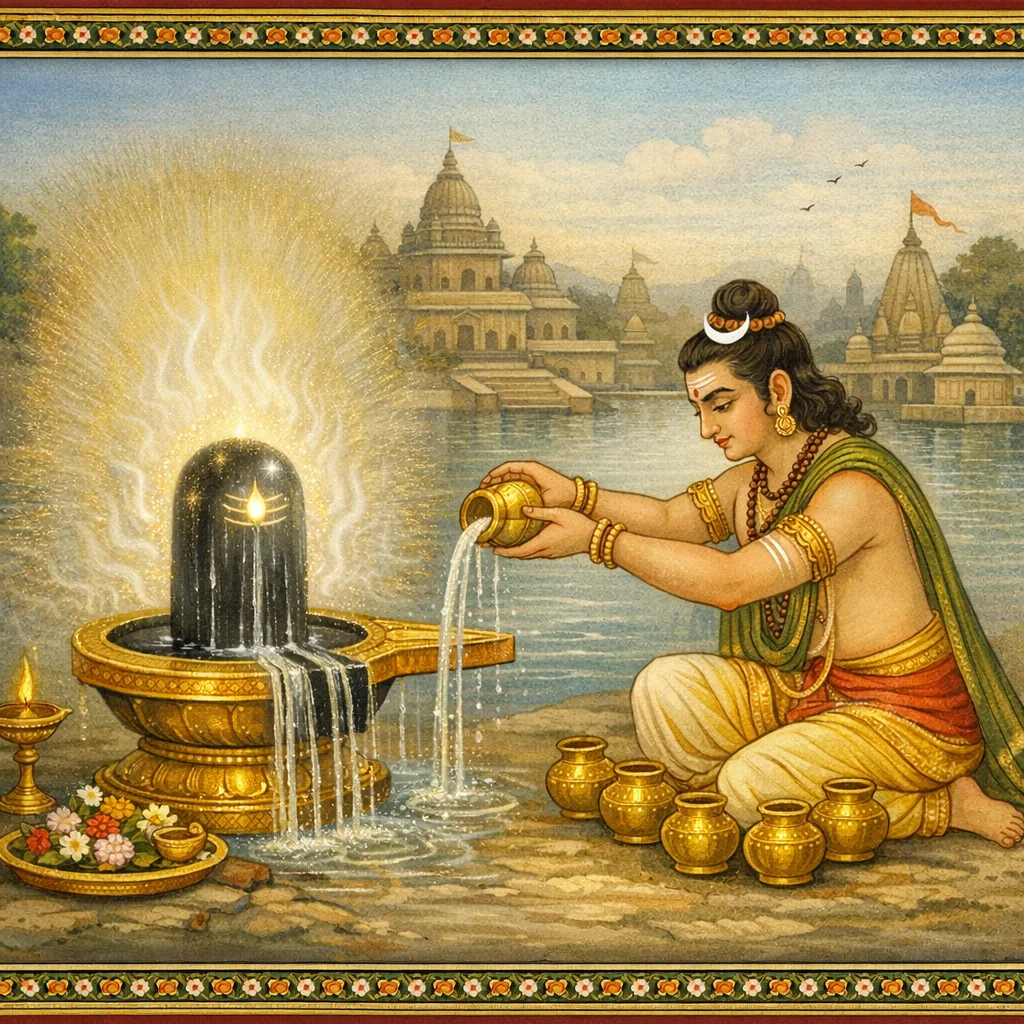
The chapter begins with Agastya asking Skanda to explain the greatness of Skandajñānoda-tīrtha and why Jñānavāpī is praised even among celestial beings. Skanda recounts its origin: in an ancient age, Īśāna (a Rudra-form) enters the sacred field of Kāśī and beholds a radiant mahāliṅga worshipped by siddhas, yogins, gandharvas, and divine attendants. Wishing to bathe it with cool water, he digs a kuṇḍa with his trident, draws forth vast subterranean waters, and performs repeated abhiṣeka with thousands of streams and vessels. Pleased, Śiva grants a boon; Īśāna asks that the incomparable tīrtha bear Śiva’s name. Śiva proclaims it the supreme Śiva-tīrtha, explains “Śivajñāna” as knowledge liquefied by divine majesty, establishes the name Jñānoda, and promises purification by mere sight, with great sacrificial equivalences through touch and sipping. The chapter then details ritual and ethical fruits: śrāddha and piṇḍadāna performed here yield multiplied ancestral merit, compared with Gayā, Puṣkara, and Kurukṣetra. Fasting on aṣṭamī/caturdaśī, and upavāsa on ekādaśī with measured sips, leads to inner liṅga-realization. It also affirms apotropaic power—afflictive beings and diseases are pacified by viewing Śiva’s tīrtha-water—and declares that bathing the liṅga with Jñānoda water equals bathing it with the waters of all tīrthas. Skanda next introduces an ancient itihāsa connected with Jñānavāpī: a Brahmin family and an exceptionally virtuous daughter devoted to repeated bathing and temple service. An abduction attempt by a vidyādhara, a violent encounter with a rākṣasa, deaths and karmic continuities, and later-life episodes re-center devotion—liṅga-arcana, vibhūti, and rudrākṣa—over worldly ornaments. The latter portion proceeds in a catalog-like sacred-topography sequence of tīrthas and shrines with their merits, reinforcing the chapter’s mapping of Kāśī’s ritual landscape.
Shlokas
Verse 1
अगस्त्य उवाच । स्कंदज्ञानोदतीर्थस्य माहात्म्यं वद सांप्रतम् । ज्ञानवापीं प्रशंसंति यतः स्वर्गौकसोप्यलम्
Agastya said: Now tell the greatness of the Skanda-Jñānoda Tīrtha. For they highly praise Jñānavāpī—so much so that even the dwellers of heaven extol it.
Verse 2
स्कंद उवाच । घटोद्भव महाप्राज्ञ शृणु पापप्रणोदिनीम् । ज्ञानवाप्याः समुत्पत्तिं कथ्यमानां मयाधुना
Skanda said: O pot-born sage, greatly wise—listen as I now relate the sin-dispelling origin of Jñānavāpī.
Verse 3
अनादिसिद्धे संसारे पुरा देवयुगे मुने । प्राप्तः कुतश्चिदीशानश्चरन्स्वैरमितस्ततः
O sage, in that beginningless world, ever firmly established, long ago in the age of the gods, Īśāna came from somewhere, wandering freely here and there.
Verse 4
न वर्षंति यदाभ्राणि न प्रावर्तंत निम्रगाः । जलाभिलाषो न यदा स्नानपानादि कर्मणि
When the clouds no longer rain and the rivers cease to flow—when even the longing for water vanishes for acts such as bathing and drinking—(then the world falls into distress).
Verse 5
क्षारस्वादूदयोरेव यदासीज्जलदर्शनम् । प्रथिव्यां नरसंचारे वतर्माने क्वचित्क्वचित्
When, on the earth, amid the wanderings of people, water could be seen only here and there—and only as either salty or sweet—(the scarcity of water became evident).
Verse 6
निर्वाणकमलाक्षेत्रं श्रीमदानंदकाननम् । महाश्मशानं सर्वेषां बीजानां परमूषरम्
It is the lotus-field of nirvāṇa, the glorious forest of bliss; the great cremation-ground where, for all seeds of karma, it becomes the supreme barren land in which they cannot sprout.
Verse 7
महाशयनसुप्तानां जंतूनां प्रतिबोधकम् । संसारसागरावर्त पतज्जंतुतरंडकम्
It awakens beings who sleep upon the great bed of ignorance; it is the life-raft for creatures falling into the whirlpools of the ocean of saṃsāra.
Verse 8
यातायातातिसंखिन्न जंतुविश्राममंडपम । अनेकजन्मगुणित कर्मसूत्रच्छिदाक्षुरम्
It is a resting pavilion for beings worn out by ceaseless coming and going; it is the keen blade that severs the thread of karma woven through many births.
Verse 9
सच्चिदानंदनिलयं परब्रह्मरसायनम् । सुखसंतानजनकं मोक्षसाधनसिद्धिदम्
It is the abode of Sat–Cit–Ānanda, the elixir of the Supreme Brahman; it begets an unbroken succession of joy and grants the accomplishment of the means to liberation (mokṣa).
Verse 10
प्रविश्य क्षेत्रमेतत्स ईशानो जटिलस्तदा । लसत्त्रिशूलविमलरश्मिजालसमाकुलः
Then the Lord, Īśāna—matted-haired with jatā—entered this sacred region, radiant and encompassed by a net of pure beams flashing from his shining triśūla.
Verse 11
आलुलोके महालिंगं वैकुंठपरमेष्ठिनोः । महाहमहमिकायां प्रादुरास यदादितः
He beheld the great Liṅga, which had first manifested during the mighty contest of “I, I” (pride) between the Lord of Vaikuṇṭha and the Parameṣṭhin (Brahmā).
Verse 12
ज्योतिर्मयीभिर्मालाभिः परितः परिवेष्टितम् । वृंदैर्वृंदारकर्षीणां गणानां च निरंतरम्
It was encircled on all sides by garlands made of light, and continually attended by hosts of divine beings and by Śiva’s gaṇas.
Verse 13
सिद्धानां योगिनां स्तोमैरर्च्यमानं निरंतरम् । गीयमानं च गंधर्वैः स्तूयमानं च चारणैः
It was ceaselessly worshipped by multitudes of Siddhas and Yogins, sung by the Gandharvas, and praised by the Cāraṇas.
Verse 14
अंगहारैरप्सरोभिः सेव्यमानमनेकधा । नीराज्यमानं सततं नागीभिर्मणिदीपकैः
It was served in many ways by the Apsarases through graceful dance-movements, and it was continually adored with waving lights by the Nāgīs, using jewel-like lamps.
Verse 15
विद्याधरीकिन्नरीभिस्त्रिकालं कृतमंडनम् । अमरीचमरीराजि वीज्यमानमितस्ततः
Adorned thrice daily by Vidyādharīs and Kinnarīs, it was fanned from every side by radiant, shimmering hosts of celestial women.
Verse 16
अस्येशानस्य तल्लिंगं दृष्ट्वेच्छेत्यभवत्तदा । स्नपयामि महल्लिंगं कलशैः शीतलैर्जलैः
On seeing that liṅga of Īśāna, the desire arose at once: “I shall bathe this great liṅga with pitchers of cool water.”
Verse 17
चखान च त्रिशूलेन दक्षिणाशोपकंठतः । कुंडं प्रचंडवेगेन रुद्रोरुद्रवपुर्धरः
And then—Rudra, bearing a fierce Rudra-form—dug a basin with his trident at the southern side, with tremendous force.
Verse 18
पृथिव्यावरणांभांसि निष्क्रांतानि तदा मुने । भूप्रमाणाद्दशगुणैर्यैरियं वसुधावृता
Then, O sage, the waters that encircle the earth burst forth—those very waters by which this world is enveloped, tenfold beyond the earth’s measure.
Verse 19
तैर्जलैः स्नापयांचक्रे त्वत्स्पृष्टैरन्यदेहिभिः । तुषारैर्जाड्यविधुरैर्जंजपूकौघहारिभिः
With those waters he performed the sacred bathing—waters untouchable to other embodied beings; yet, once touched by you, they were like cool dew that dispels dullness and drives away swarms of gnats.
Verse 20
सन्मनोभिरिवात्यच्छैरनच्छैर्व्योमवर्त्मवत् । ज्योत्स्नावदुज्ज्वलच्छायैः पावनैः शंभुनामवत्
Those waters were exceedingly clear—like noble minds—stainless like the paths of the sky; luminous like moonlight, and purifying like the very names of Śambhu.
Verse 21
पीयूषवत्स्वादुतरैः सुखस्पर्शैर्गवांगवत् । निष्पापधीवद्गंभीरैस्तरलैः पापिशर्मवत्
Sweeter than nectar, pleasant to the touch like the limbs of a cow; deep like a sinless intellect, and gently flowing, granting ease even to the sinful.
Verse 22
विजिताब्जमहागंधैः पाटलामोदमोदिभिः । अदृष्टपूर्वलोकानां मनोनयनहारिभिः
Fragrant beyond the great scent of lotuses, delighting with the perfume of pāṭalā blossoms—captivating the minds and eyes of worlds that had never seen such wonders before.
Verse 23
अज्ञानतापसंतप्त प्राणिप्राणैकरक्षिभिः । पंचामृतानां कलशैः स्नपनातिफलप्रदैः
With pitchers of the five amṛtas—guardians of the very life-breath of beings scorched by the heat of ignorance—he performed the sacred bathing, bestowing exceedingly great fruit.
Verse 24
श्रद्धोपस्पर्शि दृदयलिंग त्रितयहेतुभिः । अज्ञानतिमिरार्काभैर्ज्ञानदान निदायकैः
With acts touched by śraddhā—causes of the threefold marks of sacred worship—and with offerings of knowledge that shine like a sun dispelling the darkness of ignorance,
Verse 25
विश्वभर्तुरुमास्पर्शसुखातिसुखकारिभिः । महावभृथसुस्नान महाशुद्धिविधायिभिः
—with those acts that grant supreme delight through Umā’s touch upon the Lord who bears the universe, and with the excellent great avabhṛtha-bath that brings about great purification—
Verse 26
सहस्रधारैः कलशैः स ईशानो घटोद्भव । सहस्रकृत्वः स्नपयामास संहृष्टमानसः
Then Īśāna, O Pot-born one (Agastya), with a gladdened heart, bathed the Lord again and again—indeed a thousand times—using pitchers that poured forth in a thousand streams.
Verse 27
ततः प्रसन्नो भगवान्विश्वात्मा विश्वलोचनः । तमुवाच तदेशानं रुद्रं रुद्रवपुर्धरम्
Thereupon the Blessed Lord—Soul of the universe, All-seeing—was pleased and spoke to that Īśāna, to Rudra who bore the very form of Rudra.
Verse 28
तव प्रसन्नोस्मीशान कर्मणानेन सुव्रत । गुरुणानन्यपूर्वेण ममातिप्रीतिकारिणा
O Īśāna, I am pleased with you by this deed, O man of noble vow—by a guru-like service unparalleled before, which has brought Me exceptional delight.
Verse 29
ततस्त्वं जटिलेशान वरं ब्रूहि तपोधन । अदेयं न तवास्त्यद्य महोद्यमपरायण
Therefore, O matted-haired Īśāna, speak your boon, O treasure of austerity. Today nothing is ‘not to be given’ to you, O one devoted to great endeavor.
Verse 30
ईशान उवाच । यदि प्रसन्नो देवेश वरयोग्योस्म्यहं यदि । तदेतदतुलं तीर्थं तव नाम्नास्तु शंकर
Īśāna said: “If you are pleased, O Lord of gods, and if I am worthy of a boon, then let this incomparable sacred ford bear Your name, O Śaṅkara.”
Verse 31
विश्वेश्वर उवाच । त्रिलोक्यां यानि तीर्थानि भूर्भुवःस्वः स्थितान्यपि । तेभ्योखिलेभ्यस्तीर्थेभ्यः शिवतीर्थमिदं परम्
Viśveśvara said: “Whatever sacred fords exist in the three worlds—on earth, in the mid-region, and in heaven—this Śiva-tīrtha is supreme above them all.”
Verse 32
शिवज्ञानमिति ब्रूयुः शिवशब्दार्थचिंतकाः । तच्च ज्ञानं द्रवीभूतमिह मे महिमोदयात्
Those who contemplate the meaning of the word ‘Śiva’ call it ‘Śiva-knowledge’. And that very knowledge, by the arising of My glory, has here become as though liquefied—made manifest as a flowing presence.
Verse 33
अतो ज्ञानोद नामैतत्तीर्थं त्रैलोक्यविश्रुतम् । अस्य दर्शनमात्रेण सर्वपापैः प्रमुच्यते
Therefore this tīrtha is called Jñānoda, “the Upwelling of Knowledge,” and is renowned throughout the three worlds. By merely beholding it, one is freed from all sins.
Verse 34
ज्ञानोदतीर्थसंस्पर्शादश्वमेधफलं लभेत् । स्पर्शनाचमनाभ्यां च राजसूयाश्वमेधयोः
By merely touching the sacred ford called Jñānoda, one attains the merit of the Aśvamedha sacrifice. And by its touch and by sipping its water as ācamana, one gains the fruits of both the Rājasūya and the Aśvamedha.
Verse 35
फल्गुतीर्थे नरः स्नात्वा संतर्प्य च पितामहान् । यत्फलं समवाप्नोति तदत्र श्राद्धकर्मणा
Whatever merit a man obtains by bathing at Phalgu Tīrtha and satisfying the forefathers, that very fruit is gained here through the performance of śrāddha.
Verse 36
गुरुपुष्यासिताष्टम्यां व्यतीपातो यदा भवेत् । तदात्र श्राद्धकरणाद्गयाकोटिगुणं भवेत्
When the Vyatīpāta yoga occurs on the dark eighth day (Aṣṭamī) under Guru (Bṛhaspati) and Puṣya, then performing śrāddha here becomes a crore-fold more fruitful than (the merit of) Gayā.
Verse 37
यत्फलं समवाप्नोति पितॄन्संतर्प्य पुष्करे । तत्फलं कोटिगुणितं ज्ञानतीर्थे तिलोदकैः
Whatever merit is gained by satisfying the ancestors at Puṣkara, that same merit becomes a crore times greater at Jñānatīrtha when offered with sesame-water.
Verse 38
सन्निहत्यां कुरुक्षेत्रे तमोग्रस्ते विवस्वति । यत्फलं पिंडदानेन तज्ज्ञानोदे दिने दिने
At Kurukṣetra, on the Sannihatyā (Sannihitī) occasion, when the Sun is shrouded in darkness (an eclipse), whatever merit is gained by offering piṇḍas— that very merit is obtained at Jñānoda, day after day.
Verse 39
पिंडनिर्वपणं येषां ज्ञानतीर्थे सुतैः कृतम् । मोदंते शिवलोके ते यावदाभूतसंप्लवम्
Those for whom their sons have offered piṇḍas at Jñānatīrtha rejoice in Śiva’s world until the end of the cosmic dissolution.
Verse 40
अष्टम्यां च चतुर्दश्यामुपवासी नरोत्तमः । प्रातः स्नात्वाथ पीतांभस्त्वंतर्लिंगमयो भवेत्
On the eighth and the fourteenth lunar days, the best of men should fast. Having bathed at dawn and then drunk the water, he becomes inwardly pervaded by the Liṅga (Śiva).
Verse 41
एकादश्यामुपोष्यात्र प्राश्नाति चुलुकत्रयम् । हृदये तस्य जायंते त्रीणि लिंगान्यसंशयम्
Fasting here on the eleventh lunar day, he should sip three palmfuls. In his heart, three Liṅgas arise—without doubt.
Verse 42
ईशानतीर्थे यः स्नात्वा विशेषात्सोमवासरे । संतर्प्य देवर्षि पितॄन्दत्त्वा दानम स्वशक्तितः
He who bathes at Īśāna Tīrtha—especially on a Monday—having offered satisfaction to the gods, sages, and ancestors, and having given charity according to his capacity,
Verse 43
ततः समर्च्य श्रीलिंगं महासंभारविस्तरैः । अत्रापि दत्त्वा नानार्थान्कृतकृत्योभवेन्नरः
Then, having duly worshipped the sacred Liṅga with abundant and elaborate offerings, and having also bestowed various gifts here, a man becomes fulfilled—his aims accomplished.
Verse 44
उपास्य संध्यां ज्ञानोदे यत्पापं काललोपजम् । क्षणेन तदपाकृत्य ज्ञानवाञ्जायते द्विजः
By performing the twilight worship (Sandhyā) at Jñānoda, whatever sin has arisen from neglecting the proper times is removed in an instant, and the twice-born becomes endowed with true knowledge.
Verse 45
शिवतीर्थमिदं प्रोक्तं ज्ञानतीर्थमिदं शुभम् । तारकाख्यमिदं तीर्थं मोक्षतीर्थमिदं धुवम्
This has been declared a Śiva-tīrtha; this auspicious place is a tīrtha of knowledge. This tīrtha is famed as ‘Tāraka’, and it is assuredly a tīrtha that grants liberation.
Verse 46
स्मरणादपि पापौघो ज्ञानोदस्य क्षयेद्ध्रुवम् । दर्शनात्स्पर्शनात्स्नानात्पानाद्धर्मादिसंभवः
Even by mere remembrance of Jñānoda, a flood of sins surely perishes. By seeing it, touching it, bathing there, and drinking its waters, dharma and other auspicious attainments arise.
Verse 47
डाकिनीशाकिनी भूतप्रेतवेतालराक्षसाः । ग्रहाः कूष्मांडझोटिंगाः कालकर्णी शिशुग्रहाः
Ḍākinīs and Śākinīs; bhūtas, pretas, vetālas, and rākṣasas; malignant grahas; kūṣmāṇḍas and jhoṭiṅgas; Kālakārṇī and the child-seizing spirits—
Verse 48
ज्वरापस्मारविस्फोटद्वितीयकचतुर्थकाः । सर्वे प्रशममायांति शिवर्तार्थजलेक्षणात्
Fevers, epilepsy, eruptive diseases, and recurring fevers of the second and fourth day—all of them subside upon beholding the waters of Śivartārtha.
Verse 49
ज्ञानोदतीर्थपानीयैर्लिंगं यः स्नापयेत्सुधीः । सर्वतीर्थोदकैस्तेन ध्रुवं संस्नापितं भवेत्
The wise devotee who bathes the Śiva-liṅga with the water of Jñānoda tīrtha thereby certainly bathes it with the waters of all tīrthas.
Verse 50
ज्ञानरूपोह मेवात्र द्रवमूर्तिं विधाय च । जाड्यविध्वंसनं कुर्यां कुर्यां ज्ञानोपदेशनम्
‘I myself am of the nature of knowledge; here, taking on a liquid form, I shall destroy dullness and bestow instruction in true knowledge.’
Verse 51
इति दत्त्वा वराञ्छंभुस्तत्रैवांतरधीयत । कृतकृत्यमिवात्मानं सोप्यमंस्तत्रिशूलभृत्
Having thus granted the boons, Śambhu vanished right there; the Trident-bearer considered himself as though his purpose had been fulfilled.
Verse 52
ईशानो जटिलो रुद्रस्तत्प्राश्य परमोदकम् । अवाप्तवान्परं ज्ञानं येन निर्वृतिमाप्तवान्
Īśāna—Rudra of matted locks—having drunk that supreme water, attained the highest knowledge, by which he reached perfect peace.
Verse 53
स्कंद उवाच । कलशोद्भव चित्रार्थमितिहासं पुरातनम् । ज्ञानवाप्यां हि यद्वृत्तं तदाख्यामि निशामय
Skanda said: “O Kalaśodbhava, listen. I shall recount an ancient and wondrous episode—what happened at the Jñāna-well (Jñānavāpī).”
Verse 54
हरिस्वामीति विख्यातः काश्यामासीद्विजः पुरा । तस्यैका तनया जाता रूपेणाऽप्रतिमा भुवि
In ancient times, there lived in Kāśī a twice-born man renowned as Harisvāmin. He had a single daughter, whose beauty on earth was without any equal.
Verse 55
न समा शीलसंपत्त्या तस्या काचन भूतले । कलाकलापकुशला स्वरेणजितकोकिला
On the face of the earth, no woman equaled her in the wealth of noble character. Skilled in a full range of arts, she surpassed even the cuckoo in sweetness of voice.
Verse 56
न नारी तादृगस्तीह ना भरी किन्नरी न च । विद्याधरी न नो नागी गंधर्वी नासुरी न च
No woman like her exists here—neither among celestial maidens, nor among kinnarīs. Neither a vidyādharī, nor a nāgī, nor a gandharvī, nor even an asurī could match her.
Verse 57
निर्वाणनरसिंहोयं भक्तनिर्वाणकारणम् । मणिप्रदीपनागोयं महामणिविभूषणः
This is Narasiṃha who grants liberation—indeed, the very cause of the devotees’ nirvāṇa. This is the serpent that shines like a jeweled lamp, adorned with great gems.
Verse 58
तदास्य शरणं यातो मन्ये दर्शभयाच्छशी । दिवापि न त्यजेत्तां तु त्रस्तश्चंडमरीचितः
I think even the moon has taken refuge in her, fearing to be outshone. Even by day the moon would not leave her, trembling before the sun’s fierce rays.
Verse 59
तद्भ्रूर्भ्रमरराजीव गंडपत्रलतांतरे । उदंचन्न्यंचदुड्डीन गतेरभ्यासभाजिनी
Her eyebrow—like a sovereign bee—moved amid the vine-like leaves of her cheeks, rising and dipping, as though practicing the art of swift flight.
Verse 60
तच्चारुलोचनक्षेत्रे विचरंतौ च खंजनौ । सदैव शारदीं प्रीतिं निर्विशेते निजेच्छया
In the field of her lovely eyes, a pair of khanjana birds seemed to roam; and of their own accord they ever entered into an autumnal delight.
Verse 61
सुदत्या रदनश्रेणी छेदेषु विषमेषुणा । विहिता कांचनी रेखा क्वेंदावेतावती कला
Her delicate row of teeth—though divided by uneven gaps—seemed as if a sharp arrow had drawn a golden line there. Where could the moon possess such artistry?
Verse 62
प्रायो मदन भूपाल हर्म्य रत्नांतरे शुभे । जितप्रवालसुच्छाये तस्या रदनवाससी
O king, that maiden’s teeth and lips were as a splendid jeweled palace of Madana: radiant within, and with a hue surpassing bright coral.
Verse 63
स्वर्गे मर्त्ये च पाताले नैषा रेखा क्वचित्स्त्रियाम् । तत्कंठरेखात्रितय व्याजेन शपते स्मरः
In heaven, on earth, or in the netherworld, such lines are found in no woman. And on the pretext of the three lines upon her neck, even Smara, the God of Love, seems to swear an oath.
Verse 64
शंके चित्त भुवो राज्ञो लसत्पटकुटीद्वयम् । अनर्घ्यरत्नकोशाढ्यं तम्या वक्षोरुहद्वयम्
I suspect that the very dwelling of the King of Love has become this pair of shining cloth-pavilions—her two breasts—rich as though filled with treasuries of priceless jewels.
Verse 65
अनंगभू नियमतोऽदृश्ये मध्ये नतभ्रुवः । रोमालीलक्षिकामूर्ध्वामिव यष्टिं विधिर्व्यधात्
With deliberate restraint, the Creator fashioned her middle so subtle as to be almost unseen—like a slender staff—marked above by the line of body-hair as though it were a sign upon it.
Verse 66
तस्या नाभीदरीं प्राप्य कंदर्पोऽनंगता गतः । पुनः प्राप्तुमिवांगानि तप्यते परमं तपः
Reaching the hollow of her navel, Kandarpa became ‘bodiless’ once again; as if striving to regain his limbs, he performs the most intense austerity.
Verse 67
गुरुणैतन्नितंबेन महामन्मथ दीक्षया । भुवि के के युवानो न स्वाधीना प्रापितादृशाम्
By the weight of that broad hip—an initiation into mighty Manmatha—what young men on earth would not be brought under the sway of such a vision?
Verse 68
ऊरुस्तंभेन चैतस्याः स्तंभवत्कस्यनो मनः । तस्तंभेन मुने वापि सुवृत्तेन सुवर्तनम्
By the pillar-like firmness of her thighs, whose mind would not be stunned and made motionless? O sage, by that very “pillar,” even a steady ascetic course may be made to waver.
Verse 69
पादांगुष्ठनखज्योतिः प्रभया कस्य न प्रभा । विवेकजनिताऽध्वंसि मुने तस्या मृगीदृशः
By the radiance from the nail of her great toe, whose own splendor would not be outshone? O sage, the discernment-born resolve of that doe-eyed girl scatters all lesser fascinations.
Verse 70
सा प्रत्यहं ज्ञानवाप्यां स्नायं स्नायं शिवालये । संमार्जनादि कर्माणि कुरुतेऽनन्यमानसा
Each day she bathes again and again in the Jñāna-vāpī, and in Śiva’s temple she performs services such as sweeping and cleaning, her mind devoted to nothing else.
Verse 71
तत्पादप्रतिबिंबेषु रेखा शष्पांकुरं चरन् । नान्यद्वनांतरं याति काश्यां यूनां मनोमृगः
Grazing on the tender shoots of the lines seen in the reflections of her feet, the “deer of the mind” of Kāśī’s young men goes to no other forest-path.
Verse 72
तदास्य पंकजं हित्वा यूनां नेत्रालिमालया । न लतांतरमासेवि अप्यामोदप्रसूनयुक्
Even leaving aside the lotus of her face, the garland of bees—young men’s eyes—does not resort to any other creeper, even one laden with fragrant blossoms.
Verse 73
सुलोचनापि सा कन्या प्रेक्षेतास्यं न कस्यचित् । सुश्रवा अपि सा बाला नादत्ते कस्यचिद्वचः
Though fair-eyed, that maiden would not look upon anyone’s face; though of good repute, that young girl accepted no one’s words of courtship.
Verse 74
सुशीला शीलसंपन्ना रहस्तद्विरहातुरैः । प्रार्थितापि सुरूपाढ्यैर्नाभिलाषं बबंध सा
Suśīlā—endowed with virtue and refined conduct—though privately sought by handsome men tormented by separation from her, did not fasten her desire upon any of them.
Verse 75
धनैस्तस्याजनेतापि युवभिः प्रार्थितो बहु । नाशकत्तां सुलीलां सदातुं शीलोर्जितश्रियम्
Even her father, though entreated again and again by young men offering wealth, could not give that graceful maiden away—for her radiance was born of character and virtue.
Verse 76
ज्ञानोदतीर्थभजनात्सा सुशीला कुमाग्किा । बहिरंतस्तदाऽद्राक्षीत्सर्वलिंगमयं जगत
By worshipping at the Jñānoda Tīrtha, the maiden Suśīlā then perceived—within and without—the entire world as pervaded by Śiva’s liṅga-nature, the mark of the Lord.
Verse 77
कदाचिदेकदा तां तु प्रसुप्तां सदनांगणे । मोहितो रूपसंपत्त्या कश्चिद्विद्याधरोऽहरत्
Once, as she slept in the courtyard of her home, a certain Vidyādhara—bewildered by her beauty—carried her away.
Verse 78
व्योमवर्त्मनितां रात्रौ यावन्मलयपर्वतम् । स निनीषति तावच्च विद्युन्माली समागतः
As he bore her along the path of the sky at night, intending to take her as far as Mount Malaya, Vidyunmālī arrived at that very moment.
Verse 79
राक्षसो भीषणवपुः कपालकृतकुंडलः । वसारुधिरलिप्तांगः श्मश्रुलः पिंगलोचनः
A rākṣasa of dreadful form appeared—wearing earrings made of skulls, his limbs smeared with fat and blood, bearded, with tawny eyes.
Verse 80
राक्षस उवाच । ममदृग्गोचरं यातो विद्याधरकुमारक । अद्य त्वामेतया सार्धं प्रेषयामि यमालयम्
The rākṣasa said: “You have come within the range of my sight, O young Vidyādhara. Today I shall send you—together with this woman—to Yama’s abode.”
Verse 81
इति श्रुत्वाथ सा वाक्यं व्याघ्राघ्राता मृगी यथा । चकंपेऽतीव संभीता कदलीदलवन्मुहुः
Hearing those words, she trembled intensely in fear—like a doe scented by a tiger—shaking again and again like a banana leaf.
Verse 82
निजघान त्रिशूलेन रक्षो विद्याधरं च तम् । विद्याधरकुमारोपि नितरां मधुराकृतिः
That rākṣasa struck with a trident and wounded that Vidyādhara; and the young Vidyādhara too—though of exceedingly gentle and pleasing form—was drawn into the battle.
Verse 83
तद्भीषणत्रिशूलेन भिन्नोस्को महाबलः । जघान मुष्टिघातेन वज्रपातोपमेन तम्
Though his chest was split by that dreadful triśūla, the mighty one struck him with a fist-blow like the fall of a thunderbolt, like a vajra.
Verse 84
नरमांसवसामत्तं विद्युन्मालिनमाहवे । चूर्णितो मुष्टिपातेन सोऽपतद्वसुधातले
In the battle, Vidyunmālin—intoxicated with human flesh and fat—was smashed to pieces by a single blow of the fist and fell upon the face of the earth.
Verse 85
राक्षसो मृत्युवशगो वज्रेणेव महीधरः । विद्याधरोपि तच्छूलघातेन विकलीकृतः
The Rākṣasa, now under the power of Death, collapsed like a mountain struck by a vajra; and the Vidyādhara too was crippled by the blow of that spear.
Verse 86
उवाच गद्गदं वाक्यं विघूर्णित विलोचनः । प्रिये मुधा समानीता सुशित्यर्धोक्तिमुच्चरन्
With eyes rolling in distress, he spoke in a choked voice, uttering broken words: “Beloved—brought here in vain…,”
Verse 87
जहौ प्राणान्रणे वीरस्तां प्रियां परितः स्मरन्
On the battlefield the hero gave up his life, remembering his beloved on every side.
Verse 88
अनन्यपूर्वसंस्पर्श सुखं समनुभूय सा । तमेव च पतिं मत्वा चक्रे शोकाग्निसात्तनुम्
Having tasted the bliss of a touch never known before, she deemed him alone her husband—and offered her body into the fire of grief.
Verse 89
लिंगत्रयशरीरिण्यास्तस्याः सान्निध्यतः स हि । दिव्यं वपुः समासाद्य राक्षसस्त्रिदिवं ययौ
Indeed, by her mere proximity—she who bore the three subtle bodies—the Rākṣasa attained a divine form and went to the heavenly worlds.
Verse 90
रणे पणीकृतप्राणो विद्याधरसुतोपि सः । अंते प्रियां स्मरन्प्राप जनुर्मलयकेतुतः
Though a Vidyādhara’s son who had wagered his very life in battle, in the end—remembering his beloved—he obtained birth through Malayaketu.
Verse 91
ध्यायंती सापि तं बाला विद्याधरकुमारकम् । विरहाग्नौ विसृष्टासुः कर्णाटे जन्मभागभूत्
She too—the young girl—kept meditating on that Vidyādhara prince; releasing her life in the fire of separation, she became destined to be born in Karṇāṭa.
Verse 92
सुतो मलयकेतोस्तां कालेन परिणीतवान् । माल्यकेतुरनंगश्रीः पित्रा दत्तां कलावतीम्
In time, Malayaketu’s son—Mālyaketu, radiant with the beauty of Kāma—married Kalāvatī, whom his father had given to him in marriage.
Verse 93
सापि प्राग्वासनायोगाल्लिंगार्चनरता सती । हित्वा मलयजक्षोदं विभूतिं बह्वमंस्त वै
Through impressions from former lives, she too—chaste and devoted—took delight in worship of the Liṅga; forsaking sandal-paste powder, she esteemed sacred ash (vibhūti) as the most precious.
Verse 94
मुक्ता वैदूर्य माणिक्य पुष्परागेभ्य एव सा । मेने रुद्राक्षनेपध्यमनर्घ्यं गर्भसुंदरी
Garbhasundarī deemed a mere adornment of rudrākṣa beads more priceless than pearls, cat’s-eye, rubies, and topaz.
Verse 95
कलावती माल्यकेतुं पतिं प्राप्य पतिव्रता । अपत्यत्रितयं लेभे दिव्यभोगसमृद्धिभाक्
Kalāvatī, having obtained Mālyaketu as her husband and remaining a pativratā devoted to her lord, bore three children and enjoyed prosperity with divine-like comforts.
Verse 96
एकदा कश्चिदौदीच्यो माल्यकेतुं नरेश्वरम् । चित्रकृच्चित्रपटिकां चित्रां दर्शितवानथ
Once, a certain northerner—an artist—showed King Mālyaketu a wondrous painted panel.
Verse 97
सर्वसौंदर्यनिलया सर्वलक्षणसत्खनिः । अधिशेते ध्रुवं ध्वांतं तन्मौलिं ब्रध्न साध्वसात्
She—abode of every beauty, a true mine of all auspicious marks—beheld, with sudden fear, a fixed darkness resting upon his crown.
Verse 98
मुहुर्मुहुः प्रपश्यंती रहसि प्राणदेवताम् । विसस्मार स्वमपि च समाधिस्थेव योगिनी
Again and again, in secret solitude, she beheld the very deity of her life-breath, and forgot even herself—like a yoginī absorbed in samādhi.
Verse 99
क्षणमुन्मील्य नयने कृत्वा नेत्रातिथिं पटीम् । तर्जन्यग्रमथोत्क्षिप्य स्वात्मानं समबोधयत्
Opening her eyes for a moment and letting the painted cloth become a ‘guest’ to her gaze, she then raised the tip of her forefinger and brought herself back to awareness.
Verse 100
संभेदोयमसे रम्य उपलोलार्कमग्रतः । उपश्रीकेशवपदं वरणैषा सरिद्वरा
“This is a delightful confluence, with the trembling sun reflected upon the waters. Here is the splendid ‘Footprint of Keśava’; and this excellent river is called Varaṇā.”
Verse 110
तृणीकृत्य निजं देहं यत्र राजर्षिसत्तमः । हरिश्चंद्रः सपत्नीको व्यक्रीणाद्भूरयं हि सा
Here is that very place where Hariścandra, the best of royal sages, together with his wife, counting his own body as mere straw, sold himself.
Verse 120
एषा मत्स्योदरी रम्या यत्स्नातो मानवोत्तमः । मातुर्जातूदरदरीं न विशेदेष निश्चयः
This charming tīrtha is Matsyodarī: the best of men who bathes here will never again enter the cleft of a mother’s womb—this is the certainty.
Verse 130
चतुर्वेदेश्वरश्चैष चतुर्वेदधरो विधिः । लभेद्यद्वीक्षणाद्विप्रो वेदाध्ययनजं फलम्
He indeed is the Lord of the four Vedas—Brahmā, bearer of the four Vedas. By merely beholding him, a brāhmaṇa attains the fruit that arises from studying the Vedas.
Verse 140
वैरोचनेश्वरश्चैष पुरः प्रह्लादकेशवात् । बलिकेशवनामासावेष नारदकेशवः
This shrine is Vairocaneśvara. Before Prahlāda-Keśava stands this Keśava called Bali-Keśava, also renowned here as Nārada-Keśava.
Verse 150
बिंदुमाधवभक्तो यस्तं यमोपि नमस्यति । प्रणवात्मा य एकोऽस्ति नादबिंदु स्वरूपधृक्
Whoever is a devotee of Bindu-Mādhava—even Yama bows to him. For the One, whose very nature is the Praṇava (Oṃ), abides, bearing the form of Nāda and Bindu.
Verse 160
यस्यार्चनाल्लभेज्जंतुः प्रियत्वं सर्वजन्तुषु । इदमायतनं श्रेष्ठं मणिमाणिक्यनिर्मितम्
By worshipping him, a person gains belovedness among all beings. This sanctuary is most excellent, fashioned of gems and precious jewels.
Verse 170
कालेश्वरकपर्दीशौ चरणावतिनिर्मलौ । ज्येष्ठेश्वरो नितंबश्च नाभिर्वै मध्यमेश्वरः
Kāleśvara and Kapardīśa are the pure guardians at the feet. Jyeṣṭheśvara is at the hips, and at the navel indeed is Madhyameśvara.
Verse 180
अशोकाख्यमिदं तीर्थं गंगाकेशव एष वै । मोक्षद्वारमिदं श्रेष्ठं स्वर्ग द्वारमिदं विदुः
This tīrtha called Aśoka is indeed Gaṅgā-Keśava. This most excellent place is the “Gate of Mokṣa”; it is also known as the “Gate of Heaven”.