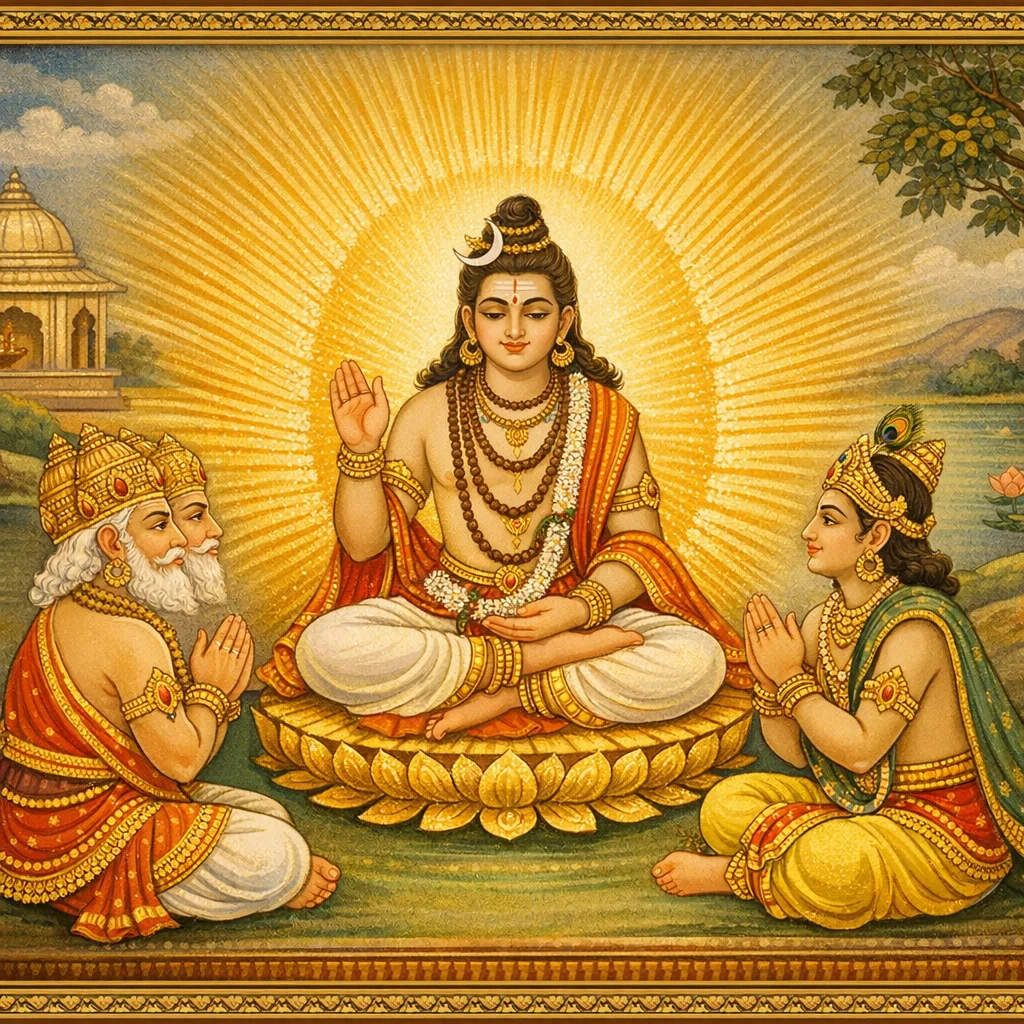
Adhyaya 31
This chapter unfolds as a dialogue: Agastya asks Skanda for a focused theological account of Bhairava in Kāśī—his true identity, form, functions, names, and the conditions under which he grants swift success to practitioners. Skanda promises a full narration and presents it as a purifying teaching that secures the spiritual fruits of dwelling in Kāśī. The discourse then turns to a doctrinal episode on divine māyā and the limits of self-asserted authority. Brahmā and a figure linked with sacrificial agency (Kratu, an aṃśa of Nārāyaṇa) dispute supremacy and appeal to the four Vedas as pramāṇa; the Vedas proclaim Rudra/Śiva as the single supreme principle. Yet the disputants remain deluded, questioning Śiva’s ascetic, cremation-ground iconography, until the personified Pranava (Oṃ) teaches that Śiva’s līlā is inseparable from his inherent Śakti. A great radiance appears; a fierce Śiva-form arises, and from it Kālabhairava is produced and commissioned as Kāśī’s perpetual ruler and moral enforcer. He receives names that mirror his functions—Bhairava in connection with bearing and sustaining (bharaṇa), Kāla- as one who terrifies even Time and punishes wrongdoing; he severs Brahmā’s fifth head and is directed to undertake the Kāpālika vow of carrying the skull as a public model of expiation. Brahmahatyā, personified, follows him until he reaches Vārāṇasī, where her access is curtailed. The chapter also recounts Bhairava’s visit to Viṣṇu’s abode and Viṣṇu’s questioning of Śiva’s conduct, answered by an explanation of the vow’s didactic purpose. It concludes by extolling the power of Śiva’s Name and devotion to dissolve sin, affirming Kāśī’s exceptional purificatory potency, and alluding to rites such as bathing at Kāla-water and offerings that uplift the ancestors.
Shlokas
Verse 1
अगस्त्य उवाच । सर्वज्ञ हृदयानंद स्कंदस्कंदित तारक । न तृप्तिमधिगच्छामि शृण्वन्वाराणसीकथाम्
Agastya said: O all-knowing one, joy of the heart, O Tāraka—praised by Skanda—listening to the sacred account of Vārāṇasī, I do not attain satiety.
Verse 2
अनुग्रहो यदि मयि योग्योस्मि श्रवणे यदि । तदा कथय मे नाथ काश्यां भैरव संकथाम्
If you would show grace to me, if I am fit to listen, then, O Lord, tell me the sacred account of Bhairava in Kāśī.
Verse 3
कोसौ भैरवनामात्र काशिपुर्यां व्यवस्थितः । किं रूपमस्य किं कर्म कानि नामानि चास्य वै
Who is that Bhairava, established in the city of Kāśī? What is his form, what is his function, and what indeed are his names?
Verse 4
कथमाराधितश्चैव सिद्धिदः साधकस्य वै । आराधितः कुत्र काले क्षिप्रं सिद्ध्यति भैरवः
How is He to be propitiated—He who grants siddhis to the practitioner? When worshipped, in what place and at what time does Bhairava swiftly bestow accomplishment?
Verse 5
स्कंद उवाच । वाराणस्यां महाभाग यथा ते प्रेम वर्तते । तथा न कस्यचिन्मन्ये ततो वक्ष्याम्यशेषतः
Skanda said: O greatly fortunate one, I do not think anyone loves Vārāṇasī as you do. Therefore I shall explain it to you in full, omitting nothing.
Verse 6
प्रादुर्भावं भैरवस्य महापातकनाशनम् । यच्छ्रुत्वा काशिवासस्य फलं निर्विघ्रमाप्नुयात्
The manifestation of Bhairava destroys great sins. By hearing of it, one attains the fruit of dwelling in Kāśī, free from obstacles.
Verse 7
पाणिभ्यां परितः प्रपीड्य सुदृढं निश्चोत्य निश्चोत्य च ब्रह्मांडं सकलं पचेलिमरसालोच्चैः फलाभं मुहुः । पायंपायमपायतस्त्रिजगतीमुन्मत्तवत्तै रसैर्नृत्यंस्तांडवडंबरेण विधिनापायान्महाभैरवः
Pressing hard with both hands all around, squeezing again and again, Mahābhairava, as it were, draws out and cooks the entire cosmic egg, repeatedly bringing forth its essence like the rich juice of ripe fruit. Drinking and drinking those intoxicating nectars, he dances—by ordained rite—with the thunderous display of the Tāṇḍava, while the three worlds reel.
Verse 8
कुंभयोने न वेत्त्येव महिमानं महेशितुः । चतुर्भजोपि वैकुंठश्चतुर्वक्त्रोपि विश्वकृत्
Even Kumbhayoni (Agastya) does not truly know the greatness of Maheśvara. Even four-armed Viṣṇu of Vaikuṇṭha, and even four-faced Brahmā, the maker of the world, do not fully grasp it.
Verse 9
न चित्रमत्र भूदेव भवमाया दुरत्यया । तया संमोहिताः सर्वे नावयंत्यपि तं परम्
This is no wonder, O divine sage: Bhava’s māyā is hard to cross. Bewildered by it, all beings fail to comprehend that Supreme Reality.
Verse 10
वेदयेद्यदिचात्मानं स एव परमेश्वरः । तदा विंदंति ब्रह्माद्याः स्वेच्छयैव न तं विदुः
If one truly knows the Self, that very one is Parameśvara. Only then do Brahmā and the other gods ‘find’ that truth; by their own will alone, they do not know Him.
Verse 11
स सर्वगोपि नेक्ष्येत स्वात्मारामो महेश्वरः । देववद्बुध्यते मूढैरतीतो यो मनोगिराम्
That Maheśvara, hidden by all veils, is not seen; he delights in his own Self. Yet fools conceive of him merely as a ‘god’, though he transcends mind and speech.
Verse 12
पुरा पितामहं विप्र मेरुशृंगे महर्षयः । प्रोचुः प्रणम्य लोकेशं किमेकं तत्त्वमव्ययम्
Long ago, O brāhmaṇa, on the peak of Mount Meru, the great sages—having bowed to the Lord of the worlds—asked: ‘What is the one imperishable Reality?’
Verse 13
समा यया महेशस्य मोहितो लोकसंभवः । अविज्ञाय परं भावमात्मानं प्राह वर्पिणम्
By that very māyā, equal in its power to delude, the progenitor of the worlds (Brahmā) was bewildered regarding Maheśvara. Not knowing the Supreme state, he spoke of himself as the embodied (supreme) one.
Verse 14
जगद्योनिरहं धाता स्वयंभूरेक ईश्वरः । अनादिमदहं ब्रह्म मामनर्च्य न मु च्यते
“I am the womb of the world; I am the Sustainer, self-born, the one Lord. I am beginningless Brahman—without worshipping me, one is not liberated.”
Verse 15
प्रवर्तको हि जगतामहमेको निवर्तकः । नान्यो मदधिकः सत्यं कश्चित्कोपि सुरोत्तमाः
“I alone am the impeller of the worlds, and I alone am their withdrawer. Truly, O best of the gods, there is no one at all superior to me.”
Verse 16
तस्यैवं ब्रुवतो धातुः क्रतुर्नारायणांशजः । प्रोवाच प्रहसन्वाक्यं रोषताम्रविलोचनः
As Dhātṛ spoke thus, Kratu—the creator, born of a portion of Nārāyaṇa—laughed and replied in words, his eyes copper-red with anger.
Verse 17
अविज्ञाय परं तत्त्वं किमेतत्प्रतिपाद्यते । अज्ञानं योगयुक्तस्य न चैतदुचितं तव
“Without realizing the supreme Reality, what is this you are trying to establish? Ignorance does not befit one who is joined to yoga—nor is this fitting for you.”
Verse 18
अहं कर्ता हि लोकानां यज्ञो नारायणः परः । न मामनादृत्य विधे जीवनं जगतामज
“I am indeed the maker of the worlds; the sacrifice (yajña) is the supreme Nārāyaṇa. O Ordainer, O Unborn—without honoring me, the worlds cannot even live.”
Verse 19
अहमेव परं ज्योतिरहमेव परा गतिः । मत्प्रेरितेन भवता सृष्टिरेषा विधीयते
I alone am the supreme Light; I alone am the highest Goal. It is by you—impelled by me—that this creation is brought about.
Verse 20
एवं विप्र कृतौ मोहात्परस्परजयैषिणौ । पप्रच्छतुः प्रमाणज्ञानागमांश्चतुरोपि तौ
Thus, O brāhmaṇa, those two—deluded and seeking victory over each other—questioned the fourfold authorities: means of valid knowledge, true knowing, and the received sacred traditions.
Verse 21
विधिक्रतू ऊचतुः । वेदाः प्रमाणं सर्वत्र प्रतिष्ठां परमामिताः । यूयमेव न संदेहः किं तत्त्वं प्रतितिष्ठत
Vidhi and Kratu said: “The Vedas are the authority everywhere, the supreme and immeasurable foundation. You indeed, O Śrutis, are that—no doubt. In which Reality do you ultimately stand established?”
Verse 22
श्रुतय ऊचुः । यदि मान्या वयं देवौ सृष्टिस्थितिकरौ विभू । तदा प्रमाणं वक्ष्यामो भवत्संदेहभेदकम्
The Śrutis said: “If we are honored by you two—O mighty ones, agents of creation and preservation—then we shall declare the true authority that will cut through your doubt.”
Verse 23
श्रुत्युक्तमिदमाकर्ण्य प्रोचतुस्तौ श्रुतीः प्रति । युष्मदुक्तं प्रमाणं नौ किं तत्त्वं सम्यगुच्यताम्
Hearing these words of the Śruti, the two replied to the Śrutis: “Let the authority spoken by you be stated for us—what is the Reality? Declare it correctly.”
Verse 24
ऋगुवाच । यदंतःस्थानि भूतानि यतः सर्वं प्रवर्तते । यदाहुस्तत्परं तत्त्वं स रुद्रस्त्वेक एव हि
Ṛg said: “That within which beings abide, and from which everything proceeds—what they call that supreme Reality is Rudra; indeed, He alone is the One.”
Verse 25
यजुरुवाच । यो यज्ञैरखिलैरीशो योगेन च समिज्यते । येन प्रमाणं हि वयं स एकः सर्वदृक्छिवः
Yajur said: “He alone is the Lord who is worshipped by all sacrifices and also by yoga. He is the very standard of true knowledge for us; that one Śiva is the all-seeing.”
Verse 26
सामोवाच । येनेदं भ्रश्यते विश्वं योगिभिर्यो विचिंत्यते । यद्भासा भासते विश्वं स एकस्त्र्यंबकः परः
Sāma said: “By whom this universe is dissolved, whom the yogins contemplate—by whose radiance the whole world shines—He alone is the supreme Tryambaka.”
Verse 27
अथर्वोवाच । यं प्रपश्यंति देवेशं भक्त्यानुग्रहिणो जनाः । तमाहुरेकं कैवल्यं शंकरं दुःखतस्करम्
Atharva said: “Those people who are graced through devotion behold Him—the Lord of the gods. They declare that Śaṅkara alone to be Kaivalya itself, the thief who steals away sorrow.”
Verse 28
श्रुतीरितं निशम्येत्थं तावतीव विमोहितौ । स्मित्वाहतुः क्रतु विधीमोहाध्येनांकितौ मुने
Hearing the words thus spoken by the Śrutis, the two became all the more bewildered. Smiling, they spoke—O sage—still marked by delusion regarding the ritual order of sacrifice.
Verse 29
कथं प्रमथनाथोसौ रममाणो निरंतरम् । दिगंबरः पितृवने शिवया धूलिधूसरः
“How can that Lord of the Pramathas sport without cease—clad in the directions, in the cremation-ground, dust-grey, together with Śivā?”
Verse 30
विटंकवेशो जटिलो वृषगोव्यालभूषणः । परं ब्रह्मत्वमापन्नः क्व च तत्संगवर्जितम्
“Wearing strange ornaments, matted-haired, adorned with a bull, a cow, and serpents—how has he attained the state of the Supreme Brahman, and yet remained utterly free from attachment?”
Verse 31
तदुदीरितमाकर्ण्य प्रणवात्मा सनातनः । अमूर्तो मूर्तिमान्भूत्वा हसमान उवाच तौ
Hearing what they had spoken, the eternal One whose very essence is Praṇava—though formless—assumed a form, and smiling, addressed the two.
Verse 32
प्रणव उवाच । न ह्येष भगवाञ्छक्त्या स्वात्मनो व्यतिरिक्तया । कदाचिद्रमते रुद्रो लीलारूपधरो हरः
Praṇava said: “This Blessed Lord does not at any time delight through a power separate from His own Self. Rudra—Hara—assumes forms only as divine play (līlā).”
Verse 33
असौ हि भगवानीशः स्वयंज्योतिः सनातनः । आनंदरूपा तस्यैषा शक्तिर्नागंतुकी शिवा
“For that Blessed Lord is the eternal Īśa, self-luminous. His Śivā—His power—is of the nature of bliss and is not something adventitious or newly acquired.”
Verse 34
इत्येवमुक्तेपि तदा मखमूर्तेरजस्य हि । नाज्ञानमगमन्नाशं श्रीकंठस्यैव मायया
Though it was spoken thus, at that time the ignorance of the Unborn—whose very form was sacrifice—did not come to an end, solely because of the māyā of Śrīkaṇṭha.
Verse 35
प्रादुरासीत्ततो ज्योतिरुभयोरंतरे महत् । पूरयन्निजया भासा द्यावाभूम्योर्यदंतरम्
Then a vast Light manifested between them, filling with its own radiance the entire space that lay between heaven and earth.
Verse 36
ज्योतिर्मंडलमध्यस्थो ददृशे पुरुषाकृतिः । प्रजज्वालाथ कोपेन ब्रह्मणः पंचमं शिरः
Within the circle of that Light, a person-like form was seen; and then, in wrath, Brahmā’s fifth head blazed forth in fiery fury.
Verse 37
आवयोरंतरं कोसौ बिभृयात्पुरुषाकृतिम् । विधिः संभावयेद्यावत्तावत्स हि विलोकितः
“Who could assume a human-like form in the space between us?”—as long as Brahmā (Vidhī) pondered thus, so long he kept gazing at that marvel.
Verse 38
स्रष्टा क्षणेन च महान्पुरुषो नीललोहितः । त्रिशूलपाणिर्भालाक्षो नागोडुपविभूषणः
And in an instant there appeared a great Being—Nīlalohita—bearing a trident in his hand, with an eye upon his forehead, adorned with serpent and moon.
Verse 39
हिरण्यगर्भस्तं प्राह जाने त्वां चंद्रशेखरम् । भालस्थलान्ममपुरा रुद्रः प्रादुरभूद्भवान्
Hiraṇyagarbha (Brahmā) said to him: “I know you as Candraśekhara; long ago you manifested as Rudra from the region of my forehead.”
Verse 40
रोदनाद्रुद्रनामापि योजितोसि मया पुरा । मामेव शरणं याहि पुत्र रक्षां करोमि ते
“Because of your crying (rodana), I formerly bestowed on you the name ‘Rudra’ as well. Come to me alone for refuge, my son; I shall grant you protection.”
Verse 41
अथेश्वरः पद्मयोनेः श्रुत्वा गर्ववतीं गिरम् । सकोपतः समुत्पाद्य पुरुषं भैरवाकृतिम्
Then the Lord, hearing the proud speech of the Lotus-born (Brahmā), in anger brought forth a Being in the form of Bhairava.
Verse 42
प्राह पंकजजन्मासौ शास्यस्ते कालभैरव । कालवद्राजसे साक्षात्कालराजस्ततो भवान्
The Lotus-born (Brahmā) said: “You are to be the chastiser, O Kālabhairava. You rule like Time itself; therefore you are truly the King of Time.”
Verse 43
विश्वं भर्तुं समर्थोऽसि भरणाद्भैरवः स्मृतः । त्वत्तो भेष्यति कालोपि ततस्त्वं कालभैरवः
“You are able to sustain the universe; because of sustaining (bharaṇa) you are remembered as ‘Bhairava’. Even Time itself fears you; therefore you are ‘Kālabhairava’.”
Verse 44
आमर्दयिष्यति भवांस्तुष्टो दुष्टात्मनो यतः । आमर्दक इति ख्याति ततः सर्वत्र यास्यति
For when you are pleased, you will crush the wicked-minded; therefore your fame shall spread everywhere as “Āmardaka” (the Crusher).
Verse 45
यतः पापानि भक्तानां भक्षयिष्यति तत्क्षणात् । पापभक्षण इत्येव तव नाम भविष्यति
Because you will, that very instant, devour the sins of devotees, therefore your name shall indeed be “Pāpabhakṣaṇa”—the Devourer of Sin.
Verse 46
या मे मुक्तिपुरी काशी सर्वाभ्योपि गरीयसी । आधिपत्यं च तस्यास्ते कालराज सदैव हि
That Kāśī—My city of liberation, greater than all others—over it, O King of Time, your lordship shall indeed stand forever.
Verse 47
तत्र ये पापकर्तारस्तेषां शास्ता त्वमेव हि । शुभाशुभं न तत्कर्म चित्रगुप्तो लिखिष्यति
There, whoever are doers of sin—of them you alone shall be the chastiser; and for that place, Citragupta shall not record those deeds as auspicious or inauspicious.
Verse 48
एतान्वरान्प्रगृह्याऽथ तत्क्षणात्कालभैरवः । वामांगुलिनखाग्रेण चकर्त च शिरो विधेः
Having accepted these boons, Kālabhairava at that very moment, with the tip of the nail of his left finger, severed the head of Vidhātṛ (Brahmā).
Verse 49
यदंगमपराध्नोति कार्यं तस्यैव शासनम् । अतो येन कृता निंदा तच्छिन्नं पचमं शिरः
Whichever limb commits an offense, the punishment is to be applied to that very part. Therefore, since the slander was committed by that head, the fifth head was cut off.
Verse 50
यज्ञमूर्तिधरो विष्णुस्ततस्तुष्टाव शंकरम् । भीतो हिरण्यगर्भोपि जजाप शतरुद्रियम्
Then Vishnu, bearing the form of the sacrifice, praised Shankara; and Hiranyagarbha too, in fear, recited the Satarudriya hymn.
Verse 51
आश्वास्य तौ महादेवः प्रीतः प्रणतवत्सलः । प्राह स्वां मूर्तिमपरां भैरवं तं कपर्दिनम्
Having reassured those two, Mahadeva—pleased, and affectionate to those who bow—addressed that Bhairava, his other manifested form, the Kapardin.
Verse 52
मान्योऽध्वरोसौ भवता तथा शतधृतिस्त्वयम् । कपालं वैधसं चापि नीललोहित धारय
Let that sacrifice be honored by you, and likewise Satadhrti (Brahma) by you. And, O Nilalohita, bear also the skull of Vaidhasa.
Verse 53
ब्रह्महत्यापनोदाय व्रतं लोकाय दर्शयन् । चर त्वं सततं भिक्षां कापालव्रतमास्थितः । इत्युक्त्वांऽतर्हितो देवस्तेजोरूपस्तदा शिवः
To remove the sin of brahmin-slaying, and to display the observance to the world, you shall continually wander seeking alms, established in the Kapala-vrata. Having spoken thus, Shiva disappeared.
Verse 54
उत्पाद्य कन्यामेकां तु ब्रह्महत्येति विश्रुताम् । रक्तांबरधरां रक्तां रक्तस्रग्गंधलेपनाम्
He brought forth a single maiden, renowned by the name “Brahmahatyā”; clad in red garments, herself red-hued, adorned with red garlands, perfumes, and unguents.
Verse 55
दंष्टाकरालवदनां ललज्जिह्वातिभीषणाम् । अंतरिक्षैकपादाग्रां पिबंतीं रुधिरं बहु
He beheld her with a face made terrifying by protruding fangs, dreadful with a restless lolling tongue—poised upon the tip of a single foot in mid-air—drinking copious blood.
Verse 56
कर्त्रीं कर्परहस्ताग्रां स्फुरत्पिंगोग्रतारकाम् । गर्जयंतीं महावेगां भैरवस्यापिभीषणाम्
She bore a cleaver, and at the very forepart of her hand was a skull; her tawny, blazing eyes were fierce. Roaring with tremendous force, she was terrifying—even to Bhairava.
Verse 57
यावद्वाराणसीं दिव्यां पुरीमेष गमिष्यति । तावत्त्वं भीषणे कालमनुगच्छोग्ररूपिणि
“So long as he is on his way to the divine city of Vārāṇasī, for that duration you—O fearsome one of dreadful form—follow him, keeping time with him.”
Verse 58
सर्वत्र ते प्रवेशोस्ति त्यक्त्वा वाराणसीं पुरीम् । नियोज्यतामिति शिवोप्यंतर्धानं गतस्ततः
“Everywhere else you may enter—except the city of Vārāṇasī. Be directed accordingly.” Having spoken thus, Śiva then vanished from sight.
Verse 59
तत्सान्निध्याद्भैरवोपि कालोभूत्कालकालतः । स देवदेववाक्येन बिभ्रत्कापालिकं व्रतम्
By that very proximity, even Bhairava became Kāla—Death of Death itself. Obedient to the word of the God of gods, he bore the Kāpālika vow.
Verse 60
कपालपाणिर्विश्वात्मा चचार भुवनत्रयम् । नात्याक्षीच्चापि तं देवं ब्रह्महत्या सुदारुणा
With skull in hand, the Universal Self wandered through the three worlds; yet that exceedingly dreadful Brahmahatyā did not abandon that god.
Verse 61
सत्यलोकेपि वैकुंठे महेंद्रादि पुरीष्वपि । त्रिजगत्पतिरुग्रोपि व्रती त्रिजगतीश्वरः
Even in Satyaloka, even in Vaikuṇṭha, and even in the cities of Mahendra and others, that fierce Lord—ruler of the three worlds—remained a vow-observer, the sovereign of the three realms.
Verse 62
प्रतितीर्थं भ्रमन्नापि विमुक्तो ब्रह्महत्यया
Even while wandering from one sacred ford (tīrtha) to another, he was not released from Brahmahatyā.
Verse 63
अनेनैवानुमानेन महिमा त्ववगम्यताम् । ब्रह्महत्यापनोदिन्याः काश्याः कलशसंभव
By this very inference, understand the greatness of Kāśī, O Pot-born one; for she is the remover of Brahmahatyā.
Verse 64
संति तीर्थान्यनेकानि बहून्यायतनानि च । अधि त्रिलोकिनो काश्याः कलामर्हंति षोडशीम्
Many are the sacred tīrthas and many the holy shrines; yet, in comparison, they attain only a sixteenth part of the measure of Kāśī, revered throughout the three worlds.
Verse 65
तावद्गर्जंति पापानि ब्रहत्यादिकान्यलम् । यावन्नाम न शृण्वंति काश्याः पापाचलाशनेः
Sins—great and grievous, beginning with brahma-hatyā—roar only so long as they do not hear the Name of Kāśī, the thunderbolt that shatters the mountain of sin.
Verse 66
प्रमथैः सेव्यमानोऽयं त्रिलोकीं विचरन्हरः । कापालिको ययौ देवो नारायणनिकेतनम्
Attended and honored by the Pramathas, Hara—roaming through the three worlds in the guise of a Kāpālika—went to the divine abode of Nārāyaṇa.
Verse 67
अथायांतं महाकालं त्रिनेत्रं सर्पकुंडलम् । महादेवांशसंभूतं भैरवं भीषणाकृतिम्
Then there arrived Mahākāla—three-eyed, adorned with serpent-earrings—Bhairava of dreadful form, born from a portion of Mahādeva.
Verse 68
पपात दंडवद्भूमौ दृष्ट्वा तं गरुडध्वजः । देवाश्च मुनयश्चैव देवनार्यः समंततः
Seeing him, the Garuḍa-bannered Lord fell to the earth like a staff; and all around, the gods, sages, and the celestial ladies did the same.
Verse 69
निपेतुः प्रणिपत्यैनं प्रणतः कमलापतिः । शिरस्यंजलिमारोप्य स्तुत्वा बहुविधैः स्तवैः
They fell down, bowing before Him; and Kamalāpati (Viṣṇu), humbled, placed his folded hands upon his head and praised Him with many kinds of hymns.
Verse 70
क्षीरोदमथनो तां प्राह पद्मालयां हरिः । प्रिये पश्याऽब्जनयने धन्याऽसि सुभगेनघे
Hari, the Churner of the Ocean of Milk, said to Padmālayā (Lakṣmī): “Beloved, lotus-eyed one—behold! Fortunate and sinless lady, you are truly blessed.”
Verse 71
धन्योऽहं देवि सुश्रोणि यत्पश्यावो जगत्पतिम् । अयं धाता विधाता च लोकानां प्रभुरीश्वरः
“I too am blessed, O Goddess, fair-hipped one, since we have beheld the Lord of the world. He is the Sustainer and the Ordainer—the sovereign Lord and master of the worlds.”
Verse 72
अनादिः शरणः शांतः परः षड्विंशसंमितः । सर्वज्ञः सर्वयोगीशः सर्वभूतैकनायकः
He is beginningless, the Refuge, the Peaceful One, the Supreme—reckoned beyond the twenty-six principles; all-knowing, the Lord of all yogins, the single ruler of all beings.
Verse 73
सर्वभूतांतरात्माऽयं सर्वेषां सर्वदः सदा । यं विनिद्रा विनिःश्वासाः शांता ध्यानपरायणाः
He is the inner Self of all beings, ever the giver of all to everyone. Him the serene ones—free from sloth and restless breathing—seek, devoted wholly to meditation.
Verse 74
धिया पश्यंति हृदये सोयमद्य समीक्ष्यताम् । यं विदुर्वेदतत्त्वज्ञा योगिनो यतमानसाः
He whom they behold in the heart by purified insight—let that very One be seen today with open eyes: the One known to the knowers of Vedic truth, to yogins of disciplined mind.
Verse 76
यस्याख्यां ब्रुवतां नित्यं न देहः सोपि देहधृक् । यं दृष्ट्वा न पुनर्जन्म लभ्यते मानवैर्भुवि
Even for one who bears a body, the body is as though not binding when His very Name is uttered daily. Having beheld Him, human beings on earth do not obtain rebirth again.
Verse 77
सोयमायाति भगवांस्त्र्यंबकः शशिभूषणः । पुंडरीकदलायामे धन्येमेऽद्य विलोचने
Behold—He comes: the Blessed Lord, Tryambaka, adorned with the moon. Fortunate indeed are these eyes today, wide as lotus petals.
Verse 78
धिग्धिक्पदं तु देवानां परं दृष्ट्वाऽत्र शंकरम् । लभ्यते यन्न निर्वाणं सर्वदुःखांतकृत्तु यत्
Shame, shame upon even the highest station of the gods—if, even after beholding Śaṅkara here, that Nirvāṇa is not attained which ends all sorrow.
Verse 79
देवत्वादशुभं किंचिद्देवलोके न विद्यते । दृष्ट्वापि सर्वदेवेशं यन्मुक्तिं न लभामहे
In the world of the gods, nothing inauspicious exists because of their divinity. Yet even after seeing the Lord of all the gods, we do not attain liberation—this is our grief.
Verse 80
एवमुक्त्वा हृषीकेशः संप्रहृष्टतनूरुहः । प्रणिपत्य महादेवमिदमाह वृषध्वजम्
Having spoken thus, Hṛṣīkeśa—his body hair standing on end in joy—bowed down to Mahādeva and said this to the Bull-bannered Lord.
Verse 81
किमिदं देवदेवेन सर्वज्ञेन त्वया विभो । क्रियते जगतां धात्रा सर्वपापहराऽव्यय
What is this that is being done by you, O Lord—God of gods, all-knowing, sustainer of the worlds, remover of all sins, imperishable one?
Verse 82
क्रीडेयं तव देवेश त्रिलोचन महामते । किं कारणं विरूपाक्ष चेष्टितं ते स्मरार्दन
Is this a sport of yours, O Lord of gods—Three-eyed one, great-minded? What is the reason for your conduct, O Virūpākṣa, destroyer of Kāma?
Verse 83
किमर्थं भगवत्र्छंभो भिक्षां चरसि शक्तिप । संशयो मे जगन्नाथ नतत्रैलोक्यराज्यद
For what purpose, O Blessed Śambhu, do you wander seeking alms, O Lord of Power? Doubt has arisen in me, O Jagannātha—the giver of sovereignty over the three worlds.
Verse 84
एवमुक्तस्ततः शंभुर्विष्णुमेतदुदाहरत् । ब्रह्मणस्तु शिरश्छिन्नमंगु्ल्यग्रनखेन ह
Thus addressed, Śambhu then explained this to Viṣṇu: “Indeed, Brahmā’s head was severed by the nail at the tip of my finger.”
Verse 85
तदघप्रतिघं विष्णो चराम्येतद्व्रतं शुभम् । एवमुक्तो महेशेन पुंडरीकविलोचनः
“Therefore, O Viṣṇu, to counteract that sin I undertake this auspicious vow.” Thus addressed by Maheśa, the lotus-eyed One (Viṣṇu) listened.
Verse 86
स्मित्वा किंचिन्नतशिराः पुनरेवं व्यजिज्ञपत् । यथेच्छसि तथा क्रीड सर्वविष्टपनायक
Smiling, and bowing his head a little, he spoke again: “Play as you wish, O Lord who leads and governs all beings.”
Verse 87
मायया मां महादेव नच्छादयितुमर्हसि । नाभीकमलकोशात्तु कोटिशः कमलासनान्
“O Mahādeva, you should not veil me with māyā. From the sheath of the lotus at my navel arise, in every age, countless Brahmās seated on lotuses.”
Verse 88
कल्पे कल्पे सृजामीश त्वन्नियोगबलाद्विभो । त्यज मायामिमां देव दुस्तरामकृतात्मभिः
“In every aeon I create, O Lord, by the force of your command, O All-pervading One. Abandon this māyā, O God—hard to cross for those who have not mastered themselves.”
Verse 89
मदाद्यो महादेव मायया तव मोहिताः । यथावदवगच्छामि चेष्टितं ते शिवापते
“Beginning with me, O Mahādeva, we are deluded by your māyā. Yet I understand, as it truly is, your intent and working, O Lord of Śivā.”
Verse 90
संहारकाले संप्राप्ते सदेवानखिलान्मुनीन् । लोकान्वर्णाश्रमवतो हरिष्यसि यदा हर
When the time of dissolution arrives, O Hara, you withdraw all: the gods together with the sages, and the worlds ordered by varṇa and āśrama.
Verse 91
तदा क्व ते महादेव पाप ब्रह्मवधादिकम् । पारतंत्र्यं न ते शंभो स्वैरं क्रीडेत्ततो भवान्
Then where, O Mahādeva, is ‘sin’ for you—such as the slaying of Brahmā and the like? You are not bound by dependence, O Śambhu; therefore you sport in complete freedom.
Verse 92
अतीतब्रह्मणामस्थ्नां स्रक्कंठे तव भासते । तदातदा क्वानुगता ब्रह्महत्या तवानघ
A garland of the bones of past Brahmās shines upon your neck. At those times, O sinless One, where has the ‘sin of Brahmā-slaying’ gone—what could it possibly cling to in you?
Verse 93
कृत्वापि सुमहत्पापं त्वां यः स्मरति भावतः । आधारं जगतामीशं तस्य पापं विलीयते
Even if one has committed a very great sin, whoever remembers you with heartfelt devotion—O Lord, the support of the worlds—his sin dissolves away.
Verse 94
यथा तमो न तिष्ठेत संनिधावंशुमालिनः । तथा न भवभक्तस्य पापं तस्य व्रजेत्क्षयम्
As darkness cannot remain in the presence of the sun, so sin cannot endure for a devotee of Bhava; it hastens to its destruction.
Verse 95
यश्चिंतयति पुण्यात्मा तव पादांबुजद्वयम् । ब्रह्महत्यादिकमपि पापं तस्य व्रजेत्क्षयम्
The pure-souled one who meditates upon Your two lotus-feet—even the sin of Brahmā-slaying and the like, for him, goes to destruction.
Verse 96
तव नामानुरक्ता वाग्यस्य पुंसो जगत्पते । अप्यद्रिकूटतुलितं नैनस्तमनुबाधते
O Lord of the world, for the person whose speech is devoted to Your Name, even sin heaped up like a mountain-peak does not afflict him.
Verse 97
रजसा तमसा विवर्धितं क्व नु पापं परितापदायकम् । क्व च ते शिव नाम मंगलं जनजीवातु जगद्रुजापहम्
Where is sin—grown by passion and darkness, bringing only torment—and where is Your auspicious Name, O Śiva, the very life of people and the remover of the world’s afflictions?
Verse 98
यदि जातुचिदंधकद्विषस्तवनामौष्ठपुटाद्विनिःसृतम् । शिवशंकर चंद्रशेखरेत्यसकृत्तस्य न संसृतिः पुनः
If even once Your Name—the foe of Andhaka—slips forth from a person’s lips, and if he repeatedly utters ‘Śiva, Śaṅkara, Candraśekhara,’ then for him there is no return to transmigration.
Verse 99
परमात्मन्परंधाम स्वेच्छा विधृत विग्रह । कुतूहलं तवेशेदं क्व पराधीनतेश्वरे
O Supreme Self, O highest abode, You who assume a form by Your own free will—what is this ‘curiosity’ of Yours, O Lord? Where could dependence on another exist for the Sovereign?
Verse 100
अद्य धन्योस्मि देवेश यं न पश्यति योगिनः । पश्यामि तं जगन्मूलं परमेश्वरमक्षयम्
Today I am blessed, O Lord of gods: Him whom even yogins do not behold, I behold—the imperishable Supreme Lord, the very root of the universe.
Verse 110
अवियोगोऽस्तु मे देव त्वदंघ्रियुगलेन वै । एष एव वरः शंभो नान्यं कंचिद्वरं वृणे
O God, may there be no separation for me from Your pair of feet. This alone is my boon, O Śambhu; I choose no other gift at all.
Verse 120
ब्रह्महत्यादि पापानि यस्या नाम्नोपि कीर्तनात् । त्यजंति पापिनं काशी सा केनेहोपमीयते
Even grave sins such as brahma-slaughter abandon the sinner merely by the chanting of her Name—such is Kāśī. With what, in this world, can she be compared?
Verse 130
महाश्मशानमासाद्य यदि देवाद्विपद्यते । पुनः श्मशानशयनं न क्वापि लभते पुमान्
Having reached the Great Cremation-ground, if a man departs (dies) by the will of God, he does not again obtain ‘lying in a cremation-ground’ anywhere—i.e., he does not return to such death again.
Verse 150
तीर्थे कालोदके स्नात्वा कृत्वा तर्पणमत्वरः । विलोक्य कालराजं च निरयादुद्धरेत्पितॄन्
Bathing at the Kālodaka tīrtha and promptly offering tarpaṇa, and then beholding Kālarāja (Yama), one can lift one’s ancestors up from hell.