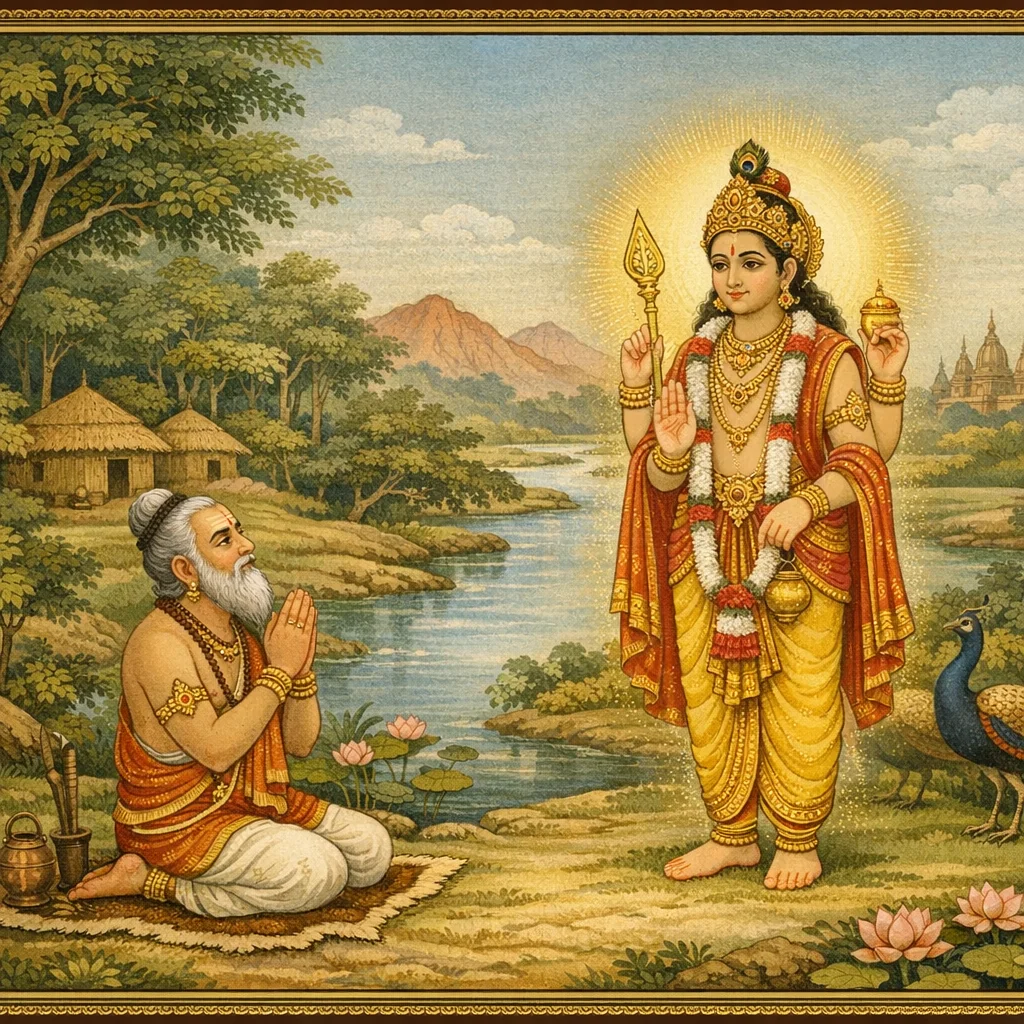
Adhyaya 25
Chapter 25 begins with Vyāsa’s pledge to Sūta to relate a purifying account of the pot-born sage Agastya. Agastya, accompanied by his wife, arrives after circumambulating a mountain and beholds the luxuriant Skanda-forest—rivers, lakes, hermitages of ascetics—and the wondrous Lohita-giri, likened to a Kailāsa-like fragment fit for tapas. He then meets Skanda (Ṣaḍānana/Kārttikeya), prostrates, and offers a Veda-toned hymn praising Skanda’s cosmic majesty and victories, including the Tāraka episode. Skanda replies by extolling Avimukta within the great kṣetra, guarded by Śiva (Triyambaka/Virūpākṣa), declaring it unequalled in all worlds and attainable chiefly through divine grace rather than mere ritual accumulation. The chapter sets forth ethical counsel: remember mortality, relinquish excessive anxiety over artha, and place dharma first, with Kāśī as the supreme support. Though many sādhanas are surveyed—yoga, tīrthas, vows, ascetic disciplines, and modes of worship—Avimukta is elevated as an effortless locus of liberation. Skanda describes graded fruits of dwelling in Avimukta, from momentary devotion to lifelong residence, affirming the cleansing of grave sins and the end of rebirth. A central doctrine states that at death in Kāśī, Śiva himself imparts the tāraka-brahma, granting liberation when ordinary memory fails. The chapter closes by reaffirming Avimukta’s ineffable greatness and the blessed desirability of even a touch of Kāśī’s sanctity.
Shlokas
Verse 1
व्यास उवाच । शृणु सूत प्रवक्ष्यामि कथां कलशजन्मनः । यामाकर्ण्य नरो भूयाद्विरजा ज्ञानभाजनम्
Vyāsa said: Listen, O Sūta. I shall relate the story of the one born from the water-pot (Agastya). Hearing it, a person becomes stainless and fit to receive true knowledge.
Verse 2
गिरिं प्रदक्षिणीकृत्य श्रीसंज्ञं कलशोद्भवः । सपत्नीको ददर्शाथ रम्यं स्कंदवनं महत्
Having circumambulated the mountain known as Śrī, the pot-born sage (Agastya), together with his wife, then beheld the vast and delightful Skandavana.
Verse 3
सर्वर्तं कुसुमाढ्यं च रसवत्फलपादपम् । सुसेव्य कंदमूलाढ्यं सुवल्कलमहीरुहम्
It bloomed in every season, rich with flowers and trees bearing luscious fruits—easy to visit, abundant in roots and tubers, and filled with great trees clad in fine bark-garments.
Verse 4
निवीतश्वापदगणं ससरित्पल्वलावृतम् । स्वच्छ गंभीरकासारं सारं सर्वभुवः परम्
It was free from packs of wild beasts, encircled by rivers and lotus-ponds, with clear and deep lakes—an excellent and supreme haven among all regions of the earth.
Verse 5
नानापतत्रिसंघुष्टं नानामुनिजनोषितम् । तपःसंकेतनिलयमिवैकं संपदां पदम्
Resounding with flocks of many kinds of birds, inhabited by hosts of diverse sages, it seemed like a single dwelling-place appointed for austerity—indeed, one seat of every prosperity.
Verse 6
लोहितो नाम तत्रास्ति गिरिः स्वर्णगिरिप्रभः । सुकंदरप्रस्रवणः स्वसानु शिखरप्रभः
There stood a mountain named Lohita, radiant like a golden peak, with fine caves and flowing springs, shining with the splendor of its own ridges and summits.
Verse 7
कैलासस्यैकशकलं कर्मभूमाविहागतम् । तपस्तप्तुमिव प्रोच्चैर्नानाश्चर्यसमन्वितम्
It was as though a single fragment of Kailāsa had come down here into the human realm of action—rising high, adorned with many marvels, as if meant for the practice of austerity.
Verse 8
तत्राद्राक्षीन्मुनिश्रेष्ठोऽगस्त्यः साक्षात्षडाननम् । प्रणम्य दंडवद्भूमौ सपत्नीको महातपाः
There the foremost sage Agastya beheld the six-faced Lord (Skanda) in person; that great ascetic, together with his wife, bowed down upon the ground like a staff in full prostration.
Verse 9
तुष्टाव गिरिजासूनुं सूक्तैः श्रुतिसमुद्भवैः । तथा स्वकृतया स्तुत्या प्रबद्ध करसंपुटः
With hands joined in reverence, he praised the Son of Girijā (Skanda) with hymns born of the Vedas, and also with a eulogy composed by himself.
Verse 10
अगस्तिरुवाच । नमोस्तु वृंदारकवृंदवंद्य पादारविंदाय सुधाकराय । षडाननायामितविक्रमाय गौरीहृदानंदसमुद्भवाय
Agastya said: Salutations to Him whose lotus-feet are adored by hosts of gods; to the moon-like Lord who cools and blesses; to the six-faced One of immeasurable prowess; to Him who is born as the very joy that arises in Gaurī’s heart.
Verse 11
नमोस्तु तुभ्यं प्रणतार्तिहंत्रे कर्त्रे समस्तस्य मनोरथानाम् । दात्रे रथानां परतारकस्य हंत्रे प्रचंडासुर तारकस्य
Salutations to You, remover of the distress of those who bow to You; fulfiller of all rightful desires; giver of the celestial chariot of the supreme Deliverer; slayer of the fierce demon Tāraka.
Verse 12
अमूर्तमूर्ताय सहस्रमूर्तये गुणाय गुण्याय परात्पराय । अपारपाराय परापराय नमोस्तु तुभ्यं शिखिवाहनाय
Salutations to You who are both formless and embodied; of a thousand manifestations; who are the very principle of excellence and the goal of excellence; beyond the beyond; whose farther shore is unfathomable; who transcend both higher and lower—salutations to You, O Rider of the Peacock.
Verse 13
नमोस्तु ते ब्रह्मविदांवराय दिगंबरायांबर संस्थिताय । हिरण्यवर्णाय हिरण्यबाहवे नमो हिरण्याय हिरण्यरेतसे
Salutations to You, foremost among the knowers of Brahman; to the sky-clad ascetic, established in the heavens; golden-hued, golden-armed—salutations to the Golden One, of golden vigor and creative potency.
Verse 14
तपःस्वरूपाय तपोधनाय तपःफलानां प्रतिपादकाय । सदा कुमाराय हिमारमारिणे तणीकृतैश्वर्य विरागिणे नमः
Salutations to Him whose very nature is tapas; whose wealth is austerity; who bestows the fruits of spiritual discipline; ever the Divine Youth; the foe of Himāra; the dispassionate One to whom worldly lordship is but a trifle.
Verse 15
नमोस्तु तुभ्यं शरजन्मने विभो प्रभातसूर्यारुणदंतपंक्तये । बालाय चाबालपराक्रमाय षाण्मातुरायालमनातुराय
Salutations to You, O Lord, born in the reeds; whose rows of teeth glow like the crimson sun at dawn; to the Child who yet possesses a valor beyond childhood; to the Son of the Six Mothers, ever sufficient and never distressed.
Verse 16
मीढुष्टमायोत्तरमीढुषे नमो नमो गणानां पतये गणाय । नमोस्तु ते जन्मजरातिगाय नमो विशाखाय सुशक्तिपाणये
Homage to the most bountiful One, to the supremely bountiful; homage, homage to the Lord of the hosts, Himself the very embodiment of the divine host. Salutations to You who transcend birth and old age; salutations to Viśākha, whose hand bears the mighty spear.
Verse 17
सर्वस्य नाथस्य कुमारकाय क्रौंचारये तारकमारकाय । स्वाहेय गांगेय च कार्तिकेय शैवेय तुभ्यं सततं नमोऽस्तु
May constant salutations be to You—Kumāra, Lord of all; the enemy of Kraunca; the slayer of Tāraka; the son of Svāhā; the son of Gaṅgā; Kārtikeya; and the divine scion of Śiva.
Verse 18
इत्थं परिष्टुत्य स कार्तिकेयं नमो नमस्त्वित्यभिभाषमाणः । द्विस्त्रिःपरिक्रम्य पुरो विवेश स्थितो मुनीशोपविशेति चोक्तः
Having thus extolled Kārtikeya, repeatedly saying, “Homage, homage to You,” he circumambulated Him two or three times and then entered before Him. Standing there, he was addressed: “O lord among sages, be seated.”
Verse 19
कार्तिकेय उवाच । क्षेमोस्ति कुंभज मुने त्रिदशैकसहायकृत् । जाने त्वामिह संप्राप्तं तथा विंध्याचलोन्नतिम्
Kārtikeya said: “Welfare be to you, O pot-born sage. I know you have come here after aiding the gods, and I also know of the Vindhya mountain’s rising.”
Verse 20
अविमुक्ते महाक्षेत्रे क्षेमं त्र्यक्षेण रक्षिते । यत्र क्षीणायुषां साक्षाद्विरूपाक्षोऽस्ति मोक्षदः
In Avimukta, the great sacred field, kept safe under the protection of the Three‑eyed Lord, there—when one’s lifespan wanes—Virūpākṣa (Śiva) is present in person as the giver of liberation.
Verse 21
भूर्भुवः स्वस्तले वापि न पातालतले मलम् । नोर्ध्वलोके मया दृष्टं तादृक्क्षेत्रं क्वचिन्मुने
Neither on the plane of Bhūḥ, nor Bhuvaḥ, nor Svah—nor even in Pātāla, nor in the higher worlds—have I seen anywhere, O sage, a sacred field like that.
Verse 22
अहमेकचरोप्यत्र तत्क्षेत्रप्राप्तये मुने । तप्ये तपांसिनाद्यापि फलेयुर्मे मनोरथाः
Though I wander alone, even here I still perform austerities, O sage, to attain that sacred field; may my cherished aspirations bear fruit.
Verse 23
न तत्पुण्यैर्न तद्दानैर्न तपोभिर्न तज्जपैः । न लभ्यं विविधैर्यज्ञैर्लभ्यमैशादनुग्रहात्
That (attainment of Kāśī) is not gained by merits alone, nor by gifts, nor by austerities, nor by japa; it is not won even by many kinds of sacrifices—rather, it is obtained through the grace of Īśa (Śiva).
Verse 24
ईश्वरानुग्रहादेव काशीवासः सुदुर्लभः । सुलभः स्यान्मुने नूनं न वै सुकृतकोटिभिः
Only by the Lord’s grace is residence in Kāśī exceedingly hard to obtain; it does not become easy, O sage, even by crores of good deeds.
Verse 25
अन्यैव काचित्सा सृष्टिर्विधातुर्याऽतिरेकिणी । न तत्क्षेत्रगुणान्वक्तुमीश्वरोऽपीश्वरो यतः
That (Kāśī) is a creation of a different order, surpassing even the Creator’s making; for the qualities of that sacred kṣetra cannot be fully spoken of—since Śiva, Lord of lords, is its source and presiding power.
Verse 26
अहो मतेः सुदौर्बल्यमहोभाग्यस्य दौर्विधम् । अहो मोहस्य माहात्म्यं यत्काशीह न सेव्यते
Alas—how weak the mind is! Alas—how perverse one’s fortune! Alas—the power of delusion indeed, that here in this world Kāśī is not sought and served.
Verse 27
शरीरं जीर्यते नित्यं संजीर्यंतींद्रियाण्यपि । आयुर्मृगो मृगयुना कृतलक्ष्यो हि मृत्युना
The body decays continually, and the senses too steadily wear away. Life is a deer—indeed already marked as the target by Death, the hunter.
Verse 28
सापदं संपदं ज्ञात्वा सापायं कायमुच्चकैः । चपला चपलं चायुर्मत्वा काशीं समाश्रयेत्
Knowing that prosperity is attended by danger, and that the body is full of perils; realizing that fortune is fickle and life too is fickle—one should take refuge in Kāśī.
Verse 29
यावन्नैत्यायुषश्चांतस्तावत्काशी न मुच्यते । कालः कलालवस्यापि संख्यातुं नैव विस्मरेत्
So long as the end of one’s allotted lifespan has not arrived, one should not let go of Kāśī. Time does not forget to count even the tiniest fractions—kalā and lava.
Verse 30
जरानिकटनिक्षिप्ता बाधंते व्याधयो भृशम् । तथापि देहो नानेहो नाहो काशीं समीहते
Though grievous diseases press hard when old age draws near, still this body does not despair—nor does it lament—so long as it yearns for Kāśī.
Verse 31
तीर्थस्नानेन जप्येन परोपकरणोक्तिभिः । विनार्थं लभ्यते धर्मो धर्मादर्थः स्वयं भवेत्
By bathing at sacred fords (tīrtha), by japa, and by words that serve and benefit others, Dharma is obtained without worldly expense; and from Dharma, prosperity arises of its own accord.
Verse 32
विनैवार्थार्जनोपायं धर्मादर्थो भवेद्ध्रुवम् । अतोऽर्थचिंतामुत्सृज्य धर्ममेकं समाश्रयेत्
Even without the usual means of acquiring wealth, prosperity surely comes from Dharma. Therefore, casting aside anxiety over gain, one should take refuge in Dharma alone.
Verse 33
धर्मादर्थोऽर्थतः कामः कामात्सर्वसुखोदयः । स्वर्गोपि सुलभो धर्मात्काश्ये का दुर्लभा परम्
From Dharma comes prosperity; from prosperity, rightful desire is fulfilled; from fulfilled desire arises the flowering of every happiness. Even heaven is easily gained through Dharma—so in Kāśī, what could possibly be difficult to attain?
Verse 34
उपायत्रयमेवात्र स्थाणुर्निर्वाणकारणम् । शर्वाण्यग्रेव भाणाद्धा परिनिर्णीय सर्वतः
Here indeed Sthāṇu (Śiva) declares three means to be the cause of liberation—set forth plainly, as Śarvāṇī herself proclaimed, having determined the matter in every way.
Verse 35
पूर्वं पाशुपतो योगस्ततस्तीर्थं सितासितम् । ततोप्येकमनायासमविमुक्तं विमुक्तिदम्
First is the Pāśupata yoga; next the sacred tīrtha called Sitāsita; yet beyond even these is the single effortless way—Avimukta, the giver of liberation.
Verse 36
श्रीशैल हिमशैलाद्या नानान्यायतनानि च । त्रिदंडधारणंचापि संन्यासः सर्वकर्मणाम्
Śrīśaila, the Himālaya, and many other holy abodes; likewise the bearing of the triple staff and the renunciation of all rites—(are known as paths).
Verse 37
तपांसि नानारूपाणि व्रतानि नियमा यमाः । सिंधूनामपि संभेदा अरण्यानि बहून्यपि
Austerities of many kinds, vows, observances and restraints; the many divisions of rivers; and numerous forests as well—(all are spoken of as means).
Verse 38
मानसान्यपि भौमानि धारातीर्थादिकानि च । ऊषराश्चापि पीठानि ह्यच्छिन्नाम्नायपाठनम्
Mental (inner) tīrthas as well as earthly ones—such as Dhārā-tīrtha and the rest; even austere seats and sacred pīṭhas of practice; and the unbroken recitation of traditional scriptural lineages—(all are reckoned as means).
Verse 39
जपश्चापि मनूनां च तथाऽग्निहवनानि च । दानानि नानाक्रतवो देवतोपासनानि च
Japa of the mantras, oblations into the sacred fire, gifts and charities, diverse sacrifices (yajñas), and the worship of deities as well—all these are praised as means of dharma.
Verse 40
त्रिरात्रं पंचरात्राणि सांख्ययोगादयस्तथा । विष्णोराराधनं श्रेष्ठं मुक्तयेऽभिहितं किल
Observances of three nights and five nights, and disciplines such as Sāṅkhya and Yoga are spoken of; yet it is declared that the worship of Viṣṇu is the supreme means to liberation.
Verse 41
पुर्यश्चापि समाख्यातानृतजंतु विमुक्तिदा । कैवल्यसाधनानीह भवंत्येव विनिश्चितम्
And the sacred cities that have been proclaimed—granting release to embodied beings—are indeed means to Kaivalya here; this is firmly established.
Verse 42
एतानि यानि प्रोक्तानि काशीप्राप्तिकराणि च । प्राप्य काशीं भवेन्मुक्तो जंतुर्नान्यत्रकुत्रचित्
All those means that have been spoken of as leading one to Kāśī—having reached Kāśī, a being becomes liberated; nowhere else, in any place whatsoever, is it the same.
Verse 43
अतएव हि तत्क्षेत्रं पवित्रमतिचित्रकृत् । विश्वेशितुः प्रियनित्यं विष्वग्ब्रह्माण्डमंडले
Therefore that sacred kṣetra is supremely pure and wondrous; throughout the entire sphere of the universe it is ever dear to Viśveśa, the Lord of the Universe.
Verse 44
इदमेव हि तत्क्षेत्रं कुशलप्रश्नकारणम् । एह्येहि देहि मे स्पर्शं निजगात्रस्य सुव्रत
Indeed, this very kṣetra is the cause of auspicious inquiry about well-being. Come, come—grant me the touch of your own body, O you of noble vow.
Verse 46
त्रिरात्रमपिये काश्यां वसंति नियतेंद्रियाः । तेषां पुनंति नियतं स्पृष्टाश्चरणरेणवः
Even those who dwell in Kāśī for merely three nights, with their senses restrained—the dust touched from their feet surely purifies others.
Verse 47
त्वं तु तत्र कृतावासः कृतपुण्यमहोच्चयः । उत्तरप्रवहा स्नान जातपिंगलमूर्धजः
But you—having dwelt there and amassed a great store of merit—by bathing in the Uttarapravāhā, have your hair turned tawny as a sacred sign.
Verse 48
तव तत्र तु यत्कुंडमगस्तीश्वरसन्निधौ । तत्र स्नात्वा च पीत्वा च कृतसर्वोदकक्रियः
And that pond of yours there, near Agastīśvara—having bathed in it and drunk its water, one is considered to have completed all water-rites.
Verse 49
पितॄन्पिंडैः समभ्यर्च्य श्रद्धाश्राद्धविधानतः । कृत्यकृत्यो भवेज्जंतुर्वाराणस्याः फलं लभेत्
Having duly worshipped the ancestors with piṇḍa-offerings according to the faithful rules of śrāddha, a person becomes ‘one whose duties are fulfilled’ and obtains the fruit of Vārāṇasī.
Verse 50
इत्युक्त्वा सर्वगात्राणि स्पष्ट्वा कुंभोद्भवस्य च । स्कंदोऽमृतसरोवारि विगाह्य सुखमाप्तवान्
Having spoken thus, and having touched all the limbs of the Pot-born sage (Agastya), Skanda plunged into the sacred waters of Amṛtasarovara and attained ease and delight.
Verse 51
जय विश्वेश नेत्राणि विनिमील्य वदन्नपि । ततः किंचित्क्षणं दध्यौ गुहः स्थाणुसुनिश्चलः
“Victory to Viśveśa!”—even as he spoke, Guha (Skanda) closed his eyes; then, for a brief moment, he entered contemplation, utterly motionless like the Steadfast Lord (Śiva).
Verse 52
स्कंदे विसर्जितध्याने सुप्रसन्नमनोमुखे । प्रतीक्ष्य वागवसरं पप्रच्छाथ मुनिर्गुहम्
When Skanda had ended his meditation and his face and mind were serene, the sage—waiting for the right moment to speak—then questioned Guha.
Verse 53
अगस्तिरुवाच । स्वामिन्यथा भगवता भगवत्यै पुराऽकथि । वाराणस्यास्तु महिमा हिमशैलभुवे मुदा
Agastya said: “O Lord, just as the Blessed Bhagavān once joyfully told the Blessed Goddess upon Himavān, so too tell me the greatness of Vārāṇasī.”
Verse 54
त्वया यथा समाकर्णि तदुत्संगनिवासिना । तथा कथय षड्वक्त्र तत्क्षेत्रं मेऽतिरोचते
“As you heard it from the One who dwells upon her lap, so narrate it in that very way, O Six-Faced One; that sacred region greatly delights me.”
Verse 55
स्कंद उवाच । शृणुष्व मैत्रावरुणे यथा भगवताऽकथि । तत्क्षेत्रस्याविमुक्तस्य मम मातुः पुरः पुरा
Skanda said: “Listen, O Maitrāvaruṇa (Agastya), as the Lord spoke long ago in my mother’s presence, concerning that holy region—Avimukta.”
Verse 56
श्रुतं च यत्तदुत्संगे स्थितेन स्थिरचेतसा । माहात्म्यं तच्छृणु मुने कथ्यमानं मयाऽनघ
“And what I heard while resting upon her lap with a steady mind—listen, O sage, to that greatness as I now recount it, O blameless one.”
Verse 57
गुह्यानां परमं गुह्यमविमुक्तमिहेरितम् । तत्र संनिहिता सिद्धिस्तत्र नित्यं स्थितो विभुः
“Here Avimukta is proclaimed as the supreme secret among secrets. There, siddhi is ever present, and there the all-pervading Lord eternally abides.”
Verse 58
भूर्लोके नैव संलग्नं तत्क्षेत्रं त्वंतरिक्षगम् । अयोगिनो न वीक्षंते पश्यंत्येव च योगिनः
“That sacred region is not truly bound to the earthly plane; it moves in the mid-space beyond ordinary perception. Non-yogins do not behold it, but yogins indeed behold it.”
Verse 59
यस्तत्र निवसेद्विप्र संयतात्मा समाहितः । त्रिकालमपि भुंजानो वायुभक्षसमो भवेत्
“O brāhmaṇa, whoever dwells there with self-restraint and a collected mind—though eating even three times a day—becomes like one who lives on air alone.”
Verse 60
निमेषमात्रमपि यो ह्यविमुक्तेऽतिभक्तिभाक् । ब्रह्मचर्यसमायुक्तं तेन तप्तं महत्तपः
Even one who, for only the span of a blink, is filled with intense devotion in Avimukta, endowed with brahmacarya, has thereby performed great austerity.
Verse 61
यस्तु मासं वसेद्धीरो लघ्वाहारो जितेंद्रियः । सर्वं तेन व्रतं चीर्णं दिव्यं पाशुपतं भवेत्
Whoever, steady-minded, lives there for a month—eating lightly and mastering the senses—has by that very act completed every vow; it becomes a divine Pāśupata observance, pleasing to Śiva.
Verse 62
संवत्सरं वसंस्तत्र जितक्रोधो जितेंद्रियः । अपरस्वविपुष्टांगः परान्नपरिवर्जकः
Living there for a full year—conquering anger and mastering the senses—without nourishing one’s body by another’s wealth, and without refusing food offered by others, one attains the proper fruit of that holy residence.
Verse 63
परापवादरहितः किंचिद्दानपरायणः । समाः सहस्रमन्यत्र तेन तप्तं महत्तपः
Free from slandering others and devoted to giving even a little, he has—by such residence and conduct in Kāśī—performed a great austerity equal to a thousand years elsewhere.
Verse 64
यावज्जीवं वसेद्यस्तु क्षेत्रमाहात्म्यविन्नरः । जन्ममृत्यु भयं हित्वा स याति परमां गतिम्
But the man who, knowing the greatness of this sacred field, dwells here for life—abandoning the fear of birth and death—goes to the supreme state.
Verse 65
न योगैर्या गतिर्लभ्या जन्मांतरशतैरपि । अन्यत्रहेलया साऽत्र लभ्येशस्य प्रसादतः
That state which is not attained even by yogic means across hundreds of lifetimes—here, in this place, it is gained with ease, by the grace of the Lord Śiva.
Verse 66
ब्रह्महा योऽभिगच्छेद्वै दैवाद्वाराणसीं पुरीम् । तस्य क्षेत्रस्य माहात्म्याद्ब्रह्महत्या निवर्तते
Even a slayer of a brāhmaṇa—if by fate he comes to the city of Vārāṇasī—then, by the greatness of that sacred field, the sin of brahmahatyā is removed.
Verse 67
आदेहपतनं यावद्योविमुक्तं न मुंचति । न केवलं ब्रह्महत्या प्रकृतिश्च निवर्तते
He who does not abandon Avimukta until the fall of the body—not only is brahmahatyā removed, but even his ingrained nature of bondage turns back.
Verse 68
अनन्यमानसो भूत्वा तत्क्षेत्रं यो न मुंचति । स मुंचति जरामृत्युं गर्भवासं सुदुःसहम्
Becoming one-pointed in mind, whoever does not abandon that sacred field is released from aging and death, and from the exceedingly painful dwelling in the womb.
Verse 69
अविमुक्तं निषेवेत देवर्षिगणसेवितम् । यदीच्छेन्मानवो धीमान्न पुनर्जननं भुवि
Let the wise man resort to Avimukta, served by hosts of devas and seers, if he desires no rebirth again upon the earth.
Verse 70
अविमुक्तं न मुंचेत संसारभयमोचनम् । प्राप्य विश्वेश्वरं देवं न स भूयोऽभिजायते
One should not abandon Avimukta, the remover of fear of saṃsāra; having attained Lord Viśveśvara there, one is not born again.
Verse 71
कृत्वा पापसह्स्राणि पिशाचत्वं वरंत्विह । न तु क्रतुशतप्राप्यः स्वर्गः काशीपुरीं विना
Even after committing thousands of sins, becoming a piśāca here would be preferable; for the heaven gained by a hundred sacrifices is not truly attained without Kāśīpuri.
Verse 72
अंतकाले मनुष्याणां भिद्यमानेषु मर्मसु । वातेनातुद्यमानानां स्मृतिर्नैवोपजायते
At the time of death, when a person’s vital points are breaking apart and they are tormented by inner winds, memory does not arise at all.
Verse 73
तत्रोत्क्रमणकाले तु साक्षाद्विश्वेश्वरः स्वयम् । व्याचष्टे तारकं ब्रह्म येनासौ तन्मयो भवेत्
There, at the time of departing the body, Viśveśvara Himself directly expounds the Tāraka Brahman, by which the dying one becomes of His very nature.
Verse 74
अशाश्वतमिदं ज्ञात्वा मानुष्यं बहुकिल्बिषम् । अविमुक्तं निषेवेत संसारभयनाशनम्
Knowing this human life to be impermanent and burdened with many faults, one should resort to Avimukta, the destroyer of fear of saṃsāra.
Verse 75
विघ्रैरालोड्यमानोपि योऽविमुक्तं न मुंचति । नैःश्रेयसी श्रियं प्राप्य दुःखांतं सोधिगच्छति
Even when shaken by obstacles, whoever does not forsake Avimukta—attaining the supreme auspicious fortune—reaches the end of suffering.
Verse 76
महापापौघशमनीं पुण्योपचयकारिणीम् । भुक्तिमुक्तिप्रदामंते को न काशीं सुधीः श्रयेत्
She who pacifies torrents of great sins, increases accumulations of merit, and in the end bestows both bhukti and mukti—what wise person would not take refuge in Kāśī?
Verse 77
एवं ज्ञात्वा तु मेधावी नाविमुक्तं त्यजेन्नरः । अविमुक्तप्रसादेन विमुक्तो जायते यतः
Knowing this, an intelligent person should not abandon Avimukta; for by Avimukta’s grace one becomes truly freed.
Verse 78
अविमुक्तस्य माहात्म्यं षड्भिर्वक्त्रैः कथं मया । वक्तुं शक्यं न शक्नोति सहस्रास्योपि यत्परम्
How could I, with only six mouths, describe the greatness of Avimukta? Even one with a thousand mouths cannot fully speak of its supreme glory.
Verse 458
अपि काश्याः समागच्छत्स्पर्शवत्स्पर्श इष्यते । मयात्र तिष्ठता नित्यं किंतु त्वं तत आगतः
Even the touch of one who is coming from Kāśī is regarded as a sanctifying touch. I dwell here always—yet you, however, have come from there.