Adhyaya 8
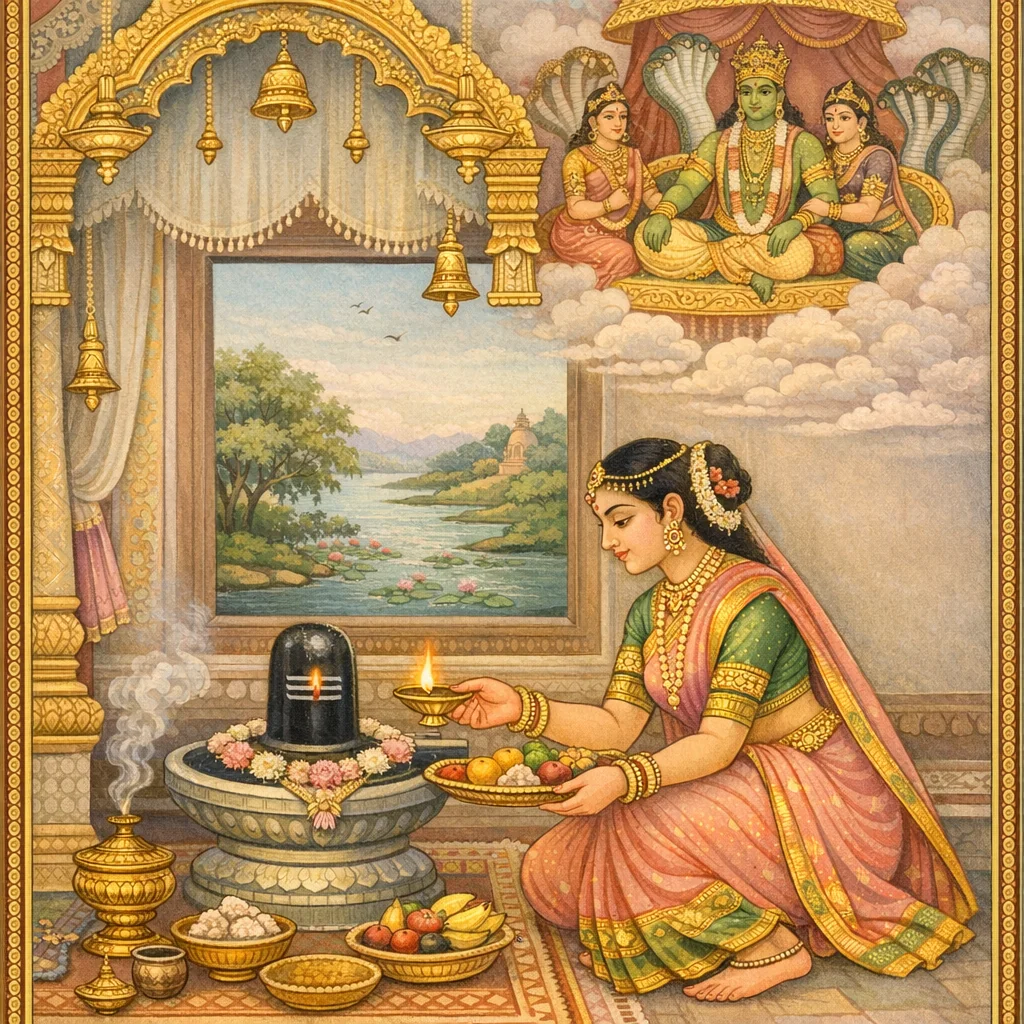
Chapter 8 begins with Sūta’s teaching: those who know Śiva-tattva as eternal, tranquil, and beyond all conceptual fabrication attain the highest state; even those still attached to sense-objects may advance through karmamaya pūjā, an accessible discipline of worship through prescribed acts. The chapter then extols Somavāra (Monday) worship of Śiva—performed with fasting, purity, self-restraint, and correct ritual procedure—as a dependable means for both worldly attainments and apavarga (liberation). An illustrative narrative follows. In Āryāvarta, Sīmantinī, daughter of King Citravarman, is praised by astrologer-Brahmins, yet another prediction declares she will be widowed at fourteen. Seeking a remedy, she consults Maitreyī, wife of Yājñavalkya, who prescribes the Somavāra-vrata to worship Śiva and Gaurī, with offerings and feeding of Brahmins, and explains the upacāras—abhiṣeka, gandha, mālya, dhūpa, dīpa, naivedya, tāmbūla, namaskāra, japa, homa—and their stated fruits. Though tragedy strikes when her husband Candrāṅgada is lost in the Yamunā, she steadfastly maintains the vow. Parallel events reveal political upheaval and Candrāṅgada’s survival in Takṣaka’s nāga realm; his explicit Śaiva confession impresses Takṣaka, who aids his return, demonstrating that Śiva-bhakti protects even amid extreme adversity. The chapter closes by indicating further exposition of the greatness of the Somavāra-vrata.
Shlokas
Verse 1
सूत उवाच । नित्यानंदमयं शांतं निर्विकल्पं निरामयम् । शिवतत्त्वमनाद्यंतं ये विदुस्ते परं गताः
Sūta said: Those who truly know the reality of Śiva—ever of the nature of bliss, tranquil, free from mental constructions, free from affliction, and without beginning or end—attain the supreme state.
Verse 2
विरक्ताः कामभोगेभ्यो ये प्रकुर्वंत्यहैतुकीम् । भक्तिं परां शिवे धीरास्तेषां मुक्तिर्न संसृतिः
Those steady-minded ones who are detached from pleasures of desire and cultivate motiveless, supreme devotion to Śiva—for them there is liberation, not rebirth in saṃsāra.
Verse 3
विषयानभिसंधाय ये कुर्वंति शिवे रतिम् । विषयैर्नाभिभूयंते भुंजानास्तत्फलान्यपि
Those who, without aiming at worldly objects, cultivate delight in Śiva are not overpowered by sense-objects—even while experiencing the fruits that come to them.
Verse 4
येन केनापि भावेन शिवभक्तियुतो नरः । न विनश्यति कालेन स याति परमां गतिम्
A person endowed with devotion to Śiva—by whatever sincere feeling—does not perish under the power of Time; he reaches the highest destination.
Verse 5
आरुरुक्षुः परं स्थानं विषयासक्तमानसः । पूजयेत्कर्मणा शंभुं भोगांते शिवमाप्नुयात्
One who longs to ascend to the supreme abode, yet whose mind is attached to worldly objects, should worship Śambhu through prescribed actions; at the end of enjoyments, he may attain Śiva.
Verse 6
अशक्तः कश्चिदुत्स्रष्टुं प्रायो विषयवासनाम् । अतः कर्ममयी पूजा कामधेनुः शरीरिणाम्
Most people are unable to cast off the latent cravings for sense-objects; therefore, worship performed through sacred action (karma) is like Kāmadhenu, the wish-fulfilling cow, for embodied beings.
Verse 7
मायामयेपि संसारे ये विहृत्य चिरं सुखम् । मुक्तिमिच्छन्ति देहांते तेषां धर्मोयमीरितः
Even in this world fashioned of māyā, for those who have long enjoyed its pleasures yet seek liberation at life’s end—this dharma is declared.
Verse 8
शिवपूजा सदा लोके हेतुः स्वर्गापवर्गयोः । सोमवारे विशेषेण प्रदोषादिगुणान्विते
In this world, worship of Śiva is ever a cause of both heaven and liberation—especially when performed on a Monday, endowed with the merits of Pradoṣa and related auspicious observances.
Verse 9
केवलेनापि ये कुर्युः सोमवारे शिवार्चनम् । न तेषां विद्यते किंचिदिहामुत्र च दुर्लभम्
Even by this alone—worship of Śiva on a Monday—there is nothing difficult for them to obtain, either in this world or the next.
Verse 10
उपोषितः शुचिर्भूत्वा सोमवारे जितेंद्रियः । वैदिकैर्लौकिकैर्वापि विधिवत्पूजयेच्छिवम्
Having fasted, become pure, and mastered the senses on a Monday, one should worship Śiva according to proper procedure—whether by Vedic rites or by customary (laukika) observances.
Verse 11
ब्रह्मचारी गृहस्थो वा कन्या वापि सभर्त्तृका । विभर्तृका वा संपूज्य लभते वरमीप्सितम्
Whether a brahmacārin or a householder, whether a maiden, a married woman, or a widow—by duly worshipping this sacred observance/deity, one attains the desired boon.
Verse 12
अत्राहं कथयिष्यामि कथां श्रोतृमनोहराम् । श्रुत्वा मुक्तिं प्रयांत्येव भर्तिर्भवति शांभवी
Here I shall relate a tale that delights the hearts of listeners; by hearing it, they indeed attain liberation, and devotion to Śambhu (Śiva) arises.
Verse 13
आर्यावर्ते नृपः कश्चिदासीद्धर्मभृतां वरः । चित्रवर्मेति विख्यातो धर्मराजो दुरात्मनाम्
In Āryāvarta there once was a king, foremost among upholders of dharma, renowned as Citravarman—like a very Dharma-king to the wicked.
Verse 14
स गोप्ता धर्मसेतूनां शास्ता दुष्पथगामिनाम् । यष्टा समस्तयज्ञानां त्राता शरणमिच्छताम्
He was the guardian of the bridges of dharma, the chastiser of those who walk evil paths, the patron who caused all sacrifices (yajñas) to be performed, and the protector of those who sought refuge.
Verse 15
कर्त्ता सकलपुण्यानां दाता सकलसंपदाम् । जेता सपत्नवृंदानां भक्तः शिवमुकुन्दयोः
He performed every meritorious deed, bestowed every form of prosperity, conquered hosts of enemies—and was a devotee of both Śiva and Mukunda (Viṣṇu).
Verse 16
सोनुकूलासु पत्नीषु लब्ध्वा पुत्रान्महौजसः । चिरेण प्रार्थितां लेभे कन्यामेकां वराननाम्
Though he had gained mighty sons from his kindly queens, after a long time he received—much prayed for—one daughter, fair of face.
Verse 17
स लब्ध्वा तनयां दिष्ट्या हिमवानिव पार्वतीम् । आत्मानं देवसदृशं मेने पूर्णमनोरथम्
Thus, by good fortune, having obtained a daughter—like Himavān obtaining Pārvatī—he deemed himself godlike, his desires fulfilled.
Verse 18
स एकदा जातकलक्षणज्ञानाहूय साधून्द्विजमुख्यवृंदान् । कुतूहलेनाभिनिविष्टचेताः पप्रच्छ कन्याजनने फलानि
Once he summoned virtuous leading Brahmins, skilled in horoscopy and auspicious marks; his mind intent with curiosity, he asked about the fruits and outcomes connected with the birth of a daughter.
Verse 19
अथ तत्राब्रवीदेको बहुज्ञो द्विजसत्तमः । एषा सीमंतिनी नाम्ना कन्या तव महीपते
Then one, highly learned—the best of Brahmins—spoke there: “O king, this daughter of yours is named Sīmaṃtinī.”
Verse 20
उमेव मांगल्यवती दमयंतीव रूपिणी । भारतीव कलाभिज्ञा लक्ष्मीरिव महागुणा
She is auspicious like Umā, beautiful like Damayantī, skilled in the arts like Bhāratī (Sarasvatī), and endowed with great virtues like Lakṣmī.
Verse 21
सुप्रजा देवमातेव जानकीव धृतव्रता । रविप्रभेव सत्कांतिश्चंद्रिकेव मनोरमा
She will be blessed with noble offspring like a divine mother, steadfast in vows like Jānakī (Sītā). Her auspicious radiance will be like the sun’s splendor, and she will be delightful like moonlight.
Verse 22
दशवर्षसहस्राणि सह भर्त्रा प्रमोदते । प्रसूय तनयानष्टौ परं सुखमवाप्स्यति
For ten thousand years she will rejoice together with her husband. Having borne eight sons, she will attain the highest happiness.
Verse 23
इत्युक्तवंतं नृपतिर्धनैः संपूज्य तं द्विजम् । अवाप परमां प्रीतिं तद्वागमृतसेवया
When he had spoken thus, the king honored that brāhmaṇa with gifts. By partaking of the nectar of his words, the king attained profound joy.
Verse 24
अथान्योऽपि द्विजः प्राह धैर्यवानमितद्युतिः । एषा चतुर्दशे वर्षे वैधव्यं प्रतिपत्स्यति
Then another brāhmaṇa spoke, steadfast and of immeasurable brilliance: “In her fourteenth year, she will meet the state of widowhood.”
Verse 25
इत्याकर्ण्य वचस्तस्य वज्रनिर्घातनिष्ठुरम् । मुहूर्तमभवद्राजा चिंताव्याकुलमानसः
Hearing those words—harsh as a thunderbolt’s strike—the king, for a moment, became distressed in mind, shaken by anxious thoughts.
Verse 26
अथ सर्वान्समुत्सृज्य ब्राह्मणान्ब्रह्मवत्सलः । सर्वं दैवकृतं मत्त्वा निश्चिंतः पार्थिवोऽभवत्
Then, having respectfully dismissed all the brāhmaṇas, the king—devoted to dharma—deemed everything to be wrought by divine destiny and became free from care.
Verse 27
सापि सीमंतिनी बाला क्रमेण गतशैशवा । वैधव्यमात्मनो भावि शुश्रावात्मसखीमुखात्
That young maiden too, as her childhood gradually passed, heard from the lips of her close friend that widowhood was destined for her.
Verse 28
परं निर्वेदमापन्ना चिंतयामास बालिका । याज्ञवल्क्यमुनेः पत्नीं मैत्रेयीं पर्यपृच्छत
Overcome with deep dispassion, the girl reflected; then she approached and questioned Maitreyī, the wife of the sage Yājñavalkya.
Verse 29
मातस्त्वच्चरणांभोजं प्रपन्नास्मि भयाकुला । सौभाग्यवर्धनं कर्म मम शंसितुमर्हसि
“Mother, trembling with fear, I have taken refuge at your lotus feet. Please instruct me in a rite that increases auspicious fortune.”
Verse 30
इति प्रपन्नां नृपतेः कन्यां प्राह मुनेः सती । शरणं व्रज तन्वंगि पार्वतीं शिवसंयुताम्
Thus, to the king’s daughter who had surrendered, the virtuous lady said: “O slender-limbed one, go and take refuge in Pārvatī, united with Śiva.”
Verse 31
सोमवारे शिवं गौरीं पूजयस्व समाहिता । उपोषिता वा सुस्नाता विरजाम्बरधारिणी
On Monday, worship Śiva and Gaurī with a gathered mind—whether fasting, or after bathing well, and wearing clean, unstained garments.
Verse 32
यतवाङ्निश्चलमनाः पूजां कृत्वा यथोचिताम् । ब्राह्मणान्भोजयित्वाथ शिवं सम्यक्प्रसादयत्
With speech restrained and the mind steady, perform the worship as is proper; then, after feeding brāhmaṇas, truly win the gracious favor of Śiva.
Verse 33
पापक्षयोऽभिषेकेण साम्राज्यं पीठपूजनात् । सौभाग्यमखिलं सौख्यं गंधमाल्याक्षतार्पणात्
By abhiṣeka comes the destruction of sins; by worship of the pīṭha comes sovereignty. By offering fragrance, flowers, and akṣata arise good fortune and every kind of happiness.
Verse 34
धूपदानेन सौगंध्यं कांतिर्दीपप्रदानतः । नैवेद्यैश्च महाभोगो लक्ष्मीस्तांबूलदानतः
By offering dhūpa comes sweet fragrance; by offering lamps comes radiance. By naivedya comes great enjoyment, and by gifting tāmbūla comes Lakṣmī—prosperity itself.
Verse 35
धर्मार्थकाममोक्षाश्च नमस्कारप्रदानतः । अष्टैश्वर्यादिसिद्धीनां जप एव हि कारणम्
Dharma, artha, kāma, and even mokṣa arise from offering reverent salutations; and for attainments such as the eight lordly powers (aṣṭaiśvarya), japa alone is indeed the cause.
Verse 36
होमेन सर्वकामानां समृद्धिरुपजायते । सर्वेषामेव देवानां तुष्टिर्ब्राह्मणभोजनात्
By homa, the fulfillment and increase of all desired aims arises; and by feeding brāhmaṇas, the satisfaction of all the devas is attained.
Verse 37
इत्थमाराधय शिवं सोमवारे शिवामपि । अत्यापदमपि प्राप्ता निस्तीर्णाभिभवा भवेः
Thus worship Śiva—and on Monday, Śivā (the Goddess) as well. Even if you fall into extreme calamity, you will cross beyond it and will not be overcome.
Verse 38
घोराद्घोरं प्रपन्नापि महाक्लेशं भयानकम् । शिवपूजाप्रभावेण तरिष्यसि महद्भयम्
Even if you are driven into the most dreadful state—into great, terrifying anguish—by the power of Śiva’s worship you will cross over that mighty fear.
Verse 39
इत्थं सीमंतिनीं सम्यगनुशास्य पुनः सती । ययौ सापि वरारोहा राजपुत्री तथाऽकरोत्
Thus, having properly instructed the married lady, Satī departed again. And that noble princess, of lovely form, did exactly so.
Verse 40
दमयंत्यां नलस्यासीदिंद्रसेनाभिधः सुतः । तस्य चंद्रांगदो नाम पुत्रोभू च्चंद्रसन्निभः
From Damayantī, Nala had a son named Indrasena; and to him was born a son called Candrāṅgada, radiant like the moon.
Verse 41
चित्रवर्मा नृपश्रेष्ठस्तमाहूय नृपात्मजम् । कन्यां सीमंतिनीं तस्मै प्रायच्छद्गुर्वनुज्ञया
King Citravarmā, foremost among rulers, summoned that prince and, with the preceptor’s consent, bestowed upon him his daughter Sīmantinī in marriage.
Verse 42
सोऽभून्महोत्सवस्तत्र तस्या उद्वाहकर्मणि । यत्र सर्वमहीपानां समवायो महानभूत्
A great festival arose there for her wedding rites, where a vast assembly of kings from across the earth gathered together.
Verse 43
तस्याः पाणिग्रहं काले कृत्वा चंद्रांगदः कृती । उवास कतिचिन्मासांस्तत्रैव श्वशुरालये
At the proper time, the capable Candrāṅgada performed the rite of taking her hand in marriage, and then dwelt for some months right there in his father-in-law’s house.
Verse 44
एकदा यमुनां तर्तुं स राजतनयो बली । आरुरोह तरीं कैश्चिद्वयस्यैः सह लीलया
Once, that strong prince, wishing to cross the Yamunā, boarded a boat playfully along with some companions of his own age.
Verse 45
तस्मिंस्तरति कालिंदीं राजपुत्रे विधेर्वशात् । ममज्ज सह कैवतैरावर्त्ताभिहता तरी
While the prince was crossing the Kāлиндī (Yamunā), by the force of fate the boat—struck by a whirlpool—sank, along with the boatmen.
Verse 46
हा हेति शब्दः सुमहानासीत्तस्यास्तटद्वये । पश्यतां सर्वसैन्यानां प्रलापो दिवम स्पृशत्
On both banks there arose a mighty cry of “Alas! Alas!” and, as all the armies looked on, the wailing rose up as though it touched the heavens.
Verse 47
मज्जंतो मम्रिरे केचित्केचिद्ग्राहोदरं गताः । राजपुत्रादयः केचिन्नादृश्यंत महाजले
Some, sinking, died; some were carried into the bellies of crocodiles. And some—beginning with the prince—could no longer be seen in that vast water.
Verse 48
तदुपश्रुत्य राजापि चित्रवर्मातिवि ह्वलः । यमुनायास्तटं प्राप्य विचेष्टः समजायत
Hearing that report, King Citravarmā too became utterly distraught; reaching the bank of the Yamunā, he fell into helpless agitation.
Verse 49
श्रुत्वाथ राजपत्न्यश्च वभूबुर्गतचेतनाः । सा च सीमंतिनी श्रुत्वा पपाप डूवि मूर्च्छिता
Hearing it, the king’s queens lost consciousness; and Sīmantinī too, upon hearing, fell to the ground in a faint.
Verse 50
तथान्ये मंत्रिमुख्याश्च नायकाः सपुरोहिताः । विह्वलाः शोकसंतप्ता विलेपुर्मुक्तमूर्धजाः
So too did the chief ministers, the commanders, and the priests—overwhelmed and scorched by grief—weep, their hair loosened in distress.
Verse 51
इंद्रसेनोपि राजेद्रः पुत्रवार्त्तां सुदुःखितः । आकर्ण्य सह पत्नीभिर्नष्टसंज्ञः पपात ह
King Indrasena too, on hearing the news of his son, was overwhelmed by piercing sorrow; with his queens he at once fainted and fell.
Verse 52
तन्मंत्रिणश्च तत्पौरास्तथा तद्देशवासिनः । आबालवृद्धवनिताश्चुक्रुशुः शोकविह्वलाः
Then his ministers, the townspeople, and the inhabitants of that land—women from young girls to the aged—cried aloud, shaken and overwhelmed by grief.
Verse 53
शोकात्केचिदुरो जघ्नुः शिरो जघ्नुश्च केचन । हा राजपुत्र हा तात क्वासि क्वासीति बभ्रमुः
In grief some struck their own chests, and others beat their heads, crying, “Alas, prince! Alas, dear child! Where are you—where are you?” and wandered in distress.
Verse 54
एवं शोकाकुलं दीनमिंद्रसेनमहीपतेः । नगरं सहसा क्षुब्धं चित्रवर्मपुरं तथा
Thus, with King Indrasena wretched and tossed by grief, the city too—Citravarmapura—was suddenly thrown into turmoil.
Verse 55
अथ वृद्धैः समाश्वस्तश्चित्रवर्मा महीपतिः । शनैर्नगरमागत्य सान्त्वयामास चात्मजाम्
Then King Citravarmā, consoled by the elders, returned slowly to the city and comforted his daughter.
Verse 56
स राजांभसिमग्नस्य जामातुस्तस्य बांधवैः । आगतैः कारयामास साकल्यादौर्ध्वदैहिकम्
That king, together with the relatives who had arrived, caused all the funerary rites for his son-in-law who had sunk in the waters to be performed in full, according to due ordinance.
Verse 57
सा च सीमंतिनी साध्वी भर्तृलोकमतिः सती । पित्रा निषिद्धा स्नेहेन वैधव्यं प्रत्यपद्यत
And that virtuous lady, chaste and intent upon her husband’s world, though her father lovingly restrained her, accepted the state of widowhood.
Verse 58
मुनेः पत्न्योऽपदिष्टं यत्सोमवारव्रतं शुभम् । न तत्याज शुभाचारा वैधव्यं प्राप्तवत्यपि
The auspicious Monday vow taught by the sage’s wives—she, steadfast in pure conduct, did not abandon it, even after widowhood came upon her.
Verse 59
एवं चतुर्दशे वर्षे दुःखं प्राप्य सुदारुणम् । ध्यायन्ती शिवपादाब्जं वत्सरत्रयमत्यगात्
Thus, in her fourteenth year, having met with exceedingly cruel sorrow, she passed three years meditating upon the lotus-feet of Śiva.
Verse 60
पुत्रशोकादिवोन्मत्तमिंद्रसेनं महीपतिम् । प्रसह्य तस्य दायादाः सप्तांगं जह्रुरोजसा
Indrasena, the king, as if maddened by grief for his son, was forcibly overpowered by his heirs, who by sheer might seized the kingdom in all its seven limbs.
Verse 61
हृतसिंहासनः शूरैर्दायादैः सोऽप्रजो नृपः । निगृह्य काराभवने सपत्नीको निवेशितः
That king, being without an heir, had his throne seized by his valiant kinsmen. Overpowered, he was confined in a prison-house together with his queen.
Verse 62
चंद्रागदोऽपि तत्पुत्रो निमग्नो यमुनाजले । अधोधोमज्जमानोऽसौ ददर्शोरगकामिनीः
And his son Candrāgada too, having sunk into the waters of the Yamunā, as he was descending ever further down, beheld serpent-maidens.
Verse 63
जलक्रीडासु सक्तास्ता दृष्ट्वा राजकुमार कम् । विस्मितास्तमथो निन्युः पातालं पन्नगालयम्
Absorbed in their water-sports, those maidens, seeing the young prince, were astonished; then they led him to Pātāla, the abode of the serpents.
Verse 64
स नीयमानस्तरसा पन्नगीभिर्नृपात्मजः । तक्षकस्य पुरं रम्यं विवेश परमाद्भुतम्
Carried swiftly by the Nāga-maidens, the king’s son entered the delightful city of Takṣaka—marvelous beyond measure.
Verse 65
सोऽपश्यद्राजतनयो महेंद्रभवनोपमम् । महारत्नपरिभ्राजन्मयूखपरिदीपितम्
There the prince beheld a palace like the mansion of great Indra, illuminated all around by the radiance of splendid, mighty jewels.
Verse 66
वज्रवैडूर्यपाचादिप्रासादशतसंकुलम् । माणिक्य गोपुरद्वारं मुक्तादामभिरुज्ज्वलम्
It was thronged with hundreds of mansions of diamond, beryl, crystal and the like; its gateway-towers were set with rubies, radiant with garlands of pearls.
Verse 67
चंद्रकांतस्थलं रम्यं हेमद्वारकपाटकम् । अनेकशतसाहस्रमणिदीपविराजितम्
Its lovely courtyards were of moonstone; its door-panels were of gold, resplendent with jewel-lamps by the hundreds and thousands.
Verse 68
तत्रापश्यत्सभा मध्ये निषण्णं रत्नविष्टरे । तक्षकं पन्नगाधीशं फणानेकशतोज्ज्वलम्
There, in the midst of the assembly hall, he saw Takṣaka, lord of the Nāgas, seated upon a jeweled throne—radiant with hundreds of hoods.
Verse 69
दिव्यांबरधरं दीप्तं रत्नकुण्डलराजितम् । नानारत्नपरिक्षिप्तमुकुट द्युतिरंजितम्
He was radiant, clad in divine garments, adorned with jeweled earrings; his crown, set all around with many gems, was suffused with shining brilliance.
Verse 70
फणामणिमयूखाढ्यैरसंख्यैः पन्नगोत्तमैः । उपासितं प्रांजलिभिश्चित्ररत्नविभूषितैः
He was attended by countless eminent Nāgas, rich with the rays of gems upon their hoods—standing with folded hands, adorned with wondrous jewels.
Verse 71
रूपयौवनमाधुर्यविलासगति शोभिना । नागकन्यासहस्रेण समंतात्परिवारितम्
He shone with beauty, youthful charm, sweetness, graceful playfulness, and elegant movement—surrounded on every side by a thousand Nāga maidens.
Verse 72
दिव्याभरणदीप्तांगं दिव्यचंदनचर्चितम् । कालाग्निमिव दुर्धर्षं तेजसादित्यसन्निभम्
His limbs blazed with celestial ornaments, and he was anointed with divine sandalpaste—unassailable like the fire of dissolution, radiant in splendour like the sun.
Verse 73
दृष्ट्वा राजसुतो धीरः प्रणिपत्य सभास्थले । उत्थितः प्रांजलिस्तस्य तेजसाक्षिप्तलोचनः
Seeing him, the steadfast prince bowed down in the assembly hall; then he rose with folded hands, his eyes overwhelmed and drawn by that blazing splendour.
Verse 74
नागराजोपि तं दृष्ट्वा राजपुत्रं मनोरमम् । कोऽयं कस्मादिहायात इति पप्रच्छ पन्नगीः
The Nāga king, seeing that charming prince, asked the serpent-maidens: “Who is he, and from where has he come here?”
Verse 75
ता ऊचुर्यमुनातोये दृष्टोऽस्माभिर्यदृच्छया । अज्ञातकुलनामायमानीतस्तव सन्निधिम्
They replied: “By chance we saw him in the waters of the Yamunā. His lineage and name were unknown, so we brought him into your presence.”
Verse 76
अथ पृष्टो राजपुत्रस्तक्षकेण महात्मना । कस्यासि तनयः कस्त्वं को देशः कथमागतः
Then the prince was questioned by the great-souled Takṣaka: “Whose son are you? Who are you? What is your land, and how did you come here?”
Verse 77
राजपुत्रो वचः श्रुत्वा तक्षकं वाक्यमब्रवीत्
Hearing those words, the prince addressed Takṣaka in reply.
Verse 78
राजपुत्र उवाच । अस्ति भूमंडले कश्चिद्देशो निषधसंज्ञकः । तस्याधिपोऽभवद्राजा नलो नाम महा यशाः । स पुण्यकीर्तिः क्षितिपो दमयन्तीपतिः शुभः
The prince said: “On this earth there is a land known as Niṣadha. Its ruler was the famed king Nala—of holy renown, a righteous sovereign, the auspicious husband of Damayantī.”
Verse 79
तस्मादपींद्रसेनाख्यस्तस्य पुत्रो महाबलः । चंद्रांगदोस्मि नाम्नाहं नवोढः श्वशुरालये । विहरन्यमुनातोये निमग्नो देवचोदितः
“From him was born Indrasena, mighty in strength; I am his son, named Candrāṅgada. Newly married and staying in my father-in-law’s house, while sporting in the waters of the Yamunā I was submerged—impelled by divine ordinance.”
Verse 80
एताभिः पन्नगस्त्रीभिरानीतोस्मि तवांतिकम् । दृष्ट्वाहं तव पादाब्जं पुण्यैर्जन्मांतरार्जितैः
“Brought by these serpent-women into your presence, I now behold your lotus-feet—by merits accumulated in former births.”
Verse 81
अद्य धन्योऽस्मि धन्योऽस्मि कृतार्थो पितरौ मम । यत्प्रेक्षितोऽहं कारुण्यात्त्वया संभाषितोपि च
“Today I am truly blessed—blessed indeed! My parents have found fulfillment, for out of compassion you have looked upon me and even spoken with me.”
Verse 82
सूत उवाच । इत्युदारमसंभ्रांतं वचः श्रुत्वातिपेशलम् । तक्षकः पुनरौत्सुक्याद्बभाषे राजनंदनम्
Sūta said: “Hearing those noble, unconfused, and exceedingly gentle words, Takṣaka, stirred again by eagerness, spoke to the prince.”
Verse 83
तक्षक उवाच । भोभो नरेंद्रदायाद मा भैषीर्धीरतां व्रज । सर्वदेवेषु को देवो युष्माभिः पूज्यते सदा
Takṣaka said: “O heir of the king, do not fear—be steadfast. Among all the gods, which deity is always worshipped by you?”
Verse 84
राजपुत्र उवाच । यो देवः सर्वेदेवेषु महादेवं इति स्मृतः । पूज्यते स हि विश्वात्मा शिवोऽस्माभिरुमापतिः
The prince said: “That deity who, among all the gods, is remembered as ‘Mahādeva’—He, the Soul of the universe, Śiva, the Lord of Umā, is worshipped by us.”
Verse 85
यस्य तेजोंशलेशेन रजसा च प्रजापतिः । कृतरूपोऽसृजद्विश्वं स नः पूज्यो महेश्वरः
“By a mere fraction of whose radiance—and through rajas—Prajāpati, assuming form, created the universe: that Maheśvara is the one we worship.”
Verse 86
यस्यांशात्सात्त्विकं दिव्यं बिभ्रद्विष्णुः सनातनः । विश्वं बिभर्त्ति भूतात्मा शिवोऽस्माभिः स पूज्यते
From His portion the eternal Viṣṇu bears the divine sāttvika power and upholds the universe as the indwelling Soul of beings—He, Śiva, is worshipped by us.
Verse 87
यस्यांशात्तामसाज्जातो रुद्रः कालाग्निसन्निभः । विश्वमेतद्धरत्यंते स पूज्योऽस्माभिरीश्वरः
From His portion, through tamas, Rudra is born—like the fire of Time at the end—and at the end he withdraws this universe. That Lord (Īśvara) is worshipped by us.
Verse 88
यो विधाता विधातुश्च कारणस्यापि कारणम् । तेजसां परमं तेजः स शिवो नः परा गतिः
He is the Ordainer—and the ordainer of the ordainer—the cause even of causes, the supreme radiance among all lights. That Śiva is our highest destination.
Verse 89
योंतिकस्थोऽपि दूरस्थः पापोपहृतचेतसाम् । अपरिच्छेद्य धामासौ शिवो नः परमा गतिः
Though near at hand, He is far away to those whose minds are carried off by sin; His abode is beyond all measure. That Śiva is our supreme refuge.
Verse 90
योऽग्नौ तिष्ठति यो भूमौ यो वायौ सलिले च यः । य आकाशे च विश्वात्मा स पूज्यो नः सदाशिवः
He who abides in fire, in earth, in wind, and in water—and who is in space as the Soul of the universe—He, Sadāśiva, is worthy of our worship.
Verse 91
यः साक्षी सर्वभूतानां य आत्मस्थो निरंजनः । यस्येच्छावशगो लोकः सोऽस्माभिः पूज्यते शिवः
He who is the Witness of all beings, who abides within the Self and is stainless; by whose mere will the world is governed—He, Śiva, is worshipped by us.
Verse 92
यमेकमाद्यं पुरुषं पुराणं वदंति भिन्नं गुणवैकृतेन । क्षेत्रज्ञमेकेथ तुरीयमन्ये कूटस्थमन्ये स शिवो गतिर्नः
That One—the primeval Puruṣa, the Ancient—whom they describe as appearing diverse through the transformations of the guṇas; whom some call the Knower of the Field, others the Fourth (turīya), and others the Unchanging (kūṭastha): that Śiva is our refuge.
Verse 93
यं नास्पृशंश्चैत्यमचिंत्यतत्त्वं दुरंतधामानमतत्स्वरूपम् । मनोवचोवृत्तय आत्मभाजां स एष पूज्यः परमः शिवो नः
Him whom the mind cannot touch—whose reality is inconceivable, whose abode is unapproachable, whose true form is beyond all ‘that-ness’; for embodied beings, the movements of mind and speech do not reach Him. He indeed—supreme Śiva—is to be worshipped by us.
Verse 94
यस्य प्रसादं प्रतिलभ्य संतो वांछंति नैंद्रं पदमुज्ज्वलं वा । निस्तीर्णकर्मार्गलकालचक्राश्चरंत्यभीताः स शिवो गतिर्नः
Having obtained whose grace, the holy ones desire even Indra’s radiant station no more; having crossed beyond the barriers of karma and the wheel of time, they move about fearless—He, Śiva, is our refuge.
Verse 95
यस्य स्मृतिः सकलपापरुजां विघातं सद्यः करोत्यपि चु पुल्कसजन्मभाजाम् । यस्य स्वरूपमखिलं श्रुतिभिर्विमृग्यं तस्मै शिवाय सततं करवाम पूजाम्
Whose remembrance instantly destroys the pain of all sins—even for those born in the Pulkaśa community; whose complete nature is sought out by the Vedas: to that Śiva we shall ever perform worship.
Verse 96
यन्मूर्ध्नि लब्धनिलया सुरलोकसिंधुर्यस्यांगगां भगवती जगदंबिका च । यत्कुंडले त्वहह तक्षकवासुकी द्वौ सोऽस्माकमेव गतिरर्धशशांकमौलिः
That Lord whose crest bears the heavenly river as her abode, upon whose body rests the holy Gaṅgā together with the Blessed Mother of the world, and in whose earrings—indeed—dwell both Takṣaka and Vāsuki: that Half-moon-crested One is truly our refuge.
Verse 97
जयति निगमचूडाग्रेषु यस्यांघ्रिपद्मं जयति च हृदि नित्यं योगिनां यस्य मूर्तिः । जयति सकलतत्त्वोद्भासनं यस्य मूर्तिः स विजितगुणसर्गः पूज्यतेऽस्माभिरीशः
Victory to the Lord whose lotus-feet are set upon the crest of the Vedas; victory to Him whose form ever abides in the hearts of yogins; victory to Him whose form illumines all tattvas. That Īśa who has conquered the entire play of the guṇas is worshipped by us.
Verse 98
सूत उवाच । इत्याकर्ण्य वचस्तस्य तक्षकः प्रीतमानसः । जातभक्तिर्महादेवे राजपुत्रमभाषत
Sūta said: Hearing those words, Takṣaka—his heart delighted and devotion to Mahādeva awakened—addressed the prince.
Verse 99
तक्षक उवाच । परितुष्टोऽस्मि भद्रं स्तात्तव राजेद्रनंदन । बालोपि यत्परं तत्त्वं वेत्सि शैवं परात्परम्
Takṣaka said: I am wholly pleased; may auspiciousness be yours, O son of the king of kings. For though you are but a boy, you know the supreme truth—the Śaiva reality beyond the beyond.
Verse 100
एष रत्नमयो लोक एताश्चारुदृशोऽबलाः । एते कल्पद्रुमाः सर्वे वाप्योमृतरसांभसः
This world is made of jewels; these women are of enchanting beauty. All these are wish-fulfilling kalpadruma trees, and these ponds hold waters that taste of amṛta, like nectar.
Verse 101
नात्र मृत्युभयं घोरं न जरारोगपीडनम् । यथेष्टं विहरात्रैव भुंक्ष्व भोगान्यथोचितान्
Here there is no dreadful fear of death, nor any torment from old age or disease. Dwell here as you wish, and partake of pleasures that are fitting and proper.
Verse 110
तत्सहायार्थमेकं च पन्नगेंद्रकुमारकम् । नियुज्य तक्षकः प्रीत्या गच्छेति विससर्ज तम्
And for his assistance, Takṣaka gladly appointed a young prince of the serpent-king and sent him forth, saying, “Go!”
Verse 120
का त्वं कस्य कलत्रं वा कस्यासि तनया सती । किमिदं तेंगने बाल्ये दुःसहं शोकलक्षणम्
Who are you? Whose wife are you, or whose virtuous daughter? And why, O slender-limbed one, do you bear in your very childhood these unbearable marks of grief?
Verse 130
दृष्टपूर्व इवाभासि मया च स्वजनो यथा । सर्वं कथय तत्त्वेन सत्यसारा हि साधवः
You appear to me as if seen before—like one of my own kin. Tell me everything truthfully, for the righteous are indeed founded upon truth.
Verse 140
स्वपाणिस्पर्शनोद्भिन्नपुलकांचितविग्रहम् । पूर्व दृष्टानि चांगेषु लक्षणानि स्वरादिषु । वयःप्रमाणं वर्णं च परीक्ष्यैनमतर्कयत्
Seeing his body thrill with gooseflesh at the touch of her own hand, and noticing on his limbs the signs she had seen before—in voice and other features—she examined his age, stature, and complexion, and then reflected upon him.
Verse 141
एष एव पतिर्मे स्याद्ध्रुवं नान्यो भविष्यति । अस्मिन्नेव प्रसक्तं मे हृदयं प्रेमकातरम्
He alone shall be my husband—surely none other will be. To him alone my heart is bound, tender and distressed with love.
Verse 142
परलोकादिहायातः कथमेवं स्वरूपधृक् । दुर्भाग्यायाः कथं मे स्याद्भर्तुर्नष्टस्य दर्शनम्
How has he come here from the other world, bearing this very form? How could I—so unfortunate—be granted the sight of my husband who was lost?
Verse 143
स्वप्नोयं किमु न स्वप्नो भ्रमोऽयं किं तु न भ्रमः । एष धूर्तोऽथवा कश्चिद्यक्षो गंधर्व एव वा
Is this a dream—or not a dream? Is this delusion—or not delusion? Is he a deceiver, or perhaps some Yakṣa, or indeed a Gandharva?
Verse 150
स पुरोपवनाभ्याशे स्थित्वा तं फणि पुत्रकम् । विससर्जात्मदायादान्नृपासनगतान्प्रति
Standing near the royal pleasure-grove, he dispatched that young serpent, directing him toward his own heirs who were seated at the king’s throne.
Verse 151
स गत्वोवाच ताञ्छीघ्रमिंद्रसेनो विमुच्यताम् । चंद्रांगदस्तस्य सुतः प्राप्तोऽयं पन्नगाल यात्
Going there, he said at once: “Let Indrāsena be released immediately. This is Candrāṃgada, his son, who has arrived—sent from the world of the nāgas.”
Verse 152
नृपासनं विमुंचंतु भवंतो न विचार्यताम् । नो चेच्चंद्रागदस्याशु बाणाः प्राणान्हरंति वः
All of you, abandon the royal throne at once—do not linger in deliberation. Otherwise, the swift arrows of Candrāṅgada will quickly take your lives.
Verse 153
स मग्नो यमुनातोये गत्वा तक्षकमंदिरम् । लब्ध्वा च तस्य साहाय्यं पुनर्लोकादिहागतः
Sunk within the waters of the Yamunā, he went to the temple-palace of Takṣaka; and having obtained his assistance, he returned again from that realm to this world.
Verse 160
तं पादमूले पतितं स्वपुत्रं विवेद नासौ पृथिवीपतिः क्षणम् । प्रबोधितोऽमात्यजनैः कथंचिदुत्थाय क्लिन्नेन हृदालिलिंग
For a moment that lord of the earth did not recognize his own son lying fallen at his feet. Somehow awakened by the ministers, he rose and, with a heart drenched in grief, embraced him.
Verse 170
चन्द्रांगदोऽपि रत्नाद्यैरानीतैस्तक्षकालयात् । स्वां पत्नीं भूषयां चक्रे मर्त्यानामतिदुर्लभैः
Candrāṅgada too, with jewels and the like brought from Takṣaka’s abode, adorned his wife with ornaments exceedingly difficult for mortals to obtain.
Verse 177
सूत उवाच । विचित्रमिदमाख्यानं मया समनुवर्णितम् । भूयोऽपि वक्ष्ये माहात्म्यं सोमवारव्रतोदितम्
Sūta said: “This wondrous narrative has been fully described by me. Yet again I shall speak of the greatness proclaimed for the Monday vow (Somavāra-vrata).”