Adhyaya 5
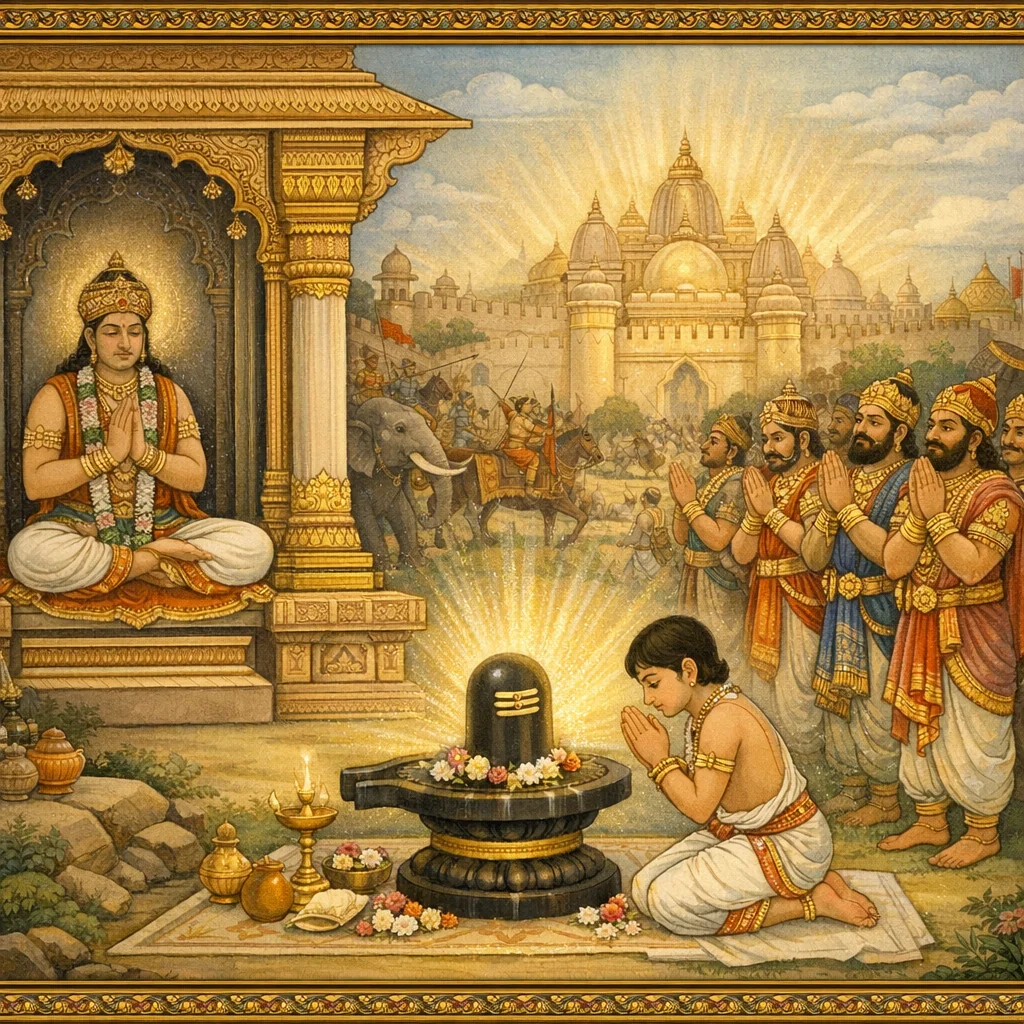
The chapter begins with a doctrinal hymn to Śiva as guru, deity, kinsman, the Self, and the very life-principle. It teaches that offerings, japa, and homa performed with Śiva as the intended object yield inexhaustible merit, affirmed by āgamic authority; even the smallest gift, when given with bhakti, becomes spiritually vast, and exclusive devotion to Śiva is praised as freedom from bondage. The narrative then turns to Ujjayinī: King Candrasena worships Mahākāla. His associate Maṇibhadra grants him the wish-fulfilling cintāmaṇi jewel, stirring other kings’ envy and a siege; Candrasena takes refuge in Mahākāla through unwavering pūjā. In parallel, a cowherd boy, inspired by the royal worship, fashions a simple liṅga and performs improvised devotion; though his mother disrupts the rite, Śiva’s grace appears as the boy’s camp becomes a splendid Śiva-temple and his household turns prosperous. The marvel pacifies the hostile kings, who renounce violence, honor Mahākāla, and reward the boy. Hanumān appears, declares that no refuge surpasses Śiva-pūjā, names the boy Śrīkara, and gives a future-oriented genealogical prophecy. The chapter closes with its phala: the account is secret, purifying, fame-bestowing, and devotion-enhancing.
Shlokas
Verse 1
सूत उवाच । शिवो गुरुः शिवो देवः शिवो बंधुः शरीरिणाम् । शिव आत्मा शिवो जीवःशिवादन्यन्न किञ्चन
Sūta said: Śiva is the guru; Śiva is God; Śiva is the kinsman of embodied beings. Śiva is the Self; Śiva is the living soul—apart from Śiva there is nothing at all.
Verse 2
शिवमुद्दिश्य यत्किंचिद्दत्तं जप्तं हुतं कृतम् । तदनंतफलं प्रोक्तं सर्वागमविनिश्चितम्
Whatever is given, chanted, offered into fire, or done with Śiva as the intention is declared to yield endless fruit, as established by all the Āgamas.
Verse 3
भक्त्या निवेदितं शंभोः पत्रं पुष्पं फलं जलम् । अल्पादल्पतरं वापि तदानंत्याय कल्पते
A leaf, a flower, a fruit, or water offered to Śambhu with devotion—even something smaller than the smallest—becomes a cause of infinite spiritual fruit.
Verse 4
विहाय सकलान्धर्मान्सकलागमनिश्चितान् । शिवमेकं भजेद्यस्तु मुच्यते सर्वबन्धनात्
Abandoning all (other) dharmas—though sanctioned by all the Āgamas—whoever worships Śiva alone is freed from every bondage.
Verse 5
या प्रीतिरात्मनः पुत्रे या कलत्रे धनेपि सा । कृता चेच्छिवपूजायां त्रायतीति किमद्भुतम्
The affection one has for one’s own child, for one’s spouse, and even for wealth—if that same love is placed in Śiva-worship, what wonder is it that it saves (one)?
Verse 6
तस्मात्केचिन्महात्मानः सकलान्विषयासवान् । त्यजंति शिवपूजार्थे स्वदेहमपि दुस्त्यजम्
Therefore, some great-souled ones abandon all intoxicating sense-objects; for the sake of Śiva-worship, they even relinquish their own body—so hard to give up.
Verse 7
सा जिह्वा या शिवं स्तौति तन्मनो ध्यायते शिवम् । तौ कर्णौ तत्कथालोलौ तौ हस्तौ तस्य पूजकौ
That is the tongue which praises Śiva; that is the mind which meditates on Śiva. Those are the ears that delight in His stories; those are the hands that worship Him.
Verse 8
ते नेत्रे पश्यतः पूजां तच्छिरः प्रणतं शिवे । तौ पादौ यौ शिवक्षेत्रं भक्त्या पर्यटतः सदा
Blessed are the eyes that behold worship; blessed the head that bows to Śiva; and blessed the feet that, in devotion, ever pilgrimage through Śiva’s sacred lands.
Verse 9
यस्येन्द्रियाणि सर्वाणि वर्तंते शिवकर्मसु । स निस्तरति संसारं भुक्तिं मुक्तिं च विंदति
One whose every sense is engaged in Śiva’s works crosses beyond saṃsāra and attains both worldly fulfillment and liberation.
Verse 10
शिवभक्तियुतो मर्त्यश्चांडालः पुल्कसोपि च । नारी नरो वा षंढो वा सद्यो मुच्येत संसृतेः
Any mortal endowed with devotion to Śiva—even a caṇḍāla or a pulkasa; whether woman, man, or one of ambiguous sex—can be freed from transmigration at once.
Verse 11
किं कुलेन किमाचारैः किंशीलेन गुणेन वा । भक्तिलेशयुतः शंभोः स वंद्यः सर्वदेहिनाम्
What matters lineage, what matters outward conduct, what matters temperament or accomplishments? One who has even a particle of devotion to Śambhu is worthy of reverence by all embodied beings.
Verse 12
उज्जयिन्यामभूद्राजा चन्द्रसेनसमाह्वयः । जातो मानवरूपेण द्वितीय इव वासवः
In Ujjayinī there was a king named Candrasena, born in human form like a second Vāsava (Indra).
Verse 13
तस्मिन्पुरे महाकालं वसंतं परमेश्वरम् । संपूजयत्यसौ भक्त्या चन्द्रसेनो नृपोत्तमः
In that city, King Candrasena—foremost among rulers—devoutly worshipped Mahākāla, the Supreme Lord who dwells there.
Verse 14
तस्याभवत्सखा राज्ञः शिवपारिषदाग्रणीः । मणिभद्रो जिताभद्रः सर्वलोकनमस्कृतः
That king had as his friend Maṇibhadra—foremost among Śiva’s attendants—Jitābhadra, revered by all the worlds.
Verse 15
तस्यै कदा महीभर्तुः प्रसन्नः शंकरानुगः । चिन्तामणिं ददौ दिव्यं मणिभद्रो महामतिः
Once, pleased with that lord of the earth, Maṇibhadra—the great-minded follower of Śaṅkara—bestowed upon him a divine Cintāmaṇi jewel.
Verse 16
स मणिः कौस्तुभ इव द्योतमानोर्कसन्निभः । दृष्टः श्रुतो वा ध्यातो वा नृणां यच्छति चिंतितम्
That jewel, shining like the Kaustubha and brilliant as the sun—whether merely seen, heard of, or meditated upon—grants people what they desire.
Verse 17
तस्य कांतिलवस्पृष्टं कांस्यं ताम्रमयस्त्रपु । पाषाणादिकमन्यद्वा सद्यो भवति कांचनम्
Touched by even a fraction of its radiance, bronze, copper, iron, tin—or even stone and the like—instantly becomes gold.
Verse 18
स तं चिन्तामणिं कंठे बिभ्रद्राजासनं गतः । रराज राजा देवानां मध्ये भानुरिव स्वयम्
Wearing the wish-fulfilling jewel Cintāmaṇi upon his neck, the king ascended his royal throne; and amid the assembled rulers he shone of himself—like the sun among the devas.
Verse 19
सदा चिन्तामणिग्रीवं तं श्रुत्वा राजसत्तमम् । प्रवृद्धतर्षा राजानः सर्वे क्षुब्धहृदोऽभवन्
Hearing of that best of kings whose neck ever bore the Cintāmaṇi, all other rulers—consumed by heightened craving—became inwardly agitated at heart.
Verse 20
स्नेहात्केचिदयाचंत धार्ष्ट्यात्केचन दुर्मदाः । दैवलब्धमजानंतो मणिं मत्सरिणो नृपाः
Some asked for it out of feigned friendship, and others—insolent and intoxicated with pride—demanded it boldly; those envious kings did not understand that the jewel had been obtained by destiny’s decree.
Verse 21
सर्वेषां भूभृतां याञ्चा यदा व्यर्थीकृतामुना । राजानः सर्वदेशानां संरंभं चक्रिरे तदा
When his refusal rendered the requests of all those earth-bearing kings futile, then the rulers from every land rose up in furious resolve.
Verse 22
सौराष्ट्राः कैकयाः शाल्वाः कलिंगशकमद्रकाः । पांचालावंतिसौवीरा मागधा मत्स्यसृंजयाः
The Saurāṣṭras, Kaikayas, Śālvas, and the Kaliṅgas, Śakas, and Madrakas; the Pāñcālas, Avantīs, and Sauvīras; the Māgadhas, Matsyas, and Sṛñjayas—
Verse 23
एते चान्ये च राजानः सहाश्वरथकुमजराः । चन्द्रसेनं मृधे जेतुमुद्यमं चक्रुरोजसा
These kings and many others, with horses, chariots, and elephant troops, strove with mighty force to defeat Candrasena in battle.
Verse 24
ते तु सर्वे सुसंरब्धाः कंपयंतो वसुन्धराम् । उज्जयिन्याश्चतुर्द्वारं रुरुधुर्बहुसैनिकाः
All of them, fiercely enraged and making the earth tremble, surrounded Ujjayinī’s four gates with vast armies.
Verse 25
संरुध्यमानो स्वपुरीं दृष्ट्वा राजभिरुद्धतैः । चंद्रसेनो महाकालं तमेव शरणं ययौ
Seeing his own city blockaded by haughty kings, Candrasena went to Mahākāla alone as his refuge.
Verse 26
निर्विकल्पो निराहारः स राजा दृढनिश्चयः । अर्चयामास गौरीशं दिवा नक्त मनन्यधीः
Free from wavering, fasting, and firm in resolve, that king—his mind fixed on none other—worshipped Gaurī’s Lord (Śiva) by day and by night.
Verse 27
एतस्मिन्नंतरे गोपी काचित्तत्पुरवासिनी । एकपुत्रा भर्तृहीना तत्रैवासीच्चिरंतना
Meanwhile, in that very city there lived a certain cowherd woman, a long-time resident there—widowed, and the mother of a single son.
Verse 28
सा पंचहायनं बालं वहंती गत भर्तृका । राज्ञा कृतां महापूजां ददर्श गिरिजापतेः
That widowed woman, carrying her five-year-old child, beheld the great worship of Girijā-pati (Śiva) performed by the king.
Verse 29
सा दृष्ट्वा सर्वमाश्चर्यं शिवपूजामहोदयम् । प्रणिपत्य स्वशिबिरं पुनरेवाभ्यपद्यत
Having seen all that wondrous grandeur—the great exaltation of Śiva-worship—she bowed down and returned again to her own camp.
Verse 30
एतत्सर्वमशेषेण स दृष्ट्वा बल्लवीसुतः । कुतूहलेन विदधे शिवपूजां विरक्तिदाम्
After seeing all of this in full, the cowherdess’s son, stirred by curiosity, undertook the worship of Śiva—bestower of detachment.
Verse 31
आनीय हृद्यं पाषाणं शून्ये तु शिबिरोत्तमे । नातिदूरे स्वशिबिराच्छिवलिंगमकल्पयत्
Bringing a pleasing stone, in an open spot within the best part of the camp, and not far from his own shelter, he fashioned a Śiva-liṅga.
Verse 32
यानि कानि च पुष्पाणि हस्तलभ्यानि चात्मनः । आनीय स्नाप्य तल्लिंगं पूजयामास भक्तितः
Gathering whatever flowers he could reach by hand, he brought them, bathed that liṅga, and worshipped it with devotion.
Verse 33
गंधालंकारवासांसि धूपदीपाक्षतादिकम् । विधाय कृत्रिमैर्दिव्यैर्नैवेद्यं चाप्यकल्पयत्
He also arranged fragrances, ornaments, and garments—incense, lamps, akṣata and the like; and with splendid, artfully fashioned items he prepared as well the naivedya, the offering of food.
Verse 34
भूयोभूयः समभ्यर्च्य पत्रैः पुष्पैर्मनोरमैः । नृत्यं च विविधं कृत्वा प्रणनाम पुनःपुनः
Worshipping again and again with delightful leaves and flowers, and performing various dances, he bowed down repeatedly.
Verse 35
एवं पूजां प्रकुर्वाणं शिवस्यानन्यमानसम् । सा पुत्रं प्रणयाद्गोपी भोजनाय समा ह्वयत्
As he thus performed the pūjā, his mind fixed solely on Śiva, the cowherdess-mother, out of affection, called her son to come and eat.
Verse 36
मात्राहूतोपि बहुशः स पूजासक्तमानसः । बालोपि भोजनं नच्छत्तदा माता स्वयं ययौ
Though called many times by his mother, his mind remained absorbed in worship; though only a child, he did not go to the meal—so the mother herself went there.
Verse 37
तं विलोक्य शिवस्याग्रे निषण्णं मी लितेक्षणम् । चकर्ष पाणिं संगृह्य कोपेन समताडयत्
Seeing him seated before Śiva with eyes closed, she seized his hand and pulled him; then, in anger, she struck him.
Verse 38
आकृष्टस्ताडितो वापि नागच्छत्स्वसुतो यदा । तां पूजां नाशयामास क्षिप्त्वा लिंगं विदूरतः
When her own son would not come, even after being pulled and struck, she ruined that worship, hurling the liṅga far away.
Verse 39
हाहेति रुदमानं तं निर्भर्त्स्य स्वसुतं तदा । पुनर्विवेश स्वगृहं गोपी रोषसमन्विता
Then, scolding her own son as he cried out “Hā! Hā!”, the cowherd woman, filled with anger, went back into her house again.
Verse 40
मात्रा विनाशितां पूजां दृष्ट्वा देवस्य शूलिनः । देवदेवेति चुक्रोश निपपात स बालकः
Seeing the worship of the trident-bearing Lord destroyed by his mother, the boy cried, “O God of gods!” and collapsed to the ground.
Verse 41
प्रनष्टसंज्ञः सहसा बाष्पपूरपरिप्लुतः । लब्धसंज्ञो मुहूर्तेन चक्षुषी उदमीलयत्
At once he lost consciousness, flooded with a torrent of tears; then, after a moment, regaining awareness, he opened his eyes.
Verse 42
ततो मणिस्तंभविराजमानं हिरण्मयद्वारकपाटतोरणम् । महार्हनीलामलवज्रवेदिकं तदेव जातं शिबिरं शिवालयम्
Then that very pavilion appeared transformed into a shrine of Śiva—shining with jeweled pillars, with golden doors, panels and archways, and with an altar-platform set with precious flawless blue gems and diamonds.
Verse 43
संतप्तहेम कलशैर्बहुभिर्विचित्रैः प्रोद्भासितस्फटिकसौधतलाभिरामम् । रम्यं च तच्छिवपुरं वरपीठमध्ये लिंगं च रत्नसहितं स ददर्श बालः
The boy beheld the lovely city of Śiva, adorned with many wondrous finials of glowing gold and made delightful by the shining crystal mansions; and, in the midst of a splendid pedestal, a liṅga set with jewels.
Verse 44
स दृष्ट्वा सहसोत्थाय भीतविस्मितमानसः । निमग्न इव संतोषात्परमानंदसागरे
On seeing it, he sprang up at once, his mind filled with fear and wonder, as though, through sheer contentment, he had been plunged into the ocean of supreme bliss.
Verse 45
विज्ञाय शिवपूजाया माहात्म्यं तत्प्रभावतः । ननाम दंडवद्भूमौ स्वमातुरघशांतये
Understanding, through that very marvel, the greatness of Śiva-worship, he bowed upon the ground like a staff, seeking the pacification of his mother’s sin.
Verse 46
देव क्षमस्व दुरितं मम मातुरुमापते । मूढायास्त्वामजानंत्याः प्रसन्नो भव शंकर
O God, O Lord of Umā, forgive the wrongdoing of my mother—deluded as she is, not knowing You. Be gracious, O Śaṅkara.
Verse 47
यद्यस्ति मयि यत्किंचित्पुण्यं त्वद्भक्तिसंभवम् । तेनापि शिव मे माता तव कारुण्यमाप्नुयात्
If there is in me any merit at all born of devotion to You, then by that as well, O Śiva, may my mother attain Your compassion.
Verse 48
इति प्रसाद्य गिरिशं भूयोभूयः प्रणम्य च । सूर्ये चास्तं गते बालो निर्जगाम शिवालयात्
Thus, having won the grace of Girīśa (Śiva) and bowing again and again, when the sun had set, the boy came forth from the abode of Śiva.
Verse 49
अथापश्यत्स्वशिबिरं पुरंदरपुरोपमम् । सद्यो हिरण्मयीभूतं विचित्रविभवोज्ज्वलम्
Then he beheld his own camp, like the city of Purandara (Indra): instantly transformed into gold, radiant with wondrous splendor and prosperity.
Verse 50
सोंतः प्रविश्य भवनं मोदमानो निशामुखे । महामणिगणाकीर्णं हेमराशिसमुज्ज्वलम्
Entering the house, rejoicing as night began, he saw it filled with multitudes of great gems, blazing like heaps of gold.
Verse 51
तत्रापश्यत्स्वजननीं स्मरंतीमकुतोभयाम् । महार्हरत्न पर्यंके सितशय्यामधिश्रिताम्
There he saw his own mother, remembering him, free from any fear, seated upon a white bed set on a priceless jeweled couch.
Verse 52
रत्नालंकारदीप्तांगीं दिव्यांबरविराजिनीम् । दिव्यलक्षणसंपन्नां साक्षात्सुरवधूमिव
Her limbs shone with jeweled ornaments; she was resplendent in divine garments, endowed with celestial marks—like a goddess-woman manifest before the eyes.
Verse 53
जवेनोत्थापयामास संभ्रमोत्फुल्ललोचनः । अंब जागृहि भद्रं ते पश्येदं महदद्भुतम्
With haste he roused her, his eyes wide with eager wonder: “Mother, wake—may auspiciousness be yours! Behold this great marvel!”
Verse 54
इति प्रबोधिता गोपी स्वपुत्रेण महात्मना । ततोऽपश्यत्स्वजननी स्मयन्ती मुकुटोज्ज्वला
Thus awakened by her noble son, the gopī then beheld— as though her own mother—smiling, radiant with a shining crown.
Verse 55
ससंभ्रमं समुत्थाय तत्सर्वं प्रत्यवेक्षत । अपूर्वमिव चात्मानमपूर्वमिव बालकम्
Rising in astonishment, she surveyed everything—seeing herself as though wholly renewed, and the boy too as though wholly renewed.
Verse 56
अपूर्वं च स्वसदनं दृष्ट्वा सीत्सुखविह्वला । श्रुत्वा पुत्रमुखात्सर्वं प्रसादं गिरिजापतेः
Seeing her own home as something unprecedented, she was overwhelmed with joy; and from her son’s lips she heard the full account of the grace of Girijā-pati (Śiva).
Verse 57
राज्ञे विज्ञापयामास यो भजत्यनिशं शिवम् । स राजा सहसागत्य समाप्त नियमो निशि
She reported to the king: “Whoever worships Śiva unceasingly—”; and the king, arriving at once, brought his observance to completion in the night.
Verse 58
ददर्श गोपिकासूनोः प्रभावं शिवतोषजम् । हिरण्मयं शिवस्थानं लिंगं मणिमयं तथा
He beheld the glory of the cowherd woman’s son—born of Śiva’s satisfaction: a golden abode of Śiva, and likewise a jeweled Liṅga.
Verse 59
गोपवध्वाश्च सदनं माणि क्यवरकोज्ज्वलम् । दृष्ट्वा महीपतिः सर्वं सामात्यः सपुरोहितः
Seeing the dwelling of the cowherd woman, radiant with excellent rubies, the king—together with his ministers and priest—beheld it all.
Verse 60
मुहूर्तं विस्मितधृतिः परमानंदनिर्भरः । प्रेम्णा वाष्पजलं मुंचन्परिरेभे तम र्भकम्
For a moment, stunned and self-possessed yet overflowing with supreme joy, he shed tears of love and embraced that boy.
Verse 61
एवमत्यद्भुताकाराच्छिवमाहात्म्यकीर्त्तनात् । पौराणां संभ्रमाच्चैव सा रात्रिः क्षणतामगात्
Thus, through that most wondrous spectacle, through the proclamation of Śiva’s greatness, and through the townspeople’s excited astonishment, the night passed as though it were but a moment.
Verse 62
अथ प्रभाते युद्धाय पुरं संरुध्य संस्थिताः । राजानश्चारवक्त्रेभ्यः शुश्रुवुः परमाद्भुतम्
Then, at dawn, having surrounded the city and standing ready for battle, the kings heard something supremely wondrous from the heralds and messengers.
Verse 63
ते त्यक्तवैराः सहसा राजानश्चकिता भृशम् । न्यस्तशस्त्रा निविविशुश्चंद्रसेनानुमोदिताः
At once those kings cast aside their enmity; greatly astonished, they laid down their weapons and entered, with Candraseṇa’s approval.
Verse 64
तां प्रविश्य पुरीं रम्यां महाकालं प्रणम्य च । तद्गोपवनितागेहमाजग्मुः सर्वभूभृतः
Entering that lovely city and bowing to Mahākāla, all those kings then went to the house of that cowherd woman.
Verse 65
ते तत्र चंद्रसेनेन प्रत्युद्गम्याभि पूजिताः । महार्हविष्टरगताः प्रीत्यानंदन्सुविस्मिताः
There Candraseṇa came forward to receive them and honored them. Seated on highly valued seats, they rejoiced with affection, filled with wonder.
Verse 66
गोपसूनोः प्रसादाय प्रादुर्भूतं शिवालयम् । लिंगं च वीक्ष्य सुमहच्छिवे चक्रुः परां मतिम्
Beholding the Śiva-temple that had manifested by grace for the cowherd’s son, and seeing the great Liṅga, they fixed their highest resolve upon Śiva.
Verse 67
तस्मै गोपकुमाराय प्रीतास्ते सर्वभूभुजः । वासोहिरण्यरत्नानि गोमहिष्यादिकं धनम्
Pleased, all those kings gave to that cowherd boy garments, gold, jewels, and wealth in the form of cows, buffaloes, and the like.
Verse 68
गजानश्वान्रथान्रौक्माञ्छत्र यानपरिच्छदान् । दासान्दासीरनेकाश्च ददुः शिवकृपार्थिनः
Seeking Śiva’s grace, they bestowed in charity elephants, horses, golden chariots, umbrellas, conveyances and their fittings, along with many male and female servants.
Verse 69
येये सर्वेषु देशेषु गोपास्तिष्ठंति भूरिशः । तेषां तमेव राजानं चक्रिरे सर्व पार्थिवाः
In every region where many cowherds dwelt, all the kings there appointed that very one as their king.
Verse 70
अथास्मिन्नंतरे सर्वैस्त्रिदशैरभिपूजितः । प्रादुर्बभूव तेजस्वी हनूमान्वानरेश्वरः
Then, at that very moment, honored by all the gods, the radiant Hanūmān—the lord of the monkeys—manifested.
Verse 71
तस्याभिगमनादेव राजानो जातसंभ्रमाः । प्रत्युत्थाय नमश्चक्रुर्भक्तिनम्रात्ममूर्त्तयः
At his very approach, the kings, filled with reverent excitement, rose up and bowed—embodiments of humility born of devotion.
Verse 72
तेषां मध्ये समासीनः पूजितः प्लवगेश्वरः । गोपात्मजं समाश्लिष्य राज्ञो वीक्ष्येदमववीत्
Seated among them and duly honored, the lord of the monkeys embraced the cowherd’s son; then, looking at the kings, he spoke these words.
Verse 73
सर्वे शृणुत भद्रं वो राजानो ये च देहिनः । शिवपूजामृते नान्या गतिरस्ति शरीरिणाम
Listen, all of you—may welfare be yours—O kings and all embodied beings: apart from the worship of Śiva, there is no other true refuge or path for those who bear bodies.
Verse 74
एष गोपसुतो दिष्ट्या प्रदोषे मंदवा सरे । अमंत्रेणापि संपूज्य शिवं शिवमवाप्तवान्
By good fortune, this cowherd’s son, at Pradoṣa by the Maṇḍavā lake, worshipped Śiva even without mantras—and attained Śiva’s auspicious grace and state.
Verse 75
मंदवारे प्रदोषोऽयं दुर्लभः सर्वदेहिनाम् । तत्रापि दुर्लभतरः कृष्णपक्षे समागते
This Pradoṣa that falls on Maṇḍavāra (a Monday) is rare for all embodied beings; rarer still is such a Pradoṣa when it occurs in the dark fortnight.
Verse 76
एष पुण्यतमो लोके गोपानां कीर्तिवर्धनः । अस्य वंशेऽष्टमो भावी नंदोनाम महायशाः । प्राप्स्यते तस्य पुत्रत्वं कृष्णो नारा यणः स्वयम्
This one is most meritorious in the world, an increaser of the cowherds’ fame. In his lineage, the eighth descendant will be the greatly renowned Nanda; and Nārāyaṇa Himself—Kṛṣṇa—will be born as his son.
Verse 77
अद्यप्रभृति लोकेस्मिन्नेष गोपालनंदनः । नाम्ना श्रीकर इत्युच्चैर्लोके ख्यातिं गमिष्यति
From today onward in this world, this cowherd boy will be renowned far and wide among people by the name “Śrīkara.”
Verse 78
सूत उवाच । एवमुक्त्वांजनीसूनुस्तस्मै गोपकसूनवे । उपदिश्य शिवाचारं तत्रैवांतरधीयत
Sūta said: Having spoken thus, Hanūmān, the son of Añjanī, instructed the cowherd’s son in the observances of Śiva, and then vanished from that very place.
Verse 79
ते च सर्वे महीपालाः संहृष्टाः प्रतिपूजिताः । चन्द्रसेनं समामंत्र्य प्रतिजग्मुर्यथागतम्
And all those kings, delighted and duly honored, took leave of Candrasena and departed, returning as they had come.
Verse 80
श्रीकरोऽपि महातेजा उपदिष्टो हनूमता । ब्राह्मणैः सह धर्मज्ञैश्चक्रे शम्भोः समर्हणम्
Śrīkara too, of great splendor, having been instructed by Hanūmān, performed due worship of Śambhu together with Brahmins who were knowers of dharma.
Verse 81
कालेन श्रीकरः सोऽपि चंद्रसेनश्च भूपतिः । समाराध्य शिवं भक्त्या प्रापतुः परमं पदम्
In due course, both Śrīkara and King Candrasena, having worshiped Śiva with devotion, attained the supreme state.
Verse 82
इदं रहस्यं परमं पवित्रं यशस्करं पुण्यमहर्द्धिवर्धनम् । आख्यानमाख्यातमघौघनाशनं गौरीशपादांबुजभक्तिवर्धनम्
This supreme secret—most purifying, fame-bestowing, and increasing merit and prosperity—this tale has been told: it destroys torrents of sin and increases devotion to the lotus-feet of Gaurīśa (Śiva).