Adhyaya 3
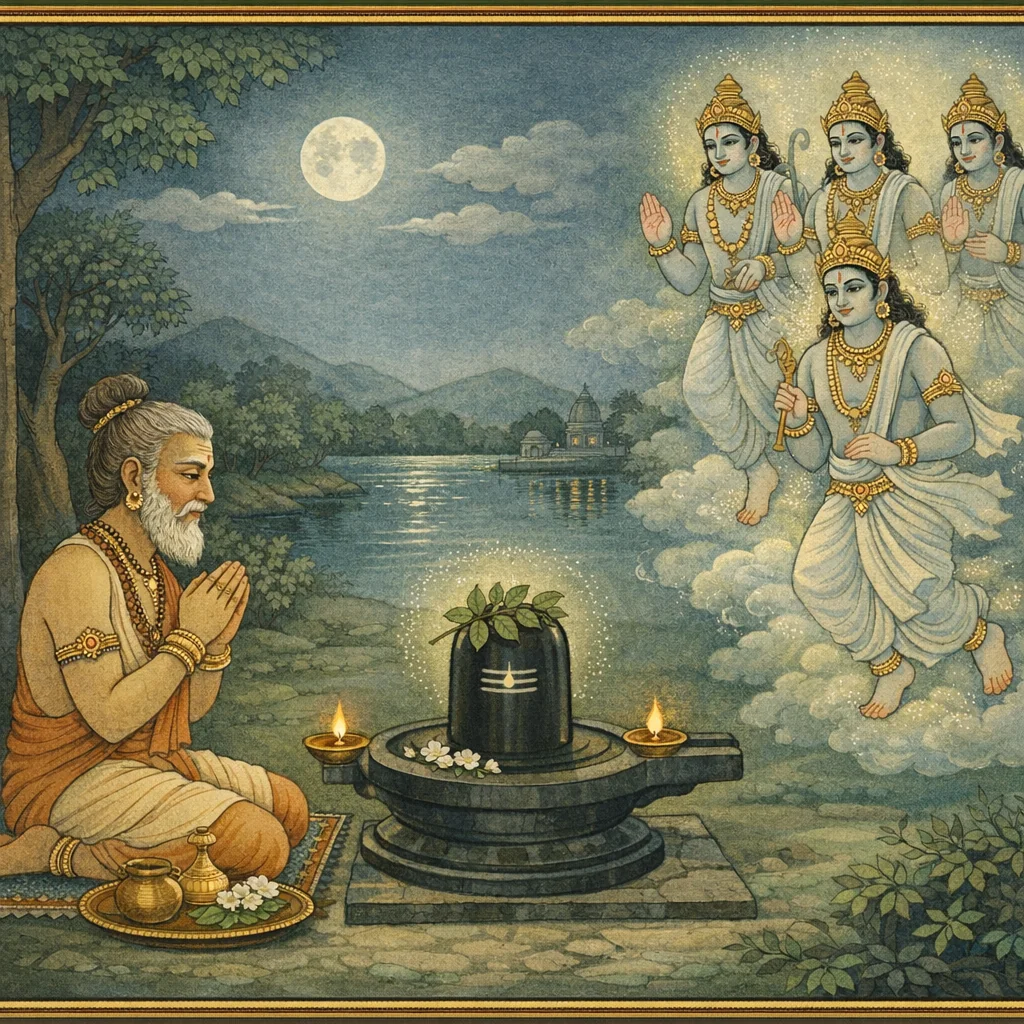
The chapter is framed as a dialogue: a king asks the sage Gautama about a wondrous scene witnessed on a journey. Gautama recounts that at midday, near a pure lake, he saw an aged caṇḍālī—blind, grievously diseased, and in extreme misery. As he watched with compassion, a radiant aerial chariot (vimāna) appeared, bearing four attendants of Śiva carrying Śaiva emblems. Gautama wonders why such divine emissaries would approach one socially despised and deemed morally fallen. The Śivadūtās explain karmic causality through her former life: she was once a Brahmin girl, later widowed, then entered transgressive relationships, took to meat and alcohol, and committed a grave wrong by killing a calf and trying to conceal it. After death she suffers punitive results and is reborn as a blind, afflicted caṇḍālī, living in deprivation. The narrative then highlights sacred time and place. During a Śiva-tithi pilgrimage flow toward Gokarṇa, she begs for food; a traveler tosses her a bilva sprig, which she rejects as inedible, yet it accidentally falls upon a Śiva-liṅga on the night of Śiva-caturdaśī, amid the spirit of fasting and vigil. That unintended bilva-offering, aligned with holy Gokarṇa and the auspicious moment, becomes the stated basis for Śiva’s compassionate uplift despite her heavy karma. The chapter closes by praising the māhātmya of Śiva worship—teaching that even minimal offerings can bear great power through grace—while still affirming her suffering as the ripening of past deeds.
Shlokas
Verse 1
राजोवाच । किं दृष्टं भवता ब्रह्मन्नाश्चर्यं पथि कुत्र वा । तन्ममाख्याहि येनाहं कृतकृत्यत्वमाप्नुयाम्
The King said: “O Brāhmaṇa, what wonder did you see upon the road, and where? Tell it to me, by which I too may attain the state of having accomplished what must be accomplished.”
Verse 2
गौतम उवाच । गोकर्णादहमागच्छन्क्वापि देशे विशांपते । जाते मध्याह्नसमये लब्ध वान्विमलं सरः
Gautama said: “As I was coming from Gokarṇa, O lord of the people, in a certain region—when midday had arrived—I came upon a clear and spotless lake.”
Verse 3
तत्रोपस्पृश्य सलिलं विनीय च पथिश्रमम् । सुस्निग्धशीतलच्छायं न्यग्रोधं समुपाश्रयम्
There, touching and bathing in the water and relieving the fatigue of travel, I took refuge beneath a nyagrodha— a banyan tree—whose shade was gentle and cool.
Verse 4
अथाविदूरे चांडालीं वृद्धामंधां कृशाकृतिम् । शुष्यन्मुखीं निराहारां बहुरोगनिपीडिताम्
Then, not far away, I saw a Cāṇḍāla woman—old, blind, and emaciated; her face parched, without food, and afflicted by many diseases.
Verse 5
कुष्ठव्रणपरीतांगीमुद्यत्कृमिकुलाकुलाम् । पूयशोणितसंसक्तजरत्पटल सत्कटीम्
I saw her body covered with leprous sores, swarming with rising clusters of worms, her aged skin clinging with pus and blood, her hips and frame wasted and deformed.
Verse 6
महायक्ष्मगलस्थेन कंठसंरोधविह्वलाम् । विनष्टदंतामव्यक्तां विलुठंतीं मुहुर्मुहुः
Afflicted by consumption lodged in her throat and gasping from choking constriction, toothless and barely able to speak, she kept collapsing again and again.
Verse 7
चंडार्ककिरणस्पृष्टखरोष्णरजसाप्लुताम् । विण्मूत्रपूयदिग्धांगीमसृग्गंधदुरासदाम्
Scorched by the fierce sun’s rays and coated in harsh, hot dust, her limbs were smeared with filth—stool, urine, and pus—so foul with the stench of blood that none could approach.
Verse 8
कफरोगबहुश्वासश्लथन्नाडीबहुव्यथाम् । विध्वस्तकेशावयवामपश्यं मरणोन्मुखीम्
I saw her tormented by phlegmatic disease and labored breathing, her nerves slack and pain manifold; her hair and limbs ruined—she was facing death.
Verse 9
तादृग्व्यथां च तां वीक्ष्य कृपयाहं परिप्लुतः । प्रतीक्षन्मरणं तस्याः क्षणं तत्रैव संस्थितः
Seeing her suffering of that kind, I was flooded with compassion; waiting for her death, I remained there on the spot for a moment.
Verse 10
अथांतरिक्षपदवीं सिंचंतमिव रश्मिभिः । दिव्यं विमानमानीतमद्राक्षं शिवकिंकरैः
Then I beheld a divine vimāna, brought by Śiva’s attendants, as though it were sprinkling the pathways of the sky with its rays.
Verse 11
तस्मिन्रवींदुवह्नीनां तेजसामिव पंजरे । विमाने सूर्यसंकाशानपश्यं शिवकिंकरान्
Within that vimāna—like a cage of the splendors of sun, moon, and fire—I saw Śiva’s attendants, radiant as the sun.
Verse 12
ते वै त्रिशूलखट्वांगटंकचर्मासिपाणयः । चंद्रार्धभूषणाः सांद्रचंद्रकुंदोरुवर्चसः
Indeed, they bore in their hands tridents, skull-topped staffs, axes, shields, and swords; adorned with the crescent moon, their splendor was dense and radiant like the moon and white jasmine blossoms.
Verse 13
किरीटकुंडलभ्राजन्महाहिवलयोज्ज्वलाः । शिवानुगा मया दृष्टा श्चत्वारः शुभलक्षणाः
Four auspiciously marked followers of Śiva I saw—shining with crowns and earrings, and radiant with great serpent-coils as their bracelets.
Verse 14
तानापतत आलोक्य विमानस्थान्सुविस्मितः । उपसृत्यांतिके वेगादपृच्छं गगने स्थितान्
Seeing them descend while stationed in the vimāna, I was greatly astonished; quickly drawing near, I questioned those who remained poised in the sky.
Verse 15
नमोनमो वस्त्रिदशोत्तमेभ्यस्त्रिलोचनश्रीचरणानुगेभ्यः । त्रिलोकरक्षाविधिमावहद्भ्यस्त्रिशूलचर्मासिगदाधरेभ्यः
Homage, homage to you—the best among the gods—devoted followers of the glorious feet of the Three-eyed Lord. You uphold the ordinance of guarding the three worlds, bearing trident, hide, sword, and mace!
Verse 16
अतोऽस्माभिरिहानीता निरयं यातु वा न वा । अनया साधितो बाल्ये पुण्यलेशोऽस्ति वा न वा
Therefore we have brought her here—whether she should go to hell or not. Tell us: in her childhood, did she accomplish even the slightest trace of merit (puṇya), or not?
Verse 17
उत सर्वजनाघौघविजयाय कृतोद्यमाः । ब्रूत कारुण्यतो मह्यं यस्माद्यूयमिहागताः
Or have you come, striving to conquer the flood of sins of all people? Out of compassion, tell me why you have arrived here.
Verse 18
शिवदूता ऊचुः । एषाग्रे दृश्यते वृद्धा चांडाली मरणोन्मुखी । एतामानेतुमायाताः संदिष्टा प्रभुणा वयम्
The Śiva-messengers said: “Here in front is seen an old caṇḍālī, an outcaste woman, facing death. Commanded by our Lord, we have come to bring her.”
Verse 19
इत्युक्ते शिवदूतैस्तैरपृच्छं पुनरप्यहम् । विस्मयाविष्टचित्तस्तान्कृतांजलिरवस्थितः
When those Śiva-messengers had spoken thus, I questioned them again. My mind filled with wonder, I stood before them with folded hands in reverence.
Verse 20
अहो पापीयसी घोरा चांडाली कथमर्हति । दिव्यं विमानमारोढुं शुनीवाध्वरमंडलम्
Alas—how can this dreadful woman, most sinful, a Caṇḍālī, be fit to mount the divine vimāna, like a she-dog entering the sacrificial enclosure?
Verse 21
आजन्मतोऽशुचिप्राया पापां पापा नुगामिनीम् । कथमेनां दुराचारां शिवलोकं निनीषथ
Impure for nearly her whole life, sinful and one who follows after sin—how will you take this ill-conducted woman to Śiva’s world?
Verse 22
अस्या नास्ति शिवज्ञानं नास्ति घोरतरं तपः । सत्यं नास्ति दया नास्ति कथमेनां निनीषथ
She has no knowledge of Śiva; she has performed no severe austerity. There is no truthfulness in her, no compassion—how will you take her away (to Śiva’s realm)?
Verse 23
पशुमांसकृताहारा वारुणीपूरितोदराम् । जीवहिंसारतां नित्यं कथमेनां निनीषथ
Her food is animal flesh; her belly is filled with liquor; ever devoted to harming living beings—how will you take her away (to Śiva’s realm)?
Verse 24
न च पंचाक्षरी जप्ता न कृतं शिवपूजनम् । न ध्यातो भगवाञ्छंभुः कथमेनां निनीषथ
Nor has she chanted the five-syllabled mantra; nor has she worshipped Śiva; nor has she meditated on the Blessed Śambhu—how will you take her away (to Śiva’s realm)?
Verse 25
नोपोषिता शिवतिथिर्न कृतं शिवपूजनम् । भूतसौहृदं न जानाति न च बिल्वशिवार्पणम् । नेष्टापूर्तादिकं वापि कथमेनां निनीषथ
She has not kept the fast on Śiva’s sacred tithis, nor has she performed the worship of Śiva. She knows no kindness toward living beings, nor the offering of bilva leaves to Śiva. Nor has she done the customary works of iṣṭa and pūrta and the like—how, then, do you intend to lead her to the supreme state?
Verse 26
न च स्नातानि तीर्थानि न दानानि कृतानि च । न च व्रतानि चीर्णानि कथमेनां निनीषथ
She has not bathed at sacred tīrthas, nor has she given gifts in charity; nor has she undertaken vows or practiced vrata—how, then, do you intend to take her to the higher goal?
Verse 27
ईक्षणे परिहर्त्तव्या किमु संभाषणादिषु । सत्संगरहितां चंडां कथमेनां निनीषथ
She is to be shunned even at the mere sight—what then of speaking with her and the like? Bereft of satsaṅga, harsh and fallen—how do you intend to lead her to the supreme end?
Verse 28
जन्मांतरार्जितं किंचिदस्याः सुकृतमस्ति वा । तत्कथं कुष्ठरोगण कृमिभिः परिभूयते
Does she have any merit at all, however slight, earned in former births? If so, how is she tormented by leprosy and overwhelmed by worms?
Verse 29
अहो ईश्वरचर्येयं दुर्विभाव्या शरीरिणाम् । पापात्मानोऽपि नीयंते कारुण्यात्परमं पदम्
Ah! This way of the Lord is hard for embodied beings to fathom. By His compassion, even sinners are led to the highest state.
Verse 30
इत्युक्तास्ते मया दूता देवदेवस्य शूलिनः । प्रत्यूचुर्मामथ प्रीत्या सर्वसंशयभेदिनः
Thus addressed by me, those messengers of the God of gods, the Trident-bearing Lord, replied to me with affection—dispellers of every doubt.
Verse 31
शिवदूता ऊचुः । ब्रह्मन्सुमहदाश्चर्यं शृणु कौतूहलं यदि । इमामुद्दिश्य चांडालीं यदुक्तं भवताधुना
The messengers of Śiva said: O Brahman, if you are curious, listen to this very great marvel—regarding this caṇḍāla woman and what you have just said about her.
Verse 32
आसीदियं पूर्वभवे काचिद्ब्राह्मणकन्यका । सुमित्रानाम संपूर्णसोमबिम्बसमानना
In a former birth, she was a brāhmaṇa maiden named Sumitrā, her face resembling the full disc of the moon.
Verse 33
उत्फुल्लमल्लिकादामसुकुमारांगलक्षणा । कैकेयद्विजमुख्यस्य कस्यचित्तनया सती
Her limbs were tender, as though adorned with garlands of blossoming jasmine; she was the virtuous daughter of a certain foremost brāhmaṇa of Kaikeya.
Verse 34
तां सर्वलक्षणोपेतां रतेर्मूर्तिमिवापराम् । वर्द्धमानां पितुर्गेहे वीक्ष्यासन्विस्मिता जनाः
Seeing her—endowed with every auspicious mark, like another embodiment of Ratī—growing up in her father’s house, people were filled with wonder.
Verse 35
दिनेदिने वर्धमाना बंधुभिर्लालिता भृशम् । सा शनैर्यौवनं भेजे स्मरस्येव महाधनुः
Day by day she grew, greatly cherished by her kinsfolk; and gradually she entered youth—like the mighty bow of Smara (Kāma) being strung for its work.
Verse 36
अथ सा बंधुवर्गैश्च समेतेन कुमारिका । पित्रा प्रदत्ता कस्मैचिद्विधिना द्विजसूनवे
Then that maiden, accompanied by her circle of relatives, was given by her father—according to due rite—to a certain son of a brāhmaṇa.
Verse 37
सा भर्त्तारमनुप्राप्य नवयौवनशालिनी । कंचित्कालं शुभाचारा रेमे बंधुभिरावृता
Having reached her husband, adorned with fresh youth, she lived for some time with good conduct, dwelling happily, surrounded by her relatives.
Verse 38
अथ कालवशात्तस्याः पतिस्तीव्र रुजार्दितः । रूपयौवनकांतोपि पंचत्वमगमन्मुने
Then, by the force of time, her husband—afflicted with severe pain—though possessed of beauty, youth, and charm, went to the state of the five elements, O sage (i.e., he died).
Verse 39
मृते भर्त्तरि दुःखेन विदग्धहदया सती । उवास कतिचिन्मासान्सुशीला विजितें द्रिया
When her husband had died, that virtuous woman—her heart scorched by grief—lived for some months, well-mannered and self-controlled.
Verse 40
अथ यौवनभारेण जृंभमाणेन नित्यशः । बभूव हृदयं तस्याः कंदपर्परिकंपितम्
Then, as the weight of youth swelled day after day, her heart began to tremble—shaken by the stirring of Kāma.
Verse 41
सा गुप्ता बन्धुवर्गेण शासितापि महोत्तमैः । न शशाक मनो रोद्धं मदनाकृष्टमंगना
Though guarded by her kin and even instructed by the most venerable elders, the woman could not restrain her mind, drawn by Madana (Kāma).
Verse 42
सा तीव्रमन्मथाविष्टा रूपयौवनशालिनी । विधवापि विशेषेण जारमार्गरताभवत्
Overpowered by fierce desire, and endowed with beauty and youth, she—though a widow—became especially devoted to the path of illicit lovers.
Verse 43
न ज्ञाता केनचिदपि जारिणीति विचक्षणा । जुगूहात्मदुराचारं कंचित्कालमसत्तमा
Cleverly, she was not known by anyone to be unfaithful; that worst of the unrighteous concealed her own misconduct for some time.
Verse 44
तां दोहदसमाक्रांतां घननीलमुखस्तनीम् । कालेन बंधुवर्गोपि बुबोध विटदूषिताम्
In time, even her relatives came to understand that she—overcome by the cravings of pregnancy, with darkened face and breasts—had been corrupted by a libertine.
Verse 45
इति भीतो महाक्लेशाच्चिंता लेभे दुरत्ययाम् । स्त्रियः कामेन नश्यंति ब्राह्मणा हीनसेवया
Thus speaking, terrified by a great affliction, he fell into an overwhelming anxiety: “Women are ruined by lust, and brāhmaṇas are ruined by serving the unworthy and sinking into base dependence.”
Verse 46
राजानो ब्रह्मदंडेन यतयो भोगसंग्रहात् । लीढं शुना तथैवान्नं सुरया वार्पितं पयः
Kings are struck down by the brāhmaṇa’s rod of chastisement, and ascetics fall through hoarding enjoyments. Likewise, food licked by a dog and milk polluted by liquor are to be regarded as defiled.
Verse 47
रूपं कुष्ठरुजाविष्टं कुलं नश्यति कुस्त्रिया । इति सर्वे समालोच्य समेताः पतिसोदराः
“Beauty becomes afflicted with the pain of leprosy; a family is destroyed by a wicked woman.” Having deliberated thus, all the husband’s brothers assembled together.
Verse 48
तत्यजुर्गोत्रतो दूरं गृहीत्वा सकचग्रहम् । सघटोत्सर्गमुत्सृष्टा सा नारी सर्वबन्धुभिः
They cast her far away from the clan, taking her along with her belongings; that woman was expelled by all her relatives, with the formal act of dismissal performed.
Verse 49
विचरंती च शूद्रेण रममाणा रतिप्रिया । सा ययौ स्त्री बहिर्यामा दृष्टा शूद्रेण केनचित्
Wandering about with a śūdra, delighting in pleasure and fond of sensual enjoyment, the woman went out at night—and was seen by a certain śūdra.
Verse 50
स तां दृष्ट्वा वरारोहां पीनोन्नतपयोधराम् । गृहं निनाय साम्ना च विधवां शूद्रनायकः । सा नारी तस्य महिषी भूत्वा तेन दिवानिशम्
Seeing her—graceful in form, with full, uplifted breasts—the śūdra leader, with gentle words, coaxed that widow and brought her to his house. Becoming his consort, that woman remained with him day and night.
Verse 51
रममाणा क्वचिद्देशे न्यवसद्गृहवल्लभा । तत्र सा पिशिताहारा नित्यमापीतवारुणी
Living in enjoyment in some place as the beloved of the household, there she became one who ate meat and continually drank liquor.
Verse 52
लेभे सुतं च शूद्रेण रममाणा रतिप्रिया । कदाचिद्भर्त्तरि क्वापि याते पीतसुरा तु सा
Delighting in pleasure, she—fond of sensuality—also bore a son by the śūdra. Once, when her husband had gone somewhere, she drank liquor.
Verse 53
इयेष पिशिताहारं मदिरामदविह्वला । अथ मेषेषु बद्धेषु गोभिः सह बहिर्व्रजे
Reeling from the intoxication of liquor, she craved meat. Then, when the sheep were tied up, she went outside to the cattle-pen along with the cows.
Verse 54
ययौ कृपाणमादाय सा तमींधे निशामुखे । अविमृश्य मदावेशान्मेषबुद्ध्यामिषप्रिया
At the onset of night, she took a knife and went into the darkness. Without reflection—overpowered by drunkenness—fond of meat, she acted under the mistaken notion that it was a sheep.
Verse 55
एकं जघानं गोवत्सं क्रोशंतं निशि दुर्भगा । निहतं गृहमानीय ज्ञात्वा गोवत्समंगना
At night, that ill-fated woman struck down a calf that was crying out; and having brought the slain calf into the house, the woman recognized it as a cow-calf.
Verse 56
भीता शिवशिवेत्याह केनचित्पुण्यकर्मणा । सा मुहूर्तमिति ध्यात्वा पिशितासवलालसा
Frightened, she cried, “Śiva, Śiva!”—through some remnant of past merit; yet, after thinking for a moment, she—craving flesh and strong drink—returned to her intent.
Verse 57
छित्त्वा तमेव गोवत्सं चकाराहारमीप्सितम् । गोवत्सार्धशरीरेण कृताहाराथ सा पुनः
Cutting up that very calf, she prepared the food she desired; and after making her meal from half the calf’s body, she again proceeded further.
Verse 58
तदर्धदेहं निक्षिप्य बहिश्चुक्रोश कैतवात् । अहो व्याघ्रेण भग्नोऽयं जग्धो गोवत्सको व्रजे
Throwing the half-body outside, she cried out deceitfully: “Alas! In the cattle-settlement this calf has been attacked by a tiger and eaten!”
Verse 59
इति तस्याः समाक्रंदः सर्वगेहेषु शुश्रुवे । अथ सर्वे शूद्रजनाः समागम्यांतिके स्थिताः
Thus her wailing was heard in all the houses. Then all the Śūdra folk gathered together and stood nearby.
Verse 60
हतं गोवत्समालोक्य व्याघ्रेणेति शुचं ययुः । गतेषु तेषु सर्वेषु व्युष्टायां च ततो निशि
Seeing the slain calf, they sank into grief, thinking, “It was a tiger.” When all of them had departed, and that night had passed into dawn, the tale went on.
Verse 61
तद्भर्ता गृहमागत्य दृष्टवान्गृहविड्वरम् । एवं बहुतिथे काले गते सा शूद्ववल्लभा
Her husband came home and saw the filth within the house. Thus, after a long time had passed, that woman—beloved of the Śūdra—(met her destined end).
Verse 62
कालस्य वशमापन्ना जगाम यममंदिरम् । यमोपि धर्ममालोक्य तस्याः कर्म च पौर्विकम्
Fallen under the dominion of Time, she went to Yama’s abode. Yama too, beholding dharma and her former deeds, (weighed her case).
Verse 63
निर्वत्र्य निरयावासाञ्चक्रे चंडालजातिकाम् । सापि भ्रष्टा यमपुराच्चांडालीगर्भमाश्रिता
Assigning her to abodes in hell, he made her of Caṇḍāla birth. And she too, cast down from Yama’s city, entered the womb of a Caṇḍālī woman.
Verse 64
ततो बभूव जात्यंधा प्रशांतांगारमेचका । तत्पिता कोपि चांडालो देशे कुत्रचिदास्थितः
Then she was born blind from birth, dark-hued like quenched charcoal. Her father was some Caṇḍāla living in a certain place.
Verse 65
तां तादृशीमपि सुतां कृपया पर्यपोषयत् । अभोज्येन कदन्नेन शुना लीढेन पूतिना
Though his daughter was in such a pitiable state, he still sustained her out of compassion—feeding her unfit, wretched food, impure and foul, licked by a dog.
Verse 66
अपेयैश्च रसैर्मात्रा पोषिता सा दिनेदिने । जात्यंधा सापि कालेन बाल्ये कुष्ठरुजार्दिता
Day after day her mother sustained her even with undrinkable liquids; and though blind from birth, in time—while still a child—she was also afflicted by the pain of leprosy.
Verse 67
ऊढा न केनचिद्वापि चांडालेनातिदुर्भगा । अतीतबाल्ये सा काले विध्वस्तपितृमातृका
Most unfortunate, she was taken as a wife by no one at all—only a caṇḍāla took her; and when her childhood had passed, in time she was left orphaned, her father and mother having perished.
Verse 68
दुर्भगेति परित्यक्ता बंधुभिश्च सहोदरैः । ततः क्षुधार्दिता दीना शोचन्ती विगतेक्षणा
Branded as ‘unlucky’, she was abandoned by her relatives and even by her own siblings. Then, tormented by hunger, wretched and grieving, she wandered on—bereft of sight.
Verse 69
गृहीतयष्टिः कृच्छ्रेण संचचाल सलोष्टिका । पत्तनेष्वपि सर्वेषु याचमाना दिनेदिने
Holding a staff, she moved about with difficulty, carrying her little bundle, begging day after day in every town.
Verse 70
चांडालोच्छिष्टपिंडेन जठराग्निमतर्पयत् । एवं कृच्छ्रेण महता नीत्वा सुबहुलं वयः
With morsels left by a caṇḍāla she scarcely appeased the fire within her belly. Thus, through great hardship, she endured and lived on for many years.
Verse 71
जरया ग्रस्तसर्वांगी दुःखमाप दुरत्ययम् । निरन्नपानवसना सा कदाचिन्महाजनान्
Her whole body seized by old age, she fell into suffering hard to endure. Without food, drink, or clothing, at one time she came upon great crowds of people.
Verse 72
आयास्यंत्यां शिवतिथौ गच्छतो बुबुधेऽध्वगान् । तस्यां तु देवयात्रायां देशदेशांतयायिनाम्
On a sacred day of Śiva, as the procession set forth, she noticed travelers upon the road. For that divine pilgrimage, people journeyed from region to region and from distant lands.
Verse 73
विप्राणां साग्निहोत्राणां सस्त्रीकाणां महात्मनाम् । राज्ञां च सावरोधानां सहस्तिरथवाजिनाम्
There were brāhmins—great-souled, upholding the agnihotra rites—together with their wives; and kings as well, with their inner households, attended by elephants, chariots, and horses.
Verse 74
सपरीवारघोषाणां यानच्छत्रादिशोभिनाम् । तथान्येषां च विट्शूद्रसंकीर्णानां सहस्रशः
There were processions resounding with the clamor of attendants, splendid with vehicles, parasols, and other adornments; and thousands of others too—mixed crowds including vaiśyas and śūdras.
Verse 75
हसतां गायतां क्वापि नृत्यतामथ धावताम् । जिघ्रतां पिबतां कामाद्गच्छतां प्रतिगर्जताम्
Some were laughing; some were singing here and there; others were dancing and then running about—some sniffing, some drinking as they pleased—while others pressed on, calling out to one another.
Verse 76
संप्रयाणे मनुष्याणां संभ्रमः सुमहानभूत् । इति सर्वेषु गच्छत्सु गोकर्णं शिवमंदिरम्
As the people set out, a very great commotion arose. Thus, as all proceeded, they made for Gokarṇa—the temple of Śiva.
Verse 77
पश्यंति दिविजाः सर्वे विमानस्थाः सकौतुकाः । अथेयमपि चांडाली वसनाशनतृष्णया
All the gods, seated in their aerial vimānas, watched with curiosity. Then this Caṇḍālī woman too, driven by longing for clothing and food, (set forth).
Verse 78
महाजनान्याचयितुं चचाल च शनैःशनैः । करावलंबेनान्यस्याः प्राग्जन्मार्जितकर्मणा । दिनैः कतिपयैर्याती गोकर्णं क्षेत्रमाययौ
To beg from the crowds she moved on, little by little, supported by another’s hand—impelled by deeds earned in a former birth. After travelling for a few days, she reached the sacred kṣetra of Gokarṇa.
Verse 79
ततो विदूरे मार्गस्य निषण्णा विवृतांजलिः । याचमाना मुहुः पांथान्बभाषे कृपणं वचः
Then, seated at a distance from the road with hands held out in supplication, she repeatedly begged the travelers, speaking pitiful words.
Verse 80
प्राग्जन्मार्जितपापौघैः पीडितायाश्चिरं मम । आहारमात्रदानेन दयां कुरुत भो जनाः
Long have I been tormented by floods of sins amassed in former births. O people, show me compassion—by granting only a little food.
Verse 82
वसनाशनहीनायां स्वपितायां महीतले । महापांसुनिमग्नायां दयां कुरुत भो जनाः
Without clothing and food, sleeping on the bare ground, sunk in heaps of dust—O people, show compassion to me.
Verse 83
महाशीतातपार्त्तायां पीडितायां महारुजा । अन्धायां मयि वृद्धायां दयां कुरुत भो जनाः
Afflicted by bitter cold and scorching heat, tormented by severe pain—blind and aged as I am—O people, show me compassion.
Verse 84
चिरोपवासदीप्तायां जठराग्निविवर्धनैः । संदह्यमानसर्वांग्यां दयां कुरुत भो जनाः
With my belly-fire inflamed by long fasting, burning through all my limbs—O people, show compassion to me.
Verse 85
अनुपार्जितपुण्यायां जन्मांतरशतेष्वपि । पापायां मंदभाग्यायां दयां कुरुत भो जनाः
Even across hundreds of lifetimes I have not gathered merit; sinful and of poor fortune as I am—O people, show compassion to me.
Verse 86
एवमभ्यर्थयंत्यास्तु चांडाल्याः प्रसृतेंऽजलौ । एकः पुण्यतमः पांथः प्राक्षिपद्बिल्वमंजरीम्
As that Caṇḍāla woman begged with her hands cupped in supplication, an exceedingly virtuous traveler tossed a cluster of bilva blossoms into her outstretched palms.
Verse 87
तामंचलौ निपतितां सा विमृश्य पुनः पुनः । अभक्ष्येत्येव मत्वाथ दूरे प्राक्षिपदातुरा
Seeing it fall into her cupped hands, she examined it again and again; then, thinking, “This is not fit to be eaten,” the distressed woman threw it far away.
Verse 88
तस्याः करेण निर्मुक्ता रात्रौ सा बिल्वमंजरी । पपात कस्यचिद्दिष्ट्या शिवलिंगस्य मस्तके
Released from her hand at night, that bilva cluster—by someone’s destined good fortune—fell upon the head of a Śiva-liṅga.
Verse 89
सैवं शिवचतुर्दश्यां रात्रौ पांथजनान्मुहुः । याचमानापि यत्किंचिन्न लेभे दैवयोगतः
Thus, on the night of Śiva-caturdaśī (Śivarātri), though she begged travelers again and again, she obtained nothing at all—by the workings of fate.
Verse 90
तत्रोषितानया रात्रिर्भद्रकाल्यास्तु पृष्ठतः । किंचिदुत्तरतः स्थानं तदर्धेनातिदूरतः
She spent the night there—behind the shrine of Bhadrakālī—at a spot a little to the north, not very far away (about half a measure).
Verse 91
ततः प्रभाते भ्रष्टाशा शोकेन महताप्लुता । शनैर्निववृते दीना स्वदेशायैव केवला
Then, at daybreak, her hopes shattered and overwhelmed by great sorrow, the wretched woman slowly turned back—alone—toward her own country.
Verse 92
श्रांता चिरोपवासेन निपतन्ती पदेपदे । क्रंदंती वहुरोगार्ता वेपमाना भृशातुरा
Exhausted by long fasting, she kept collapsing at every step—crying aloud, afflicted by many illnesses, trembling, and intensely distressed.
Verse 93
दह्यमानार्कतापेन नग्नदेहा सयष्टिका । अतीत्यैतावतीं भूमिं निपपात विचेतना
Burned by the sun’s heat, naked-bodied and leaning on a staff, after going only so far she fell down, unconscious.
Verse 94
अथ विश्वेश्वरः शंभुः करुणामृतवारिधिः । एनामानयतेत्त्यस्मान्युयुजे सविमानकान्
Then Lord Śambhu, the Lord of the universe—an ocean of compassion’s nectar—arranged to bring her from that place, commissioning celestial attendants with their aerial chariots.
Verse 96
एषा प्रवृत्तिश्चांडाल्यास्तवेह परिकीर्त्तिता । तथा संदर्शिता शंभोः कृपणेषु कृपालुता । कर्मणः परिपाकोत्थां गतिं पश्य महामते । अधमापि परं स्थानमारोहति निरामयम्
This entire account of the Caṇḍāla woman has been narrated to you here. In it, Śambhu’s compassion toward the helpless is clearly shown. Behold, O great-minded one, the destiny born of ripened karma: even the lowliest may ascend to the supreme, sorrowless state.
Verse 97
यदेतया पूर्वभवे नान्नदानादिकं कृतम् । क्षुत्पिपासादिभिः क्लेशैस्तस्मादिह निपीड्यते
Because in a former life she did not perform gifts such as the giving of food, therefore in this life she is pressed by afflictions like hunger, thirst, and the like.
Verse 98
यदेषा मदवेगांधा चक्रे पापं महोल्बणम् । कर्मणा तेन जात्यंधा बभूवात्रैव जन्मनि
Because she, blinded by the rush of intoxication, committed a grievous sin, by that very karma she was born blind in this very life.
Verse 99
अपि विज्ञाय गोवत्सं यदेषाऽभक्षयत्पुरा । कर्मणा तेन चांडाली बभूवेह विगर्हिता
Even though she knew it was a calf, when she once ate it, by that karma she became here a despised outcaste woman.
Verse 100
यदेषार्यपथं हित्वा जारमार्गरता पुरा । तेन पापेन केनापि दुर्वृत्ता दुर्भगापि वा
Because she abandoned the noble path and formerly delighted in the way of illicit lovers, by that sin she became in this life of bad conduct and ill-fated as well.
Verse 101
यदाश्लिष्य मदाविष्टा जारेण विधवा पुरा । तेन पापेन महता बहुकुष्ठव्रणान्विता
Because once a widow, overcome by intoxication, embraced a paramour, by that great sin she became afflicted with many leprous sores.
Verse 110
बुधो न कुरुते पापं यदि कुर्यात्स आत्महा । देहोऽयं मानुषो जंतोर्बहुकर्मैकभाजनम्
A wise person does not commit sin; if he were to do so, he would be a slayer of his own self. For this human body of a being is the single vessel for accomplishing many kinds of actions and merits.
Verse 120
अथापि नरकावासं प्रायशो नेयमर्हति । किंतु गोवत्सकं हत्वा विमृश्यागतसाध्वसा
Even so, she generally would not deserve residence in hell; but having killed a calf, and then reflecting, she was seized by fear and remorse.
Verse 130
श्रीगोकर्णे शिवतिथावुपोष्य शिवमस्तके । कृत्वा जागरणं ह्येषा चक्रे बिल्वार्पणं निशि
At sacred Gokarṇa, on Śiva’s holy lunar day (tithi), she observed a fast; keeping vigil through the night, she offered bilva leaves upon the head of Śiva, the liṅga.
Verse 140
अहो ईश्वरपूजाया माहात्म्यं विस्मयावहम् । पत्रमात्रेण संतुष्टो यो ददाति निजं पदम्
Ah! Wondrous indeed is the greatness of worship of the Lord: pleased with merely a single leaf, He grants His own supreme abode.
Verse 150
प्रत्याहारासन ध्यानप्राणसंयमनादिभिः । यत्र योगपथैः प्राप्तुं यतते योगिनः सदा
That supreme state which yogins ever strive to attain by the paths of yoga—through disciplines such as withdrawal of the senses, posture (āsana), meditation (dhyāna), and regulation of the life-breath (prāṇa), and the like.
Verse 160
इत्यामन्त्र्य मुनिः प्रीत्या गौतमो मिथिलां ययौ । सोऽपि हृष्टमना राजा गोकर्णं प्रत्यपद्यत
Thus, taking leave with affection, the sage Gautama departed for Mithilā. And that king too, gladdened at heart, set out for Gokarṇa.
Verse 164
इति कथितमशेषं श्रेयसामादिबीजं भवशतदुरितघ्नं ध्वस्तमोहांधकारम् । चरितममरगेयं मन्मथारेरुदारं सततमपि निषेव्यं स्वस्तिमद्भिश्च लोकैः
Thus has been fully related the primal seed of all true welfare—destroyer of the sins of hundreds of births and dispeller of the darkness of delusion: the noble deed of Śiva, the Foe of Manmatha, sung by the gods, ever to be cherished and practiced by the righteous.