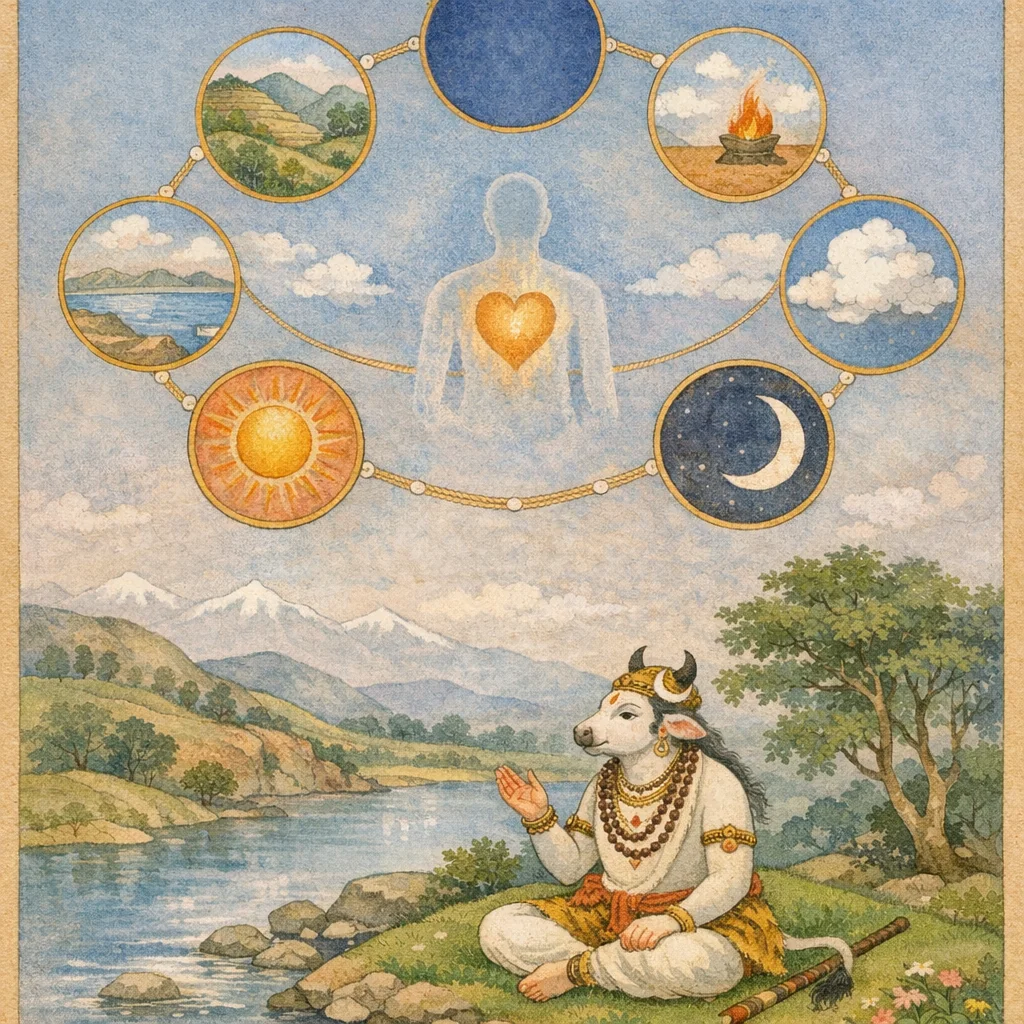
Śivāṣṭamūrti-varṇanam (Description of Shiva’s Eight Forms)
Framed as Nandīśvara’s instruction, this adhyāya teaches that the world is “mūrty-aṣṭaka-maya,” constituted by Śiva’s eightfold embodiment, and that the universe abides in Him like beads strung on a thread. It then lists the renowned eight mūrtis—Śarva, Bhava, Rudra, Ugra, Bhīma, Paśupati, Īśāna, Mahādeva—and correlates them with their governing domains: earth, water, fire, wind, space, the kṣetrajña (indwelling knower), the sun, and the moon. Each form is defined in functional and ontological terms: Bhava as the life-giving watery principle; Ugra as the dynamic force sustaining inner and outer movement; Bhīma as the all-pervading spatial expanse; Paśupati as the inner ground of all selves and the cutter of bonds. The teaching serves as an esoteric taxonomy for ritual contemplation, aligning divine names with elemental and psychological realities to support coherent Śaiva metaphysics and practice.
Shlokas
Verse 1
नन्दीश्वर उवाच । शृणु तात महेशस्यावतारान्परमान्प्रभो । सर्वकार्यकरांल्लोके सर्वस्य सुखदान्मुने
Nandīśvara said: “Listen, dear one—O noble lord. I shall speak of the supreme descents (avatāras) of Maheśa, who accomplish every undertaking in the world and bestow well-being and joy upon all, O sage.”
Verse 2
इति श्रीशिवमहापुराणे तृतीयायां शतरुद्रसंहितायां शिवाष्टमूर्त्तिवर्णनं नाम द्वितीयोऽध्यायः
Thus ends the second chapter, called “The Description of Shiva’s Eight Forms,” in the third section of the holy Shiva Mahāpurāṇa, namely the Śatarudra Saṃhitā.
Verse 3
शर्वो भवस्तथा रुद्र उग्रो भीमः पशो पतिः । ईशानश्च महादेवो मूर्तयश्चाष्ट विश्रुताः
“Śarva”, “Bhava”, “Rudra”, “Ugra”, “Bhīma”, “Paśupati”, “Īśāna”, and “Mahādeva”—these are proclaimed as the eight renowned mūrtis (manifestations) of Lord Śiva, the Supreme Pati who rules and liberates the bound paśus (souls).
Verse 4
भूम्यंभोग्निमरुद्व्योमक्षेत्रज्ञार्कनिशाकराः । अधिष्ठिताश्च शर्वाद्यैरष्टरूपैः शिवस्य हि
Earth, water, fire, wind, space, the knower of the field (the indwelling Self), the sun, and the moon—all are indeed presided over, pervaded, and governed by Shiva’s eight forms beginning with Śarva.
Verse 5
धत्ते चराचरं विश्वं रूपं विश्वंभरात्मकम् । शंकरस्य महेशस्य शास्त्रस्यैवेति निश्चयः
Śaṅkara, the Great Lord (Maheśa), upholds the entire universe—both the moving and the unmoving—by assuming the form that sustains all. This is the settled conclusion of the sacred teaching.
Verse 6
संजीवनं समस्तस्य जगतः सलिलात्मकम् । भव इत्युच्यते रूपं भवस्य परमात्मनः
That which is the life-giving sustenance of the entire world, having the nature of water, is called the form “Bhava”—the manifestation of Bhava, the Supreme Self.
Verse 7
बहिरंतर्जगद्विश्वं बिभर्ति स्पन्दतेस्य यम् । उग्र इत्युच्यते सद्भी रूपमुग्रस्य सत्प्रभो
O noble lord, that form of Shiva is called “Ugra” by the wise—He who upholds the entire universe, outwardly and inwardly, and by whose power it pulsates and vibrates into activity.
Verse 8
सर्वावकाशदं सर्वव्यापकं गगनात्मकम् । रूपं भीमस्य भीमाख्यं भूपवृन्दस्व भेदकम्
The form of Bhīma—called “Bhīma”—bestows all space, pervades everything, and is of the very nature of the sky (ākāśa). It shatters the pride and self-importance of multitudes of kings.
Verse 9
सर्वात्मनामधिष्ठानं सर्वक्षेत्रनिवासकम् । रूपं पशुपतेर्ज्ञेयं पशुपाशनिकृन्तनम्
Know this to be the form of Paśupati: the sustaining ground of all selves, dwelling in every field of existence, and the One who cuts asunder the bonds (pāśas) that bind the individual souls (paśus).
Verse 10
सन्दीपयञ्जगत्सर्वं दिवाकरसमाह्वयम् । ईशानाख्यं महेशस्य रूपं दिवि विसर्पति
Illumining the entire universe, the sun-like form so named spreads through the heavens—this is the Īśāna form of Mahādeva, expanding in the celestial realm.
Verse 11
आप्याययति यो विश्वममृतांशुर्निशाकरः । महादेवस्य तद्रूपं महादेवस्य चाह्वयम्
He who nourishes and refreshes the whole universe—the moon, the bearer of nectar-rays—this is a form of Mahādeva; and it is also one of Mahādeva’s sacred names.
Verse 12
आत्मा तस्याष्टमं रूपं शिवस्य परमात्मनः । व्यापिकेतरमूर्तीनां विश्वं तस्माच्छिवात्मकम्
The individual Self (Ātman) is the eighth form of Shiva, the Supreme Self (Paramātman). Therefore, among His forms—both the all-pervading and the localized—the entire universe is, in essence, made of Shiva.
Verse 13
शाखाः पुष्यन्ति वृक्षस्य वृक्षमूलस्य सेचनात् । तद्वदस्य वपुर्विश्वं पुष्यते च शिवार्चनात
Just as a tree’s branches thrive when its root is watered, so this entire universe—being His very body—flourishes through the worship of Lord Śiva.
Verse 14
यथेह पुत्रपौत्रादेः प्रीत्या प्रीतो भवेत्पिता । तथा विश्वस्य सम्प्रीत्या प्रीतो भवति शंकरः
Just as a father is delighted by the loving devotion of his sons, grandsons, and the rest, so Śaṅkara is pleased by the sincere loving devotion of the whole world.
Verse 15
क्रियते यस्य कस्यापि देहिनो यदि निग्रहः । अष्टमूर्त्तेरनिष्टं तत्कृतमेव न संशयः
If restraint or harm is inflicted upon any embodied being whatsoever, know without doubt that such an undesirable act is done against the Eight-Formed Lord, Aṣṭamūrti Śiva, Himself.
Verse 16
अष्टमूर्त्यात्मना विश्वमधिष्ठायास्थितं शिवम् । भजस्व सर्वभावेन रुद्रं परमकारणम्
Worship with your whole being that auspicious Rudra—Śiva—who, as the Self of the eightfold forms, pervades and upholds the universe, remaining established within it as its supreme cause.
Verse 17
इति प्रोक्ताः स्वरूपास्ते विधिपुत्राष्टविश्रुताः । सर्वोपकारनिरताः सेव्याः श्रेयोर्थिभिर्नरैः
Thus have those forms been declared—eight renowned ones associated with the sons of Vidhi (Brahmā). Ever intent on granting every kind of beneficence, they are to be reverently worshipped by people who seek the highest good.
Frequently Asked Questions
It argues that the cosmos is constituted by Śiva’s eightfold manifestation and remains pervaded by Him—like beads on a thread—so plural phenomena are unified through a single divine ground.
The mapping turns cosmology into a meditative and ritual schema: worship of a name/form becomes contemplation of the corresponding principle (element, luminary, or inner knower), integrating external rite with internal realization of Śiva’s pervasion.
The chapter highlights the eight mūrtis—Śarva, Bhava, Rudra, Ugra, Bhīma, Paśupati, Īśāna, Mahādeva—correlated with earth, water, fire, wind, space, the kṣetrajña, sun, and moon as Śiva’s governing presences.