Sukta 50
Sukta 5.50
Atri (Ātreya)
Deva as Netṛ (the Divine Leader/Guide) (often read as Savitṛ/Pūṣan-like guiding power; hymn context needed for precision)
Gāyatrī/Anuṣṭubh-like brevity is possible, but Mandala 5 commonly uses Triṣṭubh; requires metrical verification
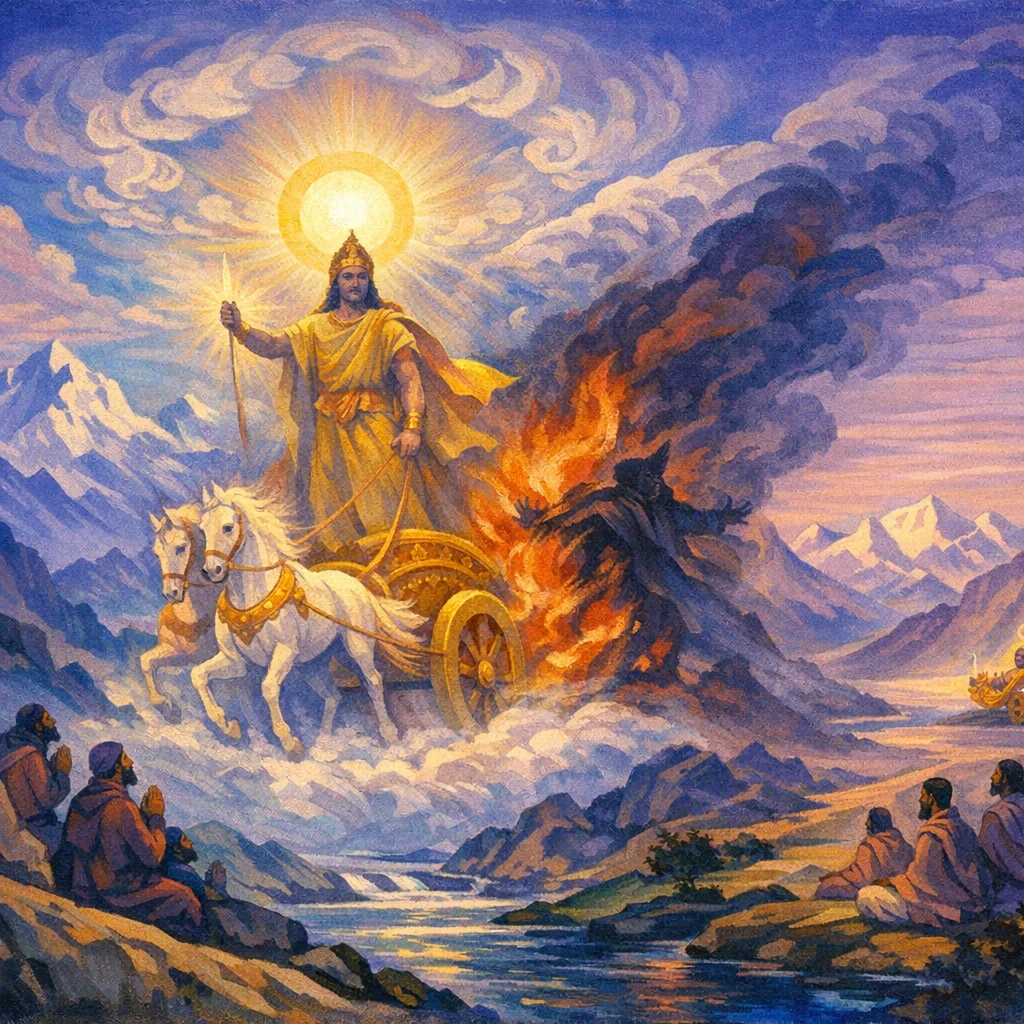
This brief Atri hymn invokes the Deva as Netṛ, the divine Guide who leads the human being on the right path, granting friendship, protection, and increase of rayi (substance/wealth) and dyumna (luminous power). It combines a personal aspiration—choosing the Leader’s companionship—with a ritual-social prayer for welcomed guests and the honoring of the patnīs (supporting consort-powers), while driving away hostility from the path. The hymn culminates in a peace-blessing (śam) tied to the chariot-lord who steers movement safely toward well-being (svasti).
Mantras
Mantra 1
विश्वो देवस्य नेतुर्मर्तो वुरीत सख्यम् । विश्वो राय इषुध्यति द्युम्नं वृणीत पुष्यसे ॥
Every mortal seeks the friendship of the divine Leader; each one arms himself for the plenitude of inner wealth, choosing luminous power and growth for his increase.
Mantra 2
ते ते देव नेतर्ये चेमाँ अनुशसे । ते राया ते ह्यापृचे सचेमहि सचथ्यैः ॥
Those are yours, O divine Leader, whom we follow in obedience; with them, with your wealth and your near-touching presence, may we unite in the true companionship of the journey.
Mantra 3
अतो न आ नॄनतिथीनतः पत्नीर्दशस्यत । आरे विश्वं पथेष्ठां द्विषो युयोतु यूयुविः ॥
Therefore bring to us the men and the welcomed powers, and therefore honour the lady-forces that uphold the home of the sacrifice. Far away, from the very standing-place of the path, let the hater be driven off by the one who keeps us safe.
Mantra 4
यत्र वह्निरभिहितो दुद्रवद्द्रोण्यः पशुः । नृमणा वीरपस्त्योऽर्णा धीरेव सनिता ॥
Where the bearer of the offering, once set in front, runs swiftly like a creature of the trough; there the force that thinks in man and works heroically wins the streams, like a steady mind that knows how to gain.
Mantra 5
एष ते देव नेता रथस्पतिः शं रयिः । शं राये शं स्वस्तय इषःस्तुतो मनामहे देवस्तुतो मनामहे ॥
This is your guiding force, O divine Leader—the lord of the chariot: a peace that is wealth. Peace for our plenitude, peace for our well-being; praised by the powers of impulse, praised by the gods, we hold it in our thought and assent.
Frequently Asked Questions
Netṛ means “leader” or “guide.” In this hymn it is a divine guiding power—often understood as Savitṛ/Pūṣan-like—who leads safely on the path, grants increase, and removes obstacles.
It asks for friendship with the divine Guide, growth in prosperity and radiance (rayi and dyumna), welcoming supportive forces (guests and patnīs), and protection by driving hostile influences away from one’s path.
The chariot symbolizes directed movement and progress. Calling the deity rathaspati emphasizes safe guidance—steering one’s journey, work, or inner progress toward peace (śam) and well-being (svasti).