Sarga 45
विशालानगरीप्रवेशः — Entry toward Viśālā and the Indra–Kṣīrodamathana Legend
बालकाण्ड
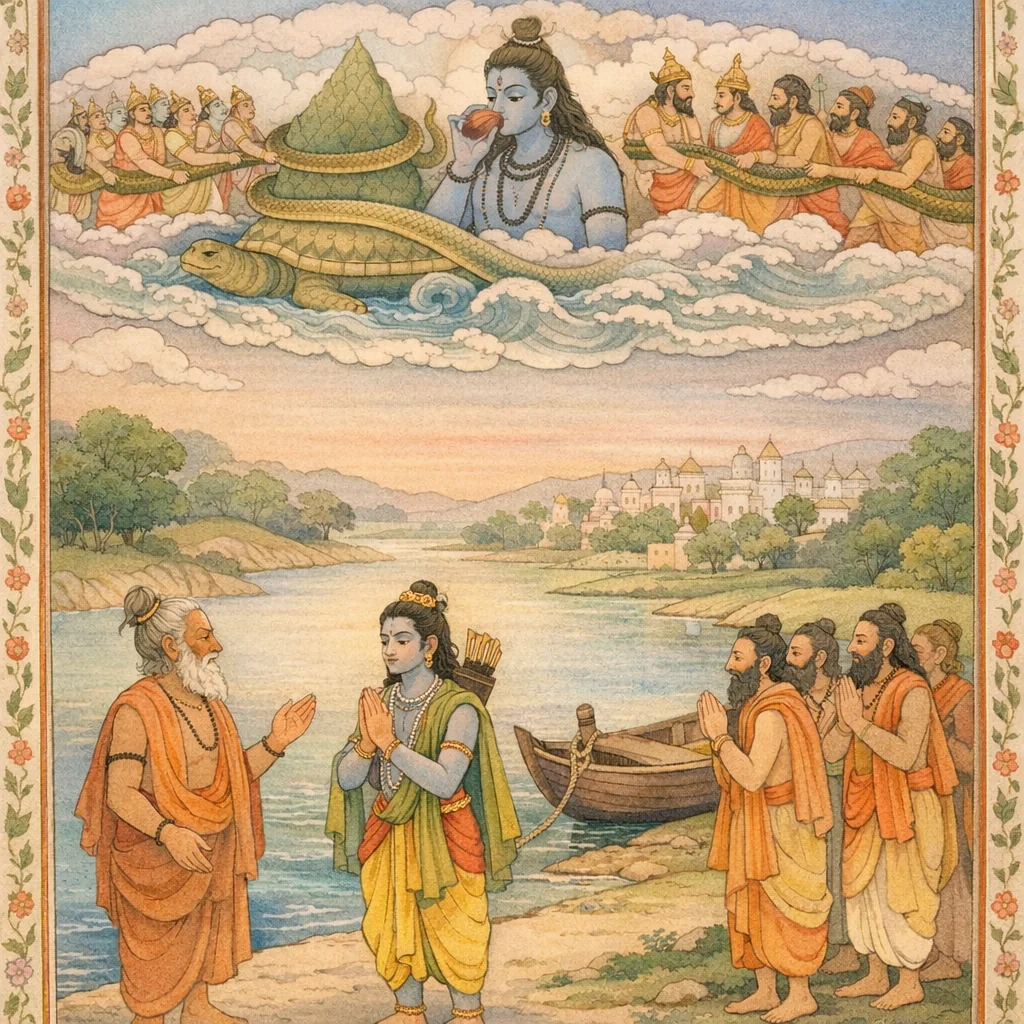
Sarga 45 moves from Rāma’s wonder at Viśvāmitra’s earlier account (especially the descent of Gaṅgā) to a new stage of travel and a fresh discourse on origins. After a night spent reflecting on the sage’s auspicious narration, Rāma respectfully addresses Viśvāmitra at dawn, saying the night passed “like a moment” through contemplative absorption. The party crosses the Tripathagā river Gaṅgā by a boat associated with pious ṛṣis, reaches the northern bank, honors the ascetic communities, and beholds the splendid, heaven-like city of Viśālā. With folded palms, Rāma asks about Viśālā’s ruling lineage and beginnings, and Viśvāmitra begins an ancient narrative centered on Śakra (Indra). He recounts the churning of the Ocean of Milk: the resolve of Diti’s and Aditi’s sons to obtain amṛta, Vāsuki as the rope and Mandara as the churning rod, the arising of the hālāhala poison, and the gods’ appeal to Rudra/Śaṅkara. By Hari’s guidance Śiva accepts the poison, and Viṣṇu, as the kūrma (tortoise), supports Mandara; then emerge Dhanvantari, apsaras, Vāruṇī, Uccaiḥśravā, the Kaustubha jewel, and finally amṛta—followed by conflict, Viṣṇu’s Mohinī stratagem, and Indra’s consolidation of rule. Thus the chapter joins sacred geography (Gaṅgā’s bank and Viśālā) with mythic history through reverent inquiry and authoritative teaching.
Shlokas
Verse 1
विश्वामित्रवचश्श्रुत्वा राघव स्सहलक्ष्मण:।विस्मयं परमं गत्वा विश्वामित्रमथाब्रवीत्।।।।
So too, dear child, though Aṃśumān possessed unmatched power in the world, when he sought to bring Gaṅgā, his vow still could not be brought to completion.
Verse 2
अत्यद्भुतमिदं ब्रह्मन् कथितं परमं त्वया।गङ्गावतरणं पुण्यं सागरस्यापि पूरणम्।।।।
O knower of Brahman, what you have recounted is supremely wondrous—the sacred descent of the Gaṅgā, and how thereby the ocean too was filled.
Verse 3
तस्य सा शर्वरी सर्वा सह सौमित्रिणा तदा।जगाम चिन्तयानस्य विश्वामित्रकथां शुभाम् ।।।।
Then Rāma, together with Saumitri (Lakṣmaṇa), passed the entire night absorbed in reflecting on Viśvāmitra’s auspicious narration.
Verse 4
तत: प्रभाते विमले विश्वामित्रं महामुनिम्।उवाच राघवो वाक्यं कृताह्निकमरिन्दम:।।।।
Then, at the clear and stainless break of dawn, Rāghava—destroyer of foes—addressed the great sage Viśvāmitra, after he had completed his daily rites.
Verse 5
गता भगवती रात्रिश्श्रोतव्यं परमं श्रुतम्।क्षणभूतेव नौ रात्रि स्सम्वृत्तेयं महातप:।।।।इमां चिन्तयतस्सर्वां निखिलेन कथां तव।
O great ascetic, the blessed night has passed, and we have heard this supreme account, most worthy to be heard. As we both reflected upon your entire story in full, this night seemed to pass like a mere moment.
Verse 6
तराम सरितां श्रेष्ठां पुण्यां त्रिपथगां नदीम्।।।।नौरेषा हि सुखास्तीर्णा ऋषीणां पुण्यकर्मणाम्।भगवन्तमिह प्राप्तं ज्ञात्वा त्वरितमागता।।।।
Let us cross the Gaṅgā, the finest of rivers—holy and flowing in three courses. This boat, comfortably prepared for the sages of meritorious deeds, has hastened here upon learning that you, O venerable one, have arrived.
Verse 7
तराम सरितां श्रेष्ठां पुण्यां त्रिपथगां नदीम्।।1.45.6।।नौरेषा हि सुखास्तीर्णा ऋषीणां पुण्यकर्मणाम्।भगवन्तमिह प्राप्तं ज्ञात्वा त्वरितमागता।।1.45.7।।
Let us cross the Gaṅgā, the finest of rivers—holy and flowing in three courses. This boat, comfortably prepared for the sages of meritorious deeds, has hastened here upon learning that you, O venerable one, have arrived.
Verse 8
तस्य तद्वचनं श्रुत्वा राघवस्य महात्मन:।सन्तारं कारयामास सर्षिसङ्घ स्सराघव:।।।।
Hearing those words of the great-souled Rāghava, Viśvāmitra—together with the company of sages, and with Rāma (and Lakṣmaṇa)—had the crossing arranged.
Verse 9
उत्तरं तीरमासाद्य सम्पूज्यर्षिगणं तदा।गङ्गाकूले निविष्टास्ते विशालां ददृशु: पुरीम्।।।।
Reaching the northern bank, they then duly honored the gathered sages there; and, encamped on the Gaṅgā’s shore, they beheld the city of Viśālā.
Verse 10
ततो मुनिवरस्तूर्णं जगाम सह राघव: ।विशालां नगरीं रम्यां दिव्यां स्वर्गोपमां तदा।।।।
Then Viśvāmitra, best among ascetics, swiftly proceeded—accompanied by Rāma (and Lakṣmaṇa)—toward the delightful, splendid city of Viśālā, famed as being like heaven.
Verse 11
अथ रामो महाप्राज्ञो विश्वामित्रं महामुनिम् ।पप्रच्छ प्राञ्जलिर्भूत्वा विशालामुत्तमां पुरीम्।।।।
Thereafter Rāma, of great understanding, with folded hands questioned the great sage Viśvāmitra about the excellent city of Viśālā.
Verse 12
कतरो राजवंशोऽयं विशालायां महामुने।श्रोतुमिच्छामि भद्रं ते परं कौतूहलं हि मे।।.।।
“O great sage, which royal lineage rules in this Viśālā? I wish to hear it; blessings be upon you—my curiosity is strong.”
Verse 13
तस्य तद्वचनं श्रुत्वा रामस्य मुनिपुङ्गव:।आख्यातुं तत्समारेभे विशालस्य पुरातनम्।।।।
Hearing Rāma’s words, the foremost of sages began to recount the ancient tale of Viśālā.
Verse 14
श्रूयतां राम शक्रस्य कथां कथयतश्शुभाम्।अस्मिन् देशे तु यद्वृत्तं तदपि शृणु राघव।।।।
“Listen, O Rāma, as I relate the auspicious legend of Śakra (Indra); and hear also, O Rāghava, what events took place in this land.”
Verse 15
पूर्वं कृतयुगे राम दिते: पुत्रा महाबला:।अदितेश्च महाभाग वीर्यवन्तस्सुधार्मिका:।।।।
“In former times, O fortunate Rāma, in the Kṛta age, Diti’s sons were exceedingly powerful, and Aditi’s sons were valorous, mighty, and steadfast in dharma.”
Verse 16
ततस्तेषां नरश्रेष्ठ बुद्धिरासीन्महात्मनाम् ।अमरा अजराश्चैव कथं स्याम निरामया:।।।।
“Then, O best of men, a thought arose in those great beings: ‘How might we become deathless, ageless, and free from disease?’”
Verse 17
तेषां चिन्तयतां राम बुद्धिरासीन्महात्मनाम्।क्षीरोदमथनं कृत्वा रसं प्राप्स्याम तत्र वै।।।।
“As they pondered, O Rāma, an idea came to those great beings: ‘By churning the Ocean of Milk, we shall indeed obtain its essence—amṛta, the nectar.’”
Verse 18
ततो निश्चित्य मथनं योक्त्रं कृत्वा च वासुकिम्।मन्थानं मन्दरं कृत्वा ममन्थुरमितौजस:।।।।
Thus, having resolved upon the churning, those of immeasurable might made Vāsuki the rope and Mount Mandara the churning staff, and began to churn.
Verse 19
अथ वर्षसहस्रेण योक्त्रसर्पशिरांसि च।वमन्त्यति विषं तत्र ददंशुर्दशनैश्शिला:।।।।
Then, after a thousand years, the serpent-heads serving as the rope began to spew exceedingly fierce poison there, and with their teeth they bit into the rocks of the mountain.
Verse 20
उत्पपाताग्निसङ्काशं हालाहलमहाविषम्।तेन दग्धं जगत्सर्वं सदेवासुरमानुषम्।।।।
Then there sprang forth the great poison Hālāhala, blazing like fire; by it the entire world—gods, asuras, and humans—was scorched.
Verse 21
अथ देवा महादेवं शङ्करं शरणार्थिन:।जग्मु: पशुपतिं रुद्रं त्राहि त्राहीति तुष्टुवु:।।।।
Then the gods, seeking refuge, went to Mahādeva—Śaṅkara, Rudra, Lord of beings—and praised him, crying, “Save us, save us!”
Verse 22
एवमुक्तस्ततो देवैर्देवदेवेश्वर: प्रभु:।प्रादुरासीत्ततोऽत्रैव शङ्खचक्रधरो हरि:।।।।
Thus addressed by the gods, the Lord—the Overlord of the gods—appeared there itself: Hari, bearing the conch and the discus.
Verse 23
उवाचैनं स्मितं कृत्वा रुद्रं शूलभृतं हरि:।दैवतैर्मथ्यमाने तु यत्पूर्वं समुपस्थितम् ।।।।त्वदीयंहि सुरश्रेष्ठ सुराणामग्रजोऽसि यत् ।अग्रपूजामिमां मत्वा गृहाणेदं विषं प्रभो।।।।
Hari, smiling, spoke to Rudra who bears the trident: “O foremost among the gods, since you are the eldest among the celestials, whatever arises first during this churning belongs to you. Accept this as the first honor, O Lord—take this poison.”
Verse 24
उवाचैनं स्मितं कृत्वा रुद्रं शूलभृतं हरि:।दैवतैर्मथ्यमाने तु यत्पूर्वं समुपस्थितम् ।।1.45.23।।त्वदीयंहि सुरश्रेष्ठ सुराणामग्रजोऽसि यत् ।अग्रपूजामिमां मत्वा गृहाणेदं विषं प्रभो।।1.45.24।।
Hari, smiling, spoke to Rudra who bears the trident: “O foremost among the gods, since you are the eldest among the celestials, whatever arises first during this churning belongs to you. Accept this as the first honor, O Lord—take this poison.”
Verse 25
इत्युक्त्वा च सुरश्रेष्ठस्तत्रैवान्तरधीयत।देवतानां भयं दृष्टवाश्रुत्वा वाक्यं तु शार्ङ्गिण:।हालाहलविषं घोरं स जग्राहामृतोपमम्।।।।
Having said this, the best of the gods disappeared there itself. Then Śiva—seeing the gods’ fear and hearing the words of Śārṅgin—took up the dreadful Hālāhala poison, treating it as though it were nectar.
Verse 26
देवान्विसृज्य देवेशो जगाम भगवान् हर:।ततो देवासुरास्सर्वे ममन्थू रघुनन्दन ।।।।
Leaving the gods behind, the Lord of gods—Bhagavān Hara—departed. Then, O joy of the Raghu line, all the gods and asuras resumed churning.
Verse 27
प्रविवेशाथ पातालं मन्थान: पर्वतोऽनघ।ततो देवास्सगन्धर्वास्तुष्टुवुर्मधुसूदनम्।।।।
Then the churning-mountain sank into Pātāla, O sinless one. Thereupon the gods, together with the gandharvas, praised Madhusūdana (Viṣṇu).
Verse 28
त्वं गति: सर्वभूतानां विशेषेण दिवौकसाम्।पालयास्मान्महाबाहो गिरिमुद्धर्तुमर्हसि।।।।
You are the refuge of all beings—especially of the dwellers in heaven. Protect us, O mighty-armed one; you alone are fit to lift up the mountain.
Verse 29
इति श्रुत्वा हृषीकेश: कामठं रूपमास्थित:।पर्वतं पृष्ठत: कृत्वा शिश्ये तत्रोदधौ हरि:।।।।
Hearing these words, Hari—Hṛṣīkeśa, the lord of the senses—assumed the form of a tortoise; placing the mountain upon his back, he lay there in the ocean.
Verse 30
पर्वताग्रे तु लोकात्मा हस्तेनाक्रम्य केशव:।देवानां मध्यत: स्थित्वा ममन्थ पुरुषोत्तम:।।।।
Then Keśava—the supreme Person, the very Self of the world—stood among the gods, took hold of the mountain’s summit with his hand, and churned on.
Verse 31
अथ वर्षसहस्रेण सदण्डस्सकमण्डलु:।पूर्वं धन्वन्तरिर्नाम अप्सराश्च सुवर्चस:।।।।
Then, after a thousand years, Dhanvantari first emerged—bearing a staff and a water-pot—and along with him apsarases of radiant splendor.
Verse 32
अप्सु निर्मथनादेव रसास्तस्माद्वरस्त्रिय:।उत्पेतुर्मनुजश्रेष्ठ तस्मादप्सरसोऽभवन्।।।।
O best of men, from the churning of the waters an essence arose; from that essence emerged excellent women—hence they came to be known as the Apsarases.
Verse 33
षष्टि: कोट्योऽभवंस्तासाम् अप्सराणां सुवर्चसाम्।असङ्ख्येयास्तु काकुत्स्थ यास्तासां परिचारिका:।।।।
O Kakutstha, sixty crores of those radiant Apsarases came forth; and countless indeed were their attendant maidens.
Verse 34
न तास्स्म परिगृह्णन्ति सर्वे ते देवदानवा:।अप्रतिग्रहणात्ताश्च सर्वास्साधारणास्स्मृता:।।।।
None among the devas or the dānavas accepted them in marriage; and because they were unaccepted, all of them came to be regarded as ‘common to all’.
Verse 35
वरुणस्य तत: कन्या वारुणी रघुनन्दन ।उत्पपात महाभागा मार्गमाणा परिग्रहम्।।।।
Then, O delight of the Raghu line, Varuṇa’s daughter Vāruṇī sprang forth—fortunate and splendid—seeking someone to accept her as consort.
Verse 36
दिते: पुत्रा न तां राम जगृहुर्वरुणात्मजाम्।अदितेस्तु सुता वीर जगृहुस्तामनिन्दिताम्।।।।
O Rāma, Diti’s sons did not accept that daughter of Varuṇa; but Aditi’s sons, O hero, accepted her—she who was without blemish.
Verse 37
असुरास्तेन दैतेयास्सुरास्तेनादितेस्सुता:।हृष्टा: प्रमुदिताश्चासन् वारुणीग्रहणात्सुरा:।।।।
For this reason Diti’s sons came to be called asuras, and Aditi’s sons suras; and the devas rejoiced, having accepted Vāruṇī.
Verse 38
उच्चैश्श्रवा हयश्रेष्ठो मणिरत्नं च कौस्तुभम्।उदतिष्ठन्नरश्रेष्ठ तथैवामृतमुत्तमम्।।।।
O best of men, Uccaiśśravas—the finest of horses—also arose, and the Kaustubha jewel; and likewise the supreme amṛta, the nectar of immortality, emerged.
Verse 39
अथ तस्य कृते राम महानासीत्कुलक्षय:।अदितेस्तु तत: पुत्रा दिते: पुत्रानसूदयन्।।।।
Then, O Rāma, for the sake of that (amṛta) there occurred a great destruction of lineages; thereafter Aditi’s sons slew the sons of Diti.
Verse 40
एकतोऽभ्यागमन् सर्वे ह्यसुरा राक्षसैस्सह।युद्धमासीन्महाघोरं वीर त्रैलोक्यमोहनम्।।।।
O hero, on one side all the asuras gathered together with the rākṣasas; and a most dreadful battle arose, casting the three worlds into bewilderment.
Verse 41
यदा क्षयं गतं सर्वं तदा विष्णुर्महाबल:।अमृतं सोऽहरत्त्तूर्णं मायामास्थाय मोहिनीम्।।।।
When all had fallen into ruin, then mighty Viṣṇu, taking up the delusive power of Māyā as Mohinī, swiftly carried off the amṛta, the nectar of immortality.
Verse 42
ये गताऽभिमुखं विष्णुमक्षयं पुरुषोत्तमम्।सम्पिष्टास्ते तदा युद्धे विष्णुना प्रभविष्णुना।।।।
Those who advanced to confront Viṣṇu—the imperishable Puruṣottama, the Supreme Person—were then crushed in battle by Viṣṇu, the all-capable.
Verse 43
अदितेरात्मजा वीरा दिते: पुत्रान्निजघ्निरे।तस्मिन् घोरे महायुद्धे दैतेयादित्ययोर्भृशम्।।।।
In that dreadful great war between the Daiteyas and the Ādityas, the heroic sons of Aditi struck down the sons of Diti in great numbers.
Verse 44
निहत्य दितिपुत्रांश्च राज्यं प्राप्य पुरन्दर:।शशास मुदितो लोकान् सर्षिसङ्घान् सचारणान्।।।।
Having slain the sons of Diti and regained sovereignty, Purandara (Indra) rejoiced and ruled the worlds—together with assemblies of ṛṣis and the Cāraṇas.
Frequently Asked Questions
The pivotal action is Rāma’s disciplined, deferential inquiry—approaching Viśvāmitra with folded palms and asking about Viśālā’s dynasty—modeling how knowledge of polity and place should be sought through respectful dialogue rather than assertion.
The chapter frames crisis and order as sustained by responsibility: when hālāhala threatens the cosmos, refuge is sought in competent authority, and Śiva accepts the burden for the common good; simultaneously, Rāma’s listening posture shows that ethical leadership begins with attentive learning.
Key landmarks are the Tripathagā Gaṅgā and its northern bank (a ritualized crossing space), and the city of Viśālā, depicted as splendid and heaven-like; culturally, the narrative foregrounds boat-crossing by ṛṣis and the etiological myth of the Ocean of Milk churning.