Sarga 38
सगरस्य पुत्रलाभः — Sagara’s Boons, Progeny, and the Rise of the Sixty Thousand
बालकाण्ड
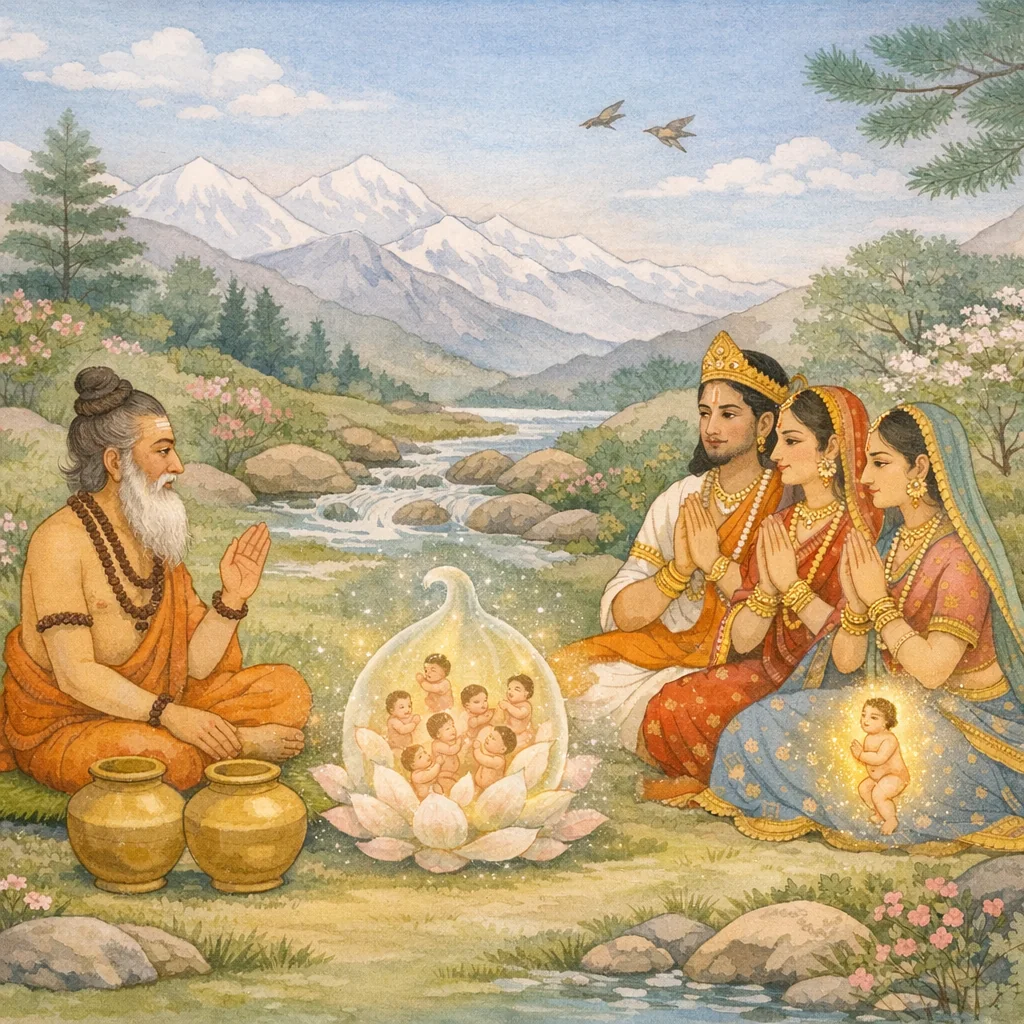
After finishing the previous account, Viśvāmitra speaks of an earlier ruler of Ayodhyā, King Sagara—righteous, yet without children—and his two queens: Keśinī of Vidarbha and Sumati, daughter of Ariṣṭanemi, famed for beauty and also remembered as sister to Suparṇa/Garuḍa. With his wives Sagara performs long austerities on Himavat at Bhṛguprasravaṇa, where the sage Bhṛgu grants boons: one queen will bear a single heir who will uphold the dynasty, while the other will bear sixty thousand sons. The queens seek clarity and are allowed to choose; Keśinī accepts the one dynastic son, and Sumati chooses the multitude. In time Keśinī bears Asamañjasa, who becomes notorious for cruelty—casting children into the Sarayū—and is banished for harming the people; yet his son Aṁśumān is valiant and beloved by all. Sumati brings forth a gourd-like embryo that bursts into sixty thousand sons, who are raised in jars filled with ghee until they reach youth. The sarga ends with Sagara’s resolve to begin a yajña, setting in motion the next sequence in the epic’s genealogical and ritual history.
Shlokas
Verse 1
तां कथां कौशिको रामे निवेद्य कुशिकात्मज:।पुनरेवापरं वाक्यं काकुत्स्थ मिदमब्रवीत्।।।।
Having narrated that account to Rāma, Kauśika—descendant of Kuśika—again spoke further words, addressing the scion of the Kakutsthas.
Verse 2
अयोध्याधिपति श्शूर: पूर्वमासीन्नराधिप:।सगरो नाम धर्मात्मा प्रजाकामस्स चाप्रज:।।।।
In ancient times there was a brave ruler of Ayodhyā, a king named Sagara—righteous in nature—who longed for children, yet remained childless.
Verse 3
वैदर्भदुहिता राम केशिनी नाम नामत:।ज्येष्ठा सगरपत्नी सा धर्मिष्ठा सत्यवादिनी।।।।
O Rāma, the daughter of the king of Vidarbha, known by name as Keśinī, was Sagara’s elder queen; devoted to dharma, she was steadfast in truth.
Verse 4
अरिष्टनेमेर्दुहिता रूपेणाप्रतिमा भुवि।द्वितीया सगरस्यासीत्पत्नी सुमतिसंज्ञिता ।।।।
Arīṣṭanemi’s daughter, named Sumati, was Sagara’s second queen—unsurpassed in beauty upon the earth.
Verse 5
ताभ्यां सह महाराज: पत्नीभ्यां तप्तवांस्तप:।हिमवन्तं समासाद्य भृगुप्रस्रवणे गिरौ।।।।
Accompanied by his two queens, King Sagara reached Himavat and performed severe austerities upon the mountain peak called Bhṛguprasravaṇa.
Verse 6
अथ वर्षशते पूर्णे तपसाऽराधितो मुनि:।सगराय वरं प्रादाद्भृगुस्सत्यवतां वर:।।।।
Then, when a full hundred years had passed, the sage Bhṛgu—pleased by that austerity and foremost among the truthful—granted Sagara a boon.
Verse 7
अपत्यलाभस्सुमहान् भविष्यति तवानघ।कीर्तिं चाप्रतिमां लोके प्राप्स्यसे पुरुषर्षभ।।।।
O blameless one, you shall gain exceedingly great progeny; and, O best of men, you will also attain incomparable fame in this world.
Verse 8
एका जनयिता तात पुत्रं वंशकरं तव।षष्ठिं पुत्रसहस्राणि अपरा जनयिष्यति।।।।
O dear one, one queen will bear you a single son who will continue your line; the other will give birth to sixty thousand sons.
Verse 9
भाषमाणं महात्मानं राजपुत्र्यौ प्रसाद्य तम्।ऊचतु: परमप्रीते कृताञ्जलिपुटे तदा।।।।
As that great-souled sage spoke, the two princesses, having reverently pleased him, then—overjoyed and with hands joined in supplication—addressed him.
Verse 10
एक: कस्यास्सुतो ब्रह्मन् का बहून् जनयिष्यति।श्रोतुमिच्छावहे ब्रह्मन् सत्यमस्तु वचस्तव।।।।
O knower of Brahman—whose will be a single heir, and who will give birth to many? We both wish to hear, O Brahmarṣi; may your words be true.
Verse 11
तयोस्तद्वचनं श्रुत्वा भृगु: परमधार्मिक:।उवाच परमां वाणीं स्वच्छन्दोऽत्र विधीयताम्।।।।
Hearing their request, Bhṛgu—supremely righteous—spoke an excellent reply: “In this matter, let your own choice be exercised.”
Verse 12
एको वंशकरो वाऽस्तु बहवो वा महाबला:।कीर्तिमन्तो महोत्साहा: का वा कं वरमिच्छति।।।।
He said: “Would you prefer one son who continues the lineage, or many sons—mighty, renowned, and of great enterprise? Which of you chooses which boon?”
Verse 13
मुनेस्तु वचनं श्रुत्वा केशिनी रघुनन्दन।पुत्रं वंशकरं राम जग्राह नृपसन्निधौ।।।।
O Rāma, delight of the Raghus—hearing the sage’s words, Keśinī, in the king’s presence, chose the boon of a son who would carry on the royal line.
Verse 14
षष्ठिं पुत्रसहस्राणि सुपर्णभगिनी तदा।महोत्साहान् कीर्तिमतो जग्राह सुमति: सुतान्।।।।
Then Sumatī, sister of Suparṇa (Garuḍa), chose as her boon sixty thousand sons—renowned and filled with mighty enterprise.
Verse 15
प्रदक्षिणमृषिं कृत्वा शिरसाऽभिप्रणम्य च।जगाम स्वपुरं राजा सभार्यो रघुनन्दन ।।।।
O Raghunandana, the king—together with his wives—circumambulated the sage in pradakṣiṇā, bowed his head in reverence, offered salutations, and then returned to his own capital.
Verse 16
अथ काले गते तस्मिन् ज्येष्ठा पुत्रं व्यजायत।असमञ्ज इति ख्यातं केशिनी सगरात्मजम्।।।।
Then, after some time had passed, the elder queen Keśinī gave birth to Sagara’s son, famed by the name Asamañja.
Verse 17
सुमतिस्तु नरव्याघ्र गर्भतुम्बं व्यजायत।षष्ठि: पुत्रसहस्राणि तुम्बभेदाद्विनि:सृता:।।।।
But Sumatī, O tiger among men, bore a gourd-like embryo; and when that gourd split open, sixty thousand sons came forth.
Verse 18
घृतपूर्णेषु कुम्भेषु धात्र्यस्तान् समवर्धयन्।कालेन महता सर्वे यौवनं प्रतिपेदिरे।।।।
In jars filled with clarified butter (ghee) the nurses reared them; and after a long passage of time, they all attained the fullness of youth.
Verse 19
अथ दीर्घेण कालेन रूपयौवनशालिन:।षष्टि: पुत्रसहस्राणि सगरस्याभवंस्तदा।।।।
Then, after a long time, Sagara’s sixty thousand sons became endowed with beauty and the vigor of youth.
Verse 20
स च ज्येष्ठो नरश्रेष्ठ सगरस्यात्मसम्भव:।बालान् गृहीत्वा तु जले सरय्वा रघुनन्दन।।।।प्रक्षिप्य प्रहसन्नित्यं मज्जतस्तान् समीक्ष्य वै।
And that elder son of Sagara, born of his own body—O best of men, O Raghunandana—would seize children and fling them into the waters of the Sarayū; and, watching them drown, he would laugh again and again.
Verse 21
एवं पापसमाचारस्सज्जनप्रतिबाधक:।।।।पौराणामहिते युक्त: पुत्रो निर्वासित: पुरात्।
Thus, because of his sinful conduct, for troubling the good and being bent on the citizens’ harm, the son was banished from the city long ago.
Verse 22
तस्य पुत्रोंऽशुमान्नाम असमञ्जस्य वीर्यवान्।।।।सम्मत स्सर्वलोकस्य सर्वस्यापि प्रियंवद:।
His son was named Aṁśumān—valiant and mighty, esteemed by all people, and gracious in speech to everyone.
Verse 23
तत: कालेन महता मतिस्समभिजायत।।।।सगरस्य नरश्रेष्ठ यजेयमिति निश्चिता।
After a long time, O best of men, a firm resolve arose in Sagara’s mind: “I shall perform a yajña, a sacred sacrifice.”
Verse 24
स कृत्वा निश्चयं राम सोपाध्यायगणस्तदा।।।।यज्ञकर्मणि वेदज्ञो यष्टुं समुपचक्रमे।
O Rāma, having firmly resolved, Sagara—learned in the Vedas—together with his company of officiating priests, then began the preliminary rites of the yajña.
Frequently Asked Questions
Asamañjasa’s repeated cruelty—throwing children into the Sarayū and delighting in their distress—creates a public-harm crisis; rājadhrama requires Sagara to prioritize citizen welfare, leading to the son’s banishment from the capital.
The sarga juxtaposes ascetic merit and boon-granting with moral accountability: ritual success and noble birth do not override conduct; lineage is sustained not merely by progeny but by dharma-aligned behavior and protection of the vulnerable.
Himavat and the sacred peak Bhṛguprasravaṇa ground the austerity-and-boon motif; the Sarayū anchors Ayodhyā’s civic life and becomes the moral stage for Asamañjasa’s wrongdoing; ghee-filled kumbhas reflect a cultural-ritual imagination of extraordinary birth and fosterage.