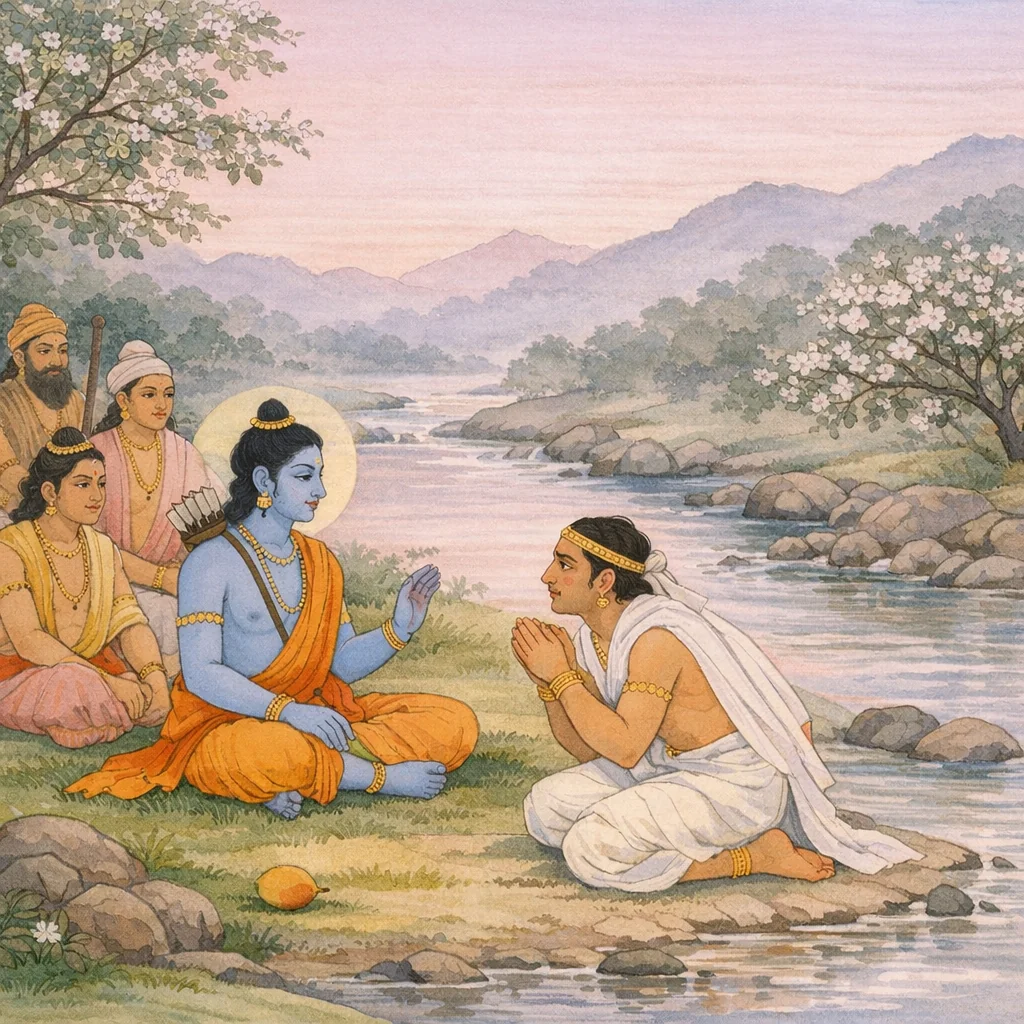
Sarga 105
भरतस्य प्रार्थना—रामस्य कालधर्मोपदेशः (Bharata’s Petition and Rama’s Instruction on Time and Mortality)
अयोध्याकाण्ड
Sarga 105 opens with a night of shared lament among the four brothers, surrounded by their well-wishers; at dawn they complete the rites on the bank of the Mandākinī and gather again. In the silence that follows, Bharata addresses Rāma: he offers to return the kingdom, insists the realm cannot endure without Rāma, and portrays his own unfitness through vivid comparisons. His chief image is of a carefully nurtured tree that blossoms yet bears no fruit—implying that Daśaratha’s lifelong hope will remain unfulfilled unless Rāma accepts kingship. He also invokes Ayodhyā’s public feeling, envisioning guilds and subjects beholding Rāma installed like the sun, with royal elephants trumpeting and palace women rejoicing. Rāma replies by consoling Bharata with an extended discourse on kāla-dharma, the law of Time: human agency is limited, fate draws beings in contrary directions, and every worldly compound ends—wealth in depletion, elevation in descent, union in separation, life in death. He reinforces impermanence with natural analogies: ripened fruit must fall; sturdy houses decay; nights do not return; rivers flow onward; and days and nights consume lifespan as the summer sun dries up water. Death is portrayed as an inseparable companion, and grief as philosophically unproductive. The chapter closes with Rāma’s firm resolve to obey Daśaratha’s command by dwelling in the forest, and his urging that Bharata return to Ayodhyā to uphold royal duty. The wise, he says, should avoid lamentation in every state.
Shlokas
Verse 1
ततः पुरुषसिंहानां वृतानां तै स्सुहृद्गणैः।शोचतामेव रजनी दुःखेन व्यत्यवर्तत।।2.105.1।।
Then the night passed in pain, as those lion-like men—surrounded by their circles of friends—did nothing but grieve.
Verse 2
रजन्यां सुप्रभातायां भ्रातरस्ते सुहृद्वृताः।मन्दाकिन्यां हुतं जप्यं कृत्वा राममुपागमन्।।2.105.2।।
When the night had brightened into dawn, the brothers—surrounded by their well-wishers—performed their morning rites on the Mandākinī, offering oblations and reciting prayers, and then approached Rama.
Verse 3
तूष्णीं ते समुपासीना न कश्चित्किञ्चिदब्रवीत्।भरतस्तु सुहृन्मध्ये रामं वचनमब्रवीत्।।2.105.3।।
They all sat together in silence, and no one spoke even a little. But Bharata, in the midst of the friends, addressed Rāma and spoke these words.
Verse 4
सान्त्विता मामिका माता दत्तं राज्यमिदं मम।तद्ददामि तवैवाहं भुङ्क्ष्व राज्यमकण्टकम्।।2.105.4।।
My mother has been appeased, and this kingdom was given to me; I now give that very kingdom to you alone—enjoy a reign free of obstacles.
Verse 5
महतेवाम्बुवेगेन भिन्नस्सेतुर्जलागमे।दुरावारं त्वदन्येन राज्यखण्डमिदं महत्।।2.105.5।।
As a dyke is breached by the mighty rush of waters in the rainy season, so too this vast realm will be impossible to restrain without you.
Verse 6
गतिं खर इवाश्वस्य तार्क्ष्यस्येव पतत्रिणः।अनुगन्तुं न शक्तिर्मे गतिं तव महीपते।।2.105.6।।
O lord of the earth, I lack the strength to follow your course—just as an ass cannot keep pace with a horse, nor any bird with Tārkṣya (Garuḍa).
Verse 7
सुजीवं नित्यशस्तस्य यः परैरुपजीव्यते।राम तेन तु दुर्जीवं यः परानुपजीवति।।2.105.7।।
O Rāma, blessed indeed is the life of one on whom others constantly rely; but hard is the life of one who must rely upon others.
Verse 8
यथा तु रोपितो वृक्षः पुरुषेण विवर्धितः।ह्रस्वकेण दुरारोहो रूढस्कन्धो महाद्रुमः।।2.105.8।।स यदा पुष्पितो भूत्वा फलानि न विदर्शयेत्।स तां नानुभवेत्प्रीतिं यस्य हेतोः प्ररोपितः।।2.105.9।।एषोपमा महाबाहो तमर्थं वेत्तु मर्हसि।यदि त्वमस्मान्वृषभो भर्ता भृत्यान्न शाधि हि।।2.105.10।।
O mighty-armed one: as a man plants a tree and rears it until it becomes a great tree with a firm trunk, hard even for a dwarf to climb—if, though it blossoms, it shows no fruit, the planter finds no joy in the very purpose for which it was planted. Such is the simile; grasp its meaning. If you, our strong protector, do not rule us—your dependents—then our father’s nurtured hope comes to nothing.
Verse 9
यथा तु रोपितो वृक्षः पुरुषेण विवर्धितः।ह्रस्वकेण दुरारोहो रूढस्कन्धो महाद्रुमः।।2.105.8।।स यदा पुष्पितो भूत्वा फलानि न विदर्शयेत्।स तां नानुभवेत्प्रीतिं यस्य हेतोः प्ररोपितः।।2.105.9।।एषोपमा महाबाहो तमर्थं वेत्तु मर्हसि।यदि त्वमस्मान्वृषभो भर्ता भृत्यान्न शाधि हि।।2.105.10।।
O mighty-armed one: as a man plants a tree and rears it until it becomes a great tree with a firm trunk, hard even for a dwarf to climb—if, though it blossoms, it shows no fruit, the planter finds no joy in the very purpose for which it was planted. Such is the simile; grasp its meaning. If you, our strong protector, do not rule us—your dependents—then our father’s nurtured hope comes to nothing.
Verse 10
यथा तु रोपितो वृक्षः पुरुषेण विवर्धितः।ह्रस्वकेण दुरारोहो रूढस्कन्धो महाद्रुमः।।2.105.8।।स यदा पुष्पितो भूत्वा फलानि न विदर्शयेत्।स तां नानुभवेत्प्रीतिं यस्य हेतोः प्ररोपितः।।2.105.9।।एषोपमा महाबाहो तमर्थं वेत्तु मर्हसि।यदि त्वमस्मान्वृषभो भर्ता भृत्यान्न शाधि हि।।2.105.10।।
O mighty-armed one, consider this simile and grasp its meaning. A man plants a tree and tends it until it becomes a great tree with a thick trunk, hard for a dwarf to climb. If, after flowering, it shows no fruit, the planter gains no joy from the purpose for which it was planted. So too, O strong protector: do not refuse to guide us, your dependents.
Verse 11
श्रेणयस्त्वां महाराज पश्यन्त्वग्य्राश्च सर्वशः।प्रतपन्तमिवादित्यं राज्ये स्थित मरिन्दमम्।।2.105.11।।
O great king, subduer of enemies—may the foremost guilds and all leading groups everywhere behold you established in the kingdom, blazing like the sun.
Verse 12
तवानुयाने काकुत्स्थ मत्ता नर्दन्तु कुञ्जराः।अन्तःपुरगता नार्यो नन्दन्तु सुसमाहिताः।।2.105.12।।
O Kākuṭstha, as you proceed, let the rut-maddened elephants trumpet; and let the women of the inner chambers rejoice with minds made calm and steady.
Verse 13
तस्य साध्वित्यमन्यन्त नागरा विविधा जनाः।भरतस्य वच श्श्रुत्वा रामं प्रत्यनुयाचतः।।2.105.13।।
Hearing Bharata’s words as he earnestly pleaded with Rama, the townspeople—people of many different groups—thought, “Well spoken!”
Verse 14
तमेवं दुःखितं प्रेक्ष्य विलपन्तं यशस्विनम्।रामः कृतात्मा भरतं समाश्वासयदात्मवान्।।2.105.14।।
Seeing Bharata—illustrious yet overwhelmed with sorrow and lamenting—Rama, steadfast in resolve and self-possessed, consoled him.
Verse 15
नाऽत्मनः कामकारोऽस्ति पुरुषोऽयमनीश्वरः।इतश्चेतरतश्चैनं कृतान्तः परिकर्षति।।2.105.15।।
A human being is not truly autonomous, nor able to act purely by personal whim; he is not independent. Fate drags him now this way, now that.
Verse 16
सर्वे क्षयान्ताः निचयाः पतनान्ता समुच्छ्रयाः।संयोगा विप्रयोगान्ता मरणान्तं च जीवितम्।।2.105.16।।
All hoards end in depletion; all high attainments end in a fall. Every union ends in separation, and every life ends in death.
Verse 17
यथा फलानां पक्वानां नान्यत्र पतनाद्भयम्।एवं नरस्य जातस्य नान्यत्र मरणाद्भयम्।।2.105.17।।
Just as a ripened fruit fears nothing but its fall, so too a person, once born, has no final fear except death.
Verse 18
यथाऽगारं दृढस्थूणं जीर्णं भूत्वाऽवसीदति।तथैव सीदन्ति नरा जरामृत्युवशं गताः।।2.105.18।।
Even a house with sturdy pillars, once it grows old, sinks into decay; in the same way, people who come under the power of aging and death are worn down.
Verse 19
अत्येति रजनी या तु सा न प्रतिनिवर्तते।यात्येव यमुना पूर्णा समुद्रमुदकाकुलम्।।2.105.19।।
A night that has passed does not return; so too the Yamunā, full in flow, moves onward into the ocean’s waters and does not come back.
Verse 20
अहोरात्राणि गच्छन्ति सर्वेषां प्राणिनामिह।अायूंषि क्षपयन्त्याशु ग्रीष्मे जलमिवांशवः।।2.105.20।।
Days and nights pass for all living beings here, swiftly wearing down their lifespans—like sunrays in summer drying up water.
Verse 21
आत्मानमनुशोच त्वं किमन्यमनुशोचसि।आयुस्ते हीयते यस्य स्थितस्य च गतस्य च।।2.105.21।।
Grieve for yourself—why grieve for another? For your own lifespan diminishes whether you stand still or you move about.
Verse 22
सहैव मृत्युर्व्रजति सह मृत्युर्निषीदति।गत्वासुदीर्घमध्वानं सहमृत्युर्निवर्तते।।2.105.22।।
Death goes with a man; death sits beside him. Even after he has traveled a very long road, he returns with death still at his side.
Verse 23
गात्रेषु वलयः प्राप्ता श्श्वेताश्चैव शिरोरुहाः।जरया पुरुषो जीर्णः किं हि कृत्वा प्रभावयेत्।।2.105.23।।
Wrinkles come upon the limbs, and the hair of the head turns white. When a man is worn down by age, what indeed can he do to assert mastery?
Verse 24
नन्दन्त्युदित आदित्ये नन्दन्त्यस्तमितेऽहनि। आत्मनो नावबुध्यन्ते मनुष्या जीवितक्षयम्।।2.105.24।।
People rejoice when the sun rises, and they rejoice again when the day wanes and the sun has set; yet they do not perceive that their own span of life is steadily being worn away.
Verse 25
हृष्यन्त्यृतुमुखं दृष्ट्वा नवं नवमिहागतम्।ऋतूनां परिवर्तेन प्राणिनां प्राणसङ्क्षयः।।2.105.25।।
Seeing the onset of a season and the ever-new things it brings, people feel delight; yet by the turning of the seasons, the life-breath of living beings is also diminished.
Verse 26
यथा काष्ठं च काष्ठं च समेयातां महार्णवे। समेत्य च व्यपेयातां कालमासाद्य कञ्चन।।2.105.26।। एवं भार्याश्चपुत्राश्च ज्ञातयश्च धनानि च। समेत्य व्यवधावन्ति ध्रुवो ह्येषां विनाभवः।।2.105.27।।
Just as two pieces of wood meet upon the great ocean, and having met remain together for a time, then, when the hour arrives, they part again—
Verse 27
यथा काष्ठं च काष्ठं च समेयातां महार्णवे। समेत्य च व्यपेयातां कालमासाद्य कञ्चन।।2.105.26।। एवं भार्याश्चपुत्राश्च ज्ञातयश्च धनानि च। समेत्य व्यवधावन्ति ध्रुवो ह्येषां विनाभवः।।2.105.27।।
So too wives and sons, kinsmen and riches come together; and having come together they go their separate ways, for their separation is indeed certain.
Verse 28
नात्र कश्चिद्यथाभावं प्राणी समभिवर्तते।तेन तस्मिन्न सामर्थ्यं प्रेतस्या स्त्यनुशोचतः।।2.105.28।।
Here no living being proceeds wholly as he wishes; therefore, in that matter, there is no power in grieving for the dead.
Verse 29
यथा हि सार्थं गच्छन्तं ब्रूयात्कश्चित्पथि स्थितः।अहमप्यागमिष्यामि पृष्ठतो भवता मिति।।2.105.29।।एवं पूर्वैर्गतो मार्गः पितृपैतामहो ध्रुवः।तमापन्नः कथं शोचेद्यस्य नास्ति व्यतिक्रमः।।2.105.30।।
Just as someone standing by the roadside might say to a passing caravan, “I too shall come behind you,”
Verse 30
यथा हि सार्थं गच्छन्तं ब्रूयात्कश्चित्पथि स्थितः।अहमप्यागमिष्यामि पृष्ठतो भवता मिति।।2.105.29।।एवं पूर्वैर्गतो मार्गः पितृपैतामहो ध्रुवः।तमापन्नः कथं शोचेद्यस्य नास्ति व्यतिक्रमः।।2.105.30।।
So too, the path taken by those before us—by fathers and forefathers—is certain. Having entered that path, how could one grieve, when there is no way to transgress or avoid it?
Verse 31
वयसः पतमानस्य स्रोतसो वाऽनिवर्तिनः।आत्मा सुखे नियोक्तव्यस्सुखभाजः प्रजाः स्मृताः।।2.105.31।।
As age slips away like a stream that never turns back, one should discipline the self toward the good that yields enduring happiness; for it is taught that people seek happiness and share in it.
Verse 32
धर्मात्मा स शुभैः कृत्स्नैः क्रतुभिश्चाप्तदक्षिणैः।स्वर्गं दशरथः प्राप्तः पिता नः पृथिवीपतिः।।2.105.32।।
That righteous-souled Daśaratha—our father, lord of the earth—has attained heaven through wholly auspicious sacrifices and by giving the proper dakṣiṇā as prescribed.
Verse 33
भृत्यानां भरणात्सम्यक्प्रजानां परिपालनात्।अर्थादानाच्च धर्मेण पिता न स्त्रिदिवंगतः।।2.105.33।।
By rightly supporting his dependents, by protecting his subjects, and by accepting revenue in accordance with dharma, our father attained heaven.
Verse 34
कर्मभि स्तु शुभैरिष्टैः क्रतुभिश्चाप्तदक्षिणैः।स्वर्गं दशरथः प्राप्तः पिता नः पृथिवीपतिः।।2.105.34।।
Through auspicious, cherished deeds, through sacrifices and offerings accompanied by proper dakṣiṇā, our father Daśaratha—the lord of the earth—reached heaven.
Verse 35
इष्ट्वा बहुविधैर्यज्ञैर्भोगां श्चावाप्य पुष्कलान्।उत्तमं चायुरासाद्य स्वर्गतः पृथिवीपतिः।।2.105.35।।
Having performed many kinds of yajña, having enjoyed abundant rightful pleasures, and having attained an excellent span of life, the king went to heaven.
Verse 36
आयुरुत्तममासाद्य भोगानपि च राघवः।स न शोच्यः पिता तात स्वर्गत स्सत्कृत स्सताम्।।2.105.36।।
O dear one, our father—the Rāghava—having attained an excellent span of life and its rightful enjoyments, has gone to heaven, honored by the virtuous; therefore he is not to be mourned.
Verse 37
स जीर्णं मानुषं देहं परित्यज्य पिता हि नः।दैवीमृद्धिमनुप्राप्तो ब्रह्मलोकविहारिणीम्।।2.105.37।।
Indeed, our father, having cast off his worn human body, has attained divine prosperity, moving in the world of Brahmā.
Verse 38
तं तु नैवंविधः कश्चित्प्राज्ञ श्शोचितुमर्हति।तत्विधो मद्विधश्चापि श्रुतवान्बुद्धिमत्तरः।।2.105.38।।
But no wise person—neither one like you nor one like me—should mourn for him, a man of learning and of still greater intelligence.
Verse 39
एते बहुविधा शोका विलापरुदिते तथा। वर्जनीया हि धीरेण सर्वावस्थासु धीमता।।2.105.39।।
These many kinds of grief—along with lamentation and weeping—are to be avoided by the steadfast and wise person, in every circumstance.
Verse 40
स स्वस्थो भव मा शोचेर्यात्वा चावसतां पुरीम्।तथा पित्रा नियुक्तोऽसि वशिना वदतां वर।।2.105.40।।
Compose yourself; do not grieve. Return and dwell in that city. For thus you were instructed by our self-controlled father—O best of speakers.
Verse 41
यत्राहमपि तेनैव नियुक्तः पुण्यकर्मणा।तत्रैवाहं करिष्यामि पितुरार्यस्य शासनम्।।2.105.41।।
And wherever I too have been appointed by him—the doer of sacred deeds—there, in that very way, I shall carry out the command of our noble father.
Verse 42
न मया शासनं तस्य त्यक्तुं न्याय्य मरिन्दम। स त्वयापि सदा मान्यं स वै बन्धु स नः पिता।।2.105.42।।
O subduer of enemies, it is not right for me to set aside his command. You too must always honor it—he is truly our kinsman and our father.
Verse 43
तद्वचः पितुरेवाहं सम्मतं धर्मचारिणः।कर्मणा पालयिष्यामि वनवासेन राघव।।2.105.43।।
Therefore, O Rāghava, I shall uphold—by my deed of dwelling in the forest—the very word of our father, that follower of righteousness, which is to be accepted.
Verse 44
धार्मिकेणानृशंसेन नरेण गुरुवर्तिना।भवितव्यं नरव्याघ्र परलोकं जिगीषता।।2.105.44।।
O tiger among men, one who seeks to win the world beyond must be a virtuous man—compassionate and obedient to elders and teachers.
Verse 45
आत्मानमनुतिष्ठत्वं स्वभावेन नरर्षभ।निशाम्यतु शुभं वृत्तं पितुर्दशरथस्य नः।।2.105.45।।
O best of men, having beheld the auspicious conduct of our father Daśaratha, remain true to yourself—steadfast in your rightful nature and in your dharma-duty.
Verse 46
इत्येवमुक्त्वा वचनं महात्मा पितुर्निदेश प्रतिपालनार्थम्।यवीयसं भ्रातरमर्थवच्च प्रभुर्मुहूर्ताद्विरराम रामः।।2.105.46।।
Having thus spoken words of weight, with the aim of upholding his father’s command, the great-souled Rāma addressed his younger brother and then, after a moment, fell silent.
Frequently Asked Questions
The dilemma is royal legitimacy versus vowed obedience: Bharata urges Rāma to take the throne for the kingdom’s stability and Daśaratha’s intent, while Rāma insists that dharma requires strict compliance with the father’s command of forest-exile.
Rāma’s upadeśa is a disciplined reflection on anityatā: all aggregates end in loss, all unions end in separation, and life ends in death; therefore grief should be moderated by wisdom, and one should act righteously within one’s assigned duty rather than trying to overturn kāla (time) and niyati (constraint).
Mandākinī is the ritual setting for morning ablutions and japa; Yamunā flowing to the ocean functions as a landmark-simile for irreversibility; Ayodhyā appears as the civic center whose guilds, palace life, and royal processional culture frame Bharata’s vision of Rāma’s installation.