Sarga 61
सीतान्वेषणारम्भः — The Search for Sita Begins
आरण्यकाण्ड
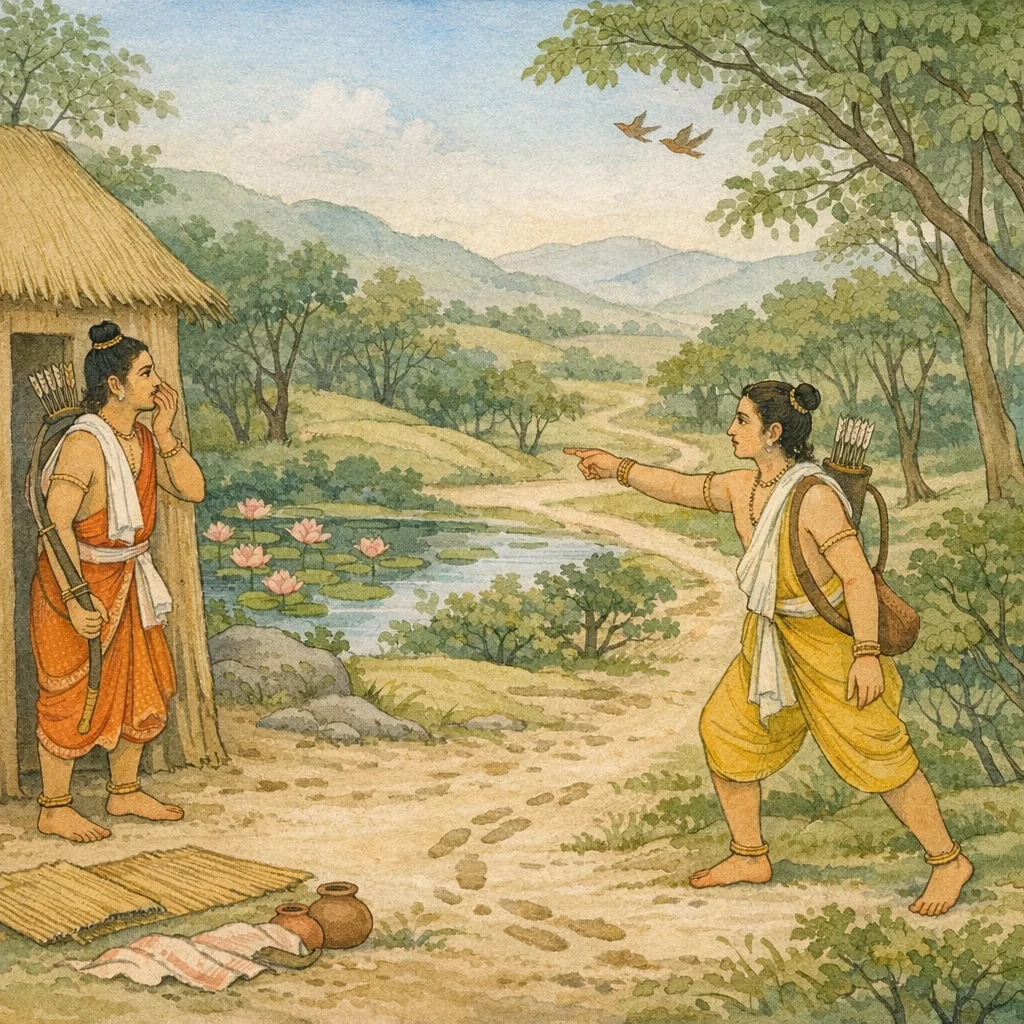
Returning to the hermitage-cottage, Rāma at once perceives a dreadful absence: Vaidehī is nowhere to be seen, the parṇaśālā stands deserted, and the seats and mats are disturbed—material signs that the ordinary order of their dwelling has been broken. He searches in every direction; failing to find Sītā, he bursts into lament, calling to her again and again and imagining possibilities from playful hiding to abduction, even to harm by wild creatures. His words intensify into self-reproach and despair, even threatening to relinquish life if he must remain separated from her, showing how grief can momentarily overwhelm discernment. Lakṣmaṇa, as moral support and strategic companion, consoles him with practical suppositions—river-bathing, hiding in the forest, or a test of affection—and urges immediate, united effort. The brothers then conduct a systematic search through forests, mountains, caves, peaks, rivers, and lotus-ponds, yet they do not find her. Thus the sarga sets vilāpa (the outcry of sorrow) beside the emerging discipline of search, turning the narrative from private loss toward organized pursuit within the forest realm.
Shlokas
Verse 1
दृष्ट्वाश्रमपदं शून्यं रामो दशरथात्मजः।रहितां पर्णशालां च विध्वस्तान्यासनानि च।।।।अदृष्ट्वा तत्र वैदेहीं सन्निरीक्ष्य च सर्वशः।उवाच रामः प्राक्रुश्य प्रगृह्य रुचिरौ भुजौ।।।।
Seeing the hermitage-ground empty, the leaf-cottage bereft of Sītā, and the seats thrown into disorder, Rāma—son of Daśaratha—searched everywhere; and when he did not find Vaidehī there, he cried aloud, raising his lovely arms, and spoke.
Verse 2
दृष्ट्वाश्रमपदं शून्यं रामो दशरथात्मजः।रहितां पर्णशालां च विध्वस्तान्यासनानि च।।3.61.1।।अदृष्ट्वा तत्र वैदेहीं सन्निरीक्ष्य च सर्वशः।उवाच रामः प्राक्रुश्य प्रगृह्य रुचिरौ भुजौ।।3.61.2।।
Not seeing Vaidehī there, and scanning in every direction, Rāma cried aloud and spoke, lifting up his handsome arms.
Verse 3
क्व नु लक्ष्मण वैदेही कं वा देशमितो गता।केनाहृता वा सौमित्रे भक्षिता केन वा प्रिया।।।।
“O Lakshmana, where indeed is Vaidehī? To what land has she gone from here? By whom has my beloved been carried off—or by whom has she been devoured, O Saumitri?”
Verse 4
वृक्षेणाच्छाद्य यदि मां सीते हसितुमिच्छसि।अलं ते हसितेनाद्य मां भजस्व सुदुःखितम्।।।।
“O Sītā, if you wish to tease me by hiding behind a tree—enough of this play now; come to me, for I am in great sorrow.”
Verse 5
यैस्सह क्रीडसे सीते विश्वस्तैर्मृगपोतकैः।एते हीनास्त्वया सौम्ये ध्यायन्त्यस्राविलेक्षणाः।।।।
O gentle Sītā, the little fawns who trusted you and played with you—now, bereft of you, they brood on you with eyes brimming with tears.
Verse 6
सीतया रहितोऽहं वै न हि जीवामि लक्ष्मण।मृतं शोकेन महता सीताहरणजेन माम्।।।।परलोके महाराजो नूनं द्रक्ष्यति मे पिता।
O Lakṣmaṇa, truly I cannot live without Sītā. This great grief born of Sītā’s abduction has made me as good as dead; surely my father, the great king, will see me in the next world.
Verse 7
कथं प्रतिज्ञां संश्रुत्य मया त्वमभियोजितः।।।।अपूरयित्वा तं कालं मत्सकाशमिहागतः।कामवृत्तमनार्यं मां मृषावादिनमेव च।।।।धिक्त्वामिति परे लोके व्यक्तं वक्ष्यति मे पिता।
“How, after being charged by me upon your pledged promise, did you come back to me here without completing that appointed time? In the next world my father will surely say to you plainly: ‘Fie on you! You have made me a man of whim, ignoble, and indeed a liar.’”
Verse 8
कथं प्रतिज्ञां संश्रुत्य मया त्वमभियोजितः।।3.61.7।।अपूरयित्वा तं कालं मत्सकाशमिहागतः।कामवृत्तमनार्यं मां मृषावादिनमेव च।।3.61.8।।धिक्त्वामिति परे लोके व्यक्तं वक्ष्यति मे पिता।
“How, after being charged by me upon your pledged promise, did you come back to me here without completing that appointed time? In the next world my father will surely condemn you: ‘Fie on you! You have made me seem fickle, ignoble, and untruthful.’”
Verse 9
विवशं शोकसन्तप्तं दीनं भग्नमनोरथम्।।।।मामिहोत्सृज्य करुणं कीर्तिर्नरमिवानृजुम्।क्व गच्छसि वरारोहे मां नोत्सृज सुमध्यमे।।।।त्वया विरहितश्चाहं मोक्ष्ये जीवितमात्मनः।
Helpless, scorched by sorrow, wretched and with hopes shattered—have you left me here pitiable, as fame abandons a crooked man? Where have you gone, O fair-limbed one? O slender-waisted lady, do not leave me; separated from you, I shall give up my life.
Verse 10
विवशं शोकसन्तप्तं दीनं भग्नमनोरथम्।।3.61.9।।मामिहोत्सृज्य करुणं कीर्तिर्नरमिवानृजुम्।क्व गच्छसि वरारोहे मां नोत्सृज सुमध्यमे।।3.61.10।।त्वया विरहितश्चाहं मोक्ष्ये जीवितमात्मनः।
“Where do you go, O fair-hipped one, leaving me here in misery—like fame abandoning a crooked man? O slender-waisted lady, do not forsake me. Separated from you, I shall give up my life.”
Verse 11
इतीव विलपन्रामस्सीतादर्शनलालसः।।।।न ददर्श सुदुःखार्तो राघवो जनकात्मजाम्।
Thus lamenting, Rāma—longing for the sight of Sītā—yet, though pierced by grievous sorrow, did not behold Janaka’s daughter.
Verse 12
अनासादयमानं तं सीतां दशरथात्मजम्।।।।पङ्कमासाद्य विपुलं सीदन्तमिव कुञ्जरम्।लक्ष्मणो राममत्यर्थमुवाच हितकाम्यया।।।।
When Daśaratha’s son could not find Sītā and was sinking like an elephant in deep mire, Lakṣmaṇa, seeking Rāma’s welfare, spoke to him earnestly.
Verse 13
अनासादयमानं तं सीतां दशरथात्मजम्।।3.61.12।।पङ्कमासाद्य विपुलं सीदन्तमिव कुञ्जरम्।लक्ष्मणो राममत्यर्थमुवाच हितकाम्यया।।3.61.13।।
Seeing Rāma, unable to find Sītā, sinking in despair like an elephant mired in deep mud, Lakṣmaṇa spoke to him earnestly, seeking his welfare.
Verse 14
मा विषादं महाबाहो कुरु यत्नं मया सह।इदं च हि वनं शूर बहुकन्दरशोभितम्।।।।
Do not yield to sorrow, O mighty-armed one; strive together with me. This forest indeed, O hero, is adorned with many caves.
Verse 15
प्रियकाननसञ्चारा वनोन्मत्ता च मैथिली।सा वनं वा प्रविष्टा स्यान्नलिनीं वा सुपुष्पिताम्।।।।
Maithilī, fond of roaming in beloved groves and enchanted by the forest, may have entered the woods—or perhaps a lotus-pond resplendent with blossoms.
Verse 16
सरितं वापि सम्प्राप्ता मीनवञ्जुलसेविताम्।स्नातुकामा निलीना स्याद्धासकामा वने क्वचित्।।।।
Or she may have reached a river where fish and reeds abound, and, wishing to bathe, has hidden herself; or, in playful jest, she may be concealing herself somewhere in the forest.
Verse 17
वित्रासयितुकामा वा लीना स्यात्कानने क्वचित्।जिज्ञासमाना वैदेही त्वां मां च पुरुषर्षभ।।।।तस्याह्यन्वेषणे श्रीमन् क्षिप्रमेव यतावहे।
Or Vaidehī may be hidden somewhere in the forest, meaning to startle us—testing you and me, O best of men. Therefore, O blessed one, let us at once strive to search for her.
Verse 18
वनं सर्वं विचिनुवो यत्र सा जनकात्मजा।।।।मन्यसे यदि काकुत्स्थ मा स्म शोके मनः कृथाः।
Let us search the entire forest, wherever Janaka’s daughter may be. If you agree, O Kākutstha, do not let your mind sink into grief.
Verse 19
एवमुक्तस्तु सौहार्दाल्लक्ष्मणेन समाहितः।।।।सह सौमित्रिणा रामो विचेतुमुपचक्रमे।
Thus addressed by Lakṣmaṇa with affectionate concern, Rāma regained composure and, together with Saumitri, began to search.
Verse 20
तौ वनानि गिरींश्चैव सरितश्च सरांसि च।।।।निखिलेन विचिन्वानौ सीतां दशरथात्मजौ।
The two sons of Daśaratha searched for Sītā everywhere—through forests and mountains, rivers and ponds—leaving nothing unexamined.
Verse 21
तस्य शैलस्य सानूनि गुहाश्च शिखराणि च।।।।निखिलेन विचिन्वानौ नैव तामभिजग्मतुः।
Even after searching that mountain entirely—its slopes, caves, and peaks—the two still did not find her.
Verse 22
विचित्य सर्वतश्शैलं रामो लक्ष्मणमब्रवित्।।।।नेह पश्यामि सौमित्रे वैदेहीं पर्वते शुभाम्।
After searching the mountain on every side, Rama said to Lakshmana: “O Saumitri, I do not see the noble Vaidehī here on this auspicious mountain.”
Verse 23
ततो दुःखाभिसन्तप्तो लक्ष्मणो वाक्यमब्रवीत्।।।।विचरन्दण्डकारण्यं भ्रातरं दीप्ततेजसम्।
Then Lakshmana, scorched by sorrow, spoke to his radiant brother as they moved about in the Dandaka forest.
Verse 24
प्राप्स्यसि त्वं महाप्राज्ञ मैथिलीं जनकात्मजाम्।।।।यथा विष्णुर्महाबाहुर्बलिं बद्ध्वा महीमिमाम्।
“O greatly wise one, you will regain Maithilī, Janaka’s daughter—just as mighty-armed Viṣṇu won this earth after binding Bali.”
Verse 25
एवमुक्तस्तु सौहार्दाल्लक्ष्मणेन स राघवः।।।।उवाच दीनया वाचा दुःखाभिहतचेतनः।
Thus addressed with affection by Lakshmana, Rāghava—his mind struck by grief—replied in a piteous voice.
Verse 26
वनं सर्वं सुविचितं पद्मिन्यः फुल्लपङ्कजाः।।।।गिरिश्चायं महाप्राज्ञ बहुकन्दरनिर्झरः।न हि पश्यामि वैदेहीं प्राणेभ्योऽपि गरीयसीम्।।।।
“O wise Lakshmana, I have thoroughly searched the whole forest, the lotus-ponds with blooming lotuses, and this mountain with its many caves and streams; yet I do not see Vaidehī—dearer to me even than my own life.”
Verse 27
वनं सर्वं सुविचितं पद्मिन्यः फुल्लपङ्कजाः।।3.61.26।।गिरिश्चायं महाप्राज्ञ बहुकन्दरनिर्झरः।न हि पश्यामि वैदेहीं प्राणेभ्योऽपि गरीयसीम्।।3.61.27।।
This verse repeats: “O wise Lakshmana, I have searched the whole forest, the lotus-ponds with blooming lotuses, and this mountain of many caves and streams; yet I do not see Vaidehī—dearer to me than life itself.”
Verse 28
एवं स विलपन्रामस्सीताहरणकर्शितः।दीनश्शोकसमाविष्टो मुहूर्तं विह्वलोऽभवत्।।।।
Thus lamenting, Rama—tormented by Sītā’s abduction—became despondent; overwhelmed by grief, he was dazed for a moment.
Verse 29
सन्तप्तो ह्यवसन्नाङ्गो गतबुद्धिर्विचेतनः।निषसादातुरो दीनो निश्श्वस्याशीतमायतम्।।।।
Scorched by anguish—his limbs weakened, his mind failing, his senses unsteady—he sank down, distressed and dejected, breathing long, burning sighs.
Verse 30
बहुलं स तु निश्श्वस्य रामो राजीवलोचनः।हा प्रियेति विचुक्रोश बहुशो बाष्पगद्गदः।।।।
Rama, lotus-eyed, heaved frequent sighs; and with a voice choked by tears he cried again and again, “Alas, my beloved!”
Verse 31
तं ततस्सान्त्वयामास लक्ष्मणः प्रियबान्धवः।बहुप्रकारं धर्मज्ञः प्रश्रितं प्रश्रिताञ्जलिः।।।।
Then Lakṣmaṇa—Rāma’s dear companion and a knower of dharma—humbly, with folded palms, consoled him in many different ways.
Verse 32
अनादृत्य तु तद्वाक्यं लक्ष्मणोष्ठपुटाच्च्युतम्।अपश्यंस्तां प्रियां सीतां प्राक्रोशत्स पुनः पुनः।।।।
But disregarding the words that had come from Lakṣmaṇa’s lips, and unable to see his beloved Sītā, he cried out again and again.
Frequently Asked Questions
The pivotal action is Rāma’s confrontation with destabilizing grief: whether to collapse into despair (including suicidal ideation) or to convert sorrow into disciplined action. Lakṣmaṇa guides him toward the latter, framing immediate search as the dharmic response.
The sarga models grief-management through counsel: intense emotion is acknowledged (vilāpa) but must be integrated into purposeful agency. Supportive speech (hitakāmyā) from a trusted companion restores composure and reorients the mind toward right action.
The narrative maps the search across āśrama-space (parṇaśālā, disturbed seats) and the wider Daṇḍakāraṇya ecology—forests, caves, mountain slopes and peaks, rivers, and lotus-ponds—turning the wilderness into an indexed terrain for inquiry.