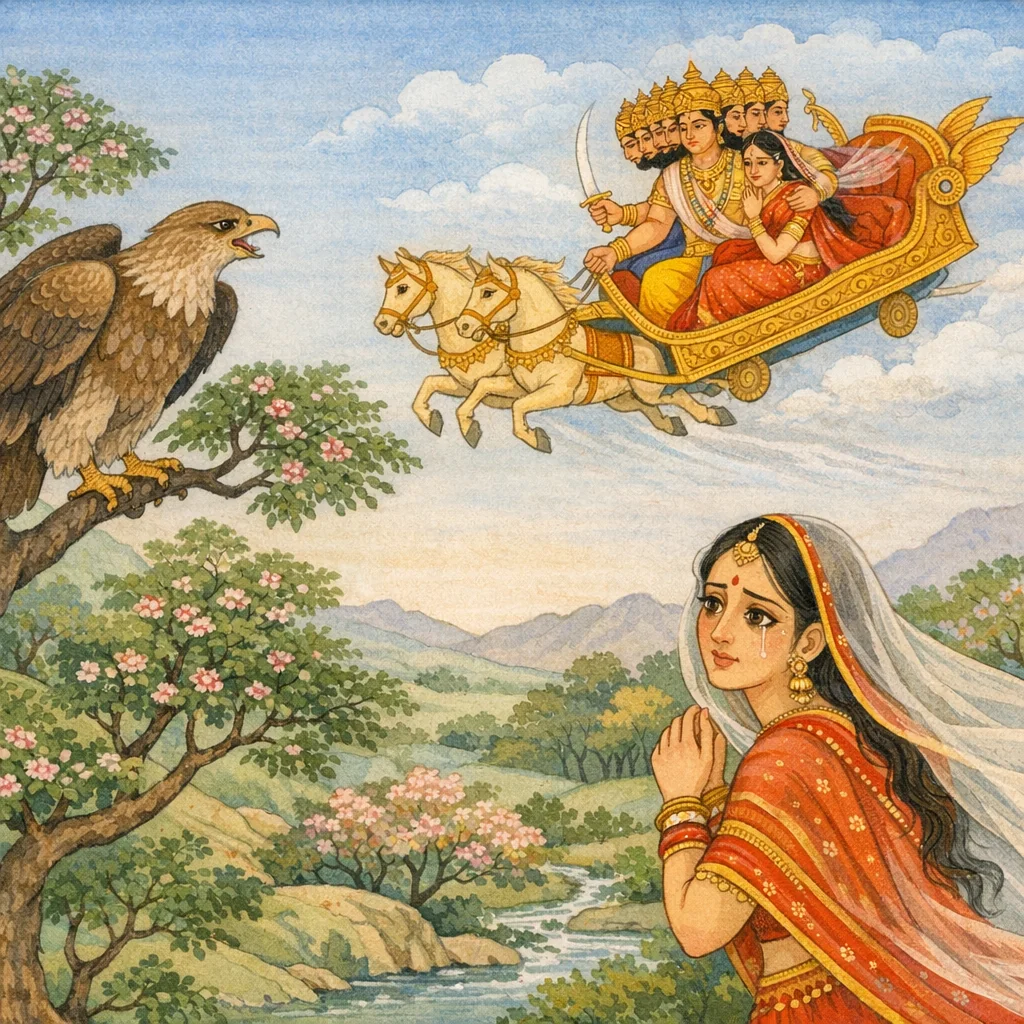
Sarga 50
जटायुरुपदेशः — Jatāyu Confronts Rāvaṇa (Ethical Admonition and Challenge)
अरण्यकाण्ड
Sarga 50 opens with Jatāyu hearing the distress-call and at once seeing Rāvaṇa carrying off Vaidehī. From a tree-top, the vulture-king introduces himself as a सत्यसंश्रय—one who abides in truth and stands with eternal dharma—then declares Sītā to be Rāma’s lawful wife and condemns her abduction as a breach of rājadharma and the kingly duty to protect society. Jatāyu teaches that kings become the root of virtue and vice, and that their conduct sets the public measure for dharma, artha, and kāma. He censures Rāvaṇa’s fickle, sinful mind, warns that prosperity cannot endure with evil intent, and asks what wrong Rāma has done to deserve such aggression—especially since Khara’s death followed from Khara’s own trespass. His admonition rises into direct deterrence: release Sītā or meet ruin; the deed is likened to binding a venomous serpent or tightening a noose of death. Declaring himself ready to die in a प्रियकार्य for Rāma and Daśaratha, Jatāyu challenges Rāvaṇa to fight and vows to drag him from his chariot like fruit plucked from a stalk.
Shlokas
Verse 1
तं शब्दमवसुप्तस्तु जटायुरथ शुश्रुवे।निरीक्ष्य रावणं क्षिप्रं वैदेहीं च ददर्श सः।।।।
Jatāyu, who was resting, heard that cry; looking up at once, he saw Rāvaṇa and Vaidehī (Sītā).
Verse 2
ततः पर्वतकूटाभस्तीक्ष्णतुण्डः खगोत्तमः।वनस्पतिगतश्श्रीमान्व्याजहार शुभां गिरम्।।।।
Then the glorious Jatāyu—best among birds, sharp-beaked, and mountain-peak-like in appearance—spoke auspicious words from the top of a tree.
Verse 3
दशग्रीव स्थितो धर्मे पुराणे सत्यसंश्रयः।जटायुर्नाम नाम्नाहं गृध्रराजो महाबलः।।।।
O Ten-necked one, I am Jatāyu by name—the mighty king of vultures—steadfast in the ancient dharma and grounded in truth.
Verse 4
राजा सर्वस्य लोकस्य महेन्द्रवरुणोपमः।लोकानां च हिते युक्तो रामो दशरथात्मजः।।।।
Rāma, the son of Daśaratha, is a king for the whole world—like Indra and Varuṇa—ever devoted to the welfare of all beings.
Verse 5
तस्यैषा लोकनाथस्य धर्मपत्नी यशस्विनी।सीता नाम वरारोहा यां त्वं हर्तुमिहेच्छसि।।।।
This illustrious woman is Sītā, the noble and lawful wife of Rāma, lord of the world—the very one whom you seek to carry away from here.
Verse 6
कथं राजास्थितो धर्मे परदारान्परामृशेत्।रक्षणीया विशेषेण राजदारा महाबल।।।।
How could a king established in dharma violate another man’s wife? A king’s consort, above all, must be guarded with special protection, O mighty one.
Verse 7
निवर्तय मतिं नीचां परदाराभिमर्शनात्।न तत्समाचरेद्धीरो यत्परोऽस्य विगर्हयेत्।।।।यथात्मनस्तथान्येषां दारा रक्ष्या विपश्चिता।
Turn your mind back from the base impulse of violating another man’s wife. A steadfast man should not do what others would rightly condemn in him. As he safeguards his own wife, so should a wise man protect the wives of others.
Verse 8
धर्ममर्थं वा कामं वा शिष्टाश्शास्त्रेष्वनागतम्।।।।व्यवस्यन्त्यनु राजानं धर्मं पौलस्त्यनन्दन।
O son of Paulastya, even when a rule is not explicitly found in the śāstras, the learned discern what is dharma, artha, and kāma by observing and judging in light of a king’s conduct, for royal behavior sets the public standard.
Verse 9
राजा धर्मस्य कामस्य द्रव्याणां चोत्तमो निधिः।।।।धर्मश्शुभं वा पापं वा राजमूलं प्रवर्तते।
The king is the foremost repository of dharma, kāma, and wealth. Whether righteousness takes a good form or turns to sin, its course in the world proceeds with the king as its root.
Verse 10
पापस्वभावश्चपलः कथं त्वं रक्षसां वर।।।।ऐश्वर्यमभिसम्प्राप्तो विमानमिव दुष्कृतिः।
“Sinful by nature and fickle—how, O ‘best of rākṣasas’, have you obtained such lordly power, like a celestial vimāna, when your deeds are wicked?”
Verse 11
कामं स्वभावो यो यस्य न शक्यः परिमार्जितुम्।।।।न हि दुष्टात्मनामार्यमावसत्यालये चिरम्।
Truly, whatever a person’s inborn nature may be, it cannot simply be wiped away. Prosperity does not dwell long in the house of the evil-minded.
Verse 12
विषये वा पुरे वा ते यदा रामो महाबलः।।।।नापराध्यति धर्मात्मा कथं तस्यापराध्यसि।
When the mighty Rāma—righteous in spirit—has not wronged you, whether in your realm or in your city, how can you commit an offence against him?
Verse 13
यदि शूर्पणखाहेतोर्जनस्थानगतः खरः।।।।अतिवृत्तो हतः पूर्वं रामेणाक्लिष्टकर्मणा।अत्र ब्रूहि यथातत्त्वं को रामस्य व्यतिक्रमः।।।।यस्य त्वं लोकनाथस्य भार्यां हृत्वा गमिष्यसि।
If, on account of Śūrpaṇakhā, Khara entered Janasthāna and—having overstepped—was earlier slain by Rāma, whose deeds meet no strain, then tell me truly: what wrongdoing of Rāma is there, that you would go off after stealing the wife of that lord of the world?
Verse 14
यदि शूर्पणखाहेतोर्जनस्थानगतः खरः।।3.50.13।।अतिवृत्तो हतः पूर्वं रामेणाक्लिष्टकर्मणा।अत्र ब्रूहि यथातत्त्वं को रामस्य व्यतिक्रमः।।3.50.14।।यस्य त्वं लोकनाथस्य भार्यां हृत्वा गमिष्यसि।
If, on account of Śūrpaṇakhā, Khara entered Janasthāna and—having overstepped—was earlier slain by Rāma, whose deeds meet no strain, then tell me truly: what wrongdoing of Rāma is there, that you would go off after stealing the wife of that lord of the world?
Verse 15
क्षिप्रं विसृज वैदेहीं मा त्वा घोरेण चक्षुषा।।।।दहेद्दहनभूतेन वृत्रमिन्द्राशनिर्यथा।
Release Vaidehī at once—lest, with her fierce gaze turned into consuming fire, she burn you as Indra’s thunderbolt burned Vṛtra.
Verse 16
सर्पमाशीविषं बद्ध्वा वस्त्रान्ते नावबुध्यसे।।।।ग्रीवायां प्रतिसक्तं च कालपाशं न पश्यसि।
You do not perceive that you are binding a venomous serpent to the hem of your garment; nor do you see the noose of Death already tightened around your neck.
Verse 17
स भारस्सौम्य भर्तव्यो यो नरं नावसादयेत्।।।।तदन्नमपि भोक्तव्यं जीर्यते यदनामयम्।
O gentle one, one should bear only that burden which does not exhaust a person; and one should eat only that food which is wholesome and digests without harm.
Verse 18
यत्कृत्वा न भवेद्धर्मो न कीर्तिर्न यशो भुवि।।।।शरीरस्य भवेत्खेदः कस्तत्कर्म समाचरेत्।
Who would undertake a deed that yields neither dharma, nor good repute, nor glory in the world, and brings only weariness to the body?
Verse 19
षष्टिर्वर्षसहस्राणि मम जातस्य रावण।।।।पितृपैतामहं राज्यं यथावदनुतिष्ठतः।
O Rāvaṇa, sixty thousand years have passed since my birth, during which I have duly upheld my ancestral kingdom in the proper way.
Verse 20
वृद्धोऽहं त्वं युवा धन्वी सशरः कवची रथी।।।।तथाप्यादाय वैदेहीं कुशली न गमिष्यसि।
I am old; you are young—armed with bow and arrows, armored, and mounted on a chariot. Even so, carrying off Vaidehī, you will not depart in safety.
Verse 21
न शक्तस्त्वं बलाद्धर्तुं वैदेहीं मम पश्यतः।।।।हेतुभिर्न्यायसंसिद्धैद्धृवां वेदश्रुतीमिव।
You cannot seize Vaidehī by force while I look on—just as one cannot, by mere reasoning, steal away the enduring Vedic revelation, established by rightful order.
Verse 22
युद्ध्यस्व यदि शूरोऽसि मुहूर्तं तिष्ठ रावण।।।।शयिष्यसे हतो भूमौ यथापूर्वं खरस्तथा।
If you are truly a hero, then fight—stand your ground for a moment, O Rāvaṇa. Slain, you will lie upon the earth, just as Khara did before.
Verse 23
असकृत्संयुगे येन निहता दैत्यदानवाः।।।।नचिराच्चीरवासास्त्वां रामो युधि वधिष्यति।
Rāma—who time and again in battle has slain demons and Dānavas—though clad in bark garments, will soon kill you in war.
Verse 24
किं नु शक्यं मया कर्तुं गतौदूरं नृपात्मजौ।।।।क्षिप्रं त्वं नश्यसे नीच तयोर्भीतो न संशयः।
What more can I do, when the two princes have gone far away? You wretch—soon you will perish, for you acted out of fear of them; of this there is no doubt.
Verse 25
न हि मे जीवमानस्य नयिष्यसि शुभामिमाम्।।।।सीतां कमलपत्राक्षीं रामस्य महिषीं प्रियाम्।
So long as I live, you will not take this auspicious Sītā—lotus-eyed, the beloved queen-consort of Rāma—away with you.
Verse 26
अवश्यं तु मया कार्यं प्रियं तस्य महात्मनः।।।।जीवितेनापि रामस्य तथा दशरथस्य च।
I must surely do what is dear and fitting for the great-souled Rāma—and for Daśaratha as well—even if it costs me my life.
Verse 27
तिष्ठ तिष्ठ दशग्रीव मुहूर्तं पश्य रावण।।।।युद्धातिथ्यं प्रदास्यामि यथाप्राणं निशाचर।वृन्तादिव फलं त्वां तु पातयेयं रथोत्तमात्।।।।
Stay, stay, O ten-necked Rāvaṇa—look here for a moment! O night-roamer, as long as I have breath I will offer you the “hospitality” of battle, and I will hurl you down from your splendid chariot like a fruit falling from its stalk.
Frequently Asked Questions
The pivotal action is Rāvaṇa’s forceful removal of Sītā; the dilemma is framed as an explicit breach of राजधर्म—how a king can violate another’s lawful पत्नी and thereby destabilize public morality that follows royal conduct.
Jatāyu teaches that character (svabhāva) and governance ethics are inseparable: prosperity does not remain with the wicked, and a ruler becomes the root of societal virtue or vice; therefore, desire must be restrained by dharma, especially regarding others’ spouses.
Janasthāna appears as the prior conflict-site tied to Khara and Śūrpaṇakhā, functioning as a narrative landmark for causality; culturally, the Sarga foregrounds norms of protecting rājadārā (a king’s wife) and the didactic tradition of nīti within epic discourse.