Sarga 48
रावणस्यात्मप्रशंसा लङ्कावर्णनं च — Ravana’s Self-Praise and the Description of Lanka
अरण्यकाण्ड
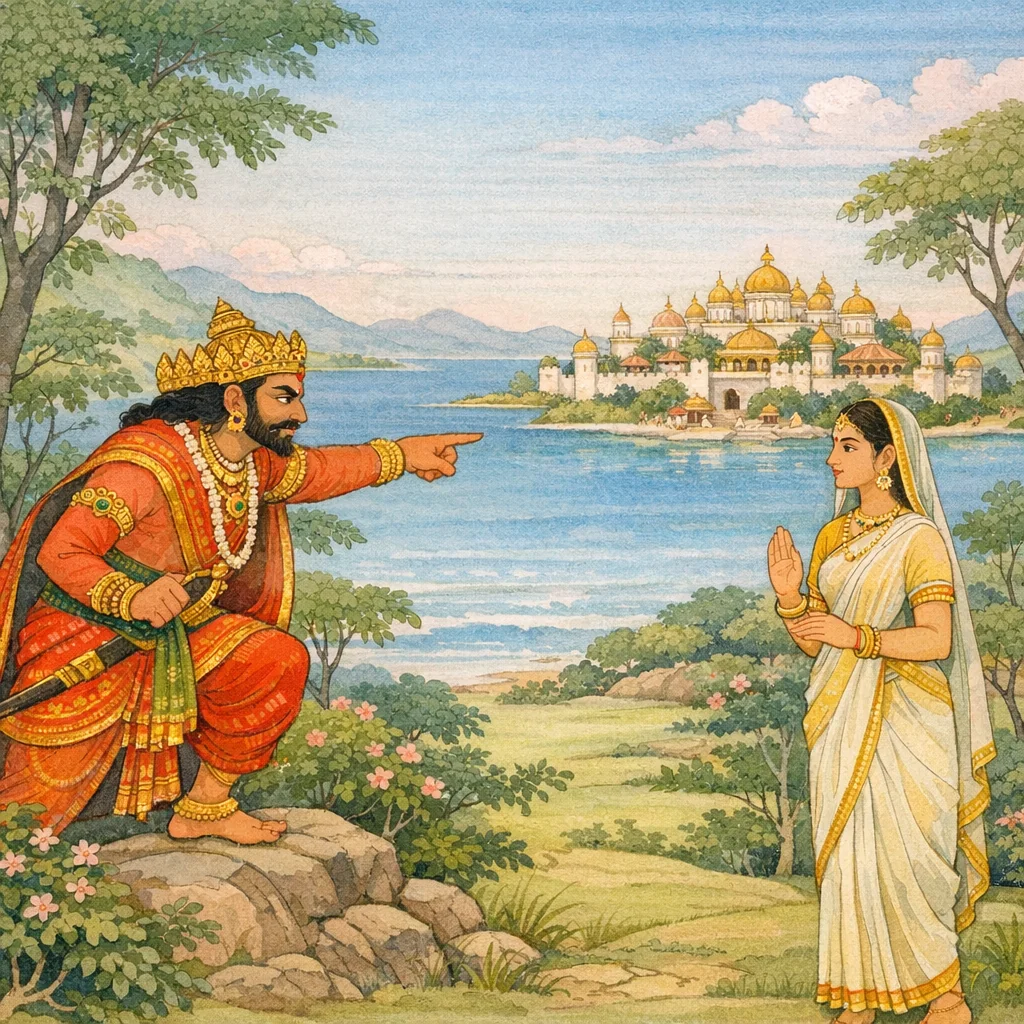
In this chapter, Ravana answers Sita’s earlier rebuke with open anger—brows drawn tight and words made sharp—and turns to a rhetoric that blends intimidation with seduction. He declares his identity and lineage as Kubera’s step-brother, magnifies his dreaded sovereignty by claiming that gods and beings flee his wrath and that even Kubera abandoned his former seat, and boasts that he won the Puṣpaka vimāna by valor. He then persuades by describing place: Lanka is portrayed as a radiant, sea-girt, strongly fortified city, crowded with formidable rakshasas, white ramparts, golden palaces, jeweled gateways, vehicles and animals, music, and gardens that bear fruit unceasingly—an urban splendor set against the forest. He offers Sita life with him in luxury, disparages Rama as a mortal ascetic bereft of kingship, and warns that refusal will bring later regret, invoking the exemplum of Pururavas and Urvasi. The speech ends in Sita’s fierce reply: she condemns the impropriety of invoking Kubera while intending an inauspicious deed, foretells ruin for Ravana’s clan under such leadership, and declares that abducting Rama’s wife cannot be survived—after violating a woman like her, not even amrita, the nectar of immortality, can avert death.
Shlokas
Verse 1
एवं बृवन्त्यां सीतायां संरब्दः परुषं वचः।ललाटे भृकुटीं कृत्वा रावणः प्रत्युवाच ह।।।।
As Sītā spoke thus, Rāvaṇa, inflamed with wrath, knit his brows upon his forehead and answered her with harsh, cutting words.
Verse 2
भ्राता वैश्रवणस्याहं सापत्न्यो वरवर्णिनि।रावणो नाम भद्रं ते दशग्रीवः प्रतापवान्।।।।
O fair-complexioned lady, I am the brother of Vaiśravaṇa (Kubera), born of a different wife; I am called Rāvaṇa—Daśagrīva, the mighty. May it be well with you.
Verse 3
यस्य देवास्सगन्धर्वाः पिशाचपतगोरगाः।विद्रवन्ति भयाद्भीता मृत्योरिव सदा प्रजाः।।।।
Like people who flee from Death itself, beings of every kind—gods with the Gandharvas, spirits, birds, and serpents—run away in fear of him.
Verse 4
येन वैश्रवणो राजा द्वैमात्रः कारणान्तरे।द्वन्द्वमासादितः क्रोधाद्रणे विक्रम्य निर्जितः।।।।
He claims that, for some other cause, he challenged King Vaiśravaṇa (Kubera), born of a different mother, and in anger defeated him in single combat through prowess in battle.
Verse 5
यद्भयार्तः परित्यज्य स्वमधिष्ठानमृद्धिमत्।कैलासं पर्वतश्रेष्ठमध्यास्ते नरवाहनः।।।।
He says that Kubera—‘Naravāhana’—abandoned his prosperous seat out of fear of him and now dwells on Mount Kailāsa, the best of mountains.
Verse 6
यस्य तत्पुष्पकं नाम विमानं कामगं शुभम्।वीर्यादेवार्जितं भद्रे येन यामि विहायसम्।।।।
He added: “O noble lady, by my valor alone I won that auspicious aerial car named Puṣpaka, which moves at will; by it I travel through the sky.”
Verse 7
मम सञ्जातरोषस्य मुखं दृष्ट्वैव मैथिलि।विद्रवन्ति परित्रस्तास्सुराश्शक्रपुरोगमाः।।।।
He declared: “O Maithilī, merely seeing my face when anger has arisen, even the gods—led by Śakra (Indra)—flee in terror.”
Verse 8
यत्र तिष्ठाम्यहं तत्र मारुतो वाति शङ्कितः।तीव्रांशुश्शिशिरांशुश्च भयात्सम्पद्यते रविः।।।।
Wherever I stand, even the Wind blows as though in hesitation; and the Sun—fearful of me—turns from scorching to cool, yet continues to perform his ordained course.
Verse 9
निष्कम्पपत्रास्तरवो नद्यश्च स्तिमितोदकाः।भवन्ति यत्र यत्राहं तिष्ठामि विचरामि च।।।।
Wherever I remain and wherever I roam, the trees stand with leaves unmoving, and the rivers keep their waters stilled.
Verse 10
मम पारे समुद्रस्य लङ्का नाम पुरी शुभा।सम्पूर्णा राक्षसैर्घोरैर्यथेन्द्रस्यामरावती।।।।
On the far shore of the sea lies my splendid city called Laṅkā, filled with fearsome rākṣasas, like Indra’s Amarāvatī.
Verse 11
प्राकारेण परिक्षिप्ता पाण्डुरेण विराजता।हेमकक्ष्या पुरी रम्या वैढूर्यमयतोरणा।।।।
The lovely city shines, enclosed by pale-white ramparts; its inner halls are of gold, and its gateways are set with vaiḍūrya gems.
Verse 12
हस्त्यश्वरथसम्बाधा तूर्यनादविनादिता।सर्वकालफलैर्वृक्षैस्सङ्कुलोद्द्यानशोभिता।।।।
It is thronged with elephants, horses, and chariots, and resounds with the blare of instruments; its pleasure-gardens are splendid, thick with trees that bear fruit in every season.
Verse 13
तत्र त्वं वसती सीते राजपुत्रि मया सह।न स्मरिष्यसि नारीणां मानुषीणां मनस्विनि।।।।
There, O Sītā—princess, high-minded lady—dwelling with me, you will not even think of human women and their lot.
Verse 14
भुञ्जाना मानुषान्भोगान्दिव्यांश्च वरवर्णिनि।न स्मरिष्यसि रामस्य मानुषस्य गतायुषः।।।।
O lady of exquisite complexion—enjoying human pleasures and divine delights, you will no longer remember Rāma, a mortal of fleeting lifespan.
Verse 15
स्थापयित्वा प्रियं पुत्रं राज्ञा दशरथेन यः।मन्दवीर्यस्सुतो ज्येष्ठस्ततः प्रस्थापितो वनम्।।।।
After King Daśaratha installed his beloved son as heir, his eldest son—deemed weak in prowess—was then sent away to the forest.
Verse 16
तेन किं भ्रष्टराज्येन रामेण गतचेतसा।करिष्यसि विशालाक्षि तापसेन तपस्विना।।।।
What can you accomplish with that Rāma—bereft of kingdom and unsteady in mind—an ascetic living by austerities, O large-eyed lady?
Verse 17
सर्वराक्षसभर्तारं कामात्स्वयमिहागतम्।न मन्मथशराविष्टं प्रत्याख्यातुं त्वमर्हसि।।।।
You should not reject me—the lord of all rākṣasas—who have come here of my own accord, driven by desire and pierced by Kāma’s arrows.
Verse 18
प्रत्याख्याय हि मां भीरु परितापं गमिष्यसि।चरणेनाभिहत्येव पुरूरवसमूर्वशी।।।।
If you reject me, O timid lady, you will fall into regret—like Urvaśī who, as it were, struck Purūravas with her foot and later repented.
Verse 19
अङ्गुल्या न समो रामो मम युद्धे स मानुषः।तव भाग्येन सम्प्राप्तं भजस्व वरवर्णिनि।।।।
That Rāma, a mere man, is not equal even to my finger in battle. By your good fortune I have come to you—take refuge in me, O fair-complexioned lady.
Verse 20
एवमुक्ता तु वैदेही क्रुद्धा संरक्तलोचना।अब्रवीत्परुषं वाक्यं रहिते राक्षसाधिपम्।।।।
Thus addressed, Vaidehī, enraged with eyes reddened, spoke harsh words to the lord of the rākṣasas while they were in that secluded place.
Verse 21
कथं वैश्रवणं देवं सर्वभूतनमस्कृतम्।भ्रातरं व्यपदिश्य त्वमशुभं कर्तुमिच्छसि।।।।
“How can you desire to commit an inauspicious deed, while calling the god Vaiśravaṇa Kubera—revered by all beings—your ‘brother’?”
Verse 22
अवश्यं विनशिष्यन्ति सर्वे रावण राक्षसाः।येषां त्वं कर्कशो राजा दुर्बुद्धिरजितेन्द्रियः।।।।
“Surely, O Rāvaṇa, all those rākṣasas will perish whose king you are—harsh, evil-minded, and uncontrolled in your senses.”
Verse 23
अपहृत्य शचीं भार्यां शक्यमिन्द्रस्य जीवितुम्।न च रामस्य भार्यां मामपनीयास्ति जीवितम्।।।।
One might yet live after abducting Śacī, Indra’s wife; but after carrying off me, the wife of Rāma, there is no life for the abductor.
Verse 24
जीवेच्चिरं वज्रधरस्य हस्ताच्छचीं प्रधृष्याप्रतिरूपरूपाम्।न मादृशीं राक्षस दूशयित्वा पीतामृतस्यापि तवास्ति मोक्षः।।।।
O rākṣasa, one might live long even after forcibly seizing the incomparable Śacī from the hand of Indra, wielder of the thunderbolt; but after violating a woman like me, there will be no escape from death for you—even if you drink nectar.
Frequently Asked Questions
The chapter centers on coercive persuasion: Ravana attempts to convert Sita’s consent through fear, luxury, and denigration of Rama, while Sita must respond within a hostile, solitary setting by reaffirming marital fidelity and condemning the intended violation as adharma with inevitable consequences.
Power and splendour are shown as ethically hollow when detached from restraint and rightful conduct; Sita’s stance models moral clarity under duress, asserting that legitimacy arises from dharma rather than from intimidation, lineage-claims, or material abundance.
Lanka is mapped as a fortified, jewel-adorned city beyond the sea, contrasted with the forest setting; Kailāsa appears as Kubera’s refuge; Amarāvatī is invoked as an aesthetic benchmark; and the Puṣpaka vimāna functions as a culturally significant aerial vehicle symbolizing contested sovereignty.