Sarga 28
खररामयुद्धम् — The Battle of Khara and Rama (Aranya Kanda, Sarga 28)
अरण्यकाण्ड
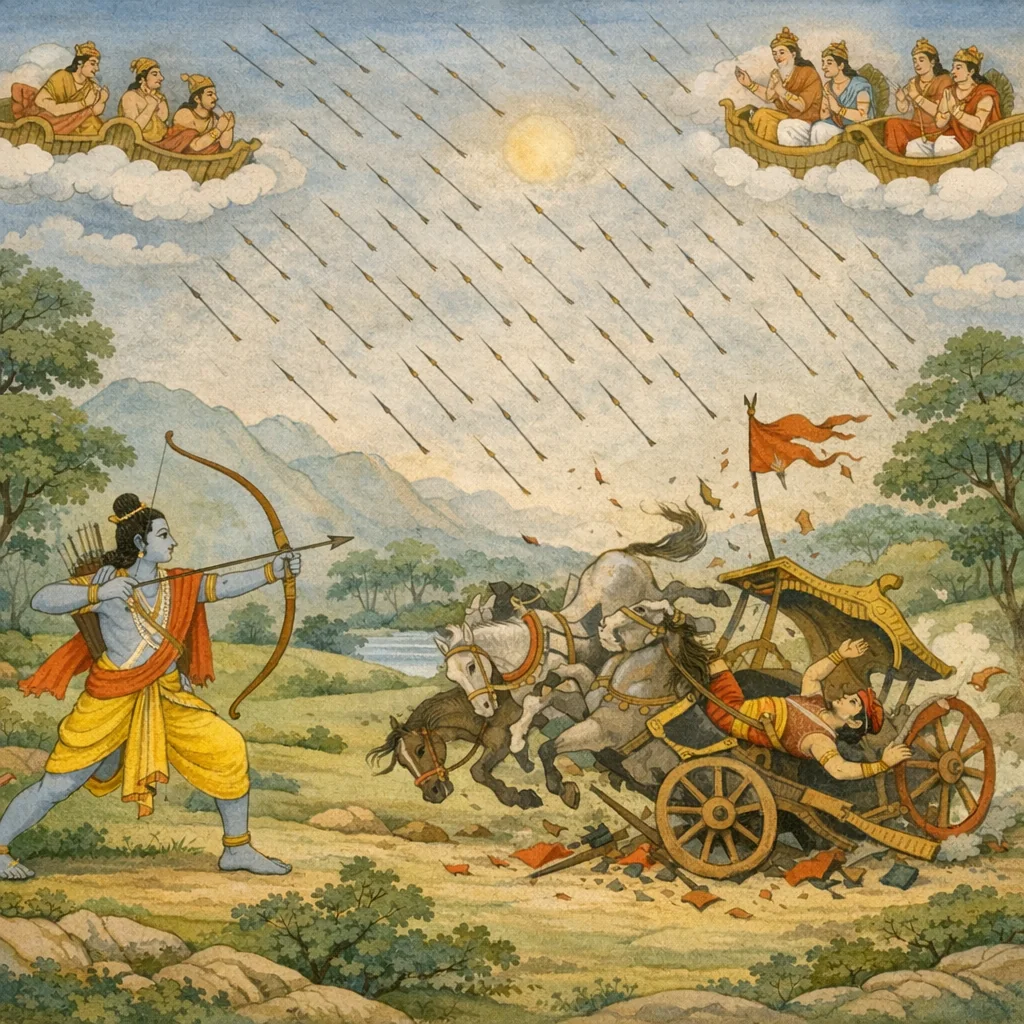
This sarga presents the climactic duel between Khara and Rāma after Khara beholds his forces destroyed and the commanders Dūṣaṇa and Triśiras fallen. Driven by fear and rage, Khara advances and unleashes dense showers of arrows that darken the sky and obscure the sun, then strikes Rāma with specialized darts (nālīka, vikarṇi), appearing to beings like Yama bearing a noose. Mistaking Rāma for weary, Khara presses hard—severing Rāma’s bow at the grip and battering his armour until it drops away. Yet Rāma, steady and clear-minded, strings a new great bow and steps forward with the superior Vaiṣṇava bow, linked to the gift-tradition of Agastya. In a tactical reversal, Rāma breaks Khara’s chariot-flag and methodically disables the chariot—yoke, horses, charioteer, pole, axle—shattering Khara’s bow and finally piercing him with a decisive thirteenth arrow. Khara, dismounted, shifts to a mace and stands upon the ground, as gods and great ṛṣis arrive in aerial chariots to offer reverent praise of Rāma’s dharmic feat, affirming disciplined valour, strategic clarity amid arrow-saturation, and the epic motif of divine witness.
Shlokas
Verse 1
निहतं दूषणं दृष्ट्वा रणे त्रिशिरसा सह।खरस्याप्यभवत्त्रासो दृष्ट्वा रामस्य विक्रमम्।।।।
Seeing Dūṣaṇa slain in battle along with Triśiras, even Khara was seized by fear when he beheld Rāma’s prowess.
Verse 2
स दृष्ट्वा राक्षसं सैन्यमविसह्यं महाबलः।हतमेकेन रामेण त्रिशिरोदूषणावपि।।।।तद्बलं हतभूयिष्ठं विमनाः प्रेक्ष्य राक्षसः।आससाद खरो रामं नमुचिर्वासवं यथा।।।।
Seeing his vast, irresistible rākṣasa host cut down by Rāma alone—and even Triśiras and Dūṣaṇa slain—Khara, shaken at the sight of his forces largely destroyed, advanced upon Rāma, as Namuci once advanced against Indra.
Verse 3
स दृष्ट्वा राक्षसं सैन्यमविसह्यं महाबलः।हतमेकेन रामेण त्रिशिरोदूषणावपि।।3.28.2।।तद्बलं हतभूयिष्ठं विमनाः प्रेक्ष्य राक्षसः।आससाद खरो रामं नमुचिर्वासवं यथा।।3.28.3।।
Seeing his irrepressible rākṣasa host cut down—and even Triśiras and Dūṣaṇa slain by Rama alone—Khara, shaken at the sight of his force largely destroyed, advanced upon Rama for battle, like Namuci approaching Vāsava (Indra).
Verse 4
विकृष्य बलवच्चापं नाराचान्रक्तभोजनान्।खरश्चिक्षेप रामाय क्रुद्धानाशीविषानिव।।।।
Drawing his powerful bow to the full, Khara, in fury, hurled at Rama barbed arrows—blood-seeking like enraged venomous serpents.
Verse 5
ज्यां विधून्वंसुबहुशश्शिक्षयास्त्राणि दर्शयन्।चचार समरे मार्गाञ्छरै रथगतः खरः।।।।
Seated in his chariot, Khara repeatedly twanged his bowstring and, displaying his trained weapon-skill, sent his arrows ranging through the battle-lines in every direction.
Verse 6
स सर्वाश्च दिशो बाणैः प्रदिशश्च महारथः।पूरयामास तं दृष्ट्वा रामोऽपि सुमहद्धनुः।।।।
Seeing him, Rama too—mighty-armed and a great charioteer—began to fill all directions and the intermediate quarters with his arrows.
Verse 7
स सायकैर्दुर्विसहैस्सस्फुलिङ्गैरिवाग्निभिः।नभश्चकाराविवरं पर्जन्य इव वृष्टिभिः।।।।
With irresistible arrows, sparkling like firebrands, he made the sky without a gap—like a rain-cloud that, when it pours, leaves no space unfilled.
Verse 8
तद्बभूव शितैर्बाणैः खररामविसर्जितैः।पर्याकाशमनाकाशं सर्वतश्शरसङ्कुलम्।।।।
Then, with sharp arrows loosed by both Khara and Rama, the surrounding sky became as though skyless—everywhere crowded with shafts.
Verse 9
शरजालावृतस्सूर्यो न तदा स्म प्रकाशते।अन्योन्यवधसंरम्भादुभयोस्संप्रयुध्यतोः।।।।
With the sun veiled by a net of arrows, it did not shine forth then—so fierce was the mutual death-intent of the two as they fought.
Verse 10
ततो नालीकनाराचैस्तीक्ष्णाग्रैश्च विकर्णिभिः।आजघान खरो रामं तोत्रैरिव महाद्विपम्।।।।
Then Khara struck at Rāma with nālīka-darts and sharp-pointed missiles called vikarṇi, like goads driving a mighty elephant.
Verse 11
तं रथस्थं धनुष्पाणिं राक्षसं पर्यवस्थितम्।ददृशुस्सर्वभूतानि पाशहस्तमिवान्तकम्।।।।
All beings beheld that rākṣasa, stationed upon his chariot with bow in hand, like Death himself holding a noose.
Verse 12
हन्तारं सर्वसैन्यस्य पौरुषे पर्यवस्थितम्।परिश्रान्तं महासत्वं मेने रामं खरस्तदा।।।।
Then Khara supposed that Rāma—mighty in spirit, steadfast in valor, the destroyer of his entire army—must by now be exhausted.
Verse 13
तं सिंहमिव विक्रान्तं सिंहविक्रान्तगामिनम्।दृष्ट्वा नोद्विजते रामः सिंहः क्षुद्रमृगं यथा।।।।
Seeing him advance fiercely like a lion, with a lion’s stride, Rāma was not disturbed—like a lion untroubled by a petty beast.
Verse 14
ततः सूर्यनिकाशेन रथेन महता खरः।आससाद रणे रामं पतङ्ग इव पावकम्।।।।
Then Khara, upon a great chariot radiant like the sun, closed in on Rāma in battle—like a moth rushing into fire.
Verse 15
ततोऽस्य सशरं चापं मुष्टिदेशे महात्मनः।खरश्चिच्छेद रामस्य दर्शयन्पाणिलाघवम्।।।।
Then, displaying swift dexterity of hand, Khara shattered Rāma’s bow—arrow still set—right at the grip, though Rāma was a great-souled warrior.
Verse 16
स पुनस्त्वपरान्सप्त शरानादाय वर्मणि।निजघान खरः क्रुद्धश्शक्राशनिसमप्रभान्।।।।
Again, the enraged Khara took up seven other arrows, blazing like Indra’s thunderbolt, and struck Rāma’s armour.
Verse 17
ततस्तत्प्रहतं बाणैः खरमुक्तैस्सुपर्वभिः।पपात कवचं भूमौ रामस्यादित्यवर्चसः।।।।
Then, struck by well-jointed arrows loosed by Khara, Rama’s armour—radiant like the sun—fell upon the earth.
Verse 18
ततश्शरसहस्रेण राममप्रतिमौजसम्।अर्दयित्वा महानादं ननाद समरे खरः।।।।
Then Khara, assailing Rama of incomparable might with a thousand arrows, roared aloud upon the battlefield.
Verse 19
स शरैरर्दितः क्रुद्धस्सर्वगात्रेषु राघवः।रराज समरे रामो विधूमोऽग्निरिव ज्वलन्।।।।
Wounded in every limb by arrows, the Rāghava grew wrathful; in battle Rama shone like a smokeless fire, blazing.
Verse 20
ततो गम्भीरनिर्ह्रादं रामश्शत्रुनिबर्हणः।चकारान्ताय स रिपोस्सज्यमन्यन्महद्धनुः।।।।
Then Rama, destroyer of foes, strung another mighty bow that rang with a deep, resounding note, intent on bringing the enemy to his end.
Verse 21
सुमहद्वैष्णवं यत्तदतिसृष्टं महर्षिणा।वरं तद्धनुरुद्यम्य खरं समभिधावत।।।।
Lifting that supremely excellent Vaiṣṇava bow, bestowed by a great sage, Rama rushed straight at Khara.
Verse 22
ततः कनकपुङ्खैस्तु शरैस्सन्नतपर्वभिः।बिभेद रामस्सङ्क्रुद्धः खरस्य समरे ध्वजम्।।।।
Then Rama, inflamed with wrath, shattered Khara’s battle-standard in the fight with smooth, well-jointed arrows tipped with golden feathers.
Verse 23
स दर्शनीयो बहुधा विकीर्णः काञ्चनध्वजः।जगाम धरणीं सूर्यो देवतानामिवाज्ञया।।।।
That splendid golden standard, shattered into many pieces, fell to the earth—like the sun itself descending to the ground at the command of the gods.
Verse 24
तं चतुर्भिः खरः क्रुद्धो रामं गात्रेषु मार्गणैः।विव्याध युधि मर्मज्ञो मातङ्गमिव तोमरैः।।।।
Enraged, Khara—skilled in striking vulnerable points—wounded Rama in battle with four arrows in his limbs, as though an elephant were jabbed with javelins.
Verse 25
स रामो बहुभिर्बाणैः खरकार्मुकनिस्सृतैः।विद्धो रुधिरसिक्ताङ्गो बभूव रुषितो भृशम्।।।।
Rama, struck by many arrows released from Khara’s bow, his limbs drenched in blood, became intensely enraged.
Verse 26
स धनुर्धन्विनां श्रेष्ठः प्रगृह्य परमाहवे।मुमोच परमेष्वासष्षट्छरानभिलक्षितान्।।।।
Then he—the finest among archers, the supreme wielder of the bow—raised his bow in that great combat, took aim, and released six well-targeted arrows.
Verse 27
शिरस्येकेन बाणेन द्वाभ्यां बह्वोरथार्दयत्।त्रिभिश्चन्द्रार्धवक्त्रैश्च वक्षस्यभिजघान ह।।।।
With one arrow he struck the head; with two he battered the shoulders; and with three crescent-faced arrows he smote the chest.
Verse 28
ततः पश्चान्महातेजा नाराचान्भास्करोपमान्।जिघांसू राक्षसङ्कृद्धस्त्रयोदश समाददे।।।।
After that, the radiant Rama—angered and intent on slaying the rākṣasa—took up thirteen nārāca arrows, blazing like the sun.
Verse 29
ततोऽस्य युगमेकेन चतुर्भिश्चतुरो हयान्।षष्ठेन तु शिरस्सङ्ख्ये खरस्य रथसारथेः।।।।त्रिभिस्त्रिवेणुं बलवान्द्वाभ्यामक्षं महाबलः।द्वादशेन तु बाणेन खरस्य सशरं धनुः।।।।छित्वा वज्रनिकाशेन राघवः प्रहसन्निव।त्रयोदशेनेन्द्रसमो बिभेद समरे खरम्।।।।
Then Rāghava, mighty like Indra, shattered the yoke of Khara’s chariot with one arrow; with four he slew the four horses; with the sixth he struck off the charioteer’s head in battle. With three he broke the chariot’s pole, with two the axle, and with the twelfth he splintered Khara’s bow together with its arrow. As though laughing, he then pierced Khara in the fight with the thirteenth, diamond-like shaft.
Verse 30
ततोऽस्य युगमेकेन चतुर्भिश्चतुरो हयान्।षष्ठेन तु शिरस्सङ्ख्ये खरस्य रथसारथेः।।3.28.29।।त्रिभिस्त्रिवेणुं बलवान्द्वाभ्यामक्षं महाबलः।द्वादशेन तु बाणेन खरस्य सशरं धनुः।।3.28.30।।छित्वा वज्रनिकाशेन राघवः प्रहसन्निव।त्रयोदशेनेन्द्रसमो बिभेद समरे खरम्।।3.28.31।।
Then Rāghava, mighty like Indra, shattered the yoke of Khara’s chariot with one arrow; with four he slew the four horses; with the sixth he struck off the charioteer’s head in battle. With three he broke the chariot’s pole, with two the axle, and with the twelfth he splintered Khara’s bow together with its arrow. As though laughing, he then pierced Khara in the fight with the thirteenth, diamond-like shaft.
Verse 31
ततोऽस्य युगमेकेन चतुर्भिश्चतुरो हयान्।षष्ठेन तु शिरस्सङ्ख्ये खरस्य रथसारथेः।।3.28.29।।त्रिभिस्त्रिवेणुं बलवान्द्वाभ्यामक्षं महाबलः।द्वादशेन तु बाणेन खरस्य सशरं धनुः।।3.28.30।।छित्वा वज्रनिकाशेन राघवः प्रहसन्निव।त्रयोदशेनेन्द्रसमो बिभेद समरे खरम्।।3.28.31।।
Then Rāghava, mighty like Indra, shattered the yoke of Khara’s chariot with one arrow; with four he slew the four horses; with the sixth he struck off the charioteer’s head in battle. With three he broke the chariot’s pole, with two the axle, and with the twelfth he splintered Khara’s bow together with its arrow. As though laughing, he then pierced Khara in the fight with the thirteenth, diamond-like shaft.
Verse 32
प्रभग्नधन्वा विरथो हताश्वो हतसारथिः।गदापाणिरवप्लुत्य तस्थौ भूमौ खरस्तदा।।।।
Then Khara—his bow broken, his chariot lost, his horses slain, and his charioteer killed—leapt down and stood upon the ground, mace in hand.
Verse 33
तत्कर्म रामस्य महारथस्य समेत्य देवाश्च महर्षयश्च।अपूजयन्प्राञ्जलयः प्रहृष्टाः तदा विमानाग्रगतास्समेताः।।।।
Then the gods and the great seers, gathering together and standing upon the heights of their aerial cars, joyfully honored Rama—the great warrior—for that deed.
Frequently Asked Questions
The pivotal action is dharma-guided escalation: after Khara’s aggression intensifies into overwhelming projectile warfare, Rāma chooses decisive, proportionate force—transitioning to a superior bow and disabling the enemy’s chariot system—to end the threat efficiently rather than prolonging violence.
Though largely non-dialogic, the chapter teaches that true prowess is not mere ferocity but composure and method: even when wounded and surrounded by fear-inducing spectacle, Rāma acts with clarity, and the narrative frames such disciplined power as worthy of cosmic (deva-ṛṣi) recognition.
The setting is the forest war-theatre of Araṇya Kāṇḍa (daṇḍakāraṇya context), culturally marked by the presence of ṛṣi traditions (Agastya’s weapon-gift lineage) and the motif of aerial chariots (vimāna) as a narrative device signaling divine surveillance of righteous action.