Sarga 27
त्रिशिरोवधः (The Slaying of Triśiras) — Araṇyakāṇḍa, Sarga 27
अरण्यकाण्ड
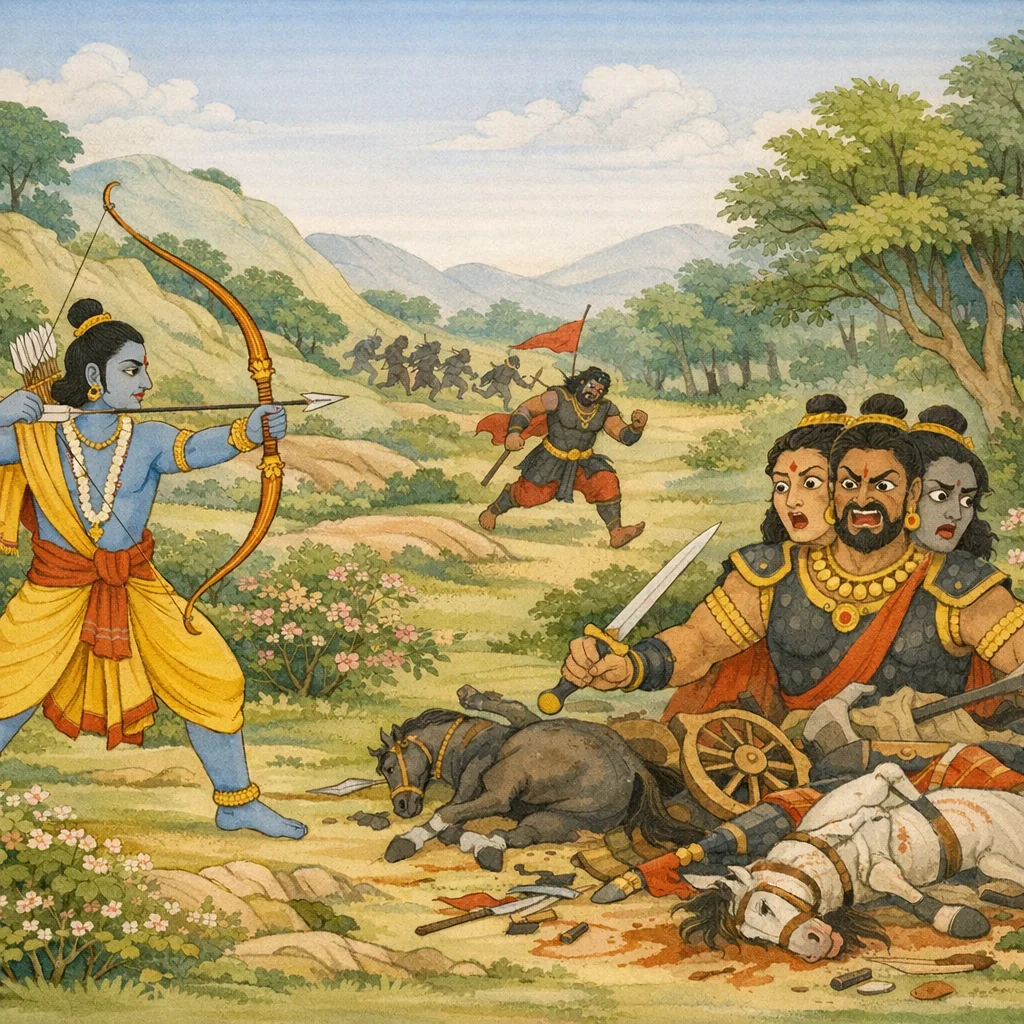
This sarga stages a focused martial episode within the Janasthāna theatre. As Khara advances toward Rāma, the rākṣasa commander Triśiras intervenes, urging Khara to withdraw and assign the combat to him; he vows upon his weapon to kill Rāma and frames the duel as a test of fate, asking Khara to act briefly as an impartial witness. Permitted, Triśiras charges in a shining, horse-yoked chariot, releasing dense arrow-showers with drum-like resonance. Rāma meets the assault with composure, then becomes intensely provoked when struck on the forehead by three arrows; he remarks on the demon’s power, yet notes the arrows only scratch him, converting injury into a rhetorical measure of endurance. Rāma retaliates with fourteen venom-like arrows to Triśiras’ chest, disables the chariot by felling its four horses, brings down the charioteer, and cuts the banner—systematically removing mobility, command, and emblematic authority. As Triśiras attempts to flee from the wreck, Rāma pierces him and finally severs his three heads with three swift, sharp arrows. The surviving rākṣasas panic and scatter; Khara, enraged, rallies them and rushes at Rāma like Rāhu approaching the moon, closing the sarga by escalating the confrontation.
Shlokas
Verse 1
खरं तु रामाभिमुखं प्रयान्तं वाहिनीपतिः। राक्षसस्त्रिशिरा नाम सन्निपत्येदमब्रवीत्।।3.27.1।।
As Khara advanced toward Rāma, Triśiras—the rākṣasa commander of the host—came up to him and spoke these words.
Verse 2
मां नियोजय विक्रान्त सन्निवर्तस्व साहसात्। पश्य रामं महाबाहुं संयुगे विनिपातितम्।।3.27.2।।
“Assign this task to me, O valiant one; desist from this rash course. You shall see mighty-armed Rāma struck down in battle.”
Verse 3
प्रतिजानामि ते सत्यमायुधं चाहमालभे। यथा रामं वधिष्यामि वधार्हं सर्वरक्षसाम्।।3.27.3।।
“I swear to you in truth—touching my weapon in pledge—that I will kill Rāma, who has become the slayer fit to be slain by all rākṣasas.”
Verse 4
अहं वास्य रणे मृत्युरेष वा समरे मम। विनिवृत्य रणोत्साहान्मुहूर्तं प्राश्निको भव।।3.27.4।।
“Either I shall be his death in battle, or he shall be mine in war. Hold back your eagerness to fight for a moment and sit as an umpire—watch who kills whom.”
Verse 5
प्रहृष्टो वा हते रामे जनस्थानं प्रयास्यसि। मयि वा निहते रामं संयुगायोपयास्यसि।।3.27.5।।
“If Rāma is slain, you may rejoice and return to Janasthāna; but if I am slain, then you yourself must go to meet Rāma in battle.”
Verse 6
खरस्त्रिशिरसा तेन मृत्युलोभात्प्रसादितः। गच्छ युध्येत्यनुज्ञातो राघवाभिमुखो ययौ।।3.27.6।।
Persuaded by Triśiras, driven by his craving to meet death, Khara granted him leave, saying, “Go, fight.” Thus permitted, Triśiras set out facing toward Rāma.
Verse 7
त्रिशिराश्च रथेनैव वाजियुक्तेन भास्वता। अभ्यद्रवद्रणे रामं त्रिशृङ्ग इव पर्वतः।।3.27.7।।
Then Triśiras, mounted on a radiant chariot yoked with horses, rushed upon Rāma in battle—like a three-peaked mountain surging forward.
Verse 8
शरधारासमूहान्स महामेघ इवोत्सृजन्। व्यसृजत्सदृशं नादं जलार्द्रस्य तु दुन्दुभेः।।3.27.8।।
Unleashing masses of arrow-showers like a great cloud pouring forth, he sent forth a roar—like the muffled booming of a drum soaked with water.
Verse 9
आगच्छन्तं त्रिशिरसं राक्षसं प्रेक्ष्य राघवः। धनुषा प्रतिजग्राह विधुन्वन्सायकान् शितान्।।3.27.9।।
Seeing the rākṣasa Triśiras advancing, Rāghava seized his bow and shook forth keen arrows, ready to meet the onslaught.
Verse 10
स सम्प्रहारस्तुमुलो रामत्रिशिरसोर्महान्। बभूवातीव बलिनोस्सिंहकुञ्जरयोरिव।।3.27.10।।
That great clash between Rāma and Triśiras grew fiercely tumultuous—like the combat of a lion and an elephant, both mighty.
Verse 11
ततस्त्रिशिरसा बाणैर्ललाटे ताडितस्त्रिभिः। अमर्षी कुपितोरामस्संरब्धमिदमब्रवीत्।।3.27.11।।
Then Triśiras struck Rāma on the forehead with three arrows; Rāma, unable to brook it, grew furious and, in agitation, spoke these words.
Verse 12
अहो विक्रमशूरस्य राक्षसस्येदृशं बलम्। पुष्पैरिव शरैर्यस्य ललाटेऽस्मिन्परिक्षतः।।3.27.12।।
“Ah! Such is the strength of this rākṣasa, brave in prowess—his arrows, as though they were flowers, have only scratched this forehead of mine.”
Verse 13
ममापि प्रतिगृह्णीष्व शरांश्चापगुणाच्च्युतान्। एवमुक्त्वा तु संरब्धश्शरानाशीविषोपमान्।3.27.13।।त्रिशिरोवक्षसि क्रुद्धो निजघान चतुर्दश।
“You, too, receive the arrows released from the string of my bow.” Having spoken thus, Rāma—angered and fiercely roused—struck Triśiras on the chest with fourteen arrows, like venomous serpents.
Verse 14
चतुर्भिस्तुरगानस्य शरैः सन्नतपर्वभिः।।3.27.14।।न्यपातयत तेजस्वी चतुरस्तस्य वाजिनः।
With four well-jointed arrows, the radiant hero struck down his opponent’s four swift horses.
Verse 15
अष्टभिस्सायकैस्सूतं रथोपस्थान्न्यपातयत्।।3.27.15।।रामश्चिच्छेद बाणेन ध्वजं चास्य समुच्छ्रितम्।
With eight arrows Rāma struck down the charioteer from the chariot-platform; and with a single shaft he severed the enemy’s banner raised aloft.
Verse 16
ततो हतरथात्तस्मादुत्पतन्तं निशाचरम्।।3.27.16।।बिभेद रामस्तं बाणैर्हृदये सोऽभवज्जडः।
Then, as that night-roamer sprang away from his shattered chariot, Rāma pierced him with arrows in the chest, and he became stunned and inert.
Verse 17
सायकैश्चाप्रमेयात्मा सामर्षस्तस्य रक्षसः।।3.27.17।।शिरांस्यपातयद्रामो वेगवद्भिस्त्रिभिश्शितैः।
And Rāma—of immeasurable might—angered, struck down the heads of that rākṣasa with three swift, razor-sharp arrows.
Verse 18
स भूमौ रुधिरोद्गारी रामबाणाभिपीडितः।।3.27.18।।न्यपतत्पतितैः पूर्वं स्वशिरोभिर्निशाचरः।
Crushed by Rāma’s arrows, the night-roamer—spilling forth blood—collapsed to the earth, his own heads already fallen before him.
Verse 19
हतशेषास्ततो भग्ना राक्षसाः खरसंश्रया।।3.27.19।।द्रवन्ति स्म न तिष्ठन्ति व्याघ्रत्रस्ता मृगा इव।
Then the surviving rākṣasas—though sheltered under Khara, their spirits shattered—fled without stopping, like deer terrified by a tiger.
Verse 20
तान्खरो द्रवतो दृष्ट्वा निवर्त्य रुषितस्स्वयम्।।3.27.20।।राममेवाभिदुद्राव राहुश्चन्द्रमसं यथा।
Seeing them flee, Khara, inflamed with wrath, turned them back himself and then charged straight at Rāma, like Rāhu rushing upon the moon.
Frequently Asked Questions
The pivotal action is Rāma’s calibrated use of force against an aggressive commander: after enduring injury and assessing threat, he escalates methodically—first neutralizing the enemy’s means of harm (horses, chariot crew, banner) and only then delivering the lethal, concluding strike.
The sarga frames valor as disciplined agency: Triśiras’ boastful oath contrasts with Rāma’s measured endurance and decisive action, implying that righteous power is validated not by proclamation but by restraint, clarity of purpose, and protection of moral order.
Janasthāna is invoked as the rākṣasa stronghold destination and strategic backdrop, while cultural-literary landmarks appear through similes—Rāhu’s approach to the moon and the Trishringa mountain—used to index cosmic threat and overwhelming martial presence.