Sarga 19
खरस्य क्रोधः — शूर्पणखावृत्तान्तकथनम् (Khara’s Wrath and Śūrpaṇakhā’s Report)
अरण्यकाण्ड
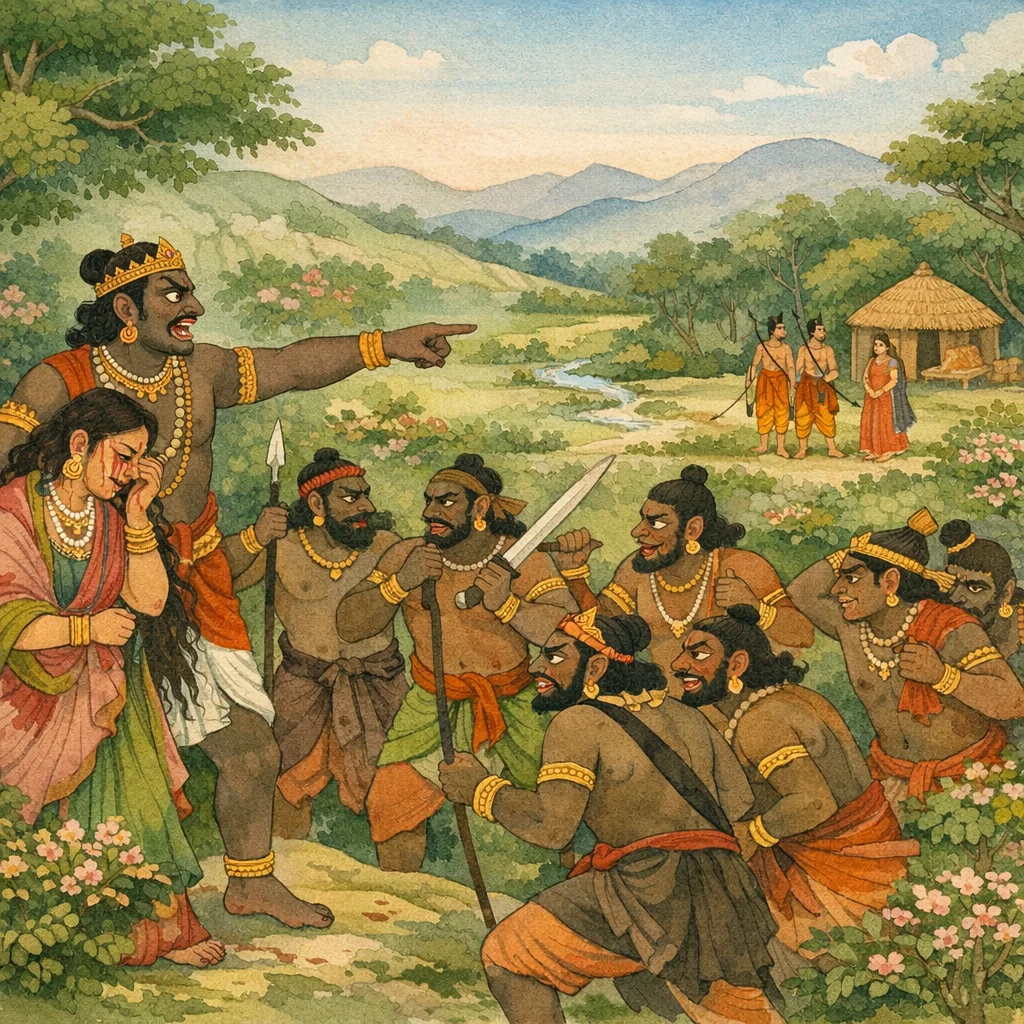
Sarga 19 opens with Khara encountering his sister Śūrpaṇakhā fallen, disfigured, and blood-soaked. His speech amplifies Rākṣasa martial pride through a chain of rhetorical questions and similes, such as the folly of provoking a venomous serpent or falling into the "noose of death," framing the offender as already doomed. Khara demands a clear identification of the perpetrator and asserts that no divine or semi-divine beings can rescue the victim once he drags him into battle. Śūrpaṇakhā, recovering gradually and speaking through tears, identifies two youthful, handsome, and powerful brothers—Rāma and Lakṣmaṇa—living like ascetics in bark and deer-skin garments yet bearing royal insignia; she also notes a jeweled woman between them, Sītā. She attributes her humiliation to both brothers "for the sake of that lady," then articulates a gruesome revenge-wish: to drink the foaming blood of Sītā and the brothers on the battlefield. Khara, enraged, orders fourteen formidable Rākṣasas to kill the trio, but the chapter culminates in the tactical failure of these night-rangers against Rāma, who is likened to a forest fire consuming elephants, establishing his overwhelming martial radiance.
Shlokas
Verse 1
तां तथा पतितां दृष्ट्वा विरूपां शोणितोक्षिताम्।भगिनीं क्रोधसन्तप्तः खरः पप्रच्छ राक्षसः।।।।
Seeing his sister fallen thus—disfigured and drenched in blood—Khara, the rākṣasa, inflamed with anger, questioned her.
Verse 2
उत्तिष्ठ तावदाख्याहि प्रमोहं जहि सम्भ्रमम्।व्यक्तमाख्याहि केन त्वमेवं रूपा विरूपिता।।।।
Rise now; cast off delusion and confusion. Tell me plainly—by whom have you been disfigured like this?
Verse 3
कः कृष्णसर्पमासीनमाशीविषमनागसम्।तुदत्यभिसमापन्नमङ्गुल्यग्रेण लीलया।।।।
Who would, for sport, poke with a fingertip an innocent yet deadly black serpent lying coiled nearby—and then imagine he can remain safe?
Verse 4
कः कालपाशं समासज्य कण्ठे मोहान्न बुध्यते।यस्त्वामद्य समासाद्य पीतवान्विषमुत्तमम्।।।।
Who, out of delusion, would fasten the noose of Death upon his own throat and still not understand? Whoever has attacked you today has, as it were, drunk the most lethal poison.
Verse 5
बलविक्रमसम्पन्ना कामगा कामरूपिणी।इमामवस्थां नीता त्वं केनान्तकसमागता।।।।
You are endowed with strength and prowess, free to move as you wish, able to take forms at will—by whom have you been reduced to this state, brought face to face with Death?
Verse 6
देवगन्धर्वभूतानामृषीणां च महात्मनाम्।कोऽयमेवं विरूपां त्वां महावीर्यश्चकार ह।।।।
Who is this mighty hero—among gods, gandharvas, spirits, or great sages—who has truly disfigured you in this manner?
Verse 7
न हि पश्याम्यहं लोके यः कुर्यान्मम विप्रियम्।अमरेषु सहस्राक्षं महेन्द्रं पाकशासनम्।।।।
For I see no one in this world who could do me harm—nor even among the gods, not even Indra himself, the thousand-eyed chastiser of Pāka.
Verse 8
अद्याहं मार्गणैः प्राणानादास्ये जीवितान्तकैः।सलिले क्षीरमासक्तं निष्पिबन्निव सारसः।।।।
This very day, with life-ending arrows, I will draw out his life-breath—just as the haṃsa is said to drink the milk even when it is mixed with water.
Verse 9
निहतस्य मया सङ्ख्ये शरसंकृत्तमर्मणः।सफेनं रुधिरं रक्तं मेदिनी कस्य पास्यति।।।।
When I strike him down in battle, his vital points cut by arrows, whose foaming red blood will the earth drink?
Verse 10
कस्य पत्ररथाः कायान्मांसमुत्कृत्य सङ्गताः।प्रहृष्टा भक्षयिष्यन्ति निहतस्य मया रणे।।।।
Whose flesh will the vultures, gathered in flocks, tear from his body and eat with glee—when he is slain by me in battle?
Verse 11
तं न देवा न गन्धर्वा न पिशाचा न राक्षसाः।मयापकृष्टं कृपणं शक्तास्त्रातुं महाहवे।।।।
Neither gods nor gandharvas, nor piśācas, nor even rākṣasas will be able to save that wretch, dragged off by me in the great battle.
Verse 12
उपलभ्य शनैस्संज्ञां तं मे शंसितुमर्हसि।येन त्वं दुर्विनीतेन वने विक्रम्य निर्जिता।।।।
As you slowly recover consciousness, you must tell me who that arrogant one is—by whose prowess in this forest you have been overpowered.
Verse 13
इति भ्रातुर्वचश्श्रुत्वा क्रुद्धस्य च विशेषतः।ततश्शूर्पणखा वाक्यं सबाष्पमिदमब्रवीत्।।।।
Hearing these words of her brother—especially as he raged—Shurpanakha then spoke, her speech accompanied by tears.
Verse 14
तरुणौ रूपसम्पन्नौ सुकुमारौ महाबलौ।पुण्डरीकविशालाक्षौ चीरकृष्णाजिनाम्बरौ।।।।फलमूलाशनौ दान्तौ तापसौ धर्मचारिणौ।पुत्रौ दशरथस्यास्तां भ्रातरौ रामलक्ष्मणौ।।।।
There are two young men—handsome, delicate yet mighty—wide-eyed like white lotuses, clad in bark-cloth and black antelope-skin. Living on fruits and roots, self-restrained, and practicing the ways of righteousness as ascetics—those two brothers are Rama and Lakshmana, sons of Dasharatha.
Verse 15
तरुणौ रूपसम्पन्नौ सुकुमारौ महाबलौ।पुण्डरीकविशालाक्षौ चीरकृष्णाजिनाम्बरौ।।3.19.14।।फलमूलाशनौ दान्तौ तापसौ धर्मचारिणौ।पुत्रौ दशरथस्यास्तां भ्रातरौ रामलक्ष्मणौ।।3.19.15।।
There are two young men—handsome, gentle yet powerful—lotus-eyed, wearing bark-cloth and black antelope-skin. Sustained by fruits and roots, self-restrained, living as ascetics in righteous conduct: they are the brothers Rama and Lakshmana, sons of Dasharatha.
Verse 16
गन्धर्वराजप्रतिमौ पार्थिवव्यञ्जनान्वितौ।देवौ वा मानुषौ वा तौ न तर्कयितुमुत्सहे।।।।
They looked like kings among the Gandharvas, bearing the marks of royalty; I could not venture to judge whether they were gods or men.
Verse 17
तरुणी रूपसम्पन्ना सर्वाभरणभूषिता।दृष्टा तत्र मया नारी तयोर्मध्ये सुमध्यमा।।।।
There I saw a young woman between the two—beautiful, adorned with every ornament, and slender-waisted.
Verse 18
ताभ्यामुभाभ्यां सम्भूय प्रमदामधिकृत्य ताम्।इमामवस्थां नीताहं यथानाथासती तथा।।।।
Acting together, those two—on account of that woman—have reduced me to this condition, as though I were a helpless, dishonored woman without protection.
Verse 19
तस्याश्चानृजुवृत्तायास्तयोश्च हतयोरहम्।सफेनं पातुमिच्छामि रुधिरं रणमूर्धनि।।।।
I desire to drink, on the battlefield, the foaming blood of that crooked-natured woman—and of those two brothers when slain.
Verse 20
एष मे प्रथमः कामः कृतस्तात त्वया भवेत्।तस्यास्तयोश्च रुधिरं पिबेयमहमाहवे।।।।
Dear one, let this be my first desire fulfilled by you: in battle I would drink the blood of that woman and of those two men.
Verse 21
इति तस्यां ब्रुवाणायां चतुर्दश महाबलान्।व्यादिदेश खरः क्रुद्धो राक्षसानन्तकोपमान्।।।।
As she spoke thus, Khara—angered—commanded fourteen mighty rākṣasas, fierce as Death itself.
Verse 22
मानुषौ शस्त्रसम्पन्नौ चीरकृष्णाजिनाम्बरौ।प्रविष्टौ दण्डकारण्यं घोरं प्रमदया सह।।।।
Two human warriors, fully armed, clad in bark garments and black antelope-skin, have entered the dreadful Daṇḍaka forest together with a woman.
Verse 23
तौ हत्वा तां च दुर्वृत्तामपावर्तितुमर्हथ।इयं च रुधिरं तेषां भगिनी मम पास्यति।।।।
Slay those two—and that wicked woman as well—and then return. This sister of mine will drink their blood.
Verse 24
मनोरथोऽयमिष्टोऽस्या भगिन्या मम राक्षसाः।शीघ्रं सम्पाद्यतां तौ च प्रमथ्य स्वेन तेजसा।।।।
O rākṣasas, swiftly fulfil this cherished desire of my sister—overpower those two by your own might and crush them.
Verse 25
इति प्रतिसमादिष्टा राक्षसास्ते चतुर्दश।तत्र जग्मुस्तया सार्धं घना वातेरिता यथा।।।।
Thus commanded, those fourteen rākṣasas went there with her, like dense clouds driven by the wind.
Verse 26
ततस्तु ते तं समुदग्रतेजसं तथापिऽतीक्ष्णप्रदरा निशाचराः।न शेकुरेनं सहसा प्रमर्दितुं वनद्विपा दीप्तमिवाग्निमुत्थितम्।।।।
Then those night-roaming rākṣasas—though bearing keen, piercing weapons—could not crush him at once; like wild elephants, they could not face a blazing forest fire newly arisen.
Frequently Asked Questions
The pivotal action is Khara’s immediate militarized response to a personal grievance: he converts familial injury into collective violence by ordering the killing of two forest-dwelling princes and a woman, raising questions about proportionality, lawful protection versus vengeance, and the misuse of power.
The dialogue contrasts rage-driven certainty with disciplined reality: Khara’s krodha produces overconfidence and moral blindness, while the narrative outcome (the fourteen rākṣasas failing against Rāma) underscores that adharma-driven aggression collapses before steady tejas aligned with duty.
Daṇḍakāraṇya is the key geographical frame—depicted as a ‘ghora’ (dread) forest where ascetic lifeways (bark robes, deer-skins, fruits/roots diet, self-restraint) coexist with armed preparedness, reflecting the cultural boundary between āśrama order and rākṣasa predation.