Sarga 17
शूर्पणखाया आगमनम् — Surpanakha Approaches Rama
अरण्यकाण्ड
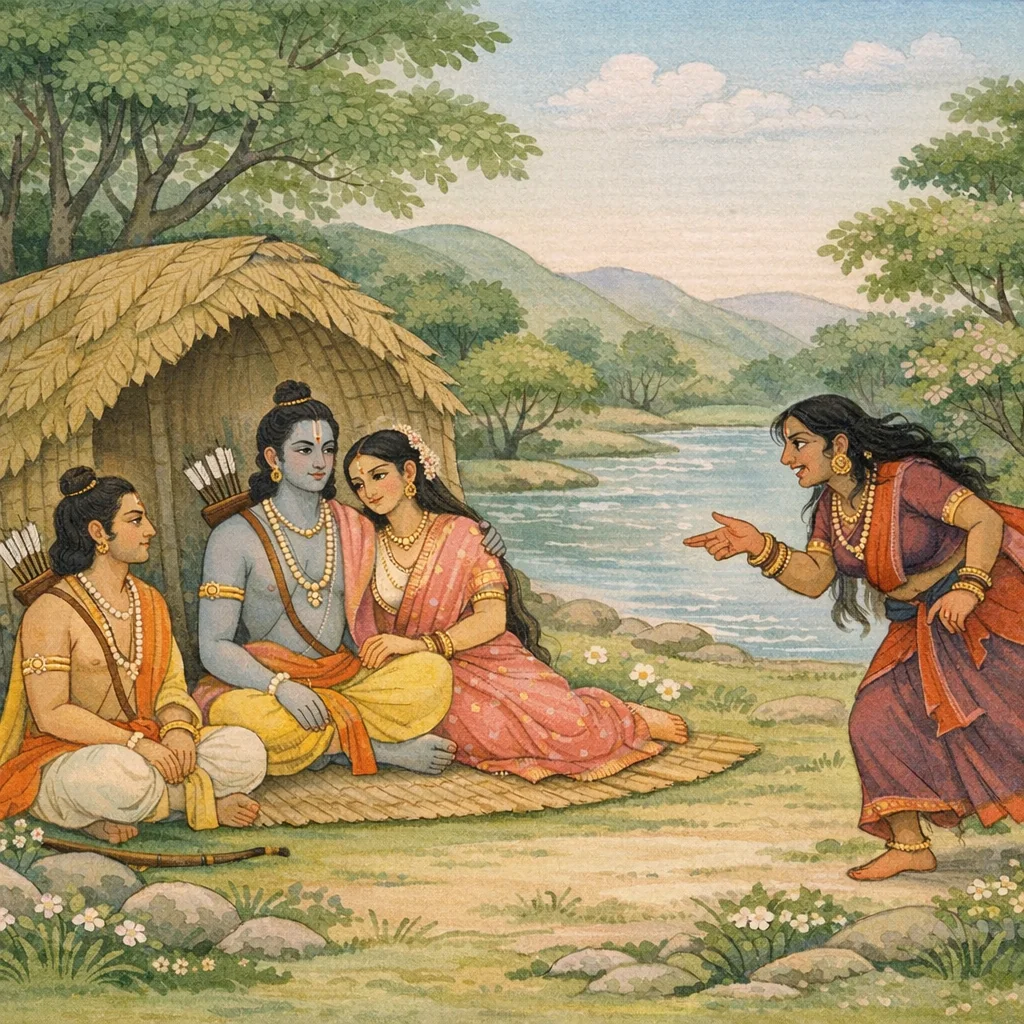
After bathing in the sacred Godavari, Rama returns with Sita and Lakshmana to their hermitage, completes the forenoon rites, and enters the leaf-thatched cottage. A chance arrival follows: Shurpanakha, Ravana’s sister, sees Rama seated with Sita and becomes inflamed with desire. Valmiki sets a deliberate contrast—Rama’s auspicious beauty, youth, and measured conduct against Shurpanakha’s distorted, lust-driven demeanor—sharpening the ethical and aesthetic opposition through parallel description. Shurpanakha questions how a bow-bearing man, marked like an ascetic, lives with his wife in a region haunted by rakshasas. Rama answers with plain candor, stating a key norm: untruth is never acceptable to him, especially within an ashrama and in the presence of a woman. He identifies himself as Dasharatha’s eldest son, introduces Lakshmana and Sita, and explains forest-dwelling as obedience to parental command and to dharma. Asked in turn, Shurpanakha declares her name, her power of shapeshifting, and her fearsome solitary roaming; she lists her brothers—Ravana, Kumbhakarna, Vibhishana, Khara, and Dushana—and proposes marriage while disparaging Sita and threatening violence. The chapter ends as Rama begins a poised, speech-skilled reply, setting the stage for the ensuing moral confrontation.
Shlokas
Verse 1
कृताभिषेको रामस्तु सीता सौमित्रिरेव च।तस्माद्गोदावरीतीरात्ततो जग्मुस्वमाश्रमम्।।।।
After completing their ablutions, Rāma—together with Sītā and Saumitrī (Lakṣmaṇa)—departed from the bank of the Godāvarī and returned to their own hermitage.
Verse 2
आश्रमं तमुपागम्य राघवस्सह लक्ष्मणः।कृत्वा पौर्वाह्णिकं कर्म पर्णशालामुपागमत्।।।।
Having reached that hermitage, Rāghava, accompanied by Lakṣmaṇa, performed the forenoon rites and then entered the leaf-thatched hut.
Verse 3
उवास सुखितस्तत्र पूज्यमानो महर्षिभिः।लक्ष्मणेन सह भ्रात्रा चकार विविधाः कथाः।।।।
Honoured by the great sages, Rāma stayed there in peace and happiness, and with his brother Lakṣmaṇa he engaged in many kinds of conversations.
Verse 4
स रामः पर्णशालायामासीनस्सह सीतया।विरराज महाबाहुश्चित्रया चन्द्रमाः इव।।।।
Rāma, the mighty-armed, seated with Sītā in the leaf-thatched hut, shone like the moon beside the star Citrā.
Verse 5
तदाऽऽसीनस्य रामस्य कथासंसक्तचेतसः।तं देशं राक्षसी काचिदाजगाम यदृच्छया।।।।
While Rāma was seated there, his mind engaged in conversation, a certain rākṣasī came to that place by chance.
Verse 6
सा तु शूर्पणखा नाम दशग्रीवस्य राक्षसः।भगिनी राममासाद्य ददर्श त्रिदशोपमम्।।।।
She was named Śūrpaṇakhā, sister of the rākṣasa Daśagrīva; drawing near to Rāma, she beheld him like a god.
Verse 7
सिंहोरस्कं महाबाहुं पद्मपत्रनिभेक्षणम्।आजानुबाहुं दीप्तास्यमतीव प्रियदर्शनम्।।।।गजविक्रान्तगमनं जटामण्डलधारिणम्।सुकुमारं महासत्त्वं पार्थिवव्यञ्जनान्वितम्।।।।राममिन्दीवरश्यामं कन्दर्पसदृशप्रभम्।बभूवेन्द्रोपमं दृष्ट्वा राक्षसी काममोहिता।।।।
Seeing Rāma—lion-chested, mighty-armed, with lotus-petalled eyes; his arms reaching to his knees, his face radiant and most pleasing to behold; moving with the stride of an elephant, wearing a circle of matted locks; delicate yet of immense power, bearing the marks of royalty; dark as a blue lotus and splendid like Kāma—the rākṣasī, deluded by desire, was bewitched and took him to be like Indra.
Verse 8
सिंहोरस्कं महाबाहुं पद्मपत्रनिभेक्षणम्।आजानुबाहुं दीप्तास्यमतीव प्रियदर्शनम्।।3.17.7।।गजविक्रान्तगमनं जटामण्डलधारिणम्।सुकुमारं महासत्त्वं पार्थिवव्यञ्जनान्वितम्।।3.17.8।।राममिन्दीवरश्यामं कन्दर्पसदृशप्रभम्।बभूवेन्द्रोपमं दृष्ट्वा राक्षसी काममोहिता।।3.17.9।।
Seeing Rāma—lion-chested, mighty-armed, with lotus-petalled eyes; his arms reaching to his knees, his face radiant and most pleasing to behold; moving with the stride of an elephant, wearing a circle of matted locks; delicate yet of immense power, bearing the marks of royalty; dark as a blue lotus and splendid like Kāma—the rākṣasī, deluded by desire, was bewitched and took him to be like Indra.
Verse 9
सिंहोरस्कं महाबाहुं पद्मपत्रनिभेक्षणम्।आजानुबाहुं दीप्तास्यमतीव प्रियदर्शनम्।।3.17.7।।गजविक्रान्तगमनं जटामण्डलधारिणम्।सुकुमारं महासत्त्वं पार्थिवव्यञ्जनान्वितम्।।3.17.8।।राममिन्दीवरश्यामं कन्दर्पसदृशप्रभम्।बभूवेन्द्रोपमं दृष्ट्वा राक्षसी काममोहिता।।3.17.9।।
Seeing Rāma—lion-chested, mighty-armed, with lotus-petalled eyes; his arms reaching to his knees, his face radiant and most pleasing to behold; moving with the stride of an elephant, wearing a circle of matted locks; delicate yet of immense power, bearing the marks of royalty; dark as a blue lotus and splendid like Kāma—the rākṣasī, deluded by desire, was bewitched and took him to be like Indra.
Verse 10
सुमुखं दुर्मुखी रामं वृत्तमध्यं महोदरी।विशालाक्षं विरूपाक्षी सुकेशं ताम्रमूर्धजा।।।।प्रीतिरूपं विरूपा सा सुस्वरं भैरवस्वरा।तरुणं दारुणा वृद्धा दक्षिणं वामभाषिणी।।।।न्यायवृत्तं सुदुर्वृत्ता प्रियमप्रियदर्शना।शरीरजसमाविष्टा राक्षसी वाक्यमब्रवीत्।।।।
Rāma was fair-faced; she was foul-faced. He was slender-waisted; she was huge-bellied. His eyes were wide; hers were misshapen. His hair was beautiful; hers was copper-red. He was pleasing in form; she was repulsive. His voice was sweet; hers was harsh and terrifying. He was young; she was dreadfully old. He was courteous and upright; she spoke perversely. He was just in conduct; she was utterly wicked. Overcome by bodily desire, that rākṣasī spoke to Rāma.
Verse 11
सुमुखं दुर्मुखी रामं वृत्तमध्यं महोदरी।विशालाक्षं विरूपाक्षी सुकेशं ताम्रमूर्धजा।।3.17.10।।प्रीतिरूपं विरूपा सा सुस्वरं भैरवस्वरा।तरुणं दारुणा वृद्धा दक्षिणं वामभाषिणी।।3.17.11।।न्यायवृत्तं सुदुर्वृत्ता प्रियमप्रियदर्शना।शरीरजसमाविष्टा राक्षसी वाक्यमब्रवीत्।।3.17.12।।
With matted hair and in an ascetic’s guise—yet accompanied by your wife and bearing bow and arrows—how have you come to this region frequented by rākṣasas? What is your purpose in coming? You ought to tell me the truth.
Verse 12
सुमुखं दुर्मुखी रामं वृत्तमध्यं महोदरी।विशालाक्षं विरूपाक्षी सुकेशं ताम्रमूर्धजा।।3.17.10।।प्रीतिरूपं विरूपा सा सुस्वरं भैरवस्वरा।तरुणं दारुणा वृद्धा दक्षिणं वामभाषिणी।।3.17.11।।न्यायवृत्तं सुदुर्वृत्ता प्रियमप्रियदर्शना।शरीरजसमाविष्टा राक्षसी वाक्यमब्रवीत्।।3.17.12।।
Thus questioned by the rākṣasī Śūrpaṇakhā, Rāma—scorcher of foes—began to recount everything, prompted by his straightforwardness of mind.
Verse 13
जटी तापसरूपेण सभार्यश्शरचापधृत्।आगतस्त्वमिमं देशं कथं राक्षससेवितम्।।।।किमागमनकृत्यं ते तत्त्वमाख्यातुमर्हसि।
With matted hair and in an ascetic’s guise—yet accompanied by your wife and bearing bow and arrows—how have you come to this region frequented by rākṣasas? What is your purpose in coming? You ought to tell me the truth.
Verse 14
एवमुक्तस्तु राक्षस्या शूर्पणख्या परन्तपः।।।।ऋजुबुद्धितया सर्वमाख्यातुमुपचक्रमे।
Thus questioned by the rākṣasī Śūrpaṇakhā, Rāma—scorcher of foes—began to recount everything, prompted by his straightforwardness of mind.
Verse 15
अनृतं न हि रामस्य कदाचिदपि सम्मतम्।।।।विशेषेणाऽश्रमस्थस्य समीपे स्त्रीजनस्य च।
For Rāma, untruth is never acceptable—especially while dwelling in a hermitage, and all the more in the presence of women.
Verse 16
आसीद्धशरथो नाम राजा त्रिदशविक्रमः।।।।तस्याहमग्रजः पुत्रो रामो नाम जनैश्श्रुतः।
There was a king named Daśaratha, mighty as the gods. I am his eldest son, known among people by the name Rāma.
Verse 17
भ्राताऽयं लक्ष्मणो नाम यवीयान्मामनुव्रतः।।।।इयं भार्या च वैदेही मम सीतेति विश्रुता।
This is my younger brother, named Lakṣmaṇa, who faithfully follows me. And this is my wife, the Vaidehī—renowned as Sītā.
Verse 18
नियोगात् तु नरेन्द्रस्य पितुर्मातुश्च यन्त्रितः।।।।धर्मार्थं धर्मकाङ्क्षी च वनं वस्तुमिहागतः।
Compelled by the command of the king—my father—and by my mother as well, and longing to uphold dharma for dharma’s sake, I have come here to dwell in the forest.
Verse 19
त्वां तु वेदितुमिच्छामि कस्य त्वं कासि कस्य वा।।।।त्वं हि तावन्मनोज्ञाङ्गी राक्षसी प्रतिभासि मे।
Yet I wish to know you—whose are you, and who are you? For though your form is pleasing, you do not appear to me to be a rākṣasī (demoness).
Verse 20
इह वा किंनिमित्तं त्वमागता ब्रूहि तत्त्वत:।।।।साब्रवीद् वचनं श्रुत्वा राक्षसी मदनार्दिता।
“Tell me truly—what purpose has brought you here?” Hearing these words, the rākṣasī, tormented by desire, replied.
Verse 21
श्रूयतां राम वक्ष्यामि तत्त्वार्थं वचनं मम। ।।अहं शूर्पणखा नाम राक्षसी कामरूपिणी।अरण्यं विचरामीदमेका सर्वभयङ्करा।।।।
“Listen, Rāma; I will speak my words in their true sense. I am Śūrpaṇakhā by name—a rākṣasī who can assume forms at will.”
Verse 22
श्रूयतां राम वक्ष्यामि तत्त्वार्थं वचनं मम। 3.17.21।।अहं शूर्पणखा नाम राक्षसी कामरूपिणी।अरण्यं विचरामीदमेका सर्वभयङ्करा।।3.17.22।।
“Alone I roam this very forest, a terror to all.”
Verse 23
रावणो नाम मे भ्राता बलीयान्राक्षसेश्वरः।वीरो विश्रवसः पुत्रो यदि ते श्रोत्रमागतः।।।।
“My brother is named Rāvaṇa—mighty, the lord of the rākṣasas, a hero, the son of Viśravas—if his name has reached your ears.”
Verse 24
प्रवृद्धनिद्रश्च सदा कुम्भकर्णो महाबलः।विभीषणस्तु धर्मात्मा न तु राक्षसचेष्टितः।।।।प्रख्यातवीर्यौ च रणे भ्रातरौ खरदूषणौ।
“Kumbhakarṇa too is my brother—very strong, ever sunk in heavy sleep. But Vibhīṣaṇa is righteous, not given to demonic conduct. And in battle my brothers Khara and Dūṣaṇa are famed for their prowess.”
Verse 25
तानहं समतिक्रान्ता राम त्वा पूर्वदर्शनात्।।।।समुपेतास्मि भावेन भर्तारं पुरुषोत्तमम्।
Setting them all aside, O Rāma—at the very first sight of you—I have come to you with heartfelt resolve, seeking you, best of men, as my husband.
Verse 26
अहं प्रभावसम्पन्ना स्वच्छन्दबलगामिनी।।।।चिराय भव मे भर्ता सीतया किं करिष्यसि।
I am endowed with power and can go wherever I please; be my husband for a long time. What will you do with Sītā?
Verse 27
विकृता च विरूपा च न चेयं सदृशी तव।।।।अहमेवानुरूपा ते भार्या रूपेण पश्य माम्।
“She is misshapen and ugly, not a fitting match for you. I alone am suited to you—behold me, in my beauty, as your wife.”
Verse 28
इमां विरूपामसतीं करालां निर्णतोदरीम्।।।।अनेन ते सह भ्रात्रा भक्षयिष्यामि मानुषीम्।
“This deformed and unworthy woman—hideous and pot-bellied—I will devour, along with your brother, for your sake.”
Verse 29
ततः पर्वतशृङ्गाणि वनानि विविधानि च।।।।पश्यन्सह मया कान्त दण्डकान्विचरिष्यसि।
“Then, my beloved, you will roam with me through the forests of Daṇḍaka, beholding mountain peaks and many kinds of woods.”
Verse 30
इत्येवमुक्तः काकुत्स्थः प्रहस्य मदिरेक्षणाम्।।।।इदं वचनमारेभे वक्तुं वाक्यविशारदः।
Thus addressed, Kakutstha (Rāma), smiling at the woman of intoxicating eyes, began to speak these words—he who was skilled in speech.
Frequently Asked Questions
The sarga presents the confrontation between dharmic speech-conduct and predatory desire: Surpanakha’s lust and threats press toward coercion, while Rama’s action is to respond transparently and within ashrama norms, refusing deceit and maintaining composure despite provocation.
A central upadesha is the discipline of satya: Rama states that untruth is never acceptable—especially in a hermitage and before a woman—implying that ethical speech is not situational convenience but a stable vow that sustains social and spiritual order.
Geographically, the Godavari riverbank and the Dandaka forest frame the episode; culturally, the ashrama setting, the parnashala dwelling, and the paurvahnika (forenoon) rites establish a ritual-ethical landscape against which Surpanakha’s disruptive entry is measured.