Adhyaya 58
Praise of the Merits of Sacred Ponds, Tree-Planting, and Water-Charities
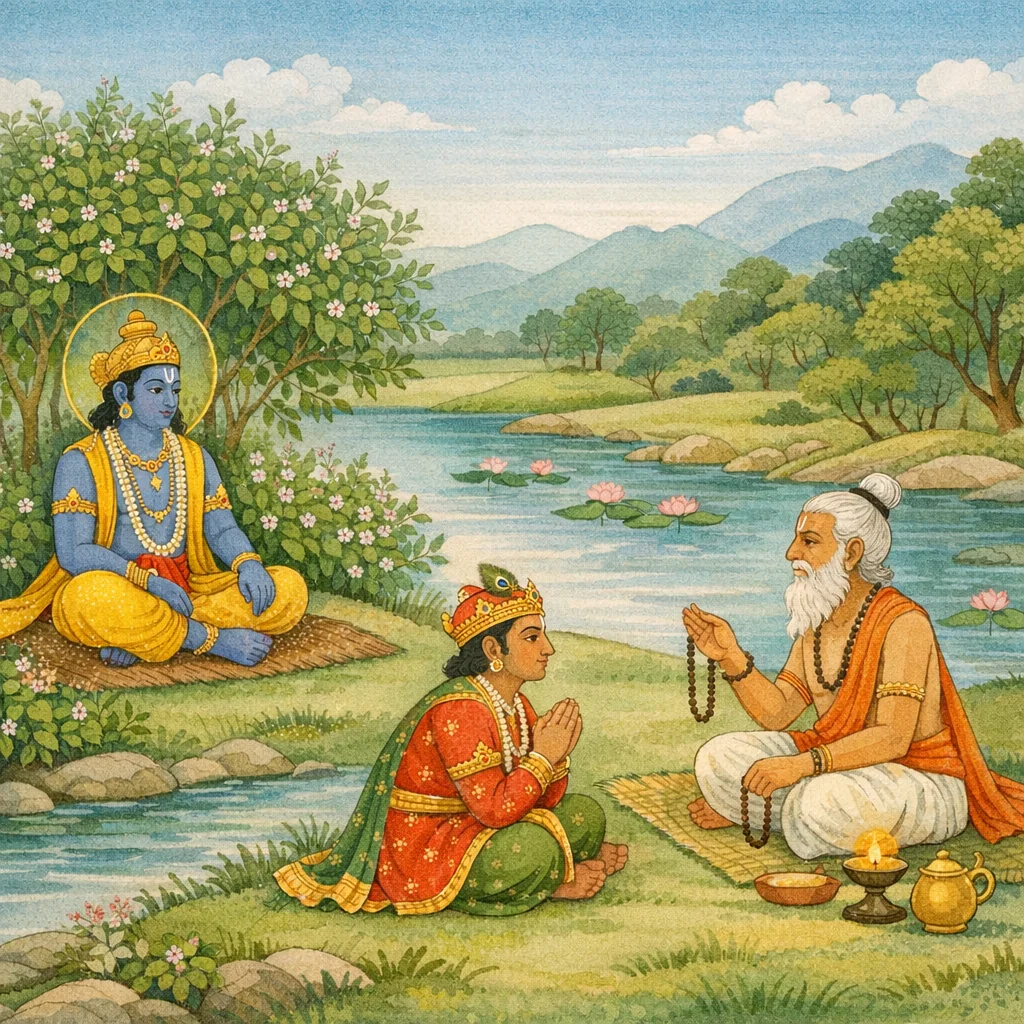
This chapter teaches that the merit (puṇya) gained by planting and protecting trees becomes immeasurably greater when done near water—on riverbanks, by ponds, reservoirs, and lotus-pools. The aśvattha (pippala) is praised as supreme: touching it, circumambulating it (pradakṣiṇā), and worshipping it remove sin and bestow prosperity, long life, sons, and heaven, while harming it brings severe hellish results. It also turns merit into public welfare by extolling puṣkariṇīs (tanks/ponds), prapās (drinking-water stations), and dharma-pots set out for the thirsty as enduring charities that support liberation (mokṣa) and benefit ancestors and descendants. Thus ecological care and civic water-giving are sanctified as devotional acts with blessings across generations.
Shlokas
Verse 1
व्यास उवाच । शाखिनामेव सर्वेषां फलं वक्ष्यामि यादृशम् । तच्छृणुध्वं महाभागा रोपणे च पृथक्पृथक्
Vyāsa said: I shall describe the kind of merit that comes from all trees. Listen, O fortunate ones—also, separately, tree by tree, in the act of planting.
Verse 2
यस्तु रोपयते तीरे पुण्यवृक्षान्समंततः । तस्य पुण्यफलं ज्ञातुं कथितुं नैव शक्यते
But whoever plants sacred, merit-giving trees all around a riverbank—his store of spiritual merit cannot truly be known, nor can it be adequately described.
Verse 3
अन्यत्र रोपणं कृत्वा शाखिनां यत्फलं लभेत् । ततो जलसमीपे तु लक्षकोटिगुणं भवेत्
Whatever merit one gains by planting trees elsewhere, that same act, when done near water, becomes multiplied a hundred million (lakṣa-koṭi) times.
Verse 4
स्वयं पुष्करिणी तीरे त्वनंतं फलमश्नुते । तस्माच्छतगुणं ब्रूमः शाखिनां पुण्यकारिणाम्
One who personally dwells on the bank of a sacred puṣkariṇī, a lotus-pond, attains an endless spiritual reward. Therefore we declare: the merit born of those who plant and nurture trees is a hundredfold greater.
Verse 5
अश्वत्थरोपणं कृत्वा जलाशयसमीपतः । यत्फलं लभते मर्त्यो न तत्क्रतुशतैरपि
By planting a sacred aśvattha (holy fig) near a water-reservoir, a mortal gains a merit whose fruit cannot be attained even through a hundred Vedic sacrifices (kratu).
Verse 6
पतंति यानि पत्राणि जले पर्वणि पर्वणि । तानि पिंडसमानीह पितॄणामक्षयं ययुः
Whatever leaves fall into the water at each parvan, each sacred lunar junction, here become equal to piṇḍas—ritual food-offerings—and grant the ancestors imperishable satisfaction.
Verse 7
खादंति पतगास्तत्र फलानि कामतो ध्रुवम् । ब्रह्मभक्ष्यसमं तस्य पुण्यं भवति चाक्षयम्
There, the birds certainly eat the fruits as they wish; and by that act the merit becomes inexhaustible—equal to the merit of offering food fit for Brahmā.
Verse 8
अश्वत्थेनैव भक्ष्येण रोपणेनैव यत्फलम् । तद्वै क्रतुशतैर्नैव पुत्रैरेव शतैरपि
The merit gained by offering food connected with the aśvattha and by planting the aśvattha itself—such a fruit is not attained even by a hundred sacrifices, nor even by a hundred sons.
Verse 9
उष्णेच्छायां प्रगृह्णंति गावो देवद्विजातयः । कर्तुः पितृगणानां च स्वर्गो भवति चाक्षयः
When, in the heat, cows are received (as an offering) by the gods and the twice-born, an imperishable heaven arises for the giver and for the hosts of his ancestors.
Verse 10
कर्तुं स्वस्थस्य वै विघ्नमक्षयत्वान्न शक्यते । तस्मात्सर्वप्रयत्नेन रोपयेद्वृक्षमाधवम्
To create an obstacle for one who is protected and spiritually sound is not possible, for such protection is imperishable. Therefore, with every effort one should plant the Mādhava-tree, sacred to Viṣṇu.
Verse 11
एकं वृक्षं समारोप्य नरः स्वर्गान्न हीयते । तस्मादेव महावृक्षं रोपयध्वं द्विजोत्तमाः
By planting even a single tree, a person does not fall away from heaven. Therefore, O best of the twice-born, plant great, long-lived trees.
Verse 12
जलानां निकटे रम्ये रसानां क्रयविक्रये । मार्गे जलाशये वृक्षान्रोपयेद्यो महाशयः
A noble-minded person who plants trees in lovely places near water, at markets where juices and other drinks are bought and sold, and along roads and near reservoirs, performs a great act of merit.
Verse 13
अश्वत्थादीन्समारोप्य स्वर्गं याति मनोरमम् । अर्चयित्वा तु यत्पुण्यं प्रवक्ष्यामि द्विजातयः
Having planted the Aśvattha and other sacred trees, one goes to the delightful heaven. Now, O twice-born ones, I shall explain the merit that arises from worship.
Verse 14
स्नात्वाश्वत्थं स्पृशेद्यस्तु सर्वपापैः प्रमुच्यते । अस्नातो यः स्पृशेन्मर्त्यो लभते स्नानजं फलम्
Whoever, after bathing, touches the sacred Aśvattha (pipal) is freed from all sins. And the mortal who touches it even without bathing attains the merit that arises from bathing.
Verse 15
दृष्ट्वा च नाशयेत्पापं स्पृष्ट्वा लक्ष्मीं प्रपद्यते । प्रदक्षिणे भवेदायुः सदाश्वत्थ नमोस्तु ते
By merely seeing you, sin is destroyed; by touching you, one attains Lakṣmī (prosperity). By circumambulating you, life is prolonged. O sacred Aśvattha, salutations to you always.
Verse 16
चलद्दलाय वृक्षाय सदा विष्णुस्थिताय च । बोधिसत्वाय योग्याय सदाश्वत्थ नमोस्तु ते
Salutations to you, O eternal Aśvattha—tree of trembling leaves—ever the abode of Viṣṇu, fit for the awakened seeker and worthy of reverence.
Verse 17
अश्वत्थाय तु हव्यं तु पयो नैवेद्यमेव च । पुष्पं धूपं दीपकं च दत्वा स्वर्गान्न हीयते
By offering oblations, milk as a food-offering, and also flowers, incense, and a lamp to the Aśvattha (sacred fig), one does not fall away from heaven.
Verse 18
सपुत्रं चाक्षयं विद्धि धनवृद्धियशस्करम् । विजयं मानदं भद्रमश्वत्थस्य प्रपूजनम्
Know that the worship of the Aśvattha (sacred fig) bestows sons and imperishable merit; it brings increase of wealth and fame, grants victory, gives honor, and produces well-being.
Verse 19
यज्जप्तं च हुतं स्तोत्रं यन्त्रमंत्रादिकं च यत् । सर्वं कोटिगुणं प्रोक्तं मूले चलदलस्य च
Whatever is uttered in japa, offered in the homa as oblation, recited as a stotra, and whatever pertains to yantras, mantras, and the like—all of it is declared to yield a koti-fold fruit when performed at the root of the sacred Caladala.
Verse 20
यस्य मूले स्थितो विष्णुर्मध्ये तिष्ठति शंकरः । अग्रभागे स्थितो ब्रह्मा कस्तं जगति नार्चयेत्
That sacred tree at whose root stands Viṣṇu, in whose middle abides Śaṅkara, and at whose foremost part stands Brahmā—who in this world would not worship it?
Verse 21
सोमवारे त्वमायां च स्नानं यन्मौनिना कृतम् । दानस्य गोसहस्रस्य फलं चाश्वत्थवंदने
The bath performed by a silent muni on a Monday at Tvamā is said to yield the merit of gifting a thousand cows; so too does the veneration of the sacred aśvattha tree.
Verse 22
सप्तप्रदक्षिणेनैव गवामयुतजं फलम् । प्रचुराल्लक्षकोटिश्च तस्मात्कार्या हि सा सदा
By seven circumambulations alone, one gains the fruit equal to (the gift of) ten thousand cows; indeed, an abundant reward of lakhs and crores of merit arises. Therefore, it should always be performed.
Verse 23
यत्किंचिद्दीयते तत्र फलमूलजलादिकम् । सर्वं तच्चाक्षयफलं जन्मजन्मसु जायते
Whatever is given there—fruits, roots, water, and the like—every such offering becomes imperishable merit, bearing fruit birth after birth.
Verse 24
अहोश्वत्थसमो नास्ति वृक्षरूपी हरिर्भुवि । यथा पूज्यो द्विजो लोके यथा गावो यथामराः
Ah! On earth there is no tree equal to the aśvattha, for Hari abides here in the form of a tree. As a brāhmaṇa is worthy of worship in the world, so too are cows, and so too are the gods.
Verse 25
तथाश्वत्थवृक्षरूपी देवः पूज्यतमः स्मृतः । रोपणे रक्षणे स्पर्शे पूजाकर्मणि वै सदा
Likewise, the deity present in the form of the aśvattha tree is remembered as most worthy of worship—always, in planting it, protecting it, touching it, and in the rites of ritual adoration.
Verse 26
ददाति वित्तं पुत्रांश्च स्वर्गं मोक्षं पुनः क्रमात् । किंचिच्छेदं तु यः कुर्यादश्वत्थस्य तनौ नरः
It bestows wealth, sons, heaven, and then, in due order, liberation (mokṣa). But the man who would make even a slight cut upon the body (trunk) of the sacred aśvattha…
Verse 27
कल्पैकं निरयं भुक्त्वा चांडालादौ प्रजायते । मूलच्छेदेन तस्यैव स च यात्यपुनर्भवम्
Having endured hell for a single kalpa, one is then born among the lowest outcastes, such as a caṇḍāla. Yet, by cutting off that very root (of sin/saṃsāra), he too attains the state of no rebirth.
Verse 28
पुरुषास्तस्य तिष्ठंति रौरवे घोरदर्शने । अश्वत्थस्यैकवृक्षस्य रोपणे यत्फलं भवेत्
Such men remain in the dreadful, terrifying hell called Raurava—this is the fruit of that deed; and likewise, there is a specific fruit that arises from planting a single aśvattha tree.
Verse 29
तथैव चंपकेर्के च त्रयाणां रोपणेपि च । अष्टौ बिल्वस्य वृक्षाश्च न्यग्रोधाश्चैव सप्त च
Likewise, there is merit in planting campaka and eraka as well; and one should plant eight bilva trees, and also seven nyagrodha (banyan) trees.
Verse 30
निंबस्य दशवृक्षाश्च फलं चैषां समं भवेत् । एकैकस्य फलं चोक्तं वृक्षाणां रोपणे द्विजाः
The fruit of the merit from planting ten neem (nimba) trees is said to be equal in result. O twice-born ones, the merit of planting trees has been stated for each tree individually.
Verse 31
एवं बुध्वा तु धर्मात्मा यः कुर्यात्कृत्रिमं वनम् । कल्पकोटिसहस्राणि कल्पकोटिशतानि च
Knowing this, a righteous person who creates an artificial forest (a plantation) earns merit enduring for thousands of crores of kalpas, and for hundreds of crores of kalpas as well.
Verse 32
नाकमेति स चूतस्य समारोप्य सहस्रकम् । ततो द्वित्रिगुणेनैव न्यूने वा प्रचुरेपि वा
Having offered a thousand mangoes as an offering, he attains heaven; thereafter the merit increases twofold or threefold—whether in smaller measure or in greater abundance.
Verse 33
भुंक्ते भुक्त्वा पुनः कुर्यान्नृपो वाथ सदीश्वरः । स्वर्गं भोग्यं ततो राज्यं कल्याणं मंगलं शुभम्
After enjoying the fruits, he should act again; whether a king or a mighty lord, he attains a heaven to be enjoyed, and thereafter sovereignty, welfare, auspiciousness, and good fortune.
Verse 34
आरोग्यं शौर्यसंपन्नमारामादेव जायते । फलानि यस्य खादंति जंतवोथ सहस्रशः
Truly, from a garden arise health and valour; and there, by the thousands, creatures partake of its fruits.
Verse 35
आश्रिता विहगाः कीटाः पतगाः शलभादयः । छायाश्रिताश्च ये सत्वास्तत्संख्याताः पृथग्जनाः
Those who take refuge there—birds, insects, winged beings such as locusts and the like—and whatever creatures dwell within its shade: all are counted, each as a distinct being, in that very number.
Verse 36
तस्य किंकरतां यांति शतशो देवतार्चिताः । ये च वृक्षा महासत्वास्सर्वे ते देवरूपिणः
Hundreds of deities, honoured even by the gods, enter into his service; and those trees of mighty vitality as well—each and all assume divine forms.
Verse 37
तदर्चा पितृवत्कार्या शुश्रूषां जलपिंडकम् । मर्त्यलोके च ते पुत्रास्तस्य जन्मनि जन्मनि
One should worship him as one worships the Pitṛs (ancestral fathers), with devoted service, libations of water, and rice-balls. And in the world of mortals, his sons shall be born again and again, in every birth.
Verse 38
सुरूपाः सुविनीताश्च सदापुण्यक्रिया शुभाः । एवं गणेशतां यांति जंतवश्चूतलग्नकाः
Fair in form, well-disciplined, ever engaged in auspicious deeds of merit—thus do the creatures devoted to the mango-tree attain the state of attendants of Gaṇeśa.
Verse 39
धात्री हरीतकी चान्ये कटुतिक्ताम्लसंभवाः । सर्वे चारामतः शुद्धाः फलदाः शिवदाः सदा
Āmalakī (dhātrī), harītakī, and other fruits arising with pungent, bitter, and sour tastes are all, by their very nature, purifying—ever bestowing fruits (benefits) and always granting Śiva’s auspiciousness.
Verse 40
प्रासादा यत्र सौवर्णाः सर्वरत्नविभूषिताः । सर्वाभरणसंयुक्ता विमानाश्चानिलोपमाः
There, the palaces are made of gold and adorned with every kind of jewel; and the aerial chariots too—fitted with all ornaments—are incomparable, swift as the wind.
Verse 41
शातकुंभमया वृक्षाः सदैव सर्वदायिनः । सर्वर्तुसुखदाः सौम्यकन्यका अप्सरस्समाः
There are trees made of refined gold, ever and always bestowing all gifts. Gentle maidens, like Apsarases, bring happiness in every season.
Verse 42
गीतनृत्यपराधीरास्तत्र तिष्ठंति वृक्षदाः । पुष्करिण्यो विशेषेण खातान्यन्यानि यानि च
There, those devoted to singing and dancing remain—along with the trees that grant desired fruits; and especially the sacred lotus-ponds, as well as other excavated tanks and whatever other water-reservoirs are found.
Verse 43
शुद्धोपलांतरचिता नद्यः पायसकर्द्दमाः । पुनर्दुग्धसफेनाश्च अन्नादिषड्रसान्विताः
Rivers flowed, formed amid pure stones, with rice-pudding for their mud; again, they were of milk with foam, and endowed with the six tastes, beginning with the taste of food-grains.
Verse 44
मर्त्यलोके यथा भोग्यं पुनः स्वर्गे पुनर्भुवि । पुनरेव तदभ्यासात्खातमारामकं पुनः
Just as enjoyments are tasted in the mortal world, so are they tasted again in heaven and again on earth. Truly, by repeated indulgence in the same, one falls again and again into a dug-out pit, a ruinous state.
Verse 45
यथा पुण्यादिकं कृत्वा स्वर्गमर्त्याधिपः पुमान् । अशक्तस्तु प्रपां कृत्वा पुष्करिण्याः फलं लभेत्
Just as a man, by performing deeds of merit (puṇya) and the like, attains lordship in heaven and on earth, so too, if he is unable to do greater works, by building a prapā—a public drinking-water shelter—he gains the fruit of constructing a sacred pond.
Verse 46
प्रपाया लक्षणं चात्र सर्वपापहरं परं । सर्वभोगप्रदं शुद्धं स्वर्गापवर्गदं स्थिरं
Here is the mark of the prapā: it is supreme in removing all sins; it grants every enjoyment; it is pure; it bestows both heaven and liberation; and its merit endures.
Verse 47
लक्षणं च प्रवक्ष्यामि प्रपायाः कीर्तिवर्धनम् । निर्जलेऽध्वनि पृक्ते च स्थाने कृत्वा च मंडपम्
Now I shall describe the proper characteristics of a prapā, which increases one’s good fame: on a waterless road, in a suitable place, one should build a maṇḍapa, a pavilion for rest.
Verse 48
बहुपान्थे समायाते ग्रीष्मवर्षाशरत्स्वपि । अगरुकादि सौगंध्यं जलं पूगं सचंद्रकम्
When many travelers arrive—whether in summer, the rainy season, or autumn—one should offer fragrant water scented with agaru and the like, along with areca-nut (pūga) and a cooling drink, refreshing as moonlight.
Verse 49
आसनं चैव तांबूलं दत्वा स्वर्गान्न हीयते । एवं वर्षत्रयेणैव पुष्करिण्याः फलं लभेत्
By offering a seat and also betel (tāmbūla), one does not fall away from heaven. Thus, in only three years, one gains the full fruit of merit associated with a sacred pond (puṣkariṇī).
Verse 50
स्वर्गाच्चैवाच्युतो मर्त्यो देवैरपि प्रपूज्यते । मासमेकं तु यो दद्यात्प्रपां ग्रीष्मेथ निर्जले
Even a mortal who has fallen from heaven is honored even by the gods, if—during the dry summer—in a waterless region he provides a water-shelter (prapā), a public drinking place, for a single month.
Verse 51
कल्पैकं तु वसेत्स्वर्गे स्वर्गाद्भ्रष्टो महीयते । प्रपादास्तत्र तिष्ठंति यत्र पुष्करिणीप्रदाः
One may dwell in heaven for a full kalpa; and even if one falls from heaven, one is still honored on earth. Such is the exalted standing of the sacred bathing-steps found where the puṣkariṇīs bestow their grace.
Verse 52
नोचेद्धर्मघटो देयः पुण्यः पापक्षयाय च । एष धर्मघटो ज्ञेयो ब्रह्मविष्णुशिवात्मकः
Otherwise, one should donate a “dharma-pot,” a meritorious gift that destroys sin. This dharma-pot should be understood as embodying Brahmā, Viṣṇu, and Śiva.
Verse 53
तवप्रसादात्सफलाः मम संतु मनोरथाः । स्वर्णमाषं चतुर्भागं दक्षिणार्थं घटस्य च
By your grace, may my wishes be fulfilled and bear fruit. And as the dakṣiṇā for the pot-rite, let there be a quarter of a māṣa of gold.
Verse 54
एवं वर्षत्रयेणैव प्रपादानफलं लभेत् । यः पठेच्छ्रावयेद्वापि पुष्करिण्यादिजं फलम्
Thus, within only three years one gains the fruit of giving a prapādāna—a public place where drinking-water is offered. And whoever recites this account, or even has it recited for others to hear, likewise attains the merit that arises from sacred ponds and similar holy acts.
Verse 55
साक्षात्पापाद्भवेन्मुक्तस्तत्प्रसादात्तु सद्गतिः । जनेषु श्रावयेद्यस्तु पुण्याख्यानमिदं शुभम्
By its grace one is directly freed from sin and attains a blessed destination. And whoever causes this auspicious, meritorious sacred narrative to be heard among people also gains that very fruit.
Verse 56
कल्पकोटिसहस्राणि सुरलोके स तिष्ठति
He remains in the world of the gods for thousands of crores of kalpas.
Verse 58
इति श्रीपाद्मपुराणे प्रथमे सृष्टिखंडे पुष्करिण्यादिधर्मकीर्तनंनामाष्टपंचाशत्तमो । ऽध्यायः
Thus ends the fifty-eighth chapter, called “The Praise of the Merits of Pushkarinī and Related Dharmas,” in the First Book (Sṛṣṭikhaṇḍa) of the holy Padma Purāṇa.