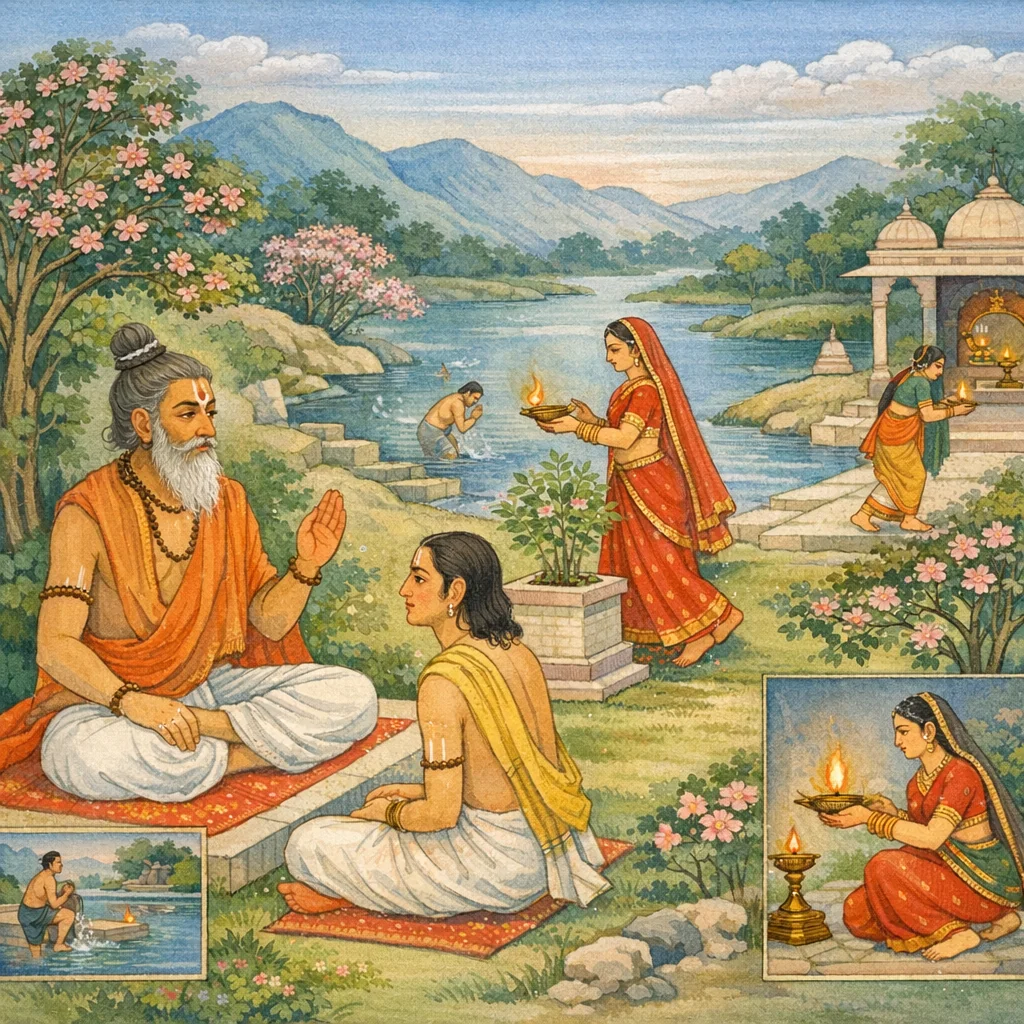
Adhyaya 31
The Account and Merit of Śivadūtī (with the Nāga-tīrtha at Puṣkara)
Bhīṣma asks Pulastya to explain several origins connected with Puṣkara: Bāṣkali’s bondage, Viṣṇu’s Vāmana–Trivikrama stride over Bali, the rise of Nāga-tīrtha, the piśācas, and the advent of Śivadūtī. The chapter turns to a Nāga calamity: serpents ravage beings, who seek Brahmā’s protection. Brahmā curses the Nāgas, foretelling Garuḍa’s predation and Janamejaya’s future serpent-sacrifice, yet also sets a compact, assigning them subterranean realms. When the Nāgas flee to Puṣkara, waters spring forth to form Nāga-tīrtha/Nāga-kuṇḍa; the merits of bathing and performing śrāddha on Śrāvaṇa Pañcamī are taught, along with dietary restraints. Then Śivadūtī manifests in fierce power amid war with the asura Ruru, attended by mother-goddesses. A dispute arises over “food” and the right manner of giving, followed by a hymn to Cāmuṇḍā/Kālarātrī. The concluding phalaśruti promises protection, prosperity, and liberation—especially to those who hear, recite, and write this sacred account.
Shlokas
Verse 1
भीष्म उवाच । भगवन्महदाश्चर्यं बाष्कलेर्बंधनं हि यत् । कृतं त्रिविक्रमं रूपं यदा संयमितो बलि
Bhīṣma said: O Lord, it is indeed a great wonder—how Bāṣkali came to be bound, and how the Trivikrama form was assumed when Bali was restrained.
Verse 2
एतन्मया श्रुतं पूर्वं कथ्यमानं द्विजोत्तमैः । पाताले वसतेद्यापि वैरोचनसुतो बलि
This I had heard before, as it was recounted by the foremost among the twice-born. Even now Bali, the son of Virocana, dwells in Pātāla, the Netherworld.
Verse 3
नागतीर्थं यथाभूतं पिशाचानां तु संभवम् । शिवदूती कथं चात्र केनेयं मंगलीकृता
How did this Nāga-tīrtha come to be, as it truly happened, and how did the piśācas arise? And in this place, how did the Śiva-dūtī come about—by whom was she made auspicious?
Verse 4
अंतरिक्षे पुष्करं तु केन नीतं महामुने । एतदाचक्ष्व मे सर्वं यथा बाष्कलिबंधनम्
O great sage, by whom was Puṣkara carried up into the sky? Tell me all of this in full, just as you would explain the binding of Bāṣkali.
Verse 5
भूमिप्रक्रमणं पूर्वं कृतं देवेन विष्णुना । द्वितीये कारणं किं च येन देवश्चकार ह
Formerly the divine Viṣṇu performed the ‘traversing of the earth’. What, then, was the reason on the second occasion, for which the Lord did it again?
Verse 6
तत्त्वतस्त्वं हि तत्सर्वं यथाभूतं तथा वद । पापक्षयकरं ह्येतच्छ्रोतव्यं भूतिमिच्छता
Therefore, tell all of it precisely as it truly is, just as it happened. For this account destroys sins, and it should be heard by one who desires prosperity and well-being.
Verse 7
पुलस्त्य उवाच । प्रश्नभारस्त्वया राजन्कौतुकादेव कीर्तितः । कथयामि हि तत्सर्वं यथाभूतं नृपोत्तम
Pulastya said: O King, you have set forth this weighty burden of questions solely out of curiosity. Therefore I shall recount to you everything exactly as it occurred, O best of rulers.
Verse 8
विष्णोः पदानुषंगेण बंधनं बाष्कलेरिह । श्रुतं तद्भवता सर्वं मया ते परिकीर्तितं
Here you have heard in full the account of Bāṣkala’s bondage, arising from association with Viṣṇu’s feet; I have related it all to you.
Verse 9
भूयोपि विष्णुना भीष्म प्राप्ते वैवस्वतेंतरे । त्रैलोक्यं बलिनाक्रांतं विष्णुना प्रभविष्णुना
Again, O Bhīṣma, when the Vaivasvata Manvantara arrived, the three worlds were overrun by Bali—until Viṣṇu, the all-powerful Lord, intervened.
Verse 10
गत्वा त्वेकाकिना यज्ञे तथा संयमितो बलि । भूयोपि देवदेवेन भूमेः प्रक्रमणं कृतम्
Having gone alone to the sacrifice, Bali was thus restrained; and once again, by the God of gods, the act of striding across the earth was performed.
Verse 11
प्रादुर्भावो वामनस्य तथाभूतो नराधिप । पुनस्त्रिविक्रमो भूत्वा वामनो भूदवामनः
O king, thus was the manifestation of Vāmana. Then again, becoming Trivikrama, Vāmana ceased to be a dwarf.
Verse 12
उत्पत्तिरेषा ते सर्वा कथिता कुरुनंदन । नागानां तु यथा तीर्थं तच्छृणुष्व महाव्रत
O descendant of the Kurus, I have told you the whole account of their origin. Now listen, O great-vowed one, to the sacred tīrtha—the pilgrimage-place associated with the Nāgas.
Verse 13
अनंतो वासुकिश्चैव तक्षकश्च महाबलः । कर्कोटकश्च नागेंद्रः पद्मश्चान्यः सरीसृपः
Ananta, Vāsuki, and the mighty Takṣaka; Karkoṭaka, lord of serpents; and Padma—another great serpent—are named.
Verse 14
महापद्मस्तथा शंखः कुलिकश्चापराजितः । एते कश्यपदायादा एतैरापूरितं जगत्
Mahāpadma, Śaṅkha, Kulika, and Aparājita the unconquered—these are descendants of Kaśyapa; by them this world has been filled.
Verse 15
एतेषां तु प्रसूत्या तु इदमापूरितं जगत् । कुटिलाभीमकर्माणस्तीक्ष्णास्याश्च विषोल्बणाः
Indeed, by the progeny of these, this world has been filled—crooked and terrifying in their deeds, sharp-faced, and overflowing with poison.
Verse 16
दष्ट्वा मंदांश्चमनुजान्कुर्युर्भस्मक्षणात्तु ते । तद्दर्शनाद्भवेन्नाशो मनुष्याणां नराधिप
Seeing feeble men, they would reduce them to ashes in an instant; and by their very sight, destruction would come upon human beings, O lord of men.
Verse 17
अहन्यहनि जायेत क्षयः परमदारुणः । आत्मनस्तु क्षयं दृष्ट्वा प्रजास्सर्वास्समंततः
Day after day there arises a most dreadful decline; and seeing that decline within himself, all the subjects on every side are affected.
Verse 18
जग्मुः शरण्यं शरणं ब्रह्माणं परमेश्वरं । इममेवार्थमुद्दिश्य प्रजाः सर्वा महीपते
Therefore, O king, all the subjects went to Brahmā—the Supreme Lord, the refuge of those who seek refuge—with this very purpose in mind.
Verse 19
ऊचुः कमलजं दृष्ट्वा पुराणं ब्रह्मसंज्ञकम् । प्रजा ऊचुः । देवदेवेश लोकानां प्रसूते परमेश्वर
Seeing Brahmā, lotus-born, and the ancient scripture known as the “Brahma-named Purāṇa,” the beings spoke: “O Lord of gods, O Supreme Lord—bring forth the worlds.”
Verse 20
त्राहि नस्तीक्ष्णदंष्ट्राणां भुजगानां महात्मनाम् । दिनेदिने भयं देव पश्यामः कृपणा भृशम्
Protect us from those great serpents with razor-sharp fangs. Day after day, O Lord, we wretched ones behold overwhelming fear.
Verse 21
मनुष्यपशुपक्ष्यादि तत्सर्वं भस्मसाद्भवेत् । त्वया सृष्टिः कृता देव क्षीयते तु भुजंगमैः
All of this—humans, beasts, birds, and the rest—would be reduced to ashes. O God, the creation made by you is, however, being diminished by serpents.
Verse 22
एतज्ज्ञात्वा यदुचितं तत्कुरुष्व पितामह । ब्रह्मोवाच । अहं रक्षां विधास्यामि भवतीनां न संशयः
“Knowing this, do what is proper, O Grandfather.” Brahmā said: “I shall provide protection for you all—of this there is no doubt.”
Verse 23
व्रजध्वं स्वनिकेतानि नीरुजो गतसाध्वसाः । एवमुक्ते प्रजाः सर्वा ब्रह्मणाऽव्यक्तमूर्तिना
“Go now to your own dwellings—free from illness and with your fear dispelled.” When the Unmanifest-formed Brahmā had spoken thus, all the beings…
Verse 24
आजग्मुः परमप्रीताः स्तुत्वा चैव स्वयंभुवम् । प्रयातासु प्रजास्वेवं तानाहूय भुजंगमान्
They returned, supremely delighted, having praised Svayambhū (Brahmā). When the creatures had thus departed, he then summoned the serpents (nāgas).
Verse 25
शशाप परमक्रुद्धो वासुकिप्रमुखांस्तदा । ब्रह्मोवाच । अहन्यहनि भूतानि भक्ष्यंते वै दुरात्मभिः
Then, in extreme anger, he cursed Vāsuki and the other leading serpents. Brahmā said: “Day after day, living beings are indeed devoured by the wicked.”
Verse 26
नश्यंति तूरगैर्दष्टा मनुष्याः पशवस्तथा । यस्मान्मत्प्रभवान्नित्यं क्षयं नयथ मानुषान्
Men and animals perish when bitten by the tūraga; therefore, since you are ever born of me, you continually bring human beings to destruction.
Verse 27
अतोन्यस्मिन्भवे भूयान्ममकोपात्सुदारुणात् । भवतां हि क्षयो घोरो भावि वैवस्वतेंतरे
Therefore, in another future existence, because of my exceedingly dreadful wrath, a terrible destruction of you will indeed occur in the interval of Vaivasvata Manu’s era.
Verse 28
तथान्यः सोमवंशीयो राजा वै जनमेजयः । धक्ष्यते सर्पसत्रेण प्रदीप्ते हव्यवाहने
Likewise, another king of the Lunar dynasty—indeed Janamejaya—will burn (the serpents) through the serpent-sacrifice, when the oblation-bearing fire is blazing.
Verse 29
मातृष्वसुश्च तनयांस्तार्क्ष्यो वो भक्षयिष्यति । एवं वो भविता नाशः सर्वेषां दुष्टचेतसाम्
Tārkṣya (Garuḍa) will devour the sons of your maternal aunts. Thus will destruction come upon you all, for every one of you is of wicked intent.
Verse 30
शप्त्वा कुलसहस्रं तु यावदेकं कुलं स्थितम् । एवमुक्ते तु वेपंतो ब्रह्मणा भुजगोत्तमाः
Having cursed a thousand lineages until only a single lineage remained, when Brahmā spoke thus, the foremost of serpents began to tremble.
Verse 31
इति श्रीपाद्मपुराणे प्रथमे सृष्टिखंडे शिवदूतीचरितं नाम एकत्रिंशोऽध्यायः
Thus, in the revered Padma Purāṇa—within the first book, the Sṛṣṭi-khaṇḍa—ends the thirty-first chapter, called “The Account of Śivadūtī.”
Verse 32
विषोल्बणत्वं क्रूरत्वं दंदशूकत्वमेव च । संपादितं त्वया देव इदानीं शपसे कथं
Poisonous ferocity, cruelty, and even the very nature of a biting serpent—these have been brought about by you, O Lord. How is it that you now proceed to curse me?
Verse 33
ब्रह्मोवाच । यदि नाम मया सृष्टा भवंतः कुटिलाशयाः । ततः किं बहुना नित्यं भक्षयध्वं गतव्यथाः
Brahmā said: “If indeed you have been created by me as beings of crooked intent, then what is the use of much talk? Eat constantly, free from distress.”
Verse 34
नागा ऊचुः । मर्यादां कुरु देवेश स्थानं चैव पृथक्पृथक् । मनुष्याणां तथास्माकं समयं देव कारय
The Nāgas said: “O Lord of the gods, establish proper boundaries and assign separate places. And, O God, set an agreed rule for both humans and for us.”
Verse 35
शापो यो भवता दत्तो मनुष्यो जनमेजयः । नाशं नः सर्पसत्रेण उल्बणं च करिष्यति
The curse you have given will cause the human king Janamejaya to destroy us through a serpent-sacrifice, and he will bring about great calamity.
Verse 36
ब्रह्मोवाच । जरत्कारुरिति ख्यातो भविता ब्रह्मवित्तमः । जरत्कन्या तस्य देया तस्यामुत्पत्स्यते सुतः
Brahmā said: “One renowned as Jaratkāru will be born, a foremost knower of Brahman. To him the maiden Jarat-kanyā should be given; and from her a son will be born.”
Verse 37
रक्षां कर्ता स वो विप्रो भवतां कुलपावनः । तथा करोमि नागानां समयं मनुजैः सह
That brāhmin shall be your protector, the purifier of your lineage. Likewise, I establish a covenant for the Nāgas together with humankind.
Verse 38
तदेकमनसः सर्वे शृणुध्वं मम शासनम् । सुतलं वितलं चैव तृतीयं च तलातलम्
With minds fixed on one purpose, all of you listen to my command: go to Sutala, to Vitala, and to the third realm, Talātala.
Verse 39
दत्तं च त्रिप्रकारं वो गृहं तत्र गमिष्यथ । तत्र भोगान्बहुविधान्भुंजाना मम शासनात्
A threefold dwelling has been granted to you; you shall go there. There, by my command, you will partake of many kinds of enjoyments.
Verse 40
तिष्ठध्वं सप्तमं यावत्कालं तं तु पुनःपुनः । ततो वैवस्वतस्यादौ काश्यपेयो भविष्यति
Remain until the seventh period of time—again and again, enduring through each cycle. Then, at the beginning of the Vaivasvata Manvantara, the son of Kaśyapa will arise.
Verse 41
दायादः सर्वदेवानां सुपर्णस्सर्पभक्षकः । तदा प्रसूतिः सर्पाणां दग्धा वै चित्रभानुना
Then appeared Garuḍa, heir of all the gods and devourer of serpents; and at that time the progeny of the serpents was indeed burned by Citrabhānu, the Sun.
Verse 42
भवतां चैव सर्वेषां भविष्यति न संशयः । ये ये क्रूरा भोगिनो दुर्विनीतास्तेषामंतो भाविता नान्यथैतत्
For all of you as well, this will surely come to pass—there is no doubt. Those who are cruel, indulgent in sense-enjoyment, and ill-disciplined—their end has been determined; it cannot be otherwise.
Verse 43
कालव्याप्तं भक्षयध्वं च सत्वं तथापकारे चकृते मनुष्यम् । मंत्रौषधैर्गारुडैश्चैव तंत्रैर्बंधैर्जुष्टा मानवा ये भवंति
“Devour that creature which is seized by Time; and likewise, devour the human who has committed harm. Those men who resort to mantras, medicinal rites, Garuḍa-incantations, and tantric bindings—such are the humans that come to be (in this way).”
Verse 44
तेभ्यो भीतैर्वर्तितव्यं न चान्यच्चित्ते कार्यं चान्यथा वो विनाशः । इतीरिते ब्रह्मणा वै भुजंगा जग्मुः स्थानं सुतलाख्यं हि सर्वे
“Out of fear of them, you must conduct yourselves accordingly; do not entertain any other intention in your minds—otherwise you will be destroyed.” Thus instructed by Brahmā, all the serpents (Nāgas) went to the place called Sutala.
Verse 45
तस्थुर्भोगान्भुंजमानाश्च सर्वे रसातले लीलया संस्थितास्ते । एवं शापं तुते लब्ध्वाप्रसादं च चतुर्मुखात्
All of them remained in Rasātala, playfully abiding there while enjoying their pleasures. Thus, having received both the curse and the favor from the four-faced (Brahmā)…
Verse 46
तस्थुः पातालनिलये मुदितेनांतरात्मना । ततः कालांत रेभूते पुनरेवं व्यचिंतयन्
They remained in the abode of Pātāla, inwardly delighted. Then, when some time had passed, they again reflected in this manner.
Verse 47
भविता भरतो राजा पांडवेयो महायशाः । अस्माकं तु क्षयकरो दैवयोगेन केनचित्
There will arise a king named Bharata, a glorious descendant of the Pāṇḍavas; yet for us he will become an agent of ruin—through some hidden conjunction of fate.
Verse 48
कथं त्रिभुवने नाथः सर्वेषां च पितामहः । सृष्टिकर्ता जगद्वंद्यः शापमस्मासु दत्तवान्
How is it that the Lord of the three worlds—the Pitāmaha of all, the Creator, revered by the whole universe—has pronounced a curse upon us?
Verse 49
देवं विरंचिनं त्यक्त्वा गतिरन्या न विद्यते । वैराजे भवनश्रेष्ठे तत्र देवः स तिष्ठति
Apart from the god Virāñci (Brahmā), there is no other refuge. In the supreme mansion called Vairāja, that very deity abides.
Verse 50
स देवः पुष्करस्थो वै यज्ञं यजति सांप्रतम् । गत्वा प्रसादयामस्तं वरं तुष्टः प्रदास्यति
That deity, residing at Puṣkara, is presently performing a yajña. Let us go and propitiate him; when pleased, he will grant a boon.
Verse 51
एवं विचिंत्य ते सर्वे नागा गत्वा च पुष्करम् । यज्ञपर्वतमासाद्य शैलभित्तिमुपाश्रिताः
Having thus deliberated, all those Nāgas went to Puṣkara; and, reaching the Yajña-mountain, they took shelter against the rocky cliff-face.
Verse 52
दृष्ट्वा नागांस्तथा श्रान्तान्वारिधाराश्च शीतलाः । उदङ्मुखा वै निष्क्रांतास्सर्वेषां तु सुखप्रदाः
Seeing the Nāgas likewise worn with fatigue, cool streams of water indeed flowed forth facing north, bestowing comfort and joy upon all.
Verse 53
नागतीर्थं ततो जातं पृथिव्यां भरतर्षभ । नागकुंडं च वै केचित्सरितं चापरेऽब्रुवन्
Then, O bull among the Bhāratas, a sacred Nāga-tīrtha arose upon the earth. Some indeed called it “Nāga-kuṇḍa,” while others spoke of it as a river.
Verse 54
पुण्यं तत्सर्वतीर्थानां सर्पाणां विषनाशनम् । मज्जन्ति तत्र ये मर्त्या अधिश्रावण पंचमि
That place is supremely meritorious among all tīrthas and destroys the poison of serpents. Mortals who bathe there on the fifth lunar day in Śrāvaṇa obtain its blessing.
Verse 55
न तेषां तु कुले सर्पाः पीडां कुर्वन्ति कर्हिचित् । श्राद्धं पितॄणां ये तत्र करिष्यंति नरा भुवि
But in their lineage, snakes never cause affliction at any time—this is for those men on earth who there perform the śrāddha rites for their ancestors.
Verse 56
ब्रह्मा तेषां परं स्थानं दास्यते नात्र संशयः । नागानां तु भयं ज्ञात्वा ब्रह्मा लोकपितामहः
Brahmā will grant them the highest abode—of this there is no doubt. And Brahmā, the grandsire of the worlds, understanding the fear of the Nāgas…
Verse 57
पूर्वोक्तं तु पुनर्वाक्यं नागानश्रावयत्तदा । पंचमी सा तिथिर्धन्या सर्वपापहरा शुभा
Then he again recited aloud the words spoken before, so that the Nāgas might hear. That fifth lunar day, Pañcamī, is blessed—auspicious and the remover of all sins.
Verse 58
यतोऽस्यामेव सुतिथौ नागानां कार्यमुद्धृतम् । एतस्यां सर्वतो यस्तु कट्वम्लं परिवर्जयेत्
Because on this very auspicious lunar day the duty and rite concerning the Nāgas was established and brought forth, therefore on this occasion whoever observes it should wholly abstain from pungent and sour foods.
Verse 59
क्षीरेण स्नापयेन्नागांस्तस्य ते यांति मित्रताम् । भीष्म उवाच । शिवदूती यथा जाता येन चैव निवेशिता
One should bathe the Nāgas with milk; then they become friendly to that person. Bhīṣma said: How was Śivadūtī born, and by whom was she appointed (or installed)?
Verse 60
तन्मे सर्वं यथातत्त्वं भवान्शंसितुर्महति । पुलस्त्य उवाच । शिवा नीलगिरिं प्राप्ता तपसे धृतमानसा
“Therefore, explain all of this to me exactly as it truly is; you are worthy to recount it.” Pulastya said: “Śivā reached Mount Nīlagiri, her mind firmly resolved on austerity.”
Verse 61
रौद्री जटोद्भवा शक्तिस्तस्याः शृणु नृप व्रतम् । तपः कृत्वा चिरं कालं ग्रसिष्याम्यखिलं जगत्
Hear, O king, the vow of that Raudrī power born from matted locks: after performing austerities for a long time, “I shall devour the entire world.”
Verse 62
एवमुद्दिश्य पंचाग्निं साधयामास भामिनी । तस्याः कालांतरे देव्यास्तपंत्यास्तप उत्तमम्
Thus, resolved to undertake the austerity of the five fires, the radiant lady performed it. In the course of time, as the goddess continued her penance, her tapas grew supremely intense.
Verse 63
रुरुर्नाममहातेजा ब्रह्मदत्तवरोऽसुरः । समुद्रमध्ये रत्नाख्यं पुरमस्ति महाधनम्
There is an Asura named Ruru, of great splendor, endowed with a boon granted by Brahmā. In the midst of the ocean lies a city called Ratna, exceedingly rich in treasure.
Verse 64
तत्रातिष्ठत्स दैत्येंद्रस्सर्वदेवभयंकरः । अनेक शतसाहस्र कोटिकोटिशतोत्तमैः
There stood the lord of the Daityas, terrifying to all the gods, attended by countless hosts—hundreds of thousands, and even crores upon crores in their finest array.
Verse 65
असुरैरर्चितः श्रीमान्द्वितीयो नमुचिर्यथा । कालेन महता सोऽथ लोकपालपुरं ययौ
Honoured by the Asuras—like Namuci in former times—this illustrious one, after a long passage of time, then went to the city of the Lokapālas.
Verse 66
जिगीषुः सैन्यसंवीतो देवैर्वैरमरोचयत् । उत्तिष्ठतस्तस्य महासुरस्य समुद्रतोयं ववृधेति वेगात्
Eager for conquest and surrounded by his army, he stirred up enmity with the gods. As that great asura rose up, the ocean’s waters surged and swelled with sudden force.
Verse 67
अनेक नाग ग्रह मीनजुष्टमाप्लावयत्पर्वतसानुदेशान् । अंतःस्थितानेकसुरारिसंघं विचित्रवर्मायुधचित्रशोभम्
It flooded the mountain slopes and regions, teeming with many nāgas, crocodiles, and fish; within it stood hosts of the gods’ foes, splendidly adorned with wondrous armour and weapons, shining with varied brilliance.
Verse 68
भीमं बलं चलितं चारुयोधं विनिर्ययौ सिंधुजलाद्विशालम् । तत्र द्विपा दैत्यभठाभ्युपेताः सयानघंटाश्च समृद्धियुक्ताः
From the waters of the Sindhu came forth a vast and terrifying force—mobile and splendid in battle. There appeared also elephants attended by daitya-soldiers, furnished with vehicles and bells, and endowed with abundant equipment and prosperity.
Verse 69
विनिर्ययुः स्वाकृतिभिर्झषाणां समत्वमुच्चैः खलु दर्शयंतः । अश्वास्तथा कांचनसूत्रनद्धा रोहीतमत्स्या इव ते जलांते
They came forth indeed, displaying aloft the likeness of fishes through their own forms. Those horses—bound with golden cords—appeared at the water’s edge like red-hued fishes.
Verse 70
व्यवस्थितास्तैः सममेव तूर्णं विनिर्ययुर्लक्षशः कोटिशश्च । तथा रविस्यंदनतुल्यवेगाः सचक्रदंडाक्षतवेणुयुक्ताः
Then, arrayed together, they swiftly set forth—by the hundreds of thousands and by the crores—moving with a speed like the Sun’s chariot, equipped with wheels and staffs, and furnished with unbroken grains and bamboo flutes.
Verse 71
रथाश्च यंत्रोपरिपीडितांगाश्चलत्पताकाः स्वनितं विचक्रुः । तथैव योधाः स्थगितास्तरीभिस्तितीर्षवस्ते प्रवरास्त्रपाणयः
The chariots, their parts compressed by the strain of the mechanisms, with banners fluttering, raised a roaring din. Likewise, the warriors—held back by boats—were eager to cross, those foremost men with excellent weapons in their hands.
Verse 72
रणेरणे लब्धजयाः प्रहारिणो विरेजुरुच्चैरसुरानुगा भृशं । देवेषु वै रणे तेषु विद्रुतेषु विशेषतः
In battle after battle, those fierce strikers—followers of the Asuras—shone forth with loud acclaim, having won victory; most of all when, in those fights, the Devas had fled.
Verse 73
असुरास्सर्वदेवानामन्वधावंस्ततस्ततः । ततो देवगणाः सर्वे द्रवंतो भयविह्वलाः
The Asuras pursued all the gods again and again; thereupon the entire host of Devas fled, trembling and bewildered with fear.
Verse 74
नीलं गिरिवरं जग्मुर्यत्र देवी स्वयं स्थिता । रौद्री तपोन्विता धन्या शांभवी शक्तिरुत्तमा
They went to the excellent mountain Nīla, where the Goddess herself abides—fierce as Raudrī, endowed with austerity, blessed and auspicious—the supreme Śāmbhavī power.
Verse 75
संहारकारिणी देवी कालरात्रीति यां विदुः । सा तु दृष्ट्वा तदा देवान्भयत्रस्तान्विचेतसः
That Goddess, known as Kālarātrī—the agent of destruction—then beheld the Devas, terrified and bereft of their senses.
Verse 76
पप्रच्छ विस्मयाद्देवी प्रोत्फुल्लांबुजलोचना । पृष्ठतो वो न पश्यामि भयं किंचिदुपागतम्
In astonishment, the Goddess—whose eyes were like fully blossomed lotuses—asked: “I do not see anything fearful coming upon you from behind.”
Verse 77
कथं तु विद्रुता देवाः सर्वे शक्रपुरःसराः । देवा ऊचुः । अयमायाति दैत्येंद्रो रुरुर्भीमपराक्रमः
How is it that all the gods, with Śakra (Indra) at their head, have fled? The gods said: “The lord of the Daityas—Ruru of dreadful prowess—is coming.”
Verse 78
चतुरंगेण सैन्येन महता परिवारितः । तस्माद्दीना वयं देवीं भवतीं शरणं गताः
Surrounded by a mighty fourfold army, we have become helpless; therefore, O Goddess, we have come to you for refuge.
Verse 79
देवानामिति वै श्रुत्वा वाक्यमुच्चैर्जहास सा । तस्यां हसंत्यां निश्चेरुर्वरांग्यो वदनात्ततः
Hearing the words, “(it is) of the gods,” she laughed aloud. And as she laughed, beautiful women then emerged from her mouth.
Verse 80
पाशांकुशधराः सर्वाः पीनोन्नतपयोधराः । सर्वाश्शूलधरा भीमाः सर्वा दंष्ट्राङ्कुशाननाः
All of them bore nooses and goads; their full breasts were high and prominent. All were fearsome, carrying tridents, and all had faces marked by protruding fangs and (the look of) a goad.
Verse 81
आबद्धमकुटाः सर्वाः संदष्टदशनच्छदाः । फूत्काररावैरशिवैस्त्रासयंत्यश्चराचरम्
All of them, with their crowns tightly bound and their lips clenched over their teeth, terrified the entire moving and unmoving world with their inauspicious hissing roars.
Verse 82
काश्चिच्छुक्लाम्बरधराः काश्चिच्चित्राम्बरास्तथा । सुनीलवसनाः काश्चिद्रक्तपानातिलालसाः
Some wore white garments; some also wore garments of many colors. Some were clad in deep-blue raiment, and some were exceedingly eager to drink blood.
Verse 83
नानारूपैर्मुखैस्तास्तु नानावेषवपुर्धराः । ताभिरेवं वृता देवी देवानामभयंकरी
Assuming many forms and faces, and wearing many kinds of garments and bodies, they surrounded the Goddess in this manner—she who grants fearlessness to the gods.
Verse 84
मा भैष्ट देवा भद्रं वो यावद्वदति दानवः । चतुरंगबलोपेतो रुरुस्तावत्समागतः
“Do not be afraid, O gods—may auspiciousness be yours—while the Dānava is still speaking. Meanwhile, Ruru has arrived, accompanied by a fourfold army.”
Verse 85
तं नीलपर्वतवरं देवानां मार्गमार्गणः । देवानामग्रतः सैन्यं दृष्ट्वा देवी समाकुलम्
Beholding that excellent Nīla mountain—(the very) path and guide of the gods—and seeing the army of the gods advancing in front, the Goddess became agitated.
Verse 86
तिष्ठतिष्ठेति जल्पंतो दैत्यास्ते समुपागताः । ततः प्रववृते युद्धं तासां तेषां महाभयम्
Crying out, “Stand! Stand!”, those Daityas rushed forward. Then battle broke out between them, and great terror arose for both sides.
Verse 87
नाराचैर्भिन्नदेहानां दैत्यानां भुवि सर्पतां । रोषाद्दंडप्रभग्नानां सर्पाणामिव सर्पताम्
On the earth, the Daityas—whose bodies had been split by iron arrows—were writhing and crawling about, like serpents that, their hoods crushed by a staff in furious blows, creep along in agony.
Verse 88
शक्तिनिर्भिन्नहृदया गदासंचूर्णितोरसः । कुठारैर्भिन्नशिरसो मुसलैर्भिन्नमस्तकाः
Their hearts were pierced by spears; their chests were crushed by maces; their heads were split by axes; and their skulls were shattered by pestles.
Verse 89
विद्धोदरास्त्रिशूलाग्रैश्छिन्नग्रीवा वरासिभिः । क्षताश्वरथमातंगपादाताः पेतुराहवे
With their bellies pierced by the points of tridents, their necks severed by excellent swords, and their horses, chariots, and elephants damaged—those warriors fell on the battlefield.
Verse 90
रणभूमिं समासाद्य दैत्याः सर्वे रुरुं विना । ततो बलं हतं दृष्ट्वा रुरुर्मायां तदाददे
Having reached the battlefield, all the Daityas—without Ruru—(fought). Then, seeing his forces destroyed, Ruru thereupon resorted to his power of illusion (māyā).
Verse 91
तया संमोहिता देव्यो देवाश्चापि रणाजिरे । तामस्या मायया देव्या सर्वमन्धंतमोभवत्
Deluded by her, the goddesses—and the gods as well—stood on the battlefield; and by the Māyā of that Goddess, everything became blind darkness.
Verse 92
ततो देवी महाशक्या तं दैत्यं समताडयत् । तया तु ताडितस्याजौ दैत्यस्य प्रगतं तमः
Then the Goddess, possessed of great power, struck that demon. And when he was struck by her in the battle, the demon’s darkness was driven away.
Verse 93
मायायामथ नष्टायां तामस्यां दानवो रुरुः । पातालमाविशत्तूर्णं तत्रापि परमेश्वरी
Then, when that dark māyā had been destroyed, the Dānava Ruru quickly entered Pātāla; there too was the Supreme Goddess.
Verse 94
देवीभिः सहिता क्रुद्धा पुरतोभिमुखी स्थिता । रुरोस्तु दानवेंद्रस्य भीतस्याग्रे गतस्य च
Enraged, and accompanied by the goddesses, she stood facing him in front; and she roared at the lord of the Dānavas, who had become frightened and had come forward.
Verse 95
नखाग्रेण शिरश्छित्वा चर्म चादाय वेगिता । निष्पपाताथ पातालात्पुष्करं च पुनर्गिरिम्
Severing the head with the tip of her nail and swiftly taking the skin, she sprang forth from Pātāla—then again came to Puṣkara and to the mountain.
Verse 96
कन्या सैन्येन महता बहुरूपेण भास्वता । देवैस्तुविस्मितैर्दृष्टा चर्ममुंडधरा रुरोः
The maiden was seen by the astonished gods, attended by a vast host—radiant and manifold in form; she wore a hide and bore a shaven head.
Verse 97
स्वकीये तपसः स्थाने निविष्टा परमेश्वरी । ततो देव्यो महाभागाः परिवार्य व्यवस्थिताः
The Supreme Goddess took her seat in her own place of austerity; then the greatly fortunate goddesses, surrounding her, stood assembled.
Verse 98
याचयामासुरव्यग्रास्तां तु देवीं बुभुक्षिताः । बुभुक्षिता वयं देवि देहि नो भोजनं वरम्
Hungry and eager, they begged that Goddess: “We are famished, O Devi—grant us excellent food.”
Verse 99
एवमुक्त्वा ततो देवी दध्यौ तासां तु भोजनम् । नाध्यगच्छत्तदा तासां भोजनं चिन्तितम्महत्
Having spoken thus, the Goddess then reflected on their meal; yet at that time she could not obtain for them the great food she had envisioned.
Verse 100
तदा दध्यौ महादेवं रुद्रं पशुपतिं विभुम् । सोपि ध्यानात्समुत्तस्थौ परमात्मा त्रिलोचनः
Then she meditated upon Mahādeva—Rudra, Paśupati, the all-pervading Lord. And that three-eyed Supreme Self, arising from meditation, stood forth.
Verse 101
उवाच रुद्रस्तां देवीं किं ते कार्यं विवक्षितम् । ब्रूहि देवि महामाये यत्ते मनसि वर्तते
Rudra said to that Goddess, “What task do you wish to speak of? Tell me, O Goddess of great Māyā, whatever is in your mind.”
Verse 102
शिवदूत्युवाच । छागमध्ये तु वै देव छागरूपेण वर्तसे । एतास्त्वां भक्षयिष्यन्ति भक्ष्यमीप्सितमादरात्
Śivadūtī said: “O god, truly you are among the goats, abiding in the form of a goat. These will devour you with eagerness and relish, as the food they desire.”
Verse 103
भक्षार्थमासां देवेश किंचिद्दातुमिहार्हसि । शूलीकुर्वंति मामेता भक्षार्थिन्यो महाबलाः
O Lord of the gods, you should give these women something here for food. These mighty ones, craving a meal, are impaling me on a stake for the sake of eating.
Verse 104
अन्यथा मामपि बलाद्भक्षयेयुर्बुभुक्षिताः । एवं मां तु समालक्ष्य भक्ष्यं कल्पय सत्वरम्
Otherwise, driven by hunger, they would even devour me by force. So, seeing me in this condition, quickly arrange something for me to eat.
Verse 105
रुद्र उवाच । शिवदूति ब्रवीम्येकं प्रवृत्तं यद्युगांतरे । गंगाद्वारे दक्षयज्ञो गणैर्विध्वंसितो मम
Rudra said: “O messenger of Śiva, I shall tell you of an event that occurred in a former age: at Gaṅgā-dvāra, Dakṣa’s sacrifice was destroyed by my gaṇas.”
Verse 106
तत्र यज्ञो मृगो भूत्वा प्रदुद्राव सुवेगवान् । मया बाणेन निर्विद्धो रुधिरेण प्रसेचितः
Thereupon Yajña, having become a deer, fled away at great speed; pierced by my arrow, he was drenched with blood.
Verse 107
अजगंधस्तदा भूतो नाम देवैस्तु मे कृतम् । अजगंधस्त्वमेवेति दास्ये चान्यत्तु भोजनम्
At that time the gods bestowed on me the name “Ajagandha.” They said, “You are indeed Ajagandha, and I shall grant you other food as well.”
Verse 108
एतासां शृणु मे देवि भक्ष्यमेकं मयोचितम् । कथ्यमानं वरारोहे कालरात्रि महाप्रभे
O Goddess, hear from me of one food-offering among these, which I deem fitting. As I set it forth, O fair-hipped one—O Kālarātri, great and radiant Lady—listen well.
Verse 109
या स्त्री सगर्भा देवेशि अन्यस्त्रीपरिधानकम् । परिधत्ते स्पृशेद्वापि पुरुषस्य विशेषतः
O Goddess, a pregnant woman—if she wears another woman’s garment, or even touches it, especially when it is connected with a man—incurs a fault.
Verse 110
सभागोस्तु वरारोहे कासांचित्पृथिवीतले । अप्येकवर्षं बालं तु गृहीत्वा तत्र वै बलात्
O fair-hipped lady, upon the earth there were certain (people) who, by force, seized even a one-year-old child and took him there.
Verse 111
भुक्त्वा तिष्ठंतु सुप्रीता अपि वर्षशतान्बहून् । अन्याः सूतिगृहे च्छिद्रं गृह्णीयुस्तु ह्यपूजिताः
Having eaten, let them remain fully pleased even for many hundreds of years; but the others—being unhonoured—will then seize upon a defect, a vulnerable opening, in the lying-in chamber (sūtigṛha).
Verse 112
निवसिष्यंति देवेशि तथा वै जातहारिकाः । गृहे क्षेत्रे तटाके च वाप्युद्यानेषु चैव हि
O Goddess, the jātahārikās too will indeed take up residence—in the house, in the field, at the pond, and also in reservoirs and gardens.
Verse 113
अत्येषु च रुदंत्यो या स्त्रियस्तिष्ठंति नित्यशः । तासां शरीरगाश्चान्याः काश्चित्तृप्तिमवाप्नुयुः
And among those who continually remain there, the women who weep—some other beings that dwell within their bodies may, for their part, attain satisfaction.
Verse 114
शिवदूत्य उवाच । कुत्सितं भवता दत्तं प्रजानां परिपीडनम् । न च त्वं बुध्यसे दातुं शंकररस्य विशेषतः
Śivadūtī said: “What you have bestowed is reprehensible—an oppression of the people. And yet you do not understand how to give, especially in the manner that pleases Śaṅkara.”
Verse 115
त्रपाकरं यद्भवति प्रजानां परिपीडकम् । न तु तद्युज्यते दातुं तासां भक्ष्यं तु शंकर
That which becomes a cause of shame and brings suffering to living beings should not be given; it is not proper—O Śaṅkara—to offer that as their food.
Verse 116
रुद्र उवाच । अवंत्यां तु यदा स्कंदो मया पूर्वं तु भद्रितः । चूडाकर्मणि वृत्ते तु कुमारस्य तदा शुभे
Rudra said: “When, formerly, in Avantī, Skanda was blessed by me—at the auspicious time when the boy’s rite of tonsure (cūḍākarma) had taken place…”
Verse 117
आगत्य मातरो भक्ष्यमपूर्वं तु प्रचक्रिरे । देवलोकाद्देवगणा मातॄणां भोक्तुमागताः
Having arrived, the Mother-goddesses prepared an unprecedented offering of food; and hosts of gods came down from the heavenly realm to partake of the Mothers’ meal.
Verse 118
तासां गृहे यदा पूर्वं ब्रह्माद्यास्सुरसत्तमाः । गंधर्वाप्सरसश्चैव यक्षास्सर्वे च गुह्यकाः
Formerly, when Brahmā and other foremost among the gods—along with the Gandharvas and Apsarases, and all the Yakṣas and Guhyakas—came to their house,
Verse 119
मेर्वादयः शिखरिणो गंगाद्याः सरितस्तथा । सर्वे नागा गजास्सिद्धाः पक्षिणोऽसुरसूदनाः
The mountain-peaks beginning with Meru, and the rivers beginning with the Gaṅgā; likewise all the Nāgas, the elephants, the Siddhas, and the birds—O slayer of demons—were present as well.
Verse 120
डाकिन्यः सह वेतालैर्वृताः सर्वैर्ग्रहैस्तदा । किमुक्तेनामुना देवि यत्सृष्टं ब्रह्मणा त्विह
Then, surrounded by ḍākinīs along with vetālas and by all the grahas, he said: “O Goddess, what more is there to be said of this—of what Brahmā has created here?”
Verse 121
तत्सर्वं भोजनं दत्तं स्वेच्छान्नं च नभोगतं । शिवदूत्युवाच । आसां कृतं देहि भोज्यं दुर्लभं यत्त्रिविष्टपे
“All that food has been given, and the freely offered meal has also reached the heavenly realm.” The messenger of Śiva said: “Give these women the prepared food—food that is rare even in the threefold heaven.”
Verse 122
स्नेहाक्तं सगुडं हृद्यं सुपक्वं परिकल्पितम् । क्वचिन्नान्येन यद्भुक्तमपूर्वं परमेश्वर
Smeared with ghee, sweetened with jaggery, pleasing to the heart, well-cooked and carefully prepared—something not eaten by anyone else even once—such an offering is truly exceptional, O Supreme Lord.
Verse 123
एवमुक्तस्तदा सोपि देवदेवो महेश्वरः । भक्ष्यार्थं तास्तदा प्राह पार्वत्याश्चैव सन्निधौ
Thus addressed, the Lord of lords, Maheśvara, then spoke to them about food, in the very presence of Pārvatī.
Verse 124
मया वै साधितं चान्नं प्रकारैर्बहुभिः कृतं । तत्सर्वं च व्ययं यातं न चान्यदिह दृश्यते
Indeed, I prepared food in many different ways; yet all of it has been spent away, and nothing else is seen here now.
Verse 125
भवतीष्वागतास्वद्य किं मया देयमुच्यताम् । अपूर्वं भवतीनां यन्मया देयं विशेषतः
Now that you ladies have arrived today, please tell me what I should give. What special and unprecedented gift should I offer you in particular?
Verse 126
अस्वादितं न चान्येन भक्ष्यार्थे च ददाम्यहम् । अधोभागे च मे नाभेर्वर्तुलौ फलसन्निभौ
I do not give for eating anything that has been tasted, nor anything tasted by someone else. And on the lower part of my navel there are two circular marks, resembling fruits.
Verse 127
भक्षयध्वं हि सहिता लंबौ मे वृषणाविमौ । अनेन चापि भोज्येन परा तृप्तिर्भविष्यति
“Eat together—consume these two pendulous testicles of mine. By this very food, complete satisfaction will also arise.”
Verse 128
महाप्रसादं ता लब्ध्वा देव्यस्सर्वास्तदा शिवम् । प्रणिपत्य स्थिताश्शर्व इदं वचनमब्रवीत्
Having received the great grace, all the goddesses then bowed to Śiva and stood reverently. Thereupon Śarva spoke these words.
Verse 129
करिष्यंति शुभाचारान्विना हास्येन ये नराः । तेषां धनं पशुः पुत्रा दाराश्चैव गृहादिकम्
Those men who practice good conduct without ridicule or frivolous mockery—for them there will be wealth, cattle, sons, wives, and household possessions.
Verse 130
भविष्यति मया दत्तं यच्चान्यन्मनसि स्थितम् । हास्येन दीर्घदशना दरिद्राश्च भवंति ते
“Whatever I have given will come to pass—and whatever else remains fixed in my mind as well. By my mere laughter, they become long-toothed, and they become poor.”
Verse 131
तस्मान्न निंदा हास्यं च कर्तव्यं हि विजानता । भवत्यो मातरः ख्याता ह्यस्मिन्लोके भविष्यथ
Therefore, one who understands should not engage in censure or ridicule. For you will become renowned in this world as mothers.
Verse 132
उपहारे नरा ये तु करिष्यंति च कौमुदीम् । चणकान्पूरिकाश्चैव वृषणैः सह पूपकान्
But those men who, as an offering, will observe the Kaumudī rite and present chickpeas, stuffed cakes, and small cakes—together with vṛṣaṇa—
Verse 133
बंधुभिः स्वजनैश्चैव तेषां वंशो न छिद्यते । अपुत्रो लभते पुत्रं धनार्थी लभते धनम्
With kinsmen and one’s own people supporting them, their family line is not cut off. One who is without a son gains a son, and one who seeks wealth gains wealth.
Verse 134
रूपवान्सुभगो भोगी सर्वशास्त्रविशारदः । हंसयुक्तेन यानेन ब्रह्म लोके महीयते
Handsome, fortunate, enjoying delights, and well-versed in all the śāstras, he is honored in Brahmā’s world, traveling in a swan-drawn celestial conveyance.
Verse 135
शिवदूति मयाप्येवं तासां दत्तं च भक्षणम् । त्रपाकरं किं भवत्या उक्तोहं तन्निशामय
O messenger of Śiva, in this very way I too gave them food to eat. What shameful thing, then, have I said to you? Listen to that.
Verse 136
जयस्व देवि चामुंडे जय भूतापहारिणि । जय सर्वगते देवि कालरात्रि नमोस्तु ते
Victory to you, Goddess Cāmuṇḍā; victory to you, remover of malignant spirits. Victory to you, all-pervading Goddess Kālarātri—obeisance to you.
Verse 137
विश्वमूर्तियुते शुद्धे विरूपाक्षि त्रिलोचने । भीमरूपे शिवे विद्ये महामाये महोदरे
O Pure One who bears the form of the universe; O Virūpākṣī, the Three-Eyed One; O Śivā of awe-inspiring form; O divine Knowledge; O great Māyā; O Great-Bellied One!
Verse 138
मनोजये मनोदुर्गे भीमाक्षि क्षुभितक्षये । महामारि विचित्रांगि गीतनृत्यप्रिये शुभे
O Manojayā, O Manodurgā; O fearsome-eyed One; O destroyer of agitation and decay; O Mahāmārī; O wondrous-limbed One; O auspicious Lady who delights in song and dance.
Verse 139
विकरालि महाकालि कालिके पापहारिणि । पाशहस्ते दंडहस्ते भीमहस्ते भयानके
O Terrifying One, O Great Kāli, O Kālikā, remover of sins—O you who hold a noose, who hold a staff, whose hands are fearsome—O awe-inspiring Goddess!
Verse 140
चामुंडे ज्वलमानास्ये तीक्ष्णदंष्ट्रे महाबले । शिवयानप्रिये देवि प्रेतासनगते शिवे
O Cāmuṇḍā, with blazing face and sharp fangs, O mighty One—O Goddess who delights in Śiva’s vehicle, O auspicious One seated upon a corpse-seat!
Verse 141
भीमाक्षि भीषणे देवि सर्वभूतभयंकरि । करालि विकराले च महाकालि करालिनि
O Goddess with terrifying eyes, O awe-inspiring Devī who brings fear to all beings—O Karālī, O Vikarālī, and O Mahākālī, O fierce One.
Verse 142
कालिकरालविक्रांते कालरात्रि नमोस्तु ते । सर्वशस्त्रभृते देवि नमो देवनमस्कृते
Salutations to You, O Kālarātri—terrible as Time, mighty in Your stride. O Goddess who bears every weapon, salutations to You, revered even by the gods.
Verse 143
एवं स्तुता शिवदूती रुद्रेण परमेष्ठिना । तुतोष परमा देवी वाक्यं चैवमुवाच ह
Thus praised by Rudra, the supreme Lord, Śiva’s messenger-maiden rejoiced; and the exalted Goddess, well-pleased, spoke these words.
Verse 144
वरं वृणीष्व देवेश यत्ते मनसि वर्तते । रुद्र उवाच । स्तोत्रेणानेन ये देवि स्तोष्यंति त्त्वां वरानने
“Choose a boon, O Lord of the gods—whatever abides in Your mind.” Rudra said: “O Goddess, O fair-faced one, those who praise You with this hymn…”
Verse 145
तेषां त्वं वरदा देवि भव सर्वगता सती । इमं पर्वतमारुह्य यः पूजयति भक्तितः
Therefore, O Goddess, bestower of boons, be gracious to them, O all-pervading Satī. Whoever ascends this mountain and worships You with devotion…
Verse 146
स पुत्रपौत्रपशुमान्समृद्धिमुपगच्छतु । यश्चैवं शृणुयाद्भक्त्या स्तवं देवि समुद्भवं
May that person attain prosperity—abounding in sons, grandsons, and cattle—who, O Goddess, listens with devotion to this hymn that has thus arisen.
Verse 147
सर्वपापविनिर्मुक्तः परं निर्वाणमृच्छतु । भ्रष्टराज्यो यदा राजा नवम्यां नियतः शुचिः
Freed from all sins, may he attain the supreme state of liberation (nirvāṇa). When a king who has lost his kingdom, disciplined and pure, observes the vow on the ninth lunar day (Navamī)…
Verse 148
अष्टम्यां च चतुर्दश्यां सोपवासो नरोत्तम । संवत्सरेण लभतां राज्यं निष्कंटकं पुनः
O best of men, one who observes a fast on the eighth and the fourteenth lunar days gains, within a year, a kingdom once again—free from thorns, that is, free from troubles and enemies.
Verse 149
एषा ज्ञानान्विता शक्तिः शिवदूतीति चोच्यते । य एवं शृणुयान्नित्यं भक्त्या परमया नृप
This power, endowed with knowledge, is called Śivadūtī, the messenger of Śiva. O king, whoever listens to this daily with supreme devotion…
Verse 150
सर्वपापविनिर्मुक्तः परं निर्वाणमाप्नुयात् । यश्चैनं पठते भक्त्या स्नात्वा वै पुष्करे जले
Freed from all sins, one attains the supreme liberation (nirvāṇa). And whoever recites this with devotion, having bathed in the waters of Puṣkara, likewise gains that merit.
Verse 151
सर्वमेतत्फलं प्राप्य ब्रह्मलोके महीयते । यत्रैतल्लिखितं गेहे सदा तिष्ठति पार्थिव
Having obtained the entire fruit of this merit, one is honored in the world of Brahmā (Brahmaloka). O king, in the house where this is written down, it ever remains, as abiding auspiciousness.
Verse 152
न तत्राग्निभयं घोरं सर्वचोरादिसंभवं । यश्चेदं पूजयेद्भक्त्या पुस्तकेपि स्थितं बुधाः
There is no dreadful fear of fire there, nor any danger arising from thieves and the like. O wise ones, whoever worships this with devotion—even as it abides in a book—attains that protection and merit.
Verse 153
तेन चेष्टं भवेत्सर्वं त्रैलोक्यं सचराचरं । जायंते बहवः पुत्रा धनं धान्यं वरस्त्रियः
By that merit, all undertakings succeed throughout the three worlds—both the moving and the unmoving; many sons are born, and there arise wealth, grain, and excellent wives.
Verse 154
रत्नान्यश्वा गजा भृत्यास्तेषामाशु भवंति च । यत्रेदं लिख्यते गेहे तत्राप्येवं ध्रुवं भवेत्
Gems, horses, elephants, and servants are quickly obtained. Wherever this is written in a house, there too this very result surely comes to pass.