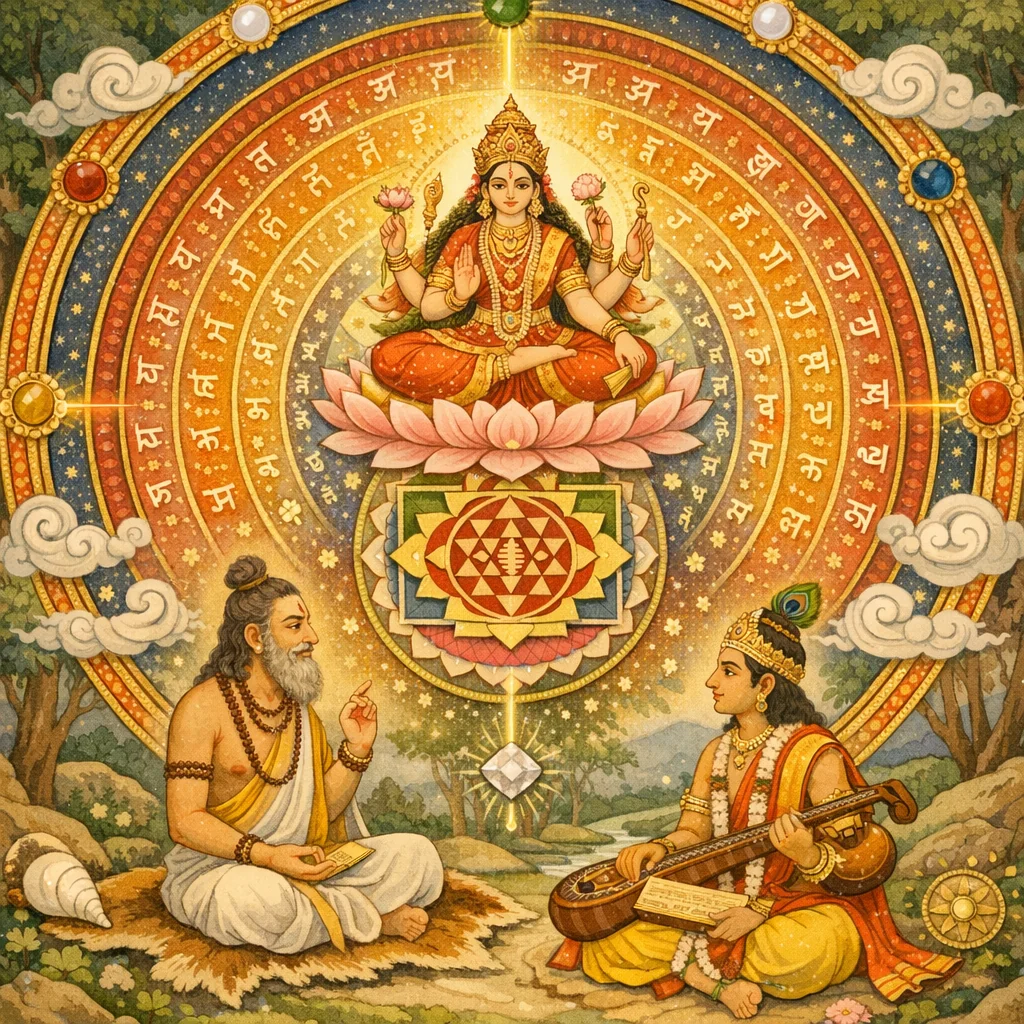
The Account of the Lalitā Hymn, the Protective Armor (Kavaca), and the Thousand Names (Sahasranāma)
Sanatkumāra teaches Nārada a graded Śākta-Śrīvidyā discipline: preliminaries of samaya observance and āvaraṇa-awareness grounded in guru-dhyāna; a Guru-stava that identifies Śiva as the Guru and source of descending sacred knowledge; contemplation of Devī as mantra-mātṛkā, where letters and syllables constitute and sustain the threefold cosmos and mantra-siddhi is praised as world-transforming power; the Lalitā-kavaca, using nine-gem imagery and directional/vertical protections that extend inward to mind, senses, prāṇas, and ethical restraints; announcement and partial unfolding of the sahasranāma and the sixteenfold (ṣoḍaśī) arrangement, listing Devī’s forms, śaktis, siddhis, phonetic classes, yoginī-circles, cakra locations, and the doctrine of levels of speech; and a phalaśruti describing graded fruits of repeated recitation—from prosperity and protection to mastery, victory, and identity-based accomplishment—culminating in the declaration that the thousand names fulfill aims and support mokṣa.
Shlokas
Verse 1
सनत्कुमार उवाच । अथासामावृतिस्थानां शक्तीनां समयेन च । नाम्नां सहस्रं वक्ष्यामि गुरुध्यानपुरः सरम् ॥ १ ॥
Sanatkumāra said: Now, in proper sequence, I shall proclaim the thousand names of these divine Powers, together with their enclosing spheres (āvaraṇa-sthānas) and the samaya conventions, with meditation upon the Guru set foremost.
Verse 2
नाथा नव प्रकाशाद्याः सुभगांताः प्रकीर्तिताः । भूम्यादीनिशिवांतानि विद्धि तत्त्वानि नारद ॥ २ ॥
The nine Nāthas have been proclaimed, beginning with Prakāśa and ending with Subhagā. Know, O Nārada, that the tattvas—the principles of reality—extend from Earth and the rest up to Śiva.
Verse 3
गुरुजन्मादिपर्वाणि दर्शान्तानि च सप्त वै । एतानि प्राहमनोवृत्त्या चिंतयेत्साधकोत्तमः ॥ ३ ॥
The seven sacred observances—beginning with the Guru’s birth-day and ending with the Darśa rite—are indeed to be contemplated within; the best of sādhakas should reflect on them with a disciplined intention of mind.
Verse 4
गुरुस्तोत्रं जपेच्चापि तद्गतेनांतरात्मना । नमस्ते नाथ भगवञ्शिवाय गुरुरूपिणे ॥ ४ ॥
One should also recite the Guru-hymn, with the inner self absorbed in Him. “Salutations to You, O Nātha—O Bhagavān Śiva—who appear in the form of the Guru.”
Verse 5
विद्यावतारसंसिद्ध्यै स्वौकृतानेकविग्रह । नवाय नवरूपाय परमार्थैकरूपिणे ॥ ५ ॥
Salutations to the One who perfects the descent of sacred knowledge; who, by His own will, assumes many forms; who is ever-new and of ever-new manifestations, yet whose true nature is one—pure Supreme Reality.
Verse 6
सर्वाज्ञानतमोभेदभानवे चिद्धनाय ते । स्वतंत्राय दयाक्लृप्तविग्रहाय शिवात्मने ॥ ६ ॥
Salutations to You—the sun that dispels the darkness of all ignorance; the treasury of consciousness; the independent Lord, who out of compassion assumes a form; whose very Self is Śiva, the Auspicious.
Verse 7
परतंत्राय भक्तानां भव्यानां भव्यरूपिणे । विवेकिनां विवेकाय विमर्शाय विमर्शिनाम् ॥ ७ ॥
Salutations to the One who becomes dependent upon His devotees; to Him whose form is auspicious for the auspicious; to Him who is discernment for the discerning; and to Him who is reflective inquiry for those who reflect.
Verse 8
प्रकाशानां प्रकाशाय ज्ञानिनां ज्ञानरूपिणे । पुरस्तात्पार्श्वयोः पृष्ठे नमः कुर्यामुपर्यधः ॥ ८ ॥
Salutations to Him who is the Light of all lights, the very form of knowledge for the knowers. Before me, at my sides, behind me, above and below—may I offer reverence in every direction.
Verse 9
सदा मञ्चित्तसदने विधेहि भवदासनम् । इति स्तुत्वा गुरुं भक्त्या परां देवीं विचिंतयेत् ॥ ९ ॥
“Always establish Your seat within the temple of my mind.” Having thus praised the Guru with devotion, one should then contemplate the Supreme Goddess.
Verse 10
गणेशग्रहनक्षत्रयोगिनीराशिरूपिणीम् । देवीं मंत्रमयीं नौमि मातृकापीठरूपिणीम् ॥ १० ॥
I bow to the Goddess who embodies Gaṇeśa, the planets, the lunar mansions, the Yoginīs, and the zodiacal signs; I bow to the Devi who is made of mantra itself, who appears as the sacred seat (pīṭha) of the Mātr̥kās.
Verse 11
प्रणमामि महादेवीं मातृकां परमेश्वरीम् । कालहृल्लोहोलोल्लोहकलानाशनकारिणीम् ॥ ११ ॥
I bow to the Great Goddess—Mātṛkā, the Supreme Sovereign Lady—who destroys the inauspicious phases and afflictions signified by the fierce mantra-sounds “kāla-hṛt, loho, lolloha.”
Verse 12
यदक्षरै कमात्रेऽपि संसिद्धे स्पर्द्धते नरः । रवितार्क्ष्येंदुकन्दर्पैः शंकरानलविष्णुभिः ॥ १२ ॥
When even a single syllable (akṣara), though only of the measure of one mātrā, becomes perfected through mantra-siddhi, a man can contend in power with the Sun, Garuḍa, the Moon, Kāma, Śaṅkara, Fire, and Viṣṇu.
Verse 13
यदक्षरशशिज्योत्स्नामंडितं भुवनत्रयम् । वन्दे सर्वेश्वरीं देवीं महाश्रीसिद्धमातृकाम् ॥ १३ ॥
I bow to the Goddess, Sovereign of all—Mahāśrī, the perfected Mother of the sacred letters—by whose syllables the three worlds are adorned like moonlight.
Verse 14
यदक्षरमहासूत्रप्रोतमेतज्जगत्त्रयम् । ब्रह्यांडादिकटाहांतं तां वन्दे सिद्धमातृकाम् ॥ १४ ॥
I bow to that perfected Mātṛkā, the sacred matrix of letters, upon whose great thread of imperishable syllables this entire threefold universe is strung—from the cosmic egg to the very rim of the cosmic cauldron.
Verse 15
यदेकादशमाधारं बीजं कोणत्रयोद्भवम् । ब्रह्यांडादिकटाहांतं जगदद्यापि दृश्यते ॥ १५ ॥
Even today the universe is seen as that seed-principle which rests upon eleven supports, arises from the triad of angles, and extends to the rim of the cosmic egg—the primordial cauldron of creation.
Verse 16
अकचादिटतोन्नद्धपयशाक्षरवर्गिणीम् । ज्येष्ठांगबाहुहृत्कंठकटिपादनिवासिनीम् ॥ १६ ॥
She is arranged in groups of syllables—beginning with ‘a’, then ‘ka’, and so on—strung like a garland of radiant letters; she abides in the chief limbs: the body, arms, heart, throat, waist, and feet.
Verse 17
नौमीकाराक्षरोद्धारां सारात्सारां परात्पराम् । प्रणमामि महादेवीं परमानंदरूपिणीम् ॥ १७ ॥
I bow to Mahādevī—she who is revealed through the sacred syllable “Naumī,” the very essence beyond all essences, the Supreme beyond the supreme, whose nature is the highest bliss.
Verse 18
अथापि यस्या जानंति न मनागपि देवताः । केयं कस्मात्क्व केनेति सरूपारूपभावनाम् ॥ १८ ॥
Even the gods do not know her in the least—who she is, whence she arises, where she abides, and by whom she is brought about—she whose very nature is conceived as both with form and without form.
Verse 19
वंदे तामहमक्षय्यां क्षकाराक्षररूपिणीम् । देवीं कुलकलोल्लोलप्रोल्लसन्तीं शिवां पराम् ॥ १९ ॥
I bow to that imperishable Goddess, whose very form is the syllable “kṣa”; the supreme, auspicious Devī who shines forth, surging and resplendent amid the waves and tumult of the multitude of lineages and assemblies.
Verse 20
वर्गानुक्रमयोगेन यस्याख्योमाष्टकं स्थितम् । वन्दे तामष्टवर्गोत्थमहासिद्ध्यादिकेश्वरीम् ॥ २० ॥
I bow to that Supreme Goddess—Lady of Mahāsiddhi and the rest—who arises from the Aṣṭavarga, and in whom the eightfold set (the ‘oṃ’-octad) is established through the ordered sequence of the phonetic classes (vargas).
Verse 21
कामपूर्णजकाराख्य सुपीठांतर्न्निवासिनीम् । चतुराज्ञाकोशभूतां नौमि श्रीत्रिपुरामहम् ॥ २१ ॥
I bow to Śrī Tripurā—she who dwells within the excellent sacred seat called “Kāmapūrṇa-ja-kāra,” and who is herself the very embodiment of the fourfold sheath of command (ājñā).
Verse 22
एतत्स्तोत्रं तु नित्यानां यः पठेत्सुसमाहितः । पूजादौ तस्य सर्वाता वरदाः स्युर्न संशयः ॥ २२ ॥
Whoever, with steady concentration, recites this hymn daily—at the time of worship and other rites—all the divine bestowers of boons will grant him blessings; of this there is no doubt.
Verse 23
अथ ते कवचं देव्या वक्ष्ये नवरतात्मकम् । येन देवासुरनरजयी स्यात्साधकः सदा ॥ २३ ॥
Now I shall declare to you the Goddess’s kavaca, the protective armor formed of the nine gems; by it the sādhaka becomes ever victorious over gods, asuras, and men.
Verse 24
सर्वतः सर्वदात्मानं ललिता पातु सर्वगा । कामेशी पुरतः पातु भगमाली त्वनंतरम् ॥ २४ ॥
May Lalitā, all-pervading, protect me on every side, at all times, and in every state of being. May Kāmeśī guard me in front, and may Bhagamālī protect me immediately thereafter, close at hand.
Verse 25
दिशं पातु तथा दक्षपार्श्वं मे पातु सर्वदा । नित्यक्लिन्नाथं भेरुण्डादिशं मे पातु कौणपीम् ॥ २५ ॥
May (the Lord) safeguard the directions, and may He ever protect my right side. May Nityaklinnātha defend me, and may Kauṇapī protect me in the direction presided over by Bheruṇḍa.
Verse 26
तथैव पश्चिमं भागं रक्षताद्वह्निवासिनी । महावज्रेश्वरी नित्या वायव्ये मां सदावतु ॥ २६ ॥
In the same way, may Vahni-vāsinī, the Goddess abiding in fire, protect the western quarter; and may the ever-present Mahāvajreśvarī always guard me in the Vāyavya (north-west) direction.
Verse 27
वामपार्श्वं सदा पातु इतीमेलरिता ततः । माहेश्वरी दिशं पातु त्वरितं सिद्धिदायिनी ॥ २७ ॥
Then, having uttered the formula, “May it always protect my left side,” one should pray: “May Māheśvarī, the power of Śiva, guard the direction, swiftly bestowing success and siddhi.”
Verse 28
पातु मामूर्ध्वतः शश्चद्दैवताकुलसुंदरी । अधो नीलपताकाख्या विजया सर्वतश्च माम् ॥ २८ ॥
May the ever-auspicious, beautiful Lady, surrounded by divine hosts, protect me from above; and may Vijayā, known as Nīlapatākā, protect me from below—and may she safeguard me on every side.
Verse 29
करोतु मे मंगलानि सर्वदा सर्वमंगला । देहंद्रियमनः प्राणाञ्ज्वालामालिनिविग्रहा ॥ २९ ॥
May She who is wholly auspicious grant me auspiciousness at all times—She whose embodied form is encircled by a garland of flames, and who presides over the body, the senses, the mind, and the vital breaths.
Verse 30
पालयत्वनिशं चित्ता चित्तं मे सर्वदावतु । कामात्क्रोधात्तथा लोभान्मोहान्मानान्मदादपि ॥ ३० ॥
May the vigilant inner awareness guard my mind unceasingly; may it protect me at all times—from desire, from anger, from greed, from delusion, from pride, and even from intoxication and arrogance.
Verse 31
पापान्मां सर्वतः शोकात्संक्षयात्सर्वतः सदा । असत्यात्क्रूरचिंतातोहिंसातश्चौरतस्तथा । स्तैमित्याच्च सदा पांतु प्रेरयंत्यः शुभं प्रति ॥ ३१ ॥
May they ever protect me on all sides—from sin, from sorrow, and from every kind of decline; from falsehood, from cruel thoughts, from violence, from theft, and from sloth—and may they continually impel me toward what is auspicious.
Verse 32
नित्याः षोडश मां पांतु गजारूढाः स्वशक्तिभिः । तथा हयसमारूढाः पांतु मां सर्वतः सदा ॥ ३२ ॥
May the sixteen eternal divine powers, mounted upon elephants and endowed with their own energies, protect me; and likewise, may those mounted upon horses protect me always, from every side.
Verse 33
सिंहारूढास्तथा पांतु पांतु ऋक्षगता अपि । रथारूढाश्च मां पांतु सर्वतः सर्वदा रणे ॥ ३३ ॥
May the divine Powers mounted on lions protect me; may those who ride upon bears protect me as well. May those seated in chariots guard me—on every side, at all times, in battle.
Verse 34
तार्क्ष्यारूढाश्च मां पांतु तथा व्योमगताश्च ताः । भूतगाः सर्वगाः पांतु पांतु देव्यश्च सर्वदा ॥ ३४ ॥
May the Goddesses who ride upon Tārkṣya (Garuḍa) protect me; and likewise may those who move through the sky protect me. May those who move among beings, and those who pervade everywhere, guard me; and may the Divine Goddesses protect me at all times.
Verse 35
भूतप्रेतपिशाचाश्च परकृत्यादिकान् गदान् । द्रावयंतु स्वशक्तीनां भूषणैरायुधैर्मम ॥ ३५ ॥
May the bhūtas, pretas, and piśācas drive away afflictions—such as hostile sorcery and the like—by the ornaments and weapons that are my own powers.
Verse 36
गजाश्वद्वीपिपंचास्यतार्क्ष्यारूढाखिलायुधाः । असंख्याः शक्तयो देव्यः पांतु मां सर्वतः सदा ॥ ३६ ॥
May the countless divine Powers (Śaktis)—mounted on elephants, horses, leopards, lion-faced forms, and Garuḍa, and bearing every kind of weapon—protect me always, on all sides.
Verse 37
सायं प्रातर्जपन्नित्याकवचं सर्वरक्षकम् । कदाचिन्नाशुभं पश्येत्सर्वदानंदमास्थितः ॥ ३७ ॥
One who regularly recites this all-protective kavaca at evening and at dawn will never behold inauspiciousness; abiding always in bliss, he remains secure.
Verse 38
इत्येतत्कवचं प्रोक्तं ललितायाः शुभावहम् । यस्य शंधारणान्मर्त्यो निर्भयो विजयी सुखी ॥ ३८ ॥
Thus has the kavaca, the protective hymn of Lalitā, been proclaimed, bestowing auspiciousness. By wearing or retaining it, a mortal becomes fearless, victorious, and happy.
Verse 39
अथ नाम्नां सहस्रं ते वक्ष्ये सावरणार्चनम् । षोडशानामपि मुने स्वस्वक्रमगतात्मकम् ॥ ३९ ॥
Now I shall tell you the thousand divine names, together with the worship of the āvaraṇas, the protective enclosures. O sage, I shall also set forth the sixteenfold arrangement in its proper order, each part placed in its own sequence.
Verse 40
ललिता चापि वा कामेश्वरी च भगमालिनी । नित्यक्लिन्ना च भेरुंडा कीर्तिता वह्निवासिनी ॥ ४० ॥
She is also praised as Lalitā, as Kāmeśvarī, and as Bhagamālinī; as Nityaklinnā and as Bheruṇḍā—she is likewise celebrated as Vahnivāsinī, the One who dwells in fire.
Verse 41
वज्रेश्वरी तथा दूती त्वरिता कुलसुंदरी । नित्या संवित्तथा नीलपताका विजयाह्वया ॥ ४१ ॥
Vajreśvarī, Dūtī, Tvaritā, Kulasundarī, Nityā, Saṃvit, Nīlapatākā, and she who is called Vijayā—these are the sacred names.
Verse 42
सर्वमंगलिका चापि ज्वालामालिनिसंज्ञिता । चित्रा चेति क्रमान्नित्याः षोडशपीष्टविग्रहाः ॥ ४२ ॥
Likewise (the forms are) Sarvamaṅgalikā, also called Jvālāmālinī, and (the one named) Citrā—thus, in due sequence, these are the eternal sixteen embodiments fashioned from the ritual piṣṭa (paste).
Verse 43
कुरुकुल्ला च वाराही द्वे एते चेष्टविग्रहे । वशिनी चापि कामेशी मोहिनी विमलारुणा ॥ ४३ ॥
Kurukullā and Vārāhī—these two are the Goddess-forms that preside over action and dynamic activity. Along with them are Vaśinī, Kāmeśī, Mohinī, and Vimalāruṇā.
Verse 44
तपिनी च तथा सर्वेश्वरी चाप्यथ कौलिनी । मुद्राणंतनुरिष्वर्णरूपा चापार्णविग्रहा ॥ ४४ ॥
She is Tapinī; likewise She is Sarveśvarī, and also Kaulinī. She is the very embodiment of the sacred mudrās; She is the Lord’s form, golden in radiance; and She whose body is the immeasurable ocean itself.
Verse 45
पाशवर्णशरीरा चाकुर्वर्णसुवपुर्द्धरा । त्रिखंडा स्थापनी सन्निरोधनी चावगुंठनी ॥ ४५ ॥
She bears a tawny-brown body and a beautiful form of radiant hue. She is threefold: the establisher, the restrainer, and the veiler that conceals.
Verse 46
सन्निधानेषु चापाख्या तथा पाशांकुशाभिधा । नमस्कृतिस्तथा संक्षोभणी विद्रावणी तथा ॥ ४६ ॥
For rites of bringing a deity or power into proximity there is the procedure called Cāpa; likewise those known as Pāśa and Aṅkuśa. So too there is Namaskṛti, and also Saṃkṣobhaṇī (rousing) and Vidrāvaṇī (driving away).
Verse 47
आकर्षणी च विख्याता तथैवावे शकारिणी । उन्मादिनी महापूर्वा कुशाथो खेचरी मता ॥ ४७ ॥
Also renowned is Ākarṣaṇī, the power of attraction, and likewise Āveśakāriṇī, which induces possession or overpowering influence. There are Unmādinī, which causes frenzy, the most ancient Mahāpūrvā, Kuśāthā, and Khecarī—so it is held.
Verse 48
बीजा शक्त्युत्थापना च स्थूलसूक्ष्मपराभिधा । अणिमा लघिमा चैव महिमा गरिमा तथा ॥ ४८ ॥
The siddhis called Bījā and Śakty-utthāpana are also spoken of, along with the powers named Sthūla, Sūkṣma, and Parā; and likewise the classic siddhis—Aṇimā, Laghimā, Mahimā, and Garimā.
Verse 49
प्राप्तिः प्रकामिता चापि चेशिता वशिता तथा । भुक्तिः सिद्धिस्तथैवेच्छा सिद्धिरूपा च कीर्तिता ॥ ४९ ॥
Prāpti (attainment), Prākāmitā (fulfilment of desired enjoyments), Īśitā (lordship), and Vaśitā (power of subjugation); likewise Bhukti (enjoyment) and Siddhi—and also Icchā-siddhi (the power of will)—are declared to be forms of siddhi.
Verse 50
ब्राह्मी माहेश्वरी चैव कौमारी वैष्णवी तथा । वाराहींद्राणी चामुंडा महालक्ष्मीस्वरूपिणी ॥ ५० ॥
Brahmī, Māheśvarī, Kaumārī, and likewise Vaiṣṇavī; Vārāhī, Indrāṇī, and Cāmuṇḍā—all these are of the very nature and form of Mahālakṣmī.
Verse 51
कामा बुद्धिरहंकारशब्दस्पर्शस्वरूपिणी । रूपरूपा रसाह्वा च गंधवित्तधृतिस्तथा ॥ ५१ ॥
She assumes the forms of desire, intellect, and ego, and becomes the very essence of sound and touch. She also takes the form of visible form, is called taste, and likewise becomes smell, awareness/thought, and steadfast firmness (dhṛti).
Verse 52
नाभबीजामृताख्या च स्मृतिदेहात्मरूपिणी । कुसुमा मेखला चापि मदना मदनातुरा ॥ ५२ ॥
She is also called Nābhabījāmṛtā, taking the forms of memory, body, and the ātman (self). She is named Kusumā and Mekhalā as well—Madana, and Madanāturā, one afflicted by Madana, love’s stirring.
Verse 53
रेखा संवेगिनी चैव ह्यंकुशा मालिनीति च । संक्षोभिणी तथा विद्राविण्याकर्षणरूपिणी ॥ ५३ ॥
They are named Rekhā, Saṃveginī, Aṅkuśā, and Mālinī; likewise there are Saṃkṣobhiṇī, Vidrāviṇī, and she whose very form is Ākarṣaṇa—attraction itself.
Verse 54
आह्लादिनीति च प्रोक्ता तथा समोहिनीति च । स्तंभिनीजंभिनीचैव वशंकर्यथ रंजिनी ॥ ५४ ॥
She is spoken of as Āhlādinī, the delight-bestowing power, and also as Samohinī, the power that confounds. Likewise there are Stambhinī, who immobilizes; Jambhinī, who paralyzes or crushes; Vaśaṃkarī, who brings under control; and then Raṃjinī, who enchants.
Verse 55
उन्मादिनी तथैवार्थसाधिनीति प्रकीर्तिता । संपत्तिपूर्णा सा मंत्रमयी द्वंद्वक्षयंकरी ॥ ५५ ॥
She is praised as Unmādinī and also as Artha-sādhinī. Abounding in prosperity, she is mantra in her very essence, and she brings dualities to dissolution.
Verse 56
सिद्धिः संपत्प्रदाचैव प्रियमंगलकारिणी । कामप्रदा निगदिता तथा दुःखविमोचिनी ॥ ५६ ॥
It is said to grant success and prosperity, to bring forth what is dear and auspicious, to bestow desired enjoyments, and likewise to free one from sorrow.
Verse 57
मृत्युप्रशमनीचैव तथा विघ्ननिवारिणी । अंगसुंदरिका चैव तथा सौभाग्यदायिनी ॥ ५७ ॥
She is indeed the pacifier of death, and likewise the remover of obstacles; she also bestows beauty upon the limbs, and grants good fortune.
Verse 58
ज्ञानैश्वर्यप्रदा ज्ञानमयी चैव च पंचमी । विंध्यवासनका घोरस्वरूपा पापहारिणी ॥ ५८ ॥
The Fifth, Pañcamī, bestows knowledge and spiritual sovereignty; she is verily formed of wisdom itself. Dwelling in the Vindhya region, of awe-inspiring form, she removes sins.
Verse 59
तथानंदमयी रक्षा रूपेप्सितफलप्रदा । जयिनी विमला चाथ कामेशी वज्रिणी भगा ॥ ५९ ॥
Likewise, she is Ānandamayī, the Blissful One; Rakṣā, the Protectress; the Giver of the desired fruits in matters of form and beauty; Jayinī, the Victorious; Vimalā, the Pure; and also Kāmeśī, Vajriṇī, and Bhagā.
Verse 60
त्रैलोक्यमोहना स्थाना सर्वाशापरिपूरणी । सर्वसक्षोभणगता सौभाग्यप्रदसंस्थिता ॥ ६० ॥
She is the abode that enchants the three worlds; the fulfiller of every desire; the power that can stir and agitate all beings; and the firmly established bestower of auspicious fortune.
Verse 61
सर्वार्थसाधकागारा सर्वरोगहरास्थिता । सर्वरक्षाकरास्थाना सर्वसिद्धिप्रदस्थिता ॥ ६१ ॥
She abides as the dwelling that accomplishes every aim; she stands as the remover of all diseases; she is established as the seat that grants all protection; and she remains as the bestower of every success and accomplishment.
Verse 62
सर्वानंदमयाधारबिंदुस्थानशिवात्मिका । प्रकृष्टा च तथा गुप्ता ज्ञेया गुप्ततरापि च ॥ ६२ ॥
She is the very essence of Śiva, abiding in the ādhāra, the bindu, and the locus (sthāna), all suffused with universal bliss. She is supreme and also hidden—indeed, to be known as even more profoundly secret.
Verse 63
संप्रदायस्वरूपा च कुलकौलनिगर्भगा । रहस्यापरापरप्राकृत्तथैवातिरहस्यका ॥ ६३ ॥
It is of the very nature of a sampradāya (initiatory lineage) and lies embedded within the Kula and Kaula traditions. It is taught as “secret,” “higher and still higher,” “in its natural (prākṛta) form,” and likewise as “supremely secret.”
Verse 64
त्रिपुरा त्रिपुरेशी च तथैव पुरवासिनी । श्रीमालिनी च सिद्धान्ता महात्रिपुरसुंदरी ॥ ६४ ॥
She is Tripurā; she is Tripureśī, sovereign of the three cities; likewise she is Puravāsinī, the indweller of the sacred city. She is Śrīmālinī, adorned with splendor; she is Siddhāntā, the very essence of established doctrine; she is Mahātripurasundarī, the supremely beautiful One of the three worlds.
Verse 65
नवरत्नमयद्वीपनवखंडविराजिता । कल्पकोद्यानसंस्था च ऋतुरूपेंद्रियार्चका ॥ ६५ ॥
She shines with nine regions like islands made of the nine gems; she abides in gardens of wish-fulfilling trees, and—taking the form of the seasons—she is worshipped through the senses.
Verse 66
कालमुद्रा मातृकाख्या रत्नदेशोपदेशिका । तत्त्वाग्रहगाभिधा मूर्तिस्तथैव विषयद्विपा ॥ ६६ ॥
Also, there are (disciplines) called Kālamudrā, Mātṛkā, Ratnadeśopadeśikā, and Tattvāgrahagā, as well as Mūrti and Viṣayadvipā.
Verse 67
देशकालाकारशब्दरूपा संगीतयोगिनी । समस्तगुप्तप्रकटसिद्धयोगिनिचक्रयुक् ॥ ६७ ॥
She is embodied as place, time, form, sound, and appearance; she is the Yoginī of sacred music. She is united with the entire circle of Yoginīs and Siddhas—those both hidden and manifest.
Verse 68
वह्निसूर्येन्दुभूताह्वा तथात्माष्टाक्षराह्वया । पंचधार्यास्वरूपा च नानाव्रतसमाह्वया ॥ ६८ ॥
She is designated by the names Fire, Sun, Moon, and the Elements; likewise she is known as the Self (Ātman) and as the eight-syllabled mantra (Aṣṭākṣara). She is also the form called “the five to be borne and observed,” and is spoken of by many names according to the various vows (vratas).
Verse 69
निषिद्धाचाररहिता सिद्धचिह्नस्वरूपिणी । चतुर्द्धा कूर्मभागस्था नित्याद्यर्चास्वरूपिणी ॥ ६९ ॥
She is devoid of forbidden conduct and is marked by the signs of spiritual perfection (siddhi). Abiding in the fourfold divisions of the Kūrma-portion, she remains the very form of worship (arcā), beginning with the daily (nitya) rites and other prescribed observances.
Verse 70
दमनादिसमभ्यर्चा षट्कर्मसिद्धिदायिनी । तिथिवारपृथग्द्रव्यसमर्चनशुभावहा ॥ ७० ॥
Worship with offerings beginning with sacred damanā grass bestows success in the six ritual operations; and worship with distinct substances according to the tithi (lunar day) and vāra (weekday) becomes a bringer of auspicious results.
Verse 71
वायोश्यनंगकुसुमा तथैवानंगमेखला । अनंगमदनानंगमदनातुरसाह्वया ॥ ७१ ॥
She is also called Vāyośyanāṅgakusumā, and likewise Anaṅgamekhalā; she is named Anaṅgamadanā, Anaṅgamadanāturā, and Sāhvayā.
Verse 72
मददेगिनीका चैव तथा भुवनपालिनी । शशिलेखा समुद्दिष्टा गतिलेखाह्वया मता ॥ ७२ ॥
Likewise she is called Madadeginīkā and also Bhuvanapālinī; she is declared to be Śaśilekhā, and is regarded as bearing the name Gatilekhā.
Verse 73
श्रद्धा प्रीति रतिश्चैव धृतिः कांतिर्मनोरमा । मनोहरा समाख्याता तथैव हि मनोरथा ॥ ७३ ॥
Śraddhā (faith), prīti (affection), rati (delight), dhṛti (steadfastness), kānti (radiance), and Manoramā—these too are spoken of as bearing the name Manoharā; and likewise, indeed, as Manorathā.
Verse 74
मदनोन्मादिनी चैव मोदिनी शंखिनी तथा । शोषिणी चैव शंकारी सिंजिनी सुभगा तथा ॥ ७४ ॥
She is Madanonmādinī, who intoxicates with passion; Modinī, the giver of joy; Śaṅkhinī, the bearer of the sacred conch; Śoṣiṇī, who dries up afflictions; the beneficent Śaṅkarī; Siñjinī, who makes a jingling sound; and Subhagā, the auspicious and fortunate one.
Verse 75
पूषाचेद्वासुमनसा रतिः प्रीतिर्धृतिस्तथा । ऋद्धिः सौम्या मरीचिश्च तथैव ह्यंशुमालिनी ॥ ७५ ॥
If the deity is Pūṣan, then his associated powers/consorts are Vāsumanasā, Rati, Prīti, and Dhṛti; likewise also Ṛddhi, Saumyā, Marīci, and Aṃśumālinī.
Verse 76
शशिनी चांगिरा छाया तथा संपूर्णमंडला । तुष्टिस्तथामृताख्या च डाकिनी साथ लोकपा ॥ ७६ ॥
Śaśinī, Āṅgirā, Chāyā, Saṃpūrṇamaṇḍalā, Tuṣṭi, the one called Amṛtā, Ḍākinī, and likewise the Lokapās (guardians of the worlds) are also enumerated here.
Verse 77
बटुकेभास्वरूपा च दुर्गा क्षेत्रेशरूपिणी । कामराजस्वरूपा च तथा मन्मथरूपिणी ॥ ७७ ॥
She is of the very form of Bhairava (Baṭukebha); she is Durgā, manifest as the presiding Lord of the sacred field. She is also of the form of Kāmarāja, and likewise of the form of Manmatha, the god of love.
Verse 78
कंदर्प्परूपिणी चैव तथा मकरकेतना । मनोभवस्वरूपा च भारती वर्णरूपिणी ॥ ७८ ॥
She is indeed of the form of Kāma (Kandarpā), and also the One whose emblem is the makara; she is the very embodiment of desire “born of the mind”; and Bhāratī (Sarasvatī) is the very form of syllables and letters (varṇas).
Verse 79
मदना मोहिनी लीला जंभिनी चोद्यमा शुभा । ह्लादिनी द्राविणी प्रीती रती रक्ता मनोरमा ॥ ७९ ॥
She is Madanā (the awakener of desire), Mohinī (the enchantress), Līlā (divine play), Jambhinī (the one who confounds and restrains), Codyamā (the impeller), and Śubhā (the auspicious). She is Hlādinī (the delight-giving), Drāviṇī (the bestower of wealth), Prītī (affection), Ratī (love), Raktā (attachment), and Manoramā (the captivating).
Verse 80
सर्वोन्मादा सर्वमुखा ह्यभंगा चामितोद्यमा । अनल्पाव्यक्तविभवा विविधाक्षोभविग्रहा ॥ ८० ॥
She is the source of all ecstatic impulses, facing every direction—truly unbroken and of immeasurable energy. Her greatness is vast yet subtle and unmanifest, and her form displays many kinds of awe-inspiring, unshakable majesty.
Verse 81
रागशक्तिर्द्वेषशक्तिस्तथा शब्दादिरूपिणी । नित्या निरंजना क्लिन्ना क्लेदेनी मदनातुरा ॥ ८१ ॥
She is the power of attachment and the power of aversion; she also assumes the forms of sound and the other sense-objects. Ever-present and stainless, yet as though moistened—causing the dampness of clinging—she is stirred by Kāma (desire).
Verse 82
मदद्रवा द्राविणी च द्रविणी चैति कीर्तिता । मदाविला मंगला च मन्मथानी मनस्विनी ॥ ८२ ॥
She is praised as Madadravā, Drāviṇī, and Draviṇī; and she is also spoken of as Madāvilā, Maṅgalā, Manmathānī, and Manasvinī.
Verse 83
मोहा मोदा मानमयी माया मंदा मितावती । विजया विमला चैव शुभा विश्वा तथैव च ॥ ८३ ॥
Moha (delusion), Modā (delight), Mānamayī (the power of pride), Māyā (illusion), Maṃdā (dullness), Mitāvatī (moderation), Vijayā (victory), Vimalā (purity), Śubhā (auspiciousness), and likewise Viśvā (universality)—these too are named.
Verse 84
विभूतिर्विनता चैव विविधा विनता क्रमात् । कमला कामिनी चैव किराता कीर्तिरूपिणी ॥ ८४ ॥
She is called Vibhūti; also Vinatā; then, in due sequence, Vividhā and again Vinatā; likewise Kamalā and Kāminī; Kirātā too—she whose very form is renown (Kīrti-rūpiṇī).
Verse 85
कुट्टिनी च समुद्दिष्टा तथैव कुलसुंदरी । कल्याणी कालकोला च डाकिनी शाकिनी तथा ॥ ८५ ॥
Also enumerated are Kuṭṭinī, and likewise Kulasundarī; Kalyāṇī, Kālakolā, and also Ḍākinī and Śākinī.
Verse 86
लाकिनी काकिनी चैव राकिनी काकिनी तथा । इच्छाज्ञाना क्रियाख्या चाप्यायुधाष्टकधारिणी ॥ ८६ ॥
Lakini and Kakini, and likewise Rakini and Kakini—these Śaktis are known as Will (icchā), Knowledge (jñāna), and Action (kriyā); and each is described as bearing an eightfold set of weapons.
Verse 87
कपर्दिनी समुद्दिष्टा तथैव कुलसुंदरी । ज्वालिनी विस्फुलिंगा च मंगला सुमनोहरा ॥ ८७ ॥
She is proclaimed as Kapardinī, and likewise as Kulasundarī; as Jvālinī and Visphuliṅgā too; as Maṅgalā—auspicious—and as Sumanoharā, the enchantress of the mind.
Verse 88
कनका किनवा विद्या विविधा च प्रकीर्तिता । मेषा वृषाह्वया चैव मिथुना कर्कटा तथा ॥ ८८ ॥
This astrological doctrine is proclaimed in many forms—whether called “Kanakā” or “Kinavā”—as a diverse body of knowledge; and it further enumerates Aries (Meṣa), Taurus (Vṛṣa), Gemini (Mithuna), and Cancer (Karkaṭa) as well.
Verse 89
सिंहा कन्या तुला कीटा चापा च मकरा तथा । कुम्भा मीना च सारा च सर्वभक्षा तथैव च ॥ ८९ ॥
Also enumerated are Leo (Siṃha), Virgo (Kanyā), Libra (Tulā), Scorpio (Kīṭa), Sagittarius (Cāpa), Capricorn (Makara), Aquarius (Kumbha), Pisces (Mīna), the “Sāra” class, and likewise the “Sarvabhakṣa” class—these are the categories as stated.
Verse 90
विश्वात्मा विविधोद्भूतचित्ररूपा च कीर्तिता । निःसपत्ना निरातंका याचनाचिंत्यवैभवा ॥ ९० ॥
She is praised as the Soul of the universe (Viśvātmā), appearing in wondrous forms born of many diverse manifestations. She is without any rival, free from fear and affliction, and possessed of an inconceivable majesty that needs no begging or dependence.
Verse 91
रक्ता चैव ततः प्रोक्ताविद्याप्राप्तिस्वरूपिणी । हृल्लेखा क्लेदिनी क्लिन्ना क्षोभिणी मदनातुरा ॥ ९१ ॥
Then she is described as “Raktā”—the very embodiment of the attainment of knowledge; as Hṛllekhā, who inscribes herself upon the heart; as Kledinī, who moistens; as Klinnā, fully drenched; as Kṣobhiṇī, who agitates; and as Madanāturā, afflicted by desire.
Verse 92
निपंदना रागवती तथैव मदनावती । मेखला द्राविणी वेगवती चैव प्रकीर्तिता ॥ ९२ ॥
Nipaṃdanā, Rāgavatī, and likewise Madanāvatī; also Mekhalā, Drāviṇī, and Vegavatī—these too are declared as well-known designations.
Verse 93
कमला कामिनी कल्पा कला च कलिताद्भुता । किरता च तथा काला कदना कौशिका तथा ॥ ९३ ॥
She is called Kamalā, Kāminī, Kalpā, and Kalā—also Kalitādbhutā; likewise Kirātā and Kālī; Kadānā and also Kauśikā.
Verse 94
कंबुवादनिका चैव कातरा कपटा तथा । कीर्तिश्चापि कुमारी च कुंकुमा परिकीर्तिता ॥ ९४ ॥
She is also called Kambuvādanikā; Kātarā and Kapaṭā; and likewise Kīrti, Kumārī, and Kuṅkumā—so it is declared here.
Verse 95
भञ्जिनी वेगिनी नागा चपला पेशला सती । रतिः श्रद्धा भोगलोला मदोन्मत्ता मनस्विनी ॥ ९५ ॥
She is Bhañjinī, the Breaker; Veginī, the Swift; Nāgā, serpent-like; Capalā, the Restless; Peśalā, the Graceful; Satī, the Virtuous. She is Rati, Desire; Śraddhā, Faith; Bhogalolā, pleasure-seeking; Madonmattā, intoxicated with pride; and Manasvinī, strong-minded.
Verse 96
विह्वला कर्षिणी लोला तथा मदनमालिनी । विनोदा कौतुका पुण्या पुराणा परिकीर्तिता ॥ ९६ ॥
She is celebrated as Vihvalā, the Bewildering One; Karṣiṇī, the Attractress; Lolā, the Playful and Restless; and Madanamālinī, garlanded with love. She is also Vinodā, Delightful; Kautukā, fond of wonder; Puṇyā, Holy; and Purāṇā, Ancient and primeval—thus she is praised.
Verse 97
वागीशी वरदा विश्वा विभवाविघ्नकारिणी । बीजविघ्नहरा विद्या सुमुखी सुंदरी तथा ॥ ९७ ॥
She is Vāgīśī, sovereign of speech; Varadā, bestower of boons; Viśvā, the all-pervading. She grants prosperity and removes obstacles. She destroys impediments at their very seed, is Vidyā—true knowledge itself—and is also Sumukhī, gracious-faced, and Sundarī, beautiful.
Verse 98
सारा च सुमना चैव तथा प्रोक्ता सरस्वती । समया सर्वगा विद्धा शिवा वाणी च कीर्तिता ॥ ९८ ॥
She is also called Sārā and Sumanā; likewise she is proclaimed as Sarasvatī. She is known as Samayā and as Sarvagā, the all-pervading; she is celebrated as Śivā and also as Vāṇī, the Sacred Speech.
Verse 99
दूरसिद्धा तथा प्रोक्ताथो विग्रहवती मता । नादा मनोन्मनी प्राणप्रतिष्ठारुणवैभवा ॥ ९९ ॥
She is also spoken of as Dūrasiddhā, and is regarded as Vigrahavatī, endowed with a manifest form. She is Nādā, Manonmanī, Prāṇapratiṣṭhā, and Aruṇavaibhavā—thus is she described by these sacred epithets.
Verse 100
प्राणापाना समाना च व्यानोदाना च कीर्तिता । नागा कूर्मा तच कृकला देवदत्ता धनञ्जया ॥ १०० ॥
Prāṇa, Apāna, Samāna, Vyāna, and Udāna are declared as the five principal vital airs. Likewise, Nāga, Kūrma, Kṛkala, Devadatta, and Dhanañjaya are spoken of as the five subsidiary airs.
Verse 101
फट्कारी किंकराराध्या जया च विजया तथा । हुंकारी खेटचरी चंडाछेदिनी क्षपिणी तथा ॥ १०१ ॥
She is Phaṭkārī, invoked with the syllable “phaṭ”; worshipped by her attendants, the kiṅkaras; and she is Jaya and Vijaya. She is Huṅkārī, invoked with the syllable “huṅ”; she moves through the skies as Kheṭacarī; she cuts down the fierce as Caṇḍāchedinī; and she is Kṣapiṇī, the Destroyer.
Verse 102
स्त्रीहुंकारी क्षेमकारी चतुरक्षररूपिणी । श्रीविद्यामतवर्णांगी काली याम्या नृपार्णका ॥ १०२ ॥
She is the feminine power of “Huṃ”, the bestower of protection and welfare, whose form is the four-syllabled mantra. She is of the nature of Śrīvidyā, her body constituted of letters (varṇas). She is Kālī; she is Yāmyā, connected with the southern quarter and Yama; and she is called Nṛpārṇakā.
Verse 103
भाषा सरस्वती वाणी संस्कृता परा । बहुरूपा चित्तरूपा रम्यानंदा च कौतुका ॥ १०३ ॥
Speech is Sarasvatī herself—Sanskrit, the supreme utterance: manifold in form, shaped by the mind, delightful, bestowing ānanda, and a source of wonder.
Verse 104
त्रयाख्या परमात्माख्याप्यमेयविभवा तथा । वाक्स्वरूपा बिंदुसर्गरूपा विश्वात्मिका तथा ॥ १०४ ॥
She is known as the Triad; she is also called Paramātman, of immeasurable majesty. She is the very nature of Vāk (Speech); she is creation arising from the Bindu; and she is likewise the Soul of the universe.
Verse 105
तथा त्रैपुरकंदाख्या ज्ञात्रादित्रिविधात्मिका । आयुर्लक्ष्मीकीर्तिभोगसौंदर्यारोग्यदायिका ॥ १०५ ॥
Likewise, the discipline known as Traipurakaṃda—threefold in nature, beginning with the knower—bestows longevity, Lakṣmī (prosperity), fame, enjoyment, beauty, and health.
Verse 106
ऐहिकामुष्मिकज्ञानमयी च परिकीर्तिता । जीवाख्या विजयाख्या च तथैव विश्वविन्मयी ॥ १०६ ॥
It is also proclaimed to be constituted of knowledge concerning both the worldly (this life) and the other-worldly (after death). It is called “Jīva”, “Vijayā”, and likewise “Viśva-vinmayī”, pervading and filled with the universe.
Verse 107
हृदादिविद्या रूपादिभानुरूपाः जगदूपुः । विश्वमो हनिका चैव त्रिपुरामृतसंज्ञिका ॥ १०७ ॥
The sciences beginning with Hṛdādi, those corresponding to the forms of the Sun and other luminaries, the one called Jagadūpu, as well as Viśvamo, Hanikā, and that known as Tripurāmṛta—thus are all enumerated.
Verse 108
सर्वाप्यायनरूपा च मोहिनी क्षोभणी तथा । क्लेदिनी च समाख्याता तथैव च महोदया ॥ १०८ ॥
She is of the nature of complete nourishment and replenishment; she is Mohinī, the Enchantress, and also the Agitator. She is called the Moistener as well—and likewise Mahodayā, the Great Bestower of prosperity.
Verse 109
संपत्करी हलक्षार्णा सीमामातृतनू रतिः । प्रीतिर्मनोभवा वापि प्रोक्ता वाराधिपा तथा ॥ १०९ ॥
She is declared as Saṃpatkarī, the bestower of prosperity; Halakṣārṇā, whose form is made of syllables and letters; Sīmāmātṛtanū, whose body is the Mother of boundaries; Rati, delight; Prīti, affection; Manobhavā, mind-born; and also Vārādhipā, sovereign of the waters.
Verse 110
त्रिकूटा चापि षट्कूटा पंचकूटा विशुद्धगा । अनाहत गता चैव मणिपूरकसंस्थिता ॥ ११० ॥
She is also called Tri-kūṭā, Ṣaṭ-kūṭā, and Pañca-kūṭā; she moves through Viśuddha, proceeds to Anāhata, and becomes established in Maṇipūraka.
Verse 111
स्वाधिष्ठानसमासीनाधारस्थाज्ञासमास्थिता । षट्त्रिंशत्कूटरूपा च पंचाशन्मिथुनात्मिका ॥ १११ ॥
Seated in Svādhiṣṭhāna, abiding in Ādhāra (the root-support), and firmly established in Ājñā, the power of knowledge, she is of the form of thirty-six kūṭas and is essentially constituted of fifty paired units.
Verse 112
पादुकादिकसिद्धीशा तथा विजयदायिनी । कामरूपप्रदा वेतालरूपा च पिशाचिका ॥ ११२ ॥
She is the presiding power of siddhis connected with pādukās and similar talismanic objects; she grants victory. She bestows the ability to assume any desired form, and she appears in the form of a vetāla and also as a piśācikā.
Verse 113
विचित्रा विभ्रमा हंसी भीषणी जनरंजिका । विशाला मदना तुष्टा कालकंठी महाभया ॥ ११३ ॥
She is wondrous and bewildering; swan-like; terrifying yet delighting to people—vast, desire-stirring, and contented; dark-throated, and exceedingly fearsome.
Verse 114
माहेंद्री शंखिनी चैंद्री मंगला वटवासिनी । मेखला सकला लक्ष्मीर्मालिनीविश्वनायिका ॥ ११४ ॥
She is Māhendrī; Śaṅkhinī; also Aindrī; Maṅgalā; the Dweller in the banyan tree; Mekhalā; Sakalā; Lakṣmī; Mālinī; and the Sovereign Lady of the universe.
Verse 115
सुलोचना सुशोभा च कामदा च विलासिनी । कामेश्वरी नंदिनी च स्वर्णरेखा मनोहरा ॥ ११५ ॥
She is Fair-eyed, Radiantly Beautiful, the Giver of desired boons, and Playful; the Sovereign Lady of Kāma, the Bestower of delight, Golden-lined, and Enchanting.
Verse 116
प्रमोदा रागिणी सिद्धा पद्मिनी च रतिप्रिया । कल्याणदा कलादक्षा ततश्च सुरसुन्दरी ॥ ११६ ॥
They are Pramodā, Rāgiṇī, Siddhā, Padminī, and Ratipriyā; Kalyāṇadā, Kalādakṣā, and then Surasundarī.
Verse 117
विभ्रमा वाहका वीरा विकला कोरकाकविः । सिंहनादा महानादा सुग्रीवा मर्कटा शठा ॥ ११७ ॥
Vibhramā, Vāhakā, Vīrā, Vikalā, Korakākavi; Siṃhanādā, Mahānādā, Sugrīvā, Markaṭā, and Śaṭhā—these are the names being listed here.
Verse 118
बिडालाक्षा बिडालास्या कुमारी खेचरी भवा । मयूरा मंगला भीमा द्विपवक्त्रा खरानना ॥ ११८ ॥
(She is) cat-eyed, cat-faced; the virgin maiden; the sky-roaming one—Bhavā; peacock-like; auspicious; terrifying; two-faced; and donkey-faced.
Verse 119
मातंगी च निशाचारा वृषग्राहा वृकानना । सैरिभास्या गजमुखा पशुवक्त्रा मृगानना ॥ ११९ ॥
And (she is) Mātaṅgī; a night-roaming one; the seizer of bulls; wolf-faced; one whose speech is like that of a buffalo; elephant-faced; beast-mouthed; and deer-faced.
Verse 120
क्षोभका मणिभद्रा च क्रीडका सिंहचक्रका । महोदरा स्थूलशिखा विकृतास्या वरानना ॥ १२० ॥
(She is) Kṣobhakā, Maṇibhadrā, and Krīḍakā; Siṃhacakrakā; Mahodarā; Sthūlaśikhā; Vikṛtāsyā; and Varānanā—these are the names enumerated here.
Verse 121
चपला कुक्कुटास्या च पाविनी मदनालसा । मनोहरा दीर्घजंघा स्थूलदन्ता दशानना ॥ १२१ ॥
She is fickle; cock-faced; purifying; languid with passion. She is charming, long-legged, large-toothed, and ten-faced.
Verse 122
सुमुखा पंडिता क्रुद्धा वराहास्या सटामुखा । कपटा कौतुका काला किंकरा कितवा खला ॥ १२२ ॥
She appears fair-faced and learned, yet is wrathful; boar-faced and bull-faced; deceitful and fickle; dark and servile; a gambler and a wicked one.
Verse 123
भक्षका भयदा सिद्धा सर्वगा च प्रकीर्तिता । जया च विजया दुर्गा भद्रा भद्रकरी तथा ॥ १२३ ॥
She is proclaimed as Bhakṣakā, Bhayadā, Siddhā, and Sarvagā; and also as Jayā, Vijayā, Durgā, Bhadrā, and Bhadrakarī.
Verse 124
अम्बिका वामदेवी च महामायास्वरूपिणी । विदारिका विश्वमयी विश्वा विश्वविभंजिता ॥ १२४ ॥
She is Ambikā and Vāmadevī, the very embodiment of Mahāmāyā; she is Vidārikā—pervading the whole universe—she is the Universe itself, and she is the power that differentiates and divides the cosmos into its manifold forms.
Verse 125
वीरा विक्षोभिणी विद्या विनोदा बीजविग्रहा । वीतशोका विषग्रीवा विपुला विजयप्रदा ॥ १२५ ॥
Sacred Vidyā is heroic: it shakes off inner turmoil and delights the mind; it is the embodied seed (bīja-vigrahā) of all attainments. Free from sorrow, it bears viṣa-grīvā, the “poison-throat” that neutralizes toxins; it is vast and bestows victory.
Verse 126
विभवा विविधा विप्रा तथैव परिकीर्तिता । मनोहरा मंगली च मदोत्सिक्ता मनस्विनी ॥ १२६ ॥
She is said to be Vibhavā, Vividhā, and likewise Vīprā; also she is celebrated as Parikīrtitā, Manoharā, Maṅgalī, Madotsiktā, and Manasvinī.
Verse 127
मानिनी मधुरा माया मोहिनी च तथा स्मृता । भद्रा भवानी भव्या च विशालाक्षी शुचिस्मिता ॥ १२७ ॥
She is remembered as Mānīnī (the dignified one), Madhurā (the sweet one), Māyā (the power of manifestation), and Mohinī (the enchantress); as Bhadrā (the auspicious one), Bhavānī (Mother of Bhava), Bhavyā (the gracious and prosperous one), Viśālākṣī (wide‑eyed), and Śucismitā (she of the pure, gentle smile).
Verse 128
ककुभा कमला कल्पा कलाथो पूरणी तथा । नित्या चाप्यमृता चैव जीविता च तथा दया ॥ १२८ ॥
She is known as Kakubhā, Kamalā, Kalpā, Kalāthā, and also Pūraṇī; she is Nityā, Amṛtā, Jīvitā, and likewise Dayā—Compassion.
Verse 129
अशोका ह्यमला पूर्णा पूर्णा भाग्योद्यता तथा । विवेका विभवा विश्वा वितता च प्रकीर्तिता ॥ १२९ ॥
She is proclaimed as Aśokā, free from sorrow; Amalā, stainless; Pūrṇā—wholly complete; and Bhāgyodyatā, fortunate and ever-striving. She is Vivekā, discriminative wisdom; Vibhavā, prosperity; Viśvā, all-pervading; and Vitatā, vastly expanded.
Verse 130
कामिनी खेचरी गर्वा पुराणापरमेश्वरी । गौरी शिवा ह्यमेया च विमला विजया परा ॥ १३० ॥
She is Kāminī, the Enchantress; Khecarī, the Sky-roaming One; Garvā, the Majestic. She is Purāṇā-Paramēśvarī, the Supreme Sovereigness revealed in the Purāṇas. She is Gaurī, Śivā, Ameyā the Immeasurable, Vimalā the Stainless, Vijayā the Victorious, and Parā, the Transcendent Supreme.
Verse 131
पवित्रा पद्मिनी विद्या विश्वेशी शिववल्लभा । अशेषरूपा ह्यानंदांबुजाक्षी चाप्यनिंदिता ॥ १३१ ॥
She is Pavitrā, the Purifier, and Padminī, lotus-like; she is Vidyā itself, sacred knowledge. She is Viśveśī, sovereign of the universe, beloved of Śiva; she assumes all forms. Truly, she is filled with ānanda, lotus-eyed, and beyond reproach.
Verse 132
वरदा वाक्यदा वाणी विविधा वेदविग्रहा । विद्या वागीश्वरी सत्या संयता च सरस्वती ॥ १३२ ॥
Sarasvatī is Varadā, giver of boons, and Vākyadā, giver of right speech; she is Vāṇī, divine utterance in manifold forms, the very embodiment of the Vedas. She is Vidyā, and Vāgīśvarī, sovereign of eloquence—truthful and self-restrained.
Verse 133
निर्मलानन्दरूपा च ह्यमृता मनिदा तथा । पूषा चैव तथा पुष्टिस्तुष्टिश्चापि रतिर्धृतिः ॥ १३३ ॥
She is the very form of pure, stainless bliss; she is Amṛta, the nectar of immortality; she is the giver of jewels. She is also Pūṣā the Nourisher, Puṣṭi nourishment, Tuṣṭi contentment, Rati delighting love, and Dhṛti steadfastness.
Verse 134
शशिनी चैद्रिका कांतिज्योत्स्ना श्रीः प्रीतिरंगगदा । पूर्णा पूर्णामृता कामदायिनीन्दुकलात्मिका ॥ १३४ ॥
She is Śaśinī and Caidrikā, the moonlight of radiant beauty; she is Śrī, holy prosperity, and Prīti, loving affection, the club-bearing one. She is Pūrṇā, the Fullness; Pūrṇāmṛtā, complete nectar; the giver of desires; and the very essence of the moon’s kalās, its sacred digits.
Verse 135
तपिनी तापिनी धूम्रा मरीचिर्ज्वालिनी रुचिः । सुषुम्णा भोगदा विश्वा बाधिनी धारिणी क्षमा ॥ १३५ ॥
Tapinī, Tāpinī, Dhūmrā, Marīci, Jvālinī, Ruci, Suṣumṇā, Bhogadā, Viśvā, Bādhinī, Dhāriṇī, and Kṣamā—these are the divine śaktis, the sacred powers, named here in sequence.
Verse 136
धूम्रार्चिरूष्मा ज्वलिनी ज्वालिनी विस्फुलिंगिनी । सुश्रीः स्वरूपा कपिला हव्यकव्यवहा तथा ॥ १३६ ॥
“Smoky-flamed; Uṣmā, heat itself; blazing, flaming, scattering sparks; Suśrī, radiant and auspicious; Svarūpā, true in form; Kapilā, tawny-hued; and Havyakavyavahā, she who bears the oblations to the gods and the offerings to the ancestors”—thus are these names declared.
Verse 137
घस्मरा विश्वकवला लोलाक्षी लोलजिह्विका । सर्वभक्षा सहस्राक्षी निःसंगा च गतिप्रिया ॥ १३७ ॥
She is ravenous, swallowing the whole universe; her eyes roam restlessly and her tongue flickers. Devouring all, thousand-eyed, unattached, and delighting in ceaseless motion—such is she.
Verse 138
अर्चित्याचाप्रमेया च पूर्णरूपा दुरासदा । सर्वा संसिद्धिरूपा च पावनीत्येकरूपिणी ॥ १३८ ॥
She is to be worshipped—immeasurable, perfect in form, and difficult to attain. She embodies every siddhi, is purifying, and is of one essential nature.
Verse 139
तथा यामलवेधाख्या शाक्ते वेदस्वरूपिणी । तथा शांभववेधा च भावनासिद्धिसृचिनी ॥ १३९ ॥
Likewise, in the Śākta tradition there is a method called Yāmala-vedha, of the very nature of the Veda; and likewise there is the Śāmbhava-vedha, which brings forth attainments through disciplined bhāvanā (contemplative cultivation).
Verse 140
वह्निरूपा तथा दस्रा ह्यमाविघ्ना भुजंगमा । षण्मुखा रविरूपा च माता दुर्गा दिशा तथा ॥ १४० ॥
She is of the form of Fire; she bestows strength and healing; she is indeed the remover of obstacles; and she abides as the serpent-power (kuṇḍalinī). She is six-faced, of the nature of the Sun; she is the Mother—Durgā; and she also presides over the directions.
Verse 141
धनदा केशवा चापि यमी चैव हरा शशा । अश्विनी च यमी वह्नि रूपा धात्रीति कीर्तिता ॥ १४१ ॥
She is also praised by the names Dhanadā, Keśavā, Yamī, Harā, Śaśā, Aśvinī, Yamī, Vahni, Rūpā, and Dhātrī.
Verse 142
चंद्रा शिवादितिर्जीवा सर्पिणी पितृरूपिणी । अर्यम्णा च भगा सूर्या त्वाष्ट्रिमारुतिसंज्ञिका ॥ १४२ ॥
She is called Caṃdrā, Śivā, Aditi, Jīvā, Sarpīṇī, and Pitṛrūpiṇī; and she is also known as Aryamṇā, Bhagā, Sūryā, Tvāṣṭrī, and by the name Mārutī.
Verse 143
इंद्राग्निरूपा मित्रा चापींद्राणी निर्ऋतिर्जला । वैश्वदेवी हरितभूर्वासवी वरुणा जया ॥ १४३ ॥
She is of the form of Indra and Agni; she is Mitrā; she is also Indrāṇī; she is Nirr̥ti; she is Jalā, the watery one. She is Vaiśvadevī; she is Haritabhū, green-hued like the earth; she is Vāsavī; she is Varuṇā; and she is Jayā—Victory.
Verse 144
अहिर्बुध्न्या पूषणी च तथा कारस्करामला । उदुंबरा जंबुका च खदिरा कृष्णारूपिणी ॥ १४४ ॥
Ahirbudhnyā, Pūṣaṇī, and likewise Kāraśkarāmalā; also Udumbarā, Jambukā, and Khadirā—all these are manifestations appearing in the form of Kṛṣṇā.
Verse 145
वंशा च पिप्पला नागा रोहिणा च पलाशका । पक्षका च तथाम्बष्ठा बिल्वाचार्जुनरूपिणी ॥ १४५ ॥
“(They are known as) Vaṁśā, Pippalā, Nāgā, Rohiṇā, and Palāśakā; likewise Pakṣakā and Ambaṣṭhā—appearing in the forms of the bilva and arjuna trees.”
Verse 146
विकंकता च ककुभा सरला चापि सर्जिका । वंजुला पनसार्का च शमी हलिप्रियाम्रका ॥ १४६ ॥
Also (the following trees are mentioned): vikaṅkatā, kakubhā, saralā, and sarjikā; as well as vañjulā, panasā, ārkā, śamī, halipriyā, and āmrakā.
Verse 147
निम्बा मधूकसंज्ञा चाप्यश्वत्था च गजाह्वया । नागिनी सर्पिणी चैव शुनी चापि बिडालिकी ॥ १४७ ॥
Nimbā is also known as Madhūka; Aśvatthā is also called Gajāhvayā. Likewise, Nāginī is called Sarpiṇī, and Śunī is also called Biḍālikī.
Verse 148
छागी मार्जारिका मूषी वृषभा माहिषी तथा । शार्दूली सैरिभी व्याघ्री हरिणी च मृगी शुनी ॥ १४८ ॥
The she-goat, the female cat, the female mouse; the bull and the she-buffalo as well; the tigress, the female śarabha, the she-wolf; the doe and the female deer, and the bitch—thus are they enumerated.
Verse 149
कपिरूपा च गोघंटा वानरी च नराश्विनी । नगा गौर्हस्तिनी चेति तथा षट्चक्रवासिनी ॥ १४९ ॥
She assumes the form of a monkey and is called Go-ghaṇṭā; she is Vānarī and Narāśvinī; she is Nagā, Gaur, and Hastinī—thus she abides within, presiding over the six cakras.
Verse 150
त्रिखंडा तीरपालाख्या भ्रामणी द्रविणी तथा । सोमा सूर्या तिथिर्वारा योगार्क्षा करणात्मिका ॥ १५० ॥
Time (kāla) is spoken of as threefold; it is also called the “protector of the boundary.” It turns all beings in their course and bestows wealth. It is reckoned by the Moon and the Sun—through tithi (lunar days), vāra (weekdays), yogas, nakṣatras, and by its very nature as karaṇas.
Verse 151
यक्षिणी तारणा व्योमशब्दाद्याप्रांणिनी च धीः । क्रोधिनी स्तंभिनी चंडोञ्चंडा ब्राह्यादिरूपिणी ॥ १५१ ॥
Yakṣiṇī, Tāraṇā, and Vyomaśabdā—together with Āprāṃṇinī and Dhī; Krodhinī and Staṃbhinī; Caṇḍā and Ati-caṇḍā—these powers assume forms beginning with Brāhmī and the rest.
Verse 152
सिंहस्था व्याघ्रगा चैव गजाश्वगरुडस्थिता । भौमाप्या तैजसीवायुरूपिणी नाभसा तथा ॥ १५२ ॥
She is seated upon a lion; she moves upon a tiger; she is mounted upon an elephant, a horse, and Garuḍa. She assumes the forms of earth and water, of fire and wind, and likewise of ether (space).
Verse 153
एकावक्त्रा चतुर्वक्त्रा नवक्त्रा कलानना । पंचविंशतिवक्त्रा च षड्विंशद्वदना तथा ॥ १५३ ॥
She is spoken of as one-faced, four-faced, nine-faced, and as the very embodiment of the arts; likewise as having twenty-five faces, and also as having twenty-six faces.
Verse 154
ऊनपंचाशदास्या च चतुःषष्टि मुखा तथा । एकाशीतिमुखा चैव शताननसमन्विता ॥ १५४ ॥
Some are described as having forty-nine faces; others as having sixty-four; some as having eighty-one; and others as being endowed with a hundred faces.
Verse 155
स्थूलरूपा सूक्ष्मरूपा तेजोविग्रहधारिणी । वृणावृत्तिस्वरूपा च नाथावृत्तिस्वरूपिणी ॥ १५५ ॥
She assumes both gross and subtle forms, bearing a radiant body of light. She is the very nature of the mode of expression called “vṛṇā-vṛtti”, and likewise the very nature of “nātha-vṛtti”.
Verse 156
तत्त्वावृत्तिस्वरूपापि नित्यावृत्तिवपुर्द्धरा ॥ १५६ ॥
Though her very nature is the turning (vṛtti) toward true principles (tattva), she bears a form ever engaged in recurrent activity (nitya-vṛtti).
Verse 157
अंगावृत्तिस्वरूपा चाप्यायुधावृत्तिरूपिणी । गुरुपंक्तिस्वरूपा च विद्यावृत्तितनुस्तथा ॥ १५७ ॥
She is the very form of the disciplines of bodily training, and also of the disciplines of weapons; she embodies the line of teachers (guru-pankti), and her very body is the functioning power of knowledge (vidyā-vṛtti).
Verse 158
ब्रह्माद्यावृत्तिरूपा च परा पश्यतिका तथा । मध्यमा वैखरी शीर्षकण्ठताल्वोष्ठदन्तगा ॥ १५८ ॥
Speech in its supreme mode, Parā, is of the nature of the primordial vibration beginning with Brahmā; likewise there is Paśyantī, the inward, seeing speech. Then come Madhyamā and Vaikharī, the latter two uttered through the head, throat, palate, lips, and teeth.
Verse 159
जिह्वामूलगता नासागतोरः स्थलगामिनी । पदवाक्यस्वरूपा च वेदभाषास्वरूपिणी ॥ १५९ ॥
Vāk arises at the root of the tongue, passes through the nose and the chest, and moves outward to the place of articulation. She assumes the forms of words and sentences, and she is the very form of the Vedic tongue.
Verse 160
सेकाख्या वीक्षणाख्या चोपदेशाख्या तथैव च । व्याकुलाक्षरसंकेता गायत्री प्रणवादिका ॥ १६० ॥
Gāyatrī—beginning with the Pranava, Oṁ—is indicated in several technical modes: as Sekā, as Vīkṣaṇā, and as Upadeśā; and it is also marked by a special, intricate arrangement and indication of syllables.
Verse 161
जपहोमार्चनध्यानयंत्रतर्पणरूपिणी । सिद्धसारस्वता मृत्युंजया च त्रिपुरा तथा ॥ १६१ ॥
She is embodied as japa (mantra-repetition), homa (fire-offering), arcana (ritual worship), dhyāna (meditation), yantra (sacred diagram), and tarpaṇa (libations). She is also known as Siddha-Sārasvatā, Mṛtyuṃjayā (the Death-conquering One), and likewise Tripurā.
Verse 162
गारुडा चान्नपूर्णा चाप्यश्वरूढा नवात्मिका । गौरी च देवी हृदया लक्षदा च मतंगिनी ॥ १६२ ॥
Gāruḍā; Annapūrṇā; Aśvarūḍhā (the Horse-riding Goddess); Navātmikā (the Nine-formed One); Gaurī; Devī; Hṛdayā (the Indwelling Heart); Lakṣadā (the Bestower of auspicious marks and prosperity); and Mataṅginī—these are her names and forms.
Verse 163
निष्कत्रयपदा चेष्टा वादिनी च प्रकीर्तिता । राजलक्ष्मीर्महालक्ष्मीः सिद्धलक्ष्मीर्गवानना ॥ १६३ ॥
She is praised as Niṣkatrayapadā, as Ceṣṭā (holy endeavour), and as Vādinī (eloquent speech). She is also known as Rājalakṣmī (royal prosperity), Mahālakṣmī (Great Lakṣmī), Siddhalakṣmī (Lakṣmī of accomplishment), and Gavānanā (the cow-faced One).
Verse 164
इत्येवं ललितादेव्या दिव्यं नामसहस्रकम् । सर्वार्थसिद्धिदं प्रोक्तं चतुर्वर्गफलप्रदम् ॥ १६४ ॥
Thus the divine Thousand Names of Goddess Lalitā have been declared—bestowing success in every aim and granting the fruits of the fourfold goals of human life.
Verse 165
एतन्नित्यमुषःकाले यो जपेच्छुद्धमानसः । स योगी ब्रह्मविज्ज्ञानी शिवयोगी तथात्मवित् ॥ १६५ ॥
Whoever, with a purified mind, recites this regularly at dawn becomes a yogin, a knower of Brahman, a wise one, a practitioner of Śiva-yoga, and a knower of the Self.
Verse 166
द्विरावृत्त्या प्रजपतो ह्यायुरारोग्यसंपदः । लोकानुरंजनं नारीनृपावर्जनकर्म च ॥ १६६ ॥
For one who recites it with a twofold repetition, there arise longevity, health, and prosperity—along with the power to win the goodwill of people, and the efficacy of rites meant for attracting women and for influencing or warding off kings.
Verse 167
अपृथक्त्वेन सिद्ध्यंति साधकस्यास्य निश्चितम् । त्रिरावृत्त्यास्य वै पुंसो विश्वं भूयाद्वशेऽखिलम् ॥ १६७ ॥
It is certain that, for this practitioner, attainments are accomplished through non-separateness—identity with the deity. Indeed, by repeating it three times, the entire universe comes under that man’s control.
Verse 168
चतुरावृत्तितश्चास्य समीहितमनारतम् । फलत्येव प्रयोगार्हो लोकरक्षाकरो भवेत् ॥ १६८ ॥
By repeating it four times, one’s desired aim is unfailingly fulfilled without interruption. Indeed, this practice becomes fit for ritual use and becomes a protector of the world.
Verse 169
पंचावृत्त्या नरा नार्यो नृपा देवाश्च जंतवः । भजंत्येनं साधकं च देव्यामाहितचेतसः ॥ १६९ ॥
By performing it in five repetitions, men and women, kings, gods, and all beings worship Him; and the sādhaka too—his mind firmly fixed on the Devī—attains devoted worship.
Verse 170
षडावृत्त्या तन्मयः स्यात्साधकश्चास्य सिद्धयः । अचिरेणैव देवीनां प्रसादात्संभवंति च ॥ १७० ॥
By repeating it six times, the sādhaka becomes absorbed in that (mantra/deity). And for this practitioner, the siddhis too arise—indeed, quickly—through the gracious favor of the Devīs.
Verse 171
सप्तावृत्त्यारिरोगादिकृत्यापस्मारनाशनम् । अष्टावृत्त्या नरो भूपान्निग्रहानुग्रहक्षमः ॥ १७१ ॥
By seven repetitions, hostile diseases, malevolent rites, and epilepsy are destroyed. By eight repetitions, a man becomes capable of withstanding a king’s punishment or obtaining royal favor.
Verse 172
नवावृत्त्या मन्मथाभो विक्षोभयति भूतलम् । दशावृत्त्या पठेन्नित्यं वाग्लक्ष्मीकांतिसिद्धये ॥ १७२ ॥
By nine repetitions, one who shines like Manmatha (Kāma) stirs the earth; by ten repetitions, one should recite it daily to attain perfection in eloquence, prosperity, and radiance.
Verse 173
रुद्रावृत्त्याखिलर्द्धिश्च तदायत्तं जगद्भवेत् । अर्कावृत्त्या सिद्धिभिः स्याद्दिग्भिर्मर्त्यो हरोपमः ॥ १७३ ॥
By adopting Rudra’s vṛtti (discipline), one gains every prosperity, and the whole world comes under one’s sway. By adopting the Sun’s (Arka’s) vṛtti, a mortal becomes endowed with siddhis and, mastering the directions, becomes comparable to Hara (Śiva).
Verse 174
विश्वावृत्त्या तु विजयी सर्वतः स्यात्सुखी नरः । शक्रावृत्त्याखिलेष्टाप्तिः सर्वतो मंगलं भवेत् ॥ १७४ ॥
By employing the Viśvā-vṛtti, a person becomes victorious and happy in every respect. By employing the Śakrā-vṛtti, one attains all desired aims, and auspiciousness arises from every side.
Verse 175
तिथ्यावृत्त्याखिलानिष्टानयन्तादाप्नुयान्नरः । षोडशावृत्तितो भूयान्नरः साक्षान्महेश्वरः ॥ १७५ ॥
By repeating the prescribed observance connected with the tithi, a person removes all inauspiciousness and attains the desired goal. By performing it sixteen times, that person becomes greatly exalted—indeed, as if Maheśvara (Mahādeva) himself.
Verse 176
विश्वं स्रष्टुं पालयितुं संहतु च क्षमो भवेत् । मंडलं मासमात्रं वा यो जपेद्यद्यदाशयः ॥ १७६ ॥
Whoever performs japa for a full maṇḍala (a fixed cycle) or even for just one month becomes capable of creating, sustaining, and also dissolving the universe—according to whatever intention he holds in his heart.
Verse 177
तत्तदेवाप्नुयात्सत्यं शिवस्य वचनं यथा । इत्येतत्कथितं विप्र नित्यावृत्त्यर्चनाश्रितम् ॥ १७७ ॥
Truly, one attains precisely that, just as Śiva’s statement declares. Thus, O brāhmaṇa, this has been explained—being based upon daily repetition (japa) and worship (arcana).
Verse 178
नाम्नां सहस्रं मनसोऽभीष्टसंपादनक्षमम् ॥ १७८ ॥
A thousand sacred Names—able to accomplish the mind’s most cherished aims.
Verse 179
इति श्रीबृहन्नारदीयपुराणे पूर्वभागे बृहदुपाख्याने तृतीयपादे ललितास्तोत्र कवचसहस्रनामकथनं नामैकोननवतितमोऽध्यायाः ॥ ८९ ॥
Thus ends the eighty-ninth chapter, entitled “The Account of the Lalitā Hymn, the Protective Armor (Kavaca), and the Thousand Names (Sahasranāma),” in the Third Section (Tṛtīya-pāda) of the Great Narrative (Bṛhad-upākhyāna) of the Pūrva-bhāga of the Śrī Bṛhannāradīya Purāṇa.
Frequently Asked Questions
In Śākta-Tantric pedagogy, mantra and Devī-upāsanā are authorized through lineage (sampradāya). The guru-dhyāna/stava establishes the channel of śakti and right understanding (adhikāra), portraying Śiva-as-Guru as the revealer of knowledge; only then does the sādhaka proceed to Devī contemplation and enclosure-based worship.
Both. The text maps protection to front/back/sides, above/below, and extends it to mind and character: guarding against kāma, krodha, lobha, moha, mada, and against falsehood, violence, theft, and sloth—showing kavaca as a psycho-ethical as well as spatial-ritual armor.
Devī is praised as the perfected matrix of imperishable syllables on whose ‘thread’ the three worlds are strung. The phonetic groupings (a, ka, etc.) become a cosmological architecture, implying that mantra and sound-structure are not symbolic only but constitutive of reality in this Śrīvidyā frame.
The ṣoḍaśī/sixteenfold scheme aligns Devī’s manifestations (often as Nityās and allied śaktis) with an ordered ritual and contemplative progression. It supports āvaraṇa worship by placing each power in sequence, allowing the sahasranāma to function as a structured liturgy rather than a mere list.