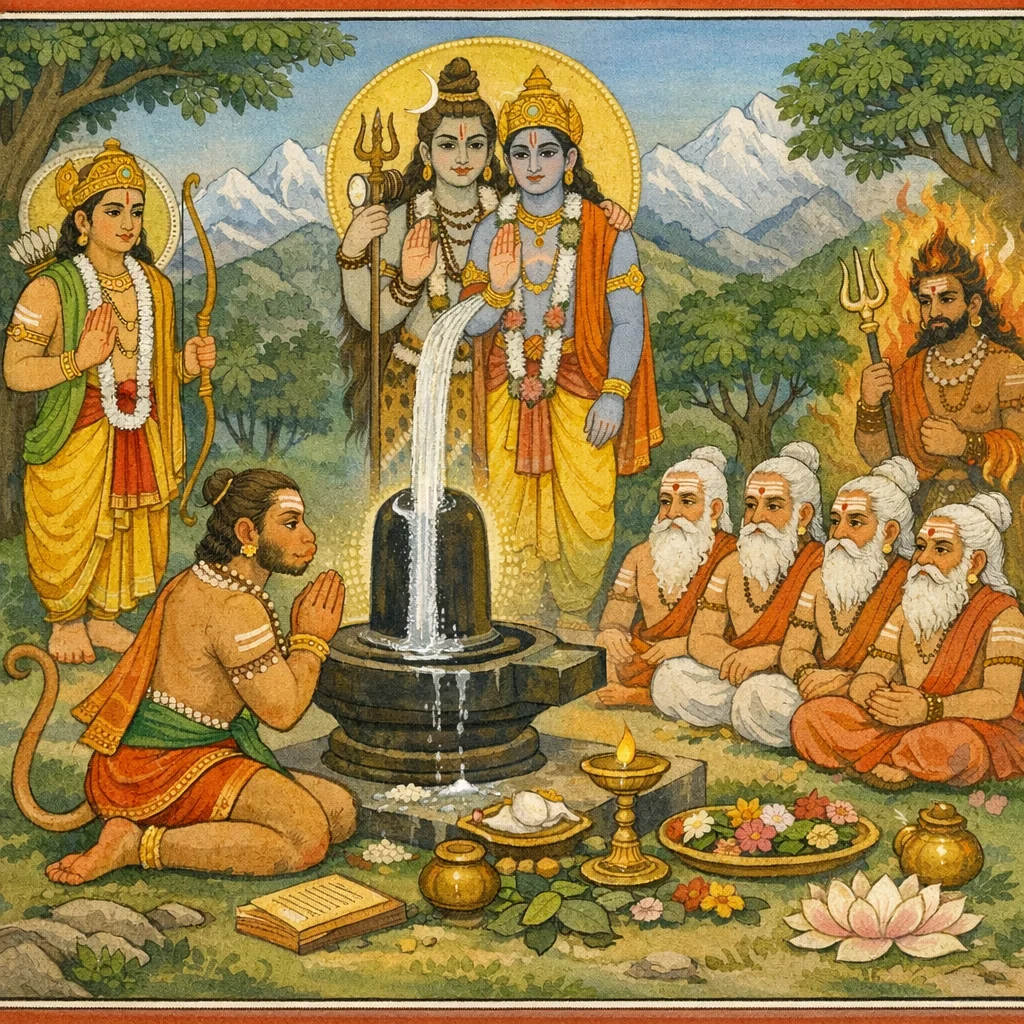
Hanūmaccarita (The Account of Hanumān)
Sanatkumāra relates a “sin-destroying” account spoken by Śrī Rāma in Ānandavana. Rāma recounts his Rāmāyaṇa course up to the return to Ayodhyā, then turns to a Śaiva episode at Gautama’s assembly on Mount Tryambaka: installing and worshiping liṅgas, bhūtaśuddhi visualization, and detailed liṅga-pūjā rites. A paradigmatic “mad-yogin” disciple (Śaṅkarātman) is slain, causing cosmic taint; Gautama and Śukra die as well. The Trimūrti intervene, revive the devotees, and grant boons. Hanumān’s exalted status is affirmed as the form where Hari and Śaṅkara converge, and he is taught proper Śiva-liṅga worship (ash-bath, nyāsa, saṅkalpa, muktidhārā abhiṣeka, upacāras). A test over a missing pīṭha triggers Vīrabhadra’s world-burning, which Śiva reverses, confirming Hanumān’s bhakti. At last Hanumān delights Śiva through song and worship, receiving life until the end of the aeon, obstacle-conquering power, śāstra-mastery, and strength; hearing or reciting this account is declared purifying and mokṣa-bestowing.
Shlokas
Verse 1
सनत्कुमार उवाच । अथापरं वायुसूनोश्चरितं पापनाशनम् । यदुक्तं स्वासु रामेण आनन्दवनवासिना ॥ १ ॥
Sanatkumāra said: Now I shall relate another account—the sin-destroying life-story of the son of Vāyu—as it was spoken among his own people by Rāma, the dweller in the Ānandavana (forest of bliss).
Verse 2
सद्योजाते महाकल्पे श्रुतवीर्ये हनूमति । मम श्रीरामचन्द्रस्य भक्तिरस्तु सदैव हि ॥ २ ॥
In this newly-begun great aeon, in Hanumān—whose heroic power is renowned—may devotion to my Śrī Rāmacandra ever abide in me indeed.
Verse 3
श्रृणुष्व गदतो मत्तः कुमारस्य कुमारक । चरितं सर्वपापघ्नं श्रृण्वतां पठतां सदा ॥ ३ ॥
O youthful Kumāra, listen to me as I speak: I shall tell the life-account of the Kumāra—an account that destroys all sins for those who continually hear it and recite it.
Verse 4
वांछाम्यहं सदा विप्र संगमं कीशरूपिणा । रहस्यं रहसि स्वस्य ममानन्दवनोत्तमे ॥ ४ ॥
O brāhmaṇa, I always long for communion with Him who appears in the form of a monkey; and, in the secrecy of my own hidden place—within my most excellent grove of bliss—I cherish this mystery in secret.
Verse 5
परीतेऽत्र सखायो मे सख्यश्च विगतज्वराः । क्रीडंति सर्वदा चात्र प्राकट्येऽपि रहस्यपि ॥ ५ ॥
Here, my companions and friends—freed from every fever of distress—ever sport; and here, even what is secret remains present, though it may also appear openly.
Verse 6
कस्मिंश्चिदवतारे तु यद्वृत्तं च रहो मम । तदत्र प्रकटं तुभ्यं करोमि प्रीतमानसः ॥ ६ ॥
But in a certain incarnation, whatever befell me in secret—I now reveal it here to you, with a heart full of affection.
Verse 7
आविर्भूतोऽस्म्यहं पूर्वं राज्ञो दशरथक्षये । चतुर्यूहात्मकस्तकत्र तस्य भार्यात्रये मुने ॥ ७ ॥
Formerly, at the time of King Daśaratha’s sacrifice, I manifested there—O sage—as the one embodying the fourfold emanations (the Caturvyūha), and I appeared for his three queens.
Verse 8
ततः कतिपयैरब्दैरागतो द्विजपुंगवः । विश्वामित्रोऽर्थयामास पितरं मम भूपतिम् ॥ ८ ॥
Then, after some time, that foremost of Brahmins—Viśvāmitra—arrived and made a request of my father, the king.
Verse 9
यक्षरक्षोविघातार्थं लक्ष्मणेन सहैव माम् । प्रेषयामास धर्मात्मा सिद्धाश्रममरम्यकम् ॥ ९ ॥
For the purpose of destroying the Yakṣas and Rākṣasas, the righteous one sent me together with Lakṣmaṇa to the delightful hermitage called Siddhāśrama.
Verse 10
तत्र गत्वाश्रममृबेर्दूषयन्ती निशाचरौ । ध्वस्तौ सुबाहुमारीचौ प्रसन्नोऽभूत्तदा मुनिः ॥ १० ॥
Having gone there, the two night-roaming demons began to defile the sage’s hermitage; but when Subāhu and Mārīca were destroyed, the muni became pleased at that time.
Verse 11
अस्त्रग्रामं ददौ मह्यं मासं चावासयत्तथा । ततो गाधिसुतोधीमान् ज्ञात्वा भाव्यर्थमादरात् ॥ ११ ॥
He bestowed upon me a whole collection of weapons, and likewise kept me residing there for a month. Then the wise son of Gādhi—understanding with respect what the future purpose would be—acted accordingly.
Verse 12
मिथिलामनयत्तत्र रौद्रं चादर्शयद्ध्वनुः । तस्य कन्यां पणीभूतां सीतां सुरसुतोपमाम् ॥ १२ ॥
He led him to Mithilā, and there made him behold the formidable bow. He then gave his daughter Sītā—won as the bride-prize—who was like the daughter of the gods.
Verse 13
धनुर्विभज्य समिति लब्धवान्मानिनोऽस्य च । ततो मार्गे भृगुपतेर्दर्प्पमूढं चिरं स्मयन् ॥ १३ ॥
Having measured out and apportioned the bow in the assembly, he also won this proud one in the gathering. Then, along the way, he long mocked the lordly Bhṛgu—whose mind was deluded by arrogance.
Verse 14
व्यषनीयागमं पश्चादयोध्यां स्वपितुः पुरीम् । ततो राज्ञाहमाज्ञाय प्रजाशीलनमानसः ॥ १४ ॥
Afterwards I came to Ayodhyā, the city of my father. Then, having learned the king’s command, my mind became intent on the proper care and governance of the people.
Verse 15
यौवराज्ये स्वयं प्रीत्या सम्मंत्र्यात्पैर्विकल्पितः । तच्छुत्वा सुप्रिया भार्या कैकैयी भूपतिं मुने ॥ १५ ॥
With gladness, the king himself took counsel and resolved upon the consecration of Rāma as yūvarāja. Hearing that decision, his most beloved queen Kaikeyī, O sage, approached the king.
Verse 16
देवकार्यविधानार्थं विदूषितमतिर्जगौ । पुत्रो मे भरतो नाम यौवराज्येऽभिषिच्यताम् ॥ १६ ॥
With her judgment clouded, she spoke under the pretext of arranging a divine rite: “Let my son, named Bharata, be anointed as yūvarāja.”
Verse 17
रामश्चतुर्दशसमा दंडकान्प्रविवास्यताम् । तदाकर्ण्या हमुद्युक्तोऽरण्यं भार्यानुजान्वितः ॥ १७ ॥
“Let Rāma be exiled to the Daṇḍaka forest for fourteen years.” Hearing this, I too set out for the wilderness, accompanied by my wife and younger brothers.
Verse 18
गंतुं नृपतिनानुक्तोऽप्यगमं चित्रकूटकम् । तत्र नित्यं वन्यफलैर्मांसैश्चावर्तितक्रियः ॥ १८ ॥
Though not commanded by the king to go, I went to Chitrakūṭa; and there, sustained daily by wild fruits and meat, I continued my customary rites without interruption.
Verse 19
निवसन्नेव राज्ञस्तु निधनं चाप्यवागमम् । ततो भरतशत्रुघ्नौ भ्रातरौ मम मानदौ ॥ १९ ॥
While I was still residing there, I learned of the king’s death. Thereupon my honorable brothers—Bharata and Śatrughna—also became involved in the events that followed.
Verse 20
मांतृवर्गयुतौ दीनौ साचार्यामात्यनागरौ । व्यजिज्ञपतमागत्यपंचवट्यां निजाश्रमम् ॥ २० ॥
Accompanied by their mothers’ kinsfolk, in a pitiable state, and with their teacher, ministers, and citizens, they came to Pañcavaṭī—into his own hermitage—and reverently submitted their petition.
Verse 21
अकल्पयं भ्रातृभार्यासहितश्च त्रिवत्सरम् । ततस्त्रयोदशे वर्षे रावणो नाम राक्षसः ॥ २१ ॥
I arranged these matters for three years, together with my brother’s wife. Then, in the thirteenth year, a rākṣasa named Rāvaṇa appeared.
Verse 22
मायया हृतवान्सीतां प्रियां मम परोक्षतः । ततोऽहं दीनवदन ऋष्यमूकं हि पर्वतम् ॥ २२ ॥
By deception, through māyā, he abducted Sītā, my beloved, while I was unaware. Then I, with a downcast face, went to the mountain called Ṛṣyamūka.
Verse 23
भार्यामन्वेषयन्प्राप्तः सख्यं हर्यधिपेन च । अथ वालिनमाहत्य सुग्रीव स्तत्पदे कृतः ॥ २३ ॥
While searching for his wife, he formed an alliance with the lord of the monkeys; then, after slaying Vālin, Sugrīva was installed in that very position as king.
Verse 24
सह वानरयूथैश्च साहाय्यं कृतवान्मम । विरुध्य रावणेनालं मम भक्तो विभीषणः ॥ २४ ॥
Along with the troops of monkeys, Vibhīṣaṇa, my devoted bhakta, rendered me great assistance, having firmly opposed Rāvaṇa.
Verse 25
आगतो ह्यभिषिच्याशुलंकेशो हि विकल्पितः । हत्वा तु रावणं संख्ये सपुत्रामात्यबांधवम् ॥ २५ ॥
Having returned, he was swiftly consecrated by abhiṣeka as the lord of Laṅkā, duly installed according to righteous resolve; for in battle he had slain Rāvaṇa, together with his sons, ministers, and kinsmen.
Verse 26
सीतामादाय संशुद्ध्वामयोध्यां समुपागतः । ततः कालांतरे विप्रसुग्रीवश्च विभीषणः ॥ २६ ॥
Taking Sītā with him and establishing her purity, he returned to Ayodhyā. Then, after some time, O brāhmaṇa, Sugrīva and Vibhīṣaṇa also arrived.
Verse 27
निमंत्रितौ पितुः श्राद्ध्वे षटेकुलाश्च द्विजोत्तमाः । अयोध्यायां समाजग्मुस्ते तु सर्वे निमंत्रिताः ॥ २७ ॥
Invited for their father’s śrāddha, the finest brāhmaṇas—six from each lineage—assembled in Ayodhyā; indeed, all of them came, having been duly invited.
Verse 28
ऋते विभीषिणं तत्र चिंतयाने रघूत्तमे । शंभुर्ब्राह्मणरूपेण षट्कुलैश्च सहागतः ग ॥ २८ ॥
Except for Vibhīṣaṇa, while Raghūttama (Śrī Rāma) was reflecting there, Śambhu (Śiva) arrived in the guise of a brāhmaṇa, accompanied by members of six lineages.
Verse 29
अथ पृष्टो मया शंभुर्विभीषणसमागमे । नीत्वा मां द्रविडे देशे मोचय द्विजबंधनात् ॥ २९ ॥
Then, at the time of meeting Vibhīṣaṇa, I questioned Śambhu: “Take me to the Draviḍa country and release me from the bondage imposed by a brāhmaṇa.”
Verse 30
मया निमंत्रिताः श्रद्धे ह्यगस्त्याद्या मुनीश्वराः । संभोजितास्तु प्रययुः स्वस्वमाश्रममंडलम् ॥ ३० ॥
O Śraddhā, the great sages—Agastya and the rest—were invited by me; and, after being duly fed and honored, they departed for their respective āśrama abodes.
Verse 31
ततः कालांतरे विप्रा देवा दैत्या नरेश्वराः । गौतमेन समाहूताः सर्वे यज्ञसभाजिताः ॥ ३१ ॥
Then, after some time, the brāhmaṇa sages, the Devas, the Daityas, and the kings were all summoned by Gautama and took their seats in the sacrificial assembly.
Verse 32
ते सर्वे स्फाटिकं लिंगं त्र्यंबकाद्रौ निवेशितम् । संपूज्य न्यवंसस्तत्र देवदैत्यनृपाग्रजाः ॥ ३२ ॥
All of them—foremost among the Devas, the Daityas, and the royal princes—installed the crystal liṅga upon Mount Tryambaka; having worshipped it in full, they remained there.
Verse 33
तस्मिन्समाजे वितते सर्वौर्लिंगे समर्चिते । गौतमोऽप्यथ मध्याह्ने पूजयामास शंकरम् ॥ ३३ ॥
When that great assembly had convened and all the liṅgas had been duly worshipped, Gautama too, at midday, performed worship of Śaṅkara (Śiva).
Verse 34
सर्वे शुक्लांबरधरा भस्मोद्धूलितविग्रहाः । सितेन भस्मना कृत्वा सर्वस्थाने त्रिपुंड्रकम् ॥ ३४ ॥
All of them, clad in white garments and with their bodies smeared with sacred ash (bhasma), should, with pure white ash, apply the triple ash-mark (tripuṇḍra) on all the prescribed parts of the body.
Verse 35
नत्वा तु भार्गवं सर्वे भूतशुद्धिं प्रचक्रमुः । हृत्पद्ममध्ये सुषिरं तत्रैव भूतपञ्चकम् ॥ ३५ ॥
Having bowed to Bhārgava, the sage of the Bhṛgu line, they all began the practice of bhūtaśuddhi, the purification of the elements. Within the lotus of the heart they contemplated a subtle inner space, and there itself they placed (visualized) the five elements.
Verse 36
तेषां मध्ये महाकाशमाकाशे निर्मलामलम् । तन्मध्ये च महेशानं ध्यायेद्दीप्तिमयं शुभम् ॥ ३६ ॥
Among them, one should contemplate the great expanse of space—within space, pure and stainless; and within that, one should meditate on Maheśāna, the Great Lord, auspicious and filled with radiance.
Verse 37
अज्ञानसंयुतं भूतं समलं कर्मसंगतः । तं देहमाकाशदीपे प्रदहेज्ज्ञानवह्निना ॥ ३७ ॥
The embodied being, bound up with ignorance, stained and entangled with karma—let that body be burned, as it were, in the lamp of inner space, by the fire of knowledge.
Verse 38
आकाशस्यावृत्तिं चाहं दग्ध्वाकाशमथो दहेत् । दग्ध्वाकाशमथो वायुमग्निभूतं तथा दहेत् ॥ ३८ ॥
“Having burned up the enclosing sphere of ākāśa, I then burn space itself; and once space is burned, I likewise burn the wind (vāyu) that has become fire in nature.”
Verse 39
अब्भूतं च ततो दग्ध्वा पृथिवीभूतमेव च । तदाश्रितान्गुणान्दग्ध्वा ततो देहं प्रदाहयेत् ॥ ३९ ॥
Then, having “burned” (dissolved) the water-element, and likewise the earth-element, and having burned the qualities dependent upon them, one should thereafter burn (dissolve) the body itself.
Verse 40
एवं प्रदग्ध्वा भूतार्दि देही तज्ज्ञानवह्निना । शिखामध्यस्थितं विष्णुमानंदरसनिर्भरम् ॥ ४० ॥
Thus, having burned away the elemental afflictions and the body by the fire of that knowledge, the embodied one beholds Viṣṇu, abiding in the midst of the crown-flame, overflowing with the nectar of bliss.
Verse 41
निष्पन्नचंद्रकिरणसंकाशकिरणं किरणं शिवम् । शिवांगोत्पन्नकिरणैरमृतद्रवसंयुतैः ॥ ४१ ॥
That auspicious Radiance (Śiva) is a beam whose rays resemble fully manifested moonlight; and it is attended by rays arising from Śiva’s own limbs, united with the flowing essence of nectar (amṛta).
Verse 42
सुशीतला ततो ज्वाला प्रशांता चंद्ररश्मिवत् । प्रसारितसुधारुग्भिः सांद्रीभूतश्च संप्लवः । अनेन प्लावितं भूतग्रामं संचिंतयेत्परम् ॥ ४२ ॥
Then that flame becomes exceedingly cool, calm like moonbeams. As streams of nectar spread out, the cosmic inundation (saṃplava) grows dense; and one should contemplate the Supreme as the entire host of beings is flooded by it.
Verse 43
इत्थं कृत्वा भूतशुद्धिं क्रियार्हो मर्त्यः शुद्धो जायते ह्येव सद्यः । पूजां कर्तुं जप्यकर्मापि पश्चादेवं ध्यायेद्ब्रह्महत्यादिशुद्ध्यै ॥ ४३ ॥
Thus, having performed bhūta-śuddhi, a mortal immediately becomes purified and fit for ritual action. Thereafter, to perform worship and also japa, one should meditate in this very way for purification even from sins such as brahma-hatyā (killing a brāhmaṇa) and the like.
Verse 44
एवं ध्यात्वा चद्रंदीप्तिप्रकाशं ध्यानेनारोप्याशु लिंगे शिवस्य । सदाशिवं दीपमध्ये विचिंत्य पञ्चाक्षरेणार्चनमव्ययं तु ॥ ४४ ॥
Having thus meditated on the radiance that shines like the moon, one should swiftly, by contemplation, place that vision upon Śiva’s liṅga. Then, envisioning Sadāśiva in the very midst of the lamp-flame, one should perform the imperishable worship using the five-syllabled mantra.
Verse 45
आवाहनादीनुपचारांरतथापि कृत्वा स्नानं पूर्ववच्छंकरस्य । औदुंबरं राजतं स्वर्णपीठं वस्त्रादिच्छन्नं सर्वमेवेह पीठम् ॥ ४५ ॥
Even after performing the services beginning with invocation (āvāhana) and the other ritual attentions, one should then bathe Śaṅkara as prescribed before. Here the sacred seat (pīṭha) should be of udumbara wood, or of silver, or of gold, wholly covered with cloth and the like.
Verse 46
अंते कृत्वा बुद्बुदाभ्यां च सृष्टिं पीठे पीठे नागमेकं पुरस्तात् । कुर्यात्पीठे चोर्द्ध्वके नागयुग्मं देवाभ्याशे दक्षिणे वामतश्च ॥ ४६ ॥
At the end, having fashioned the ‘creation’ (sṛṣṭi) with two bubble-like forms, one should place, on each pedestal (pīṭha), a single nāga in front. And on the upper pedestal too, one should arrange a pair of nāgas near the deity, on the right and on the left.
Verse 47
जपापुष्पं नागमध्ये निधाय मध्ये वस्त्रं द्वादशप्रातिगुण्ये । सुश्वेतेन तस्य मध्ये महेशं लिंगाकारं पीठयुक्तं प्रपूज्यम् ॥ ४७ ॥
Placing a japā (hibiscus) flower in the midst of the nāga-coil, and in its center setting a cloth folded twelve times, one should then, in the middle of that—upon a perfectly white cloth—duly worship Maheśa in the form of a liṅga, together with its pīṭha.
Verse 48
एवं कृत्वा साधकास्ते तु सर्वे दत्त्वा दत्त्वा पंचगंधाशष्टगंधम् । पुष्पैः पत्रैः श्रीतिलैरक्षतैश्च तिलोन्मिश्रैः केवलैश्चप्रपूज्य ॥ ४८ ॥
Having done so, all the practitioners should repeatedly offer the five (or eight) kinds of fragrant substances. Then they should worship thoroughly with flowers, leaves, auspicious sesame, and unbroken rice-grains (akṣata), using sesame either mixed with the offerings or even by itself.
Verse 49
धूपं दत्त्वा विधिवत्संप्रयुक्तं दीपं दत्त्वा चोक्तमेवोपहारम् । पूजाशेषं ते समाप्याथ सर्वे गीतं नृत्यं तत्र तत्रापि चक्रुः ॥ ४९ ॥
Having duly offered incense in the prescribed manner, and having offered a lamp along with the stated oblations, they then completed the remaining rites of worship. After finishing, all of them also performed singing and dancing there and then as part of the celebration.
Verse 50
काले चास्मिन्सुव्रते गौतमस्य शिष्यः प्राप्तः शंकरात्मेति नाम्ना ॥ ५० ॥
At that time, O virtuous one, a disciple of Gautama arrived, bearing the name Śaṅkarātman.
Verse 51
उन्मत्तवेषो दिग्वासा अनेकां वृत्तिमास्थितः । क्वचिद्द्विजातिप्रवरः क्वचिञ्चंडालसन्निभः ॥ ५१ ॥
He appeared in the guise of a madman, sometimes naked, adopting many different modes of living—at times like the foremost among the twice-born, and at other times resembling a caṇḍāla.
Verse 52
क्वचिच्छूद्रसमो योगी तापसः क्वचिदप्युत । गर्जत्युत्पतते चैव नृत्यति स्तौति गायति ॥ ५२ ॥
At times the so-called yogin behaved like a śūdra; at other times he posed as an ascetic. He bellows, leaps about, dances, offers praises, and sings.
Verse 53
रोदिति श्रृणुतेऽत्युक्तं पतत्युत्तिष्ठति क्वचित् । शिवज्ञानैकसंपन्नः परमानंदनिर्भरः ॥ ५३ ॥
He may weep; he may not hear even when spoken to repeatedly; at times he may fall down and at times rise again—yet he is endowed solely with the knowledge of Śiva, completely immersed in supreme bliss.
Verse 54
संप्राप्तो भोज्यवेलायां गौतमस्यांतिकं ययौ । बुभुजे गुरुणा साकं क्वचिदुच्छिष्टमेव च ॥ ५४ ॥
When the time for the meal arrived, he went to Gautama’s presence. He ate together with his teacher, and at times even partook of what remained (the teacher’s leftovers).
Verse 55
क्वचिल्लिहति तत्पात्रं तूष्णीमेवाभ्यगात्क्वचित् । हस्तं गृहीत्वैव गुरोः स्वयमेवाभुनक्क्वचित् ॥ ५५ ॥
At times he would lick that very vessel; at times he would draw near in utter silence. At times, seizing the teacher’s hand, he himself would eat.
Verse 56
क्वचिद् गृहांतरे मूत्रं क्वचित्कर्दमलेपनम् । सर्वदा तं गुरुर्दृष्ट्वा करमालंब्य मंदिरम् ॥ ५६ ॥
In one house there was urine; in another, smearing with mud. Yet whenever the teacher saw him, he would take him by the hand and lead him into the house.
Verse 57
प्रविश्य स्वीयपीठे तमुपवेश्याप्यभोजयत् । स्वयं तदस्य पात्रेण बुभुजेगौतमो मुनिः ॥ ५७ ॥
Entering the hermitage, the sage seated him upon his own seat and had him partake of food; and Gautama Muni himself ate from that very vessel belonging to him.
Verse 58
तस्य चित्तं परिज्ञातुं कदाचिदथ सुंदरी । अहल्या शिष्यमाहूय भुङ्क्ष्वेति प्राह तं मुदा । निर्दिष्टो गुरुपत्न्या तु बुभुजे सोऽविशेषतः ॥ ५८ ॥
Then, wishing to discern the state of his mind, the beautiful Ahalyā once summoned the disciple and joyfully said to him, “Eat.” Thus instructed by the teacher’s wife, he ate without making any distinction or hesitation.
Verse 59
यथा पपौ हि पानीयं तथा वह्निमपि द्विजा । कंटकानन्नवद्भुक्त्वा यथापूर्वमतिष्ठत ॥ ५९ ॥
Just as he drank water, so too—O twice-born ones—he even consumed fire; and, having eaten thorns as though they were food, he remained exactly as before.
Verse 60
पुरो हि मुनिकन्याभिराहूतो भोजनाय च । दिनेदिने तत्प्रदत्तं लोष्टमंबु च गोमयम् ॥ ६० ॥
Indeed, the daughters of the sages would invite him beforehand to partake of a meal; and day after day they gave him the same—clods of earth, water, and cow-dung.
Verse 61
कर्दमं काष्ठदंडं च भुक्त्वा पीत्वाथ हर्षितः । एतादृशो मुनिरसौ चंडालसदृशाकृतिः ॥ ६१ ॥
Having eaten mud and even a wooden staff, and then drinking it, he became delighted. Such was that sage—his appearance was like that of a caṇḍāla, an outcaste.
Verse 62
सुजीर्णोपानहौ हस्ते गृहीत्वा प्रलपन्हसन् । अंत्यजोचितवेषश्च वृषपर्वाणमभ्यगात् ॥ ६२ ॥
Holding in his hand a pair of very worn sandals, talking and laughing, and dressed in a guise befitting an outcaste, he approached Vṛṣaparvan.
Verse 63
वृषपर्वेशयोर्मध्ये दिग्वासाः समतिष्टत । वृषपर्वा तमज्ञात्वा पीडयित्वा शिरोऽच्छिनत् ॥ ६३ ॥
Between Vṛṣaparvan and Īśa stood a naked ascetic (dig-vāsā). Not recognizing him, Vṛṣaparvan oppressed him and cut off his head.
Verse 64
हते तस्मिन्द्विजश्रेष्ठे जगदेतञ्चराचरम् । अतीव कलुषं ह्यासीत्तत्रस्था मुनयस्तथा ॥ ६४ ॥
When that foremost of brāhmaṇas was slain, this entire world—both moving and unmoving—became exceedingly tainted; and the sages who were present there became so as well.
Verse 65
गौतमस्य महाशोकः संजातः सुमहात्मनः । निर्ययौ चक्षुषो वारि शोकं संदर्शयन्निव ॥ ६५ ॥
A great sorrow arose in the noble-souled Gautama; and tears flowed from his eyes, as though openly revealing his grief.
Verse 66
गौतमः सर्वदैत्तयानां सन्निधौ वाक्यमुक्तवान् । किमनेन कृते पापं येन च्छिन्नमिदं शिरः ॥ ६६ ॥
Gautama spoke these words in the presence of all the Daityas: “What sin has he committed, that this head has been cut off?”
Verse 67
मम प्राणाधिकस्येह सर्वदा शिवयोगिनः । ममापि मरणं सत्यं शिष्यच्छद्मा यतो गुरुः ॥ ६७ ॥
Here, this Śiva-yogin is always dearer to me than my very life. Yet my death too is certain—because the guru has assumed the guise of a disciple.
Verse 68
शैवानां धर्मयुक्तानां सर्वदा शिववर्तिनाम् । मरणं यत्र दृष्टं स्यात्तत्र नो मरणं ध्रुवम् ॥ ६८ ॥
For those devoted to Śiva—steadfast in dharma and ever abiding in Śiva—wherever death may seem to appear, there, for them, death certainly does not truly prevail.
Verse 69
तच्छ्रुत्वा ह्यसुराचार्यः सुक्रः प्राह विदांवरः । एनं संजीवयिष्यामि भार्गवं शंकरप्रियम् ॥ ६९ ॥
Hearing this, Śukra—the preceptor of the Asuras, foremost among the wise—said: “I shall restore this Bhārgava to life, for he is beloved of Śaṅkara (Śiva).”
Verse 70
किमर्थं म्रियते ब्रह्मन्पश्य मे तपसो बलम् । इति वादिनि विप्रेंद्रे गौतमोऽपि ममार ह ॥ ७० ॥
“Why should he die, O Brahmin? Behold the power of my austerity!”—as that foremost of Brahmins spoke thus, even the sage Gautama indeed passed away.
Verse 71
तस्मिन्मृतेऽथ शुक्रोऽपि प्राणांस्तत्याज योगतः । तस्यैवं हतिमाज्ञाय प्रह्लादाद्या दितीश्वराः ॥ ७१ ॥
When he had died, then Śukra too, by the power of yoga, gave up his life-breath. Knowing that he had been slain in this manner, the Daitya lords beginning with Prahlāda—the sons of Diti—understood what had occurred.
Verse 72
देवा नृपा द्विजाः सर्वे मृता आसंस्तदद्भुतम् । मृतमासीदथ बलं तस्य बाणस्य धीमतः ॥ ७२ ॥
All the gods, kings, and twice-born were dead—this was astonishing. Then even the very power of that wise one’s arrow became inert, as though dead.
Verse 73
अहल्या शोकसंतप्ता रुरोदोञ्चैः पुनःपुनः । गौतमेन महेशस्य पूजया पूजितो विभुः ॥ ७३ ॥
Ahalyā, scorched by grief, wept aloud again and again; and the mighty Lord Maheśa (Śiva) was duly worshipped by Gautama through acts of reverent worship.
Verse 74
वीरभद्रो महायोगी सर्वं दृष्ट्वा चुकोप ह । अहो कष्टमहोकष्टं महेशा बहवो हताः ॥ ७४ ॥
Vīrabhadra, the great yogin, saw everything and became enraged. “Alas—how grievous, how utterly grievous! Many of Maheśa’s (Śiva’s) followers have been slain.”
Verse 75
शिवं विज्ञापयिष्यामि तेनोक्तं करवाण्यथ । इति निश्चित्य गतवान्मंदराचलमव्ययम् ॥ ७५ ॥
“I shall inform Śiva, and then I shall act according to his word.” Thus resolved, he went to the imperishable Mandara Mountain.
Verse 76
नमस्कृत्वा विरूपाक्षं वृत्तसर्वमथोक्तवान् । ब्रह्माणं च हरिं तत्र स्थितौ प्राह शिवो वचः ॥ ७६ ॥
Having bowed to Virūpākṣa (Śiva) and recounted the whole matter, he spoke words to Brahmā and to Hari (Viṣṇu), who were standing there.
Verse 77
मद्भक्तैः साहसं कर्म कृतं ज्ञात्वा वरप्रदम् । गत्वा पश्यामि हे विष्णो सर्वं तत्कृतसाहसम् ॥ ७७ ॥
“Knowing that My devotees have undertaken a daring deed that bestows boons, O Viṣṇu, I shall go and behold in full that act of boldness performed by them.”
Verse 78
इत्युक्त्वा वृषमारुह्य वायुना धूतचामरः । नन्दिकेन सुवेषेण धृते छत्रेऽतिशोभने ॥ ७८ ॥
Having spoken thus, he mounted the bull; the yak-tail fan (cāmara) swayed in the wind, and Nandī, splendidly adorned, held aloft an exceedingly beautiful parasol over him.
Verse 79
सुश्वेते हेमदंडे च नान्ययोग्ये धृते विभो । महेशानुमतिं लब्ध्वा हरिर्नागांतके स्थितः ॥ ७९ ॥
O Lord, holding the splendid white golden staff—fit for none other—Hari, having obtained Mahesha’s consent, remained stationed at Nāgāntaka.
Verse 80
आरक्तनीलच्छत्राभ्यां शुशुभे लक्ष्मकौस्तुभः । शिवानुमत्या ब्रह्मापि हंसारूढोऽभवत्तदा ॥ ८० ॥
Beneath crimson and blue parasols, Śrī Lakṣmī and the Kaustubha jewel shone in splendor. Then, with Śiva’s consent, even Brahmā mounted his swan-vāhana.
Verse 81
इंद्रगोपप्रभाकारच्छत्राभ्यां शुशुभे विधिः । इन्द्रादिसर्वदेवाश्च स्वस्ववाहनसंयुताः ॥ ८१ ॥
Vidhī (Brahmā) shone beneath a pair of parasols radiant like the indragopa insect. And all the devas—Indra and the rest—were present, each attended by his own vāhana.
Verse 82
अथ ते निर्ययुः सर्वे नानावाद्यानुमोदिताः । कोटिकोटिगणाकीर्णा गौतमस्याश्रमं गताः ॥ ८२ ॥
Then they all set forth, gladdened by the sounds of many kinds of instruments. Surrounded by hosts numbering in crores upon crores, they proceeded to Gautama’s āśrama.
Verse 83
ब्रह्मविष्णु महेशाना दृष्ट्वा तत्परमाद्भुतम् । स्वभक्तं जीवयामास वामकोणनिरीक्षणात् ॥ ८३ ॥
Beholding that supremely wondrous event, Brahmā, Viṣṇu, and Maheśāna (Śiva) revived their own devotee by merely a sidelong glance from the left corner of the eye.
Verse 84
शंकरो गौतमं प्राह तुष्टोऽहं ते वरं वृणु । तदाकर्ण्य वचस्तस्य गौतमः प्राह सादरम् ॥ ८४ ॥
Śaṅkara (Śiva) said to Gautama, “I am pleased with you—choose a boon.” Hearing his words, Gautama replied with reverence.
Verse 85
यदि प्रसन्नो देवेश यदि देयो वरो मम । त्वल्लिंगार्चनसामर्थ्यं नित्यमस्तु ममेश्वर ॥ ८५ ॥
O Lord of the gods, if You are pleased—if a boon is to be granted to me—then, O my Lord, let me always possess the power to worship Your liṅga daily.
Verse 86
वृतमेतन्मया देव त्रिनेत्र श्रृणु चापरम् । शिष्योऽयं मे महाभागो हेयादेयादिवर्जितः ॥ ८६ ॥
O Deva, O Three‑eyed One, I have related this account; now hear yet another. This disciple of mine is greatly blessed—free from the notions of “to be rejected” and “to be accepted,” and from such dualities.
Verse 87
प्रेक्षणीयं ममत्वेन न च पश्यति चक्षुषा । न घ्राणग्राह्यं देवेश न पातव्यं न चेतरत् ॥ ८७ ॥
It seems ‘to be seen’ only through possessiveness—through the thought of “mine”—yet it is not truly seen by the eyes. O Lord of the gods, it is not grasped by smell; it is not something to be drunk—nor any other object of the senses.
Verse 88
इति बुद्ध्व्या तथा कुर्वन्स हि योगी महायशः । उन्मत्तविकृताकारः शंकरात्मेति कीर्तितः ॥ ८८ ॥
Understanding thus, the illustrious yogin indeed acts accordingly. Though his outward appearance may seem like that of a madman—odd or distorted—he is proclaimed to be one whose very self is Śaṅkara (Śiva).
Verse 89
न कश्चित्तं प्रति द्वेषी न च तं हिंसयेदपि । एतन्मे दीयतां देव मृतानाममृतिस्तथा ॥ ८९ ॥
Let no one bear hatred toward him, nor harm him in any way. O Lord, grant me this; and likewise, let those who have died be freed from death—attaining immortality.
Verse 90
तच्छ्रुत्वोमापतिः प्रीतो निरीक्ष्य हरिमव्ययः । स्वांशेन वायुना देहमाविशज्जगदीश्वरः ॥ ९० ॥
Hearing this, Umāpati (Śiva) was pleased; and, gazing upon Hari, the imperishable Lord of the world, the Lord of the universe entered the body by means of Vāyu, through a portion of his own power.
Verse 91
हरिरूपः शंकरात्मा मारुतिः कपिसत्तमः । पर्यायैरुच्यतेऽधीशः साक्षाद्विष्णुः शिवः परः ॥ ९१ ॥
He whose form is Hari and whose inmost essence is Śaṅkara—Māruti, the foremost of monkeys—is praised by many synonymous epithets; that Lord is directly Viṣṇu, the supreme Śiva.
Verse 92
आकल्पतेषु प्रत्येकं कामरूपमुपाश्रितः । ममाज्ञाकारको रामभक्तः पूजितविग्रहः ॥ ९२ ॥
In every kalpa, assuming whatever form is desired, he acts under my command; he is a devotee of Rāma, and his embodied form is worthy of worship.
Verse 93
अनंतकल्पमीशानः स्थास्यति प्रीतमानसः । त्वया कृतमिदं वेश्म विस्तृतं सुप्रतिष्टितम् ॥ ९३ ॥
With a delighted mind, the Lord will abide here for endless ages. This dwelling you have made is spacious and firmly established.
Verse 94
नित्यं वै सर्वरूपेण तिष्ठामः क्षणमादरात् । समर्चिताः प्रयास्यामः स्वस्ववासं ततः परम् ॥ ९४ ॥
“Indeed, we ever remain present in every form; therefore, with reverence, worship us even for a moment. When we have been duly honored, we shall then depart—each to our own abode thereafter.”
Verse 95
अथाबभाषे विश्वेशं गौतमो मुनिपुंगवः । अयोग्यं प्रार्थयामीश ह्यर्थी दोषं न पश्यति ॥ ९५ ॥
Then Gautama, foremost among sages, addressed the Lord of the universe: “O Lord, I beg for what may be unfit; for one in need does not perceive his own fault.”
Verse 96
ब्रह्माद्यलभ्यं देवेश दीयतां यदि रोचते । अथेशो विष्णुमालोक्य गृहीत्वा तत्करं करे ॥ ९६ ॥
“O Lord of the gods, if it pleases you, grant that which is unattainable even for Brahmā and the others.” Then the Lord, looking upon Viṣṇu, took his hand into his own hand.
Verse 97
प्रहसन्नंबुजाभाक्षमित्युवाच सदाशिवः । क्षामोदरोऽसि गोविंद देयं ते भोजनं किमु ॥ ९७ ॥
Smiling, Sadāśiva said to the lotus-eyed one: “Govinda, your belly looks thin—what food should be given to you?”
Verse 98
स्वयं प्रविश्य यदि वा स्वयं भुंक्ष्व स्वगेहवत् । गच्छ वा पार्वतीगेहं या कुक्षिं पूरयिष्यति ॥ ९८ ॥
Either enter yourself and eat on your own as if it were your own home; or else go to Pārvatī’s house—she will fill your belly.
Verse 99
इत्युक्त्वा तत्करालंबी ह्येकांतमगमद्विभुः । आदिश्य नंदिनं देवो द्वाराध्यक्षं यथोक्तवत् ॥ ९९ ॥
Having spoken thus, the all-powerful Lord—taking him by the hand—went to a secluded place, after instructing Nandin, the guardian of the door, exactly as had been said.
Verse 100
स गत्वा गौतमं वाथ ह्युक्तवान्विष्णुभाषणम् । संपादयान्नं देवेशा भोक्तुकामा वयं मुने ॥ १०० ॥
Then he went to Gautama and conveyed Viṣṇu’s message: “O sage, prepare food; we—the lords of the gods—desire to eat.”
Verse 101
इत्युक्त्वैकांतमगमद्वासुदेवेन शंकरः । मृदुशय्यां समारुह्य शयितौ देवतोत्तमौ ॥ १०१ ॥
Having said this, Śaṅkara went to a secluded place together with Vāsudeva. Mounting a soft couch, the two supreme gods lay down to rest.
Verse 102
अन्योन्यं भाषणं कृत्वा प्रोत्तस्थतुरुभावपि । गत्वा तडागं गंभीरं स्रास्यंतौ देवसत्तमौ ॥ १०२ ॥
After conversing with each other, both of those best among the gods rose up, went to a deep pond, and began to let themselves down into it.
Verse 103
करांबुपातमन्योन्यं पृथक्कृत्वोभयत्र च । मुनयो राक्षसाश्चैव जलक्रीडां प्रचक्रिरे ॥ १०३ ॥
Separating into two opposing sides, the sages and the Rākṣasas began a water-sport, splashing handfuls of water at one another.
Verse 104
अथ विष्णुर्महेशश्च जलपानानि शीघ्रतः । चक्रतुः शंकरऋ पद्मकिंजल्कांजलिना हरेः ॥ १०४ ॥
Then Viṣṇu and Maheśa quickly performed the drinking of water; and Śaṅkara, in the presence of Hari, drank with a cupped handful filled with lotus-filaments.
Verse 105
अवाकिरन्मुखे तस्य पद्मोत्फुल्लविलोचने । नेत्रे केशरसंपातात्प्रमीलयत केशवः ॥ १०५ ॥
They showered it upon his face; and Keśava—whose eyes were like fully opened lotuses—closed his eyes as drifting pollen fell into them.
Verse 106
अत्रांतरे हरेः स्कंधमारुरोह महेश्वरः । हर्युत्तमांगं बाहुभ्यां गृहीत्वा संन्यमज्जयत् ॥ १०६ ॥
Meanwhile, Mahēśvara climbed onto Hari’s shoulder; seizing Hari’s noble head with both arms, he pressed it down in a forceful embrace.
Verse 107
उन्मज्जयित्वा च पुनः पुनश्चापि पुनःपुनः । पीडितः स हरिः सूक्ष्मं पातयामास शंकरम् ॥ १०७ ॥
After repeatedly making him rise again and again, Hari—being harassed—caused Śaṅkara to fall into a subtle, imperceptible state.
Verse 108
अथ पादौ गृहीत्वा तं भ्रामयन्विचकर्ष ह । अताडयद्ध्वरेर्वक्षः पातयामास चाच्युतम् ॥ १०८ ॥
Then, seizing his feet, he whirled him around and dragged him; he struck Dhvara’s chest and also caused Acyuta to fall down.
Verse 109
अथोत्थितो हरिस्तोयमादायांजलिना ततः । शीर्षे चैवाकिरच्छंभुमथ शंभुरथो हरिः ॥ १०९ ॥
Then Hari rose, took water in his cupped palms, and poured it upon Śambhu’s head; and then Śambhu, in turn, did the same to Hari.
Verse 110
जलक्रीडैवमभवदथ चर्षिगणांतरे । जलक्रीडासंभ्रमेण विस्रस्तजटबंधनाः ॥ ११० ॥
Thus, amid the assembly of the ṛṣis, a sport in the water arose; and in the excitement of that watery play, the knots binding their jaṭās—matted locks—came undone.
Verse 111
अथ संभ्रमतां तेषामन्योन्यजटबंधनम् । इतरेतरबद्ध्वासु जटासु च मुनीश्वराः ॥ १११ ॥
Then, as they rushed about in agitation, the great sages’ jaṭās became entangled with one another; and with their matted locks mutually bound, those lords among munis were caught fast.
Verse 112
शक्तिमंतोऽशक्तिमत आकर्षंति च सव्यथम् । पातयंतोऽन्यतश्चापि क्त्रोशंतो रुदतस्तथा ॥ ११२ ॥
The strong painfully drag the weak; they even fling them elsewhere—while the victims cry out and weep.
Verse 113
एवं प्रवृत्ते तुमुले संभूते तोयकर्मणि । आकाशे वानरेशस्तु ननर्त च ननाद च ॥ ११३ ॥
When that fierce commotion arose and the water-rite (toya-karma) was underway, the lord of the vānara, in the sky, danced and roared aloud.
Verse 114
विपंचीं वादयन्वाद्यं ललितां गीतिमुज्जगौ । सुगीत्या ललिता यास्तु आगायत विधा दश ॥ ११४ ॥
While playing the vipaṃcī (lute), he sang a graceful melody. And those delicate songs, rendered with fine singing, are sung in ten distinct modes.
Verse 115
शुश्राव गीतिं मधुरां शंकरो लोकभावतः । स्वयं गातुं हि ललितं मंदंमंदं प्रचक्रमे ॥ ११५ ॥
Hearing the sweet melody, Śaṅkara—moved by the world’s shared feeling—began himself to sing, gently and gracefully, little by little.
Verse 116
स्वयं गायति देवेशे विश्रामं गलदेशिकम् । स्वरं ध्रुवं समादाय सर्वलक्षणसंयुतम् ॥ ११६ ॥
He himself sang before the Lord of the gods, setting the pause at the proper point in the throat and taking up the steady ‘dhruva’ note, endowed with all the marks of correct singing.
Verse 117
स्वधारामृतसंयुक्तं गानेनैवमपोनयन् । वासुदेवो मर्दलं च कराभ्यामप्यवादयत् ॥ ११७ ॥
Thus, by his singing—laden with the nectar of his own inner current—he dispelled fatigue and sorrow. And Vāsudeva too played the mṛdaṅga (mardala) with both hands.
Verse 118
अम्बुजांगश्चतुर्वक्रस्तुंबुरुर्मुखरो बभौ । तानका गौतमाद्यास्तु गयको वायुजोऽभवत् ॥ ११८ ॥
Ambujāṅga became Caturvakra; Tuṃburu became Mukhara. Likewise, Tānakā and the sages beginning with Gautama manifested, and Gayaka was born as the son of Vāyu.
Verse 119
गायके मधुरं गीतं हनूमति कपीश्वरे । म्लानमल्मानमभवत्कृशाः पुष्टास्तदाभवन् ॥ ११९ ॥
When the singer sang sweetly in the presence of Hanumān, lord of the monkeys, the dejected became cheerful, and the emaciated then became well-nourished.
Verse 120
स्वां स्वां गीतिमतः सर्वे तिरस्कृत्यैव मूर्च्छिता । तूष्णीभूतं समभवद्देवर्षिगणदानवम् ॥ १२० ॥
All of them—masters of their own songs—were struck senseless, as though their very melodies had been eclipsed; and the assembly of divine sages and Dānavas fell into silence.
Verse 121
एकः स हनुमान् गाता श्रोतारः सर्व एव ते । मध्याह्नकाले वितते गायमाने हनूमति । स्वस्ववाह नमारुह्य निर्गताः सर्वदेवताः ॥ १२१ ॥
Hanumān alone was the singer, and all of them were listeners. At midday, when Hanumān began to sing at length, all the gods set out, mounting their respective celestial vehicles.
Verse 122
गानप्रियो महेशस्तु जग्राह प्लवगेश्वरम् । प्लवग त्वं मयाज्ञप्तो निःशंको वृषमारुह ॥ १२२ ॥
Then Maheśa, who delights in sacred song, seized the lord of the monkeys and said: “O monkey, you have been commanded by me—mount the bull without fear.”
Verse 123
मम चाभिमुखो भूत्वा गायस्वानेकगायनम् । अथाह कपिशार्दूलो भगवंतं महेश्वरम् ॥ १२३ ॥
“Turn to face me and sing a many-versed chant, varied in its strains.” Having said this, the tiger among monkeys addressed the Lord, Maheśvara (Mahādeva).
Verse 124
वृषभारोहसामर्थ्यं तव नान्यस्य विद्यते ष । तव वाहनमारुह्य पातकी स्यामहं विभो ॥ १२४ ॥
The power to mount the bull belongs to you alone—no one else has it. O all-pervading Lord, if I were to climb upon your mount, I would become a sinner, O Mighty One.
Verse 125
मामेवारुह देवेश विहंगः शिवधारणः । तव चाभिमुखँ गानं करिष्यामि विलोकय ॥ १२५ ॥
O Lord of the gods, mount upon me alone. I am the bird who bears Śiva; behold—facing You, I shall sing Your praise.
Verse 126
अथेश्वरो हनूमंतमारुरोह यथा वृषम् । आरूढे शंकरे देवे हनुमत्कंधरां शिवः ॥ १२६ ॥
Then the Lord (Śiva) mounted Hanumān, as one mounts a bull. When the divine Śaṅkara had ascended, Śiva sat upon Hanumān’s shoulder.
Verse 127
छित्वा त्वचं परावृत्य सुखं गायति पूर्ववत् । श्रृण्वन्गीतिसुधां शंभुर्गौत मस्य गृहं ततः ॥ १२७ ॥
Having cut off the skin and wrapped it around himself, he sang happily just as before. Hearing that nectar-like sweetness of the song, Śambhu then went to Gautama’s house.
Verse 128
सर्वे चाप्यागतास्तत्र देवर्षिगणदानवाः । पूजिता गौतमेनाथ भोजनावसरे सति ॥ १२८ ॥
There, all of them arrived as well—the hosts of divine seers and the Dānavas. And at the time of the meal, O Lord, they were duly honored by Gautama.
Verse 129
यच्छुष्कं दारुसंभूतं गृहो पकरणादिकम् । प्ररूढमभवत्सर्वं गायमाने हनूमति ॥ १२९ ॥
Whatever in the house—made of dry wood, including its implements and furnishings—had been withered, all of it sprouted and became fresh again while Hanumān was being praised in song.
Verse 130
तस्मिन्गाने समस्तानां चित्रं दृष्टिरतिष्टत ॥ १३० ॥
When that singing began, the gaze of everyone became fixed—held fast in wonder.
Verse 131
द्विबाहुरीशस्य पदाभिवं दनः समस्तगात्राभरणोपपन्नः । प्रसन्नमूर्तिस्तरुणः सुमध्ये विन्यस्तमूर्द्ध्वांजलिभिः शिरोभिः ॥ १३१ ॥
He bowed at the feet of the two-armed Lord; adorned with ornaments over all his limbs, youthful and of graceful waist, his face serene—he stood with his hands joined in reverence, his head inclined in devotion.
Verse 132
शिरः कराभ्यां परिगृह्य शंकरो हनूमतः पूर्वमुखं चकार । पद्मासनासीनहनूमतोंऽजलौ निधाय पादं त्वपरं मुखे च ॥ १३२ ॥
Taking Hanumān’s head in both hands, Śaṅkara turned his face to the east. Then, placing one of his feet upon the folded palms of Hanumān who was seated in padmāsana, he placed the other foot upon Hanumān’s mouth.
Verse 133
पादांगुलीभ्यामथ नासिकां विभुः स्नेहेन जग्राह च मन्दमन्दम् । स्कन्धे मुखे त्वंसतले च कण्ठे वक्षस्थले च स्तनमध्यमे हृदि ॥ १३३ ॥
Then the Lord, with gentle affection, slowly took hold of the nose with the toes; and likewise, softly touched the shoulder, the face, the hollow at the collarbone, the throat, the chest, the space between the breasts, and the heart-region.
Verse 134
ततश्च कुक्षावथ नाभिमंडलं पादं द्वितीयं विदधाति चांजलौ । शिरो गृहीत्वाऽवनमय्य शंकरः पस्पर्श पृष्ठं चिबुकेन सोऽध्वनि ॥ १३४ ॥
Then he placed the second foot upon the belly and the region of the navel. Holding the head and bending it down, Śaṅkara, on that very path, touched the back with his chin.
Verse 135
हारं च मुक्तापरिकल्पितं शिवो हनूमतः कंठगतं चकार ॥ १३५ ॥
And Śiva placed upon Hanumān’s neck a pearl-garland, exquisitely fashioned of pearls.
Verse 136
अथ विष्णुर्महेशानमिह वचनमुक्तवान् । हनूमता समो नास्ति कृत्स्नब्रह्माण्डमण्डले ॥ १३६ ॥
Then Viṣṇu spoke these words to Maheśa: “In the entire sphere of the cosmos, there is none equal to Hanūmān.”
Verse 137
श्रुतिदेवाद्यगम्यं हि पदं तव कपिस्थितम् । सर्वोपनिषदव्यक्तं त्वत्पदं कपिसर्वयुक् ॥ १३७ ॥
Indeed, that supreme abode of Yours—unreachable even to the Vedas and the gods—stands established in the Lord of the Monkey-banner. Your state is unmanifest to all the Upaniṣads, yet it is united with all powers and perfections, O Monkey-emblemed One.
Verse 138
यमादिसाधनैंर्योगैर्न क्षणं ते पदं स्थिरम् । महायोगिहृदंभोजे परं स्वस्थं हनूमति ॥ १३८ ॥
By yogic disciplines beginning with yama and other means, Your state does not remain steady even for a moment. Yet in Hanūmān—the supreme, ever-established one—you abide perfectly at rest in the lotus of the great yogin’s heart.
Verse 139
वर्षकोटिसहस्रं तु सहस्राब्दैरथान्वहम् । भक्त्या संपूजितोऽपीश पादो नो दर्शितस्त्वया ॥ १३९ ॥
For thousands of crores of years—through millennia without break—we have worshipped You with bhakti, O Lord; yet You have not shown us even Your foot, Your divine presence.
Verse 140
लोके वादो हि सुमहाञ्छंभुर्नारायणप्रियः । हरिप्रियस्तथा शंभुर्न तादृग्भाग्यमस्ति मे ॥ १४० ॥
In the world there is indeed a great saying: “Śambhu (Śiva) is dear to Nārāyaṇa, and likewise Śambhu is dear to Hari.” Yet such good fortune as theirs is not found in me.
Verse 141
तच्छ्रुत्वा वचनं शंभुर्विष्णोः प्राह मुदान्वितः । न त्वया सदृशो मह्यं प्रियोऽन्योऽस्ति हरे क्वचित् ॥ १४१ ॥
Hearing those words of Viṣṇu, Śambhu (Śiva) spoke, filled with joy: “O Hari, there is no one anywhere who is dearer to me than you—none equal to you.”
Verse 142
पार्वती वा त्वया तुल्या वर्तते नैव भिद्यते । अथ देवाय महते गौतमः प्रणिपत्य च ॥ १४२ ॥
“Pārvatī, indeed, stands equal to you and is in no way different.” Then Gautama, bowing down, (spoke) to that great Lord.
Verse 143
व्यजिज्ञपदमेयात्मज्देवैर्हि करुणानिधे । मध्याह्नोऽयं व्यतिक्रांतो भुक्तिवेलाखिलस्य च ॥ १४३ ॥
The gods informed the immeasurable-souled one, the son of Aditi: “O ocean of compassion, midday has already passed—and with it, the proper time for everyone’s meal as well.”
Verse 144
अथाचम्य महादेवो विष्णुना सहितो विभुः । प्रविश्य गौतमगृहं भोजनायोपचक्रमे ॥ १४४ ॥
Then, after performing ācamana, the mighty Mahādeva—accompanied by Viṣṇu—entered Gautama’s house and began to take the meal.
Verse 145
रत्नांगुलीयैरथनूपुराभ्यां दुकूलबंधेन तडित्सुकांच्या । हारैरनेकैरथ कण्ठनिष्कयज्ञोपवीतोत्तरवाससी च ॥ १४५ ॥
He was adorned with jeweled rings and anklets, with a fine silk fastening and a radiant girdle like lightning; with many garlands and necklaces, and also with a golden neck-ornament, the sacred thread (yajñopavīta), and an upper garment.
Verse 146
विलंबिचंचन्मणिकुंडलेन सुपुष्पधम्मिल्लवरेण चैव । पंचांगगंधस्य विलेपनेन बाह्वंगदैः कंकणकांगुलीयैः ॥ १४६ ॥
With gem-studded earrings swaying as they hung, with excellent hair adorned with beautiful flowers, with the body anointed with the fragrance of the fivefold perfume, and with armlets, bracelets, and finger-rings—(that form) shone resplendent.
Verse 147
अथो विभूषितः शिवो निविष्ट उत्तमासने । स्वसंमुखं हरिं तथा न्यवेशयद्वरासने ॥ १४७ ॥
Then the adorned Lord Śiva sat upon an excellent throne, and likewise seated Hari on a splendid seat directly facing him.
Verse 148
देवश्रेष्ठौ हरीशौ तावन्योन्याभिमुखस्थितौ । सुवर्णभाजनस्थान्नं ददौ भक्त्या स गौतमः ॥ १४८ ॥
As those two supreme gods, Hari and Īśa, stood facing one another, Gautama, with devotion, offered them food served in a golden vessel.
Verse 149
त्रिंशत्प्रभेदान्भक्ष्यांस्तु पायसं च चतुर्विधम् । सुपक्वं पाकजातं च कल्पितं यच्छतद्वयम् ॥ १४९ ॥
He should offer edible preparations in thirty varieties, and pāyasa (rice-milk pudding) in four kinds—well-cooked, produced by cooking, and two specially compounded preparations (kalpita)—to be presented to them both.
Verse 150
अपक्कं मिश्रकं तद्वत्त्रिंशतं परिकल्पितम् । शतं शतं सुकन्दानां शाकानां च प्रकल्पितम् ॥ १५० ॥
Likewise, a mixed assortment of uncooked items is prescribed as thirty measures. For fragrant bulbs or tubers and for leafy greens, one hundred measures each are prescribed.
Verse 151
पंचविंशतिधा सर्पिःसंस्कृतं व्यंजनं तथा । शर्कराद्यं तथा चूतमोचाखर्जूरदाडिमम् ॥ १५१ ॥
Ghee prepared in twenty-five varieties, along with well-seasoned side dishes; sugar and the like; and also mango, plantain, dates, and pomegranate.
Verse 152
द्राक्षेक्षुनागरंगं च मिष्टं पक्वं फलोत्करम् । प्रियालक्रंजम्बुफलं विकंकतफलं तथा ॥ १५२ ॥
Grapes, sugarcane, nāgaraṅga (citron), and a heap of sweet, ripe fruits—also the fruits of priyāla, krañjambu, jambu, and likewise vikaṅkata (for offering).
Verse 153
एवमादीनि चान्यानि द्रव्याणीशे समर्प्य च । दत्त्वापोशानकं विप्रो भुंजध्वमिति चाब्रवीत् ॥ १५३ ॥
Thus, having offered these and other items to the Lord, the brāhmaṇa, after giving the rite of ācamana (sipping purifying water), said: “Now partake of the meal.”
Verse 154
भुंजानैषु च सर्वेषु व्यजनं सूक्ष्मविस्तृतम् । गौतमः स्वयमादाय शिवविष्णू अवीजयत् ॥ १५४ ॥
While all were dining, Gautama himself took up a delicate fan, finely spread, and fanned Śiva and Viṣṇu.
Verse 155
परिहासमथो कर्तुमियेष परमेश्वरः । पश्य विष्णो हनूमन्तं कथं भुंक्ते स वानरः ॥ १५५ ॥
Then the Supreme Lord, wishing to jest in divine play, said: “O Viṣṇu, look at Hanūmān—how this monkey eats!”
Verse 156
वानरं पश्यति हरौ मण्डकं विष्णुभाजने । चक्षेप मुनिसंषेषु पश्यत्स्वपि महेश्वरः ॥ १५६ ॥
As Hari looked on, a monkey hurled a frog into a vessel used in Viṣṇu’s worship—this Maheśvara did, even while the assembled sages were watching.
Verse 157
हनूमते दत्तवांश्च स्वोच्छिष्टं पायसादिकम् । त्वदुच्छिष्टभोज्यं तु तवैव वचनाद्विभो ॥ १५७ ॥
He also gave Hanūmān the remnants of his own food—rice-pudding and the like. But eating what had been left by you, O mighty one, was only by your own command.
Verse 158
अनर्हं मम नैवेद्यं पत्रं पुष्पं फलादिकम् । मह्यं निवेद्य सकलं कूप एव विनिःक्षिपेत् ॥ १५८ ॥
If any leaf, flower, fruit, or similar offering is unfit to be presented to Me, then after duly offering it to Me, one should discard it entirely into a well.
Verse 159
अभुक्ते त्वर्द्वंचो नूनं भुक्ते चापि कृपा तव । बाणलिंगे स्वयंभूते चन्द्रकांते हृदि स्थिते ॥ १५९ ॥
Surely, if one has not eaten, it is your deception; and even if one has eaten, it is still your mercy—O Lord abiding in the heart, present as the self-manifest Bāṇa-liṅga, radiant like the moonstone.
Verse 160
चांद्रायण समं ज्ञेयं शम्भोर्नैवेद्यभक्षणम् । भुक्तिवेलेयमधुना तद्वैरस्यं कथांतरात् ॥ १६० ॥
Know that eating the naivedya, the food-offering dedicated to Śambhu (Śiva), is equal to performing the Cāndrāyaṇa penance. But now is the time for the meal; the unpleasantness of that matter will be told later, in another account.
Verse 161
भुक्त्वा तु कथयिष्यामि निर्विशंकं विभुंक्ष्व तत् । अथासौ जलसंस्कारं कृतवान् गौतमो मुनिः ॥ १६१ ॥
“After you have eaten, I shall explain it; eat that without any doubt.” Then the sage Gautama performed the rite of water-consecration (jalasaṁskāra).
Verse 162
आरक्तसुस्निगन्धसुसूक्ष्मगात्राननेकधाधौतसुशोभितांगान् । तडागतोयैः कतबीजघर्षितैर्विशौधितैस्तैः करकानपूरयत् ॥ १६२ ॥
He filled the water-jars with waters made perfectly pure—washed many times, fragrant, slightly reddish, and rubbed with kataka seeds—drawn from the pond, so that the vessels shone brightly.
Verse 163
नद्याः सैकतवेदिकां नवतरां संछाद्य सूक्ष्मांबरैःशुद्ध्वैः श्वेततरैरथोपरि घटांस्तोयेन पूर्णान्क्षिपेत् । लिप्त्वा नालकजातिमास्तपुटकं तत्कौलकं कारिकाचूर्णं चन्दनचन्द्ररश्मिविशदां मालां पुटांतं क्षिपेत् । यामस्यापि पुनश्च वारिवसनेनाशोध्य कुम्भेन तञ्चंद्प्रन्थिमथो निधाय बकुलं क्षिप्त्वा तथा पाटलम् ॥ १६३ ॥
Having prepared a fresh altar of sand on the riverbank and covered it with clean, very white fine cloth, one should place upon it pots filled with water. Then, after smearing and arranging the nālaka-type fragrant substance, along with its kaulaka preparation and kārikā-powder, one should place there a garland—clear and lustrous like sandalwood and moonbeams—within the enclosed arrangement. After a yāma again, having purified it with water and cloth and using a water-pot, one should set down the candrapranthi (lunar-knot), and then place bakula flowers, and likewise pāṭala flowers.
Verse 164
शेफालीस्तबकमथो जलं च तत्रविन्यस्य प्रथमत एव तोयशुद्धिम् । कृत्वाथो मृदुतरं सूक्ष्मवस्त्रखण्डेनावेष्टेत्सृणिकमुखं च सूक्ष्मचन्द्रम् ॥ १६४ ॥
Placing there a cluster of śephālī flowers and water, one should first perform the purification of the water. Then, using a very soft, fine piece of cloth, one should wrap the ritual implement and cover the mouth of the sṛṇikā, as well as the subtle “moon-disc” used in the rite.
Verse 165
अनातपप्रदेशे तु निधाय करकानथ । मन्दवातसमोपेते सूक्ष्मव्यजनवीजेते ॥ १६५ ॥
Then, placing it in a spot free from sunlight, where a gentle breeze is present, one should fan it with a fine, delicate fan.
Verse 166
सिंचेच्छीतैर्जलैश्चापि वासितैः सृणिकामपि । संस्कृताः स्वायतास्तत्र नरा नार्योऽथवा नृपाः ॥ १६६ ॥
One should also sprinkle it with cool water—even with perfumed water—and apply the fragrant paste as well. Thus refined and self-possessed there, whether men, women, or even kings, become proper in conduct.
Verse 167
तत्कन्या वा क्षालितांगा धौतपादास्सुवाससः । मधुर्पिगमनिर्यासमसांद्रमगुरूद्भवम् ॥ १६७ ॥
Then that maiden (or woman), having bathed—her limbs washed, her feet cleansed, and clad in clean garments—should apply a sweet-scented resinous perfume, a light (non-thick) fragrant unguent produced from agaru (aloeswood).
Verse 168
बाहुमूले च कंठे च विलिप्यासांद्रमेव च । मस्तके जापकं न्यस्य पंचगंधविलेपनम् ॥ १६८ ॥
One should apply the thick paste at the base of the arm and on the throat as well; and, placing the jāpaka (japa-string/rosary) upon the head, one should anoint oneself with the pañcagandha, the five sacred fragrances.
Verse 169
पुष्पनद्ध्वसुकेशास्तु ताः शुभाः स्युः सुनिर्मलाः । एवमेवार्चिता नार्य आप्तकुंकुमविग्रहाः ॥ १६९ ॥
Women whose hair is neatly arranged and adorned with flowers become auspicious and exceedingly pure; likewise, O women, when worshipped in this manner, their bodies are graced with well-applied kuṅkuma (vermilion).
Verse 170
युवत्यश्चारुसर्वांग्यो नितरां भूषणैरपि । एतादृग्वनिताभिर्वा नरैर्वा दापयेज्जलम् ॥ १७० ॥
Let the offering of water be made—either by young women of lovely, well-proportioned limbs, adorned with ornaments, or else by men of equal fitness.
Verse 171
तेऽपि प्रादानसमये सूक्ष्मवस्त्राल्पवेष्टनम् । अथवामकरे न्यस्य करकं प्रेक्ष्य तत्र हि ॥ १७१ ॥
At the time of giving (the sacred gift), they too should wear a thin cloth with only a small wrap; or else, placing the water-vessel in the left hand, one should look into that vessel there (and proceed with the rite).
Verse 172
दोरिकान्यस्तमुन्मुच्य ततस्तोयं प्रदापयेत् । एवं स कारयामास गौतमो भगवान्मुनिः ॥ १७२ ॥
After loosening (removing) what had been tied/placed with a cord, one should then present water (as an offering). In this manner did the venerable sage Gautama have it performed.
Verse 173
महेशादिषु सर्वेषु भुक्तवत्सु महात्मसु । प्रक्षालितांघ्रिहस्तेषु गंधोद्वर्तितपाणिषु ॥ १७३ ॥
When all the great souls—beginning with Maheśa—had finished eating, having washed their feet and hands, and having anointed their hands with fragrant unguents,
Verse 174
उञ्चासनसमासीने देवदेवे महेश्वरे । अथ नीचसमासीनादेवाः सर्षिगणास्तथा ॥ १७४ ॥
When Maheśvara—the God of gods—was seated upon a lofty throne, then the gods as well, together with the hosts of sages, sat down on lower seats.
Verse 175
मणिपात्रेषु संवेष्ट्थ पूगखंडान्सुधूपितान् । अकोणान्वर्तुलान्स्थूलानसूक्ष्मानकृशानपि ॥ १७५ ॥
Place the well-fragranced pieces of areca-nut into jewel-like vessels, wrapping them properly—choose those without sharp angles, round in form, thick, not too minute, and not overly thin.
Verse 176
श्वेतपत्राणि संशोध्य क्षिप्त्वा कर्पूरखंडकम् । चूर्णं च शंकरायाथ निवेदयति गौतमे ॥ १७६ ॥
After purifying the white leaves and placing a piece of camphor upon them, he then offers that powder as a naivedya to Śaṅkara—O Gautama.
Verse 177
गृहाण देव तांबूलमित्युक्तवचने मुनौ । कपे गृहाण तांबूलं प्रयच्छ मम खंडकान् ॥ १७७ ॥
When the sage spoke the words, “O Lord, accept this tāmbūla (betel),” the monkey said, “Accept the tāmbūla, O sage, and give me my pieces.”
Verse 178
उवाच वानरो नास्ति मम शुद्धिर्महेश्वर । अनेकफलभोक्तॄत्वाद्वानरस्तु कथं शुचिः ॥ १७८ ॥
The monkey said: “O Maheśvara, there is no purity for me. Since a monkey eats many kinds of fruits, how could a monkey ever be considered pure?”
Verse 179
तच्छ्रुत्वा तु विरूपाक्षाः प्राह वानरसत्तमम् । मद्वाक्यादखिलं शुद्ध्येन्मद्वाक्यादमृतं विषम् ॥ १७९ ॥
Hearing that, Virūpākṣa spoke to the best of monkeys: “By my word, everything becomes purified; by my word, even poison turns into amṛta, nectar.”
Verse 180
मद्वाक्यादखिला वेदा मद्वाक्याद्देवतादयः । मद्वांक्याद्ध्वर्मविज्ञानं मद्वाक्यान्मोक्ष उच्यते ॥ १८० ॥
From my utterance arise all the Vedas; from my utterance arise the deities and all else. From my utterance comes the knowledge of Dharma, and from my utterance mokṣa—liberation—is proclaimed.
Verse 181
पुराणान्यागमाश्चैव स्मृतयो मम वाक्यतः । अतो गृहाण तांबूलं मम देहि सुखंडकान् ॥ १८१ ॥
The Purāṇas, the Āgamas, and the Smṛtis are all spoken by the authority of my word. Therefore accept this tāmbūla (betel offering), and give me the sweet pieces.
Verse 182
हरिर्वामकरेणाधात्तांबूलं पूगखंडकम् । ततः पत्राणि संगृह्य तस्मै खंडान्समर्पयत् ॥ १८२ ॥
Hari, with his left hand, took the tāmbūla and a piece of areca-nut. Then, gathering the leaves together, he offered those pieces to him.
Verse 183
कर्पूरमग्रतो दत्तं गृहीत्वाभक्षयच्छिवः । देवे तु कृततांबूले पार्वती मंदराचलात् ॥ १८३ ॥
Camphor was placed before him; Śiva took it and ate it. And when the Lord had prepared the tāmbūla, Pārvatī (brought it) from Mount Mandara.
Verse 184
जयाविजययोर्हस्तं गृहीत्वायान्मुनेर्गृहम् । देवपादौ ततो नत्वा विनम्रवदनाभवत् ॥ १८४ ॥
Taking the hand of Jaya and Vijaya, he went to the sage’s house; then, bowing to the Lord’s feet, he became humble-faced, filled with reverence.
Verse 185
उन्नमय्य मुखि तस्या इदमाह त्रिलोचनः । त्वदर्थं देवदेवेशि अपराधः कृतो मया ॥ १८५ ॥
Lifting up her face, the three-eyed Lord spoke: “O supreme Goddess, sovereign of the gods, for your sake I have committed an offense.”
Verse 186
यत्त्वां विहाय भुक्तं हि तथान्यच्छृणु सुंदरि । यत्त्वां स्वमंदिरे त्यक्त्वा महदेनो मया कृतम् ॥ १८६ ॥
“Indeed, I ate while neglecting you—hear also, O beautiful one. And by leaving you in your own dwelling, I have committed a great sin.”
Verse 187
क्षंतुमर्हसि देवेशि त्यक्तकोपा विलोकय । न बभाषेऽप्येवमुक्ता सारुंधत्या विनिर्ययौ ॥ १८७ ॥
“O Goddess, ruler of the gods, forgive me; set aside anger and cast your gaze upon me.” Yet thus addressed, she did not reply, and departed with Arundhatī.
Verse 188
निर्गच्छंतीं मुनिर्ज्ञात्वा दंडवत्प्रणनाम ह । अथोवाच शिवा तं चगौतम त्वं किमिच्छसि ॥ १८८ ॥
Knowing she was about to depart, the sage bowed in full prostration. Then Śivā spoke to him: “Gautama, what do you desire?”
Verse 189
अथाह गौतमो देवीं पार्वतीं प्रेक्ष्य सस्मिताम् । कृतकृत्यो भवेयं वै भुक्तायां मद्गृहे त्वयि ॥ १८९ ॥
Then Gautama, gazing upon the goddess Pārvatī with a gentle smile, said: “Truly, I shall deem my duty fulfilled when you have eaten in my house.”
Verse 190
ततः प्राह शिवा विप्रं गौतमं रचितांजलिम् । भोक्ष्यामि त्वद्गृहे विप्र शंकरानुमतेन वै ॥ १९० ॥
Then Śivā (Pārvatī) spoke to the brāhmaṇa Gautama, who stood with joined palms: “O brāhmaṇa, I shall take my meal in your house—indeed, with Śaṅkara’s permission.”
Verse 191
अथ गत्वा शिवं विंशे लब्धानुज्ञस्त्वरागतः । भोजयामास गिरिजां देवीं चारुंधतीं तथा ॥ १९१ ॥
Then, having gone to Śiva in the twentieth (period) and obtained his permission, he returned in haste; and he arranged a ceremonial feeding for Goddess Girijā and also for the chaste Arundhatī.
Verse 192
भुक्त्वाथ पार्वती सर्वगंधपुष्पाद्यलंकृता । सहानु चरकन्याभिः सहस्राभिर्हरं ययौ ॥ १९२ ॥
Then, after dining, Pārvatī—adorned with every kind of fragrant flower and other ornaments—went to Hara (Śiva), accompanied by a thousand attendant maidens.
Verse 193
अथाह र्शकरो देवी गच्छ गौतममंदिरम् । संध्योपास्तिमहं कृत्वा ह्यागमिष्ये तवांतिकम् ॥ १९३ ॥
Then Ṛśakara said to the goddess: “Go to Gautama’s hermitage. After I have performed the Sandhyā worship, I will come to you.”
Verse 194
इत्युक्त्वा प्रययौ देवी गौतमस्यैव मदिरम् । संध्यावदनकामास्तु सर्व एव विनिर्गताः ॥ १९४ ॥
Having spoken thus, the goddess departed for Gautama’s hermitage. And all those who desired to perform the Sandhyā-vandana worship went out as well.
Verse 195
कृतसंध्यास्तडागे तु महेशाद्याश्च कृत्स्नशः । अथोत्तरमुखः शंभुर्न्यास कृत्वा जजाप ह ॥ १९५ ॥
Having duly completed the Sandhyā rites at the pond—Maheśa and the others in full and in proper order—Śambhu then faced north, performed nyāsa, and began his japa, the sacred repetition of the mantra.
Verse 196
अथ विष्णुर्महातेजा महेशमिदमब्रवीत् । सर्वैर्नमस्यते यस्तु सर्वैरेव समर्च्यते ॥ १९६ ॥
Then mighty, radiant Viṣṇu said to Maheśa: “He whom all bow to is indeed the One whom all worship.”
Verse 197
हूयतं सर्वयज्ञेषु स भवान्किम् जपिष्यति । रचितांजलयः सर्वे त्वामेवैकमुपासिते ॥ १९७ ॥
When oblations are being offered in all sacrifices, what mantra indeed will you repeat? With palms joined in reverence, all of us worship you alone as the One.
Verse 198
स भवान्देवदेवेशः कस्मै विरचितांजलिः । नमस्कारादिपुण्यानां फलदस्त्वं महेश्वरर ॥ १९८ ॥
O Lord of the gods, to whom have you offered your folded hands? O Maheśvara, you are the giver of the fruits of merits such as salutations and other pious acts.
Verse 199
तव कः फलदो वंद्यः को वा त्वत्तोऽधिको वद । तच्छ्रुत्वा शंकरः प्राह देवदेवं जनार्दनम् ॥ १९९ ॥
“Tell me: who is to be revered as the giver of fruits for you, and who could be greater than you?” Hearing this, Śaṅkara spoke of Janārdana, the God of gods.
Verse 200
ध्याये न किंचिद्गोविंदनमस्ये ह न किंचन । किंतु नास्तिकजंतूनां प्रवृत्त्यर्थमिदं मया ॥ २०० ॥
Here I meditate on nothing, nor do I bow to Govinda for any personal gain. Rather, I have done this only to awaken right engagement in those beings who are atheistic.
Frequently Asked Questions
The chapter frames Māruti as a divinely authorized form in which Viṣṇu and Śiva’s powers converge, teaching Hari–Hara abheda and establishing Hanumān as an exemplary bhakti-sādhaka whose worship and song delight both deities.
Bhūtaśuddhi is the contemplative dissolution of the elements (space, wind, fire, water, earth) and the body through knowledge, culminating in vision of the Supreme; it renders the practitioner purified and fit for japa and liṅga-worship, even as expiation for grave sins.
It is bathing the liṅga with an unbroken stream of consecrated water, explicitly called the ‘stream of liberation,’ prescribed in repeated counts (1/3/5/7/9/11) and praised as a sin-destroying, mokṣa-oriented bathing rite.
It gives a brāhmaṇa-oriented bhasma/nyāsa sequence using pañcabrahma mantras and also supplies a simplified consecration method for Śūdras and others (using ‘Śiva’ and related names), while restricting prāṇāyāma/praṇava usage and substituting mantra-linked meditation.