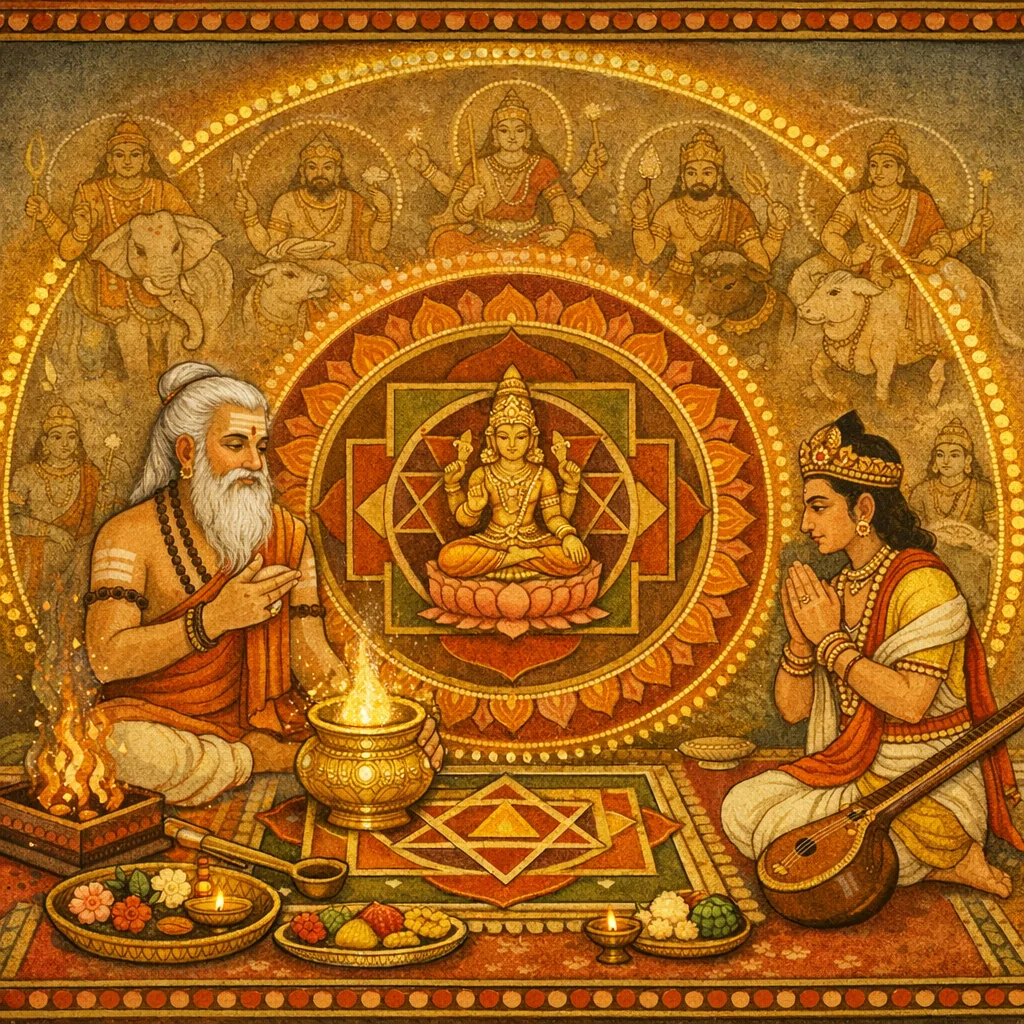
Devapūjā-krama: Ārghya-saṃskāra, Maṇḍala–Nyāsa, Mudrā-pradarśana, Āvaraṇa-arcana, Homa, Japa, and Kṣamāpaṇa
Sanatkumāra teaches Nārada a complete, technically ordered protocol of Devapūjā. It opens with preparing the ritual space and maṇḍala (triangle/hexagon/square), establishing the ādhāra and agni-maṇḍala, and consecrating ārghya-water into amṛta with go-mudrā and kavaca. The chapter explains aṅga-nyāsa, worship of the solar and lunar kalās, invocation of tīrthas, and sealing rites with matsya-mudrā and astra. A full pūjā-upacāra sequence follows (pādya, ārghya, ācamanīya, madhuparka, snāna, vastra, yajñopavīta, gandha, puṣpa, dhūpa, dīpa, naivedya, tāmbūla), including deity-specific offering prohibitions. It then expands into āvaraṇa-arcana with dikpālas, their vāhanas and weapons, followed by ārati, prostration, and homa (25 oblations) with the vyāhṛtis. The rite concludes with bali to fierce attendants, submission of japa, rules for circumambulation, and extended kṣamāpaṇa prayers. Finally, it teaches contingency modes (āturī/sautikī/trāsī) that emphasize mental worship during illness, impurity, or fear, and warns against insincere anukalpa (substitute ritual) done with improper intent.
Shlokas
Verse 1
सनत्कुमार उवाच । अथ वक्ष्ये देवपूजां साधकाभीष्टसिद्धिदाम् । त्रिकोणं चतुरस्रं वा वामभागे प्रकल्प्य च ॥ १ ॥
Sanatkumāra said: Now I shall describe the worship of the deities, which grants the sādhaka the fulfillment of the desired attainments. First, on the left side, one should arrange a triangular or a square ritual space/diagram…
Verse 2
सम्पूज्या स्रेण संक्षाल्य हृदाधारं निधाय च । तत्राग्निमण्डलं चेद्वा पात्रं संक्षाल्य चास्रतः ॥ २ ॥
Having duly worshipped and then, in proper order, washing and purifying the place and vessels, one should establish the ādhāra within the heart, the inner seat of support. Thereupon one should set the fire-circle (agni-maṇḍala); or else, having washed the ritual vessel, proceed onward without haste.
Verse 3
आधारे नामसं स्थाप्य तत्र चेद्रविमंडलम् । क्लिममातृका पूलमुञ्चरन्पूरपेज्जलैः ॥ ३ ॥
Having placed in the ādhāra the syllable-group called “nāmasaṃ”, one should then establish there the solar disc (ravi-maṇḍala). Then, uttering the mātṛkā-series with “klīm”, one should release the stream of mantra-power, filling it with the waters of the rite.
Verse 4
चत्रेंजुमंडलं प्रार्च्य तीर्थान्यावाह्य पूर्ववत् । गोमुद्रयामृतीकृत्य कवचेनावगुंठयेत् ॥ ४ ॥
Having duly worshipped the catreṁju-maṇḍala, and then invoking the sacred tīrthas as done previously, one should make it into amṛta by means of the go-mudrā, and then cover and protect it with the kavaca, the protective mantra.
Verse 5
संक्षाल्यास्रेण प्रणवं तदुपर्यष्टधा जपेत् । सामान्यार्घमिदं प्रोक्तं सर्वसिद्धिकरं नृणाम् ॥ ५ ॥
Having rinsed with water, one should repeat the Praṇava (Oṃ) eight times over it. This is declared to be the general arghya-offering, bestowing every accomplishment upon people.
Verse 6
तज्जलं र्किचिदुदूधृत्य प्रोक्षिण्या साधकोत्तमः । आत्मानं यागवस्तूनि तेन संप्रोक्षयेत्पुथक् ॥ ६ ॥
Drawing up a little of that water with the sprinkling ladle (prokṣiṇī), the best of practitioners should separately sprinkle and purify himself and the articles used for the sacrifice (yāga) with it.
Verse 7
आत्मवामाग्रतः कुर्यात्षट्ट्कोणांतस्रिकोणकम् । चतुरस्रेण संवेष्ट्य संक्षाल्यार्घोदकेन च ॥ ७ ॥
In front of oneself, on the left side, one should draw a triangle within a hexagon; then encircle it with a square, and cleanse (the place/diagram) with arghya-water, the water offered in worship.
Verse 8
ततस्तु साधकश्रेष्टः स्तंभयेच्छंखमुद्रया । आग्नेयादिषु कोणेषु हृदाद्यंगचतुष्टयम् ॥ ८ ॥
Then the foremost practitioner should, by the Conch (Śaṅkha) mudrā, stabilize and restrain the four auxiliary mantra-limbs beginning with the Heart, in the corners starting from the Southeast (Agni) and the others.
Verse 9
नेत्रं मध्ये दिक्षु चास्रं त्रिकोणे पूजयेत्ततः । मूलखंडत्रयेनाथाधारशक्तिं तु मध्यगाम् ॥ ९ ॥
Then one should worship the ‘Eye’ (netra) in the center; and in the directions, the triangle and the astra, the mantra-weapon. Thereafter, using the three root-segments, one should worship the Support-Power (Ādhāra-Śakti) abiding in the middle.
Verse 10
एवं संपूज्य विधिवदस्रंसंक्षालितं हृदा । प्रतिष्टाप्य त्रिपदिकां पूजयेन्मनुनामुना ॥ १० ॥
Thus, having duly worshipped according to the prescribed rite, and having cleansed away all impurity with heartfelt devotion, one should install the Tripadikā and worship it with this mantra.
Verse 11
मं वह्निमण्डला येति ततो देशकलात्मने । अमुकार्ध्येति पात्रांते सनापहृदयोंऽतिमे ॥ ११ ॥
He should utter the mantra “maṃ” and direct it into the circle of fire; then (he should offer) to the presiding principle of place and time. At the end of the vessel, saying “amuka-arghya” (“this arghya for so-and-so”), he should finally make the offering with a mind purified by bathing.
Verse 12
चतुर्विंशतिवर्णोऽयमाधारस्यार्चने मनुः । स्वमंत्रक्षालितं शरंवं संस्याप्याय समर्चयेत् ॥ १२ ॥
This is the twenty-four-syllabled mantra for worship of the Ādhāra, the sacred support. Having purified the śarāva-bowl with one’s own mantra, one should set it in place and then worship the Ādhāra with it.
Verse 13
तारः कार्म्ममहांस्ते तु ततो जलचराय च । वर्म फट् हृदयं पांचजन्याय हृदयं मनेः ॥ १३ ॥
Then one should apply the bīja “tāra” for the great Kūrma (the divine Tortoise), and thereafter for the Jalacara, the aquatic one. Next one should use the protective formula “varma” and the weapon-syllable “phaṭ”, and perform the heart-nyāsa for Pāñcajanya, the divine conch, and the heart-nyāsa for the Lord of the mind (Maṇi/Manas-pati).
Verse 14
तत्रार्कमण्डलायेति द्वादशांते कलारमने । अमुकार्ध्येति पात्रांते नमोंतस्त्र्यक्षिवर्णवान् ॥ १४ ॥
There, upon completing the twelve (units/syllables), one should utter “tatrārkamaṇḍalāya” and then “kalāramane.” At the end of the arghya-vessel, while concluding the offering, one should say “amukārdhye” and end with “namo,” the formula bearing the three-eyed (Tryakṣi) syllabic pattern/colouring.
Verse 15
सम्पूज्य तेन तत्रार्चेद्द्वादशार्ककलाः क्रमात् । ततः शुद्धजलैर्मूलं विलोममातृकां पठन् ॥ १५ ॥
Having duly worshipped with that, one should then worship there, in due order, the twelve solar kalās. Thereafter, using purified water, one should perform the root (mūla) rite/mantra while reciting the Mātṛkā (alphabet-mantra) in reverse order.
Verse 16
शङ्खमापूरयेत्तस्मिन्पूजयेन्मनुनामुना । ॐ सोममण्डलायेति षोडशांते कलात्मने ॥ १६ ॥
He should fill the conch (śaṅkha) with sanctified water and then worship it with this mantra: “Oṁ, salutations to the maṇḍala of Soma (the Moon), to the One whose essence is the sixteenfold kalā.”
Verse 17
अमुकार्ध्यामृतायेति हृन्मनुश्चार्ध्यपूजने । तत्र षोडशसंख्याका यजेञ्चंद्रमसः कलाः ॥ १७ ॥
In the worship with the arghya-offering, one should employ the heart-mantra (hṛnmanu) beginning with “amukārghyāmṛtāya.” There one should worship the Moon’s sixteen kalās (digits).
Verse 18
ततस्तु तीर्थान्यावाह्य गङ्गे चेत्यादिपूर्ववत् । गोमुद्रयामृतीकृत्याच्छादयेन्मत्स्ममुद्रया ॥ १८ ॥
Then, invoking the deities of the sacred tīrthas—beginning with “O Gaṅgā …” and the rest as taught earlier—one should sanctify (the water/offerings) by forming the Go-mudrā, making it amṛta, and then cover and seal it with the Matsya-mudrā.
Verse 19
कवचेनावगुंठ्याथ रक्षेदस्त्रेण तत्पुनः । चिंतयित्वेष्टदेवं च ततो मुद्राः प्रदर्शयेत् ॥ १९ ॥
Then, having veiled oneself with the protective kavaca, one should again safeguard the rite with the astra-mantra. After meditating on one’s chosen deity (iṣṭa-deva), one should then display the ritual mudrās.
Verse 20
शङ्खमौशलचकाख्याः परमीकरणं ततः । महामुद्रां योनिमुद्रां दर्शयेत्क्रमतः सुधीः ॥ २० ॥
Then the wise practitioner should, in proper sequence, demonstrate the mudrās known as Śaṅkha, Mauśala, and Cakā. Thereafter comes the rite of “Paramīkaraṇa”; and next, in order, he should teach the Mahā-mudrā and the Yoni-mudrā.
Verse 21
गारुडी गालिनी चैव मुख्ये मुद्रे प्रकीर्तिते । गन्धपुष्पादिभिस्तत्र पूजयेद्देवतां स्मरन् ॥ २१ ॥
The two principal mudrās are declared to be Gāruḍī and Gālinī. There, remembering the deity, one should worship with sandal-paste, flowers, and other offerings.
Verse 22
अष्टकृत्वो जपेन्मूलं प्रणवं चाष्टधा तथा । शंखाद्दक्षिणदिग्भागे प्रोक्षणीपात्रमादिशेत् ॥ २२ ॥
One should recite the root-mantra eight times, and likewise recite the Praṇava “Oṁ” eight times. Then, on the southern side of the conch, one should place the sprinkling vessel (prokṣaṇī-pātra) for ritual purification.
Verse 23
प्रोक्षण्यां तज्जलं किंचित्कृत्वात्मानं त्रिधा ततः । आत्मतत्त्वात्मने हृञ्च विद्यातत्त्वात्मने नमः ॥ २३ ॥
Placing a little of that water in the sprinkling vessel, one should then perform a threefold consecration (nyāsa) of oneself. (Reciting:) “Obeisance to Him whose very Self is the principle of the Self; and obeisance to Him whose very Self is the principle of sacred knowledge (vidyā).”
Verse 24
शिवतत्त्वात्मने हृञ्च इत्येतैर्मनुभिस्त्रिभिः । प्रोक्षेत्पुष्पाक्षतैश्चापि मण्डलं विधिवत्सुधीः ॥ २४ ॥
Using these three mantras—“śiva-tattvātmane” and “hṛñ” (etc.)—the wise practitioner should duly sprinkle and consecrate the maṇḍala with flowers and unbroken grains of rice (akṣata).
Verse 25
अथवा मूलगायत्र्या पूजाद्रव्याणि प्रोक्षयेत् । पाद्यार्ध्याचमनूयार्थं मधुपर्कार्थमप्युत ॥ २५ ॥
Alternatively, one should sprinkle and purify the articles of worship by reciting the root Gāyatrī. This prepares them for the offerings of foot-water (pādya), the respectful oblation (arghya), sipping-water (ācamanīya), and also the offering of madhuparka.
Verse 26
पात्राण्याधारयुक्तानि स्थापयेद्विधिना पुरः । पाद्यं श्यामाकदूर्वाब्जविष्णुक्रांतजलैः स्मृतम् ॥ २६ ॥
According to the prescribed rule, one should place the vessels upon their stands in front. The foot-washing offering (pādya) is taught to be water infused with śyāmāka grain, dūrvā grass, lotus, and viṣṇu-krāntā.
Verse 27
अर्ध्यं पुष्पाक्षतयवैः कुशाग्रतिलसर्षपैः । गंधदूर्वादलैः प्रोक्तं ततश्चाचमनीयकम् ॥ २७ ॥
Arghya, the reverent water-offering, is prescribed with flowers, akṣata (unbroken rice), barley, the tips of kuśa grass, sesame and mustard, together with fragrance and blades of dūrvā grass; thereafter one should perform ācamana, the sipping of purifying water.
Verse 28
जातीफलं च कंकोलं लवंगं च जलान्वितम् । क्षौद्राज्यदधिसंमिश्रं मधुपर्कसमीरितम् ॥ २८ ॥
Nutmeg, cubeb, and clove—moistened with water—mixed with honey, ghee, and curd: this is declared to be the madhuparka offering.
Verse 29
एकस्मिन्नथवा पात्रे पाद्यादीनि प्रकल्पयेत् । शंकरार्कार्चने शंखमयेनैव प्रशस्यते ॥ २९ ॥
The offerings beginning with pādya (water for washing the feet) and the rest may be arranged either in a single vessel or in separate vessels; but for the worship of Śaṅkara (Śiva) and Arka (the Sun), a conch-shell vessel is especially commended.
Verse 30
श्वेताकृष्णारुणापीताश्यामारक्तासितासिताः । रक्तांबराभयकराध्येयास्स्पुः पीठशक्तयः ॥ ३० ॥
The Pīṭha-Śaktis are described as of many hues—white, black, tawny-red, yellow, dark-blue, red, and very dark. Clad in red garments and displaying the abhaya gesture of fearlessness, they are to be contemplated in meditation.
Verse 31
स्वर्णादिलिखिते यंत्रे शालग्रामे मणौ तथा । विधिना स्थापितायां वा प्रतिमायां प्रपूजयेत् ॥ ३१ ॥
One should duly offer worship—upon a yantra inscribed on gold (or other metals), upon a Śālagrāma stone, upon a sacred gem, or upon an image (pratimā) that has been installed according to proper ritual procedure.
Verse 32
अंगुष्टादिवितस्त्यंतमाना स्वर्णादिधातुभिः । निर्मिता शुभदा गेहे पूजनाय दिने दिने ॥ ३२ ॥
Fashioned of gold and other metals, and measured from a thumb’s length up to a vitasti (span), it becomes in the home an auspicious bestower of good fortune—worthy to be worshipped day after day.
Verse 33
वक्रां दग्धां खंडितां च भिन्नमूर्द्धदृशं पुनः । स्पष्टां वाप्यन्त्यजाद्यैश्च प्रतिमां नैव पूजयेत् ॥ ३३ ॥
One should never worship an image that is crooked, burnt, broken, or fragmented—nor one whose head or gaze is damaged. Likewise, an image that is poorly finished or defaced by blemishes and the like should not be worshipped.
Verse 34
बाणादिलिंगे वाभ्यर्चेत्सर्वलक्षणलक्षिते । मूलेन मूर्तिं संकल्प्य ध्यात्वा देवं यथोदितम् ॥ ३४ ॥
One should worship a Bāṇa-liṅga (or other sacred liṅga) marked with all auspicious characteristics. Using the root-mantra, one should mentally form the deity’s icon, meditate upon that Lord as prescribed, and then perform the worship.
Verse 35
आवाहा पूजयेतस्यां परिवारगणैः सह । शालग्रामे स्थापितायां नावाहनविसर्जने ॥ ३५ ॥
Having invoked (the deity), one should worship Him there along with His attendant retinue. But when the Lord is established in a Śālagrāma, there is no need for invocation or dismissal.
Verse 36
पुष्पांजलिं समादाय ध्यात्वा मंत्रमुदीरयेत् ॥ ३६ ॥
Taking a handful of flowers as an offering, and meditating, one should then recite the mantra.
Verse 37
आत्मसंस्थमजं शुद्धं त्वामहं परमेश्वर । अरण्यामिव हव्याशं मूर्तावावाहयाम्यहम् ॥ ३७ ॥
O Supreme Lord, abiding in the Self, unborn and pure—I invoke You into this sacred icon, as fire is kindled and brought forth in the forest.
Verse 38
तवेयं हि महामूर्तिस्तस्यां त्वां सर्वगं प्रभो । भक्तिरेवहसमाकृष्टं दीपवत्स्थापयाम्यहम् ॥ ३८ ॥
This great form is truly Yours; O Lord who pervades all, I establish You within it—drawn near by devotion alone—like a lamp set in its proper place.
Verse 39
सर्वांतर्यामिणे देवं सर्वबीजमय शुभम् । रवात्मस्थाय परं शुद्धमासनं कल्पयाव्यहम् ॥ ३९ ॥
Each day I shall prepare a supremely pure seat for the auspicious Lord who abides as the Inner Controller (Antaryāmin) of all, the source-seed of everything, established in the radiant solar Self.
Verse 40
अनन्या तव देवेश मूर्तिशक्तिरियं प्रभो । सांनिध्यं कुरु तस्यां त्वं भक्तानुग्राहकारक ॥ ४० ॥
O Lord of the gods, O Master—this power as embodied form is Your undivided śakti. Therefore be present in it, for You are the giver of grace to Your devotees.
Verse 41
अज्ञानाजुच मत्तत्त्वाद्वैकल्यात्साधनस्य च । यद्यपूर्णं भवेत्कल्पं कतथाप्यभिमुखो भव ॥ ४१ ॥
Through ignorance, through a mistaken grasp of true tattva, and through deficiency in the means of practice—if a rite or observance proves incomplete, then in any case turn inwardly toward the Divine and set your face toward Him.
Verse 42
दृशा पूयूषवर्षिण्या पूरयन्यज्ञविष्टरे । मूर्तौ वा यज्ञसंपूर्त्यै स्थितो भव महेश्वर ॥ ४२ ॥
With a gaze that rains nectar and fills the whole expanse of the yajña, O Maheśvara—abide there, whether in manifested form or otherwise, for the complete fulfillment of the sacrifice.
Verse 43
अभक्तवाङ्मनश्चक्षुः श्रोत्रदूरायितद्युते । स्वतेजः पंजरेणाशु वेष्टितो भव सर्वतः ॥ ४३ ॥
O radiant one, render powerless the speech, mind, and eyes of those without bhakti, and keep their hearing far away; swiftly surround Yourself on all sides with the protective cage of Your own splendor.
Verse 44
यस्य दर्शनामिच्छंति देवाः स्वाभीष्टसिद्धये । तस्मै ते परमेशाय स्वागतं स्वागतं च मे ॥ ४४ ॥
He whose audience even the gods desire for the fulfillment of their cherished aims—to that Supreme Lord, to You, I offer welcome, welcome indeed from me.
Verse 45
कृतार्थोऽनुगृहीतोऽस्मि सफलं जीवितं मम । आगतो देवदेवेशः सुखागतमिदं पुनः ॥ ४५ ॥
I am fulfilled; I have been graced. My life has become fruitful. The Lord of the gods has arrived—welcome, and welcome again!
Verse 46
यद्भक्तिलेप्तसंपर्कात्परमानंदसंभवः । तस्मै मे परणाब्जाय पाद्यं शुद्धाय कल्प्यते ॥ ४६ ॥
From that contact, anointed with devotion, supreme bliss arises; therefore, for my Supreme Lord—pure and lotus-footed—I prepare pure water for washing the feet (pādya).
Verse 47
वेदानामपि वेदाय देवानां देवतात्मने । आचामं कल्पयामीश शुद्धानां शुद्धिहेतवे ॥ ४७ ॥
O Lord, Veda of the Vedas and the indwelling divinity of the gods, I now perform ācamana, for the sake of purification even for those already pure.
Verse 48
तापत्रयहर दिव्यं परमानन्दलक्षणम् । तापत्रयविनिर्मुक्त्यै तवार्घ्यं कल्पयाम्यहम् ॥ ४८ ॥
O Divine One who removes the threefold suffering, whose very nature is supreme bliss—so that I may be freed from the three afflictions, I prepare this arghya-offering for You.
Verse 49
सर्वकालुष्यहीनाय परिपूर्णसुखात्मने । मधुपर्कमिदं देव कल्पयामि प्रसीद मे ॥ ४९ ॥
O Deva, to You who are free from every impurity and whose very nature is perfect bliss, I prepare and offer this madhuparka; be gracious to me.
Verse 50
अवच्छिष्टोऽप्यशुचिर्वापि यस्य स्मरणमात्रतः । शुद्धिमाप्नोति तस्मै ते पुनराचमनीयकम् ॥ ५० ॥
Even if one has remnants of food on the body or is otherwise impure, merely by remembering Him one attains purity; therefore, for that purpose, perform ācamana once again.
Verse 51
स्नेहं गृहाण स्नेहेन लोकनाथ महाशय । सर्वलोकेषु शुद्धात्मन्ददामि स्नेहमुत्तमम् ॥ ५१ ॥
O noble Lord of the worlds, accept affection with affection. O pure-souled One—throughout all the worlds, I offer You the highest love.
Verse 52
परमानंदबोधाब्धिनिमग्ननिजमूर्तये । सांगोपांगमिदं स्नानं कल्पयाम्यहमीश ते । सहस्रं वा शतं वापि यथाशक्त्यादरेण च ॥ ५२ ॥
O Lord, whose very form is immersed in the ocean of supreme bliss and awakened consciousness—this complete bathing-offering, with all its auxiliaries, I now arrange for You, whether a thousand times or a hundred times, according to my capacity and with reverent care.
Verse 53
गन्धपुष्पादिकैरीश मनुनां चाभिषिंचेत् ॥ ५३ ॥
O Lord, one should also perform the ritual bathing (consecration) of the Manus using fragrances, flowers, and the like.
Verse 54
मायाचि त्रपटच्छन्ननिजगुह्योरुतेजसे । निरावरणविज्ञान वासस्ते कल्पयाम्यहम् ॥ ५४ ॥
For You—whose mighty radiance is veiled by the threefold covering of Māyā and by the shame (that hides) one’s own secret parts—I fashion the garment of unobstructed knowledge.
Verse 55
यमाश्रित्य म हामाया जगत्संमोहिनी सदा । तस्मै ते परमेशाय कल्पयाम्युत्तरीयकम् ॥ ५५ ॥
Taking refuge in Yama, the great Māyā—ever deluding the world—operates. Therefore, for that Supreme Lord (Parameśa), I prepare this upper garment (uttarīya) for You.
Verse 56
रक्तं शक्त्यर्कविघ्नेषु पीतंविष्णौ सितं शिवे । तैलादिदूषितं जीर्णं सच्छिद्रं मलिनं त्यजेत् ॥ ५६ ॥
Red offerings are prescribed for Śakti, the Sun, and for the removal of obstacles; yellow is for Viṣṇu; white is for Śiva. Anything tainted by oil and the like, old, perforated, or dirty should be discarded.
Verse 57
यस्य शक्तित्रयेणदं संप्रीतमखिलं जगत् । यज्ञसूत्राय तस्मै ते यज्ञसूत्रं प्रकल्पये ॥ ५७ ॥
To Him by whose threefold power this entire universe is upheld and made glad—to that Lord who is Himself the sacred thread of sacrifice—I duly invest you with this yajña-thread (yajñopavīta).
Verse 58
स्वभावसुन्दरांगाय नानाशक्त्याश्रयाय ते । भूषणानि विचित्राणि कल्पयाम्यमरार्चित ॥ ५८ ॥
For You, whose limbs are beautiful by their very nature, the refuge of manifold powers—O One worshipped by the gods—I fashion wondrous and varied ornaments for You.
Verse 59
परमानन्दसौरभ्यपरिपूर्णदिगंतरम् । गृहाण परम गंध कृपया परमेश्वर ॥ ५९ ॥
O Parameśvara, by Your grace accept this supreme fragrance—an aroma of highest bliss that fills the horizons in every direction.
Verse 60
तुरीयवनसंभूतं नानागुणमनोहरम् । अमंदसौरभपुष्पं गृह्यतामिदमुत्तमम् । जपाक्षतार्कधत्तूरान्विष्णौ नैवार्पयेत्क्वचित् ॥ ६० ॥
Let this excellent flower—born in the Turīya forest, delightful with many qualities, and rich with unfading fragrance—be accepted. But japā (hibiscus), akṣata (unbroken rice), arka, and dhattūra should never be offered to Viṣṇu at any time.
Verse 61
केतकीं कुटजं कुंदं बंधूकं केसरं जपाम् । मालतीपुष्पक चैव नार्पयेत्तु महेश्वरे ॥ ६१ ॥
One should not offer to Maheśvara (Śiva) the ketakī flower, kuṭaja, kunda, bandūka, kesara, japā, or mālatī blossoms.
Verse 62
मातुलिंगं च तगरं रवौ नैवार्पयेत्क्वचित् । शक्तौ दूर्वार्कमंदारान् गणेशे तुलसीं त्यजेत् ॥ ६२ ॥
One should never offer mātuḷiṅga (citron) or the fragrant tagara flower to the Sun at any time. For Śakti, one should offer dūrvā grass, arka, and mandāra flowers; and in the worship of Gaṇeśa, one should avoid offering tulasī (holy basil).
Verse 63
सरोजिनीदमनकौ तथा मरुबकः कुशः । विष्णुक्रांता नागवल्ली दूर्वापामार्गदाडिमौ ॥ ६३ ॥
Also to be included are sarojinī and damanaka, likewise marubaka and kuśa grass; viṣṇukrāntā, nāgavallī, dūrvā grass, apāmārga, and the pomegranate tree.
Verse 64
धात्री मुनियुतानां च पत्रैर्देवार्चनं चरेत् । कदली बदरी धात्री तिंतिणी बीजपूरकम् ॥ ६४ ॥
One should perform the worship of the gods using leaves of dhātrī and of the plants associated with sages. Suitable leaves include banana, badarī (jujube), dhātrī (āmalakī), tamarind, and bījapūraka (citron).
Verse 65
आम्रदाडिमजंबीरजंबूपनसभूरुहाः । एतेषां तु फलैः कुर्याद्देवतापूजनं बुधः ॥ ६५ ॥
With the fruits of mango, pomegranate, jambīra (citron), jambu, jackfruit, and other fruit-bearing trees, a wise person should perform the worship of the deities.
Verse 66
शुष्कैस्तु नार्चयेद्देवं पत्रैः पुष्पैः फलैरपि ॥ ६६ ॥
But one should not worship the Deity with withered, dry items—whether leaves, flowers, or even fruits.
Verse 67
धात्री खदिरबित्वानां तमालस्य दलानि च । छिन्नभिन्नान्यपि मुने न दूष्याणि जगुर्बुधाः ॥ ६७ ॥
O sage, the wise have declared that the fruits of dhātrī, khadira, and bitvāna, and the leaves of tamāla—even when cut or broken—are not to be regarded as impure or defective.
Verse 68
पद्ममामलकं तिष्टेच्छुद्धं चैव दिनत्रयम् । सर्वदा तुलसी शुद्धा बिल्वपत्राणि वै तथा ॥ ६८ ॥
The lotus and the āmalaka (Indian gooseberry) remain ritually pure for three days. Tulasī is always pure, and bilva leaves are likewise (always pure).
Verse 69
पलाशकाशकुसुमैस्तमालतुलसीदलैः । छात्रीदलैश्च दूर्वाभिर्नार्चयेज्जगदंबिकाम् ॥ ६९ ॥
One should not worship Jagadambikā (the World-Mother) with flowers of palāśa and kāśa, nor with leaves of tamāla and tulasī, nor with chātrī leaves, nor with dūrvā grass.
Verse 70
नार्पयेत्कुसुमं पत्रं फलं देवे ह्यधोमुखम् । पुष्पपत्रादिकं विप्र यथोत्पन्नं तथार्पयेत् ॥ ७० ॥
One should not offer a flower, leaf, or fruit to the deity with its face turned downward. O brāhmaṇa, flowers, leaves, and the like should be offered just as they naturally grow, in their proper orientation.
Verse 71
वनस्पतिरसं दिव्यं गंधाढ्यं सुमनोहरम् । आघ्रेयं देवदेवेश धूपं भक्त्या गृहाम मे ॥ ७१ ॥
O Lord of lords, accept from me with devotion this divine incense—drawn from the essence of forest plants—rich in fragrance and exceedingly pleasing to the mind, fit to be inhaled as an offering.
Verse 72
सुप्रकाशं महादीपं सर्वदा तिमिरापहम् । घृतवर्तिसमायुक्तं गृहाण मम सत्कृतम् ॥ ७२ ॥
Please accept from me this honoured offering: a great lamp, brilliantly radiant, ever dispelling darkness, fitted with a wick soaked in ghee.
Verse 73
अन्नं चतुर्विधं स्वादु रसैः षड्भिः समन्वितम् । भक्त्या गृहाण मे देव नैवेद्यंतुष्टिदंसदा ॥ ७३ ॥
This sweet food, prepared in four kinds and endowed with the six tastes—O Lord—please accept my naivedya with devotion; may it ever bestow satisfaction.
Verse 74
नागवल्लीदलं श्रेष्टं पूगखदिरचूर्णयुक् । कर्पूरादिसुगंधाढ्यं यद्दत्तं तद्गृहाण मे ॥ ७४ ॥
Please accept from me this excellent betel leaf, prepared with areca-nut and khadira (catechu) powder, richly scented with camphor and other fragrances—this offering I have presented.
Verse 75
दद्यात्पुष्पाञ्जलिं पश्चात्कुर्यादावरणार्चनम् ॥ ७५ ॥
Afterwards, one should offer a handful of flowers; then one should perform āvaraṇa-arcana, the worship of the surrounding deities.
Verse 76
यदाशाभिमुखो भूत्वा पूजनं तु समाचरेत् । सैव प्राची तु विज्ञेया ततोऽन्या विदिशो दश ॥ ७६ ॥
Whichever direction one faces while performing worship, that very direction should be understood as the East; from it, the other ten intermediate directions are determined.
Verse 77
केशरेष्वग्निकोणादि हृदयादीनि पूजयेत् । नेत्रमग्रे दिक्षु चास्त्रं अंगमंत्रैर्यथाक्रमम् ॥ ७७ ॥
On the lotus petals, one should worship the deities beginning from the Agni corner, and the six aṅga-mantras beginning with the Heart. In front, worship the Eye; and in the directions, the Astra (weapon-mantra), in proper sequence along with the aṅga-mantras.
Verse 78
शुक्लश्वेतसितश्यामकृष्णरक्तार्चिषः क्रमात् । वराभयकरा ध्येयाः स्वस्वदिक्ष्वं गशक्तयः ॥ ७८ ॥
In due order, their radiances are white, bright-white, pale, dark-blue, black, and red. Bearing the mudrās of boon-giving and fearlessness, these Aṃga-śaktis are to be meditated upon in their respective directions.
Verse 79
अमुकावरणांते तु देवता इति संवदेत् । सालंकारास्ततः पश्चात्सांगाः सपरिचारिकाः ॥ ७९ ॥
At the end of the prescribed enclosing rite (āvaraṇa), one should utter: “(This is) the deity.” Thereafter, one should contemplate or address the deity as adorned with ornaments, together with the aṅgas and accompanied by attendant maidservants.
Verse 80
सवाहनाः सायुधाश्च ततः सर्वो पचारकैः । संपूजितास्तर्पिताश्च वरदाः संत्विदं पठेत् ॥ ८० ॥
Then—together with their mounts and weapons—the deities are to be worshipped with all offerings. Having been duly honored and satisfied with libations (tarpana), may those bestowers of boons be gracious. Thus one should recite this.
Verse 81
मूलांते च समुञ्चार्य दिवतायै निवेदयेत् । अभीष्टसिद्धिं मे देहि शरणागतवत्सल ॥ ८१ ॥
Having clearly recited it at the end of the root-mantra, one should offer it to the deity: “O tender guardian of those who take refuge, grant me the fulfillment of my desired aim.”
Verse 82
भक्तया समर्पये तुभ्यममुकावरणार्चनम् । इत्युञ्चार्य क्षिपेत्पुष्पाञ्जलिं देवस्य मस्तके ॥ ८२ ॥
Saying, “With bhakti I offer to You this worship of the āvaraṇa, the attendant protective covering,” one should utter these words and then place a handful of flowers upon the head of the Deity.
Verse 83
ततस्त्वभ्यर्च्यनीयाः स्युः कल्पोक्ताश्चावृतीः क्रमात् । सायुधांस्तत इंद्राद्यान्स्वस्वदिक्षु प्रपूजयेत् ॥ ८३ ॥
Then, in proper sequence, one should worship the āvaraṇas as enjoined in the Kalpa texts; thereafter one should duly worship Indra and the other devas—each bearing their own weapons—in their respective directions.
Verse 84
इद्रो वह्निर्यमो रक्षो वरुणः पवनो विधुः । ईशानोऽथ विधिश्चैवमधस्तात्पन्न गाधिपः ॥ ८४ ॥
Indra, Agni, Yama, Rakṣa the guardian of the directions, Varuṇa, Vāyu, and the Moon; then Īśāna and Brahmā the Ordainer. Likewise, below is the Lord of the Nāgas, ruler of the subterranean waters.
Verse 85
ऐरावतस्तथा मेषो महिषः प्रेतस्तिमिर्मृगः । वाजी वृषो हंसकूर्मौ वाहनानि विदुर्बुधाः ॥ ८५ ॥
Airāvata, likewise the ram and the buffalo; the preta, the timi, and the deer; also the horse, the bull, the swan, and the tortoise—these the learned know as the vāhanas, the divine mounts.
Verse 86
वज्रं शक्तिं दंडखङ्गौ पाशां कुशगदा अपि । त्रिशूलं पद्मचक्रे च क्रमादिंद्रादिहेतयः ॥ ८६ ॥
The vajra (thunderbolt), the śakti (spear), the daṇḍa and khaḍga (staff and sword), the pāśa (noose), the aṅkuśa and gadā (goad and mace), and also the triśūla, the lotus, and the cakra—these are, in due order, the weapons of Indra and the other devas.
Verse 87
समाप्यावरणार्चां तु देवतारार्तिकं चरेत् । शंखतोयं परिक्षिप्योद्वाहुर्नृत्यन् पतेत्क्षितौ ॥ ८७ ॥
Having completed the worship of the surrounding deities (āvaraṇa), one should then perform the Deity’s ārati. After sprinkling the conch-water all around, the worshipper should raise the arms, dance in bhakti, and finally prostrate upon the earth.
Verse 88
दंडवञ्चाप्यथोत्थाय प्रार्थयित्वा निजेश्वरम् । दक्षिणे स्थंडिलं कृत्वा तत्र संस्कारमाचरेत् ॥ ८८ ॥
Having performed a full prostration like a staff (daṇḍavat) and then rising, one should pray to one’s own Lord. Then, on the right side, preparing a ritual ground (sthaṇḍila), one should perform the prescribed saṃskāra there.
Verse 89
मूलेनेक्षणमस्त्रेण प्रोक्षणं ताडनं पुनः । कुशैस्तद्वर्मणाभ्युक्ष्य पूज्य तत्र न्यसेद्वसुम् ॥ ८९ ॥
With the root-mantra, employing the ‘seeing’ and ‘weapon’ mantras, one should perform the purifying sprinkling (prokṣaṇa) and then again the striking rite (tāḍana) to ward off obstacles. Then, sprinkling with kuśa-grass under the protection of the armour-mantra (varma), one should worship and place the vasu—offering or sacred wealth—there in its proper spot.
Verse 90
प्रदाप्य तत्र जुहुयाद्ध्यात्वा चैवेष्टदेवताम् । महाव्याहृतिभिर्यस्तु समस्ताभिश्चतुष्टयम् ॥ ९० ॥
After kindling the fire there, one should offer oblations (homa), meditating upon one’s chosen Deity (iṣṭa-devatā). The offering should be performed with the great Vyāhṛtis, using the complete set of four together.
Verse 91
जुहुयात्सर्पिषा भक्तैस्तिलैर्वा पायसेन वा । सघृतैः साधकश्रेष्टः पञ्चविंशतिसंख्यया ॥ ९१ ॥
The best of practitioners should offer oblations—either with ghee along with devotional offerings, or with sesame seeds, or with milk-rice (pāyasa)—each prepared with ghee, in a count of twenty-five.
Verse 92
पुनर्व्याहृतिभिघिर्हुत्वा गंधाद्यैः पुनरर्चयेत् । देवं संयोजयेन्मूर्तौ ततो वह्निं विसर्जयेत् ॥ ९२ ॥
Having again offered oblations accompanied by the sacred vyāhṛtis, one should worship once more with fragrances and the like; then one should install the Deity into the mūrti (icon), and thereafter ritually dismiss the sacred fire.
Verse 93
भो भो वह्ने महाशक्ते सर्वकर्मप्रसाधक । कर्मांतरेऽपि संप्राप्ते सान्निध्यं कुरु सादरम् ॥ ९३ ॥
O Fire, O mighty Power, accomplisher of all rites—when another rite is undertaken as well, be present there too, reverently and without fail.
Verse 94
विसृज्याग्निदेवतायै दद्यादाचमनीयकम् । अवशिष्टेन हविषा गंधपुष्पाक्षतान्वितम् ॥ ९४ ॥
After dismissing the rite, one should offer ācamana (sipping-water) to the deity of Fire; and with the remaining havis, one should make an offering accompanied by fragrance, flowers, and akṣata (unbroken rice grains).
Verse 95
देवतापार्षदेभ्योऽपि पूर्वोक्तेभ्यो बलिं ददेत् । ये रौद्रा रौद्रकर्माणो रौद्रस्थाननिवासिनः ॥ ९५ ॥
One should also present a bali offering to the attendants of the deities mentioned earlier—those fierce in nature, fierce in action, and dwelling in fierce places associated with Rudra.
Verse 96
योगिन्यो ह्युग्ररूपाश्च गणानामधिपास्च ये । विघ्नभूतास्तथा चान्ये दिग्विदिक्षु समाश्रिताःग ॥ ९६ ॥
Indeed, the Yoginīs of fierce form, the lords of the gaṇas, and other beings that become sources of obstacles abide in the directions and the intermediate quarters.
Verse 97
सर्वे ते प्रीतमनसः प्रतिगृह्णंत्विमं बलिम् । इत्यष्टदिक्षु दत्वा च पुनर्भूतबलिं चरेत् ॥ ९७ ॥
“May all of you accept this bali-offering with pleased hearts.” Having offered the bali to the eight directions, one should again proceed to make the offering for the bhūtas (elemental beings).
Verse 98
पानीयममृतीकृत्य मुद्रया धेनुसंज्ञया । देवतायाः करे दद्यात्पुनश्चाचमनीयकम् ॥ ९८ ॥
Having sanctified the drinking-water, making it “nectar” by the dhenu (cow) mudrā, one should place it into the Deity’s hand; and then again offer ācamanīya, water for ritual sipping.
Verse 99
देवमुद्वास्य मूर्तिस्थं पुनस्तत्रैव योजयेत् । नैवेद्यं च ततो दद्यात्तत्तदुच्छिष्टभोजिने ॥ ९९ ॥
After formally concluding the Deity’s invocation and dismissal, one should again establish the Deity in the image at that very place. Then one should offer naivedya, the food-offering, to the one who partakes of the remnants of that offering.
Verse 100
महेश्वरस्य चंडेशो विष्वक्सेनस्तथा हरेः । चंडांशुस्तरणेर्वक्ततुंडश्चापि गणेशितुः । शक्तेरुच्छिष्टचांडाली प्रोक्ता उच्छिष्टभोजिनः ॥ १०० ॥
Caṇḍeśa is the attendant of Maheśvara; and Viṣvaksena, likewise, is of Hari. Caṇḍāṃśu belongs to the Sun (Taraṇi), and Vaktatuṇḍa also to Gaṇeśa. For Śakti, the attendant called Ucchiṣṭacāṇḍālī is declared—these are known as the ucchiṣṭa-bhojins, those who partake of the remnants.
Verse 101
ततो ऋष्यादिकं स्मृत्वा कृत्वा मूलषडंगकम् । जप्त्वा मंत्रं यथाशक्ति देवतायै निवेदयेत् ॥ १०१ ॥
Then, remembering the ṛṣi and the other mantra-details, and performing the sixfold ancillary rite (ṣaḍaṅga) of the root mantra, one should chant the mantra to the best of one’s ability and offer it to the presiding deity.
Verse 102
गुह्यातिगुह्यगोप्ता त्वं गृहाणास्मत्कृतं जपम् । सिद्धिर्भवतु मे देव त्वत्प्रसादात्त्वयि स्थिता ॥ १०२ ॥
O guardian of the most secret of secrets, accept this japa performed by me. O Lord, may success be mine—through your grace—firmly established in you.
Verse 103
ततः पराङ्मुखं चार्घं कृत्वा पुष्पैः प्रपूजयेत् । दोर्भ्यां पभ्द्यां च जानुभ्यामुरसा शिरसादृशा । मनसा वचसा चेति प्रणामोऽष्टांग ईरितः ॥ १०३ ॥
Thereafter, turning one’s face away in reverence, having offered arghya, one should worship with flowers. With the two arms, the two feet, the two knees, the chest, the head, and the gaze—and also with mind and speech—this is declared to be the eight-limbed prostration (aṣṭāṅga-praṇāma).
Verse 104
बाहुभ्यां च सजानुभ्यां शिरसा वचसापि वा । पंचांगकः प्रणामः स्यात्पूजायां प्रवरावुभौ ॥ १०४ ॥
In worship, the excellent form of salutation is the five-limbed prostration (pañcāṅga-praṇāma)—performed with the arms, with the knees, with the head, and also with words; both bodily act and verbal reverence are commendable.
Verse 105
नत्वा च दंडवन्मंत्री ततः कुर्यात्प्रदक्षिणाः । विष्णुसोमार्कविघ्नानां वेदार्धेंद्वद्रिवह्नयः ॥ १०५ ॥
Having bowed down in the manner of a staff (daṇḍavat), the reciter of the mantra should then perform circumambulations (pradakṣiṇā). The prescribed numbers are indicated by code-words: for Viṣṇu, Soma, Arka, and Vighna the remover of obstacles, they are respectively ‘half of the Vedas’, ‘the moon’, ‘the mountains’, and ‘the fires’.
Verse 106
ततः स्तोत्रादिकं मंत्री प्रपठेद्भक्तिपूर्वकम् । इतः पूर्णं प्राणबुद्धिदेहधर्माधिकारतः ॥ १०६ ॥
Thereafter, the mantra-practitioner should recite hymns (stotra) and related prayers with devotion (bhakti). By this, the rite becomes complete—according to one’s capacity as determined by vital strength, understanding, bodily ability, and prescribed duty (dharma).
Verse 107
जाग्रत्स्वप्नसुषुप्त्यंतेऽवस्थासु मनसा वदेत् । वाचा हस्ताभ्यां च पद्भ्यामुदरेण ततः परम् ॥ १०७ ॥
At the close of waking, dreaming, and deep sleep, one should “speak” with the mind; then with speech, with the hands, with the feet, and thereafter with the belly—through bodily functions beyond articulated words.
Verse 108
शिष्णांते यत्स्मृतं पश्चाद्यदुक्तं यत्कृतं ततः । तत्सर्वं च ततो ब्रह्मर्पणं भवतु ठद्वयम् ॥ १०८ ॥
Whatever was later remembered, whatever was spoken, and whatever was done thereafter—may all of it, from this moment on, become an offering unto Brahman; may it be made complete in both respects.
Verse 109
मां मदीयं च सकलं विष्णवे च समर्पये । तारं तत्सदतो ब्रह्मर्पणमस्तु मनुर्मतः ॥ १०९ ॥
I offer myself—and all that is mine—unto Viṣṇu. With the sacred syllable Tāra (Oṁ), together with “tat-sat,” let this be an offering to Brahman, as taught in the Mantra tradition.
Verse 110
प्रणवाद्योऽष्टवस्वर्णो ह्यनेनात्मानमर्पयेत् । अज्ञानाद्वा प्रमादाद्वा वैकल्यात्साधनस्य च ॥ ११० ॥
Beginning with the sacred syllable Oṁ and consisting of eight syllabic sounds, by means of this one should offer (surrender) oneself—whether through ignorance, through negligence, or through some deficiency in the prescribed sādhana.
Verse 111
यन्न्यूनमतिरिक्तं वा तत्सर्वं क्षन्तुमर्हसि । द्रव्यहीनं क्रियाहीनं मंत्रहीनं मयान्यथा ॥ १११ ॥
Whatever has been done deficiently or in excess—please forgive all of it. Whatever I performed otherwise than prescribed, lacking proper offerings, lacking proper rites, or lacking the proper mantras—may it all be pardoned.
Verse 112
कृतं यत्तत्क्षमस्वेश कृपया त्वं दयानिधे । यन्मया क्रियते कर्म जाग्रत्स्वप्रसुषुप्तिषु ॥ ११२ ॥
O Lord, ocean of compassion, in Your mercy forgive whatever has been done amiss. Whatever actions I perform in waking, in dreaming, or in deep sleep—may You pardon them all.
Verse 113
तत्सर्वं तावकी पूजा भूयाद्भूत्यै च मे प्रभो । भूमौ स्खलितपादानां भूमिरेवावलंबनम् ॥ ११३ ॥
O Lord, may all of this be worship offered to You, and may it become the cause of my well-being and prosperity. For those whose feet slip upon the ground, the earth itself becomes their support.
Verse 114
त्वयि जातापराधानां त्वमेव शरणं प्रभो । अन्यथा शरणं नास्ति त्वमेव शरणं मम ॥ ११४ ॥
For those who have committed offenses against You, O Lord, You alone are the refuge. There is no other refuge; You alone are my refuge.
Verse 115
तस्मात्कारुण्यभावेन क्षमस्व परमेश्वर । अपराधसहस्राणि क्रियंतेऽहर्न्निशं मया ॥ ११५ ॥
Therefore, O Supreme Lord, forgive me out of compassion; by me, thousands of offenses are committed day and night.
Verse 116
दासोऽयमिति मां मत्वा क्षमस्व जगतां पते । आवाहनं न जानामि न जानामि विसर्जनम् ॥ ११६ ॥
Considering me to be only Your servant, O Lord of the worlds, forgive me. I do not know the proper invocation, nor do I know the proper dismissal.
Verse 117
पूजां चैव न जानामि त्वं गतिः परमेश्वर । संप्रार्थ्यैवं ततो मंत्री मूलांते श्लोकमुञ्चरेत् ॥ ११७ ॥
“I do not even know the proper way of worship; You alone are my refuge, O Supreme Lord.” Having thus prayed, the practitioner of the mantra should then recite the verse at the end of the root-mantra as its concluding formula.
Verse 118
गच्छ गच्छ परं स्थानं जगदीश जगन्मय । यन्न ब्रह्मादयो देवा जानंति च सदाशिवः ॥ ११८ ॥
Go on—go on—to the supreme abode, O Lord of the universe, O All-pervading One; that realm which even Brahmā and the other gods do not know, nor even Sadāśiva.
Verse 119
इति पुष्पांजलिं दत्वा ततः संहारमुद्रया । निधाय देवं सांगं च स्वीयदृत्सरसीरुहे ॥ ११९ ॥
Thus, having offered a handful of flowers, then—using the saṃhāra (concluding/withdrawal) hand-gesture—one should mentally place the Deity, together with all His associated limbs and attendants, into the lotus of one’s own heart-lake.
Verse 120
सुषुम्णावर्त्मना पुष्पमाघ्रायोद्वासयेद् बुधः । शंखचक्रशिलालिंगविघ्नसूर्यद्वयं तथा ॥ १२० ॥
Having inhaled the fragrance of a flower through the suṣumṇā pathway, the wise practitioner should then gently exhale. In the same way, he should contemplate: the conch, the discus, the sacred stone (śilā), the liṅga, the remover of obstacles (Vighna/Gaṇeśa), and the pair of suns.
Verse 121
शक्तित्रयं न चैकत्र पूजयेद्दुःखकारणम् । अकालमृत्युहरणं सर्वव्याधिविनाशन् ॥ १२१ ॥
One should not worship the triad of Śaktis together in a single place, for it becomes a cause of suffering. Properly performed worship removes untimely death and destroys all diseases.
Verse 122
सर्वपापक्षयकरं विष्णुपादोदकं शुभम् ॥ १२२ ॥
Auspicious is the water that has bathed the feet of Vishnu; it destroys all sins.
Verse 123
तत्तद्भक्तैर्गृही तव्यं तन्नैवेद्यनिवेदितम् । अग्राह्यं शिवनिर्माल्यं पत्रं पुष्पं फलं जलम् ॥ १२३ ॥
What has been offered as naivedya should be accepted only by the devotees of that very deity. But the leaf, flower, fruit, and water that are Śiva’s nirmālya (remnants of worship) are not to be accepted by others.
Verse 124
शालग्रामशिलास्पर्शात्सर्वं याति पवित्रताम् । पूजा पंचविधा तत्र कथिता नारदाखिलैः ॥ १२४ ॥
By the mere touch of the Śālagrāma stone, everything attains purity. In that context, Nārada has fully taught the fivefold method of worship.
Verse 125
आतुरी सौतिकी त्रासी साधना भाविनी तथा । दौर्बोधी च क्रमादासां लक्षणानि श्रृणुष्व मे ॥ १२५ ॥
“The Aturī, the Sautikī, the Trāsī, the Sādhanā, the Bhāvinī, and the Daurbodhī—hear from me, in due order, the distinguishing marks of these types.”
Verse 126
रोगादियुक्तो न स्रायान्न जपेन्न च पूजयेत् । विलोक्य पूजां देवस्य मूर्तिं वा सूर्य्यमंडलम् ॥ १२६ ॥
One afflicted with illness and the like should not bathe, nor perform japa, nor undertake formal worship. Instead, he should be content to simply behold the Lord’s worship, or the deity’s image, or the solar orb.
Verse 127
प्रणम्याथ स्मरन्मंत्रमर्पयेत्कुमांजलिम् । रोगे निवृत्ते स्नात्वाथ नत्वा संपूञ्चेद्गुरुम् ॥ १२७ ॥
Then, having bowed down and remembering the mantra, one should offer a handful of flowers with joined palms. When the illness has subsided, one should bathe, and after bowing again, respectfully take leave of the guru.
Verse 128
त्वत्प्रसादाज्जगन्नाथ जगत्पूज्य दयानिधे । पूजाविच्छेददोषो मे मास्त्विति प्रार्थयेच्च तम् ॥ १२८ ॥
By Your grace, O Jagannātha, Lord of the universe—worshipped by all worlds, ocean of compassion—let him pray: “May the fault of interrupting my worship never arise in me.”
Verse 129
द्विजानपि च संपूज्य यथाशक्त्या प्रतोष्य च । तेभ्यश्चाशिषमादाय देवं प्राग्वत्ततोऽर्चयेत् ॥ १२९ ॥
Having duly honored the twice-born (brāhmaṇas), satisfied them according to one’s capacity, and received their blessings, one should then worship the Deity in the same manner as previously prescribed.
Verse 130
आतुरी कथिता ह्येषा सोतिक्यथ निगद्यते । सूतकं द्विविधं प्रोक्तं जाताख्यं मृतसंज्ञकम् ॥ १३० ॥
This state (of impurity) is indeed described as ‘āturī’, and it is also called ‘sotikā’. Sūtaka (ritual impurity) is declared to be of two kinds: birth-impurity and death-impurity.
Verse 131
तत्र स्नात्वा मानसीं तु कृत्वा संध्यां समाहितः । मनसैव यजेद्देवं मनसैव जपेन्मनुम् ॥ १३१ ॥
Having bathed there, and performing the Sandhyā inwardly with full concentration, one should worship the Deity with the mind alone, and with the mind alone repeat the sacred mantra.
Verse 132
निवृत्ते सूतके प्राग्वत्संपूज्य च गुरुं द्विजान् । तेभ्यश्चाशिषमादाय ततो नित्यक्रमं चरेत् ॥ १३२ ॥
When the period of sūtaka (post-birth or post-death impurity) has ended, one should, as before, duly honor one’s teacher and the twice-born elders; having received their blessings, one should then resume the regular daily observances.
Verse 133
एषा तु सौतिकी प्रोक्ता त्रासी चाथ निगद्यते । दुष्टेभ्यस्त्रासमापन्नो यथालब्धोपचारंकैः ॥ १३३ ॥
This procedure is declared to be the “Sautikī,” and it is also called the “Trāsī.” When one is seized with fear because of wicked people, it should be applied with whatever remedial measures are available at the time.
Verse 134
मानसैर्वै यजेद्देवं त्रासी सा परिकीर्तिता । पूजासाधनवस्तूनाम सामर्थ्ये तु सर्वतः ॥ १३४ ॥
One should indeed worship the Lord mentally; this is proclaimed as the ‘Trāsī’ (mental mode of worship). It is applicable in every circumstance, regardless of one’s ability to procure the materials required for ritual worship.
Verse 135
पुष्पैः पत्रैः फलैर्वापि मनसा वा यजेद्विभुम् । साधनाभाविनी ह्येषा दौर्बोधीं श्रृणु नारद ॥ १३५ ॥
One may worship the all-pervading Lord with flowers, leaves, or fruits—or even with the mind alone. For this method is independent of external means; hear, O Nārada, this subtle (hard-to-grasp) teaching.
Verse 136
स्त्रियो वृद्धास्तथा बाला मूर्खास्तैस्तु यथाक्रमम् । यथाज्ञानकृता सा तु दौर्बोधीति प्रकीर्तिता ॥ १३६ ॥
Women, the elderly, children, and the unlearned—each in due order—employ speech according to their level of understanding; therefore that usage is described as ‘hard to grasp’ (durbodhā).
Verse 137
एवं यथाकथंचित्तु पूजां कुर्याद्धि साधकः । देवपूजाविहीनो यः स गच्छेन्नरकं ध्रुवम् ॥ १३७ ॥
Therefore, in whatever manner one is able, the sādhaka should indeed perform worship. He who is without worship of the Deity surely goes to hell.
Verse 138
वैश्वदेवादिकं कृत्वा भोजयेद्द्विजसत्तमान् । देवे निवेदितं पश्चाद्भुंमजीत स्वगणैः स्वयम् ॥ १३८ ॥
Having first performed the Vaiśvadeva and other preliminary offerings, one should feed the most excellent of the twice-born. After the food has been offered to the Deity, one should then eat oneself, together with one’s attendants.
Verse 139
आचम्याननशुद्धिं च कृत्वा तिष्टेत् कियत्क्षणम् । पुराणमितिहासं च श्रृणुयात्स्वजनैः सह ॥ १३९ ॥
After performing ācamana and cleansing the mouth, one should remain composed for a short while; then, together with one’s own people, one should listen to the Purāṇa and the Itihāsa.
Verse 140
समर्थः सर्वकल्पेषु योऽनुकल्पं समाचरेत् । न सांगशयिकं तस्य दुर्मतेर्जायते फलम् ॥ १४० ॥
Even if one is capable in all prescribed ritual procedures (kalpas), if one chooses to follow only a substitute procedure (anukalpa), then—because of that misguided intent—no complete fruit, together with its proper auxiliaries, will arise.
Frequently Asked Questions
The arghya is ritually ‘transformed’ through mantra and mudrā (notably go/dhenu-mudrā, kavaca sealing, and protective astra) so it becomes a purified medium fit for consecration, self-sprinkling, maṇḍala cleansing, and deity-offering—serving as the chapter’s core sacramental substance.
Āvaraṇa-arcana establishes a protected and hierarchically ordered sacred space by honoring attendant powers, directional guardians (dikpālas), their mounts and weapons, thereby stabilizing the rite, removing obstacles, and integrating the main deity’s worship into a complete cosmological mandala.
It authorizes reduced or purely mental worship (Trāsī), emphasizing remembrance, inner Sandhyā, and manas-japa when bathing or formal ritual is not possible; after the condition ends, the practitioner resumes full observance with guru and brāhmaṇa honor.
It lists deity-specific prohibitions (e.g., certain flowers/leaves/fruits not to be offered to Viṣṇu, Śiva, Sūrya, Śakti, or Gaṇeśa), forbids withered items and downward-facing offerings, and notes exceptions of enduring purity (e.g., tulasī and bilva always pure; lotus and āmalaka pure for three days).