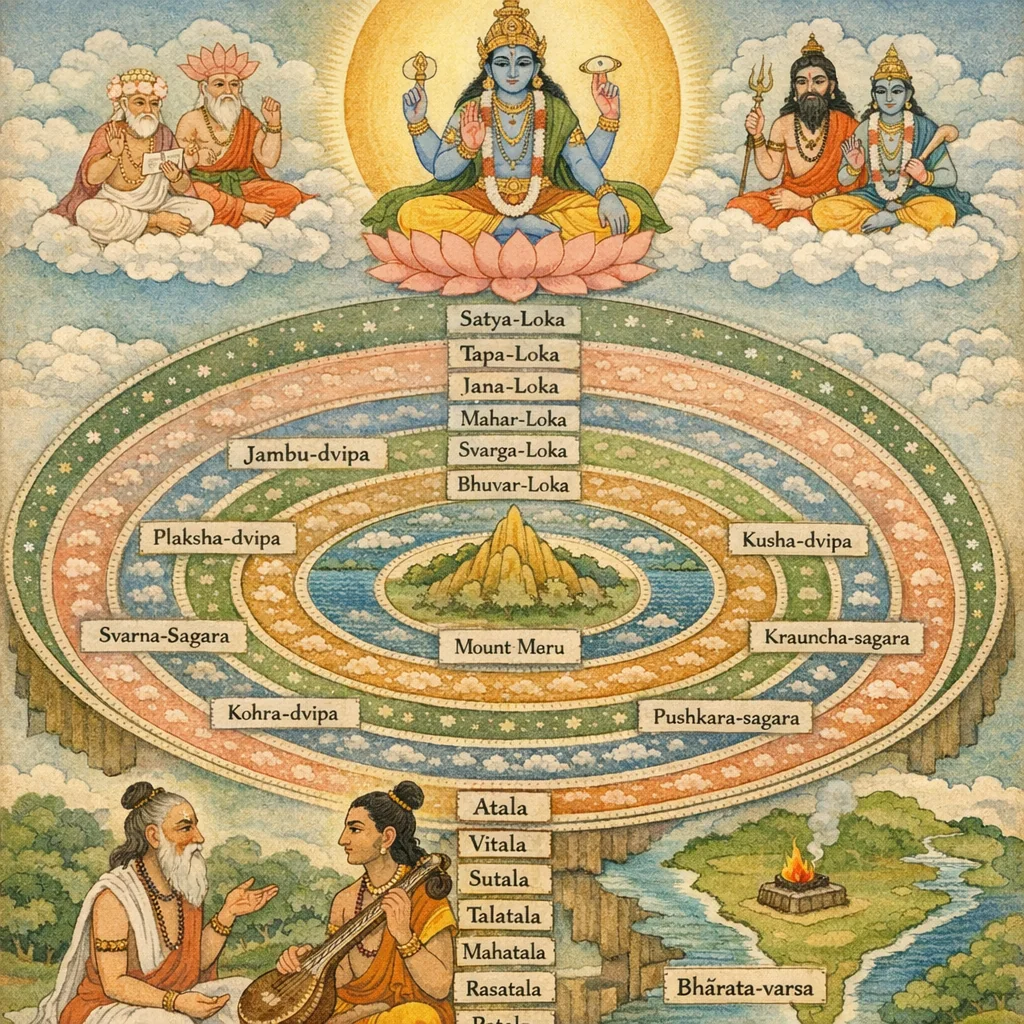
Sṛṣṭi-varṇana, Bhārata-khaṇḍa-mahātmya, and Jagad-bhūgola (Creation, Glory of Bhārata, and World Geography)
Nārada asks Sanaka how the primordial, all-pervading Lord brought forth Brahmā and the gods. Sanaka replies with a Viṣṇu-centered non-dual teaching: Nārāyaṇa pervades all, and the triad—Prajāpati/Brahmā, Rudra, and Viṣṇu—manifests for creation, dissolution, and protection. Māyā/Śakti is both vidyā and avidyā: bondage when taken as separate, liberation when known as non-different. The chapter then presents a Sāṃkhya-like cosmogony (prakṛti–puruṣa–kāla; mahat, buddhi, ahaṃkāra; tanmātras and mahābhūtas) and Brahmā’s subsequent creations. It maps the vertical cosmos (seven higher lokas and nether regions), Meru, Lokāloka, the seven dvīpas with surrounding oceans, and defines Bhārata-varṣa as karmabhūmi. The conclusion exalts bhakti and niṣkāma-karma: offering all acts to Hari/Vāsudeva, honoring devotees, seeing Nārāyaṇa and Śiva as non-different, and declaring that nothing exists apart from Vāsudeva.
Shlokas
Verse 1
नारद उवाच । कथं ससर्ज ब्रह्मादीनादिदेवः पुरा विभुः । तन्ममाख्याहि सनक सर्वज्ञोऽस्ति यतो भवान् ॥ १ ॥
Nārada said: “How did the all-pervading primordial Lord, in ancient times, bring forth Brahmā and the other gods? O Sanaka, tell me that—since you are indeed omniscient.”
Verse 2
श्रीसनक उवाचा । नारायणोऽक्षरोऽनन्तः सर्वव्यापी निरञ्जनः । तेनेदमखिलं व्याप्तं जगत्स्थावरजङ्गमम् ॥ २ ॥
Śrī Sanaka said: “Nārāyaṇa is the imperishable and infinite One—all-pervading and stainless. By Him this entire universe, of both the immovable and the moving, is completely pervaded.”
Verse 3
आदिसर्गे महाविष्णुः स्वप्रकाशो जगन्मयः । गुणभेदमधिष्ठाय मूर्त्तित्रिकमवासृजत् ॥ ३ ॥
At the dawn of creation, Mahāviṣṇu—self-luminous and pervading the cosmos—presided over the distinctions of the guṇas and brought forth the triad of divine forms.
Verse 4
सृष्ट्यर्थं तु पुरा देवो दक्षिणाङ्गात्प्रजापतिम् । मध्येरुद्राख्यमीथानं जगदन्तकरं मुने ॥ ४ ॥
In ancient times, for the sake of creation, the Lord brought forth Prajāpati from His right side; and from the middle of His body He manifested the one called Rudra—fierce, the bringer of the world’s dissolution, O sage.
Verse 5
पालनायास्य जगतो वामाङ्गाद्विष्णुमव्ययम् । तमादिदेवमजरं केचिदाहुः शिवाभिधम् । केचिद्विष्णुं सदा सत्यं ब्रह्माणं केचिदूचिरे ॥ ५ ॥
For the protection of this universe, from His left side the imperishable Viṣṇu manifested. That primordial, ageless Lord—some call Him “Śiva”; some declare Him to be Viṣṇu, ever true; and some speak of Him as Brahmā.
Verse 6
तस्य शक्तिः परा विष्णोर्जगत्कार्यप्रवर्तिनी । भावाभावस्वरुपा सा विद्याविद्येति गीयते ॥ ६ ॥
His supreme Power—Viṣṇu’s Śakti—sets in motion the workings of the universe. Having the nature of both being and non-being, that Power is sung of as Knowledge (vidyā) and Ignorance (avidyā).
Verse 7
यदा विश्वं महाविष्णोर्भिन्नत्वेन प्रतीयते । तदा ह्यविद्या संसिद्धा भवेद्दुःखस्य साधनम् ॥ ७ ॥
When the universe is perceived as separate from Mahāviṣṇu, then ignorance becomes fully established—and it becomes the very means that produces sorrow.
Verse 8
ज्ञातृज्ञेयाद्युपाधिस्ते यदा नश्यति नारद । सर्वैकभावना बुद्धिः सा विद्येत्यभिधीयते ॥ ८ ॥
O Nārada, when the limiting adjuncts such as the “knower” and the “known” are destroyed, that intellect which contemplates all as one—this is declared to be true knowledge (vidyā).
Verse 9
एषं माया महाविष्णोर्भिन्ना संसारदायिनी । अभेदबुद्ध्या दृष्टा चेत्संसारक्षयकारिणी ॥ ९ ॥
This Māyā of Mahāviṣṇu, when regarded as separate from Him, becomes the giver of worldly bondage; but when beheld with the understanding of non-difference, it becomes the destroyer of worldly existence.
Verse 10
विष्णुशक्तिसमुद्भूतमेतत्सर्वं चराचरम् । यस्माद्भिन्नमिदं सर्वं यच्चेङ्गेद्यच्चनेङ्गति ॥ १० ॥
All this universe—moving and unmoving—has arisen from the power (Śakti) of Viṣṇu. From Him this entire world is not separate, whether it moves or does not move.
Verse 11
उपाधिभिर्यथाकाशो भिन्नत्वेन प्रतीयते । अविद्योपाधियोगेनतथेदमखिलं जगत् ॥ ११ ॥
Just as space appears divided because of limiting adjuncts, so too does this entire universe appear as differentiated due to its association with the limiting adjunct of ignorance (avidyā).
Verse 12
यथा हरिर्जगद्यापी तस्य शक्तिस्तथा मुने । दाहशक्तिर्यथांगारे स्वाश्रयं व्याप्य तिष्टति ॥ १२ ॥
Just as Hari (Viṣṇu) pervades the entire universe, so too, O sage, does His Power (Śakti) pervade all. As the power of burning abides in a live coal, pervading its own support, so does that Śakti remain, filling its very locus.
Verse 13
उमेति केचिदाहुस्तां शक्तिं लक्ष्मीं तथा परे । भारतीत्यपरे चैनां गिरिजेत्यम्बिकेति च ॥ १३ ॥
Some call her Umā; others call her Śakti, and still others call her Lakṣmī. Some name her Bhāratī, and others call her Girijā and Ambikā as well.
Verse 14
दुर्गेति भद्रकालीति चण्डी माहेश्वरीत्यपि । कौमारी वैष्णवी चेति वाराह्येन्द्री च शाम्भवी ॥ १४ ॥
She is praised as Durgā, as Bhadrakālī, as Caṇḍī, and also as Māheśvarī; as Kaumārī and Vaiṣṇavī; and likewise as Vārāhī, Indrī, and Śāmbhavī.
Verse 15
ब्राह्मीति विद्याविद्येति मायेति च तथा परे । प्रकृतिश्च परा चेति वदन्ति परमर्षस्यः ॥ १५ ॥
Some call her “Brāhmī”; others call her “knowledge and non-knowledge”; likewise, some call her “Māyā”. The supreme seers also describe her as “Prakṛti” and as “the higher (Parā) power”.
Verse 16
शेषशक्तिः परा विष्णोर्जगत्सर्गादिकारिणी । व्यक्ताव्यक्तस्वरुपेण जगह्याप्य व्यवस्थिता ॥ १६ ॥
That supreme residual power of Viṣṇu—responsible for the creation and other processes of the universe—abides everywhere in the world, taking the form of both the manifest and the unmanifest.
Verse 17
प्रकृतिश्चपुमांश्चैव कालश्चेति विधिस्थितिः । सृष्टिस्थितिविनाशानामेकः कारणतां गतः ॥ १७ ॥
Prakṛti (primordial Nature), Puruṣa (the conscious principle), and Time—so runs the ordained doctrine: the One Reality becomes the single causal ground of creation, preservation, and dissolution.
Verse 18
येनेदमखिलं जातं ब्रह्मरुपधरेण वै । तस्मात्परतरो देवो नित्यइत्यभिधीयते ॥ १८ ॥
He by whom this entire universe is brought forth—assuming the form of Brahmā—therefore that Deity is spoken of as “Nitya,” the Eternal, for none is higher than Him.
Verse 19
रक्षां करोति यो देवो नित्य इत्यभिधीयते । रक्षां करोति यो देवो जगतां परतः पुमान् ॥ १९ ॥
That Deity who grants protection is called “Nitya” (the Eternal). And that Deity who protects the worlds is the Supreme Person, transcending all.
Verse 20
तस्मात्परतरं यत्तदव्ययं परमं पदम् ॥ २० ॥
Therefore, beyond that is That—the imperishable, supreme state, the highest abode.
Verse 21
अक्षरो निर्गुणः शुद्धः परिपूर्णः सनातनः । यः परः कालपुपाख्यो योगिध्येयः परात्परः ॥ २१ ॥
He is the Imperishable (Akṣara)—without attributes (nirguṇa), pure, complete, and eternal; the Supreme, also known as Kālapu, the One to be meditated upon by yogins, transcending even the transcendent.
Verse 22
परमात्मा परानन्दः सर्वोपाधिविवर्जितः । ज्ञानैकवेद्यः परमः सञ्चिदानन्दविग्रहः ॥ २२ ॥
The Supreme Self (Paramātmā) is the highest bliss, free from all limiting adjuncts (upādhis). He is the Supreme, knowable only through true knowledge, whose very form is Sat–Cit–Ānanda: Existence, Consciousness, and Bliss.
Verse 23
योऽसौ शुद्धोऽपि परमो ह्यहंकारेण संयुतः । देहीति प्रोच्यते मूढैरहोऽज्ञानविडम्बनम् ॥ २३ ॥
Though the Supreme Self is ever pure and transcendent, when joined with ahaṃkāra (ego) it is foolishly spoken of as “the embodied one” (dehī). Alas—what a mockery wrought by ignorance!
Verse 24
स देवः परमः शुद्धः सत्त्वदिगुणभेदतः । मूर्तित्रयं समापन्नः सृष्टिस्थित्यन्तकारणम् ॥ २४ ॥
That Supreme Deity is utterly pure; and, through the distinctions of the guṇas beginning with sattva, He assumes the threefold form and becomes the cause of creation, preservation, and dissolution.
Verse 25
योऽसौ ब्रह्मा जगत्कर्ता यन्नाभिकमलोद्भवः । स एवानन्दरुपात्मा तस्मान्नास्त्यपरो मुने ॥ २५ ॥
That very Brahmā—creator of the universe, born from the lotus arising from His navel—is in truth the Self whose nature is bliss (ānanda); therefore, O sage, there is none other higher than Him.
Verse 26
अन्तर्यामी जगद्यापी सर्वसाक्षी निरञ्जनः । भिन्नाभिन्नस्वरुपेण स्थितो वै परमेश्वरः ॥ २६ ॥
The Supreme Lord is the Antaryāmī, the Inner Controller—pervading the whole universe, the witness of all, and stainless. Indeed, He abides in a nature both distinct and non-distinct: transcendent, yet present within all.
Verse 27
यस्य शक्तिर्महामाया जगद्विश्त्रम्भधारिणी । विश्वोत्पत्तेर्निदानत्वात्प्रकृतिः प्रोच्यते बुधैः ॥ २७ ॥
That great power of His—Mahāmāyā, which upholds the vast expanse of the universe—because it is the causal source of the world’s origination, is therefore called Prakṛti by the wise.
Verse 28
आदिसर्गे महाविष्णोर्लोकान्कर्त्तुं समुद्यतः । प्रकृतिः पुरुषश्चेति कालश्चेति त्रिधा भवेत् ॥ २८ ॥
At the dawn of creation, when Mahāviṣṇu is poised to bring forth the worlds, the process is understood as threefold: Prakṛti (primordial Nature), Puruṣa (the conscious Principle), and Kāla (Time).
Verse 29
पश्यन्ति भावितात्मानो यं ब्रह्मत्यभिसंज्ञितम् । शुद्धं यत्परमं धाम तद्विष्णोः परमं पदम् ॥ २९ ॥
Those whose minds are purified and well-cultivated behold That which is designated as Brahman. That stainless, supreme abode—this indeed is the highest station of Vishnu.
Verse 30
एवं शुद्धोऽक्षरोऽनन्तः कालरुपी महेश्वरः । गुणरुपीगुणाधारोजगतामादिकृद्विभुः ॥ ३० ॥
Thus, He is pure, imperishable, and infinite—the Great Lord who assumes the form of Time; He is the very form of the guṇas and also their support, the all-pervading originator of the worlds.
Verse 31
प्रकृतिः क्षोभमापन्ना पुरुषाख्ये जगद्गुरौ । महान्प्रादुरभूद्धुद्धिस्ततोऽहं समवर्त्तत ॥ ३१ ॥
When Prakṛti was stirred into activity in the presence of the World-Teacher known as Puruṣa, Mahat (the Great Principle) manifested; from that arose Buddhi (intellect), and from Buddhi, I—the sense of ‘I’ (ahaṃkāra)—came into being.
Verse 32
अहंकाराश्च सूक्ष्माणि तन्मात्राणीन्द्रियाणि च । तन्मात्रेभ्यो हि जातानि भूतानि जगतः कृते ॥ ३२ ॥
From egoity (ahaṃkāra) arise the subtle principles—the tanmātras and the sense-faculties; and from those tanmātras, indeed, the great elements are born for the formation of the world.
Verse 33
आकाशवाय्वग्रिजलभूमयोऽब्जभवात्मज । यथाक्रमं कारणतामेकैकस्योपयान्ति च ॥ ३३ ॥
O son of the Lotus-born (Brahmā), space, air, fire, water, and earth—each in due order—become the cause of the next.
Verse 34
ततो ब्रह्या जगद्धाता तामसानसृजत्प्रभुः । तिर्यग्योनिगताञ्जन्तून्पशुपक्षिमृगादिकान् ॥ ३४ ॥
Then Brahmā, the sovereign sustainer of the universe, created beings of the tāmasika kind—creatures born in animal wombs, such as cattle, birds, deer, and the like.
Verse 35
तमप्यसाधकं मत्वा देवसर्गं सनातनात् । ततोवैमानुषं सर्गं कल्पयामास पव्मजः ॥ ३५ ॥
Deeming even that ancient creation of the gods insufficient for his purpose, Padmaja (Brahmā) then set about fashioning the creation of human beings.
Verse 36
ततो दक्षादिकान्पुत्रान्सृष्टिसाधनतत्परान् । एभिः पुत्रैरिदं व्याप्तं सदेवासुरमानुषम् ॥ ३६ ॥
Then he produced sons such as Dakṣa and others, devoted to carrying forward the work of creation. Through these sons, this entire world became pervaded—along with the gods, the asuras, and humankind.
Verse 37
भुर्भुवश्च तथा स्वश्च महश्वैव जनस्तथा । तपश्च सत्यमित्येवं लोकाः सत्योपरि स्थिताः ॥ ३७ ॥
Thus the worlds are: Bhūḥ, Bhuvaḥ, Svaḥ, Mahas, Jana, Tapas, and Satya; in this order, these lokas are situated one above another, culminating in Satya-loka above.
Verse 38
अतलं वितलं चैव सुतलं च तलातलम् । महातलं च विप्रेन्द्र ततोऽधच्च रसातलम् ॥ ३८ ॥
Atala and Vitala, Sutala and Talātala, and Mahātala as well—O best of brāhmaṇas—and beneath these lies Rasātala.
Verse 39
पातालं चेति सप्तैव पातालानि क्रमादधः । एष सर्वेषु लोकेषु लोकनाथांश्च सृष्टवान् ॥ ३९ ॥
And further below, in due order, are the seven nether regions beginning with Pātāla. In all these worlds, He also created their respective rulers, the lords of each realm.
Verse 40
कुलाचलान्नदीश्चासौ तत्तल्लोकनिवासिनाम् । वर्त्तनादीनि सर्वाणि यथायोग्यंमकल्पयत् ॥ ४० ॥
He also arranged the mountain ranges and the rivers; and for the inhabitants of each realm He duly established all their conduct and ways of life, according to what was fitting.
Verse 41
भूतले मध्यगो मेरुः सर्वदेवसमाश्रयः । लोकालोकश्च भूम्यन्ते तन्मध्ये सत्प सागराः ॥ ४१ ॥
At the center of the earth stands Mount Meru, the common support and refuge of all the devas. At the earth’s outer limit lies the Lokāloka boundary; and within that region are the seven oceans.
Verse 42
द्वीपाश्च सप्त विप्रेन्द्र द्वीपे कुलाचलाः । बाह्या नद्यश्च विख्याता जनाश्चामरसन्निभाः ॥ ४२ ॥
O best of brāhmaṇas, there are seven dvīpas (continents), and in each dvīpa are its own principal mountain ranges. There are also renowned outer rivers, and the people there are said to be like the amaras (immortals) in radiance and excellence.
Verse 43
जम्बूप्लक्षाभिधानौ च शाल्मलश्च कुशस्तथा । क्रौञ्चशाकौ पुष्करश्च ते सर्वे देवभूमयः ॥ ४३ ॥
Jambū and the one called Plakṣa, and also Śālmala and Kuśa, as well as Krauñca and Śāka and Puṣkara—these all are lands of the devas, divine realms.
Verse 44
एते द्वीपाः समुद्रैस्तु सत्पसत्पभिरावृताः । लवणेक्षुसुरासर्पिर्दधिक्षीरजलैः समम् ॥ ४४ ॥
All these dvīpas are encircled by oceans, each successive ocean of a different essence—salt-water, sugarcane-juice, surā (liquor), ghee, curds, and milk—surrounding the lands in due order.
Verse 45
एते द्वीपाः समुद्राश्च पूर्वस्मादुत्तशेत्तराः । ज्ञेया द्विगुणविस्तरा लोकालोकाञ्च पर्वतात् ॥ ४५ ॥
These dvīpas and oceans are each successively greater than the preceding; they are to be understood as doubling in extent, stretching up to Mount Lokāloka.
Verse 46
क्षारोदधेरुपत्तरं यद्धि माद्रेश्चैव दक्षिणाम् । ज्ञेयं तद्भारतं वर्षं सर्वकर्मफलप्रदम् ॥ ४६ ॥
That region lying north of the Kṣāra Ocean and south of Mount Mādr(a) is to be known as Bhārata-varṣa; it is the land that bestows the fruits of all karma.
Verse 47
अत्र कर्माणि कुर्वन्ति त्रिविधानि तु नारद । तत्फलं भुज्यते चैव भोगभूमिष्वनुक्रमात् ॥ ४७ ॥
Here, O Nārada, beings perform actions of three kinds; and the fruit of those actions is indeed experienced, in due order, in the various bhoga-bhūmis, realms of enjoyment.
Verse 48
भारते तु कृतं कर्म शुभं वाशुभमेव च । तत्फलं क्षयि विप्रेन्द्र भुज्यतेऽन्यत्रजन्तुभिः ॥ ४८ ॥
O best of brāhmaṇas, action performed in Bhārata—whether auspicious or inauspicious—yields a perishable fruit; that fruit is experienced by beings in other realms after death.
Verse 49
अद्यापि देवा इच्छन्ति जन्म भारतभूतले । संचितं सुमहत्पुण्यमक्षय्यममलं शुभम् ॥ ४९ ॥
Even now the gods yearn to be born upon the soil of Bhārata, for there one may accumulate exceedingly great merit—imperishable, stainless, and auspicious.
Verse 50
कदा लभामहे जन्म वर्षभारतभूमिषु । कदा पुण्येन महता यास्याम परमं पदम् ॥ ५० ॥
When shall we obtain birth in the lands of Bhārata-varṣa? When, by great merit, shall we attain the supreme abode?
Verse 51
दानैर्वाविविधैर्यज्ञैस्तपोभिर्वाथवा हरिम् । जगदीशंसमेष्यामो नित्यानन्दमनामयम् ॥ ५१ ॥
Through various kinds of charity, through sacrifices (yajña), or through austerities (tapas)—thus shall we attain Hari, the Lord of the universe, who is eternal bliss and free from all affliction.
Verse 52
यो भारतभुवं प्राप्य विष्णुपूजापरो भवेत् । न तस्य सदृशोऽन्योऽस्ति त्रिषु लोकेषु नारद ॥ ५२ ॥
O Nārada, one who, having attained birth in the land of Bhārata, becomes devoted to the worship of Viṣṇu—there is none equal to him in the three worlds.
Verse 53
हरिकीर्तनशीलो वा तद्भक्तानां प्रियोऽपि वा । शुक्षषुर्वापि महतः सवेद्यो दिविजैरपि ॥ ५३ ॥
Whether one is devoted to singing kīrtana of Hari’s names and glories, or is dear to His bhaktas—even if outwardly worn and emaciated—such a one is truly a great soul, worthy to be known and honored even by the gods.
Verse 54
हरिपूजारतो नित्यं भक्तः पूजास्तोऽषि वा । भक्तोच्छिष्टान्नसेवी च याति विष्णोः परं पदम् ॥ ५४ ॥
A bhakta ever engaged in worship of Hari—or even one who simply remains devoutly present at the pūjā—and one who partakes of devotees’ remnants of food (prasāda), attains the supreme abode of Viṣṇu.
Verse 55
नारायणेति कृष्णेति वासुदेवेति यो वदेत् । अहिंसादिपरः शन्तः सोऽपि वन्द्यः सुरोत्तमैः ॥ ५५ ॥
Whoever utters the names “Nārāyaṇa,” “Kṛṣṇa,” and “Vāsudeva,” devoted to ahiṃsā and other virtues and abiding in tranquility, is also worthy of reverence even by the foremost of the gods.
Verse 56
शिवेति नीलकण्ठेति शङ्करेतिच यः स्मरेत् । सर्वभूतहितो नित्यं सोऽभ्यर्च्यो दिविजैः स्मृतः ॥ ५६ ॥
Whoever remembers (the Lord) as “Śiva,” as “Nīlakaṇṭha,” and as “Śaṅkara,” becomes ever devoted to the welfare of all beings; such a person is regarded as worthy of worship even by the gods.
Verse 57
गुरुभक्तः शिवध्यानी स्वाश्रमाचारतत्परः । अनसूयुःशुचिर्दक्षो यः सोऽप्यर्च्यःसुरेश्वरैः ॥ ५७ ॥
One who is devoted to the guru, who meditates on Śiva, who is intent on the proper conduct of one’s own āśrama, who is free from envy, pure, and capable—such a person is worthy of worship even by the lords of the gods.
Verse 58
ब्राह्यणानां हितकरः श्रध्दावान्वर्णधर्मयोः । वेदवादरतो नित्यं स ज्ञेयः पङ्किपावनः ॥ ५८ ॥
One who labors for the welfare of the brāhmaṇas, has faith in the duties of varṇa and dharma, and is ever devoted to the recitation and study of the Veda—such a person is to be known as a purifier of the dining-row (paṅkti-pāvana).
Verse 59
अभेददर्शी देवेशे नारायणशिवात्मके । सर्वं यो ब्रह्मण नित्यमस्मदादिषु का कथा ॥ ५९ ॥
He who ever sees no difference in the Lord of the gods—whose very nature is Nārāyaṇa and Śiva—and who always beholds all as Brahman: what need is there to speak of distinctions among beings such as us?
Verse 60
गोषु क्षान्तो ब्रह्मचारी परनिंदाविवर्जितः । अपरिग्रहशी लश्च देवपूज्यः स नारद ॥ ६० ॥
O Nārada, one who is patient—especially in matters concerning cows—who lives in the discipline of brahmacarya, refrains from censuring others, is free from possessiveness, and is devoted to the worship of the Devas—such a person is truly worthy of reverence.
Verse 61
स्तेयादिदोषविमुखः कृतज्ञः सत्यवाक् शुचिः । परोपकारनिरतः पूजनीयः सुरासुरैः ॥ ६१ ॥
Free from faults such as theft, grateful, truthful in speech, and pure—one who is devoted to the welfare of others becomes worthy of reverence even by Devas and Asuras alike.
Verse 62
वेदार्थश्रवणे बुद्धिः पुराणश्रवणे तथा । सत्संगेऽपि च यस्यास्ति सोऽपि वन्द्यः सुरोत्तमैः ॥ ६२ ॥
Even one who has discernment for hearing the meaning of the Vedas, likewise for hearing the Purāṇas, and who is steadfast in the company of the virtuous (sat-saṅga)—that person too is worthy of reverence by the foremost of the Devas.
Verse 63
एवमादीन्यनेकानि कर्माणि श्रद्धयान्वितः । करोति भारते वर्षे संबन्धोऽस्माभिरेव च ॥ ६३ ॥
Thus, endowed with śraddhā, a person performs many such rites and duties in Bhārata-varṣa; and it is with us alone—the sacred tradition and the teachers—that his true connection is established.
Verse 64
एतेष्वन्यतमो विप्रमात्मानं नारभेत्तु यः । स एव दुष्कृतिर्मूढो नास्त्यन्योऽस्मादचेतनः ॥ ६४ ॥
O brāhmaṇa, whoever among these teachings or paths does not set himself to practice even one—he alone is truly a doer of evil, deluded; there is no one more senseless than he.
Verse 65
संप्राप्य भारते जन्म सत्कर्म सुपराङ्मुखः । पीयूषकलशं सुक्त्वा विषभाण्डमुपाश्रितः ॥ ६५ ॥
Having obtained birth in Bhārata, one who turns away from satkarma—righteous deeds—is like a person who abandons a pitcher of nectar and instead takes refuge in a vessel of poison.
Verse 66
श्रुतिस्मृत्युदितैर्द्धर्मैर्नात्मानं पावयेत्तु यः । स एवात्मविधाती स्यात्पापिनामग्रणीर्मुने ॥ ६६ ॥
But whoever does not purify himself through the dharmas taught in the Śruti and the Smṛti—he alone becomes the destroyer of his own self, O sage, and the foremost among sinners.
Verse 67
कर्मभूमिं समासाद्य यो न धर्मं समाचरेत् । स च सर्वाधमः प्रोक्तो वेदविद्भिर्मुनीश्वर ॥ ६७ ॥
O lord of sages, one who attains karmabhūmi—the realm of human action—yet does not practice dharma is declared by the Veda-knowing seers to be the lowest of all.
Verse 68
शुभं कर्म समुत्सृज्य दुष्कर्माणि करोति यः । कामधेनुं परित्यज्य अर्कक्षीरं सं मार्गति ॥ ६८ ॥
Whoever casts aside auspicious deeds and commits sinful acts is like one who forsakes Kāmadhenū, the wish-fulfilling cow, and goes searching for the milky sap of the arka plant.
Verse 69
एवं भारतभूभागं प्रशंसन्ति दिवौकसः । ब्रह्माद्या अपि विप्रेन्द्र स्वभोगक्षयभीरवः ॥ ६९ ॥
Thus do the dwellers of heaven praise the sacred land of Bhārata. O best of brāhmaṇas, even Brahmā and the other gods extol it, fearful that their own heavenly enjoyments will be exhausted.
Verse 70
तस्मात्पुण्यतमं ज्ञेयं भारतं वर्षमुत्तमम् । देवानां दुर्लभं वापि सर्वकर्मफलप्रदम् ॥ ७० ॥
Therefore, know Bhārata-varṣa to be the most sacred and the highest of lands—indeed difficult even for the gods to obtain—for it bestows the fruits of all actions (karma).
Verse 71
अस्मिन्पुण्ये च भूभागे यस्तु सत्कर्मसूद्यतः । न तस्य सदृशं कश्चित्रिषु लोकेषु विद्यते ॥ ७१ ॥
In this sacred tract of land, whoever is earnestly engaged in righteous deeds—no one equal to him is found in the three worlds.
Verse 72
अस्मिञ्जातो नरो यस्तु स्वंकर्मक्षपणोद्यतः । नररुपपरिच्छन्नः स हरिर्नात्र संशयः ॥ ७२ ॥
Whoever is born in this world as a man and is intent on exhausting the results of his own karma—though concealed in human form—he is Hari indeed; of this there is no doubt.
Verse 73
परं लोकफलं प्रेप्सुः किर्यात्कर्माण्यतन्द्रितः । निवेद्य हरये भक्त्या तत्फलं ह्यक्षयं स्मृतम् ॥ ७३ ॥
One who longs for the supreme fruit in the world to come should perform one’s duties without negligence; for when their fruits are offered to Hari with bhakti, that reward is remembered as imperishable.
Verse 74
विरागी चेत्कर्मफलेष्वपि किंचित्र कारयेत् । अर्पयेत्सुकृतं कर्म प्रीयतामितिं मे हरिः ॥ ७४ ॥
Even if one is dispassionate, should one still set some action in motion with an eye on its fruits, one should offer that meritorious deed to the Lord, saying, “May Hari be pleased with me.”
Verse 75
आब्रह्यभुवनाल्लोकाः पुनरुत्पत्तिदायकाः । फलागृध्नुः कर्मणां तत्प्रात्प्रोति परमं पदम् ॥ ७५ ॥
All worlds up to Brahmā’s realm are causes of repeated rebirth. But one who performs actions without craving their fruits attains that highest state.
Verse 76
वेदोदितानि कर्माणि कुर्यादीश्वरतुष्टये । यथाश्रमं त्यक्तुकामः प्रान्पोति पदमव्ययम् ॥ ७६ ॥
Let one perform the actions enjoined by the Veda for the Lord’s satisfaction; and, according to one’s own āśrama, when the desire for renunciation arises, one attains the imperishable state.
Verse 77
निष्कामो वा सकामो वा कुर्यात्कर्म यथाविधि । स्वाश्रमाचारशून्यश्च पतितः प्रोच्यते बुधैः ॥ ७७ ॥
Whether one acts without desire or with desire, one should perform one’s duties according to the prescribed rule; but one who is devoid of the conduct proper to one’s own āśrama is declared by the wise to be fallen.
Verse 78
सदाचारपरो विप्रो वर्द्धते ब्रह्मतेजसा । तस्य विष्णुश्च तुष्टः स्याद्भक्तियुक्तस्य नारद ॥ ७८ ॥
A brāhmaṇa devoted to right conduct flourishes through the radiance of Brahman; and for such a one—endowed with bhakti—Viṣṇu becomes pleased, O Nārada.
Verse 79
भारते जन्म संप्राप्य नात्मानं तारयेतु यः । पच्यते निरये धोरे स त्वाचन्द्रार्कतारकम् ॥ ७९ ॥
Having obtained birth in Bhārata, whoever does not strive to ferry his own self across saṃsāra is cooked in a dreadful hell for as long as the moon, sun, and stars endure.
Verse 80
वासदेवपरो धर्मो वासुदेवपरं तपः । वासुदेवपरं ज्ञानं वासुदेवपरा गतिः ॥ ८० ॥
Dharma is oriented toward Vāsudeva; austerity is oriented toward Vāsudeva. Knowledge is oriented toward Vāsudeva; and the supreme destination is Vāsudeva alone.
Verse 81
वासुदेवात्मकं सर्वं जगत्स्थावरजङ्गमम् । आब्रह्मस्तम्बपर्यन्तं तस्मादन्यन्न विद्यते ॥ ८१ ॥
This entire universe—everything moving and unmoving—is of the very nature of Vāsudeva. From Brahmā down to a blade of grass, nothing exists apart from Him.
Verse 82
स एव धाता त्रिपुरान्तकश्च स एव देवासुरयज्ञरुपः । स एवब्रह्माण्डमिदं ततोऽन्यन्न किंचिदस्ति व्यतिरिक्तरुपम् ॥ ८२ ॥
He alone is the Creator; He alone is the destroyer of Tripura; He alone is the very form of the sacrifices (yajñas) of gods and asuras. He alone is this entire cosmos, the brahmāṇḍa; apart from Him there exists nothing whatsoever in any separate form.
Verse 83
यस्मात्परं नापरमस्ति किंचिद्यस्मादणीयान्नतथा महीयान् । व्यात्पं हि तेनेदमिदं विचित्रं तं देवदेवं प्रणमेत्समीङ्यम् ॥ ८३ ॥
Beyond Him there is nothing higher, nor is there anything apart from Him; subtler than the subtlest, yet not merely the greatest by size. By Him this wondrous universe is wholly pervaded. Let one bow to that Deva-deva, the God of gods, worthy to be sought and reverently approached.
Verse 84
इति श्रीबृहन्नारदीयपुराणे पूर्वभागे प्रथमपादे सृष्टिभरतखण्डप्राशस्त्यभूगोलानां वर्णनं नाम तृतीयोऽध्यायः ॥ ३ ॥
Thus ends the Third Chapter, entitled “The Description of Creation, the Glory of Bharata-khaṇḍa, and the Geography of the World,” in the First Pāda of the Pūrva-bhāga of the Śrī Bṛhan-Nāradīya Purāṇa.
Frequently Asked Questions
Because the text treats māyā/śakti as the Lord’s power: when apprehended as separate from Mahāviṣṇu it functions as avidyā producing duality and sorrow; when apprehended through non-difference (abheda-buddhi) it is reinterpreted as vidyā that dissolves the knower-known split and thus ends saṃsāra.
Bhārata is presented as karmabhūmi—the arena where actions, śruti–smṛti duties, charity, austerity, and Viṣṇu-bhakti can be intentionally performed and dedicated to Hari, yielding imperishable spiritual gain; hence even devas desire birth there to accumulate merit and attain the supreme abode.
No. While framed as Viṣṇu-centric, it explicitly praises non-difference in the Lord of gods—recognizing Nārāyaṇa and Śiva as one reality—so that devotion and right conduct culminate in Brahman-vision beyond factional distinction.