Nārada’s Hymn to Viṣṇu (Nāradasya Viṣṇu-stavaḥ)
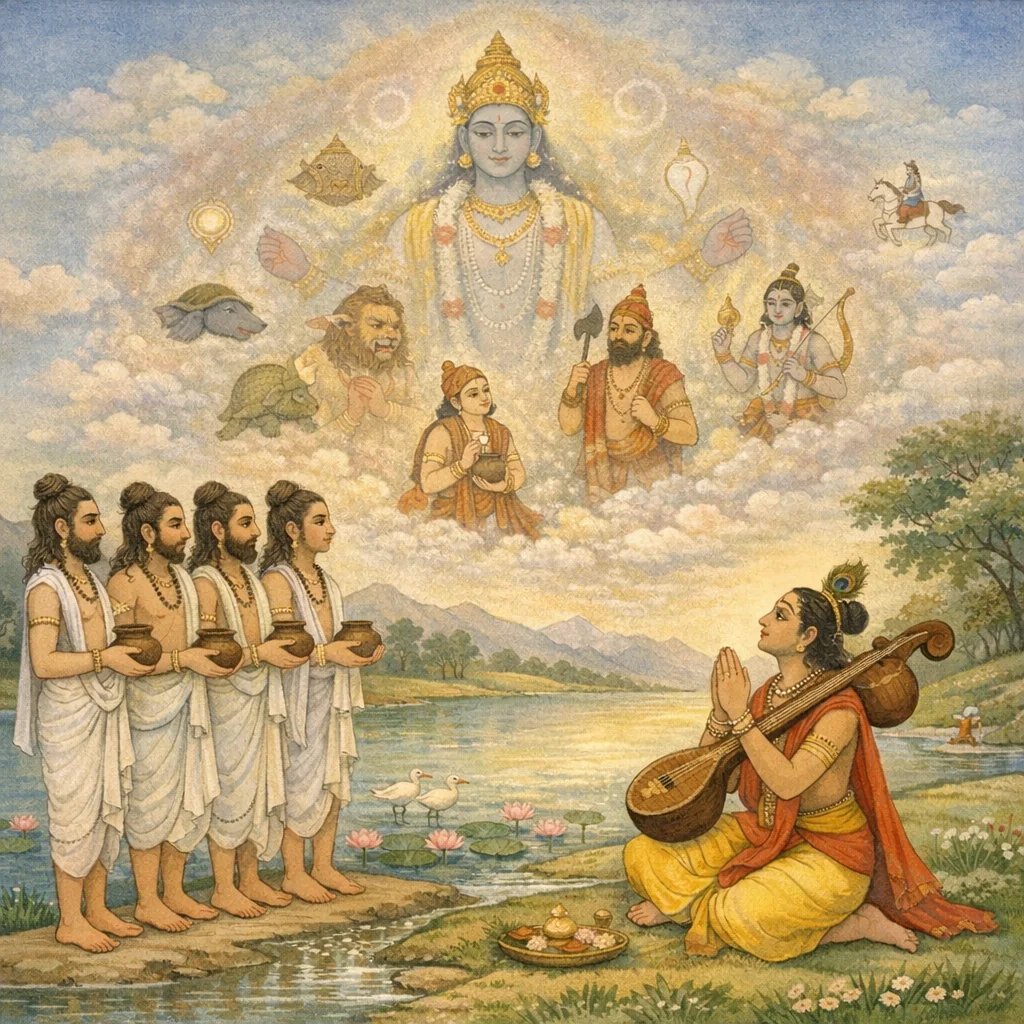
Answering the sages, Sūta introduces the Sanakādi Kumāras—Brahmā’s mind-born, celibate sons intent on liberation—traveling from Meru toward Brahmā’s assembly. En route they behold the Gaṅgā, hailed as Viṣṇu’s sacred river, and wish to bathe in the Sītā waters. Nārada arrives, reveres his elder brothers, and devoutly recites Viṣṇu’s names (Nārāyaṇa, Acyuta, Ananta, Vāsudeva, Janārdana), followed by an expansive stotra. The hymn praises Viṣṇu as both with attributes and beyond them, as knowledge and knower, as yoga and attainable through yoga, and as the cosmic viśvarūpa while ever unattached; it lists major avatāras (Kūrma, Varāha, Narasiṃha, Vāmana, Paraśurāma, Rāma, Kṛṣṇa, Kalki) and repeatedly extols the purifying, liberating power of the divine Name. After bathing and completing sandhyā and tarpaṇa rites, the sages engage in Hari-centered discourse; Nārada then asks for Bhagavān’s defining marks and guidance on fruitful karma, true knowledge, tapas, and guest-honoring conduct that pleases Viṣṇu. The chapter ends with the stotra’s phalaśruti: morning recitation grants purification and attainment of Viṣṇu’s realm.
Shlokas
Verse 1
ऋषय ऊचुः । कथं सनत्कुमारस्तु नारदाय महात्मने । प्रोक्तवान् सकलान् धर्मान् कथं तौ मिलितावुभौ 1. ॥ १ ॥
The sages said: “How did Sanatkumāra expound all the dharmas to the great-souled Nārada? And how did the two of them come to meet?”
Verse 2
कस्मिन् स्थाने स्थितौ सूत तावुभौ ब्रह्मवादिनौ । हरिगीतसमुद्गाने चक्रतुस्तद्वदस्व नः ॥ २ ॥
O Sūta, in what place were those two expounders of Brahman seated? And where did they begin the melodious chanting of songs in praise of Hari? Please tell us.
Verse 3
सूत उवाच । सनकाद्या महात्मानो ब्रह्मणो मानसाः सुताः । निर्ममा निरहङ्काराः सर्वे ते ह्यूर्ध्वरेतसः ॥ ३ ॥
Sūta said: The great souls beginning with Sanaka were Brahmā’s mind-born sons. Free from possessiveness and ego, all of them were indeed brahmacārīs, steadfast in continence, with their vital energy moving upward.
Verse 4
तेषां नामानि वक्ष्यामि सनकश्च सनन्दनः । सनत्कुमारश्च विभुः सनातन इति स्मृतः ॥ ४ ॥
I shall declare their names: Sanaka and Sanandana; Sanatkumāra, the mighty lord; and the powerful one remembered as Sanātana.
Verse 5
विष्णुभक्ता महात्मानो ब्रह्मध्यानपरायणाः । सहस्रसूर्यसंकाशाः सत्यसन्धा मुमुक्षवः ॥ ५ ॥
They are great souls—devotees of Viṣṇu—wholly devoted to meditation on Brahman; radiant like a thousand suns, steadfast in truth, and intent on liberation (mokṣa).
Verse 6
एकदा मेरुशृङ्गं ते प्रस्थिताः ब्रह्मणः सभाम् । इष्टां मार्गेऽथ ददृशुः गंगां विष्णुपदीं द्विजाः ॥ ६ ॥
Once, those twice-born sages set out from Meru’s peak for the assembly of Brahmā; and on the chosen path they beheld the Gaṅgā—Viṣṇupadī, Viṣṇu’s own sacred river.
Verse 7
तां निरीक्ष्य समुद्युक्ताः स्नातुं सीताजलेऽभवन् । एतस्मिन्नन्तरे तत्र देवर्षिर्नारदो मुनिः ॥ ७ ॥
Seeing her, they became eager to bathe in the waters of the Sītā. Meanwhile, at that very moment, the divine seer—sage Nārada—arrived there.
Verse 8
आजगाम द्विजश्रेष्ठा दृष्ट्वा भ्रातॄन् स्वकाग्रजान् । तान् दृष्ट्वा स्नातुमुद्युक्तान् नमस्कृत्य कृताञ्जलि ॥ ८ ॥
Then the best among the twice-born arrived. Seeing his own elder brothers, and seeing them prepared to bathe, he bowed to them and stood with folded hands.
Verse 9
गृणन् नामानि सप्रेमभक्तियुक्तो मधुद्विषः । नारायणाच्युतानन्त वासुदेव जनार्दन ॥ ९ ॥
With loving devotion, one should recite the names of the slayer of Madhu—Nārāyaṇa, Acyuta, Ananta, Vāsudeva, and Janārdana.
Verse 10
यज्ञेश यज्ञपुरुष कृष्ण विष्णो नमोऽस्तु ते । पद्माक्ष कमलाकान्त गङ्गाजनक केशव । क्षीरोदशायिन् देवेश दामोदर नमोऽस्तु ते ॥ १० ॥
O Lord of sacrifice, O Yajña-Puruṣa—the very essence of sacrifice—O Kṛṣṇa, O Viṣṇu, salutations to You. O Lotus-eyed One, beloved of Lakṣmī, source of the Gaṅgā, O Keśava; O One who reclines on the Ocean of Milk, O Lord of the gods, O Dāmodara—salutations to You.
Verse 11
श्रीराम विष्णो नरसिंह वामन प्रद्युम्न संकर्षण वासुदेव । अजानिरुद्धामलरुङ् मुरारे त्वं पाहि नः सर्वभयादजस्रम् ॥ ११ ॥
O Śrī Rāma, O Viṣṇu—Narasimha, Vāmana; O Pradyumna, Saṃkarṣaṇa, Vāsudeva; O Aniruddha, the stainless One, O Murāri, slayer of Mura—please protect us unceasingly from every fear.
Verse 12
इत्युच्चरन् हरेर्नाम नत्वा तान् स्वाग्रजान् मुनीन् । उपासीनश्च तैः सार्धं सस्नौ प्रीतिसमन्वितः ॥ १२ ॥
Thus, uttering the Name of Hari and bowing to those elder sages, he sat with them and then bathed, filled with joy and affectionate devotion.
Verse 13
तेषां चापि तु सीताया जले लोकमलापहे । स्नात्वा सन्तर्प्य देवर्षिपितॄन् विगतकल्मषाः ॥ १३ ॥
They too bathed in Sītā’s water, which washes away the world’s defilement; purified of sin, they then duly offered rites of satisfaction to the gods, the divine sages, and the ancestors.
Verse 14
उत्तीर्य सन्ध्योपास्त्यादि कृत्वाचारं स्वकं द्विजाः । कथां प्रचक्रुर्विविधाः नारायणगुणाश्रिताः ॥ १४ ॥
Having come out of the water and performed their prescribed observances—such as Sandhyā worship—the twice-born sages began various discussions, all resting upon the virtues of Nārāyaṇa.
Verse 15
कृतक्रियेषु मुनिषु गङ्गातीरे मनोरमे । चकार नारदः प्रश्नं नानाख्यानकथान्तरे ॥ १५ ॥
When the sages had completed their rites on the beautiful bank of the Gaṅgā, Nārada raised a question amid various narratives and accounts.
Verse 16
नारद उवाच । सर्वज्ञाः स्थ मुनिश्रेष्ठाः भगवद्भक्तितत्पराः । यूयं सर्वे जगन्नाथा भगवन्तः सनातनाः ॥ १६ ॥
Narada said: “O foremost of sages, you are all omniscient and wholly intent upon bhakti to the Bhagavān. Truly, you are all lords of the universe—eternal and venerable.”
Verse 17
लोकोद्धारपरान् युष्मान् दीनेषु कृतसौहृदान् । पृच्छे ततो वदत मे भगवल्लक्षणं बुधाः ॥ १७ ॥
You who are devoted to uplifting the worlds and who show friendship to the humble—therefore I ask: O wise ones, tell me the defining characteristics of the Bhagavān.
Verse 18
येनेदमखिलं जातं जगत्स्थावरजङ्गमम् । गङ्गापादोदकं यस्य स कथं ज्ञायते हरिः ॥ १८ ॥
By Him this entire universe—both the immovable and the moving—has come into being; and the waters of the Gaṅgā are the washing of His feet. How can that Hari ever be fully known by ordinary means?
Verse 19
कथं च त्रिविधं कर्म सफलं जायते नृणाम् । ज्ञानस्य लक्षणं ब्रूत तपसश्चापि मानदाः ॥ १९ ॥
And how does the threefold karma of human beings become fruitful? Tell me the mark of true knowledge (jñāna), and also of austerity (tapas), O venerable ones.
Verse 20
अतिथेः पूजनं वापि येन विष्णुः प्रसीदति । एवमादीनि गुह्यानि हरितुष्टिकराणि च । अनुगृह्य च मां नाथास्तत्त्वतो वक्तुमर्हथ ॥ २० ॥
Or the honoring of a guest (atithi), by which Lord Viṣṇu is pleased—such practices and other secret observances that delight Hari: O revered masters, show me grace and explain them to me truthfully, in their real essence.
Verse 21
शौनक उवाच । नमः पराय देवाय परस्मात् परमाय च । परावरनिवासाय सगुणायागुणाय च ॥ २१ ॥
Śaunaka said: Salutations to the Supreme Lord—higher than the highest, beyond even the beyond—abode of the higher and the lower realms, and at once with attributes and without attributes.
Verse 22
अमायायात्मसंज्ञाय मायिने विश्वरूपिणे । योगीश्वराय योगाय योगगम्याय विष्णवे ॥ २२ ॥
Salutations to Viṣṇu—beyond all illusion, known as the very Self; wielder of māyā, whose form is the entire universe; Lord of yogins, Yoga itself, and attainable only through Yoga.
Verse 23
ज्ञानाय ज्ञानगम्याय सर्वज्ञानैकहेतवे । ज्ञानेश्वराय ज्ञेयाय ज्ञात्रे विज्ञानसम्पदे ॥ २३ ॥
Salutations to Him who is Knowledge itself; attainable through knowledge; the single source of all knowledge; the Lord of knowledge; the One to be known; the Knower; and the very abundance of realized wisdom (vijñāna).
Verse 24
ध्यानाय ध्यानगम्याय ध्यातृपापहराय च । ध्यानेश्वराय सुधिये ध्येयध्यातृस्वरूपिणे ॥ २४ ॥
Salutations to Meditation—attainable through meditation itself; to the One who destroys the sins of the meditator; to the Lord of meditation; to the source of clear intelligence; and to That Reality whose very nature is both the object of meditation and the meditator.
Verse 25
आदित्यचन्द्रा ग्निविधातृदेवाः सिद्धाश्च यक्षासुरनागसंघाः । यच्छक्तियुक्तास्तमजं पुराणं सत्यं स्तुतीशं सततं नतोऽस्मि ॥ २५ ॥
Endowed with His power are the Sun and Moon, Agni and the gods, and also Vidhātṛ the Creator; likewise the Siddhas and the hosts of Yakṣas, Asuras, and Nāgas. To that unborn, primeval Lord—Truth itself, the sovereign of all praises—I bow continually.
Verse 26
यो ब्रह्मरूपी जगतां विधाता स एव पाता द्विजविष्णुरूपी । कल्पान्तरुद्रा ख्यतनुः स देवः शेतेऽङघ्रिपानस्तमजं भजामि ॥ २६ ॥
I worship that Unborn Lord: as Brahmā He is the Creator of the worlds; as Viṣṇu He is their Protector; and at the end of a kalpa He assumes the form called Rudra. That very God reclines, resting His sacred feet upon Śeṣa.
Verse 27
यन्नामसङ्कीर्तनतो गजेन्द्रो ग्राहोग्रबन्धान्मुमुचे स देवः । विराजमानः स्वपदे पराख्ये तं विष्णुमाद्यं शरणं प्रपद्ये ॥ २७ ॥
By the saṅkīrtana of His Name, Gajendra was freed from the crocodile’s fierce bondage. That radiant Lord shines in His own supreme abode called “Para”. To that primordial Viṣṇu I take refuge.
Verse 28
शिवस्वरूपी शिवभक्तिभाजां यो विष्णुरूपी हरिभावितानाम् । सङ्कल्पपूर्वात्मकदेहहेतुस्तमेव नित्यं शरणं प्रपद्ये ॥ २८ ॥
I eternally take refuge in Him alone: to Śiva’s devotees He appears as Śiva, and to those whose hearts are absorbed in Hari He appears as Viṣṇu. He is the very cause of embodied existence, arising from prior intention and the subtle ātman.
Verse 29
यः केशिहन्ता नरकान्तकश्च बालो भुजाग्रेण दधार गोत्रम् । देवं च भूभारविनोदशीलं तं वासुदेवं सततं नतोऽस्मि ॥ २९ ॥
I ever bow to Vāsudeva: He who slew Keśin and ended Naraka; who, while still a child, lifted the mountain upon the tip of His arm; and who, as the divine Lord, delights in removing the burden of the earth.
Verse 30
लेभेऽवतीर्योग्रनृसिंहरूपी यो दैत्यवक्षः कठिनं शिलावत् । विदार्य संरक्षितवान् स्वभक्तं प्रह्लादमीशं तमजं नमामि ॥ ३० ॥
I bow to the Unborn Lord who, descending in the fierce form of Narasiṁha, tore open the demon’s chest—hard as stone—and protected His own devotee Prahlāda.
Verse 31
व्योमादिभिर्भूषितमात्मसंज्ञं निरंजनं नित्यममेयतत्त्वम् । जगद्विधातारमकर्मकं च परं पुराणं पुरुषं नतोऽस्मि ॥ ३१ ॥
I bow to the Supreme, primeval Person—the highest Purāṇa—adorned with space and the other cosmic principles; known as the Self, stainless, eternal, of immeasurable reality; the ordainer of the universe, and yet actionless.
Verse 32
ब्रह्मेन्द्र रुद्रा निलवायुमर्त्यगन्धर्वयक्षासुरदेवसंघैः । स्वमूर्तिभेदैः स्थित एक ईशस्तमादिमात्मानमहं भजामि ॥ ३२ ॥
Amid the hosts of Brahmā, Indra, Rudra, the winds, mortals, Gandharvas, Yakṣas, Asuras, and Devas—appearing through the many distinctions of His own forms—there stands the one Lord. That primordial Self I worship.
Verse 33
यतो भिन्नमिदं सर्वं समुद्भूतं स्थितं च वै । यस्मिन्नेष्यति पश्चाच्च तमस्मि शरणं गतः ॥ ३३ ॥
I have taken refuge in That from which this entire differentiated universe has arisen, in which it abides, and into which it will finally return.
Verse 34
यः स्थितो विश्वरूपेण सङ्गीवात्र प्रतीयते । असङ्गी परिपूर्णश्च तमस्मि शरणं गतः ॥ ३४ ॥
I take refuge in Him who, abiding as the universe in the form of the Viśvarūpa, is here perceived as though associated with all, yet is truly unattached and perfectly complete.
Verse 35
हृदि स्थितोऽपि यो देवो मायया मोहितात्मनाम् । न ज्ञायेत परः शुद्धस्तमस्मि शरणं गतः ॥ ३५ ॥
Though the Divine Lord abides within the heart, for those whose minds are deluded by Māyā He is not recognized—the Supreme, the ever-pure. To Him I have gone for refuge.
Verse 36
सर्वसङ्गनिवृत्तानां ध्यानयोगरतात्मनाम् । सर्वत्र भाति ज्ञानात्मा तमस्मि शरणं गतः ॥ ३६ ॥
For those who have renounced all attachments and whose minds are absorbed in the yoga of meditation, the Self of knowledge shines everywhere. To Him I have gone for refuge.
Verse 37
दधार मंदरं पृष्ठे निरोदेऽमृतमन्थने । देवतानां हितार्थाय तं कूर्मं शरणं गतः ॥ ३७ ॥
During the churning of the ocean for nectar, He bore Mount Mandara upon His back. For the welfare of the gods, I have taken refuge in that Tortoise incarnation, Kūrma.
Verse 38
दंष्ट्रांकुरेण योऽनन्तः समुद्धृत्यार्णवाद् धराम् । तस्थाविदं जगत् कृत्स्नं वाराहं तं नतोऽस्म्यहम् ॥ ३८ ॥
I bow to Varāha—Ananta Himself—who, with the tip of His tusk, lifted the Earth from the ocean; and upon whom this entire universe stood established.
Verse 39
प्रह्लादं गोपयन् दैत्यं शिलातिकठिनोरसम् । विदार्य हतवान् यो हि तं नृसिंहं नतोऽस्म्यहम् ॥ ३९ ॥
I bow to Lord Nṛsiṃha, who, protecting Prahlāda, tore open and slew the demon whose chest was hard as stone.
Verse 40
लब्ध्वा वैरोचनेर्भूमिं द्वाभ्यां पद्भ्यामतीत्य यः । आब्रह्मभुवनं प्रादात् सुरेभ्यस्तं नतोऽजितम् ॥ ४० ॥
Having obtained the ground promised by Bali, Virocana’s son, He surpassed it with two strides and then bestowed the realms up to Brahmā’s world upon the gods. To Ajita, the unconquered Lord, I bow.
Verse 41
हैहयस्यापराधेन ह्येकविंशतिसंख्यया । क्षत्रियान्वयभेत्ता यो जामदग्न्यं नतोऽस्मि तम् ॥ ४१ ॥
I bow to Jāmadagnya (Paraśurāma), who—because of the Haihaya’s offense—became the destroyer of the Kṣatriya line, annihilating them twenty-one times.
Verse 42
आविर्भूतश्चतुर्धा यः कपिभिः परिवारितः । हतवान् राक्षसानीकं रामचन्द्रं नतोऽस्म्यहम् ॥ ४२ ॥
I bow to Rāmacandra—He who manifested in fourfold form, surrounded by the monkey-hosts, and who destroyed the army of the Rākṣasas.
Verse 43
मूर्तिद्वयं समाश्रित्य भूभारमपहृत्य च । संजहार कुलं स्वं यस्तं श्रीकृष्णमहं भजे ॥ ४३ ॥
I worship Śrī Kṛṣṇa—who, assuming a twofold manifestation, removed the burden of the earth and thereafter brought about the destruction of His own clan.
Verse 44
भूम्यादिलोकत्रितयं संतृप्तात्मानमात्मनि । पश्यन्ति निर्मलं शुद्धं तमीशानं भजाम्यहम् ॥ ४४ ॥
I worship that Sovereign Lord (Īśāna)—spotless and pure—whom the contented sages behold within their own Self, as the inner reality pervading the three worlds beginning with the earthly realm.
Verse 45
युगान्ते पापिनोऽशुद्धान् भित्त्वा तीक्ष्णसुधारया । स्थापयामास यो धर्मं कृतादौ तं नमाम्यहम् ॥ ४५ ॥
At the end of the age, he cleft the sinful and impure with a razor-sharp blade, and at the beginning of the Kṛta-yuga he re-established Dharma—him I bow to.
Verse 46
एवमादीन्यनेकानि यस्य रूपाणि पाण्डवाः । न शक्यं तेन संख्यातुं कोट्यब्दैरपि तं भजे ॥ ४६ ॥
O Pāṇḍavas, thus He has countless forms; even in crores of years one cannot number them. Therefore I worship Him.
Verse 47
महिमानं तु यन्नाम्नः परं गन्तुं मुनीश्वराः । देवासुराश्च मनवः कथं तं क्षुल्लको भजे ॥ ४७ ॥
If even the lordly sages cannot reach the supreme greatness of that Divine Name—nor the gods, the asuras, or the Manus—then how can I, so insignificant, truly worship it?
Verse 48
यन्नामश्रवणेनापि महापातकिनो नराः । पवित्रतां प्रपद्यन्ते तं कथं स्तौमि चाल्पधीः ॥ ४८ ॥
By merely hearing His Name, even those guilty of the gravest sins attain purity; how can I, of little understanding, possibly praise Him?
Verse 49
यथाकथञ्चिद्यन्नाम्नि कीर्तिते वा श्रुतेऽपि वा । पापिनस्तु विशुद्धाः स्युः शुद्धा मोक्षमवाप्नुयुः ॥ ४९ ॥
Even if someone somehow utters that Name, or even merely hears it, sinners become purified; and those who are purified attain liberation.
Verse 50
आत्मन्यात्मानमाधाय योगिनो गतकल्मषाः । पश्यन्ति यं ज्ञानरूपं तमस्मि शरणं गतः ॥ ५० ॥
Establishing the self within the Self, the yogins—freed from all impurity—behold Him whose very nature is knowledge; to that One I have come for refuge.
Verse 51
साङ्ख्याः सर्वेषु पश्यन्ति परिपूर्णात्मकं हरिम् । तमादिदेवमजरं ज्ञानरूपं भजाम्यहम् ॥ ५१ ॥
The followers of Sāṅkhya behold Hari as the all-complete Self present in all beings. I worship that primal Deity—unaging, whose very form is knowledge.
Verse 52
सर्वसत्त्वमयं शान्तं सर्वद्र ष्टारमीश्वरम् । सहस्रशीर्षकं देवं वन्दे भावात्मकं हरिम् ॥ ५२ ॥
I bow to Hari—the divine Lord who pervades all beings, tranquil, the all-seeing Sovereign; the God of a thousand heads, the very essence of every state of being and feeling.
Verse 53
यद्भूतं यच्च वै भाव्यं स्थावरं जङ्गमं जगत् । दशाङ्गुलं योऽत्यतिष्ठत्तमीशमजरं भजे ॥ ५३ ॥
All that has been and all that will be, and this entire world of the moving and the unmoving, is transcended by that unborn Lord “by ten fingers’ breadth.” I worship that unaging Sovereign.
Verse 54
अणोरणीयांसमजं महतश्च महत्तरम् । गुह्याद्गुह्यतमं देवं प्रणमामि पुनः पुनः ॥ ५४ ॥
Again and again I bow to that Deity—subtler than the subtlest atom, unborn, greater than the great, and the most secret of all that is secret.
Verse 55
ध्यातः स्मृतः पूजितो वा श्रुतः प्रणमितोऽपि वा । स्वपदं यो ददातीशस्तं वन्दे पुरुषोत्तमम् ॥ ५५ ॥
Whether He is meditated upon, remembered, worshipped, heard of, or even merely bowed to—He, the Lord who bestows His own supreme abode, I bow to that Puruṣottama.
Verse 56
इति स्तुवन्तं परमं परेशं हर्षाम्बुसंरुद्धविलोचनास्ते । मुनीश्वरा नारदसंयुतास्तु सनन्दनाद्याः प्रमुदं प्रजग्मुः ॥ ५६ ॥
Thus, praising the Supreme Lord, the highest Master, their eyes choked with tears of joy, those great sages—accompanied by Nārada—Sanandana and the others, departed in profound delight.
Verse 57
यं इदं प्रातरुत्त्थाय पठेद्वै पौरुषं स्तवम् । सर्वपापविशुद्धात्मा विष्णुलोकं स गच्छति ॥ ५७ ॥
Whoever, rising early at dawn, recites this hymn to the Supreme Person (Puruṣa), is purified of all sins and attains the realm of Lord Viṣṇu.
Verse 58
इति श्रीबृहन्नारदीयपुराणे पूर्वभागे प्रथमपादे सनत्कुमारनारदसंवादेनारदकृतविष्णुस्तुतिर्नाम द्वितीयोऽध्यायः ॥ २ ॥
Thus ends the Second Chapter, called “Nārada’s Hymn to Viṣṇu,” in the First Pāda of the Pūrva-bhāga of the Śrī Bṛhannāradīya Purāṇa, in the dialogue between Sanatkumāra and Nārada.
Frequently Asked Questions
It sacralizes the teaching environment by linking tīrtha practice to Viṣṇu-theology (Gaṅgā as Viṣṇu-pāda-jala) and demonstrates the Purāṇic ideal that Vedic rites (snāna, sandhyā, tarpaṇa) are completed and crowned by Hari-nāma and stotra, integrating karma with mokṣa-dharma.
The stotra compresses core Purāṇic Vedānta: Viṣṇu as both saguṇa and nirguṇa, as knowledge/yoga and their goal, as viśvarūpa yet unattached, alongside an avatāra taxonomy and the doctrine that hearing or uttering the Divine Name purifies even grave sins and leads toward liberation.