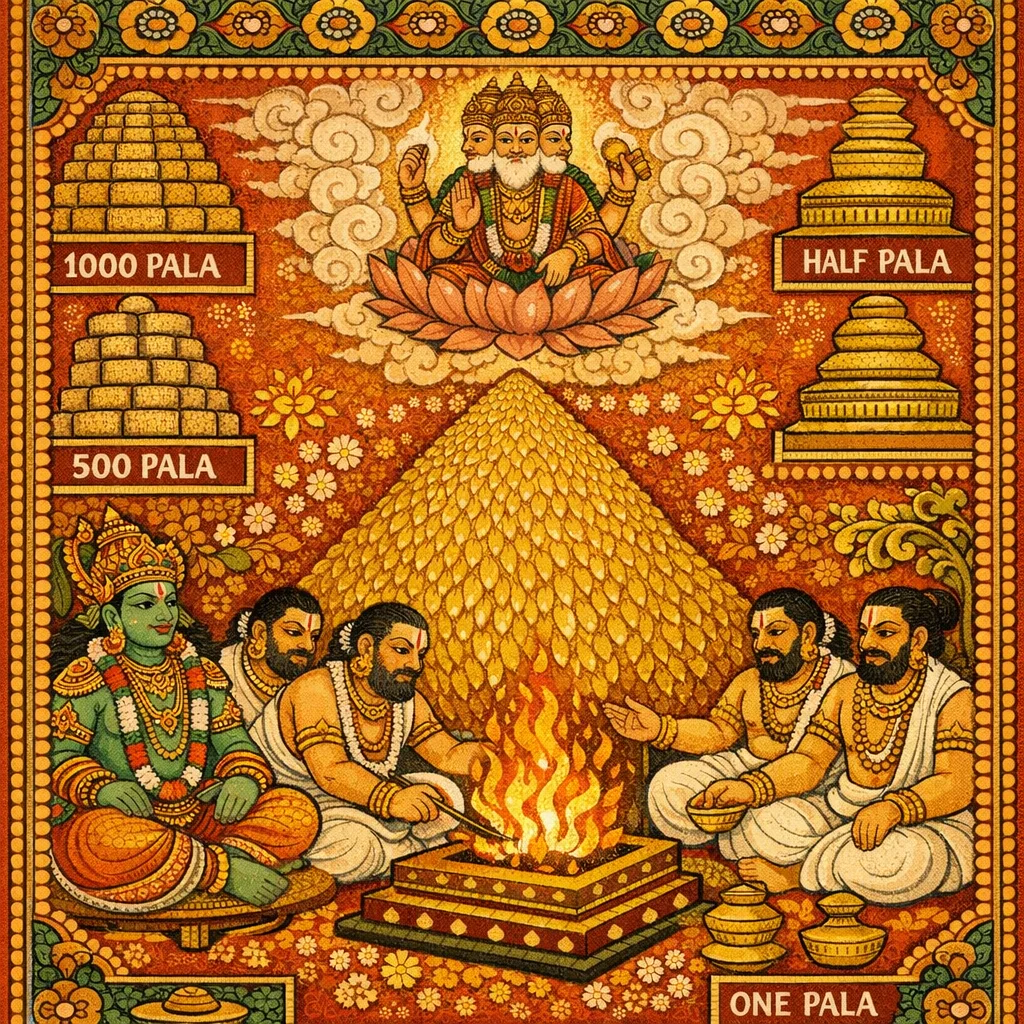
Adhyaya 86: The Rite of Donating the Golden Mountain (Kanaka-Parvata Dāna)
कनकपर्वतदानविधिः (सुवर्णाचलदानम्)
Speaker: Īśvara (the Lord, instructing voice)
In samvāda (dialogue) form, the Lord continues his prescriptive discourse on dharma and ritual, announcing a new topic: the sin-destroying gift of a “Golden Mountain.” He sets tiers of donation by weight, then softens the rule with an inclusive ethic—give according to one’s capacity, free from jealousy. The offering is to be arranged like a “mountain of grain,” and the related “Viṣkambha-mountains” are to be duly handed to the ṛtviks (officiating priests). The rite is sealed with brief salutations that sacralize the mound as Brahmā-linked and Agni-born, praying that it protect the donor. The chapter ends with a clear phalaśruti: correct performance grants Brahma-loka, residence there for a hundred kalpas, and thereafter the highest state.
Key Concepts
Shlokas in Adhyaya 86
Verse 1
*ईश्वर उवाच अथ पापहरं वक्ष्ये सुवर्णाचलमुत्तमम् यस्य प्रदानाद्भवनं वैरिञ्चं याति मानवः //
The Lord said: “Now I shall describe the supreme ‘Golden Mountain’, the remover of sin; by gifting (or offering) it, a human being attains the world of Brahmā (Vairiñca), the abode of the Creator.”
Verse 2
उत्तमः पलसाहस्रो मध्यमः पञ्चभिः शतैः तदर्धेनाधमस्तद्वद् अल्पवित्तो ऽपि शक्तितः दद्यादेकपलादूर्ध्वं यथाशक्त्या विमत्सरः //
The best standard of donation is a thousand palas; the middling is five hundred; the lowest is half of that. Even one of little wealth should, according to his ability and without envy, give—beginning from at least one pala and upwards.
Verse 3
धान्यपर्वतवत्सर्वं विदध्यान्मुनिपुंगव विष्कम्भशैलास्तद्वच्च ऋत्विग्भ्यः प्रतिपादयेत् //
O best of sages, one should arrange everything in the manner of a ‘mountain of grain’; and likewise, those ‘Viṣkambha-mountains’ should also be duly presented to the officiating priests (ṛtviks).
Verse 4
नमस्ते ब्रह्मबीजाय ब्रह्मगर्भाय ते नमः यस्मादनन्तफलदस् तस्मात्पाहि शिलोच्चय //
Salutations to you, the seed of Brahmā; salutations to you, the womb of Brahmā. Since you bestow limitless results, therefore protect us, O mound of stone.
Verse 5
यस्मादग्नेरपत्यं त्वं यस्मात्पुण्यं जगत्पते हेमपर्वतरूपेण तस्मात्पाहि नगोत्तम //
Since you are born of Agni (fire), and since you are holy, O Lord of the world—therefore, in the form of a golden mountain, protect us, O best of mountains.
Verse 6
अनेन विधिना यस्तु दद्यात्कनकपर्वतम् स याति परमं ब्रह्मलोकमानन्दकारकम् तत्र कल्पशतं तिष्ठेत् ततो याति परां गतिम् //
Whoever, following this prescribed procedure, donates a “mountain of gold,” attains the supreme Brahma-world, the abode that bestows bliss. Having dwelt there for a hundred kalpas, he then proceeds to the highest final state.
Frequently Asked Questions
The chapter instructs the procedure and spiritual value of donating a symbolic “Golden Mountain” (kanaka-parvata/suvarṇācala). It gives graded donation standards (1000 palas as best, 500 as middling, 250 as lowest) while insisting that even the poor should give at least one pala according to capacity, without envy. Performed as prescribed and offered to the ṛtviks, this dāna is said to remove sin and lead the donor to Brahma-loka and ultimately the highest state.
This adhyāya is primarily Dharma—specifically dāna-dharma and ritual gifting (dāna-vidhi), including standards of donation, arrangement of the offering, priestly recipients (ṛtviks), mantras/salutations, and phalaśruti (promised results). It does not focus on Vastu-śāstra, royal statecraft (rājadharma), or genealogical/creation narratives in these verses.