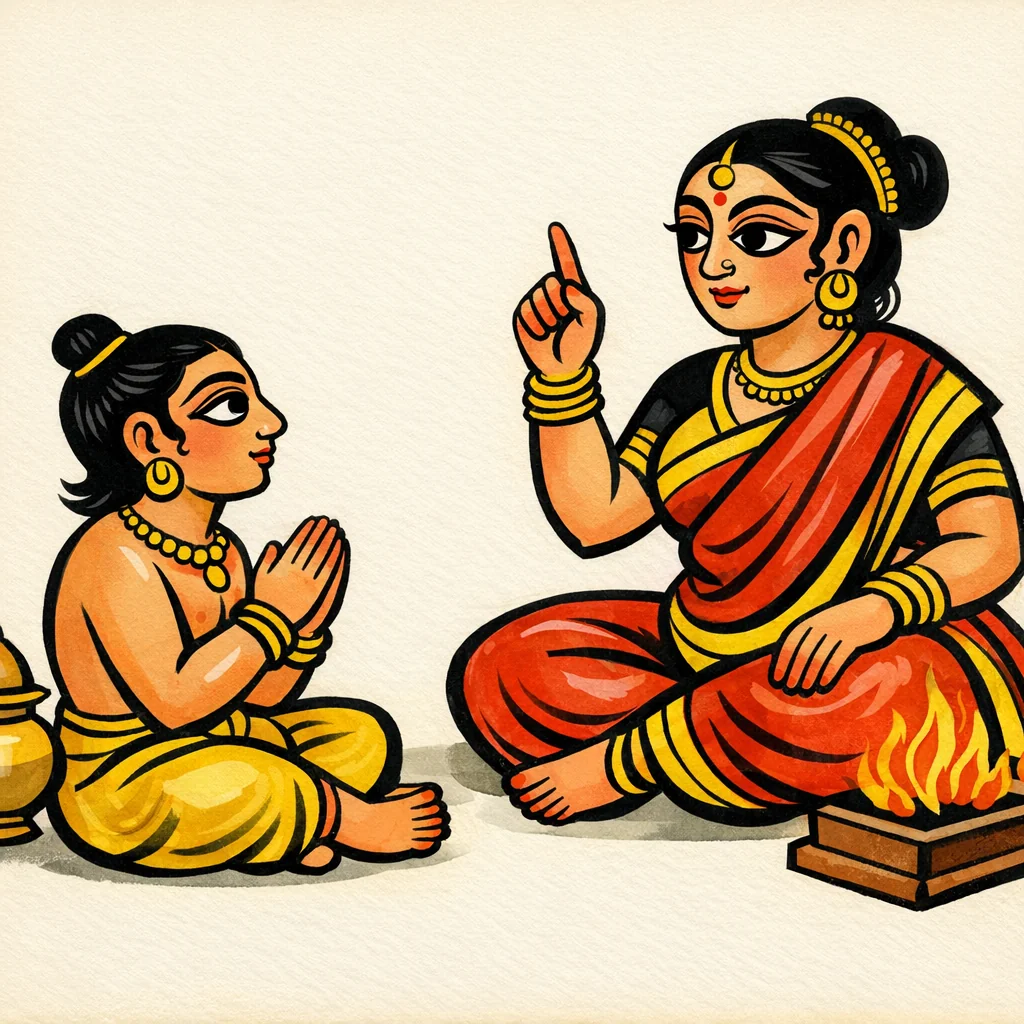
Adhyaya 34: Madālāsā’s Instruction on Sadācāra (Householder Conduct, Purity, and Daily Rites)
सदाचारवर्णनम् (Sadācāra-varṇanam)
Duties of Women
In this adhyaya, Madālāsā teaches Sadācāra—the righteous discipline of a householder: bodily and mental purity, bathing and cleanliness, orderly daily duties, reverence to the sacred fire and the deities, the practice of sandhyā-vandana, japa, and daily worship. She upholds truthfulness, compassion, moderation, and honoring the guest, so that dharma is preserved and peace and merit abide within the home.
Divine Beings
Key Content Points
Focus Keywords
Shlokas in Adhyaya 34
Verse 1
इति श्रीमार्कण्डेयपुराणे काम्यश्राद्धफलाकथनं नाम त्रयस्त्रिंशोऽध्यायः । चतुस्त्रिंशोऽध्यायः । मदालसोवाच एवम् पुत्र ! गृहस्थेन देवताः पितरस्तथा । संपूज्या हव्यकव्याभ्यामन्नेनातिथिबान्धवाः ॥
Thus ends the thirty-third chapter called “The account of the fruits of desire-motivated śrāddha.” Now begins the thirty-fourth chapter. Madālasa said: “Therefore, my son: a householder should duly honor the deities and likewise the ancestors with offerings meant for the gods (havis) and for the fathers (kavya); and with food he should honor guests and kinsmen.”
Verse 2
भूतानि भृत्याः सकलाः पशुपक्षिपिपीलिकाः । भिक्षवो याचमानाश्च ये चान्ये वसता गृहे ॥
(He should care for) all beings and all dependents or servants—animals, birds, even ants—as well as mendicants who ask for alms, and any others who dwell in the house.
Verse 3
सदाचारवता तात ! साधुना गृहमेदिना । पापं भुङ्क्ते समुल्लङ्घ्य नित्यनैमित्तिकीः क्रियाः ॥
O dear son: even a ‘good’ householder, though otherwise of proper conduct, incurs sin and must suffer its fruit if he transgresses and neglects the daily and the occasional duties.
Verse 4
अलर्क उवाच कथितं मे त्वया मातर्नित्य नैमित्तिकञ्च यत् । नित्यनैमित्तिकञ्चैव त्रिविधं कर्म पौरुषम् ॥
Alarka said: “Mother, you have explained to me what is daily duty and what is occasional duty; thus human action is threefold—daily, occasional, and that which is both daily and occasional.”
Verse 5
सदाचारमहं श्रोतुमिच्छामि कुलनन्दिनि । यत् कुर्वन् सुखमाप्रोति परत्रेह च मानवः ॥
“O delight of the lineage, I wish to hear about right conduct—by practicing which a person attains happiness both here and in the world beyond.”
Verse 6
मदालसोवाच गृहस्थेन सदा कार्यमाचारपरिपालनम् । न ह्याचारविहीनस्य सुखमत्र परत्र वा ॥
Madālasa said: “A householder must always maintain proper conduct; for one who is devoid of conduct finds happiness neither here nor hereafter.”
Verse 7
यज्ञदानतपांसीह पुरुषस्य च भूतये । भवन्ति यः सदाचारं समुल्लङ्घ्य प्रवर्तते ॥
Sacrifice, charity, and austerity in this world become means to a person’s prosperity only when he acts without transgressing right conduct; but he who proceeds by overstepping sadācāra (good conduct) undermines their benefit.
Verse 8
दुराचारो हि पुरुषो नेहायुर् विन्दते महत् । कार्यॊ यत्नः सदाचारॆ आचारो हन्त्यलक्षणम् ॥
A man of bad conduct does not obtain long life in this world. Therefore one must strive for good conduct; proper conduct destroys misfortune and inauspiciousness.
Verse 9
तस्य स्वरूपं वक्ष्यामि सदाचारस्य पुत्रक । तन्ममैकमनाः श्रुत्वा तथैव परिपालय ॥
I shall explain the true nature of good conduct, dear child. Listen to me with a one-pointed mind, and then practice it exactly so.
Verse 10
त्रिवर्गसाधने यत्नः कर्तव्यो गृहमॆधिना । तत्संसिद्धो गृहस्थस्य सिद्धिरत्र परत्र च ॥
A householder must strive to accomplish the three aims (dharma, artha, and kāma). When these are properly fulfilled, the householder attains success both here and hereafter.
Verse 11
पादेनार्थस्य पारत्र्यं कुर्यात् सञ्चयमात्मवान् । अर्धेन चात्मभरणं नित्यनैमित्तिकान्वितम् ॥
With one quarter of his wealth, a self-controlled man should make savings for the next world (through meritorious provisions). With half, he should support himself and his household, together with the regular and occasional obligations.
Verse 12
पादं चात्मार्थमायस्य मूलभूतं विवर्धयेत् । एवमाचरतः पुत्र अर्थः साफल्यमर्हति ॥
And with one quarter, he should increase the very foundation of his income for his own livelihood. O son, for one who acts in this way, wealth becomes truly fruitful.
Verse 13
तद्वत् पापनिषेधार्थं धर्मः कार्यो विपश्चिता । परत्रार्थं तथैवान्यः काम्योऽत्रैव फलप्रदः ॥
Likewise, the wise should practice dharma in order to restrain sin. Another kind of dharma is for the sake of the next world; and the kāmya (desire-motivated) one yields its fruit here itself.
Verse 14
प्रत्यवायभयात् काम्यस्तथान्यश्चाविरोधवान् । द्विधा कामोऽपि गदितस्त्रिवर्गस्याविरोधतः ॥
The kāmya (desire-motivated) is undertaken out of fear of adverse consequence (pratyavāya), and another kind is non-conflicting with dharma. Thus kāma too is said to be twofold, in a way that does not oppose the triad of aims.
Verse 15
परम्परानुबन्धान् च धर्मादीन् तान् शृणुष्व मे ॥
Hear from me the successive interconnections of those—dharma and the rest (artha and kāma).
Verse 16
धर्मो धर्मानुबन्धार्थो धर्मो नात्मार्थबाधकः । उभाभ्यां च द्विधा कामस्तेन तौ च द्विधा पुनः ॥
Dharma is that which brings further dharma in its train; dharma does not obstruct one’s true self-interest. And with respect to both (dharma and artha), kāma becomes twofold; therefore those two (dharma and artha) are again twofold in their relation to kāma.
Verse 17
ब्राह्मे मुहूर्ते बुध्येत धर्मार्थौ चापि चिन्तयेत् । समुत्थाय तथाचम्य प्राङ्मुखो नियतः शुचिः ॥
One should awaken at the brāhma-muhūrta and reflect upon dharma and artha. Rising then and sipping water for purification (ācamanam), one should be disciplined and clean, facing east.
Verse 18
पूर्वां सन्ध्यां सनक्षत्रां पश्चिमां सदिवाकराम् । उपासीत यथान्यायं नैनां जह्यादनापदि ॥
One should duly perform the morning Sandhyā while the stars are still visible, and the evening Sandhyā while the sun is still present. Sandhyā should not be abandoned except in times of calamity.
Verse 19
असत्प्रलापमनृतं वाक्पारुष्यञ्च वर्जयेत् । असच्छास्त्रमसद्वादमसत्सेवाञ्च पुत्रक ॥
My child, one should avoid idle and unwholesome talk, falsehood, and harsh speech; and also avoid false teachings, wicked doctrines, and association with or service to the unrighteous.
Verse 20
सायं प्रापतस्तथा होमं कुर्वोत नियतात्मवान् । नोदयास्तमने बिम्बमुदीक्षेत विवस्वतः ॥
Having returned in the evening, a self-restrained person should perform the homa. He should not gaze at the disk of the sun at sunrise or at sunset.
Verse 21
केशप्रसाधनादर्शदर्शनं दन्तधावनम् । पूर्वाह्न एव कार्याणि देवतानाञ्च तर्पणम् ॥
Arranging the hair, looking into a mirror, and cleaning the teeth—these should be done only in the forenoon; and likewise the libations (tarpaṇa) to the deities.
Verse 22
ग्रामावसथतीर्थानां क्षेत्राणाञ्चैव वर्त्मनि । विण्मूत्रं नानुतिष्ठेत न कृष्टे न च गोव्रजे ॥
One should not pass stool or urine on the paths of villages, dwellings, sacred bathing places, or fields—nor on ploughed land, nor in a cowshed or cattle-pen.
Verse 23
नग्नां परस्त्रियां नेक्षेन्न पश्येदात्मनः सकृत् । उदक्यादर्शनं स्पर्शो वर्ज्यं सम्भाषणं तथा ॥
One should not look upon another man’s wife when she is unclothed, nor should one gaze upon one’s own nakedness. One should avoid seeing, touching, and even conversing with a woman who is menstruating.
Verse 24
नाप्सु मूत्रं पुरीषं वा मैथुनं वा समाचरेत् । नाधितिष्ठेच्छकृन्मूत्रकेशभस्मकपालिकाः ॥
One should not urinate or defecate in water, nor engage in sexual intercourse there. One should not step upon feces, urine, hair, ashes, or shards of a pot.
Verse 25
तुषाङ्गारास्थिशीर्णानि रज्जुवस्त्रादिकानि च । नाधितिष्ठेत्तथा प्राज्ञः पथि चैव तथाऽपि भुवि ॥
Likewise, a wise person should not step on chaff, live coals, scattered bones, ropes, cloth, and similar things—whether on the road or on the ground.
Verse 26
पितृदेवमनुष्याणां भूतानाञ्च तथाऽर्च्चनम् । कृत्वा विभवतः पश्चाद् गृहस्थो भोक्तुमर्हति ॥
After performing worship, according to one’s means, for the ancestors (pitṛ), the gods, human beings, and also living beings or spirits, a householder may then eat.
Verse 27
प्राङ्मुखोदङ्मुखो वापि स्वाचान्तो वाग्यतः शुचिः । भुञ्जीतान्नञ्च तच्चित्तो ह्यन्तर्जानुः सदा नरः ॥
Facing east or north, having sipped water for purification (ācāmana), restrained in speech and clean, a man should eat his food with mind attentive to it, seated properly (with knees drawn in).
Verse 28
उपगातादृते दोषं नान्यस्योदीरयेद् बुधः । प्रत्यक्षलवणं वर्ज्यमन्नमत्युष्णमेव च ॥
A wise person should not speak of another’s fault unless it has come directly to his notice. He should avoid food that is openly over-salted, and also food that is excessively hot.
Verse 29
न गच्छन्न च तिष्ठन् वै विण्मूत्रोत्सर्गमात्मवान् । कुर्वोत नैव चाचामन् यत् किञ्चिदपि भक्षयेत् ॥
A self-controlled person should not void feces or urine while walking or while standing. And without performing ācamana (ritual sipping/cleansing), he should not eat anything at all.
Verse 30
उच्छिष्टो नालपेत् किञ्चित् स्वाध्यायञ्च विवर्जयेत् । गां ब्राह्मणं तथा चाग्निं स्वमूर्धानञ्च न स्पृशेत् ॥
When in a state of ucchiṣṭa (impurity after eating), one should not speak anything and should avoid Vedic study. One should not touch a cow, a brāhmaṇa, fire, or one’s own head.
Verse 31
न च पश्येद्रवीं नेन्दुं न नक्षत्राणि कामतः । भिन्नासनं तथा शय्यां भाजनञ्च विवर्जयेत् ॥
One should not gaze at the sun, the moon, or the stars out of mere fancy. One should also avoid a broken seat, a broken bed, and a damaged vessel.
Verse 32
गुरूणामासनं देयमभ्युत्थानादिसत्कृतम् । अनुकूलं तथालापमभिवादनपूर्वकम् ॥
One should offer a seat to one’s teachers and elders and honor them by rising and other acts of respect. One should speak to them pleasantly, beginning with salutations.
Verse 33
तथानुगमनं कुर्यात् प्रतिकूलं न संजयेत् । नैकवस्त्रश्च भुञ्जीत न कुर्याद्देवतार्चनम् ॥
One should attend upon elders and teachers in a fitting manner and should not set oneself against them. One should not eat while wearing only a single garment, nor should one worship the deities in such an improper state.
Verse 34
न वाहयेद् द्विजान्नाग्नौ मेहं कुर्वोत् बुद्धिमान् । स्नायीत न नरो नग्नो न शयीत कदाचन ॥
A wise person should not make brāhmaṇas into a burden or conveyance, and should not urinate into fire. A man should not bathe naked, and he should never sleep naked.
Verse 35
न पाणिभ्यामुभाभ्याञ्च कण्डूयेत शिरस्तथा । न चाभीक्ष्णं शिरः स्नानं कार्यं निष्कारणं नरैः ॥
One should not scratch one’s head with both hands. And men should not bathe the head frequently without any reason.
Verse 36
शिरः स्नातश्च तैलेन नाङ्गं किञ्चिदपि स्पृशेत् । अनध्यायेषु सर्वेषु स्वाध्यायञ्च विवर्जयेत् ॥
After bathing the head with oil, one should not touch any part of the body improperly or without need. And on all days or times of anadhyāya (when study is suspended), one should avoid svādhyāya (self-recitation and study).
Verse 37
ब्राह्मणानिलगोसूर्यान् न मेहेत कदाचन । उदङ्मुखो दिवा रात्रावुत्सर्गं दक्षिणामुखः ॥
One should never urinate toward a brāhmaṇa, the wind (open air), a cow, or the sun. In the daytime one should relieve oneself (urine or feces) facing north; at night, facing south.
Verse 38
आबाधासु यथाकामं कुर्यान्मूत्रपुरीषयोः । दुष्कृतं न गुरोर् ब्रूयात् क्रुद्धं चैनं प्रसादयेत् ॥
In times of illness or distress, one may relieve urine and feces as needed. One should not speak of a teacher’s wrongdoing; and if the teacher is angry, one should pacify him.
Verse 39
परिवादं न शृणुयादन्येषामपि कुर्वताम् । पन्था देयो ब्राह्मणानां राज्ञो दुःखातुरस्य च ॥
One should not listen to slander, even when others are engaging in it. One should give way on the road to brāhmaṇas, to the king, and to one who is afflicted by suffering.
Verse 40
विद्याधिकस्य गुर्विण्या भारार्तस्य यवीयसः । मूकान्धबधिराणाञ्च मत्तस्योन्मत्तकस्य च ॥
One should yield precedence to one superior in learning, to a pregnant woman, to one burdened by a load, to one younger in need of consideration, and to the mute, the blind, and the deaf, as well as to the intoxicated and the insane.
Verse 41
पुंश्चल्याः कृतवैरस्य बालस्य पतितस्य च । देवालयं चैत्यतरुं तथैव च चतुष्पथम् ॥
One should be cautious and keep due space with regard to a wanton woman, one who has made enmity, a child, and a fallen person; and likewise, near a temple, a sacred tree, and at a crossroads, one should maintain respect and avoid impropriety.
Verse 42
विद्याधिकं गुरुं देवं बुधः कुर्यात् प्रदक्षिणम् । उपानद्वस्त्रमाल्यादि धृतमन्यैर्न धारयेत् ॥
A wise person should circumambulate one who is superior in learning, the guru, and the deity. One should not wear sandals, garments, garlands, and the like that have been worn by others.
Verse 43
उपवीतमलङ्कारं करकञ्चैव वर्जयेत् । चतुर्दश्यां तथाष्टम्यां पञ्चदश्याञ्च पर्वसु ॥
On the fourteenth lunar day, on the eighth, and on the fifteenth—days of festival or religious observance—one should refrain from wearing the sacred thread (yajñopavīta) as ordinary display, as well as ornaments and bracelets.
Verse 44
तैलाभ्यङ्गं तथा भोगं योषितश्च विवर्जयेत् । न क्षिप्तपादजङ्घश्च प्राज्ञस्तिष्ठेत् कदाचन ॥
One should avoid oil-massage, indulgent enjoyment, and improper association with women. A wise person should never stand in an undisciplined posture, with legs and feet flung about.
Verse 45
न चापि विक्षिपेत् पादौ पादं पादेन नाक्रमेत् । मर्माभिघातमाक्रोशं पैशुन्यञ्च विवर्जयेत् ॥
One should not swing or fling one’s feet about, nor place one foot upon the other in disrespect. One should avoid striking vital spots, abusive shouting, and malicious tale-bearing.
Verse 46
दम्भाभिमानतीक्ष्णानि न कुर्वोत विचक्षणः । मूर्खोन्मत्तव्यसनिनो विरूपान्मायिनस्तथा ॥
A discerning person should not act with hypocrisy, pride, or harshness—especially toward the foolish, the mad, the addicted, the deformed, and likewise toward the deceitful.
Verse 47
न्यूनाङ्गांश्चाधिकाङ्गांश्च नोपहासैर्विदूषयेत् । परस्य दण्डं नॊद्यच्छेच्छिक्षार्थं पुत्रशिष्ययोः ॥
One should not disgrace by mockery those with deficient limbs or with extra limbs. One should not raise a rod against another person—except for instruction, in the case of one’s own son or one’s student.
Verse 48
तद्वन्नोपविशेत्प्राज्ञः पादेनाक्रम्य चासनम् । संयावं कृसरं मांसं नात्मार्थमुपसाधयेत् ॥
Likewise, a wise person should not sit down after stepping on the seat (āsana) with the foot. He should not cook saṃyāva (sweet gruel), kṛsarā (a rice-and-pulse dish), or meat solely for his own sake.
Verse 49
सायं प्रातश्च भोक्तव्यं कृत्वा चातिथिपूजनम् । प्राङ्मुखोदङ्मुको वापि वाग्यतो दन्तधावनम् ॥
One should eat in the evening and in the morning, after worshiping and honoring a guest. One should clean the teeth facing east or north, with speech restrained (in silence or with moderation).
Verse 50
कुर्वोत सततं वत्स ! वर्जयेद्वर्ज्यवीरुधः । नोदक्शिराः स्वपेज्जातु न चप्रत्यक्शिरा नरः ॥
Always do so, dear child; one should avoid the plants that are to be avoided. A man should never sleep with his head toward the north, nor with his head toward the west.
Verse 51
शिरस्यगस्त्यमास्थाय शयीताथ पुरंदरम् । न तु गन्धवतीष्वप्सु स्नायीत न तथा निशि ॥
Let him sleep with his head (or pillow) placed toward Agastya (the southern direction/the Agastya star), and then reverently remember Purandara (Indra). But he should not bathe in perfumed water, nor should he bathe at night.
Verse 52
उपरागे परं स्नानमृते दिनमुदाहृतम् । अपमृज्यान्न चास्नातो गात्राण्यंबरपाणिभिः ॥
During an eclipse (uparāga), bathing is declared supremely meritorious, except on a prohibited day (as taught). After bathing, one should wipe the body; one who has not bathed should not rub the limbs with cloth and hands as though clean.
Verse 53
न चापि धूनयेत्केशान् वाससी न च धूनयेत् । नानुलेपनमादद्यादस्नातः कर्हिचिद्बुधः ॥
One should not shake out the hair, nor shake out one’s garments. A wise person, when unbathed, should never apply oils or anointing pastes/unguents.
Verse 54
न चापि रक्तवासाः स्याच्चित्रासितधरोऽपि वा । न च कुर्याद्विपर्यासं वाससोर्नापि भूषणे ॥
One should not wear red garments, nor even variegated or black clothing. And one should not wear clothes in a reversed or improper manner, nor wear ornaments improperly.
Verse 55
वर्ज्यञ्च विदशं वस्त्रमत्यन्तोपहतञ्च यत् । केशकीटावपन्नञ्च क्षुण्णं श्वभिरवेक्षितम् ॥
One should avoid torn clothing and that which is excessively damaged; also garments infested with lice or insects, those that are crushed or soiled, and those that have been looked upon or defiled by dogs.
Verse 56
अवलीढावपन्नञ्च सारोद्धरणदूषितम् । पृष्ठमांसं वृथामांसं वर्ज्यमांसञ्च पुत्रक ! ॥
Also, meat that has been licked and thereby tainted, and meat spoiled by the removal of its essence/juice (or by improper extraction) should be avoided; likewise back-meat, useless meat, and meat that is forbidden—O dear son.
Verse 57
न भक्षयीत सततं प्रत्यक्षलवणानि च । वर्ज्यं चिरोषितं पुत्र ! भक्तं पर्युषितञ्च यत् ॥
One should not constantly eat foods that are overtly salty. And, dear son, food that has been kept long, and that which is stale or left overnight, should be avoided.
Verse 58
पिष्टशाकेक्षुपयसां विकारान्नृपनन्दन । तथा मांसविकारांश्च ते च वर्ज्याश्चिरोषिताः ॥
O prince, one should avoid preparations made from flour (pastes), leafy vegetables, sugarcane, and milk; likewise, preparations of meat should be avoided—especially foods that have been kept for a long time (stale).
Verse 59
उदयास्तमने भानोः शयनञ्च विवर्जयेत् । नास्नातो नैव संविष्टो न चैवान्यमना नरः ॥
One should avoid lying down at sunrise and at sunset. A man should not sit to eat (or recline) without bathing, nor while not properly seated, nor with a distracted mind.
Verse 60
न चैव शयने नोर्व्यामुपविष्टो न शब्दवत् । न चैैकवस्त्रो न वदन् प्रेक्षतामप्रदाय च ॥
One should not eat while seated on a bed, nor seated on bare ground, nor noisily. One should not eat wearing only a single garment, nor while speaking, and not without offering (a share) to those who are watching/nearby.
Verse 61
भुञ्जीत पुरुषः स्नातः सायं प्रातर्यथाविधि । परदाराः न गन्तव्याः पुरुषेण विपश्चिता ॥
A man should eat after bathing, in the evening and in the morning, according to prescribed rule. A wise man must not approach another man’s wife.
Verse 62
इष्टापूर्तायुषां हन्त्री परदारगतिर् नृणाम् । न हीदृशमनायुष्यं लोके किञ्चन विद्यते ॥
For men, going to another’s wife destroys the merit of sacrifices and pious works and also destroys lifespan. Nothing so harmful to longevity exists in this world.
Verse 63
यादृशं पुरुषस्येह परदाराभिमर्षणम् । देवार्चनाग्निकार्याणां तथा गुर्वभिवादनम् ॥
Such is the fault and ruin for a man in this world when he commits the transgression of violating another’s wife; likewise is the fault in neglecting the worship of the gods, the rites of the sacred fire, and the reverent salutation of one’s guru and elders.
Verse 64
कुर्वोत सम्यगाचम्य तद्वदन्नभुजिक्रियाम् । अफेनाभिरगन्धाभिरद्भिरच्छाभिरादरात् ॥
Having properly performed ācamana, one should likewise undertake the act of eating in due manner, using clear water that is without foam and without foul smell, and doing so with care.
Verse 65
आचामेत् पुत्र ! पुण्याभिः प्राङ्मुखोदङ्मुखोऽपि वा । अन्तर्जलादावसथाद्वल्मीकान्मूषिकस्थलात् ॥
O son, one should perform ācamana with pure water, facing east—or also facing north. One should avoid water from enclosed or standing pools, from dwellings, from ant-hills, and from places frequented by mice or rats.
Verse 66
कृतशौचावशिष्टाश्च वर्जयेत् पञ्च वै मृदः । प्रक्षाल्य हस्तौ पादौ च समभ्युक्ष्य समाहितः ॥
After cleansing (śauca), one should avoid five kinds of earth (used, leftover, or impure clays). Having washed the hands and feet and then sprinkling water upon oneself, one should remain composed.
Verse 67
अन्तर्जानुस्तथाऽचामेत् त्रिश्चतुर्वा पिबेदपः । परिमृज्य द्विरास्यान्तं खानि मूर्धानमेव च ॥
With the knees drawn in (in a proper posture), one should perform ācamana, sipping water three times—or four. Then, wiping twice the inside of the mouth, one should also wipe the sense-openings and the head.
Verse 68
सम्यगाचम्य तोयेन क्रियां कुर्वोत वै शुचिः । देवतानामृषीणाञ्च पितॄणाञ्चैव यत्नतः ॥
Having duly performed ācamana (the purificatory sipping of water), one who is clean should carefully carry out the rites—those intended for the gods, the seers (ṛṣi), and the ancestors.
Verse 69
समाहितमना भूत्वा कुर्वोत सततं नरः । क्षुत्वा निष्ठीव्य वासश्च परिधायाचमेद् बुधः ॥
A man should act continually with a collected mind. After sneezing or spitting, the wise should adjust his garment and then perform ācamana.
Verse 70
क्षुतेऽवलीढे वान्ते च तथा निष्ठीवनादिषु । कुर्यादाचमनं स्पर्शं गोपृष्ठस्यार्कदर्शनम् ॥
After sneezing, licking something impure, vomiting, and likewise after spitting and similar acts, one should perform ācamana, touch the back of a cow, and behold the sun.
Verse 71
कुर्वोतालम्बनं चापि दक्षिणश्रवणस्य वै । यथाविभवतो ह्येतत् पूर्वाभावे ततः परम् ॥
One should also take hold of (touch) the right ear. These acts are to be done according to one’s means; when the earlier prescribed act is not possible, the next is to be adopted.
Verse 72
अविद्यमाने पूर्वोक्ते उत्तरप्राप्तिरिष्यते । न कुर्याद् दन्तसङ्घर्षं नात्मनो देहताडनम् ॥
When the previously stated act is not available, recourse to the next is approved. One should not grind the teeth, nor strike one’s own body.
Verse 73
स्वप्नाध्ययनभोज्यानि सन्ध्ययोश्च विवर्जयेत् । सन्ध्यायां मैथुनञ्चापि तथा प्रस्थानमेव च ॥
At the two twilight times one should avoid sleeping, studying, and eating. At twilight one should also avoid sexual intercourse and setting out on a journey.
Verse 74
पूर्वाह्ने तात ! देवानां मनुष्याणाञ्च मध्यमे । भक्त्या तथापराह्ने च कुर्वोत पितृपूजनम् ॥
In the forenoon, dear one, worship is due to the gods; at midday, to human beings; and in the afternoon one should, with devotion, perform worship of the ancestors.
Verse 75
शिरः स्नातश्च कुर्वोत दैवं पैत्र्यमथापि वा । प्राङ्मुखोदङ्मुखो वापि श्मश्रुकर्म च कारयेत् ॥
Having bathed (including the head), one should perform rites—whether for the gods or for the ancestors. Facing east or facing north, one should also have the shaving or grooming of the beard done.
Verse 76
व्यङ्गिनीं वर्जयेत् कन्यां कुलजामपि रोगिणीम् । विकृतां पिङ्गलाञ्चैव वाचाटां सर्वदूषिताम् ॥
One should avoid marrying a maiden who is physically impaired—even if she is of good family—or one who is diseased; likewise one who is deformed, tawny-eyed, overly talkative, or otherwise wholly blemished.
Verse 77
अव्यङ्गीं सौम्यनासाञ्च स्रवलक्षणलक्षिताम् । तादृशीमुद्वहेत् कन्यां श्रेयः कामो नरः सदा ॥
A man who always seeks well-being should marry a maiden who is without bodily defect, with a pleasing nose and face, and marked by auspicious feminine characteristics.
Verse 78
उद्वहेत् पितृमात्रोश्च सप्तमीं पञ्चमीं तथा । रक्षेद्दारान् त्यजेद् ईर्ष्यां दिवा च स्वप्नमैथुने ॥
He should avoid marital intercourse on the fifth and the seventh nights counted from the onset of the wife’s menses; he should protect his wife, abandon jealousy, and avoid sexual union in the daytime and in dreams (i.e., indulgence in erotic dreaming or fantasizing).
Verse 79
परोपतापकं कर्म जन्तुपीडां च वर्जयेत् । उदक्या सर्ववर्णानां वर्ज्या रात्रिचतुष्टयम् ॥
One should avoid actions that cause suffering to others and avoid harming living beings. A menstruating woman (udakyā) is to be avoided (for sexual contact) by men of all social classes for four nights.
Verse 80
स्त्रीजन्मपरिहारार्थं पञ्चमीमपि वर्जयेत् । ततः षष्ठ्यां व्रजेन्नात्र्याṃ श्रेष्ठा युगमासु पुत्रक ॥
With the aim (as stated here) of avoiding the birth of a daughter, one should avoid the fifth night as well. Then, on the sixth night one should approach; among the even-numbered nights, those are said to be best, dear child.
Verse 81
युग्मासु पुत्रा जायन्ते स्त्रियो 'युग्मासु रात्रिषु । तस्माद् युग्मासु पुत्रार्थो संविशेत सदा नरः ॥
Sons are born on even-numbered nights; daughters on odd-numbered nights. Therefore, a man desiring a son should always cohabit on even-numbered nights.
Verse 82
विधर्मिणो 'ह्नि पूर्वाख्ये सन्ध्याकाले च षण्डकाः । क्षुरकर्मणि वान्ते च स्त्रीसम्भोगे च पुत्रक ॥
Children who are ‘vidharmī’ (deviant from proper dharma) are said to result from intercourse in the daytime (as taught earlier) and at twilight; and ‘ṣaṇḍaka’ (impotent/eunuch-like offspring) from intercourse connected with shaving/tonsure, after vomiting, and other improper conditions—dear child.
Verse 83
स्नायीत चेलवान् प्राज्ञः कटभूमिमुपेत्य च । देववेदद्विजातीनां साधुसत्यमहात्मनाम् ॥
The wise person should bathe, don clean garments, and approach a proper place that has been purified. He should act with reverence toward the gods, the Veda, the twice-born, and the saints—truthful, great-souled persons.
Verse 84
गुरोः पतिव्रतानाञ्च तथा यज्वितपस्विनाम् । परिवादं न कुर्वीत परिहासं च पुत्रक ॥
Dear child, one should engage neither in slander nor in ridicule of one’s guru, of devoted chaste wives (pativratās), and likewise of sacrificers and ascetics.
Verse 85
कुर्वतामविनीतानां न श्रोतव्यं कथञ्चन । नोत्कृष्टशय्यासनयोर्नापकृष्टस्य चारुहेत् ॥
One should not in any way listen to the talk of those who behave without discipline. One should not occupy an overly superior bed or seat, nor mount or step upon that which belongs to one’s inferior in status.
Verse 86
न चामङ्गल्यवेषः स्यान्न चामङ्गल्यवाग्भवेत् । धवलाम्बरसंवीतः सितपुष्पविभूषितः ॥
Let him not wear inauspicious attire, nor speak inauspicious words. Let him be clad in white garments and adorned with white flowers.
Verse 87
नोद्धूतोन्मत्तमूढैश्च नाविनीतैश्च पण्डितः । गच्छेन्मैत्रीं न चाशीलेर्न च चौर्यादिदूषितैः ॥
A learned person should not associate with the arrogant, the mad, the foolish, or the undisciplined. He should not form friendships with the immoral, nor with those tainted by theft and similar vices.
Verse 88
न चातिव्ययशीलैश्च न लुब्धैर्नापि वैरिभिः । न बन्धकीभिर्न न्यूनैर्बन्धकीपतिभिस्तथा ॥
One should not associate with those given to excessive expenditure, nor with the greedy, nor with enemies; nor with courtesans, nor with the lowly, nor likewise with the husbands or keepers of courtesans.
Verse 89
सार्धं न बलिभिः कुर्यान्न च न्यूनैर्न निन्दितैः । न सर्वशङ्किभिर्नित्यं न च दैवपरैर्नरैः ॥
One should not enter into dealings or partnership with the powerful and overbearing, nor with the inferior, nor with the blameworthy; nor always with those who suspect everything, nor with men who are merely fate-dependent.
Verse 90
कुर्वीत साधुभिर्मैत्रीं सदाचारावलम्बिभिः । प्राज्ञैरपिशुनैः शक्तैः कर्मण्युद्योगभागिभिः ॥
One should cultivate friendship with the good—those devoted to proper conduct—who are wise, not slanderous, capable, and who share in diligence and enterprise in work.
Verse 91
सुहृद्दीक्षितभूपालस्नातकश्वशुरैः सह । ऋत्विगादीन् षडर्घार्हानर्चयेच्च गृहागतान् ॥
Together with friends, consecrated persons, kings, snātakas, and fathers-in-law, one should honor those worthy of the sixfold hospitality (ṣaḍ-argha)—such as officiating priests and others—when they come to one’s house.
Verse 92
यथाविभवतः पुत्र ! द्विजान् संवत्सरोषितान् । अर्चयेन मधुपर्केण यथाकालमतन्द्रितः ॥
O son, according to one’s means, one should honor twice-born (dvija) guests who have stayed for a year with the madhuparka offering, punctually and without negligence.
Verse 93
तिष्ठेच्च शासने तेषां श्रेयस्कामो द्विजोत्तमः । न च तान् विवदेद्वीमानाक्रुष्टश्चापि तैः सदा ॥
A foremost twice-born who seeks welfare should abide by their instruction; he should not dispute with them, nor become resentful, even if he is rebuked by them.
Verse 94
सम्यग्गृहाचनं कृत्वा यथास्थानमनुक्रमात् । संपूजयेत् ततो वह्निं दद्याच्चैवाहुतीः क्रमात् ॥
Having properly performed the worship in the house in due order and in the proper places, one should then worship the sacred fire and offer oblations sequentially.
Verse 95
प्रथमां ब्रह्मणे दद्यात् प्रजानांपतये ततः । तृतीयाञ्चैव गुह्येभ्यः कश्यपाय तथापराम् ॥
One should give the first oblation to Brahmā, then to the Lord of creatures (Prajāpati); the third to the Guhyas, and another likewise to Kaśyapa.
Verse 96
ततोऽनुमतये दत्त्वा दद्याद् गृहबलिं ततः । पूर्वाख्यातं मया यत्ते नित्यकर्मक्रियाविधौ ॥
Then, having offered to Anumatī, one should next give the house-offering (gṛha-bali). This is what I previously explained to you in the procedure for daily obligatory rites.
Verse 97
वैश्वदेवन्ततः कुर्याद्धलयस्तत्र मे शृणु । यथास्थानविभागन्तु देवानुद्दिश्य वै पृथक् ॥
Thereafter one should perform the Vaiśvadeva offering; listen to me regarding the portions there. The distribution should be made according to the proper places, addressing the deities separately.
Verse 98
पर्जन्याय धरित्रीणां दद्याच्च माणके त्रयम् । वायवे च प्रतिदिशं दिग्भ्यः प्राच्यादितः क्रमात् ॥
He should offer three māṇaka-measures to Parjanya (the rain-god) and to the Earth; and likewise to Vāyu (the Wind) in each direction—making the offerings to the quarters in due order, beginning with the East.
Verse 99
ब्रह्मणे चान्तरीक्षाय सूर्याय च यथाक्रमम् । विश्वेभ्यश्चैव देवेभ्यो विश्वभूतभ्य एव च ॥
And he should offer to Brahmā, to the mid-region (Antarikṣa), and to the Sun, in their proper order; and also to the Viśvedevas, indeed to all universal beings.
Verse 100
उषसे भूतपतये दद्याच्चोत्तरतो ततः । स्वधा नम इतीत्युक्त्वा पितृभ्यश्चापि दक्षिणे ॥
Then, toward the North, he should offer to Uṣas (Dawn) and to the Lord of beings (Bhūtapati). Saying, “Svadhā, namaḥ,” he should also offer to the Pitṛs toward the South.
Verse 101
कृत्वापसव्यं वायव्यां यक्ष्मैतत्तेति भाजनात् । अन्नावशेषमिच्छन् वै तोयं दद्याद्यथाविधि ॥
Then, in the north-west (vāyavya) direction, having performed the rite as apasavya (with the sacred thread reversed) and uttered “yakṣma etat te” from the vessel—thereafter, if he desires the remainder of the food, he should give water according to rule.
Verse 102
ततोऽन्नाग्रं समुद्धृत्य हन्तकारोपकल्पनम् । यथाविधि यथान्यायं ब्राह्मणायोपपादयेत् ॥
Then, having lifted up the foremost portion of the food and arranged the offering as prescribed, he should duly and properly present it to a brāhmaṇa.
Verse 103
कुर्यात्कर्माणि तीर्थेन स्वेन स्वेन यथाविधि । देवादीनां तथा कुर्याद् ब्राह्मेणाचमनक्रियाम् ॥
He should perform the rites with the appropriate hand-tīrtha, each according to its prescribed procedure. Likewise, for the gods and others, he should perform ācamana (ritual sipping for purification) using the brāhma-tīrtha.
Verse 104
अङ्गुष्ठोत्तरतो रेखा पाणेर्या दक्षिणस्य तु । एतद् ब्राह्ममिति ख्यातं तीर्थमाचमनाय वै ॥
The line on the right palm, just above the thumb—this is known as the brāhma-tīrtha, indeed for the purpose of ācamana.
Verse 105
तर्जन्यङ्गुष्ठयोरन्तः पैत्र्यं तीर्थमुदाहृतम् । पितॄणां तेन तोयादि दद्याद् नान्दीमुखादृते ॥
The space between the index finger and the thumb is declared to be the paitṛya-tīrtha. With that, one should offer water and the like to the Pitṛs—except in the Nāndīmukha rite.
Verse 106
अङ्गुल्यग्रे तथा दैवं तेन दिव्यक्रियाविधिः । तीर्थं कनिष्ठिकामूले कायं तेन प्रजापतेः ॥
At the tips of the fingers is the daiva-tīrtha; by that the proper procedure for divine rites is observed. The tīrtha at the base of the little finger is the prājāpatya (of Prajāpati); by that one performs rites for Prajāpati.
Verse 107
एवमेभिः सदा तीर्थैर्देवानां पितृभिः सह । सदा कार्याणि कुर्वोत नान्यतीर्थेन कर्हिचित् ॥
Thus, always with these designated tīrthas, for the gods and together with the Pitṛs, one should always perform the rites—never at any time with another tīrtha.
Verse 108
ब्राह्मेणाचमनं शस्तं पित्र्यं पैत्र्येण सर्वदा । देवतीर्थेन देवानां प्राजापत्यं निजेन च ॥
Sipping water in the rite of ācamana is properly performed with the Brāhma-tīrtha; the rite for the Pitṛs should always be done with the Paitrya-tīrtha. For the gods one should use the Deva-tīrtha, and for Prajāpati the Prājāpatya-tīrtha—each according to its own proper mode.
Verse 109
नान्दीमुखानां कुर्वोत प्राज्ञः पिण्डोदकक्रियाम् । प्राजापत्येन तीर्थेन यच्च किञ्चित् प्रजापतेः ॥
A wise person should perform the piṇḍa-and-water offerings connected with the Nāndīmukhas using the Prājāpatya-tīrtha; and likewise, whatever rite belongs to Prajāpati should be done in that same manner.
Verse 110
युगपज्जलमग्निं च बिभृयान्न विचक्षणः । गुरुदेवान् प्रति तथा न च पादौ प्रसारयेत् ॥
A discerning person should not carry water and fire together at the same time. Likewise, in the presence of one’s guru or the gods, one should not stretch out one’s feet.
Verse 111
नाचक्षीत धयन्तीं गां जलं नाञ्जलिना पिबेत् । शौचकालेषु सर्वेषु गुरुṣ्वल्पेषु वा पुनः ॥
One should not look at a cow while she is nursing, and one should not drink water from the cupped palms. At all times of śauca (ritual impurity/purification), and again in the presence of elders or gurus—even if they are young—one should observe such restraint.
Verse 112
न विलम्बेत शौचार्थं न मुखेनानलं धमेत् । तत्र पुत्र ! न वस्तव्यं यत्र नास्ति चतुष्टयम् ॥
When purification is required, one should not delay, and one should not blow a fire with the mouth. And, O son, one should not live in a place where the fourfold set of essential supports is absent.
Verse 113
ऋणप्रदाता वैद्यश्च श्रोत्रियः सजला नदी । जितामित्रो नृपो यत्र बलवान् धर्मतत्परः ॥
Where there is a lender, a physician, a learned śrotriya, and a river with water—and where the king is strong, devoted to dharma, and has conquered or subdued his enemies—there is a fit place (to dwell).
Verse 114
तत्र नित्यं वसेत् प्राज्ञः कुतः कुनृपतौ सुखम् । यत्राप्रधृष्यो नृपतिर्यत्र शस्यवती मही ॥
A wise person should always live in such a place; for how can there be happiness under a bad king? Live where the ruler is not easily assailed and where the land is rich in crops.
Verse 115
पौराः सुसंयता यत्र सततं न्यायवर्तिनः । यत्रामत्सरिणो लोकास्तत्र वासः सुखोदयः ॥
Where the townspeople are well-restrained and constantly follow justice, and where people are free from envy—dwelling there gives rise to happiness.
Verse 116
यस्मिन् कृषीबला राष्ट्रे प्रायशो नातिभोगिनः । यत्रौषधन्यशेषाणि वसेत्तत्र विचक्षणः ॥
In a kingdom strong in agriculture, where people are generally not excessive in indulgence, and where medicinal herbs and grains are plentiful—there a discerning person should live.
Verse 117
तत्र पुत्र न ! वस्तव्यं यत्रैतत् त्रितयं सदा । जिगीषुः पूर्ववैरश्च जनश्च सततोत्सवः ॥
But, O son, one should not live where these three are always present: a ruler (or people) bent on conquest, longstanding enmity, and a populace continually given to festivities.
Verse 118
वसेन्नित्यं सुशीलेषु सहवासिषु पण्डितः । इत्येतत् कथितं पुत्र ! मया ते हितकाम्यया ॥
A wise person should always dwell among those of right conduct, who are good companions. Thus, O son, I have told you this out of a desire for your welfare.
Frequently Asked Questions
Alarka asks Madālāsā to define sadācāra—right conduct for a householder—that secures sukha both in the present life and in the hereafter; the chapter answers by integrating ethics, purity, and domestic ritual into a single normative regimen.
This Adhyāya is not a Manvantara chronicle; it functions instead as a dharma-śāstric interlude within the broader Purāṇic discourse, detailing gṛhastha conduct and daily rites rather than Manu lineages or cosmic durations.
It does not belong to the Devi Māhātmya section (Adhyāyas 81–93). Its relevance is ethical-ritual: it codifies household purity, offerings, and social duties that form the liturgical and moral substrate upon which later devotional theologies—including Śākta practice—are commonly enacted.