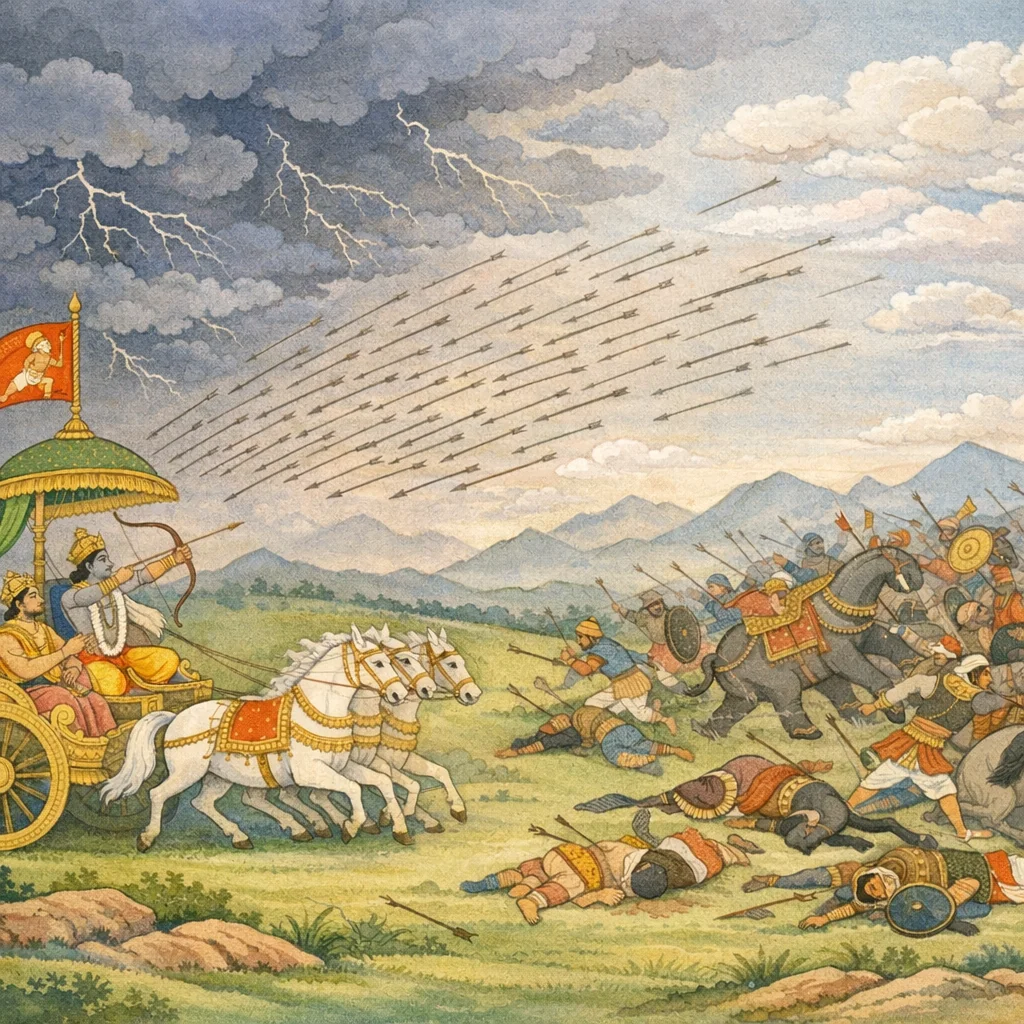
Adhyaya 63
उत्तरो जयमावेदयति—विराटस्य हर्षः, द्यूतनिषेधः (Uttara’s Victory Report—Virāṭa’s Rejoicing and the Counsel Against Gambling)
Upa-parva: Gograhana (Cattle-Raid) / Kuru–Matsya Encounter Episode
Vaiśaṃpāyana narrates Virāṭa’s return to the city after defeating the Trigartas and recovering cattle, followed by courtly reception by subjects and Brahmins. Virāṭa anxiously inquires about his son Uttara, learns that the Kurus have taken Matsya cattle, and hears that Uttara—boldly departing with Bṛhannaḍā as charioteer—has confronted eminent Kuru commanders. Messengers arrive announcing complete recovery of the cattle and Kuru defeat; Virāṭa orders public celebrations, processions, music, and welcomes for Uttara and Bṛhannaḍā. In the palace, Virāṭa, elated, calls for dice play; Yudhiṣṭhira (as Kaṅka) advises against gambling by citing its harms and recalling Yudhiṣṭhira’s own catastrophic loss. Virāṭa, irritated by perceived insult to his status and by praise of Bṛhannaḍā, strikes Yudhiṣṭhira with a die, causing a nosebleed. Yudhiṣṭhira restrains escalation; Draupadī (as Sairandhrī) collects the blood to prevent it from falling to the ground, mitigating the risk of exposing identity and averting consequences tied to Bṛhannaḍā’s stated vow. The chapter closes with Uttara’s triumphant return and a doorkeeper’s announcement, while Karṇa attempts to restrict Bṛhannaḍā’s entry, citing a dangerous retaliatory vow if blood is seen outside battle.
Chapter Arc: वैशम्पायन जनमेजय को सुनाते हैं कि गोहरण के प्रसंग में दुर्योधन, कर्ण, दुःशासन, विविंशति, द्रोण (पुत्र सहित) और कृप—क्रोध से भरकर धनंजय (अर्जुन) को मारने के लिए एक साथ पलट पड़ते हैं। → कौरव-महारथी दृढ़ धनुषों की टंकार के साथ निकट आकर अर्जुन की गति रोकने का यत्न करते हैं; समरभूमि में बाण-वर्षा घनी होती जाती है और चारों ओर से घेरने का दबाव बढ़ता है। → वानरध्वज अर्जुन सूर्य-तेज रथ पर प्रत्युद्यत होकर गाण्डीव को इन्द्रधनुष-सी दीप्ति देता है; उसकी बाण-धारा बिजली की तरह दसों दिशाओं को ढँक लेती है, जिससे नाग, अश्व, रथी—सब मोहग्रस्त हो उठते हैं और कौरव-सेना का धैर्य टूट जाता है। → कौरवों के व्यूह भग्न हो जाते हैं; योद्धा जड़ता/मूकता में पड़कर विमुख होते हैं और जीवन से निराश होकर दिशाओं में भागते हैं—अर्जुन का प्रभुत्व निर्णायक रूप से स्थापित होता है। → पराजित सेना के पलायन के बाद गोहरण-प्रसंग का आगे का परिणाम और कौरवों की अगली चाल अगले अध्यायों की ओर संकेत करती है।
Shlokas
Verse 1
वैशम्पायनजी कहते हैं--जनमेजय! तदनन्तर दुर्योधन, कर्ण, दुःशासन, विविंशति, पुत्रसहित आचार्य द्रोण और महारथी कृपाचार्य--ये सब योद्धा रोषमें भरकर धनंजयको मार डालनेकी इच्छासे अपने मजबूत और दृढ़ धनुषोंकी टंकार फैलाते हुए उनपर पुनः चढ़ आये
Vaiśampāyana said: “O Janamejaya, thereafter Duryodhana, Karṇa, Duḥśāsana, Viviṁśati, Droṇa the preceptor together with his son, and the great chariot-warrior Kṛpācārya—all these fighters, inflamed with wrath and intent on killing Dhanañjaya (Arjuna), once again charged at him, making their strong, firm bows resound with twanging.”
Verse 2
पुनर्ययुश्व संरब्धा धनंजयजिघांसव: । विस्फारयन्तश्नापानि बलवन्ति दृढानि च,वैशम्पायनजी कहते हैं--जनमेजय! तदनन्तर दुर्योधन, कर्ण, दुःशासन, विविंशति, पुत्रसहित आचार्य द्रोण और महारथी कृपाचार्य--ये सब योद्धा रोषमें भरकर धनंजयको मार डालनेकी इच्छासे अपने मजबूत और दृढ़ धनुषोंकी टंकार फैलाते हुए उनपर पुनः चढ़ आये
Vaiśaṃpāyana said: Then, inflamed with anger and intent on killing Dhanaṃjaya (Arjuna), they charged again, making their strong, unyielding bows resound with loud twangs. The scene underscores how wrath and vengeance drive warriors to renewed assault, tightening the spiral of violence on the battlefield.
Verse 3
तान् विकीर्णपताकेन रथेनादित्यवर्चसा । प्रत्युधयौ महाराज समनन््तादू वानरध्वज:,महाराज! तब वानरयुक्ता ध्वजावाले अर्जुन भी सूर्यके समान तेजस्वी तथा फहराती हुई पताकासे सुशोभित रथके द्वारा सब ओरसे उनका सामना करनेके लिये आगे बढ़े
Vaiśampāyana said: O King, then Arjuna—whose banner bore the emblem of a monkey—advanced to meet them on every side, riding a chariot radiant like the sun and adorned with a broad, fluttering flag. Thus was shown the warrior’s duty: to confront aggression without fear and to hold fast to steadfast resolve as battle drew near.
Verse 4
ततः कृपश्च कर्णश्न द्रोणश्व॒ रथिनां वर: । त॑ महास्त्रैर्महावीर्य परिवार्य धनंजयम्,यह देख कृपाचार्य, कर्ण तथा रथियोंमें श्रेष्ठ आचार्य द्रोण--ये महापराक्रमी धनंजयको (चारों ओरसे) घेरकर अपने महान् धनुषोंसे उनपर राशि-राशि बाणोंका खूब जमकर प्रहार करने लगे। ये तीनों महारथी धनंजयको मार गिरानेकी इच्छासे वर्षाकालके मेघोंकी भाँति सायकोंकी वर्षा कर रहे थे
Vaiśampāyana said: Then Kṛpa, Karṇa, and Droṇa—the foremost among chariot-warriors—surrounded the mighty Dhanañjaya and assailed him with volleys of arrows loosed from their great weapons. Bent on bringing him down, those three mahārathas rained shafts upon him like monsoon clouds, sharpening the battle’s moral strain where prowess, duty, and rivalry collide.
Verse 5
शरौघान् सम्यगस्यन्तो जीमूता इव वार्षिका: । ववर्षु: शरवर्षाणि पातयन्तो धनंजयम्,यह देख कृपाचार्य, कर्ण तथा रथियोंमें श्रेष्ठ आचार्य द्रोण--ये महापराक्रमी धनंजयको (चारों ओरसे) घेरकर अपने महान् धनुषोंसे उनपर राशि-राशि बाणोंका खूब जमकर प्रहार करने लगे। ये तीनों महारथी धनंजयको मार गिरानेकी इच्छासे वर्षाकालके मेघोंकी भाँति सायकोंकी वर्षा कर रहे थे
Vaiśampāyana said: “With flawless aim they loosed volleys of arrows, like monsoon clouds heavy with rain, and poured down showers of shafts upon Dhanañjaya. Seeing this, Kṛpācārya, Karṇa, and Droṇa—the foremost among chariot-warriors—surrounded the mighty Dhanañjaya on every side and, intent on bringing him down, assailed him without pause with great bows, raining arrows like the clouds of the rainy season.”
Verse 6
इषुभिर्बहुभिस्तूर्ण समरे लोमवाहिभि: । अदूरात् पर्यवस्थाप्य पूरयामासुरादृता:,उन्होंने समरभूमिमें थोड़ी ही दूरपर पार्थकी गतिको कुण्ठित करके बड़े चावसे बहुसंख्यक पंखयुक्त बाणोंकी बौछार करते हुए उन्हें तुरंत दँक दिया
Vaiśampāyana said: In the battle they swiftly closed in from no great distance, hemming him about and checking Pārtha’s advance; then, with eager intent, they flooded him with a dense shower of countless feathered arrows, so swift as to make the hair stand on end, covering him in an instant.
Verse 7
तथा तैरवकीर्णस्य दिव्यैरस्त्रै: समन््तत: । न तस्य द्वयड्गुलमपि विवृतं सम्प्रदृश्यते,वे महारथी जब इस प्रकार सब ओरसे अर्जुनपर दिव्यास्त्रोंसे अभिमन्त्रित बाणोंकी वर्षा करने लगे, उस समय उनके शरीरका दो अंगुल भाग भी बाणोंसे खाली नहीं दिखायी देता था
Vaiśampāyana said: When those mahārathas thus showered Arjuna from every side with arrows empowered by divine weapons, not even a space two fingers wide could be seen bare upon his body—so completely was he covered by shafts.
Verse 8
ततः प्रहस्य बीभत्सुर्दिव्यमैन्द्रे महारथ: । अस्त्रमादित्यसंकाशं गाण्डीवे समयोजयत्,तब महारथी अर्जुनने हँसकर गाण्डीव धनुषपर सूर्यके समान तेजस्वी दिव्य ऐन्द्रास्त्रका संधान किया
Then Arjuna—called Bībhatsu, the great chariot-warrior—smiled and, with calm confidence, fitted to the Gāṇḍīva the divine weapon of Indra, blazing like the sun. The moment signaled not mere display of power, but the disciplined, rightful use of celestial force in a dharmic battle, where mastery was joined to restraint and purpose.
Verse 9
शररश्मिरिवादित्य: प्रतस्थे समरे बली । किरीटमाली कौन्तेय: सर्वान् प्राच्छादयत् कुरून्,फिर तो महाबली किरीटमाली कुन्तीनन्दन अर्जुन सूर्यकी भाँति बाणरूपी प्रचण्ड किरणोंको बिखेरते हुए समरभूमिमें आगे बढ़े। उन्होंने समस्त कौरव-योद्धाओंको सायकोंसे ढक दिया
Vaiśampāyana said: Then the mighty Arjuna, Kuntī’s son, wearing his diadem, advanced into the battle like the sun scattering its fierce rays—his arrows like blazing beams. With a relentless shower of shafts he seemed to veil the entire host of the Kurus, asserting overwhelming prowess in the righteous clash of arms.
Verse 10
यथा बलाहके विद्युत् पावको वा शिलोच्चये । तथा गाण्डीवमभवदिन्द्रायुधमिवानतम्,जैसे मेघोंमें बिजली और पर्वतपर आगकी ज्वाला शोभा पाती है, उसी प्रकार अर्जुनके हाथमें गाण्डीव धनुष सुशोभित होता था। वह आकाशमें इन्द्रधनुष-सा झुका हुआ था
Vaiśampāyana said: “As lightning gleams within a rain-cloud, or as fire shines upon a rocky peak, so did the Gāṇḍīva bow appear—resplendent in Arjuna’s hand—arched like Indra’s rainbow in the sky.”
Verse 11
यथा वर्षति पर्जन्ये विद्युद् विभ्राजते दिवि । द्योतयन्ती दिश: सर्वा: पृथिवीं च समन््ततः,जैसे मेघके वर्षा करते समय आकाशमें बिजली चमक उठती है और वह सम्पूर्ण दिशाओं तथा पृथ्वीको भी सब ओरसे प्रकाशित कर देती है, उसी प्रकार बाणोंकी वर्षा करते हुए गाण्डीव धनुषने दसों दिशाओंको सम्पूर्णतया आच्छादित कर दिया। जनमेजय! उस समय वहाँ हाथीसवार और रथी आदि सब सैनिक मोहित ([मूर्च्छित) हो रहे थे
Vaiśampāyana said: “Just as, when the rain-cloud pours, lightning flashes in the sky, illuminating all the directions and the earth on every side—so too, as a shower of arrows was released, the Gāṇḍīva bow seemed to cover the ten quarters completely. O Janamejaya, at that time the elephant-riders, charioteers, and the rest of the troops there were struck with bewilderment and faintness.”
Verse 12
तथा दश दिश: सर्वा: पतद्गाण्डीवमावृणोत् । नागाश्व रथिन: सर्वे मुमुहुस्तत्र भारत,जैसे मेघके वर्षा करते समय आकाशमें बिजली चमक उठती है और वह सम्पूर्ण दिशाओं तथा पृथ्वीको भी सब ओरसे प्रकाशित कर देती है, उसी प्रकार बाणोंकी वर्षा करते हुए गाण्डीव धनुषने दसों दिशाओंको सम्पूर्णतया आच्छादित कर दिया। जनमेजय! उस समय वहाँ हाथीसवार और रथी आदि सब सैनिक मोहित ([मूर्च्छित) हो रहे थे
Vaiśampāyana said: “So it was: as lightning, flashing through a rain-laden sky, illuminates all directions and the earth on every side, in the same way the Gāṇḍīva—pouring forth a rain of arrows—seemed to cover the ten directions completely. O Bhārata (Janamejaya), at that moment there, all the warriors—elephant-riders, horsemen, and chariot-fighters—were struck with bewilderment and faintness.”
Verse 13
सर्वे शान्तिपरा योधा: स्वचित्तानि न लेभिरे | संग्रामे विमुखा: सर्वे योधास्ते हतचेतस:,सबने शान्ति (जडता और मूकता) धारण कर ली थी। किसीका होश ठिकाने न था। सभी योद्धाओंने हतोत्साह होकर युद्धसे मुँह मोड़ लिया
Vaiśampāyana said: All the warriors fell into a stunned silence; they could not regain their composure. Disheartened and shaken in mind, every one of those fighters turned away from the battle.
Verse 14
एवं सर्वाणि सैन्यानि भग्नानि भरतर्षभ । व्यद्रवन्त दिश: सर्वा निराशानि स्वजीविते,भरतश्रेष्ठ जनमेजय! इस प्रकार सारी सेनाका व्यूह टूट गया। सब सैनिक अपने जीवनसे निराश होकर चारों दिशाओंमें भागने लगे
Vaiśampāyana said: Thus, O bull among the Bharatas, all the divisions of the army were shattered. Despairing of their very lives, the soldiers fled in every direction.
Verse 63
इति श्रीमहाभारते विराटपर्वणि गोहरणपर्वणि उत्तरगोग्रहे अर्जुनसंकुलयुद्धे त्रिषष्टितमो5 ध्याय:,इस प्रकार श्रीमह्याभारत विराटपर्वके अन्तर्गत योहरणपर्वमें उत्तरगोग्रहके समय अर्जुनका संकुलयुद्धविषयक तिरसठवाँ अध्याय पूरा हुआ
Thus, in the Śrī Mahābhārata, within the Virāṭa Parva, in the episode of the cattle-raid, at the time of Uttara’s recovery of the cows, the sixty-third chapter—describing Arjuna’s fierce and crowded battle—comes to an end.
Frequently Asked Questions
The dilemma is whether truthful, corrective counsel (anti-gambling nīti) should be voiced when it risks provoking a ruler and endangering concealment; the episode tests how dharmic speech is balanced against situational prudence and hierarchical sensitivity.
The chapter emphasizes disciplined restraint: governance requires measured celebration and public messaging, while personal ethics require resisting addictive or destabilizing practices (gambling) and managing anger so that momentary pride does not produce lasting harm.
No explicit phalaśruti is stated here; the meta-function is narrative and ethical, illustrating how concealment, vow-keeping, and de-escalation protect both persons and polity during a volatile transitional phase.