Adhyaya 220
Skanda–Svāhā-saṃvāda; Gaṇa-vyutpatti and Śvetaparvata-vaibhava (Chapter 220)
Upa-parva: Skanda–Svāhā–Gaṇa-janma (Mārkaṇḍeya-kathā cycle)
Mārkaṇḍeya reports that after Skanda has pleased the Mothers (mātṛs), Svāhā addresses him as her true-born son and requests an exceptionally rare form of affection/boon. She identifies herself as Dakṣa’s beloved daughter, perpetually desiring Agni, yet not fully recognized by him as a consort; she asks for perpetual cohabitation with Agni. Skanda responds by instituting an enduring ritual solution: from that day, disciplined officiants will offer havya and kavya into the fire while pronouncing “svāhā,” thereby securing Svāhā’s continual association with Agni. Gratified, Svāhā—now united with Pāvaka—honors Skanda. The narrative then shifts to Brahmā’s commissioning of Mahāsena to approach Mahādeva (Tripurārdana), explaining Skanda’s origin as serving the welfare of all worlds through divine interpenetrations (Rudra with Agni; Svāhā with Umā). A further etiological account describes Rudra’s seed and its dispersion into multiple loci (including the mountain, waters, sun-rays, earth, and trees), producing diverse, formidable gaṇas identified as Skanda’s attendants. Prescriptive notes follow: specific gaṇas are to be worshipped with arka-flowers for wealth and for the pacification of illness; the Miñjikāmiñjika pair is to be saluted for children’s welfare; and Vṛddhikā figures associated with trees are to be revered by those seeking progeny. The chapter concludes with an origin note about bells and banners associated with Skanda and Viśākha (linked to Airāvata and Indra’s gifts) and a descriptive tableau of Śvetaparvata’s splendor—divine assemblies, sages, gandharvas and apsarases, and the mountain’s flourishing groves—where the world joyfully beholds Skanda without satiety.
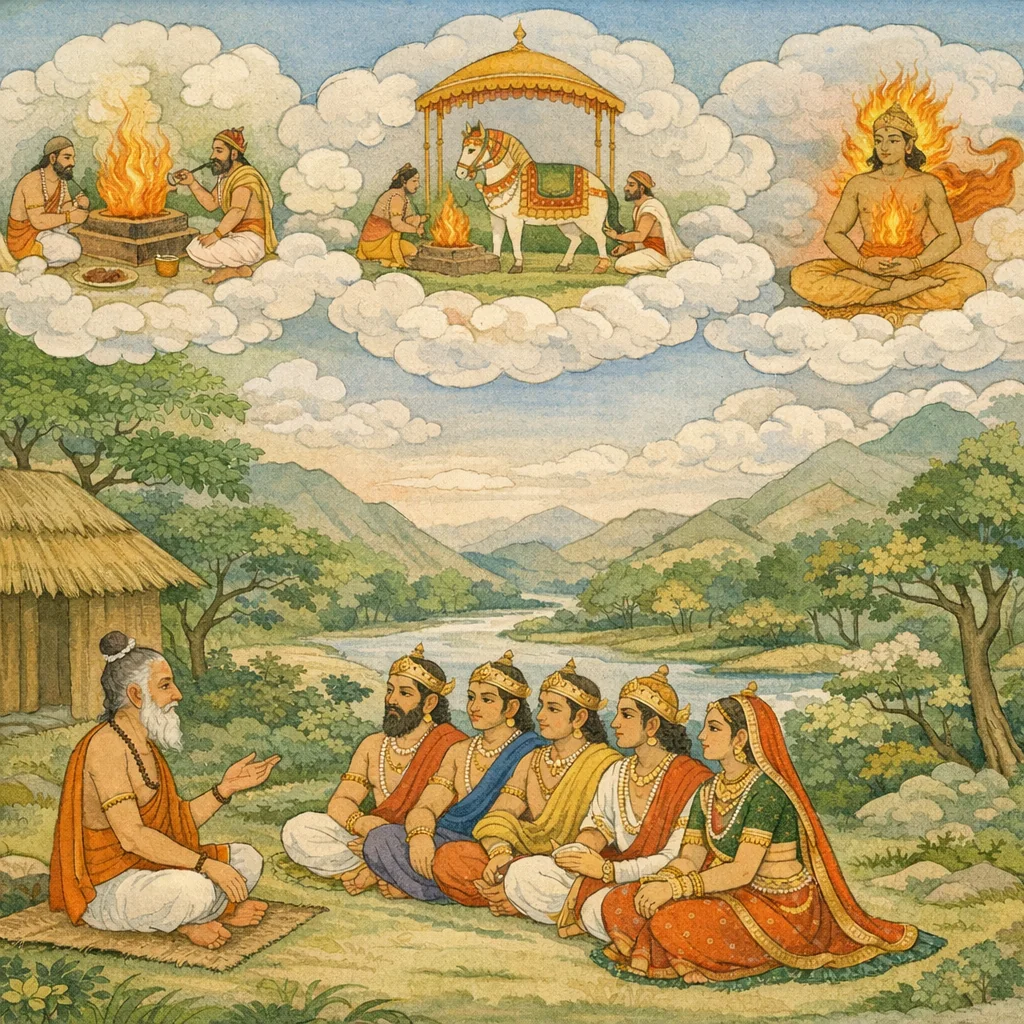
Chapter Arc: Markandeya begins a sacred genealogy: the luminous Chandramasi, wife of Brihaspati, becomes the doorway into a hidden lineage of Agnis—fires that are not merely flames but cosmic functions. → One by one, the chapter unfolds named fires and their domains: the Agni who receives the principal oblations in rites (Darsha–Purnamasa), the blazing fire honored in Chaturmasya and Ashvamedha, and the progeny-lines where each fire embodies a specific power—nourishment, fame, digestion, wrath, and invincible martial force. → The revelation peaks when Agni is shown as inward and universal: the ‘Antaragni’ that digests the food of embodied beings is identified as a born power (Vishvabhuj), while wrath itself becomes a fire—Manyu—whose fierce daughter ‘Svaha’ is said to pervade beings, turning emotion into a cosmic, ritualized force. → Markandeya stabilizes the vision by returning the many fires to a single order: each named Agni is a facet of one sacrificial and living principle—praised by Brahmanas through uktha-mantras, linked to the discovery of the supreme voice (para), and functioning as assurance and support for the knowing. → The catalogue-like momentum implies further continuation of the Agni-lineage and its ritual-philosophical meanings beyond this adhyaya.
Shlokas
Verse 1
हि लय न (0) मआधटआ आप एकोनविशर्त्याधिकॉद्विशततमो< ध्याय: बृहस्पतिकी संततिका वर्णन मार्कण्डेय उवाच बृहस्पतेश्चान्द्रमसी भार्या55सीद् या यशस्विनी । अग्नीन् साजनयत् पुण्यान् षडेकां चापि पुत्रिकाम्,मार्कण्डेयजी कहते हैं--राजन्! बृहस्पतिजीकी जो यशस्विनी पत्नी चान्द्रमसी (तारा) नामसे विख्यात थी, उसने पुत्ररूपमें छ: पवित्र अग्नियोंको तथा एक पुत्रीको भी जन्म दिया
Mārkaṇḍeya said: O King, Bṛhaspati’s illustrious wife, known as Candramasī (Tārā), gave birth to six sacred fires and also to a single daughter.
Verse 2
आहुतिष्वेव यस्याग्नेर्हविषाद्यं विधीयते । सोअग्निर्बहस्पते: पुत्र: शंयुर्नाम महाव्रत:,(दर्श-पौर्णमास आदियें) प्रधान आहुतियोंको देते समय जिस अग्निके लिये सर्वप्रथम घीकी आहुति दी जाती है, वह महान् व्रतधारी अग्नि ही बृहस्पतिका “शंयु” नामसे विख्यात (प्रथम) पुत्र है
Mārkaṇḍeya said: “That sacred fire for whom, at the time of offering the principal oblations, the first offering of ghee is prescribed—this fire is the great-vowed one, Śaṃyu by name, the son of Bṛhaspati.”
Verse 3
चातुमस्यिषु यस्येष्टमश्वमेधेडग्रज: प्रभु: । दीप्तो ज्वालैरनेकाभैरग्निरेको5थ वीर्यवान्,चातुर्मास्य-सम्बन्धी यज्ञोंमें तथा अश्वमेध-यज्ञमें जिसका पूजन होता है, जो सर्वप्रथम उत्पन्न होनेवाला और सर्वसमर्थ है तथा जो अनेक वर्णकी ज्वालाओंसे प्रज्वलित है, वह अद्वितीय शक्तिशाली अग्नि ही शंयु है
Mārkaṇḍeya said: In the Cāturmāsya rites and in the Aśvamedha sacrifice, the One who is worshipped—primeval, sovereign, and fully capable—blazes as the single, mighty Fire, kindled with many-colored flames. That unique, powerful Agni is indeed Śaṃyu.
Verse 4
शंयोरप्रतिमा भार्या सत्या सत्याथ धर्मजा । अग्निस्तस्य सुतो दीप्तस्तिस््र: कन्याश्न सुव्रता:,शंयुकी पत्नीका नाम था सत्या। वह धर्मकी पुत्री थी। उसके रूप और गुणोंकी कहीं तुलना नहीं थी। वह सदा सत्यके पालनमें तत्पर रहती थी। उसके गर्भसे शंयुके एक अग्निस्वरूप पुत्र तथा उत्तम व्रतका पालन करनेवाली तीन कन्याएँ हुईं
Mārkaṇḍeya said: Śaṁyu had an incomparable wife named Satyā—truthful and born of Dharma. From her, Śaṁyu begot a radiant son, Agni, and also three daughters who were steadfast in excellent vows and conduct.
Verse 5
प्रथमेनाज्यभागेन पूज्यते योडग्निरध्वरे । अग्निस्तस्य भरद्वाज: प्रथम: पुत्र उच्यते,यज्ञमें प्रथभ आज्यभागके द्वारा जिस अग्निकी पूजा की जाती है, वही शंयुका ज्येष्ठ पुत्र “भरद्वाज” नामक अग्नि बताया जाता है
Mārkaṇḍeya said: “That Agni who, in a sacrificial rite, is honored first with the initial oblation of clarified butter—of him, the fire named Bharadvāja is spoken of as the first-born son.”
Verse 6
पौर्णमासेषु सर्वेषु हविषा5<5ज्यं ख्रुवोद्यतम् । भरतो नामत: सोडन्निर्द्धितीय: शंयुत: सुत:,समस्त पौर्णमास यागोंमें खुवासे हविष्यके साथ घी उठाकर जिसके लिये “प्रथम आघार' अर्पित किया जाता है, वह “भरत” (ऊर्ज) नामक अग्नि शंयुका द्वितीय पुत्र है (इसका जन्म शंयुकी दूसरी स्त्रीके गर्भसे हुआ था)
Mārkaṇḍeya said: “At every full-moon sacrifice, when ghee is lifted up together with the oblation (havis) in the fixed ladle appointed for offering—at the first āghāra—that fire is known by the name ‘Bharata’ (also called Ūrj). He is the second son of Śaṃyukā.”
Verse 7
तिस््र: कन्या भवन्त्यन्या यासां स भरत: पति: । भरतस्तु सुतस्तस्य भरत्येका च पुत्रिका,शंयुके तीन कनन््याएँ और हुईं, जिनका बड़ा भाई भरत ही पालन करता था। भरत (ऊर्ज)-के “भरत” नामवाला ही एक पुत्र तथा “भरती” नामकी एक कन्या हुई
Mārkaṇḍeya said: “Three other maidens were born, and for them Bharata became the protector and guardian. To that Bharata there was born one son named Bharata and one daughter named Bhāratī.”
Verse 8
भरतो भरतस्याग्ने: पावकस्तु प्रजापते: । महानत्यर्थमहितस्तथा भरतसत्तम,सबका भरण-पोषण करनेवाले प्रजापति भरत नामक अग्निसे “पावक' की उत्पत्ति हुई। भरतश्रेष्ठ) वह अत्यन्त महनीय (पूज्य) होनेके कारण “महान” कहा गया है
Mārkaṇḍeya said: “From the fire named Bharata—belonging to Bharata—there arose Pāvaka, the Fire-god associated with Prajāpati. And because he is exceedingly revered and worthy of worship, he is also called ‘Mahān’ (the Great).”
Verse 9
भरद्वाजस्य भार्या तु वीरा वीरस्य पिण्डदा । प्राहुराज्येन तस्येज्यां सोमस्येव द्विजा: शनैः,शंयुके पहले पुत्र भरद्वाजकी पत्नीका नाम “वीरा” था, जिसने वीर नामक पुत्रको शरीर प्रदान किया। ब्राह्मणोंने सोमकी ही भाँति वीरकी भी आज्यभागसे पूजा बतायी है*। इनके लिये आहुति देते समय मन्त्रका उपांशु उच्चारण किया जाता है
Mārkaṇḍeya said: “Bharadvāja’s wife was named Vīrā; she gave bodily form to a son named Vīra. The Brahmins declare that Vīra is to be worshipped with a share of ghee (ājya-bhāga), in the same manner as Soma, and that the oblation is to be made with a subdued, near-whispered recitation.”
Verse 10
हविषा यो द्वितीयेन सोमेन सह युज्यते । रथप्रभू रथध्वान: कुम्भरेता: स उच्यते,सोमदेवताके साथ इन्हींको द्वितीय आज्यभाग प्राप्त होता है। इन्हें “रथप्रभु', 'रथध्वान' और “कुम्भरेता' भी कहते हैं
Mārkaṇḍeya said: “He who is joined with Soma by means of the second oblation is known by the epithets ‘Lord of the Chariot’ (Rathaprabhu), ‘He whose sound is the rumble of a chariot’ (Rathadhvāna), and ‘He whose seed is in a pot’ (Kumbharetā).”
Verse 11
सरय्वां जनयत् सिद्धि भानुं भाभि: समावृणोत् | आग्नेयमानयन् नित्यमाद्दाने होष सूयते,वीरने “सरयू” नामवाली पत्नीके गर्भसे 'सिद्धि' नामक पुत्रको जन्म दिया। सिद्धिने अपनी प्रभासे सूर्यको भी आच्छादित कर लिया। सूर्यके आच्छादित हो जानेपर उसने अग्निदेवता-सम्बन्धी यज्ञका अनुष्ठान किया। आह्वान-मन्त्र (अग्निमग्न आवह इत्यादि)-में इस सिद्धि नामक अग्निकी ही स्तुति की जाती है
Mārkaṇḍeya said: From Sarayū was born a son named Siddhi. By the radiance of Siddhi, even the Sun (Bhānu) was veiled. When the Sun was thus obscured, Siddhi continually performed an Agni-related rite; and in the invocation-mantras of that offering, it is this very Siddhi—identified with the fire being summoned—who is praised. The episode underscores the ethical idea that spiritual power (tapas/tejas) must be directed into rightful ritual order rather than mere display, restoring harmony through disciplined worship.
Verse 12
यस्तु न च्यवते नित्यं यशसा वर्चसा श्रिया । अन्निर्निश्ष्यवनो नाम पृथिवीं स्तौति केवलम्
Mārkaṇḍeya said: “But he who never declines—ever steadfast in fame, spiritual radiance, and prosperity—(such a one), known as Niṣṣyavana, merely praises the Earth.”
Verse 13
बृहस्पतिके (दूसरे) पुत्रका नाम “निश्चयवन' है। ये यश, वर्चस् (तेज) और कान्तिसे कभी च्युत नहीं होते हैं। निश्षयवन अग्नि केवल पृथ्वीकी स्तुति करते हैं? ।। विपाप्मा कलुषैर्मुक्तो विशुद्धश्चार्चिषा ज्वलन् । विपापो<ग्नि: सुतस्तस्य सत्य: समयधर्मकृत्,वे निष्पाप, निर्मल, विशुद्ध तथा तेज:पुञ्जसे प्रकाशित हैं। उनका पुत्र “सत्य नामक अनिन है; सत्य भी निष्पाप तथा कालधर्मके प्रवर्तक हैं
Mārkaṇḍeya said: “Freed from all taints, sinless, and wholly pure, blazing with radiant flame—such was that Agni. From him was born another Agni named Satya, likewise without sin, who establishes and upholds the dharma of proper order and right conduct.”
Verse 14
आक्रोशतां हि भूतानां यः करोति हि निष्कृतिम् । अग्नि: स निष्कृतिर्नाम शोभयत्यभिसेविते,वे वेदनासे पीडित होकर आर्तनाद करनेवाले प्राणियोंको उस कष्टसे निष्कृति (छुटकारा) दिलाते हैं, इसीलिये उन अग्निका एक नाम निष्कृति भी है। वे ही प्राणियोंद्वारा सेवित गृह और उद्यान आदिमें शोभाकी सृष्टि करते हैं
Mārkaṇḍeya said: “That which grants release to living beings who, tormented by pain, cry out in distress is called ‘deliverance’ (Niṣkṛti). Fire does exactly this; therefore Agni bears the name Niṣkṛti. And when tended and employed by creatures, that very fire brings beauty and prosperity to dwellings, gardens, and the like.”
Verse 15
अनुकूजन्ति येनेह वेदनार्ता: स्वयं जना: । तस्य पुत्र: स्वनो नाम पावक: स रुजस्कर:,सत्यके पुत्रका नाम 'स्वन” है, जिनसे पीडित होकर लोग वेदनासे स्वयं कराह उठते हैं। इसीलिये उनका यह नाम पड़ा है। वे रोगकारक अनग्नि हैं
Mārkaṇḍeya said: “Because of him, people here—afflicted by pain—begin to groan of their own accord. Therefore his son is called Svana (‘Groan’). Though termed a ‘fire’ (pāvaka), he is in truth a maker of disease and suffering.”
Verse 16
यस्तु विश्वस्य जगतो बुद्धिमाक्रम्य तिष्ठति । त॑ प्राहुरध्यात्मविदो विश्वजिन्नाम पावकम्,(बृहस्पतिके तीसरे पुत्रका नाम “विश्वजित' है) वे सम्पूर्ण विश्वकी बुद्धिको अपने वशमें करके स्थित हैं, इसीलिये अध्यात्मशास्त्रके दिद्वानोंने उन्हें 'विश्वजित” अग्नि कहा है
That Fire who, having mastered the intelligence of the whole universe, stands firm—those versed in the knowledge of the inner Self call him “Viśvajit,” the Conqueror of the World, for he holds the mind of all creation under his sway.
Verse 17
अन्तराग्नि: स्मृतो यस्तु भुक्तं पचति देहिनाम् । स जज्ञे विश्वभुड़्नाम सर्वलोकेषु भारत,भरतनन्दन! जो समस्त प्राणियोंके उदरमें स्थित हो उनके खाये हुए पदार्थोंको पचाते हैं, वे सम्पूर्ण लोकोंमें 'विश्वभुक्' नामसे प्रसिद्ध अग्नि बृहस्पतिके (चौथे) पुत्रके रूपमें प्रकट हुए हैं
O descendant of Bharata! The inner fire—remembered as that which digests what embodied beings have eaten—manifested as Bṛhaspati’s fourth son and became renowned in all the worlds by the name Viśvabhuk.
Verse 18
ब्रह्मचारी यतात्मा च सततं विपुलव्रत: । ब्राह्मणा: पूजयन्त्येनं पाकयज्ञेषु पावकम्,ये विश्वभुक् अग्नि ब्रह्मचारी, जितात्मा तथा सदा प्रचुर व्रतोंका पालन करनेवाले हैं। ब्राह्मणलोग पाकयज्ञोंमें इन्हींकी पूजा करते हैं
This Agni, Viśvabhuk, is a lifelong celibate, self-restrained, ever steadfast, and devoted to many vows. Therefore the Brāhmaṇas worship him as the sacred Fire in the domestic pākayajñas.
Verse 19
पवित्रा गोमती नाम नदी यस्याभवत् प्रिया । तस्मिन् कर्माणि सर्वाणि क्रियन्ते धर्मकर्त॒भि:,पवित्र गोमती नदी इनकी प्रिय पत्नी हुईं। धर्मांचरण करनेवाले द्विजलोग विश्वभुक् अग्निमें ही सम्पूर्ण कर्मोंका अनुष्ठान करते हैं
A sacred river named Gomatī became dear to him. There, all rites and duties are performed by those devoted to dharma.
Verse 20
वडवाग्नि: पिबत्यम्भो योडसौ परमदारुण: | ऊर्ध्वभागूर्ध्वभाड़नाम कवि: प्राणाश्रितस्तु यः:,जो अत्यन्त भयंकर वडवानलरूपसे समुद्रका जल सोखते रहते हैं, वे ही शरीरके भीतर ऊर्ध्वगति--'उदान' नामसे प्रसिद्ध हैं। ऊपरकी ओर गतिशील होनेसे ही उनका नाम 'ऊर्ध्वऐभाक्' है। वे प्राणवायुके आश्रित एवं त्रिकालदर्शाी हैं। (उन्हें बृहस्पतिका पाँचवाँ पुत्र माना गया है)
That exceedingly fierce “mare-fire” (vaḍavāgni) which drinks up the ocean’s waters is, within the body, known as the upward-moving vital current called Udāna. Because it moves upward it is also called Ūrdhvabhāg/Ūrdhvabhāk. Dependent upon Prāṇa, it is a kavi—a seer who knows the three times.
Verse 21
उदब्द्वारं हविर्यस्य गृहे नित्यं प्रदीयते । ततः स्विष्टं भवेदाज्यं स्विष्टकृत् परम: स्मृत:,प्रत्येक गृह्मकर्ममें जिस अग्निके लिये सदा घीकी ऐसी धारा दी जाती है जिसका प्रवाह उत्तराभिमुख हो और इस प्रकार दी हुई वह घृतकी आहुति अभीष्ट मनोरथकी सिद्धि करती है। इसीलिये उस उत्कृष्ट अग्निका नाम *स्विष्टकृत” है। (उसे बृहस्पतिका छठा पुत्र समझना चाहिये)
Mārkaṇḍeya said: In that household where an oblation is regularly offered into the fire with the flow directed northward, the clarified butter becomes “well-offered” and yields the desired, auspicious result. Therefore that excellent sacred fire is remembered as Sviṣṭakṛt—“the accomplisher of a well-made offering”—because it perfects the rite and brings its intended fruition.
Verse 22
यः प्रशान्तेषु भूतेषु मन्युर्भवति पावक: । क्रुद्धस्य तु रसो जज्ञे मन्युतीव्रा च पुत्रिका । स्वाहेति दारुणा क्रूरा सर्वभूतेषु तिषछतति,जिस समय अग्निस्वरूप बृहस्पतिका क्रोध प्रशान्त प्राणियोंपर प्रकट हुआ उस समय उनके शरीरसे जो पसीना निकला, वही उनकी पुत्रीके रूपमें परिणत हो गया। वह पुत्री अधिक क्रोधवाली थी। वह 'स्वाहा' नामसे प्रसिद्ध हुई। वह दारुण एवं क्रूर कन्या सम्पूर्ण भूतोंमें निवास करती है
Mārkaṇḍeya said: When the fiery wrath arose even among beings that were otherwise calm, from that anger there came forth an essence—like sweat from one who is enraged—which became a daughter, fierce with intensified fury. She became known as Svāhā, a dreadful and cruel maiden, abiding among all beings.
Verse 23
त्रिदिवे यस्य सदृशो नास्ति रूपेण कश्नन । अतुलत्वात् कृतो देवै्नाम्ना कामस्तु पावक:,स्वर्गमें भी कहीं तुलना न होनेके कारण जिसके समान रूपवान् दूसरा कोई नहीं है, उस स्वाहा-पुत्रको देवताओंने “काम” नामक अग्नि कहा है
Mārkaṇḍeya said: “In the heavenly world there is none equal to him in beauty—no one comparable in form. Therefore, because he is without peer, the gods gave that son of Svāhā the name ‘Kāma’, the Fire.”
Verse 24
संहर्षाद् धारयन् क्रोधं धनन््वी सख्रग्वी रथे स्थित: । समरे नाशयेच्छत्रूनमोघो नाम पावक:
Markandeya said: “Roused by exhilaration, the bowman—garlanded and standing upon his chariot—held his anger in check. In the thick of battle, the fire called ‘Amogha’ would destroy the enemies unfailingly.”
Verse 25
जो हृदयमें क्रोध धारण किये धनुष और मालासे विभूषित हो रथपर बैठकर हर्ष और उत्साहके साथ युद्धमें शत्रुओंका नाश करते हैं, उसका नाम है 'अमोघ' अग्नि ।। उक्थो नाम महाभाग त्रिभिरुक्थैरभिष्ठत: । महावाचं त्वजनयत् समाश्चासं हि यं विदु:
Markandeya said: “He who, with wrath held in his heart, adorned with bow and garland, seated upon a chariot, and filled with joy and ardor, destroys enemies in battle—his name is the ‘Unfailing’ fire (Amogha Agni). And there is another, O noble one, named Uktha: when praised by three uktha-hymns, he brought forth a mighty utterance; and the wise know him as ‘Samāśa’ as well.”
Verse 219
महाभाग! ब्राह्मणलोग त्रिविध उक्थ मन्त्रोंद्रार जिसकी स्तुति करते हैं, जिसने महावाणी (परा)-का आविष्कार किया है तथा ज्ञानी पुरुष जिसे आश्वासन देनेवाला समझते हैं; उस अग्निका नाम 'उक्थ' है ।। इति श्रीमहा भारते वनपर्वणि मार्कण्डेयसमास्यापर्वणि आंगिरसोपाख्याने एकोनविंशत्यधिकद्वधिशततमो<5ध्याय:
Markandeya said: “O noble one! The Brahmins praise that Fire with the threefold Uktha-hymns. He is the one who brought forth the supreme speech (Parā), and the wise regard him as a giver of reassurance and inner confidence. That Fire bears the name ‘Uktha.’”
Frequently Asked Questions
The tension is between desire and recognition within a lawful order: Svāhā’s enduring attachment to Agni is unresolved socially/ritually until Skanda provides a sanctioned, repeatable rite that legitimizes and stabilizes the relationship.
The chapter models dharma as institution-building: when a relationship or obligation lacks public form, it is stabilized through disciplined practice, correct speech, and community-reproducible ritual—turning private longing into an ordered, welfare-bearing norm.
No explicit phalaśruti formula is stated; however, the text embeds outcome-claims as practical meta-guidance—worship with arka-flowers for wealth, observances for illness-pacification, and salutations for children/progeny—functioning as implied benefits of correct observance.