Adhyaya 313
Śuka–Janaka Saṃvāda: Āśrama-krama, Jñāna-vijñāna, and the Marks of Liberation (शुक-जनक संवादः)
Upa-parva: Mokṣa-dharma (Liberation Discourse) — Śuka–Janaka Saṃvāda Unit
Bhīṣma narrates how King Janaka ceremonially receives Śuka with priestly accompaniment and formal honors (seat, offerings, arghya, pādya, and gifts), establishing a pedagogical setting grounded in śāstric etiquette. Śuka states that Vyāsa has sent him to Janaka—renowned as a qualified guide—to resolve uncertainty about pravṛtti (engaged life) versus nivṛtti (withdrawal), and asks what a brāhmaṇa should do for mokṣa, and whether knowledge or austerity is primary. Janaka outlines an orthodox life-cycle: upanayana and Veda-study, disciplined brahmacarya, repayment of obligations to gods and ancestors, return to household life, gradual forest withdrawal, and renunciant stabilization. Śuka then questions whether one who has direct, abiding inner realization must still inhabit external āśrama stages. Janaka replies that mokṣa requires jñāna/vijñāna and that knowledge is traditionally attained through guru-connection; the teacher is the ‘ferryman’ and knowledge the ‘boat’. He defends the four-āśrama framework as a continuity-preserving social dharma, yet concedes that a purified self may attain mokṣa even early; for one already liberated, the remaining āśramas have no further instrumental purpose. The chapter culminates in practical markers of liberation: avoidance of rajas/tamas, establishment in sattva, seeing self in all beings without adhesion, equanimity toward praise/blame, gain/loss, heat/cold, life/death, restraint of senses (tortoise simile), and inner illumination (lamp-in-dark-house simile). Janaka finally recognizes Śuka’s realized state and frames his continued questioning as unnecessary given his established orientation to the ‘parama mārga’.
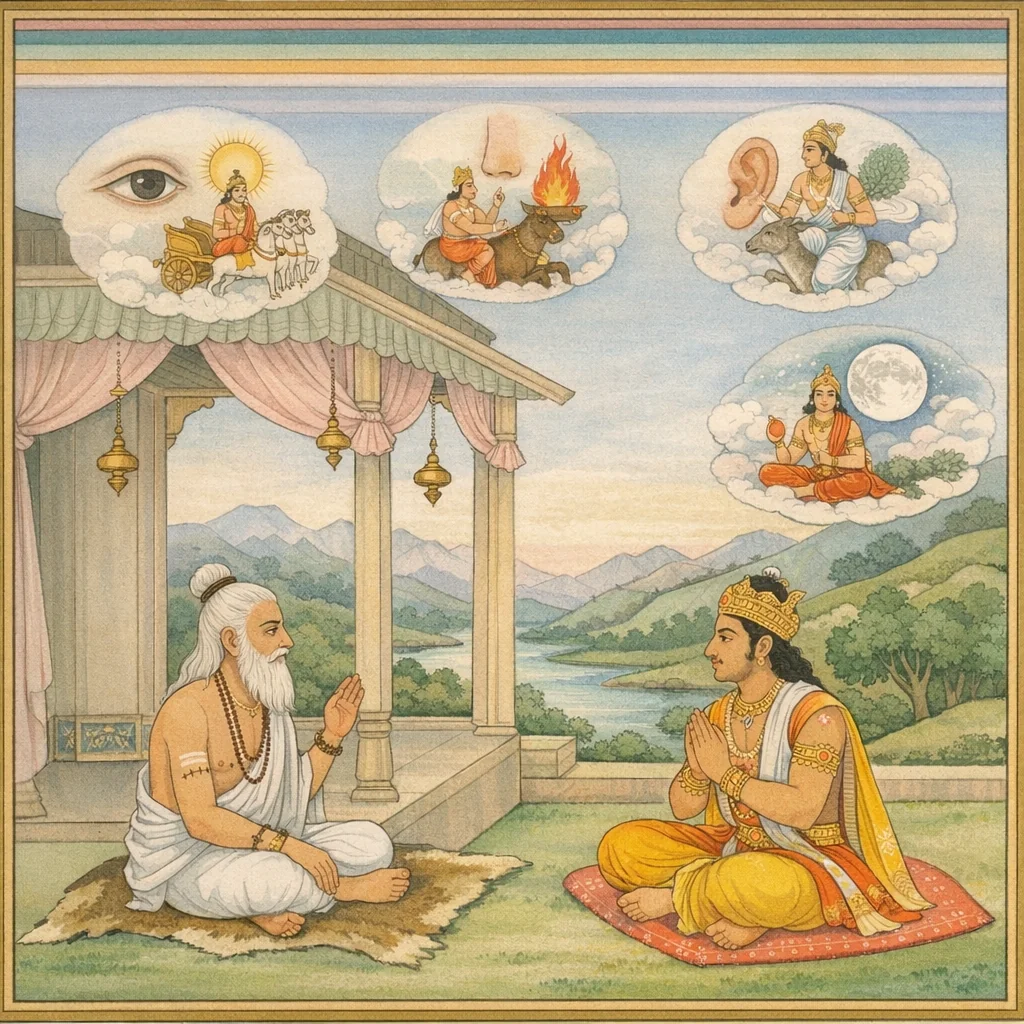
Chapter Arc: राजा जनक के जिज्ञासु प्रश्नों की पृष्ठभूमि में याज्ञवल्क्य सूक्ष्म देह-तत्त्व का द्वार खोलते हैं—‘अध्यात्म, अधिभूत और अधिदैवत’ का त्रिविध मानचित्र, मानो मनुष्य-शरीर ही एक यज्ञवेदी हो। → इन्द्रियों और अंगों के ‘अध्यात्म’ रूप, उनके विषयों के ‘अधिभूत’ रूप, और उनके नियामक देव-तत्त्व ‘अधिदैवत’ के रूप में क्रमशः निरूपण होता है; साथ ही प्रकृति के स्वच्छन्द ‘क्रीडार्थ’ विकारों से गुणों का जाल फैलता है—सत्त्व, रजस्, तमस् के लक्षणों की सूची मनुष्य के भीतर चल रहे अदृश्य युद्ध को तीखा कर देती है। → गुण-लक्षणों का निर्णायक उद्घोष: सत्त्व के प्रकाश, शुद्धि, आरोग्य, धैर्य आदि बनाम तमस् के मोह, अप्रकाश, प्रमाद, दिवास्वप्न, अतिवाद, नृत्य-वाद्य-गीत में अज्ञानजन्य आसक्ति तथा धर्म-विशेषों के प्रति द्वेष—यहाँ अध्याय का शिखर उस क्षण बनता है जब श्रोता समझता है कि बन्धन और मुक्ति का द्वार बाहर नहीं, गुणों की अन्तःप्रवृत्तियों में है। → याज्ञवल्क्य त्रिविध तत्त्व-व्यवस्था और त्रिगुण-स्वभाव को एक ही सूत्र में बाँधते हैं: प्रकृति गुणों को विकृत करती है, और जीव उन्हीं के अनुरूप वृत्तियाँ धारण करता है; विवेक से गुणों की पहचान ही आत्म-मार्ग का प्रथम चरण है।
Shlokas
Verse 1
अफ-#-राज त्रयोदशाधिकत्रिशततमो< ध्याय: अध्यात्म, अधिभूत और अधिदैवतका वर्णन तथा सात््विक, राजस और तामस भावोंके लक्षण याज़्वल्क्य उवाच पादावध्यात्ममित्याहुर्ब्राह्मणास्तत्त्वदर्शिन: । गन्तव्यमधि भूतं च विष्णुस्तत्राधिदेवतम्,याज्ञवल्क्यजी कहते हैं--राजन्! तत्त्वदर्शी ब्राह्मगोंका कथन है कि दोनों पैर अध्यात्म हैं, गन्तव्य स्थान अधिभूत हैं और विष्णु अधिदैवत हैं
Yājñavalkya said: “O King, the Brahmins who see reality declare that the two feet are to be understood as the ‘adhyātma’ (the inner, personal dimension). The destination to be reached is the ‘adhibhūta’ (the realm of embodied beings and objects). And in relation to that, Viṣṇu is the ‘adhidaivata’ (the presiding divine principle).”
Verse 2
पायुरध्यात्ममित्याहुर्यथा तत्त्वार्थदर्शिन: । विसर्गमधि भूतं च मित्रस्तत्राधिदेवतम्,तच्त्वार्थदर्शी विद्वान् गुदाको अध्यात्म कहते हैं। मलत्याग अधिभूत है और मित्र अधिदैवत हैं
Yājñavalkya said: “Those who truly see reality declare that the anus (pāyu) is the ‘adhyātma’ aspect. Its function of evacuation (visarga) is the ‘adhibhūta’ aspect, and the deity presiding over it is Mitra as the ‘adhidaivata.’”
Verse 3
उपस्थो<्थध्यात्ममित्याहुर्यथा योगप्रदर्शिन: । अधिभूतं तथा55नन््दो दैवतं च प्रजापति:,योगमतका प्रदर्शन करनेवाले जैसा कहते हैं, उसके अनुसार उपस्थ अध्यात्म है, मैथुनजनित आनन्द अधिभूत है और प्रजापति अधिदैवत हैं
Yājñavalkya said: “Those who expound the discipline of yoga declare that the generative organ is to be understood as the ‘adhyātma’ (the inner, personal basis). The pleasure arising from sexual union is the ‘adhibhūta’ (the experiential object), and Prajāpati is the ‘adhidaivata’ (the presiding divine principle).”
Verse 4
हस्तावध्यात्ममित्याहुर्यथा संख्यानदर्शिन: । कर्तव्यमधिभूतं तु इन्द्रस्तत्राधिदिवतम्
Yājñavalkya said: “Those who truly discern the categories declare that the ‘hands’ belong to the inner self (the domain of adhyātma). The act that is to be done is the adhibhūta (the objective field of action); and in that very sphere, Indra is spoken of as the presiding deity (adhidaivata).”
Verse 5
सांख्यदर्शी विद्वानोंके कथनानुसार दोनों हाथ अध्यात्म हैं, कर्तव्य अधिभूत है और इन्द्र अधिदैवत हैं ।। वागध्यात्ममिति प्राहुर्यथा श्रुतिनिदर्शिन: । वक्तव्यमधिभूतं तु वह्निस्तत्राधिदिवतम्,वेदार्थपर विचार करनेवाले विद्वान् जैसा कहते हैं, उसके अनुसार वाक् अध्यात्म है, वक्तव्य अधिभूत है और अग्नि अधिदैवत हैं
Yājñavalkya said: “As the seers who illustrate the meaning of the Veda declare, speech (vāk) is the inner, spiritual principle (adhyātma); the thing to be spoken is the objective, elemental domain (adhibhūta); and in this triad, Fire (Agni) is the presiding divine power (adhidaivata).”
Verse 6
चक्षुरध्यात्ममित्याहुर्यथा श्रुतिनिदर्शिन: । रूपमत्राधिभूतं तु सूर्य श्षाप्पधिदैवतम्
Yājñavalkya said: “The seers who illustrate their teaching by the authority of the Veda declare that the eye belongs to the inner, personal domain (adhyātma). In this same triad, form is the element on the objective plane (adhibhūta), and the Sun is the presiding divine power (adhidaivata).”
Verse 7
वेददर्शी विद्वान् जैसा बताते हैं, उसके अनुसार नेत्र अध्यात्म है, रूप अधिभूत है और सूर्य अधिदैवत हैं ।। श्रोत्रमध्यात्ममित्याहुर्यथा श्रुतिनिदर्शिन: । शब्दस्तत्राधिभूत॑ तु दिशश्वात्राधिदिवतम्,वैदिक सिद्धान्तका ज्ञान रखनेवाले विद्वान् पुरुष कहते हैं कि श्रोत्र अध्यात्म है, शब्द अधिभूत है, और दिशाएँ अधिदैवत हैं
Yājñavalkya said: “Those who discern the meaning of the Veda declare that the ear belongs to the inner self (adhyātma); sound is its corresponding element in the world (adhibhūta); and the directions preside over it as the divine principle (adhidaivata).” The teaching frames perception as a disciplined triad—self, object, and presiding cosmic order—so that one may understand experience without confusion and live in harmony with dharma.
Verse 8
जिह्दामध्यात्ममित्याहुर्यथा श्रुतिनिदर्शिन: । रस एवाधिभूतं तु आपस्तत्राधिदेवतम्,वेदके अनुसार दृष्टि रखनेवाले विद्वानोंका कथन है कि जिह्ठा अध्यात्म है, रस अधिभूत है और जल अधिदैवत है
Yājñavalkya said: “Those who interpret in accordance with the Vedic revelation declare that the tongue is the inner (adhyātma) factor; taste (rasa) is the elemental (adhibhūta) factor; and water is the presiding divine (adhidaivata) factor there. Thus, even ordinary sense-experience is to be understood through the Vedic triad—self, world, and deity—so that perception is disciplined by right knowledge.”
Verse 9
प्राणमध्यात्ममित्याहुर्यथा श्रुतिनिदर्शिन: । गन्ध एवाधिभूतं तु पृथिवी चाधिदेवतम्,वैदिक मतके अनुसार यथार्थ तत्त्वका ज्ञान रखनेवाले विद्वान् कहते हैं कि नासिका अध्यात्म है, गन्ध अधिभूत है और पृथ्वी अधिदैवत है
Yājñavalkya said: “Those who truly understand the purport of the Vedic revelation declare that, in this triadic mapping, prāṇa is the inner (adhyātma) principle; fragrance is the elemental (adhibhūta) object; and Earth is the presiding divine (adhidaivata) power.” In this way he teaches how experience is to be read ethically and contemplatively—as a coordinated order linking the self, the world, and the divine governance of nature.
Verse 10
त्वगध्यात्ममिति प्राहुस्तत्त्वबुद्धिविशारदा: । स्पर्शमेवाधि भूतं तु पवनश्चाधिदेवतम्
Yājñavalkya said: “Those skilled in discerning reality declare that the skin belongs to the adhyātma, the inner self. Touch alone is its adhibhūta, and the Wind is its adhidaivata, the presiding divine power.”
Verse 11
तत्त्वज्ञानमें कुशल पुरुषोंका कथन है कि त्वचा अध्यात्म है, स्पर्श अधिभूत है और वायु अधिदैवत है ।। मनो<ध्यात्ममिति प्राहुर्यथा शास्त्रविशारदा: | मन्तव्यमधिभूतं तु चन्द्रमा श्चाधिदेवतम्
Yājñavalkya said: “Those skilled in the knowledge of reality declare that, in this triadic analysis, the skin is adhyātma, touch is adhibhūta, and wind is adhidaivata. Likewise, the learned in the scriptures say that the mind is adhyātma; the object to be thought upon is adhibhūta; and the Moon is the corresponding adhidaivata.”
Verse 12
शास्त्रज्ञाननिपुण विद्वान् कहते हैं कि मन अध्यात्म है, मन्तव्य अधिभूत है और चन्द्रमा अधिदेवता हैं ।। अहंकारिकमध्यात्ममाहुस्तत्त्वनिदर्शिन: । अभिमानो<धिभूत॑ तु रुद्रश्नात्राधिदिवतम्,तत्त्वदर्शी पुरुषोंका कथन है कि अहंकार अध्यात्म है, अभिमान अधिभूत है और रुद्र अधिदेवता हैं
Yājñavalkya said: “Those who truly discern reality declare that ego-sense (ahaṅkāra) is the adhyātma, the inner subjective principle; that self-assertive identification (abhimāna) is the adhibhūta, the objective field; and that Rudra is the adhidaivata, the presiding deity here. Thus one should understand experience by distinguishing the inner knower, the outer domain of objects, and the divine governance that connects and illumines both.”
Verse 13
बुद्धिरध्यात्ममित्याहुर्यथावदभिदर्शिन: । बोद्धव्यमधिभूतं तु क्षेत्रज्ञक्नाधिदिवतम्,यथार्थ ज्ञानी पुरुष कहते हैं कि बुद्धि अध्यात्म है, बोद्धव्य अधिभूत है और आत्मा अधिदेवता है
Yājñavalkya said: “Those seers who perceive things as they truly are declare that intellect (buddhi) belongs to the adhyātma, the inner spiritual domain. The object to be known is adhibhūta, the realm of embodied elements. And the Knower of the Field (Kṣetrajña)—the Self that witnesses within—is to be understood as adhidaivata, the presiding divine principle.”
Verse 14
एषा ते व्यक्तितो राजन् विभूतिरनुदर्शिता । आदी मध्ये तथान्ते च यथातत्त्वेन तत्त्ववित्,तत्त्वज्ञ नरेश! यह मैंने तुम्हारे निकट आदि, मध्य और अन्तमें तत्त्वतः प्रकाशित होनेवाली जीवकी व्यक्तिगत विभूतिका वर्णन किया है
Yājñavalkya said: “O King, I have thus shown you the individual manifestation (vibhūti) of the living being as it is discerned in personal experience. From the beginning, through the middle, and up to the end, I have set it forth in accordance with reality—so that you, a knower of truth, may grasp it as it truly is.”
Verse 15
प्रकृतिर्गुणान् विकुरुते स्वच्छन्देनात्मकाम्यया । क्रीडार्थे तु महाराज शतशोडथ सहस्रश:,महाराज! प्रकृति स्वतन्त्रतापूर्वक खेल करनेके लिये अपनी ही इच्छासे सैकड़ों और हजारों गुणोंको उत्पन्न करती है
Yājñavalkya said: “O great king, Prakṛti (Nature), freely and by her own self-willed desire, diversifies and transforms the guṇas. Indeed, for the sake of play, she brings them forth in hundreds and in thousands.”
Verse 16
यथा दीपसहस्राणि दीपान्मर्त्या: प्रकुर्वते । प्रकृतिस्तथा विकुरुते पुरुषस्य गुणान् बहून्,जैसे मनुष्य एक दीपकसे हजारों दीपक जला लेते हैं, उसी प्रकार प्रकृति पुरुषके सम्बन्धसे अनेक गुण उत्पन्न कर देती है
Yājñavalkya said: “Just as mortals light thousands of lamps from a single lamp, so too Prakṛti, in association with Puruṣa, brings forth many qualities and manifestations. From one underlying source, multiplicity appears—yet the originating principle remains unchanged—thereby teaching discernment between the witnessing Self and the produced attributes of nature.”
Verse 17
सत्त्वमानन्द उद्रेक: प्रीति: प्राकाश्यमेव च । सुखं शुद्धित्वमारोग्यं संतोष: श्रद्धधानता,धैर्य, आनन्द, प्रीति, उत्कर्ष, प्रकाश (ज्ञानशक्ति), सुख, शुद्धि, आरोग्य, संतोष, श्रद्धा, अकार्पण्य (दीनताका अभाव), असंरम्भ (क्रोधका अभाव), क्षमा, धृति, अहिंसा, समता, सत्य, ऋणसे रहित होना, मृदुता, लज्जा, अचंचलता, शौच, सरलता, सदाचार, अलोलुपता, हृदयमें सम्भ्रमका न होना, इष्ट और अनिष्टके वियोगका बखान न करना, दानके द्वारा धैर्य धारण करना, किसी वस्तुकी इच्छा न करना, परोपकार और सम्पूर्ण प्राणियोंपर दया--ये सब सत्त्वसम्बन्धी गुण बताये गये हैं
Yājñavalkya said: From the quality of sattva arise an upsurge of inner joy, affectionate goodwill, and clarity of illumination. From it also come happiness, purity, freedom from disease, contentment, and a steady disposition of faith. These are described as the characteristic virtues grounded in sattva—qualities that refine conduct, stabilize the mind, and support ethical living.
Verse 18
अकार्पण्यमसंरम्भ: क्षमा धृतिरहिंसता । समता सत्यमानृण्यं मार्दवं हवीरचापलम्,धैर्य, आनन्द, प्रीति, उत्कर्ष, प्रकाश (ज्ञानशक्ति), सुख, शुद्धि, आरोग्य, संतोष, श्रद्धा, अकार्पण्य (दीनताका अभाव), असंरम्भ (क्रोधका अभाव), क्षमा, धृति, अहिंसा, समता, सत्य, ऋणसे रहित होना, मृदुता, लज्जा, अचंचलता, शौच, सरलता, सदाचार, अलोलुपता, हृदयमें सम्भ्रमका न होना, इष्ट और अनिष्टके वियोगका बखान न करना, दानके द्वारा धैर्य धारण करना, किसी वस्तुकी इच्छा न करना, परोपकार और सम्पूर्ण प्राणियोंपर दया--ये सब सत्त्वसम्बन्धी गुण बताये गये हैं
Yājñavalkya said: “Freedom from meanness, absence of wrathful agitation, forbearance, steadfastness, and non-violence; equanimity, truthfulness, freedom from debt (owing nothing), gentleness, modesty, and unwavering steadiness—these are declared to be virtues born of sattva.”
Verse 19
शौचमार्जवमाचारमलौल्यं हृद्यसम्भ्रम: | इष्टानिष्टवियोगानां कृतानामविकत्थना,धैर्य, आनन्द, प्रीति, उत्कर्ष, प्रकाश (ज्ञानशक्ति), सुख, शुद्धि, आरोग्य, संतोष, श्रद्धा, अकार्पण्य (दीनताका अभाव), असंरम्भ (क्रोधका अभाव), क्षमा, धृति, अहिंसा, समता, सत्य, ऋणसे रहित होना, मृदुता, लज्जा, अचंचलता, शौच, सरलता, सदाचार, अलोलुपता, हृदयमें सम्भ्रमका न होना, इष्ट और अनिष्टके वियोगका बखान न करना, दानके द्वारा धैर्य धारण करना, किसी वस्तुकी इच्छा न करना, परोपकार और सम्पूर्ण प्राणियोंपर दया--ये सब सत्त्वसम्बन्धी गुण बताये गये हैं
Yājñavalkya said: Purity, straightforwardness, good conduct, freedom from greed, and a calm, unagitated heart; not boasting about one’s deeds; not making a display of separation from what is dear or what is disliked; steadiness, joy, affection, excellence, inner illumination (the power of knowledge), happiness, clarity, health, contentment, faith, freedom from miserly weakness, absence of anger, forgiveness, fortitude, non-violence, equanimity, truthfulness, being free from debt, gentleness, modesty, unshakable composure, cleanliness, simplicity, right conduct, non-covetousness, lack of inner agitation, not publicizing one’s losses and gains, sustaining courage through giving, desirelessness, doing good to others, and compassion toward all beings—these are declared to be the qualities belonging to sattva.
Verse 20
दानेन चात्मग्रहणमस्पृहत्वं परार्थता । सर्वभूतदया चैव सच्त्वस्यैते गुणा: स्मृता:,धैर्य, आनन्द, प्रीति, उत्कर्ष, प्रकाश (ज्ञानशक्ति), सुख, शुद्धि, आरोग्य, संतोष, श्रद्धा, अकार्पण्य (दीनताका अभाव), असंरम्भ (क्रोधका अभाव), क्षमा, धृति, अहिंसा, समता, सत्य, ऋणसे रहित होना, मृदुता, लज्जा, अचंचलता, शौच, सरलता, सदाचार, अलोलुपता, हृदयमें सम्भ्रमका न होना, इष्ट और अनिष्टके वियोगका बखान न करना, दानके द्वारा धैर्य धारण करना, किसी वस्तुकी इच्छा न करना, परोपकार और सम्पूर्ण प्राणियोंपर दया--ये सब सत्त्वसम्बन्धी गुण बताये गये हैं
Yājñavalkya said: Through giving arise self-mastery, freedom from craving, living for the good of others, and compassion toward all beings—these are remembered as the qualities of sattva. Also counted among sattva are: steadiness, joy, affection, uplift, inner illumination (the power of knowledge), happiness, purity, health, contentment, faith, absence of meanness, absence of anger, forgiveness, fortitude, non-violence, equanimity, truthfulness, freedom from debt, gentleness, modesty, unshakable composure, cleanliness, straightforwardness, good conduct, non-greed, an untroubled heart, not lamenting separation from the pleasant or the unpleasant, sustaining courage through generosity, desirelessness, beneficence, and mercy toward all living creatures. These are declared to be sattvic virtues.
Verse 21
रजोगुणानां संघातो रूपमैश्चर्यविग्रहौ । अत्यागित्वमकारुण्यं सुखदुःखोपसेवनम्,रूप, ऐश्वर्य, विग्रह, त्यागकका अभाव, करुणाका अभाव, दुःख-सुखका उपभोग, परनिन्दामें प्रीति, वाद-विवाद करना, अहंकार, माननीय पुरुषोंका सत्कार न करना, चिन्ता, वैरभाव रखना, संताप करना, दूसरोंका धन हड़प लेना, निर्लज्जता, कुटिलता, भेदबुद्धि, कठोरता, काम, क्रोध, मद, दर्द, द्वेष और बहुत बोलनेका स्वभाव--यह रजोगुणका समूह है। ये सारे भाव रजोगुणके कार्य बताये गये हैं। अब मैं तामस भावोंके समूहका परिचय देता हूँ, ध्यान देकर सुनो
Yājñavalkya said: “The cluster of qualities born of rajas includes: preoccupation with outward form, lordly power and self-assertion; inability to renounce, lack of compassion, and indulgence in pleasure and pain; delight in disparaging others, contentious debate, egoism, and failure to honor worthy persons; anxiety, enmity, inner burning, seizing another’s wealth; shamelessness, crookedness, divisive thinking, hardness; lust, anger, intoxicated pride, arrogance, hatred, and a habit of excessive speech. This is the aggregate of rajas. All these dispositions are declared to be the effects of the rajas-guṇa. Now I shall describe the aggregate of tamasic dispositions—listen with attention.”
Verse 22
परापवादेषु रतिर्विवादानां च सेवनम् | अहंकारमसत्कारकश्िन्ता वैरोपसेवनम्,रूप, ऐश्वर्य, विग्रह, त्यागकका अभाव, करुणाका अभाव, दुःख-सुखका उपभोग, परनिन्दामें प्रीति, वाद-विवाद करना, अहंकार, माननीय पुरुषोंका सत्कार न करना, चिन्ता, वैरभाव रखना, संताप करना, दूसरोंका धन हड़प लेना, निर्लज्जता, कुटिलता, भेदबुद्धि, कठोरता, काम, क्रोध, मद, दर्द, द्वेष और बहुत बोलनेका स्वभाव--यह रजोगुणका समूह है। ये सारे भाव रजोगुणके कार्य बताये गये हैं। अब मैं तामस भावोंके समूहका परिचय देता हूँ, ध्यान देकर सुनो
Yājñavalkya said: “Delight in slander, and the habit of engaging in disputes; egoism; failure to honor the worthy; anxious brooding; cultivating enmity; attachment to beauty and display; lordliness and power; quarrelsomeness; lack of generosity and forbearance; absence of compassion; indulgence in pleasures and pains; pleasure in censuring others; contentious argument; pride; neglect of venerable persons; worry; hostility; inner torment; seizing another’s wealth; shamelessness; crookedness; a divisive mindset; harshness; desire; anger; intoxication with self-importance; arrogance; hatred; and a tendency to talk excessively—this is the cluster of qualities belonging to rajas. All these dispositions are declared to be the workings of the rajas-guṇa. Now I shall describe the group of tamasic dispositions; listen with attention.”
Verse 23
परितापो5भिहरणं हीनाशो5नार्जवं तथा । भेद: परुषता चैव काम: क्रोधो मदस्तथा,रूप, ऐश्वर्य, विग्रह, त्यागकका अभाव, करुणाका अभाव, दुःख-सुखका उपभोग, परनिन्दामें प्रीति, वाद-विवाद करना, अहंकार, माननीय पुरुषोंका सत्कार न करना, चिन्ता, वैरभाव रखना, संताप करना, दूसरोंका धन हड़प लेना, निर्लज्जता, कुटिलता, भेदबुद्धि, कठोरता, काम, क्रोध, मद, दर्द, द्वेष और बहुत बोलनेका स्वभाव--यह रजोगुणका समूह है। ये सारे भाव रजोगुणके कार्य बताये गये हैं। अब मैं तामस भावोंके समूहका परिचय देता हूँ, ध्यान देकर सुनो
Yājñavalkya said: “Tormenting agitation, seizing what belongs to others, mean-spiritedness, and crookedness; creating divisions, harshness of speech and conduct, and likewise desire, anger, and intoxicated pride—these are declared to be the workings of rajas. Such impulses drive a person outward into conflict, grasping, and contention, obscuring discernment and weakening ethical restraint.”
Verse 24
दर्पो द्वेषोतिवादश्न एते प्रोक्ता रजोगुणा: । तामसानां तु संघातं प्रवक्ष्याम्युपधार्यताम्,रूप, ऐश्वर्य, विग्रह, त्यागकका अभाव, करुणाका अभाव, दुःख-सुखका उपभोग, परनिन्दामें प्रीति, वाद-विवाद करना, अहंकार, माननीय पुरुषोंका सत्कार न करना, चिन्ता, वैरभाव रखना, संताप करना, दूसरोंका धन हड़प लेना, निर्लज्जता, कुटिलता, भेदबुद्धि, कठोरता, काम, क्रोध, मद, दर्द, द्वेष और बहुत बोलनेका स्वभाव--यह रजोगुणका समूह है। ये सारे भाव रजोगुणके कार्य बताये गये हैं। अब मैं तामस भावोंके समूहका परिचय देता हूँ, ध्यान देकर सुनो
Yājñavalkya said: “Pride, hatred, and contentious over-argument—these are declared to belong to the quality of rajas. Now I shall set forth the whole collection of tamasic dispositions; listen with careful attention.”
Verse 25
मोहो<5प्रकाशस्तामिस्रमन्धतामिस्रसंज्ञितम् । मरणं चान्धतामिस्रं तामिस््र क्रोध उच्यते,मोह, अप्रकाश (अज्ञान), तामिस्र और अन्धतामिस्र--ये सब तमोगुणके लक्षण हैं। इनमें तामिस्र क्रोधका वाचक है और अन्धतामिस्र मरणका। भोजनमें रुचिका न होना, खानेकी वस्तुओंसे तृप्ति या संतोषका अभाव अथवा कितना ही भोजन क्यों न मिले, उसे पर्याप्त न मानना, पीनेकी वस्तुओंसे कभी तृप्त न होना, दुर्गन्धयुक्त वस्त्र, अनुचित विहार, मलिन शय्या और आसनोंका सेवन, दिनमें सोना, अत्यन्त वाद-विवादमें और प्रमादमें अत्यन्त आसक्त रहना, अज्ञानवश नाच-गीत और नाना प्रकारके बाजोंमें श्रद्धा, नाना प्रकारके धर्मोंसे द्वेष--ये तमोगुणके लक्षण हैं
Yājñavalkya said: “Delusion is the state called ‘non-illumination’ (ignorance), known as tāmisra and andhatāmisra. Andhatāmisra is identified with death, while tāmisra is said to be anger. In ethical terms, these are marks of the tamas quality: when the mind is clouded, it falls into darkness—anger drives one deeper into that darkness, and the final extreme of such obscuration is death-like ruin of discernment and life.”
Verse 26
तमसो लक्षणानीह भक्षणाद्यभिरोचनम् | भोजनानामपर्याप्तिस्तथा पेयेष्वतृप्तता,मोह, अप्रकाश (अज्ञान), तामिस्र और अन्धतामिस्र--ये सब तमोगुणके लक्षण हैं। इनमें तामिस्र क्रोधका वाचक है और अन्धतामिस्र मरणका। भोजनमें रुचिका न होना, खानेकी वस्तुओंसे तृप्ति या संतोषका अभाव अथवा कितना ही भोजन क्यों न मिले, उसे पर्याप्त न मानना, पीनेकी वस्तुओंसे कभी तृप्त न होना, दुर्गन्धयुक्त वस्त्र, अनुचित विहार, मलिन शय्या और आसनोंका सेवन, दिनमें सोना, अत्यन्त वाद-विवादमें और प्रमादमें अत्यन्त आसक्त रहना, अज्ञानवश नाच-गीत और नाना प्रकारके बाजोंमें श्रद्धा, नाना प्रकारके धर्मोंसे द्वेष--ये तमोगुणके लक्षण हैं
Yājñavalkya said: “Here are the marks of tamas (the dark, inert quality): a craving for eating and the like; a sense that food is never enough; and an inability to feel satisfied even with drinks. Such tamasic disposition expresses itself as delusion and lack of inner light (ignorance), sinking into ‘tāmisra’ (blind rage) and ‘andhatāmisra’ (the darkness that ends in death). It shows as distaste for wholesome food, perpetual dissatisfaction no matter how much one receives, never being quenched by what one drinks, delight in foul-smelling garments, improper habits, unclean beds and seats, sleeping by day, excessive addiction to quarrels and heedlessness, infatuation—through ignorance—with dancing, singing, and various instruments, and hostility toward diverse paths of dharma.”
Verse 27
गन्धवासो विहारेषु शयनेष्वासनेषु च । दिवास्वप्नेडतिवादे च प्रमादेषु च वै रति:,मोह, अप्रकाश (अज्ञान), तामिस्र और अन्धतामिस्र--ये सब तमोगुणके लक्षण हैं। इनमें तामिस्र क्रोधका वाचक है और अन्धतामिस्र मरणका। भोजनमें रुचिका न होना, खानेकी वस्तुओंसे तृप्ति या संतोषका अभाव अथवा कितना ही भोजन क्यों न मिले, उसे पर्याप्त न मानना, पीनेकी वस्तुओंसे कभी तृप्त न होना, दुर्गन्धयुक्त वस्त्र, अनुचित विहार, मलिन शय्या और आसनोंका सेवन, दिनमें सोना, अत्यन्त वाद-विवादमें और प्रमादमें अत्यन्त आसक्त रहना, अज्ञानवश नाच-गीत और नाना प्रकारके बाजोंमें श्रद्धा, नाना प्रकारके धर्मोंसे द्वेष--ये तमोगुणके लक्षण हैं
Yājñavalkya said: Taking delight in perfumes and sensual enjoyments, in frivolous outings, and in indulgent beds and seats; sleeping by day; and being excessively attached to quarrelsome disputation and heedless negligence—these are marks of the tamas-guṇa. In such a disposition, delusion and darkness prevail, drawing one toward sloth, confusion, and self-destructive habits rather than clarity, restraint, and dharmic conduct.
Verse 28
नृत्यवादित्रगीतानामज्ञानाच्छुद्धधानता । द्वेषो धर्मविशेषाणामेते वै तामसा गुणा:,मोह, अप्रकाश (अज्ञान), तामिस्र और अन्धतामिस्र--ये सब तमोगुणके लक्षण हैं। इनमें तामिस्र क्रोधका वाचक है और अन्धतामिस्र मरणका। भोजनमें रुचिका न होना, खानेकी वस्तुओंसे तृप्ति या संतोषका अभाव अथवा कितना ही भोजन क्यों न मिले, उसे पर्याप्त न मानना, पीनेकी वस्तुओंसे कभी तृप्त न होना, दुर्गन्धयुक्त वस्त्र, अनुचित विहार, मलिन शय्या और आसनोंका सेवन, दिनमें सोना, अत्यन्त वाद-विवादमें और प्रमादमें अत्यन्त आसक्त रहना, अज्ञानवश नाच-गीत और नाना प्रकारके बाजोंमें श्रद्धा, नाना प्रकारके धर्मोंसे द्वेष--ये तमोगुणके लक्षण हैं
Yājñavalkya said: From ignorance arises a misplaced sense of purity and propriety regarding dance, instrumental music, and song; and there is aversion toward particular forms of dharma. These indeed are qualities born of tamas—darkness and delusion—by which one clings to superficial notions of ‘purity’ while rejecting ethical discernment and the diversity of righteous practice.
Verse 312
इस प्रकार श्रीमहाभारत शान्तिपर्वके अन्तर्गत गोक्षधर्मपर्वमें याज़वल्क्य और जनकका संवादविषयक तीन सौ बारहवाँ अध्याय पूरा हुआ
Thus ends the three-hundred-and-twelfth chapter of the Śānti Parva of the Śrī Mahābhārata, within the section known as the Gokṣa-dharma Parva, dealing with the dialogue between Yājñavalkya and King Janaka—signaling the close of their ethical and dharmic discussion in this unit.
Verse 313
इति श्रीमहाभारते शान्तिपर्वणि मोक्षधर्मपर्वणि याज्ञवल्क्यजनकसंवादे त्रयोदशाधिकत्रिशततमो< ध्याय:,इस प्रकार श्रीमहाभारत शान्तिपर्वके अन्तर्गत गोक्षधर्मपर्वमें याज़वल्क्य और जनकका संवादविषयक तीन सौ तेरहवाँ अध्याय पूरा हुआ
Thus, in the Śrī Mahābhārata, within the Śānti Parva and specifically the Mokṣa-dharma section, the dialogue between Yājñavalkya and King Janaka concludes here as the three-hundred-and-thirteenth chapter. This colophon marks the completion of a teaching on liberation-oriented dharma, framed as a philosophical exchange between a sage and a righteous ruler.
Frequently Asked Questions
Whether a person with direct inner realization must still follow external āśrama obligations, or whether realized knowledge (jñāna/vijñāna) makes the staged life-cycle non-essential for mokṣa.
Liberation depends on knowledge stabilized by disciplined purity: knowledge is commonly obtained through guru-relationship, and its fruition is expressed as sattva-based equanimity, non-attachment, and restraint rather than mere external status.
A direct phalaśruti formula is not foregrounded; instead, the chapter closes meta-textually with Janaka’s recognition that Śuka already abides in the ‘parama mārga’, implying the chapter’s function as a diagnostic of liberation’s markers within mokṣadharma.