Adhyaya 204
अव्यक्त–व्यक्त–कारणकार्यविवेकः (Avyakta–Vyakta and Causality: Discrimination of Field and Knower)
Upa-parva: Mokṣa-dharma (Liberation Teachings) — Metaphysics of Avyakta, Mind, and Causality
A teacher (guru) explains that beings are classified and that manifest phenomena arise from the unmanifest (avyakta) and return to it. Mind (manas) is characterized as rooted in the unmanifest and implicated as a causal factor when conjoined with ignorance and action. Analogies illustrate emergence and causal attraction: a great tree latent within a seed, and iron drawn toward a magnet, implying patterned causation without attributing conscious agency to inert factors. The discourse outlines kāraṇa–kārya relations, emphasizing that cause and effect are mutually implicated in process, with time (kāla) functioning as an enabling condition in operations. A wheel metaphor depicts cyclic becoming: an unmanifest hub, manifest rim of transformations (vikāra), revolving under the presidency of kṣetrajña; the world is “pressed” by experiences (bhoga) born of ignorance, leading to karma and ego-appropriation. The chapter concludes with a liberation claim: afflictions do not reattach to the self when “burnt” by knowledge, like seeds scorched by fire that cannot sprout again.
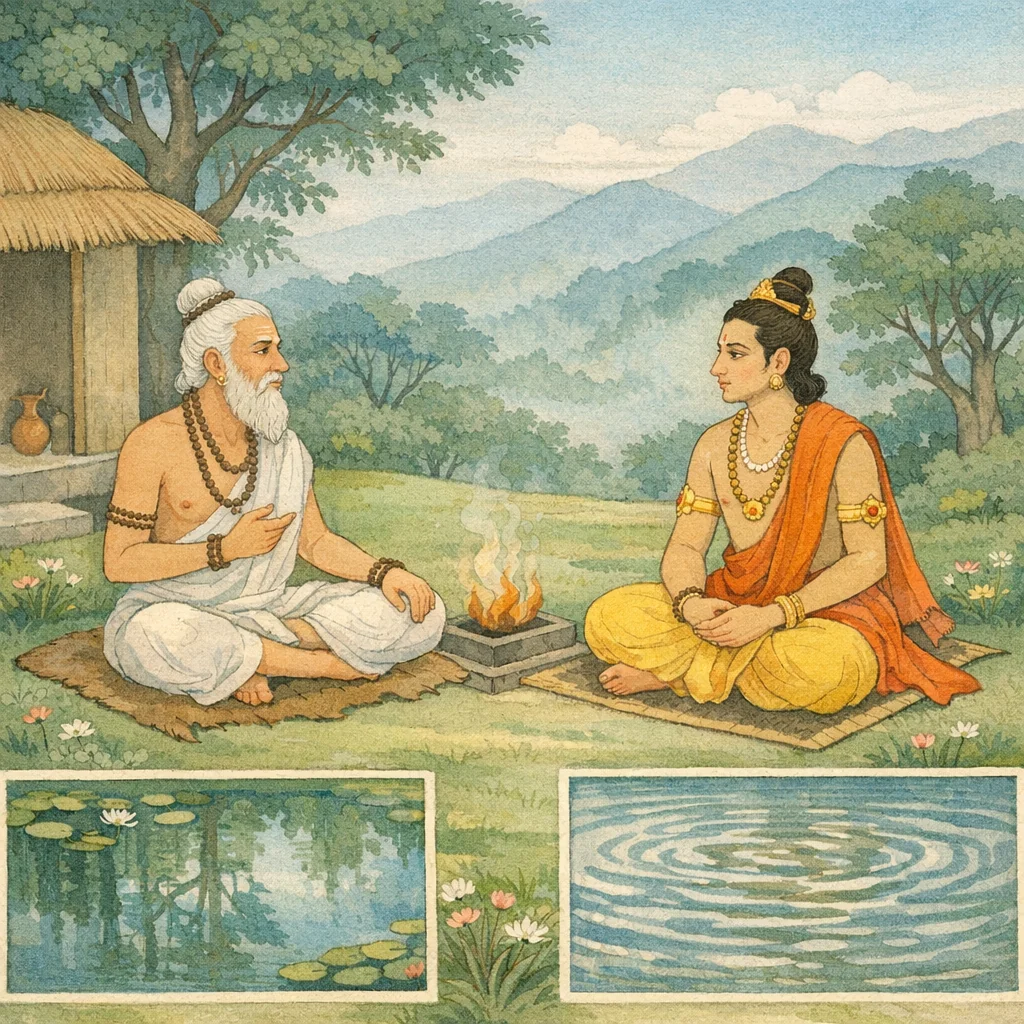
Chapter Arc: मनु बृहस्पति से आत्मा-परमात्मा के साक्षात्कार का उपाय बताते हैं—जैसे स्वप्न में चेतना चलती-फिरती प्रतीत होती है, वैसे ही जाग्रत में भी भीतर का ज्ञाता इन्द्रियों के पार स्थित है। → उपमा के द्वारा मनु दिखाते हैं कि ज्ञान का दर्शन इन्द्रियों की ‘प्रसन्नता’ पर निर्भर है: स्वच्छ, स्थिर जल में प्रतिबिम्ब दिखता है; जल के मथने पर वही रूप अदृश्य हो जाता है। इसी तरह इन्द्रियाँ-मन विक्षुब्ध हों तो ज्ञेय (आत्मतत्त्व) ज्ञान से भी नहीं दिखता। → विषयासक्ति की जड़ पर प्रहार: अज्ञान से तृप्त होकर मनुष्य विषयों के अगाध जल में डूबता है और कभी नहीं भरता; पर जब ‘भूतात्मा’ (अन्तरात्मा) अदृष्टवत् होकर विषयों से निवृत्त होता है, तब इन्द्रियों को आत्मा द्वारा रोकने का निर्णायक विधान प्रकट होता है—‘प्रसृत इन्द्रियाँ दुःख देती हैं, नियत इन्द्रियाँ सुख देती हैं’। → मनु अन्तःकरण-क्रम को स्पष्ट करते हैं: इन्द्रियों से मन श्रेष्ठ, मन से बुद्धि, बुद्धि से ज्ञान, और ज्ञान से भी परे ‘महत्’—और फिर लय-क्रम: विषय-आकृतियाँ मन में, मन बुद्धि में, बुद्धि ज्ञान में, ज्ञान परम में विलीन होता है। साधक को इन्द्रिय-रश्मियों से भीतर लौटकर सूक्ष्म का साक्षी बनना है।
Shlokas
Verse 1
अपना छा अकाल चतुरराधिकद्विशततमो< ध्याय: आत्मा एवं परमात्माके साक्षात्कारका उपाय तथा महत्त्व मनुर्वाच यथा व्यक्तमिदं शेते स्वप्ने चरति चेतनम् । ज्ञानमिन्द्रियसंयुक्तं तद्धत् प्रेत्म भवाभवौ,मनु कहते हैं--बृहस्पते! जैसे स्वप्लावस्थामें यह स्थूल शरीर तो सोया रहता है और सूक्ष्म शरीर विचरण करता रहता है, उसी प्रकार इस शरीरको छोड़नेपर यह ज्ञानस्वरूप जीवात्मा या तो इन्द्रियोंके सहित पुन: शरीर ग्रहण कर लेता है या सुषुप्तिकी भाँति मुक्त हो जाता है
Manu said: “O Bṛhaspati, just as in a dream the visible (gross) body lies asleep while the conscious principle moves about, so too, when one departs from this body, the self that is of the nature of awareness either takes up another embodiment together with the senses, or—like the stillness of deep sleep—attains release.”
Verse 2
यथाम्भसि प्रसन्ने तु रूपं पश्यति चक्षुषा । तद्वव्प्रसन्नेन्द्रियत्वाउज्ञेयं ज्ञानेन पश्यति,जिस प्रकार मनुष्य स्वच्छ और स्थिर जलमें नेत्रोंद्वारा अपना प्रतिबिम्ब देखता है, वैसे ही मनसहित इन्द्रियोंके शुद्ध एवं स्थिर हो जानेपर वह ज्ञानदृष्टिसे ज्ञेयस्वरूप आत्माका साक्षात्कार कर सकता है
Bhīṣma said: “Just as a person sees a clear reflection with the eyes in calm, transparent water, so too, when the mind and senses become purified and steady, one beholds the knowable Self through the vision of true knowledge.”
Verse 3
स एव लुलिते तस्मिन् यथा रूप॑ न पश्यति । तथेन्द्रियाकुली भावे ज्ञेयं ज्ञाने न पश्यति
Bhīṣma said: “Just as, when the water is disturbed, one does not see a form clearly, so too, when the senses are agitated and confused, one does not truly perceive the knowable reality even when knowledge is present.”
Verse 4
वही मनुष्य हिलते हुए जलमें जैसे अपना रूप नहीं देख पाता, उसी प्रकार मनसहित इन्द्रियोंके चंचल होनेपर वह बुद्धिमें ज्ञेयस्वरूप आत्माका दर्शन नहीं कर सकता ।। अबुद्धिरज्ञानकृता अबुद्धा कृष्यते मन: । दुष्टस्य मनस: पठ्च सम्प्रदुष्यन्ति मानसा:,अविवेकसे बुद्धि भ्रष्ट हो जाती है और उस भ्रष्ट बुद्धिसे मन राग आदि दोषोंमें फँस जाता है। इस प्रकार मनके दूषित होनेसे उसके अधीन रहनेवाली पाँचों ज्ञानेन्द्रियाँ भी दूषित हो जाती हैं
Bhishma said: Just as a person cannot see his own reflection in water that is shaking, so too, when the mind and the senses are restless, one cannot behold within the intellect (buddhi) the Self (Atman), whose nature is the true object of knowledge. When discernment (viveka) is ruined by ignorance, the intellect becomes perverted, and through that perverted intellect the mind is dragged into faults such as attachment and passion. When the mind is corrupted, the five sense-faculties that move under its command are corrupted as well. Thus inner steadiness and clear discrimination are prerequisites for self-knowledge and ethical self-mastery.
Verse 5
अज्ञानतृप्तो विषयेष्ववगाढो न तृप्यते । अदृष्टवच्च भूतात्मा विषयेभ्यो निवर्तते,जिसको अज्ञानसे ही तृप्ति प्राप्त हो रही है, वह मनुष्य विषयोंके अगाध जलमें सदा डूबा रहकर भी कभी तृप्त नहीं होता। वह जीवात्मा प्रारब्धाधीन हुआ विषय-भोगोंकी इच्छाके कारण बारंबार इस संसारमें आता और जन्म ग्रहण करता है
Bhishma said: One who feels satisfied only through ignorance, though plunged deep into sense-objects, never truly becomes content. And the embodied self (jiva), as if driven by unseen destiny, turns back again toward those very objects—returning repeatedly to the round of experience rather than withdrawing into clarity and restraint.
Verse 6
तर्षच्छेदो न भवति पुरुषस्येह कल्मषात् | निवर्तते तदा तर्ष: पापमन्तगतं यदा,पापके कारण ही संसारमें पुरुषकी तृष्णाका अन्त नहीं होता। जब पापोंकी समाप्ति हो जाती है, तभी उसकी तृष्णा निवृत्त हो जाती है
Bhīṣma said: In this world, a person’s craving is not cut off so long as he remains tainted by moral impurity. Only when sin has reached its end—when wrongdoing is exhausted and brought to cessation—does that craving truly subside.
Verse 7
विषयेषु तु संसर्गाच्छा श्वतस्य तु संश्रयात् । मनसा चान्यथा कांक्षन् परं न प्रतिपद्यते
Bhīṣma said: Through continued contact with sense-objects, and by taking refuge in what is transient and unstable, a person—though inwardly wishing for something higher—fails to attain the Supreme. The mind, pulled outward by habitual attachment, cannot realize the highest good while it clings to impermanent supports.
Verse 8
विषयोंके संसर्गसे, सदा उन्हींमें रचे-पचे रहनेसे तथा मनके द्वारा साधनके विपरीत भोगोंकी इच्छा रखनेसे पुरुषको परब्रह्म परमात्माकी प्राप्ति नहीं होती है ।। ज्ञानमुत्पद्यते पुंसां क्षयात् पापस्य कर्मण: । यथा<<दर्शतले प्रख्ये पश्यत्यात्मानमात्मनि,पाप-कर्मोंका क्षय होनेसे ही मनुष्योंके अन्तःकरणमें ज्ञानका उदय होता है। जैसे स्वच्छ दर्पणमें ही मानव अपने प्रतिबिम्बको अच्छी तरह देख पाता है
Bhishma said: By associating with sense-objects, by remaining constantly absorbed in them, and by letting the mind crave enjoyments that run contrary to the true means of spiritual attainment, a person does not reach the Supreme Brahman, the Paramatman. Knowledge arises in human beings only when sinful action is exhausted and purified away; just as one can clearly see one’s reflection only in a clean, bright mirror, so the Self is discerned when the inner instrument is cleansed of wrongdoing.
Verse 9
प्रसृतैरिन्द्रियैर्द:खी तैरेव नियतै: सुखी । तस्मादिन्द्रियरूपेभ्यो यच्छेदात्मानमात्मना,विषयोंकी ओर इन्द्रियोंके फैले रहनेसे ही मनुष्य दुखी होता है और उन्हींको संयममें रखनेसे सुखी हो जाता है; इसलिये इन्द्रियोंके विषयोंसे बुद्धिके द्वारा अपने मनको रोकना चाहिये
Bhīṣma said: When the senses are allowed to roam outward toward their objects, a person becomes miserable; when those same senses are restrained, one becomes happy. Therefore, by one’s own inner self—through disciplined understanding—one should check the mind from the pull of sense-objects.
Verse 10
इन्द्रियेभ्यो मन: पूर्व बुद्धि: परतरा ततः । बुद्धेः परतरं ज्ञानं ज्ञानातू परतरं महत्,इन्द्रियोंसे मन श्रेष्ठ है, मनसे बुद्धि श्रेष्ठ है, बुद्धिसे ज्ञान श्रेष्ठठर है और ज्ञानसे परात्पर परमात्मा श्रेष्ठ है
Bhishma said: “Beyond the senses stands the mind; beyond the mind stands the intellect. Beyond the intellect is true knowledge, and beyond knowledge is the Supreme Reality (the Great Self).”
Verse 11
अव्यक्तात् प्रसृतं ज्ञानं ततो बुद्धिस्ततो मन: । मनः श्रोत्रादिभिययुक्त शब्दादीन् साधु पश्यति,अव्यक्त परमात्मासे ज्ञान प्रसारित हुआ है। ज्ञानसे बुद्धि और बुद्धिसे मन प्रकट हुआ है। वह मन ही श्रोत्र आदि इन्द्रियोंसे युक्त होकर शब्द आदि विषयोंका भलीभाँति अनुभव करता है
Bhishma said: From the Unmanifest, knowledge issues forth; from knowledge arises the intellect, and from the intellect the mind. That very mind, joined with the ear and the other senses, properly apprehends sound and the rest of the sense-objects.
Verse 12
यस्तांस्त्यजति शब्दादीन् सर्वाश्व व्यक्तयस्तथा । विमुज्चेत् प्राकृतान्ग्रामांस्तान् मुक्त्वामृतमश्चुते,जो पुरुष शब्द आदि विषयोंको, उनके आश्रयभूत सम्पूर्ण व्यक्त तत्त्वोंको, स्थूलभूतों और प्राकृत गुण-समुदायोंको त्याग देता है अर्थात् उनसे सम्बन्धविच्छेद कर लेता है, वह उन्हें त्यागकर अमृतस्वरूप परमात्माको प्राप्त हो जाता है
Bhishma said: Whoever renounces sound and the other sense-objects, and likewise all the manifest principles that support them, and becomes free from the natural aggregates born of Prakriti—having abandoned these, he attains the immortal Reality.
Verse 13
उद्यन् हि सविता यद्वत्सृजते रश्मिमण्डलम् | स एवास्तमपागच्छंस्तदेवात्मनि यच्छति,जैसे सूर्य उदित होकर अपनी किरणोंको सब ओर फैला देता है और अस्त होते समय उन समस्त किरणोंको अपने भीतर ही समेट लेता है, उसी प्रकार जीवात्मा देहमें प्रविष्ट होकर फैली हुई इन्द्रियोंकी वृत्तिरूपी किरणोंद्वारा पाँचों विषयोंको ग्रहण करता है और शरीरको छोड़ते समय उन सबको समेटकर अपने साथ लेकर चल देता है
Bhishma said: “Just as the Sun, on rising, sends forth its circle of rays in every direction, and on setting draws those very rays back into itself, so too the embodied self, upon entering a body, extends itself outward through the ‘ray-like’ activities of the senses to grasp the five objects of sense; and when it departs the body, it gathers those activities back within and carries them along.”
Verse 14
अन्तरात्मा तथा देहमाविश्येन्द्रियरश्मिभि: । प्राप्येन्द्रिययुणान् पडच सो<स्तमावृत्य गच्छति,जैसे सूर्य उदित होकर अपनी किरणोंको सब ओर फैला देता है और अस्त होते समय उन समस्त किरणोंको अपने भीतर ही समेट लेता है, उसी प्रकार जीवात्मा देहमें प्रविष्ट होकर फैली हुई इन्द्रियोंकी वृत्तिरूपी किरणोंद्वारा पाँचों विषयोंको ग्रहण करता है और शरीरको छोड़ते समय उन सबको समेटकर अपने साथ लेकर चल देता है
Bhishma said: When the inner Self enters the body, it spreads out through the “rays” of the senses and, by those sensory functions, apprehends the five objects of experience. When it departs at death, it gathers those powers back into itself and goes on—just as the sun, having risen, casts its rays in all directions, and at setting draws those very rays back into itself. Therefore embodied experience is a temporary projection of consciousness through the senses; one should not mistake sensory life for the Self, nor cling to objects as if they were permanent.
Verse 15
प्रणीतं कर्मणा मार्ग नीयमान: पुन: पुनः । प्राप्रोत्ययं कर्मफल प्रवृत्तं धर्ममाप्तवान्,जिसने प्रवृत्तिप्रधान पुण्य-पापमय कर्मका आश्रय लिया है, वह जीवात्मा कर्मोद्वारा कर्म-मार्गपर बारंबार लाया जाकर अर्थात् संसार-चक्रमें भ्रमाया जाकर सुख-दुःखरूप कर्म- फलको प्राप्त होता है
Bhishma said: One who has taken refuge in action dominated by worldly engagement—merit and demerit—gets led again and again by his own deeds onto the path of action. Thus, made to wander in the cycle of existence, he repeatedly attains the fruits of karma as pleasure and pain.
Verse 16
विषया विनिवर्तन्ते निराहारस्य देहिन: । रसवर्ज रसो<प्यस्य परं दृष्टवा निवर्तते,इन्द्रियद्वारा विषयोंको ग्रहण न करनेसे पुरुषके वे विषय तो निवृत्त हो जाते हैं; परंतु उनमें उनकी आसक्ति बनी रहती है। परमात्माका साक्षात्कार कर लेनेपर पुरुषकी वह आसक्ति भी दूर हो जाती है
Bhīṣma said: For a person who abstains from sense-enjoyments, the objects of the senses withdraw; yet the lingering taste for them remains. But when one beholds the Supreme Reality directly, even that residual craving is extinguished. The teaching underscores that mere external restraint is incomplete unless inner attachment is dissolved through higher realization.
Verse 17
बुद्धि: कर्मगुणैहीना यदा मनसि वर्तते । तदा सम्पद्यते ब्रह्म तत्रैव प्रलयं गतम्,जिस समय बुद्धि कर्मजनित गुणोंसे छूटकर हृदयमें स्थित हो जाती है, उस समय जीवात्मा ब्रह्ममें लीन होकर ब्रह्मको प्राप्त हो जाता है
Bhīṣma said: When the intellect becomes free from the qualities produced by action and abides steadily in the mind’s inner seat, then the individual self attains Brahman—dissolving right there into that supreme reality. The ethical thrust is that liberation is not achieved by outward performance alone, but by inner detachment from action-born tendencies and a settled, purified awareness.
Verse 18
अस्पर्शनमशृण्वानमनास्वादमदर्शनम् । अप्राणमवितर्क च सत्त्वं प्रविशते परम्,परब्रह्म परमात्मा स्पर्श, श्रवण, रसन, दर्शन, प्राण और संकल्प-विकल्पसे भी रहित है; इसलिये केवल विशुद्ध बुद्धि ही उसमें प्रवेश कर पाती है
Bhishma explains that the Supreme Reality—Param Brahman, the Paramatman—lies beyond the reach of sensory contact, hearing, taste, and sight, and is also beyond the ordinary operations of breath and discursive thought. Therefore, it is only a purified, lucid intelligence (sattva/śuddha buddhi), freed from sense-driven agitation and mental wavering, that can enter into and realize that highest principle.
Verse 19
मनस्याकृतयो मग्ना मनस्त्वभिगतं मतिम् | मतिस्त्वभिगता ज्ञानं ज्ञानं चाभिगतं परम्,मनमें शब्दादि विषयरूप समस्त आकृतियोंका लय होता है। मनका बुद्धिमें, बुद्धिका ज्ञानमें और ज्ञानका परमात्मामें लय होता है
Bhishma said: “All forms and impressions sink back into the mind; the mind, in turn, is absorbed into the intellect. The intellect is absorbed into knowledge, and knowledge itself is absorbed into the Supreme. Thus, in the inward ascent of discipline, the many are gathered into the one—until the seeker rests in the highest reality.”
Verse 20
नेन्द्रियर्मनस: सिद्धिर्न बुद्धि बुछाते मन: । न बुद्धिर्बुद्धाते5व्यक्तं सूक्ष्मं त्वेतानि पश्यति,इन्द्रियोंद्रार मनकी सिद्धि नहीं होती अर्थात् इन्द्रियाँ मनको नहीं जानती हैं। मन बुद्धिको नहीं जानता और बुद्धि सूक्ष्म एवं अव्यक्त आत्माको नहीं जानती है; किंतु अव्यक्त आत्मा इन सबको देखता और जानता है
Bhishma said: “The senses do not truly apprehend the mind; the mind does not apprehend the intellect; and the intellect does not apprehend the subtle, unmanifest Self. Yet that unmanifest, subtle Self is the witness that sees and knows all of these.”
Verse 204
इति श्रीमहाभारते शान्तिपर्वणि मोक्षधर्मपर्वणि मनुबृहस्पतिसंवादे चतुरधिकद्विशततमो<ध्याय:
Thus, in the Śrī Mahābhārata, within the Śānti Parva—specifically the Mokṣa-dharma section—ends the dialogue between Manu and Bṛhaspati: the two-hundred-and-fourth chapter. This closing colophon marks the completion of a teaching episode framed as a dharma-discourse oriented toward liberation (mokṣa), preserved within Bhīṣma’s larger instruction on peace and right conduct.
Frequently Asked Questions
It addresses confusion about agency and causality—how inert factors can produce ordered effects and how the self can be implicated in experience without being intrinsically altered—resolved through distinguishing conditioned processes from the knower.
Discern the unmanifest basis behind manifest change, recognize mind’s role when coupled with ignorance and ego-appropriation, and stabilize kṣetra–kṣetrajña discrimination so that experience does not compel renewed bondage.
Yes in doctrinal form: the closing analogy states that afflictions do not reattach once “burnt” by knowledge, like fire-scorched seeds that cannot germinate—indicating the soteriological efficacy of insight.