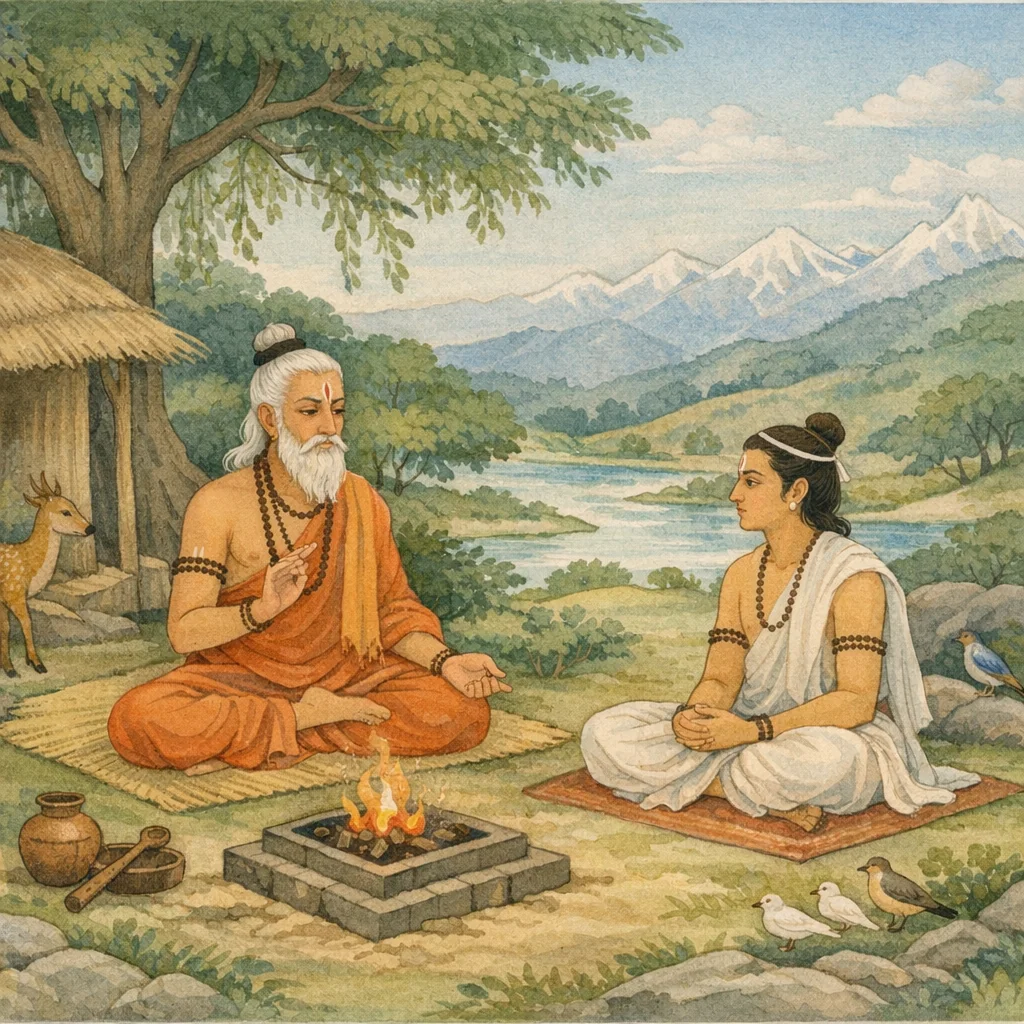
Adhyaya 190
Jāpakānāṃ Gatiḥ — The Destinies of Japa-Practitioners (Śānti Parva 12.190)
Upa-parva: Mokṣa-dharma (Liberation Teachings) — Japa and the Ethics of Mental Discipline
Yudhiṣṭhira asks whether japa-practitioners attain a single ‘highest’ destination or whether other outcomes occur. Bhīṣma replies with a typology of defective japa: a practitioner who fails to follow what was previously taught, performs only partial observance, or practices with avajñā (disrespect) is said to reach niraya. Bhīṣma further associates ego-driven practice (ahaṃkāra), disparagement of others, and japa performed under delusive intention (abhidhyā/misguided fixation) with adverse destinies. Attachment to power or prosperity (aiśvarya) is described as becoming the practitioner’s “niraya” insofar as it binds the mind and prevents release. Additional faults include rāga (attachment), mental instability, immaturity of discernment (akṛtaprajñatā), and rigid self-assertion (“I do it”) without completeness or proper integration. Yudhiṣṭhira then raises a metaphysical question about how one established in the formless Brahman could enter embodiment, prompting Bhīṣma to summarize: many ‘nirayas’ are taught for poor discernment, while commendable japa exists alongside these defects—thereby framing gati as conditioned by cognition and intention rather than by recitation alone.
Chapter Arc: भरद्वाज के प्रश्न के उत्तर में भगु ऋषि चारों वर्णों के ‘स्वरूप’ को कर्म, संस्कार और सदाचार के कसौटी-पत्थर पर कसने लगते हैं—जन्म नहीं, आचरण निर्णायक है। → ब्राह्मण, क्षत्रिय, वैश्य, शूद्र—प्रत्येक के लिए शुचिता, वेदाध्ययन/कर्तव्य, संयम, दया, सत्य, दान, अहिंसा और लोभ-क्रोध-निग्रह जैसे गुणों का क्रमशः विधान आता है; साथ ही यह भी कि लोभ और क्रोध मनुष्य के कल्याण को सतत बाधित करते हैं, इसलिए सर्वोपाय से उनका दमन आवश्यक है। → वैराग्य और त्याग का शिखर-उपदेश: ‘जिसने त्याग में सब कुछ होम कर दिया’ और जिसके समस्त आरम्भ निराशा (निष्कामता) से युक्त हैं—वही बुद्धिमान त्यागी है; यही मार्ग परब्रह्म-प्राप्ति की ओर ले जाता है। → वर्ण-धर्म का सार ‘आत्मसंयम’ और ‘निष्काम कर्म’ में प्रतिष्ठित कर दिया जाता है—सदाचार, शौच, सत्य, दया, और इन्द्रियनिग्रह से जीवन शुद्ध होता है और वैराग्य से मोक्ष का द्वार खुलता है।
Shlokas
Verse 1
अपन बक। है २ >> एकोननवर्त्याधेकशततमो< ध्याय: चारों वर्णगोके अलग-अलग कर्मोका और सदाचारका वर्णन तथा वैराग्यसे परब्रह्म॒की प्राप्ति भरद्वाज उवाच ब्राह्मण: केन भवति क्षत्रियो वा द्विजोत्तम | वैश्य: शूद्रश्न विप्र्षे तद् ब्रूहि वदतां वर,भरद्वाजने पूछा--वक्ताओंमें श्रेष्ठ ब्रह्मर्षे! द्विजोत्तम! अब मुझे यह बताइये कि मनुष्य कौन-सा कर्म करनेसे ब्राह्मण, क्षत्रिय, वैश्य अथवा शूद्र होता है?
Bharadvāja said: “O best of the twice-born, O brahmarṣi—foremost among speakers—tell me this: by what does a person become a brāhmaṇa, or a kṣatriya? By what does one become a vaiśya or a śūdra? Explain it to me.”
Verse 2
भगुरुवाच जातकमदिभिर्यस्तु संस्कारै: संस्कृत: शुचि: । वेदाध्ययनसम्पन्न: षट्सु कर्मस्ववस्थित:,भगुजीने कहा--जो जाति, कर्म आदि संस्कारोंसे सम्पन्न, पवित्र तथा वेदोंके स्वाध्यायमें संलग्न है, (यपजन-याजन, अध्ययनाध्यापन और दान-प्रतिग्रह--इन) छ: कर्मोमें स्थित रहता है, शौच एवं सदाचारका पालन तथा परम उत्तम यज्ञशिष्ट अन्नका भोजन करता है, गुरुके प्रति प्रेम रखता, नित्य व्रतका पालन करता तथा सत्यमें तत्पर रहता है, वही ब्राह्मण कहलाता है
Bhagu said: “He who has been refined by the sacraments beginning with the birth-rites, who is pure in conduct, who is accomplished in the study of the Veda, and who remains established in the six prescribed duties—such a person is to be recognized as a brāhmaṇa.”
Verse 3
शौचाचारस्थित: सम्यग्विघसाशी गुरुप्रिय: । नित्यव्रती सत्यपर: स वै ब्राह्मण उच्यते,भगुजीने कहा--जो जाति, कर्म आदि संस्कारोंसे सम्पन्न, पवित्र तथा वेदोंके स्वाध्यायमें संलग्न है, (यपजन-याजन, अध्ययनाध्यापन और दान-प्रतिग्रह--इन) छ: कर्मोमें स्थित रहता है, शौच एवं सदाचारका पालन तथा परम उत्तम यज्ञशिष्ट अन्नका भोजन करता है, गुरुके प्रति प्रेम रखता, नित्य व्रतका पालन करता तथा सत्यमें तत्पर रहता है, वही ब्राह्मण कहलाता है
Bhagu said: “One who is firmly established in purity and right conduct, who eats only what remains after sacred offering, who is devoted to the teacher, who keeps regular vows, and who is intent on truth—such a person is truly called a brāhmaṇa.”
Verse 4
सत्यं दानमथाद्रोह आनृशंस्यं त्रपा घृणा । तपश्न दृश्यते यत्र स ब्राह्मण इति स्मृतः,जिसमें सत्य, दान, द्रोह न करनेका भाव, क्रूरताका अभाव, लज्जा, दया और तप-ये सदगुण देखे जाते हैं, वह ब्राह्मण माना गया है
Bharadvāja said: “One in whom are seen truthfulness, generosity, non-injury, kindness (freedom from cruelty), modesty, compassion, and austerity—such a person is remembered as a brāhmaṇa.”
Verse 5
क्षत्रजं सेवते कर्म वेदाध्ययनसंगत: । दानादानरतिर्यस्तु स वै क्षत्रिय उच्यते,जो क्षत्रियोचित युद्ध आदि कर्मका सेवन करता है, वेदोंके अध्ययनमें लगा रहता है, ब्राह्मणोंको दान देता है और प्रजासे कर लेकर उसकी रक्षा करता है, वह क्षत्रिय कहलाता है
Bharadvāja said: “One who undertakes the duties born of royal power—who is devoted to the study of the Vedas, who delights in giving and in receiving what is due, and who performs the warrior’s proper works such as protection and battle—is indeed called a Kṣatriya.”
Verse 6
वणिज्या पशुरक्षा च कृष्यादानरति: शुचि: । वेदाध्ययनसम्पन्न: स वैश्य इति संज्ञित:
Bharadvāja said: “One who is devoted to trade, the protection of cattle, agriculture, and the giving of gifts; who is pure in conduct; and who is accomplished in Vedic study—such a person is designated a Vaiśya.”
Verse 7
इसी प्रकार जो वेदाध्ययनसे सम्पन्न होकर व्यापार, पशुपालन और खेतीका काम करके अन्न संग्रह करनेकी रुचि रखता है और पवित्र रहता है, वह वैश्य कहलाता है ।। सर्वभक्षरतिर्नित्यं सर्वकर्मकरो5शुचि: । त्यक्तवेदस्त्वनाचार: स वै शूद्र इति स्मृत:,किंतु जो वेद और सदाचारका परित्याग करके सदा सब कुछ खानेमें अनुरक्त रहता है और सब तरहके काम करता है, साथ ही बाहर-भीतरसे अपवित्र रहता है, वह शूद्र कहा गया है
Bharadvāja said: “One who has abandoned Vedic study and right conduct, who is constantly attached to eating anything whatsoever, who undertakes every kind of work indiscriminately, and who remains impure outwardly and inwardly—such a person is remembered in the tradition as a Śūdra.”
Verse 8
शूट्रे चैतद्धवेल्लक्ष्यं द्विजे तच्च न विद्यते | न वै शूद्रो भवेच्छूद्रो ब्राह्मणो न च ब्राह्मण:,उपर्युक्त सत्य आदि सात गुण यदि शूद्रमें दिखायी दें और ब्राह्मणमें न हों तो वह शाद्र शूद्र नहीं है और वह ब्राह्मण ब्राह्मण नहीं है
Bharadvāja said: “If these defining marks are found in a Śūdra, and they are not found in a twice-born man, then that person is not truly a Śūdra; and the other is not truly a Brāhmaṇa.”
Verse 9
सर्वोपायैस्तु लोभस्य क्रोधस्य च विनिग्रह: । एतत् पवित्र ज्ञानानां तथा चैवात्मसंयम:
Bharadvāja said: By every possible means one should restrain greed and anger. This is the purifying discipline for those who seek true knowledge, and it is indeed self-mastery.
Verse 10
सभी उपायोंसे लोभ और क्रोधको जीतना चाहिये। यही ज्ञानोंमें पवित्र ज्ञान है और यही आत्मसंयम है ।। वार्यो सर्वात्मना तौ हि श्रेयोघातार्थमुच्छितौ । नित्यं क्रोधाच्छियं रक्षेत् तपो रक्षेच्च मत्सरात्
Bharadvāja said: One should conquer greed and anger by every possible means. This is the purest knowledge among all forms of knowledge, and this alone is true self-restraint. Indeed, these two—greed and anger—must be rejected with one’s whole being, for they strike down one’s highest good. Therefore, one should always protect prosperity from anger, and protect austerity from envy.
Verse 12
अहिंस्र: सर्वभूतानां मैत्रायणगतश्चरेत्,किसी भी प्राणीकी हिंसा न करे, सबके साथ मैत्रीपूर्ण बर्ताव करे। स्त्री-पुत्र आदिकी ममता एवं आसक्तिको त्यागकर बुद्धिके द्वारा इन्द्रियोंको वशमें करे और उस स्थितिको प्राप्त करे, जो इहलोक और परलोकमें भी निर्भय एवं शोकरहित है
Bharadvāja said: One should live without violence toward any being and conduct oneself in a spirit of friendship toward all. Abandoning possessive attachment and clinging to wife, son, and the like, one should, by the power of discernment, bring the senses under control and attain that state which is fearless and free from sorrow both in this world and the next.
Verse 13
परिग्रहान् परित्यज्य भवेद् बुद्धया जितेन्द्रिय: । अशोकं स्थानमातिषछेदिह चामुत्र चाभयम्,किसी भी प्राणीकी हिंसा न करे, सबके साथ मैत्रीपूर्ण बर्ताव करे। स्त्री-पुत्र आदिकी ममता एवं आसक्तिको त्यागकर बुद्धिके द्वारा इन्द्रियोंको वशमें करे और उस स्थितिको प्राप्त करे, जो इहलोक और परलोकमें भी निर्भय एवं शोकरहित है
Bharadvāja said: Renouncing possessions and attachments, one should, through disciplined understanding, become a conqueror of the senses. Thus one attains a state free from sorrow and fear—secure both in this world and in the world to come.
Verse 14
तपोनित्येन दान्तेन मुनिना संयतात्मना । अजित जेतुकामेन भाव्य॑ सड्लेष्वसज्धिना,नित्य तप करे, मननशील होकर इन्द्रियोंका दमन और मनका संयम करे। आसक्तिके आश्रयभूत देह-गेह आदिमें आसक्त न होकर अजित (परमात्मा) को जीतने (प्राप्त करने) की इच्छा रक्खे
Bharadvāja said: “One should cultivate the state of a sage—ever devoted to austerity, self-restrained, and with the inner self brought under control. Remaining unattached amid objects of attachment, one should nurture the resolve to ‘conquer’ the Unconquered—i.e., to attain the Supreme Self.”
Verse 15
इन्द्रियैर्गह्यते यद् यत् तत्तद् व्यक्तमिति स्थिति: । अव्यक्तमिति विज्ञेयं लिड़ग्राह्म॒मतीन्द्रियम्,इन्द्रियोंसे जिसका ग्रहण होता है, वह सब व्यक्त, कहलाता है। जो इन्द्रियातीत होनेके कारण अनुमानसे ही जाना जाय, उसे अव्यक्त समझना चाहिये
Bharadvāja said: Whatever is apprehended by the senses is, by definition, called the manifest. But that which lies beyond the senses and is known only through inference from signs should be understood as the unmanifest.
Verse 16
अविस्रम्भे न गन्तव्यं विस्रम्भे धारयेन्मन: । मन: प्राणे निगृह्नलीयात् प्राणं ब्रह्मणि धारयेत्,जो विश्वासके योग्य नहीं है, उस मार्गपर न चले और जो विश्वास करनेयोग्य है, उसमें मन लगावे। मनको प्राणमें और प्राणको ब्रह्ममें स्थापित करे
Bharadvāja said: One should not proceed on a path where trust is absent; where trust is well placed, there one should steady the mind. Let the mind be restrained and gathered into the vital breath, and let the vital breath be fixed in Brahman. Thus, ethical discernment in human dealings culminates in inner discipline and spiritual absorption.
Verse 17
निर्वेदादेव निर्वाणं न च किज्चिद् विचिन्तयेत् । सुखं वै ब्राह्मणो ब्रह्म निर्वेदेनाधिगच्छति,वैराग्यसे ही निर्वाणपद (मोक्ष) प्राप्त होता है। उसे पाकर मनुष्य किसी अनात्मपदार्थका चिन्तन नहीं करता है। ब्राह्मण संसारसे वैराग्य होनेपर सुखस्वरूप परब्रह्म परमात्माको प्राप्त कर लेता है
From dispassion alone arises liberation; having attained it, one no longer broods over anything that is not the Self. When a brahmin becomes inwardly detached from the world, he reaches Brahman—the blissful Supreme Reality—through that very dispassion.
Verse 18
शौचेन सतत युक्त: सदाचारसमन्वित: । सानुक्रोशश्व भूतेषु तद् द्विजातिषु लक्षणम्,सर्वदा शौच और सदाचारका पालन करे और समस्त प्राणियोंपर दयाभाव बनाये रकक््खे; यह ब्राह्मणका प्रधान लक्षण है
Bharadvāja said: One should be ever devoted to purity and endowed with good conduct, and should maintain compassion toward all living beings—this is the defining mark of the twice-born, especially the brāhmaṇa, as a standard of dharma and ethical life.
Verse 103
विद्यां मानापमानाभ्यामात्मानं तु प्रमादत: । क्रोध और लोभ मनुष्यके कल्याणमें बाधा डालनेके लिये सदा उद्यत रहते हैं; अतः पूरी शक्ति लगाकर इन दोनोंका निवारण करना चाहिये। धन-सम्पत्तिको क्रोधके आघातसे बचाना चाहिये, तपको मात्सर्यके आघातसे बचाना चाहिये, विद्याको मान-अपमानसे और अपने-आपको प्रमादके आक्रमणके बचाना चाहिये
Bharadvāja said: One should guard learning from the twin assaults of honor and dishonor, and guard oneself from heedlessness. Anger and greed are ever poised to obstruct a person’s welfare; therefore, with full effort, these two must be restrained. Protect wealth from the blows of anger, protect austerity from the blows of envy, protect knowledge from honor and dishonor, and protect the self from the onrush of negligence.
Verse 116
त्यागे यस्य हुतं सर्व स त्यागी च स बुद्धिमान् ब्रह्म! जिसके सभी कार्य कामनाओंके बन्धनसे रहित होते हैं तथा जिसने त्यागकी अतामें सब कुछ होम दिया है, वही त्यागी और वही बुद्धिमान् है
Bharadvāja said: “O Brahman! He alone is truly a renouncer and truly wise, who has offered everything into the fire of renunciation—whose every action is free from the bondage of desire.”
Verse 131
यस्य सर्वे समारम्भा निराशीर्बन्धना द्विज
Bharadvāja said: “O twice-born one, he whose every undertaking is free from craving and from the fetters of attachment…”
Verse 189
इति श्रीमहाभारते शान्तिपर्वणि मोक्षधर्मपर्वणि भूगुभरद्वाजसंवादे वर्णस्वरूपकथने एकोननवत्यधिकशततमो<ध्याय:
Thus, in the Śrī Mahābhārata, within the Śānti Parva—specifically the Mokṣa-dharma section—this marks the close of the dialogue between Bhṛgu and Bharadvāja, in the discourse explaining the true nature of the social orders (varṇas): the one-hundred-and-ninetieth chapter.
Frequently Asked Questions
The chapter warns that japa performed with disrespect, ego, attachment, delusion, or incomplete observance is ethically defective and is mapped to adverse outcomes, including niraya.
Japa must be integrated with discernment, steadiness, and non-attachment; the practitioner’s mental disposition and motivation determine the spiritual trajectory more than mechanical repetition.
A formal phalaśruti is not explicit in the provided verses; the meta-point functions as a doctrinal criterion: outcomes (gati) follow from cognitive-ethical quality (prajñā, humility, restraint), not from technique alone.