Adhyaya 156
Satya-lakṣaṇa (The Characteristics and Forms of Truth) | सत्यलक्षणम्
Upa-parva: Rājadharmānuśāsana Parva (Instruction on the Duties of Kings)
This adhyāya is a focused ethical discourse initiated by Yudhiṣṭhira’s inquiry into satya: its defining marks, methods of attainment, outcomes, and proper articulation. Bhīṣma answers by elevating satya as the most stable, unmodified (avikāri), and universally relevant principle across social classes, identifying it as dharma’s enduring form and the highest refuge (paramā gati). He frames satya as the substrate of tapas, yoga, brahman, and yajña, asserting that other religious and civic practices are secured by truthfulness. The chapter then enumerates thirteen ‘forms’ or operational expressions of satya—truth itself, equanimity (samatā), self-restraint (dama), non-envy (amātsarya), forgiveness (kṣamā), modesty/shame (hrī), forbearance (titikṣā), non-censoriousness (anasūyatā), renunciation (tyāga), meditation (dhyāna), nobility/ethical refinement (āryatva), steadfastness (dhṛti), and non-injury (ahiṃsā)—and briefly characterizes several as attainments through yoga, knowledge, and the reduction of desire-aversion, lust, and anger. The adhyāya closes with comparative valuation: satya outweighs even vast ritual merit (e.g., a thousand aśvamedhas), and falsehood is presented as the gravest ethical fault because it destabilizes dharma itself.
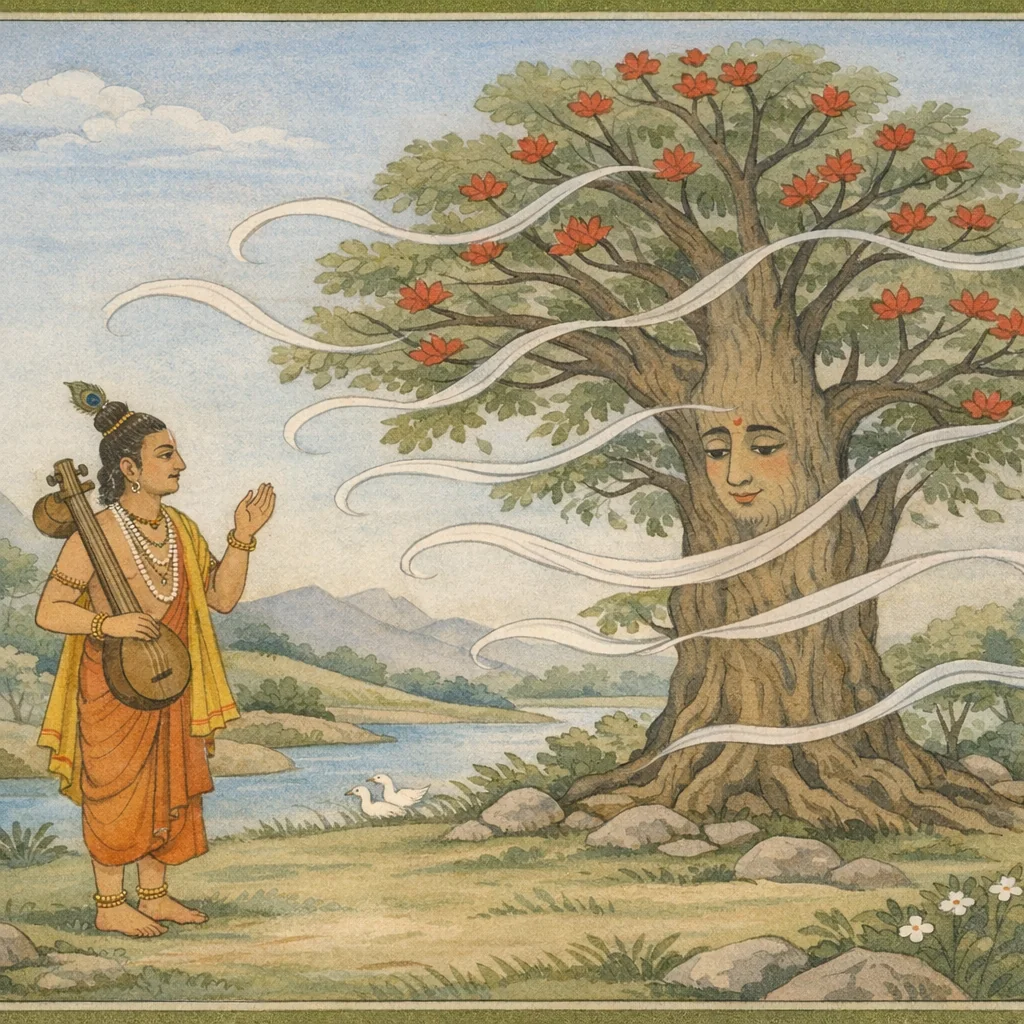
Chapter Arc: देवर्षि नारद शाल्मलि-वृक्ष के पास आते हैं और उसके भीतर पल रहे अहंकार को भाँपकर बन्धुत्व/सख्य के बहाने उसे टोकते हैं—‘शाल्मले, इसमें संशय नहीं कि तू अपने को वायु से भी बड़ा मान बैठा है।’ → नारद वायु की सर्वशक्तिमत्ता का स्मरण कराते हैं—पृथ्वी पर ऐसा वृक्ष, पर्वत या भवन नहीं जो वायु-बल से न टूट सके; फिर भी शाल्मलि कैसे अडिग है? शाल्मलि प्रत्युत्तर में अपने ‘तेज-बल’ का गर्व करता है और कहता है कि उसने प्रभञ्जन वायु की गति को अनेक बार रोक-तोड़ दिया, इसलिए उसे क्रुद्ध वायु से भी भय नहीं। → नारद निर्णायक वचन कहते हैं: पृथ्वी पर जो भी प्राणी चेष्टा करता है, वह वायु के कारण—प्राण, गति और प्रेरणा से—करता है; अतः शाल्मलि का ‘मैं’ मिथ्या है। यदि वह बचा है तो अपने बल से नहीं, वायु की ही किसी कारण-रक्षा/अनुग्रह से। → शाल्मलि का अहंकार ढहता है; वह समझता है कि वायु केवल विनाशक झोंका नहीं, समस्त प्राणियों की चेष्टा का अधिष्ठाता ‘भगवान् वायु’ है। बलवान वृक्ष भी अंततः श्वसन (वायु) को नमस्कार करते हैं—यह विनय और पराश्रय-बोध का निष्कर्ष बनता है।
Shlokas
Verse 1
ऑपन--माजल बक। असल पञ्चपञ्चाशर्दाधिकशततमो< ध्याय: नारदजीका सेमल-वृक्षको उसका अहंकार देखकर फटकारना नारद उवाच बन्धुत्वादथवा सख्याच्छाल्मले नात्र संशय: । पालयत्येव सततं भीम: सर्वत्रगोडनिलः,नारदजीने कहा--शाल्मले! इसमें संहाय नहीं कि तुम्हें अपना बन्धु अथवा मित्र माननेके कारण ही सर्वत्रगामी भयानक वायुदेव सदा तुम्हारी रक्षा करते हैं
Nārada said: “O Śālmali, there is no doubt about this: it is because he regards you as a kinsman or a friend that the terrible, all-moving Wind-god continually protects you everywhere.”
Verse 2
न्यग्भावं परमं वायो: शाल्मले त्वमुपागत: । तवाहमस्मीति सदा येन रक्षति मारुत:,शाल्मले! मालूम होता है, तुम वायुके सामने अत्यन्त विनम्र होकर कहते हो कि “मैं तो आपका ही हूँ इसीसे वह सदा तुम्हारी रक्षा करता है
Nārada said: “O Śālmali, you have adopted the utmost humility before Vāyu, always declaring, ‘I belong to you.’ It is precisely because of this attitude that Māruta (the Wind) continually protects you.”
Verse 3
नतं पश्याम्यहं वृक्ष पर्वतं वेश्म चेदृशम् । यं न वायुबलाद भग्नं पृथिव्यामिति मे मति:,मैं इस भूतलपर ऐसे किसी वृक्ष, पर्वत या घरको नहीं देखता, जो वायुके बलसे भग्न न हो जाय। मेरा यही विश्वास है कि वायुदेव सबको तोड़कर गिरा सकते हैं
Nārada said: “On this earth I see no tree, no mountain, no house of such a kind that it would not be broken by the force of the wind. This is my settled conviction: the Wind-god can shatter and bring down all things.”
Verse 4
त्वं पुन: कारणैर्नूनं रक्ष्यसे शाल्मले यथा । वायुना सपरीवारस्तेन तिष्ठस्यसंशयम्
Nārada said: “But you, surely, will be protected by the very causes that now surround you, just as a śālmali tree is safeguarded by the wind. With your attendants and retinue, you will remain firm because of that—without doubt.”
Verse 5
शाल्मले! कुछ ऐसे कारण अवश्य हैं, जिनसे प्रेरित होकर वायुदेव निश्चितरूपसे सपरिवार तुम्हारी रक्षा करते हैं। निस्संदेह इसीसे यों ही खड़े रहते हो ।। शाल्मलिरुवाच न मे वायु: सखा ब्रह्मन् न बन्धुर्न च मे सुहृत् । परमेष्ठी तथा नैव येन रक्षति वानिल:,सेमलने कहा--ब्रह्मन! वायु न तो मेरा मित्र है, न बन्धु है, न सुहृद् ही है। वह ब्रह्मा भी नहीं है, जो मेरी रक्षा करेगा
Nārada said: “O Śālmali! There must surely be some causes that impel the Wind-god, with his attendants, to protect you. Undoubtedly, it is because of this that you stand here unharmed.” Śālmali replied: “O Brahmin, Vāyu is neither my friend, nor my kinsman, nor my well-wisher. Nor is he the Creator (Parameṣṭhin) whose duty it would be to protect me.”
Verse 6
मम तेजो बल॑ भीम॑ वायोरपि हि नारद । कलामशष्टादशीं प्राणैर्न मे प्राप्रोति मारुत:,नारद! मेरा तेज और बल वायुसे भी भयंकर है। वायु अपनी प्राणशक्तिके द्वारा मेरी अठारहवीं कलाको भी नहीं पा सकता
Śālmali said: “My splendor and strength are truly formidable—greater even than the Wind. Even with all his life-breath power, Māruta cannot attain even an eighteenth part of my might.”
Verse 7
आगच्छन् परुषो वायुर्मया विष्टम्भितो बलात् | भज्जन् ट्रुमान् पर्वतांश्व॒ यच्चान्यदपि किंचन,जिस समय वायुदेवता वृक्ष, पर्वत तथा दूसरी वस्तुओंको तोड़ता-फोड़ता हुआ मेरे पास पहुँचता है, उस समय मैं बलसे उसकी गतिको रोक देता हूँ
Śālmali said: “When the fierce Wind-god comes toward me, shattering trees, mountains, and whatever else lies in his path, I forcibly check his movement and hold him back.”
Verse 8
स मया बहुशो भग्नः प्रभञ्जन् वै प्रभञ्जन: । तस्मान्न बिभ्ये देवर्षे क्रुद्धादपि समीरणात्,देवर्षे! इस प्रकार मैंने तोड़-फोड़ करनेवाले वायुकी गतिको अनेक बार रोक दिया है; अतः वह कुपित हो जाय तो भी मुझे उससे भय नहीं है
Nārada said: “Many times have I checked and thwarted the Wind—Prabhañjana, the great breaker and scatterer. Therefore, O divine seer, even if that Samīraṇa (the wind) becomes enraged, I do not fear him.”
Verse 9
नारद उवाच शाल्मले विपरीत ते दर्शन नात्र संशय: । न हि वायोर्बलेनास्ति भूतं तुल्यबलं क्वचित्,नारदजीने कहा--शाल्मले! इस विषयमें तुम्हारी दृष्टि विपरीत है--समझ उलटी हो गयी है, इसमें संशय नहीं है; क्योंकि वायुके बलके समान किसी भी प्राणीका बल नहीं है
Nārada said: “O Śālmali, your understanding on this matter is mistaken—there is no doubt about it. For nowhere is there any being whose strength is equal to the strength of the Wind.”
Verse 10
इन्द्रो यमो वैश्रवणो वरुणश्न जलेश्वर: । नैतेडपि तुल्या मरुत: कि पुनस्त्वं वनस्पते,वनस्पते! इन्द्र, यम, कुबेर तथा जलके स्वामी वरुण--ये भी वायुके तुल्य बलशाली नहीं हैं; फिर तुम जैसे साधारण वृक्षकी तो बात ही क्या है?
Nārada said: “Indra, Yama, Vaiśravaṇa (Kubera), and Varuṇa, lord of the waters—none of these is equal in might to the Maruts (the storm-winds). How much less, then, are you, O lord of the forest, O tree!”
Verse 11
यच्च किंचिदिह प्राणी चेष्टते शाल्मले भुवि । सर्वत्र भगवान् वायुश्नेष्टाप्राणकर: प्रभु:,शाल्मले! प्राणी इस पृथ्वीपर जो कुछ भी चेष्टा करता है, उस चेष्टाकी शक्ति तथा जीवन देनेवाले सर्वत्र सामर्थ्यशाली भगवान् वायु ही हैं
Nārada said: “Whatever any living being does here on the earth, O Śālmali—everywhere it is the Lordly Wind (Vāyu), the sovereign power, who provides the capacity for action and who bestows and sustains life-breath.”
Verse 12
एष चेष्टयते सम्यक् प्राणिन: सम्यगायतः: । असम्यगायतो भूयश्चनेष्टते विकृतं नूषु,ये जब शरीरमें ठीक ढंगसे प्राण आदिके रूपमें विस्तारको प्राप्त होते हैं, तब समस्त प्राणियोंको चेष्टाशील बनाते हैं और जब ये ठीक ढंगसे काम नहीं करते हैं, तब प्राणियोंके शरीरमें विकृति आने लगती है
Nārada said: “When this vital principle, properly extended and functioning as the life-breath and the like within the body, operates in a balanced way, it makes all living beings capable of orderly activity. But when it does not function rightly, it again produces distorted activity and bodily disorder among people.”
Verse 13
स त्वमेवंविध॑ वायुं सर्वसत्त्वभृतां वरम् । न पूजयसि पूज्यं तं किमन्यद् बुद्धिलाघवात्,इस प्रकार समस्त बलवानोंमें श्रेष्ठ एवं पूजनीय वायुदेवकी जो तुम पूजा नहीं करते हो, यह तुम्हारी बुद्धिकी लघुताके सिवा और क्या है
Nārada said: “You, though capable of understanding, do not honor Vāyu—worthy of reverence and the foremost among those who sustain all living beings. If you fail to worship one who deserves worship, what can this be except a smallness and shallowness of intellect?”
Verse 14
असारक्नापि दुर्मेधा: केवलं बहु भाषसे । क्रोधादिभिरवच्छन्नो मिथ्या वदसि शाल्मले,शाल्मले! तुम सारहीन और दुर्बुद्धि हो, केवल बहुत बातें बनाते हो तथा क्रोध आदि दुर्गुणोंसे प्रेरित होकर झूठ बोलते हो
Nārada said: “Though you are devoid of substance and of poor understanding, you merely speak at great length. Veiled by anger and other faults, you utter falsehoods, O Śālmali—O Śālmali!”
Verse 15
मम रोष: समुत्पन्नस्त्वय्येवं सम्प्रभाषति । ब्रवीम्येष स्वयं वायोस्तव दुर्भाषितं बहु,तुम्हारे इस तरह बातचीत करनेसे मेरे मनमें रोष उत्पन्न हुआ है; अतः मैं स्वयं वायुके सामने तुम्हारे इन दुर्वचनोंको सुनाऊँगा
Nārada said: “Your manner of speaking has stirred anger in me. Therefore, I shall myself report to Vāyu the many harsh and improper words you have uttered.”
Verse 16
चन्दनै: स्यन्दनै: शालै: सरलैदेवदारुभि: । वेतसैर्धन्वनैश्लापि ये चान्ये बलवत्तरा:,तस्मात् त॑ वै नमस्यन्ति श्वसनं तरुसत्तमा: । चन्दन, स्यन्दन (तिनिश), शाल, सरल, देवदारु, वेतस (बेत), धामिन तथा अन्य जो बलवान वृक्ष हैं, उन जितात्मा वृक्षोंने भी कभी इस प्रकार वायु-देवपर आक्षेप नहीं किया है। दुर्बुद्धे! वे भी अपने और वायुके बलको अच्छी तरह जानते हैं; इसीलिये वे श्रेष्ठ वृक्ष वायुदेवके सामने मस्तक झुका देते हैं
Nārada said: “Even mighty trees—sandalwood, syandana (tiniśa), śāla, sarala, deodāra, vetasa, dhanvana, and others still stronger—do not cast blame upon the Wind. Knowing well both their own strength and the Wind’s power, those best of trees bow their heads to the Wind’s moving breath.”
Verse 17
तैश्वापि नैवं दुर्बुद्धे क्षिप्तो वायु: कृतात्मभि: । तेडपि जानन्ति वायोश्ष बलमात्मन एव च
Nārada said: “Even by those self-controlled men, O foolish one, the Wind is not thus ‘thrown down’ or overpowered. They, in fact, understand both the might of the Wind and the strength that lies within the self.”
Verse 18
त्वं तु मोहान्न जानीषे वायोर्बलमनन्तकम् | एवं तस्माद् गमिष्यामि सकाशं मातरिश्वन:,तुम तो मोहवश वायुके अनन्त बलको कुछ समझते ही नहीं हो; अतः अब मैं यहाँसे सीधे वायुदेवके ही पास जाऊँगा
Nārada said: “But you, deluded, do not understand the boundless power of Vāyu. Therefore, I shall now depart from here and go directly into the presence of Mātariśvan, the Wind-god.”
Verse 154
इस प्रकार श्रीमह्याभारत शान्तिपर्वके अन्तर्गत आपद्धर्मपर्वमें वायु और शाल्मलिसंवादके प्रसंगें एक सौ चौवनवाँ अध्याय पूरा हुआ
Thus, in the Śrī Mahābhārata, within the Śānti Parva—specifically in the section on conduct in times of distress (Āpaddharma)—the one hundred and fifty-fourth chapter comes to an end, in the context of the dialogue between Vāyu and the Śālmalī tree.
Verse 155
इति श्रीमहाभारते शान्तिपर्वणि आपद्धर्मपर्वणि पवनशाल्मलिसंवादे पजञ्चपञ्चाशदधिकशततमो<ध्याय:
Thus, in the Śrī Mahābhārata, within the Śānti Parva—specifically the Āpaddharma Parva—in the dialogue between Pavaṇa (the Wind) and Śālmali, ends the one-hundred-and-fifty-sixth chapter.
Verse 176
तस्मात् त॑ वै नमस्यन्ति श्वसनं तरुसत्तमा: । चन्दन, स्यन्दन (तिनिश), शाल, सरल, देवदारु, वेतस (बेत), धामिन तथा अन्य जो बलवान वृक्ष हैं, उन जितात्मा वृक्षोंने भी कभी इस प्रकार वायु-देवपर आक्षेप नहीं किया है। दुर्बुद्धे! वे भी अपने और वायुके बलको अच्छी तरह जानते हैं; इसीलिये वे श्रेष्ठ वृक्ष वायुदेवके सामने मस्तक झुका देते हैं
Therefore the finest of trees bow in reverence to that Wind—O best among trees. Sandalwood, syandana (tiniśa), śāla, sarala, deodāru, vetasa, dhāmin, and other mighty trees—those self-controlled trees have never, at any time, spoken in accusation against the Wind-god in this manner. O foolish-minded one, they know well both their own strength and the strength of the Wind; hence those excellent trees lower their heads before the Wind-deity.
Frequently Asked Questions
He asks for satya’s defining characteristics (lakṣaṇa), how it is attained, what results follow from attaining it, and how it should be properly stated or understood in practice.
Satya is presented as dharma’s most stable foundation—supporting tapas, yoga, brahman, and yajña—and is operationalized through thirteen allied virtues such as equanimity, restraint, forgiveness, steadiness, and non-injury.
Yes. It asserts that truthfulness exceeds even immense ritual merit (symbolized by a thousand aśvamedha sacrifices) and that falsehood is the most severe ethical failing because it undermines dharma’s stability.