Adhyaya 40
Mokṣa–Saṃnyāsa–Tyāga–Guṇa-Vibhāga (Renunciation, Relinquishment, and the Three Guṇas) — Mahābhārata 6, Bhīṣma-parva
Upa-parva: Bhagavad Gītā Parva (Gītā-Upaparvan) — Mokṣa-Saṃnyāsa Yoga Context
This chapter opens with Arjuna requesting a precise distinction between saṃnyāsa (renunciatory ‘laying down’ of desire-driven acts) and tyāga (relinquishment of claim over the fruits of action). Kṛṣṇa defines saṃnyāsa as the abandonment of kāmya-karmas (desire-motivated actions) and tyāga as sarva-karma-phala-tyāga (renouncing fruit-attachment), then classifies tyāga as tāmasa (abandoning duty from delusion), rājasa (abandoning duty from fear of hardship), and sāttvika (performing duty while relinquishing attachment and results). The chapter proceeds to a causal analysis of action via five factors (locus/body, agent, instruments, diverse efforts, and daiva), correcting the error of attributing sole agency to the self. It then offers guṇa-based taxonomies of knowledge, action, doer, intellect (buddhi), resolve (dhṛti), and happiness (sukha), and links vocational duties (brāhmaṇa, kṣatriya, vaiśya, śūdra) to svabhāva-born qualities, emphasizing excellence through one’s own duty (svadharma) rather than imitation. The closing movement is a doctrinal consolidation: inner renunciation through purified intellect, restraint, meditation, and dis-identification from ego culminates in brahma-bhāva and supreme devotion; Kṛṣṇa articulates a final injunction toward exclusive refuge (śaraṇāgati). Arjuna affirms restored memory and resolve; Sañjaya frames the dialogue as extraordinary testimony received through Vyāsa’s grace and concludes with an assurance of prosperity where disciplined agency aligns with yogic sovereignty.
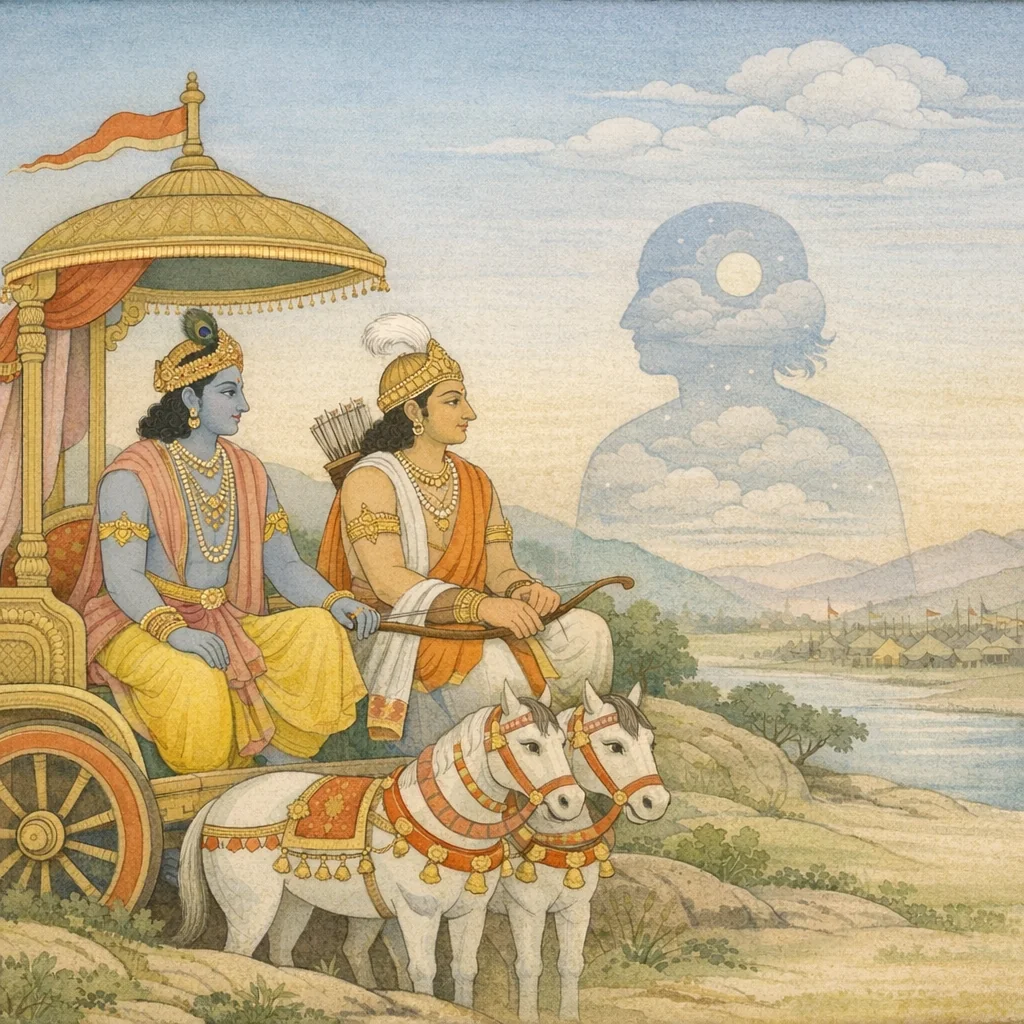
Chapter Arc: Kurukshetra ke rath-par, Krishna Arjuna ko drishti deta hai jo yuddha se pare hai: deha ko ‘kshetra’ aur uske jnata ko ‘kshetrajna’ jaan—yahi vivek bandhan ka bhed kholta hai. → Arjuna ke antarman ki uljhan ko dhyan me rakhkar upadesh gahra hota hai: prakriti aur purush dono anadi hain; trigun aur raga-dvesh adi vikaar prakriti se utpann hote hain; jeev ka anubhav in gunon ke sang se bandhta dikhta hai, par jnata ka swaroop alag hai. → Nirnayak ghoshna: jo purush ko aur gunon sahit prakriti ko tattvatah jaan leta hai, vah ‘sarvatha vartaman’ hote hue bhi punarjanma ko prapt nahi hota; aur jo itna na samjhe, par shruti-parayan hokar sun-kar upasana kare, vah bhi mrityu ko tar jata hai. → Atma ki aliptata ka drishtant sthapit hota hai: jaise sarvagat aakash sookshmata ke karan lipta nahi hota, vaise hi deh me sarvatr avasthit atma nirgun hone se deh-gunon se lipti nahi hoti—isi se samadarshi jnana ka phal nishchit hota hai. → Arjuna ke liye agla sanket: jab atma alipta aur akarta hai, to kartapan ka bhram kaise tootega aur yuddh-karm me sthir buddhi kaise banegi? (Agla adhyaya is vivek ko aur teekshn karega.)
Shlokas
Verse 13
इति श्रीमहाभारते भीष्मपर्वणि श्रीमद्भगवद्गीतापर्वणि श्रीमद्भगवद्गीतासूपनिषत्सु ब्रह्मविद्यायां योगशास्त्रे श्रीकृष्णार्जुनसंवादे क्षेत्रक्षेत्रज्विभागयोगो नाम त्रयोदशो 5 ध्याय:
Thus, within the Mahābhārata’s Bhīṣma Parva, in the section known as the Bhagavad Gītā, among the Upaniṣadic teachings called the Bhagavad Gītā—within the discipline of Brahma-knowledge and the science of Yoga—this concludes the dialogue between Śrī Kṛṣṇa and Arjuna: the thirteenth chapter, titled “The Yoga of Discerning the Field and the Knower of the Field.”
Verse 19
प्रकृति] और पुरुष, इन दोनोंको ही तू अनादि जानः और राग-द्वेषादि विकारोंको तथा त्रिगुणात्मक सम्पूर्ण पदार्थोंको भी प्रकृतिसे ही उत्पन्न जान
Arjuna said: Know Prakṛti (material nature) and Puruṣa (the conscious Self) to be beginningless. And know that all modifications—such as attachment and aversion—and all things constituted by the three guṇas arise from Prakṛti.
Verse 20
सम्बन्ध-- इस अध्यायके तीसरे शलोकमें जिससे जो उत्पन्न हुआ है, यह बात युननेके लिये कहा गया था, उसका वर्णन पूर्वश्लोकके उत्तराद्धमें कुछ किया गया। अब उसीकी कुछ बात इस श्लोकके पूर्वाद्धमें कहते हुए इसके उत्तराद्धधमें और इक्कीसवें श्लोकमें प्रकृतियें स्थित पुरुषके स्वरूपका वर्णन किया जाता है-- कार्यकरणकर्तत्वे हेतु: प्रकृतिरुच्यते । पुरुष: सुखदु:खानां भोक्तृत्वे हेतुरुच्यते,कार्य और करणको उत्पन्न करनेमें हेतु प्रकृति कही जाती है: और जीवात्मा सुख- दुःखोंके भोक्तापनमें अर्थात् भोगनेमें हेतु कहा जाता है+
Arjuna said: In the production of actions and the instruments of action, Prakṛti is declared to be the cause; but Puruṣa is declared to be the cause in the experience of pleasure and pain—namely, in enjoying and suffering.
Verse 21
पुरुष: प्रकृतिस्थो हि भुड्क्ते प्रकृतिजान् गुणान् । कारणं गुणसड्रो5स्य सदसद्योनिजन्मसु,प्रकृतिमें स्थित ही पुरुष प्रकृतिसे उत्पन्न त्रिगुणात्मक पदार्थोंकी भोगता हैः और इन गुणोंका संग ही इस जीवात्माके अच्छी-बुरी योनियोंमें जन्म लेनेका कारण है
Arjuna said: The Puruṣa, abiding in Prakṛti, experiences the guṇas born of Prakṛti. Attachment to these guṇas is the cause of its birth in good and evil wombs.
Verse 22
सम्बन्ध-- इस प्रकार प्रकृतिस्थ पुरुषके स्वरूपका वर्णन करनेके बाद अब जीवात्मा और परमात्माकी एकता करते हुए आत्माके गुणातीत स्वरूपका वर्णन करते हैं-- उपद्रष्टानुमन्ता च भर्ता भोक्ता महेश्वर: । परमात्मेति चाप्युक्तो देहेडस्मिन् पुरुष: पर:,इस देहमें स्थित यह आत्मा वास्तवमें परमात्मा ही है*। वही साक्षी होनेसे उपद्रष्टा और यथार्थ सम्मति देनेवाला होनेसे अनुमन्ता, सबका धारण-पोषण करनेवाला होनेसे भर्ता, जीवरूपसे भोक्ता, ब्रह्मा आदिका भी स्वामी होनेसे महेश्वर और शुद्ध सच्चिदा-नन्दघन होनेसे परमात्मा--ऐसा कहा गया है
Arjuna said: Within this very body there is a higher Puruṣa who is called the Paramātman, the Supreme Self. He is the Witness who observes, the Approver who grants inner assent, the Sustainer who upholds and nourishes, the Experiencer who tastes the fruits of embodied life, and the Great Lord who rules even over the highest powers.
Verse 23
य एवं वेत्ति पुरुष प्रकृतिं च गुणै: सह । सर्वथा वर्तमानो5पि न स भूयो&भिजायते,इस प्रकार पुरुषको और गुणोंके सहित प्रकृतिको जो मनुष्य तत्त्वसे जानता हैः, वह सब प्रकारसे कर्तव्य-कर्म करता हुआ भी फिर नहीं जन्मता*
Arjuna said: Whoever truly understands Puruṣa and Prakṛti together with its guṇas, that person—though acting in every circumstance—does not come to birth again.
Verse 24
सम्बन्ध-- इस प्रकार गुणोंके सहित प्रकृति और पुरुषके ज्ञानका महत्त्व सुनकर यह इच्छा हो सकती है कि ऐसा ज्ञान कैसे होता है। इयलिये अब दो श्लोकोंद्वारा भिन्न-भिन्न अधिकारियोंके लिये तत्त्वज्ञानके भिन्न-भिन्न साधनोंका प्रतिपादन करते हैं-- ध्यानेनात्मनि पश्यन्ति केचिदात्मानमात्मना । अन्ये सांख्येन योगेन कर्मयोगेन चापरे,उस परमात्माको कितने ही मनुष्य तो शुद्ध हुई सूक्ष्म बुद्धिके ध्यानके द्वारा हृदयमें देखते हैं;* अन्य कितने ही ज्ञानयोगके द्वारा और दूसरे कितने ही कर्मयोगके द्वाराः देखते हैं अर्थात् प्राप्त करते हैं
Arjuna said: Some perceive the Self within the heart by the discipline of meditation—using the purified inner self to behold the Self. Others reach that realization through the path of discernment and knowledge (Sāṅkhya-yoga), and still others through the path of selfless action (karma-yoga).
Verse 25
अन्ये त्वेवमजानन्त: श्र॒त्वान्ये भ्य उपासते । तेडपि चातितरन्त्येव” मृत्युं श्रुतिपरायणा:,परंतु इनसे दूसरे अर्थात् जो मन्दबुद्धिवाले पुरुष हैं, वे इस प्रकार न जानते हुए दूसरोंसे अर्थात् तत्त्वके जाननेवाले पुरुषोंसे सुनकर ही तदनुसार उपासना करते हैं और वे श्रवणपरायण पुरुष भी मृत्युरूप संसार-सागरको नि:संदेह तर जाते हैं
Arjuna said: Others, not understanding it in this way, worship by listening to it from those who do know the truth and then practicing accordingly. Even they—devoted to hearing and faithfully following what they have heard—surely cross beyond death, the mortal current of worldly existence.
Verse 26
सम्बन्ध-- इस प्रकार परमात्मसम्बन्धी तत्त्वज्ञानके भिन्न-भिन्न साधनोंका प्रतिपादन करके अब तीसरे श्लोकमें जो 'यादृक्” पदसे क्षेत्रके स््वभावकों युननेके लिये कहा था; उसके अनुसार भगवान् दो “*्लोकोंद्वारा उस क्षेत्रकों उत्पत्ति-विनाशशील बतलाकर उसके स्वभावका वर्णन करते हुए आत्माके यथार्थ तत्त्वको जाननेवालेकी प्रशंसा करते हैं-- यावत् संजायते किंचित् सत्त्वं स्थावरजड्रमम् । क्षेत्रक्षेत्रजसंयोगात् तद् विद्धि भरतर्षभ,हे अर्जुन! जितने भी स्थावर-जंगम प्राणी उत्पन्न होते हैं, उन सबको तू क्षेत्र और क्षेत्रज्क संयोगसे ही उत्पन्न जानः
Whatever being comes into existence—whether immobile or mobile—know it, O bull among the Bharatas, to arise from the conjunction of the field (body–mind nature) and the knower of the field (the conscious self).
Verse 27
सम॑ सर्वेषु भूतेषु तिष्ठन्तं परमेश्वरम् । विनश्यत्स्वविनश्यन्तं यः: पश्यति स पश्यति,जो पुरुष नष्ट होते हुए सब चराचर भूतोंमें परमेश्वरको नाशरहित और समभावसे स्थित देखता है, वही यथार्थ देखता हैः
He truly sees who, amid all beings, perceives the Supreme Lord abiding equally in all—imperishable even as perishable forms pass away.
Verse 28
सम॑ पश्यन् हि सर्वत्र समवस्थितमी श्वरम् । न हिनस्त्यात्मना55त्मानं ततो याति परां गतिम्,क्योंकि जो पुरुष सबमें समभावसे स्थित परमेश्वरको समान देखता हुआ अपनेद्वारा अपनेको नष्ट नहीं करता5, इससे वह परमगतिको प्राप्त होता है
For one who, with equal vision, beholds the Lord abiding evenly in all beings does not injure the self by the self; therefore, such a person attains the supreme goal.
Verse 29
सम्बन्ध-- इस प्रकार नित्य विज्ञानानन्न्दधन आत्मतत्त्वको सर्वत्र समभावसे देखनेका महत्त्व और फल बतलाकर अब जगले श्लोकमें उसे अकर्ता देखनेवालेकी महिमा कहते हैं प्रकृत्यैव च कर्माणि क्रियमाणानि सर्वश: । यः पश्यति तथा55त्मानमकर्तारें स पश्यति,और जो पुरुष सम्पूर्ण कर्मोंको सब प्रकारसे प्रकृतिके द्वारा ही किये जाते हुए देखता है और आत्माको अकर्ता देखता है, वही यथार्थ देखता हैं
All actions, in every way, are carried out by Nature (Prakṛti) alone. The one who sees this—and who also sees the Self (Ātman) as the non-doer (akartā)—truly sees. In the ethical setting of the battlefield, this teaching turns Arjuna from ego-claimed agency to clear discernment: act where duty (dharma) requires, but do not appropriate action as “I am the doer.”
Verse 30
यदा भूतपृथग्भावमेकस्थमनुपश्यति । तत एव च विस्तार ब्रह्म सम्पद्यते तदा,जिस क्षण यह पुरुष भूतोंके पृथक्-पृथक् भावको एक परमात्मामें ही स्थित तथा उस परमात्मासे ही सम्पूर्ण भूतोंका विस्तार देखता है,“ उसी क्षण वह सच्चिदानन्दघन ब्रह्मको प्राप्त हो जाता है
When a person truly perceives the diverse, separate conditions of beings as resting in the One (Paramātman), and also sees that the entire expanse of beings unfolds from that One alone—then, at that very moment, he attains Brahman. In the midst of the war’s moral crisis, this teaching redirects vision from division and hostility to a unifying spiritual ground, dissolving ego-based separateness and grounding right action in insight.
Verse 31
सम्बन्ध--इस प्रकार आत्माकों सब प्राणियोंमें समभावसे स्थित, निर्विकार और अकर्ता बतलाया जानेपर यह शंका होती है कि समस्त शरीरोंगें रहता हुआ भी आत्मा उनके दोषोंसे निर्लिप्त और अकर्ता कैसे रह सकता है; इस शंकाका निवारण करनेके लिये अब भगवान्ू--इस अध्यायके तीसरे श्लोकमें जो “यत्प्रभावश्च" पदसे क्षेत्रज्ञका प्रभाव युननेका संकेत किया गया था; उसके अनुसार--तीन शलोकोद्रार आत्माके प्रभावका वर्णन करते हैं-- अनादित्वान्निर्गुणत्वात् परमात्मायमव्यय:+ | शरीरस्थो5डपि कौन्तेय न करोति न लिप्यते,हे अर्जुन! अनादि होनेसे और निर्गुण होनेसे यह अविनाशी परमात्मा: शरीरमें स्थित होनेपर भी वास्तवमें न तो कुछ करता है और न लिप्त ही होता हैः
Because the Supreme Self (Paramātman) is without beginning and beyond the guṇas, it is imperishable. Therefore, O son of Kuntī, even while abiding within the body, it neither truly acts nor becomes tainted. In the ethical setting of the battlefield teaching, this clarifies how inner awareness can remain unstained by bodily conditions and faults, grounding responsibility in right discernment rather than in the Self’s being “a doer.”
Verse 32
सम्बन्ध-- शरीरमें स्थित होनेपर भी आत्मा क्यों नहीं लिप्त होता? इसपर कहते हैं-- यथा सर्वगतं सौक्ष्म्यादाकाशं नोपलिप्यते । सर्वत्रावस्थितो देहे तथा55त्मा नोपलिप्यते
Just as space, though all-pervading, is not tainted because of its subtlety, so too the Self, though present everywhere within the body, is not stained by bodily conditions or actions. The ethical point is that inner purity and responsibility are grounded in recognizing the Self as untouched, while actions and their consequences pertain to embodied nature.
Verse 33
जिस प्रकार सर्वत्र व्याप्त आकाश सूक्ष्म होनेके कारण लिप्त नहीं होता, वैसे ही देहमें सर्वत्र स्थित आत्मा निर्गुण होनेके कारण देहके गुणोंसे लिप्त नहीं होता* ।। सम्बन्ध-- शरीरमें स्थित होनेपर भी आत्मा कर्ता क्यों नहीं है? इसपर कहते हैं-- यथा प्रकाशयत्येक: कृत्स्नं लोकमिमं रवि: । क्षेत्र क्षेत्री तथा कृत्स्नं प्रकाशयति भारत,हे अर्जुन! जिस प्रकार एक ही सूर्य इस सम्पूर्ण ब्रह्माण्डको प्रकाशित करता है, उसी प्रकार एक ही आत्मा सम्पूर्ण क्षेत्रको प्रकाशित करता हैः
Just as all-pervading space, because it is subtle, is not stained by anything, so too the Self—though present everywhere within the body—being beyond the guṇas (nirguṇa), is not tainted by the body’s qualities. And just as a single sun illumines this entire world, so the one Knower of the Field (kṣetrajña) illumines the whole field (kṣetra) of embodied experience, O Bharata.
Verse 34
सम्बन्ध-- तीसरे श्लोकमें जिन छः बातोंको कह्दनेका भ्रगवान्ने संकेत किया था, उनका वर्णन करके अब इस जध्यायमें वर्णित समस्त उपदेशको भलीभॉति समझनेका फल परत्रह्म परमात्माकी प्राप्ति बतलाते हुए अध्यायका उपसंद्वार करते हैं-- क्षेत्रक्षेत्रज्योरेवमन्तरं ज्ञानचक्षुषा । भूतप्रकृतिमोक्षं च ये विदुर्यान्ति ते परम्,इस प्रकार क्षेत्र और क्षेत्रज्षक भेदको तथा कार्यसहित प्रकृतिसे मुक्त होनेको जो पुरुष ज्ञाननेत्रोंद्वारा तत््व्से जानते हैं,“ वे महात्माजन परम ब्रह्म परमात्माको प्राप्त होते हैं
Those who, with the eye of true knowledge, clearly discern the distinction between the field (the embodied complex) and the knower of the field (the conscious self), and who also understand liberation from material nature together with its products—such great-souled persons attain the Supreme. In the ethical frame of the teaching, the verse closes the instruction by stating that right discernment and freedom from nature’s binding tendencies culminate not merely in insight, but in the highest spiritual attainment.
Verse 37
भीष्मपर्वणि तु सप्तत्रिंशो 5ध्याय:
In the Bhīṣma Parva, this is the thirty-seventh chapter.
Frequently Asked Questions
Whether ethical integrity is better served by withdrawing from action (as a form of renunciation) or by performing obligatory duty while relinquishing attachment to outcomes; the chapter argues that abandoning prescribed action from delusion or fear is ethically inferior to sāttvika tyāga.
Embodied beings cannot fully avoid action; therefore liberation-oriented discipline lies in purifying motivation, relinquishing fruit-attachment, understanding causality beyond ego-centric agency, and aligning duty with clarity (sāttvika buddhi) and devotion.
Yes: Sañjaya’s concluding testimony presents the dialogue as a supremely ‘dharmic’ discourse whose study and faithful listening are said to yield auspicious outcomes; the final assurance links well-being and stability to the alignment of yogic sovereignty (Kṛṣṇa) with disciplined agency (Arjuna).