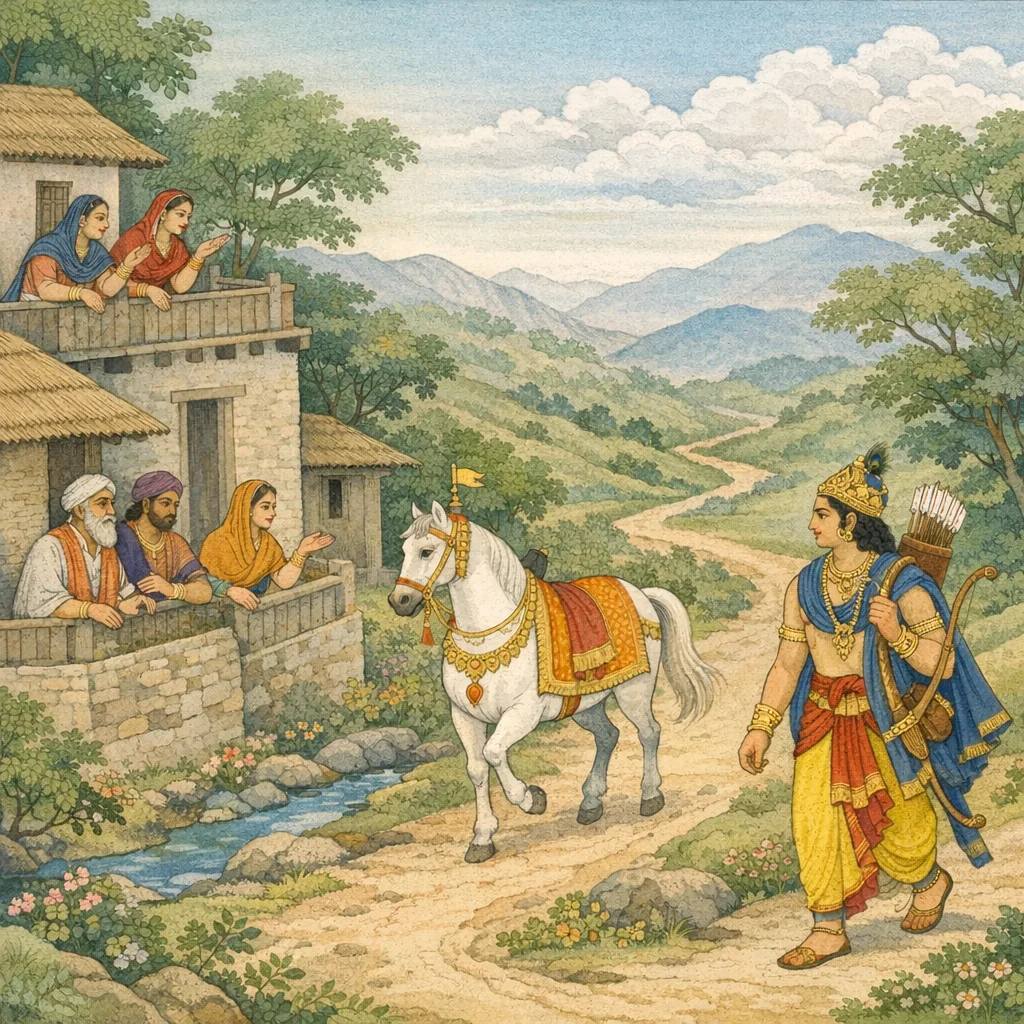
Adhyaya 73
Traigarta Attempt to Seize the Aśvamedha Horse; Arjuna’s Restraint and Tactical Victory
Upa-parva: Aśvamedha Horse Campaign Episodes (Traigarta Encounter Arc)
Vaiśaṃpāyana reports that the Trigartas—identified as descendants of warriors previously slain—learn the consecrated sacrificial horse has reached the edge of their territory and assemble in armed chariots to capture it. Arjuna (Kirīṭin/Jiṣṇu/Gūḍākeśa/Dhanaṃjaya) anticipates their intention and initially attempts to deter them with conciliatory speech, aligning with Yudhiṣṭhira’s injunction that bereaved kings should not be further harmed. The Trigartas disregard the warning and initiate a dense arrow exchange. Arjuna targets their leadership (notably Sūryavarmā) and counters volleys with superior archery. Ketuvarmā engages on behalf of his brother; Dhṛtavarmā displays remarkable speed and wounds Arjuna’s hand, causing the Gāṇḍīva to fall briefly—an emphasized moment of vulnerability. Arjuna regains composure, resumes the bow, and delivers decisive counterfire; the Traigarta forces break and flee. They then approach in submission, offering service. Arjuna instructs them to protect their lives and accept governance, converting battlefield superiority into regulated political compliance rather than continued punishment.
Chapter Arc: दीक्षा-काल आते ही महर्षि-ऋत्विज विधिवत् यज्ञ-क्रम आरम्भ कराते हैं; धर्मराज युधिष्ठिर पशुबन्ध-कर्म कर दीक्षित होकर तेज से दीप्त हो उठते हैं। → अश्वमेध हेतु व्यास के शास्त्र-विधान से छोड़ा गया घोड़ा दिशाओं में विचरने लगता है। उसके पीछे महाबाहु अर्जुन धनुष को स्पर्श करते हुए अनुगमन करता है; नगर-जन और पथिक उसकी कीर्ति, शस्त्र-तेज और यज्ञ-रक्षा की चर्चा करते हैं—पर साथ ही यह संकेत भी है कि घोड़े का मार्ग अनिश्चित है और कहीं भी विघ्न/प्रतिरोध उठ सकता है। → घोड़ा पृथ्वी की प्रदक्षिणा-सी करता हुआ उत्तर-पूर्व की ओर बढ़ता है; भीड़ में लोग अर्जुन को प्रत्यक्ष न देख पाने पर भी उसके दिव्य धनुष-चिह्न से पहचानते हैं—यह क्षण अर्जुन की अदृश्य-सी, किंतु सर्वत्र अनुभूत उपस्थिति और यज्ञ-प्रतिष्ठा के विस्तार को चरम पर ले आता है। → अर्जुन स्त्री-पुरुषों की मधुर वाणी और शुभाशंसाएँ बार-बार सुनता हुआ आगे बढ़ता है। विघ्न-शान्ति के लिए याज्ञवल्क्य के एक वेदपारग, यज्ञकर्म-कुशल शिष्य को पार्थ के साथ प्रेषित किया जाता है, जिससे यात्रा और यज्ञ दोनों की रक्षा सुनिश्चित हो। → घोड़ा अभी भी दिशाओं में विचर रहा है—आगे किस देश/राजा के यहाँ प्रतिरोध होगा और अर्जुन को किस धर्म-संकट का सामना करना पड़ेगा, यह अनकहा रह जाता है।
Shlokas
Verse 1
ऑपन-- माल छा अकाल त्रिसप्ततितमो<ध्याय: सेनासहित अर्जुनके द्वारा अश्वका अनुसरण वैशम्पायन उवाच दीक्षाकाले तु सम्प्राप्ते ततस्ते सुमहर्त्विज: । विधिवद् दीक्षयामासुरश्चवमेधाय पार्थिवम्,वैशम्पायनजी कहते हैं--जनमेजय! जब दीक्षाका समय आया, तब उन व्यास आदि महान् ऋत्विजोंने राजा युधिष्ठिरको विधिपूर्वक अश्वमेधयज्ञकी दीक्षा दी
Vaiśampāyana said: When the time for consecration arrived, those eminent officiating priests then duly initiated the king for the Aśvamedha sacrifice. The narrative underscores that even royal power must be placed under ritual law and disciplined restraint, so that sovereignty is exercised in alignment with dharma rather than mere force.
Verse 2
कृत्वा स पशुबन्धांश्व दीक्षित: पाण्डुनन्दन: । धर्मराजो महातेजा: सहर्व्विम्भिव्यरोचत,पशुबन्ध-कर्म करके यज्ञकी दीक्षा लिये हुए महातेजस्वी पाण्डुनन्दन धर्मराज युधिष्छिर ऋत्विजोंके साथ बड़ी शोभा पाने लगे
Vaiśampāyana said: Having completed the prescribed rites of binding the sacrificial animals and having taken the consecratory vow for the rite, the son of Pāṇḍu—King Dharmarāja, radiant with great splendor—shone forth in the company of the officiating priests. The scene underscores a return to dharma through regulated sacrifice and royal self-discipline after the upheavals of war.
Verse 3
अश्वमेधयज्ञके लिये छोड़े हुए घोड़ेका अर्जुनके द्वारा अनुगमन हयश्न हयमेधार्थ स्वयं स ब्रह्म॒वादिना । उत्सृष्ट: शास्त्रविधिना व्यासेनामिततेजसा,अमिततेजस्वी ब्रह्मवादी व्यासजीने अश्वमेधयज्ञके लिये चुने गये अश्वको स्वयं ही शास्त्रीय विधिके अनुसार छोड़ा
Vaiśaṃpāyana said: For the purpose of the Aśvamedha sacrifice, the horse was released according to scriptural procedure by Vyāsa himself—the brahmavādī of immeasurable splendor. The act signals that royal power is being placed under Vedic law and ethical restraint, with the rite initiated under the authority of a sage rather than mere political ambition.
Verse 4
स राजा धर्मराड् राजन् दीक्षितो विबभौ तदा | हेममाली रुक्मकण्ठ: प्रदीप्त इव पावक:,राजन! यज्ञमें दीक्षित हुए धर्मराज राजा युधिष्ठिर सोनेकी माला और कण्ठमें सोनेकी कण्ठी धारण किये प्रज्वलित अग्निके समान प्रकाशित हो रहे थे
Vaiśampāyana said: O king, at that time Dharma-rāja Yudhiṣṭhira, having been consecrated for the sacrifice, shone forth—wearing a golden garland and a golden neck-ornament—like a blazing fire. The verse underscores the ethical ideal that a ruler’s radiance is grounded in dharma and disciplined ritual commitment, not mere power.
Verse 5
कृष्णाजिनी दण्डपाणि: क्षौमवासा: स धर्मज: । विबभौ द्युतिमान् भूय: प्रजापतिरिवाध्वरे,काला मृगचर्म, हाथमें दण्ड और रेशमी वस्त्र धारण किये धर्मपुत्र राजा युधिष्छिर अधिक कान्तिमान् हो यज्ञमण्डपमें प्रजापतिकी भाँति शोभा पा रहे थे
Vaiśampāyana said: Wearing a black antelope-skin, holding a staff in his hand, and clad in fine linen, that son of Dharma—King Yudhiṣṭhira—shone with renewed radiance, appearing in the sacrificial arena like Prajāpati himself. The scene underscores how rightful kingship expresses itself through disciplined, Vedic restraint and the ethical ordering of power in a consecrated rite.
Verse 6
तथैवारस्यर्त्विज: सर्वे तुल्यवेषा विशाम्पते । बभूवुरर्जुनश्वापि प्रदीप्त इव पावक:,प्रजानाथ! उनके समस्त ऋत्विज् भी उन्हींके समान वेश-भूषा धारण किये सुशोभित होते थे। अर्जुन भी प्रज्वलित अग्निके समान दीप्तिमान् हो रहे थे
Vaiśampāyana said: “In the same manner, all the officiating priests of the king appeared, wearing attire identical to his. Arjuna too shone forth, blazing like a kindled fire.” The scene underscores the ordered dignity of royal rite: harmony in outward form reflects disciplined participation in dharma, while Arjuna’s radiance signals heroic excellence placed in service of a lawful sacrifice rather than mere personal glory.
Verse 7
श्वेताश्वः कृष्णसारं तं ससाराश्च धनंजय: । विधिवत् पृथिवीपाल धर्मराजस्य शासनात्,भूपाल जनमेजय! श्वेत घोड़ेवाले अर्जुनने धर्मराजकी आज्ञासे उस यज्ञसम्बन्धी अश्वका विधिपूर्वक अनुसरण किया
Vaiśaṃpāyana said: O King Janamejaya, at the command of Dharmarāja (Yudhiṣṭhira), Dhanaṃjaya Arjuna—mounted on his white horse—set out and duly followed that sacrificial horse, in accordance with the prescribed rites.
Verse 8
विक्षिपन् गाण्डिवं राजन् बद्धगोधाडगुलित्रवान् । तमश्वं पृथिवीपाल मुदा युक्त: ससार च,पृथिवीपाल! राजन! अर्जुनने अपने हाथोंमें गोधाके चमड़ेके बने दस्ताने पहन रखे थे। वे गाण्डीव धनुषकी टंकार करते हुए बड़ी प्रसन्नताके साथ अश्वके पीछे-पीछे जा रहे थे
Vaiśampāyana said: O king, wearing arm-guards fastened with iguana-hide, Arjuna twanged the Gāṇḍīva. Joyfully intent on his charge, the protector of the earth followed after that sacrificial horse.
Verse 9
आकुमारं तदा राजन्नागमत् तत्पुरं विभो । द्रष्टकामं कुरुश्रेष्ठ प्रयास्यन्तं धनंजयम्,जनमेजय! प्रभो! उस समय यात्रा करते हुए कुरुश्रेष्ठ अर्जुनको देखनेके लिये बच्चोंसे लेकर बूढ़ोंतक सारा हस्तिनापुर वहाँ उमड़ आया था
Vaiśampāyana said: O King, O mighty one—at that time the entire city came out: from children upward (even to the aged), all Hastināpura surged forth, eager to see Dhanañjaya Arjuna, the best of the Kurus, as he was setting out on his journey.
Verse 10
तेषामन्योन्यसम्मर्दादूष्मेपत समजायत । दिदृक्षूणां हयं तं च तं चैव हयसारिणम्,यज्ञके घोड़े और उसके पीछे जानेवाले अर्जुनको देखनेकी इच्छासे लोगोंकी इतनी भीड़ इकट्टी हो गयी थी कि आपसकी धक्का-मुक्कीसे सबके बदनमें पसीने निकल आये
Vaiśampāyana said: Because of the mutual jostling among them, sweat broke out on their bodies. So great was the crowd of people, eager to see that sacrificial horse and also the rider who followed it.
Verse 11
ततः शब्दो महाराज दिश: खं प्रति पूरयन् । बभूव प्रेक्षतां नृणां कुन्तीपुत्रं धनंजयम्,महाराज! उस समय कुन्तीपुत्र धनंजयका दर्शन करनेवाले लोगोंके मुखसे जो शब्द निकलता था, वह सम्पूर्ण दिशाओं और आकाशगमें गूँज रहा था
Then, O King, the cry that rose from the mouths of the onlookers as they beheld Kuntī’s son Dhanañjaya filled all the quarters and resounded through the sky.
Verse 12
एष गच्छति कौन्तेय तुरगश्चैव दीप्तिमान् यमन्वेति महाबाहु: संस्पृशन् धनुरुत्तमम्,(लोग कहते थे--) *ये कुन्तीकुमार अर्जुन जा रहे हैं और वह दीप्तिमान् अश्व जा रहा है, जिसके पीछे महाबाहु अर्जुन उत्तम धनुष धारण किये जा रहे हैं!
Vaiśampāyana said: “There goes Arjuna, the son of Kuntī; and there goes the radiant sacrificial horse. Following it is the mighty-armed Arjuna, keeping his hand upon his excellent bow.” Thus people spoke, marking both the public visibility of the rite and Arjuna’s vigilant guardianship in service of Yudhiṣṭhira’s dharma.
Verse 13
एवं शुश्राव वदतां गिरो जिष्णुरुदारधी: । स्वस्ति ते<स्तु व्रजारिष्टं पुनश्चैहीति भारत,उदारबुद्धि अर्जुनने परस्पर वार्तालाप करते हुए लोगोंकी बातें इस प्रकार सुनीं -- भारत! तुम्हारा कल्याण हो। तुम सुखसे जाओ और पुनः कुशलपूर्वक लौट आओ"
Vaiśaṁpāyana said: Thus did Arjuna—of noble understanding, the unconquered—hear the words spoken among the people: “May well-being be yours, O Bhārata. Go forth safely and unharmed, and then return again in good health.” The verse frames a public blessing that upholds auspiciousness, protection, and the ethical hope for a safe return after duty is undertaken.
Verse 14
अथापरे मनुष्येन्द्र पुरुषा वाक्यमब्रुवन् । नैनं पश्याम सम्मर्दे धनुरेतत् प्रदृश्यते,निवृत्तमेनं द्रक्ष्याम: पुनरेष्यति च ध्रुवम् । नरेन्द्र! दूसरे लोग ये बातें कहते थे--“इस भीड़में हम अर्जुनको तो नहीं देखते हैं; किंतु उनका यह धनुष दिखायी देता है। यही वह भयंकर टंकार करनेवाला विख्यात गाण्डीव धनुष है। अर्जुनकी यात्रा सकुशल हो। उन्हें मार्गमें कोई कष्ट न हो। ये निर्भय मार्गपर आगे बढ़ते रहें। ये निश्चय ही कुशलपूर्वक लौटेंगे और उस समय हम फिर इनका दर्शन करेंगे”
Then other men spoke these words: “O lord among men, in this crush of the crowd we do not see Arjuna himself; yet his bow is visible. When he turns back, we shall behold him again—for he will surely return.”
Verse 15
एतद्धि भीमनिर्द विश्रुतं गाण्डिवं धनुः । स्वस्ति गच्छत्वरिष्टो वै पनथानमकुतो भयम्
Vaiśaṃpāyana said: “This indeed is the famed Gāṇḍīva bow, renowned for its awe-inspiring might. May it proceed in auspiciousness, unharmed, along its path—without fear from any quarter.”
Verse 16
एवमाद्या मनुष्याणां स्त्रीणां च भरतर्षभ
Vaiśaṃpāyana said: “Thus, O bull among the Bharatas, these were the earliest (origins/precedents) among human beings—and among women as well.”
Verse 17
याज्ञवल्क्यस्य शिष्यश्न कुशलो यज्ञकर्मणि
Vaiśampāyana said: “And he was a disciple of Yājñavalkya, skilled in the rites and procedures of sacrifice.”
Verse 18
ब्राह्मणाश्ष महीपाल बहवो वेदपारगा:,महाराज! प्रजानाथ! उनके सिवा और भी बहुत-से वेदोंमें पारंगत ब्राह्मणों और क्षत्रियोंने धर्मराजकी आज्ञासे विधिपूर्वक महात्मा अर्जुनका अनुसरण किया
Vaiśampāyana said: “O king, many Brāhmaṇas who had mastered the Vedas followed along. O great king, protector of the people, besides them many other Brāhmaṇas and Kṣatriyas, deeply learned in the Vedas, also accompanied the great-souled Arjuna—doing so in due ritual order and in obedience to Dharmarāja’s command.”
Verse 19
अनुजममुर्महात्मान क्षत्रियाश्व विशाम्पते । विधिवत् पृथिवीपाल धर्मराजस्य शासनात्,महाराज! प्रजानाथ! उनके सिवा और भी बहुत-से वेदोंमें पारंगत ब्राह्मणों और क्षत्रियोंने धर्मराजकी आज्ञासे विधिपूर्वक महात्मा अर्जुनका अनुसरण किया
Vaiśampāyana said: “O lord of the people, many Kṣatriyas and other rulers of the earth, acting in due ritual order under the command of Dharmarāja, followed that younger brother, the great-souled Arjuna. Along with them, numerous Brāhmaṇas learned in the Vedas also accompanied him in accordance with Dharmarāja’s injunction—showing disciplined obedience to rightful authority and the collective support given to a dharmic royal undertaking.”
Verse 20
पाण्डवै: पृथिवीम श्वो निर्जितामस्त्रतेजसा । चचार स महाराज यथादेशं च सत्तम,महाराज! साधुशिरोमणे! पाण्डवोंने अपने अस्त्रके प्रतापसे जिस पृथ्वीको जीता था, उसके सभी देशोंमें वह अश्व क्रमश: विचरण करने लगा
Vaiśaṃpāyana said: “O best of kings, the sacrificial horse then roamed, as it had been directed, through all the regions of the earth that the Pāṇḍavas had conquered by the splendor and force of their weapons.”
Verse 21
तत्र युद्धानि वृत्तानि यान्यासन् पाण्डवस्य ह । तानि वक्ष्यामि ते वीर विचित्राणि महान्ति च,वीर! उन देशोंमें अर्जुनको जो बड़े-बड़े अद्भुत युद्ध करने पड़े, उनकी कथा तुम्हें सुना रहा हूँ
Vaiśaṃpāyana said: “There, the battles that occurred for the Pāṇḍava (Arjuna)—great and wondrous in their variety—I shall now recount to you, O hero.”
Verse 22
स हय: पृथिवीं राजन् प्रदक्षिणमवर्तत । ससारोत्तरत: पूर्व तन्निबोध महीपते
Vaiśampāyana said: “O King, that sacrificial horse began to move about the earth in an auspicious rightward circuit. It went on, keeping first to the northern and then to the eastern direction. Know this, O lord of the land.”
Verse 23
अवमृदनन् स राष्ट्राणि पार्थिवानां हयोत्तम: । शनैस्तदा परिययोौ श्वेताश्वक्ष महारथ:
Vaiśampāyana said: “That excellent horse, trampling through the kingdoms of many earthly rulers, then moved on gradually; and Śvetāśvaketu, the great chariot-warrior, went along with it.”
Verse 24
पृथ्वीनाथ! वह घोड़ा पृथ्वीकी प्रदक्षिणा करने लगा। सबसे पहले वह उत्तर दिशाकी ओर गया। फिर राजाओंके अनेक राज्योंको रौंदता हुआ वह उत्तम अश्व॒ पूर्वकी ओर मुड़ गया। उस समय श्वेतवाहन महारथी अर्जुन धीरे-धीरे उसके पीछे-पीछे जा रहे थे ।। तत्र संगणना नास्ति राज्ञामयुतशस्तदा । येड्युध्यन्त महाराज क्षत्रिया हतबान्धवा:,महाराज! महाभारत-युद्धमें जिनके भाई-बन्धु मारे गये थे, ऐसे जिन-जिन क्षत्रियोंने उस समय अर्जुनके साथ युद्ध किया था, उन हजारों नरेशोंकी कोई गिनती नहीं है
Vaiśampāyana said: “O lord of the earth, that sacrificial horse set out to circumambulate the world. First it went toward the northern quarter; then, trampling through the many realms of kings, the excellent steed turned toward the east. At that time Arjuna, the great chariot-warrior with white steeds, followed it steadily, step by step. There was no counting the kings then—tens of thousands—Kṣatriyas whose kinsmen had been slain in the Great Bhārata war, who rose to fight, O king.”
Verse 25
किराता यवना राजन् बहवो5सिथनुर्धरा: । म्लेच्छाश्षान्ये बहुविधा: पूर्व ये निकृता रणे,राजन्! तलवार और धनुष धारण करनेवाले बहुत-से किरात, यवन और म्लेच्छ, जो पहले महाभारत-युद्धमें पाण्डवोंद्वारा परास्त किये गये थे, अर्जुनका सामना करनेके लिये आये
Vaiśampāyana said: “O King, many Kirātas and Yavanas—fighters bearing bows and weapons—along with other mleccha groups of various kinds, who had earlier been defeated in battle, now came forward to confront Arjuna.”
Verse 26
आर्याश्न पृथिवीपाला: प्रहृष्टनरवाहना: । समीयु: पाण्डुपुत्रेण बहवो युद्धदुर्मदा:
Vaiśampāyana said: “Many noble rulers of the earth—riding in high spirits with their men and mounts—came together with the son of Pāṇḍu, proud and intoxicated with the ardor of war.”
Verse 27
हृष्ट-पुष्ट मनुष्यों और वाहनोंसे युक्त बहुत-से रणदुर्मद आर्य नरेश भी पाण्डुपुत्र अर्जुनसे भिड़े थे ।। एवं वृत्तानि युद्धानि तत्र तत्र महीपते । अर्जुनस्य महीपालैर्नानादेशसमागतै:,पृथ्वीनाथ! इस प्रकार भिन्न-भिन्न स्थानोंमें नाना देशोंसे आये हुए राजाओंके साथ अर्जुनको अनेक बार युद्ध करने पड़े
Vaiśampāyana said: Many noble kings—exultant, well supplied with men and mounts, and made arrogant by the pride of battle—also confronted Arjuna, the son of Pāṇḍu. Thus, O lord of the earth, in place after place, Arjuna repeatedly had to wage war against kings who had come from many different lands. The passage underscores how the Aśvamedha’s progress tests sovereignty and duty: Arjuna meets challengers not out of personal hatred, but as a consequence of royal obligation and the assertion of lawful rule.
Verse 28
यानि तूभयतो राजन प्रतप्तानि महान्ति च | तानि युद्धानि वक्ष्यामि कौन्तेयस्य तवानघ,निष्पाप नरेश! जो युद्ध दोनों पक्षके योद्धाओंके लिये अधिक कष्टदायक और महान् थे, अर्जुनके उन्हीं युद्धोंका मैं यहाँ तुमसे वर्णन करूँगा
Vaiśaṃpāyana said: “O King, those battles which were grievous to both sides and truly great in their scale—those very wars of Arjuna, O sinless lord of men, I shall now recount to you.”
Verse 72
इस प्रकार श्रीमह्ााभारत आश्वमेधिकपरववके अन्तर्गत अनुगीतापर्वरमें यज्ञसामग्रीका सम्पादनविषयक बह्त्तरवाँ अध्याय पूरा हुआ
Thus, in the Śrī Mahābhārata, within the Āśvamedhika Parva, in the Anugītā sub-section, the seventy-second chapter—concerning the procurement and preparation of materials for sacrifice—comes to an end. The closing note underscores the disciplined, orderly completion of ritual duties as part of dharma.
Verse 73
इति श्रीमहा भारते आश्वमेधिके पर्वणि अनुगीतापर्वणि अश्वानुसरणे त्रिसप्ततितमो<5ध्याय:
Thus ends the seventy-third chapter in the Aśvamedhika Parva of the Śrī Mahābhārata, within the Anugītā sub-section, in the episode concerning the following of the sacrificial horse.
Verse 153
निवृत्तमेनं द्रक्ष्याम: पुनरेष्यति च ध्रुवम् । नरेन्द्र! दूसरे लोग ये बातें कहते थे--“इस भीड़में हम अर्जुनको तो नहीं देखते हैं; किंतु उनका यह धनुष दिखायी देता है। यही वह भयंकर टंकार करनेवाला विख्यात गाण्डीव धनुष है। अर्जुनकी यात्रा सकुशल हो। उन्हें मार्गमें कोई कष्ट न हो। ये निर्भय मार्गपर आगे बढ़ते रहें। ये निश्चय ही कुशलपूर्वक लौटेंगे और उस समय हम फिर इनका दर्शन करेंगे”
Vaiśaṃpāyana said: “We shall see him again after he has turned back; surely he will return. O king, people were saying among themselves: ‘In this crowd we do not see Arjuna, yet his bow is clearly visible. This is that famed Gāṇḍīva, terrible in its resounding twang. May Arjuna’s journey be auspicious; may no hardship befall him on the road. Let him proceed fearlessly along the path. He will certainly come back in safety, and then we shall behold him again.’”
Verse 166
शुश्राव मधुरा वाच: पुन: पुनरुदारधी: । भरतश्रेष्ठ) इस प्रकार उदारबुद्धि अर्जुन स्त्रियों और पुरुषोंकी कही हुई मीठी-मीठी बातें बारंबार सुनते थे
Vaiśampāyana said: Arjuna, noble-minded and best of the Bharatas, listened again and again to the sweet words spoken by women and men. The scene highlights his courteous restraint and receptivity—an ethical posture of honoring others’ speech and answering with patience rather than pride.
Verse 176
प्रायात् पार्थेन सहित: शान्त्यर्थ वेदपारग: । याज्ञवल्क्य मुनिके एक विद्वान् शिष्य, जो यज्ञकर्ममें कुशल तथा वेदोंमें पारंगत थे, विघ्नकी शान्तिके लिये अर्जुनके साथ गये
Vaiśampāyana said: A learned disciple, accomplished in Vedic study and skilled in the rites of sacrifice, set out together with Pārtha (Arjuna) for the sake of pacification—so that obstacles might be appeased and the sacred undertaking could proceed without disruption. The narrative underscores that righteous action is safeguarded not only by strength but by disciplined ritual knowledge and the ethical duty to remove impediments to a lawful rite.
Frequently Asked Questions
Arjuna must enforce sacrificial sovereignty through force while honoring Yudhiṣṭhira’s restraint toward bereaved rulers; the chapter stages the tension between necessary defense and the prohibition of vengeance-driven excess.
Legitimate power is demonstrated by controlled force: warn first, fight only when compelled, and end hostilities upon submission—transforming victory into stable order rather than prolonged punitive violence.
No explicit phalaśruti appears in the provided passage; the meta-significance is implicit, presenting restraint, protection of life after compliance, and disciplined kingship as ethically superior outcomes within the post-war framework.