Adhyaya 34
Adhyāya 34: Kṣetrajña-Lakṣaṇa and the Araṇi Metaphor (Mind–Intellect Allegory)
Upa-parva: Āśvamedhika-parva — Kṣetrajña-Upadeśa (Brahmaṇī–Brahmaṇa Dialogue Episode)
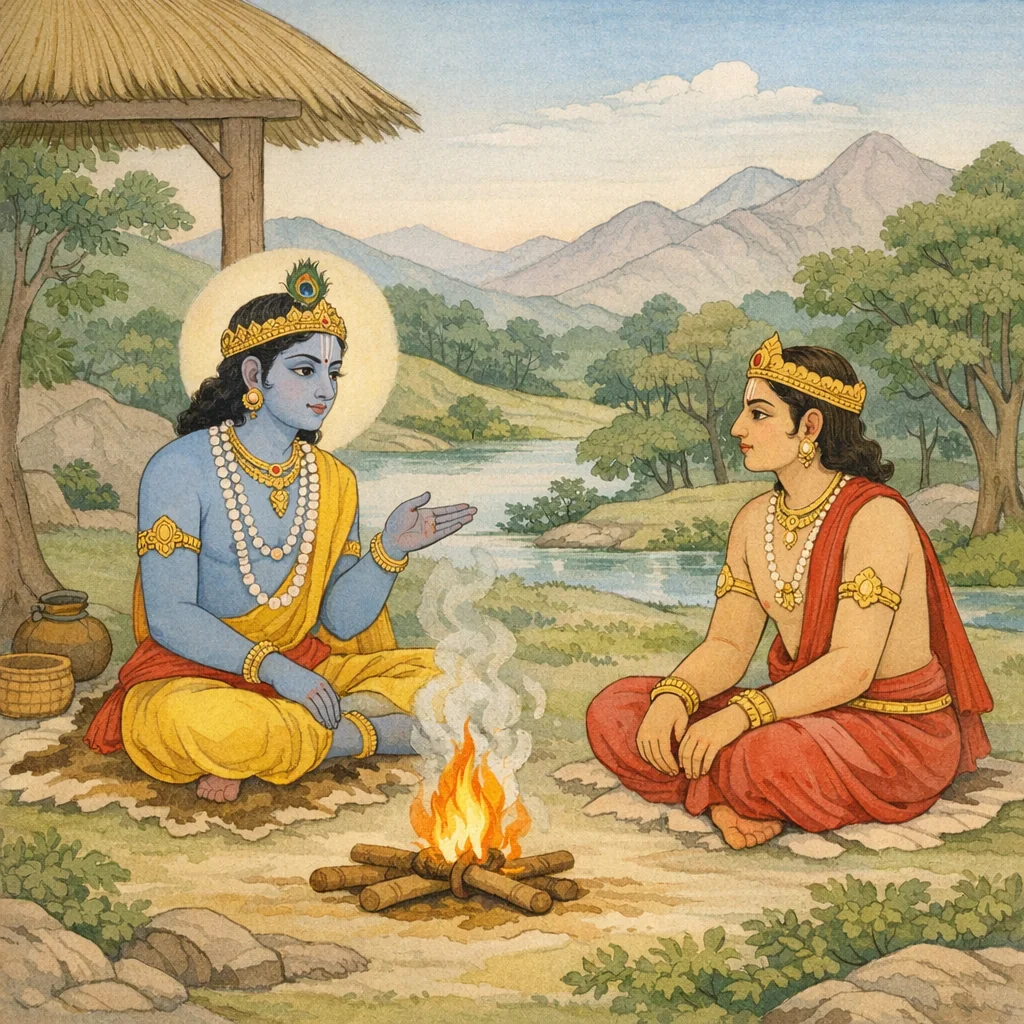
This chapter stages a technical inquiry into how the kṣetrajña—described as the ‘liṅga’ (referent/indicator) of brahman—can be apprehended. The brāhmaṇī first states that such knowledge is not accessible to the ‘small self’ or the unprepared, and requests an upāya (means) by which the relevant insight arises. The brāhmaṇa replies with an araṇi metaphor: the brāhmaṇī is likened to a fire-drill (araṇi) and the guru to the upper araṇi; by friction through tapas and śruti, the ‘fire of knowledge’ is generated. When asked for defining marks (lakṣaṇa), the teacher asserts the kṣetrajña’s lack of external sign (aliṅga), being nirguṇa and causally unconditioned, and therefore only indirectly approachable through method. The discourse warns that even correct instruction can be misconstrued; fixation on action-classifications (‘this is to be done/this is not’) is not itself mokṣa-teaching. Instead, discernment arises in the attentive observer—through seeing and hearing—supported by analytic partitioning of phenomena into many aspects (manifest and unmanifest), culminating in practice (abhyāsa) when nothing further remains to be posited. Vāsudeva then summarizes the brāhmaṇī’s insight as a ‘dissolution/ending’ of kṣetrajña-conceptions, beyond which another (higher) kṣetrajña is indicated. Arjuna asks where these two figures are; Vāsudeva clarifies the allegory: his mind is the brāhmaṇa, his intellect the brāhmaṇī, and the kṣetrajña spoken of is Vāsudeva himself—thereby closing the chapter with a hermeneutic identification of inner faculties and ultimate knower.
Chapter Arc: युद्धोत्तर शान्ति के बीच अर्जुन के भीतर एक सूक्ष्म प्यास उठती है—जिस ‘मति’ (आत्मबोध) से ब्राह्मणी ने क्षेत्रज्ञ का रहस्य जाना, वही बुद्धि उसे भी कैसे प्राप्त हो। → ब्राह्मण-उपदेश में प्रतीक-भाषा गाढ़ी होती जाती है: ब्राह्मणी को ‘अरणि’ (नीचे की लकड़ी), गुरु को ‘उत्तर-अरणि’ कहा जाता है; तप और श्रुति के मंथन से ‘ज्ञान-अग्नि’ प्रकट होती है। साथ ही क्षेत्रज्ञ के निर्गुण, अलिप्त, देह-संबंध से परे होने का कथन साधक के लिए चुनौती बनता है—जो प्रत्यक्ष दिखता है, वह अंतिम सत्य नहीं। → श्रीकृष्ण स्वयं निर्णायक व्याख्या देते हैं: ब्राह्मणी की मति ‘क्षेत्रज्ञ-संक्षय’ (क्षेत्र/देह-आसक्ति के क्षय) से उठती है और क्षेत्रज्ञ-ज्ञान के द्वारा परम की ओर प्रवृत्त होती है; फिर वे रहस्य को आत्मसात कर कहते हैं—‘मन को ब्राह्मण जानो, बुद्धि को ब्राह्मणी जानो; और जो क्षेत्रज्ञ कहा गया है, वह मैं ही हूँ।’ → उपदेश का उपसंहार इस निष्कर्ष पर टिकता है कि साधना का उपाय बाह्य नहीं, अंतःकरण में है—मन-बुद्धि के मंथन, गुरु-श्रुति-तप के अनुशासन, और प्रत्यक्ष-रूपों की सीमाओं को पहचानकर क्षेत्रज्ञ में स्थित होने से ही वह ‘मति’ उपलब्ध होती है।
Shlokas
Verse 1
#-.5.7#:522 हु हक अल चतुस्त्रिंशो 5 ध्याय: भगवान् श्रीकृष्णके द्वारा ब्राह्मण, ब्राह्मणी और क्षेत्रज्ञका रहस्य बतलाते हुए ब्राह्मणगीताका उपसंहार ब्राह्मण्युवाच नेदमल्पात्मना शक््यं वेदितुं नाकृतात्मना । बहु चाल्प॑ च संक्षिप्तं विप्लुतं च मतं मम,ब्राह्मणी बोली--नाथ! मेरी बुद्धि थोड़ी और अन्तःकरण अशुद्ध है, अतः आपने संक्षेपमें जिस महान् ज्ञानका उपदेश किया है, उस बिखरे हुए उपदेशको समझना मेरे लिये कठिन है। मैं तो उसे सुनकर भी धारण न कर सकी
The Brahmin woman said: “This cannot be truly understood by one of little inner strength, nor by one whose self is undisciplined. What I have grasped is at once much and yet little—compressed into brief form—and my understanding feels scattered and unsettled.”
Verse 2
उपायं त॑ मम ब्रूहि येनैषा लभ्यते मतिः । तन्मन्ये कारण त्वत्तो यत एषा प्रवर्तते,अतः आप कोई ऐसा उपाय बताइये, जिससे मुझे भी यह बुद्धि प्राप्त हो। मेरा विश्वास है कि वह उपाय आपहीसे ज्ञात हो सकता है
The Brahmin said: “Tell me the means by which such understanding may be attained by me as well. I am convinced that the cause of this—whence this insight arises—is known to you; therefore, instruct me in the method.”
Verse 3
ब्राह्मण उवाच अरणीं ब्राह्माणीं विद्धि गुरुरस्पोत्तरारणि: । तपःश्रुतेडभिमथ्नीतो ज्ञानाग्निर्जायते तत:,ब्राह्मणने कहा--देवि! तुम बुद्धिको नीचेकी अरणी और गुरुको ऊपरकी अरणी समझो। तपस्या और वेद-वेदान्तके श्रवण-मननद्वारा मन्थन करनेपर उन अरणियोंसे ज्ञानरूप अग्नि प्रकट होती है
The Brahmin said: “Know the intellect to be the lower fire-stick, and the teacher to be its upper fire-stick. When these are churned together through austerity and through hearing and reflecting upon the Veda and Vedānta, the fire of knowledge is born from them.”
Verse 4
ब्राह्मण्युवाच यदिदं ब्राह्म॒णो लिड़ं क्षेत्रज्ञ इति संज्ञितम् ग्रहीतुं येन यच्छक्यं लक्षणं तस्य तत् क्व नु,ब्राह्मणीने पूछा--नाथ! क्षेत्रज्ञ नामसे प्रसिद्ध शरीरान्तर्वर्ती जीवात्माको जो ब्रह्मका स्वरूप बताया जाता है, यह बात कैसे सम्भव है? क्योंकि जीवात्मा ब्रह्मके नियन्त्रणमें रहता है और जो जिसके नियमन्त्रणमें रहता है, वह उसका स्वरूप हो, ऐसा कभी नहीं देखा गया
The Brahmin woman said: “O lord, this inner knower that the Brahmin has indicated and named ‘the Kṣetrajña’—by what means can it be apprehended? What is its defining mark, and where is it to be found? For the individual self is seen to live under the governance of Brahman; and what is governed by another is not ordinarily regarded as identical in essence with that ruler.”
Verse 5
ब्राह्मण उवाच अलिड्ो निर्गुणश्चैव कारणं नास्य लक्ष्यते उपायमेव वक्ष्यामि येन गृहोत वा न वा,ब्राह्मणने कहा--देवि! क्षेत्रज्ञ वास्तवमें देह-सम्बन्धसे रहित और निर्गुण है; क्योंकि उसके सगुण और साकार होनेका कोई कारण नहीं दिखायी देता। अतः मैं वह उपाय बताता हूँ जिससे वह ग्रहण किया जा सकता है अथवा नहीं भी किया जा सकता
The Brāhmaṇa said: “O goddess, the knower of the field (the Self) is truly without any distinguishing mark and is free from qualities; for no cause is perceived by which it could be qualified or embodied. Therefore I shall state the means by which it may be apprehended—or, indeed, may not be apprehended at all.”
Verse 6
सम्यगुपायो दृष्टश्न॒ भ्रमरैरिव लक्ष्यते । कर्मबुद्धिरबुद्धित्वाज्ज्ञानलिज्जैरिवाश्रितम्,उस क्षेत्रका साक्षात्कार करनेके लिये पूर्ण उपाय देखा गया है। वह यह है कि उसे देखनेकी क्रियाका त्याग कर देनेसे भौंरोंके द्वारा गन्धकी भाँति वह अपने-आप जाना जाता है। किंतु कर्मविषयक बुद्धि वास्तवमें बुद्धि न होनेके कारण ज्ञानके सदृश प्रतीत होती है तो भी वह ज्ञान नहीं है। (अतः क्रियाद्वारा उसका साक्षात्कार नहीं हो सकता)
The Brahmin said: “A complete and proper means has been discerned for realizing that Reality. It is known of itself—like fragrance apprehended by bees—when one relinquishes the very activity of ‘trying to see’ it. But the intellect that clings to action, being in truth a kind of non-intelligence, only appears to resemble knowledge; it is not knowledge. Therefore, that realization cannot be attained through mere doing.”
Verse 7
इदं कार्यमिदं नेति न मोक्षेषूपदिश्यते । पश्यत: शृण्वतो बुद्धिरात्मनो येषु जायते,यह कर्तव्य है, यह कर्तव्य नहीं है--यह बात मोक्षके साधनोंमें नहीं कही जाती। जिन साधनोंमें देखने और सुननेवालेकी बुद्धि आत्माके स्वरूपमें निश्चित होती है, वही यथार्थ साधन है
“This is to be done, this is not to be done”—such talk is not taught as a means to liberation. Only those disciplines are true in which the understanding of the one who sees and hears arises and becomes established in the very nature of the Self.
Verse 8
यावन्त इह शकक््येरंस्तावन्तों5शान् प्रकल्पयेत् । अव्यक्तान् व्यक्तरूपांश्न शतशोडथ सहस्रश:,यहाँ जितनी कल्पनाएँ की जा सकती हैं, उतने ही सैकड़ों और हजारों अव्यक्त और व्यक्तरूप अंशोंकी कल्पना कर लें
“As many distinctions as can possibly be conceived here, one may posit just so many ‘parts’ or aspects—hundreds and even thousands—some unmanifest and some taking manifest form.”
Verse 9
सव्वन्ननार्थयुक्तां श्व सर्वान् प्रत्यक्षहेतुकान् यतः परं न विद्येत ततो<भ्यासे भविष्यति,वे सभी प्रत्यक्ष प्रतीत होनेवाले पदार्थ वास्तविक अर्थयुक्त नहीं हो सकते। जिससे पर कुछ भी नहीं है, उसका साक्षात्कार तो “नेति-नेति” अर्थात् यह भी नहीं, यह भी नहीं--इस अभ्यासके अन्तमें ही होगा
The Brahmin said: All things that appear directly to the senses and seem to have evident causes are not, in truth, endowed with ultimate meaning. The realization of That beyond which nothing exists arises only at the culmination of sustained practice—through the discipline of negation, ‘not this, not this’ (neti-neti), by which one withdraws false identifications and approaches the highest reality.
Verse 10
श्रीभगवानुवाच ततस्तु तस्या ब्राह्माण्या मति: क्षेत्रज्ञसंक्षये । क्षेत्रज्ञानेन परत: क्षेत्रज्ञेभ्य: प्रवर्तते,भगवान् श्रीकृष्णने कहा--पार्थ! उसके बाद उस ब्राह्मणीकी बुद्धि, जो क्षेत्रज्ञके संशयसे युक्त थी, क्षेत्रके ज्ञानसे अतीत क्षेत्रज्ञोंसे युक्त हुई
The Blessed Lord said: “Thereafter, the understanding of that Brahmin woman—still beset by doubt concerning the Knower of the Field (kṣetrajña)—passed beyond the knowledge of the Field (kṣetra) and moved onward toward the realization of the Knowers of the Field who are beyond.”
Verse 11
अजुन उवाच क्व नु सा ब्राह्मणी कृष्ण क््व चासौ ब्राह्मणर्षभ: । याभ्यां सिद्धिरियं प्राप्ता तावुभी वद मे5च्युत,अर्जुनने पूछा--श्रीकृष्ण! वह ब्राह्मणी कौन थी और वह श्रेष्ठ ब्राह्मण कौन था? अच्युत! जिन दोनोंके द्वारा यह सिद्धि प्राप्त की गयी, उन दोनोंका परिचय मुझे बताइये
Arjuna said: “Kṛṣṇa, where is that Brahmin woman, and where is that bull among Brahmins? By those two this extraordinary attainment was achieved. O Acyuta, tell me about them both.”
Verse 12
श्रीभगवानुवाच मनो मे ब्राह्माणं विद्धि बुद्धि मे विद्धि ब्राह्मणीम् क्षेत्रज्ञ इति यश्चोक्त: सो5हमेव धनंजय,भगवान् श्रीकृष्ण बोले--अर्जुन! मेरे मनको तो तुम ब्राह्मण समझो और मेरी बुद्धिको ब्राह्यणी समझो एवं जिसको क्षेत्रज्ञ--ऐसा कहा गया है, वह मैं ही हूँ
The Blessed Lord said: “O Dhanañjaya, know My mind to be Brahman, and know My intellect to be the Brahmin woman. And the one who is spoken of as the ‘Knower of the Field’ (kṣetrajña)—that is none other than I Myself.”
Verse 33
इस प्रकार श्रीमहद्याभारत आश्वमेधिकपर्वके अन्तर्गत अनुगीतापर्वमें ब्राह्मणगीताविषयक तैतीसवाँ अध्याय पूरा हुआ
Thus ends the thirty-third chapter of the Brāhmaṇa-Gītā section within the Anugītā sub-parvan of the Āśvamedhika Parvan of the revered Mahābhārata.
Verse 34
इति श्रीमहाभारते आश्वमेधिके पर्वणि अनुगीतापर्वणि ब्राह्मणगीतासु चतुस्त्रिंशो 5ध्याय:
Thus, in the Śrī Mahābhārata, within the Āśvamedhika Parvan, in the section called the Anugītā-parvan, in the Brāhmaṇa-gītās, ends the thirty-fourth chapter.
Frequently Asked Questions
The dilemma is methodological: the listener seeks a definable ‘mark’ (lakṣaṇa) for the kṣetrajña, but the teaching insists the ultimate knower is signless (aliṅga) and nirguṇa, requiring disciplined means rather than object-like identification.
Knowledge arises through guided discipline—tapas and śruti under a guru—combined with careful observation and sustained practice; liberation-oriented insight is not reducible to mere action-categorization (‘do this / do not do this’).
Yes. Vāsudeva interprets the brāhmaṇa as mind (manas) and the brāhmaṇī as intellect (buddhi), identifying the kṣetrajña with himself; this signals that the dialogue functions as an interiorized map of cognition culminating in the highest knower.