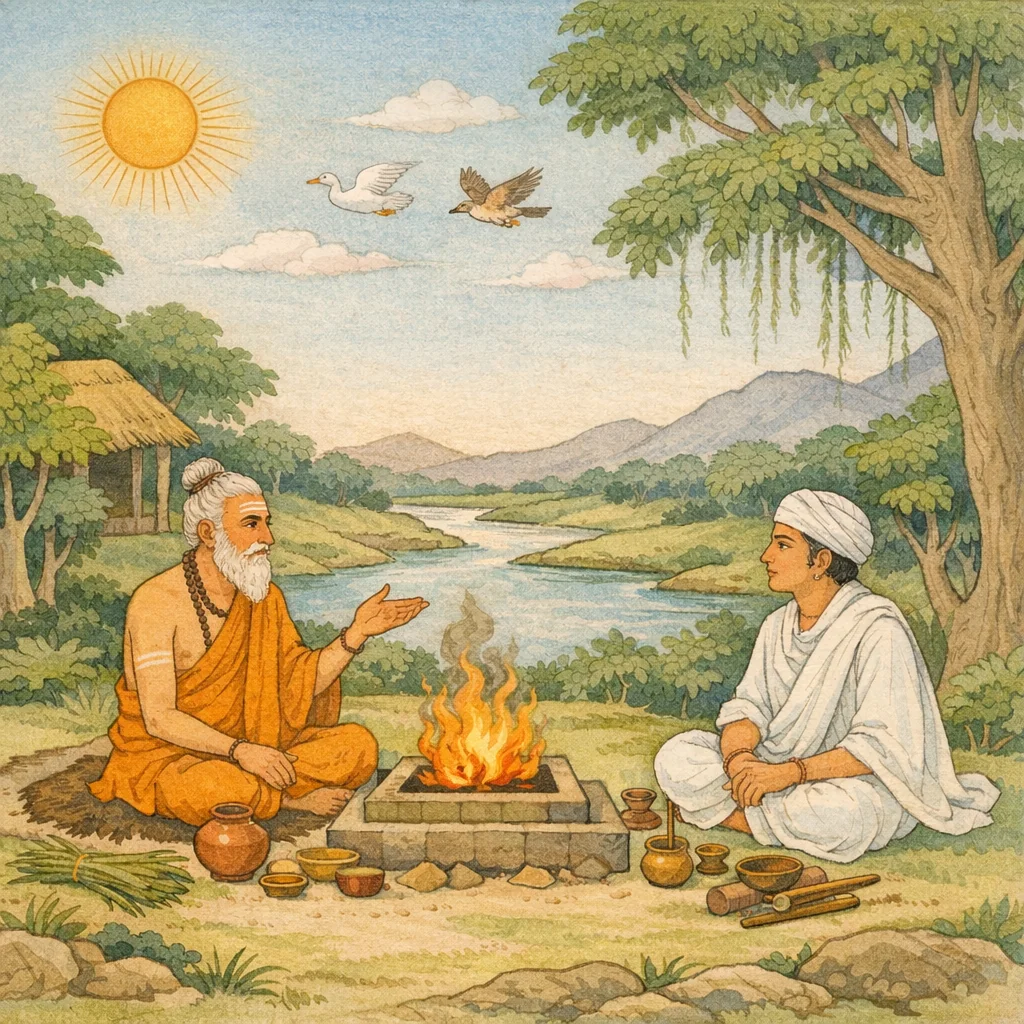
Adhyaya 28
अध्वर्यु–यति संवादः (Adhvaryu–Yati Dialogue on Svabhāva, Ahiṃsā, and Mokṣa)
Upa-parva: Adhvaryu–Yati Saṃvāda (Discourse on Yajña, Ahiṃsā, and Mokṣa) — within Āśvamedhika Parva
A brāhmaṇa voice presents a first-person analysis of sensory non-identification and mental non-appropriation: the speaker denies autonomous agency over smell, taste, sight, touch, and sound, and locates desire (kāma) and aversion (dveṣa) in svabhāva operating through embodied functions (prāṇa–apāna). He asserts that when one stands as the observing self within the body, one is not truly afflicted by kāma, krodha, aging, or death; non-craving and non-hatred prevent ‘adhesion’ of faults, like water on a lotus leaf. An ancient exemplum is then introduced: a yati criticizes the impending ritual killing of a goat; the adhvaryu replies with a cosmological redistribution argument (elements return to their sources) and claims śruti-sanctioned blamelessness. The yati counters by questioning beneficiary and consent, advancing ahiṃsā as the superior norm. The adhvaryu replies that ordinary living entails harm and frames perception and cognition as functions of the elements and prāṇa. The yati distinguishes the self’s dual aspect—akṣara (imperishable) and kṣara (perishable svabhāva)—and describes liberation as freedom from prāṇa-driven faculties, dualities, possessiveness, and fear, grounded in equality toward all beings. The adhvaryu acknowledges the instruction, continues the great rite without delusion, and the chapter closes by stating that such subtle mokṣa is known to brāhmaṇas and practiced under the guidance of the kṣetrajña (knower of the field).
Chapter Arc: अनुगीत के भीतर ब्राह्मण-गीत का सूक्ष्म द्वार खुलता है—ज्ञानी पुरुष की स्थिति का वर्णन, जहाँ इन्द्रियाँ विषयों को नहीं ‘भोगतीं’, केवल प्रकृति-स्वभाव के प्रवाह में कर्म घटता दिखता है। → संवाद में स्वभाव (प्रकृति) की प्रबलता उभरती है—काम-द्वेष का युद्ध, प्राण-अपान का देह में निवेश, और यह प्रश्न कि जब प्रत्येक चेष्टा में किसी-न-किसी रूप की हिंसा अनिवार्य है, तो यति/अध्वर्यु का आचरण कैसे निर्दोष कहा जाए। → यति आत्मा के द्वैध रूप का निर्णायक प्रतिपादन करता है—अक्षर (अविनाशी, सद्भाव) और क्षर (परिवर्तनशील, स्वभाव-प्रवृत्त); और ब्राह्मण-स्वर में यह बोध चरम पर पहुँचता है कि ‘क्षेत्रज्ञ’ की दृष्टि से देह-स्थित भावों को देखते हुए भी आसक्ति न हो—काम, क्रोध, जरा, मृत्यु से परे स्थित रहना ही मोक्ष का सूक्ष्म मार्ग है। → अध्वर्यु यति की बुद्धि-दीप्ति को स्वीकार कर अपने व्रत/मन्त्रकृत कर्म के संदर्भ में ‘भगवद्बुद्धि’ से आचरण की शुद्धि का निवेदन करता है; निष्कर्ष रूप में ब्राह्मण कहते हैं कि मोक्ष का यह अत्यन्त सूक्ष्म स्वरूप ब्राह्मण जानते हैं और उसे जानकर ‘क्षेत्रज्ञ’ की अर्थदर्शी दृष्टि से अनुष्ठान करते हैं।
Shlokas
Verse 1
ऑपन-साज बक। डे अष्टाविशोड ध्याय: ज्ञानी पुरुषकी स्थिति तथा अध्वर्यु और यतिका संवाद ब्राह्मण उवाच गन्धान् न जिप्रामि रसान् न वेझि रूपं॑ न पश्यामि न च स्पृशामि | न चापि शब्दान् विविधान् शूणोमि न चापि संकल्पमुपैमि कंचित्,ब्राह्मण कहते हैं--मैं न तो गन्धोंको सूँघता हूँ, न रसोंका आस्वादन करता हूँ, न रूपको देखता हूँ, न किसी वस्तुका स्पर्श करता हूँ, न नाना प्रकारके शब्दोंको सुनता हूँ और न कोई संकल्प ही करता हूँ
The Brāhmaṇa said: “I do not smell fragrances; I do not apprehend tastes. I do not see form, nor do I touch. Nor do I hear the many kinds of sounds; and I do not even entertain any intention or mental construction at all.”
Verse 2
अर्थानिष्टान् कामयते स्वभाव: सर्वान् देष्यान् प्रद्धिषते स्वभाव: । कामद्वेषायुद्धवत: स्वभावात् प्राणापानौ जन््तुदेहान्निवेश्य,स्वभाव ही अभीष्ट पदार्थोकी कामना रखता है, स्वभाव ही सम्पूर्ण द्वेष्य वस्तुओंके प्रति द्वेष करता है। जैसे प्राण और अपान स्वभावसे ही प्राणियोंके शरीरोंमें प्रविष्ट होकर अन्न-पाचन आदिका कार्य करते रहते हैं, उसी प्रकार स्वभावसे ही राग और द्वेषकी उत्पत्ति होती है। तात्पर्य यह कि बुद्धि आदि इन्द्रियाँ स्वभावसे ही पदार्थोंमें बर्त रही हैं
The Brāhmaṇa said: It is one’s very nature that longs for what is desired, and it is one’s very nature that recoils from all that is hateful. Just as prāṇa and apāna, entering the bodies of living beings by their own inherent function, continually carry on processes such as digestion, so too—by nature itself—attachment and aversion arise. The point is that the faculties such as the intellect and the senses, driven by their inborn disposition, keep engaging with objects.
Verse 3
तेभ्यश्नान्यांस्तेषु नित्यांश्व भावान् भूतात्मानं लक्षयेरन् शरीरे । तस्मिंस्तिष्ठन्नास्मि सक्त: कथंचित् कामक्रोधाभ्यां जरया मृत्युना च,इन बाह्य इन्द्रियों और विषयोंसे भिन्न जो स्वप्न और सुषुप्तिके वासनामय विषय एवं इन्द्रियाँ हैं तथा उनमें भी जो नित्यभाव हैं, उनसे भी विलक्षण जो भूतात्मा है, उसको शरीरके भीतर योगीजन देख पाते हैं। उसी भूतात्मामें स्थित हुआ मैं कहीं किसी तरह भी काम, क्रोध, जरा और मृत्युसे ग्रस्त नहीं होता
Distinct from the outer senses and their objects—and even from the dream and deep-sleep realms where impressions (vāsanās) fashion subtle objects and faculties, and from the enduring dispositions found there—the yogins discern within the body the Bhūtātman, the elemental Self. Abiding in that Self, I am not bound in any way: desire and anger do not seize me, nor do old age and death overcome me.
Verse 4
अकामयानस्य च सर्वकामा- नविद्विषाणस्य च सर्वदोषान् | न मे स्वभावेषु भवन्ति लेपा- स्तोयस्य बिन्दोरिव पुष्करेषु,मैं सम्पूर्ण कामनाओंमेंसे किसीकी कामना नहीं करता। समस्त दोषोंसे भी कभी द्वेष नहीं करता। जैसे कमलके पत्तोंपर जल-बिन्दुका लेप नहीं होता, उसी प्रकार मेरे स्वभावमें राग और द्वेषका स्पर्श नहीं है
The Brahmin says: “I do not crave any of the objects of desire, and I bear no hatred even toward all faults. Just as a drop of water does not cling to a lotus leaf, so attachment and aversion do not adhere to my nature.”
Verse 5
नित्यस्य चैतस्य भवन्त्यनित्या निरीक्ष्यमाणस्य बहुस्वभावान् | न सज्जते कर्मसु भोगजालं दिवीव सूर्यस्य मदूखजालम्,जिनका स्वभाव बहुत प्रकारका है, उन इन्द्रिय आदिको देखनेवाले इस नित्यस्वरूप आत्माके लिये सब भोग अनित्य हो जाते हैं। अतः वे भोगसमुदाय उस विद्वानको उसी प्रकार कर्मोमें लिप्त नहीं कर सकते, जैसे आकाशमें सूर्यकी किरणोंका समुदाय सूर्यको लिप्त नहीं कर सकता
For this Self, eternal and merely observing the many-natured play of the senses and their objects, all enjoyments are seen to be impermanent. Therefore the web of pleasures cannot entangle the wise in actions—just as the spread of the sun’s rays in the sky does not stain or bind the sun itself.
Verse 6
अत्राप्युदाहरन्तीममितिहासं पुरातनम् । अध्वर्युयतिसंवादं तं निबोध यशस्विनि,यशस्विनि! इस विषयमें अध्वर्यु और यतिके संवादरूप प्राचीन इतिहासका उदाहरण दिया जाता है, तुम उसे सुनो
Here too, they cite an ancient precedent as an illustration. Listen, O illustrious lady, to that old account—the dialogue between the Adhvaryu priest and the ascetic Yati—offered to clarify this matter and its moral bearing.
Verse 7
प्रोक्ष्यमाणं पशुं दृष्टवा यज्ञकर्मण्यथाब्रवीत् । यतिरध्वर्युमासीनो हिंसेयमिति कुत्सयन्,किसी यज्ञ-कर्ममें पशुका प्रोक्षण होता देख वहीं बैठे हुए एक यतिने अध्वर्युसे उसकी निन्दा करते हुए कहा--'यह हिंसा है (अत: इससे पाप होगा)'
Seeing an animal being sprinkled with consecrated water as part of a sacrificial rite, a renunciant who was seated there spoke to the officiating priest in condemnation: “This is violence; it will bring sin.”
Verse 8
तमध्वर्यु: प्रत्युवाच नायं छागो विनश्यति । श्रेयसा योक्ष्यते जन्तुर्यदि श्रुतिरियं तथा,अध्वर्युने यतिको इस प्रकार उत्तर दिया--'यह बकरा नष्ट नहीं होगा। यदि “पशुर्व नीयमान:” इत्यादि श्रुति सत्य है तो यह जीव कल्याणका ही भागी होगा
The officiating priest (Adhvaryu) replied, “This goat will not be destroyed. If the Vedic injunction (śruti) that speaks of the ‘animal being led (for the rite)’ is indeed true, then this living being will be joined to a higher good.”
Verse 9
यो हास्य पार्थिवो भाग: पृथिवीं स गमिष्यति । यदस्य वारिजं किंचिदपस्तत् सम्प्रवेक्ष्यति,“इसके शरीरका जो पार्थिव भाग है, वह पृथ्वीमें विलीन हो जायगा। इसका जो कुछ भी जलीय भाग है, वह जलमें प्रविष्ट हो जायगा
The Brahmin said: “Whatever in this body is of the earth will return and merge into the earth; and whatever in it is of the nature of water will enter into water. Thus the embodied being is seen as a temporary compound of elements, destined to dissolve back into their sources.”
Verse 10
सूर्य चक्षु्दिश: श्रीत्रं प्राणोडस्य दिवमेव च । आगमगमे वर्तमानस्य न मे दोषो5स्ति कश्षन,“नेत्र सूर्यमें, कान दिशाओंमें और प्राण आकाशमें ही लयको प्राप्त होगा। शास्त्रकी आज्ञाके अनुसार बर्ताव करनेवाले मुझको कोई दोष नहीं लगेगा'
The brāhmaṇa said: “My sight will merge into the Sun, my hearing into the directions, and my vital breath into the sky—indeed, into the heavenly expanse itself. Since I conduct myself in accordance with the scriptural injunctions and established tradition, no fault attaches to me.”
Verse 11
यतिरुवाच प्राणैर्वियोगे च्छागस्य यदि श्रेय: प्रपश्यसि । छागार्थे वर्तते यज्ञों भवत: कि प्रयोजनम्,यतिने कहा--यदि तुम बकरेके प्राणोंका वियोग हो जानेपर भी उसका कल्याण ही देखते हो, तब तो यह यज्ञ उस बकरेके लिये ही हो रहा है। तुम्हारा इस यज्ञसे क्या प्रयोजन है?
The ascetic said: “If you deem it a benefit to this goat even when its life-breaths are severed, then this sacrifice is being performed for the goat alone. What purpose, then, do you have in this sacrifice?”
Verse 12
अत्र त्वां मन््यतां भ्राता पिता माता सखेति च । मन्त्रयस्वैनमुन्नीय परवन्तं विशेषत:,श्रुति कहती है 'पशो! इस विषयमें तुझे तेरे भाई, पिता, माता और सखाकी अनुमति प्राप्त होनी चाहिये।' इस श्रुतिके अनुसार विशेषतः पराधीन हुए इस पशुको ले जाकर इसके पिता माता आदिसे अनुमति लो (अन्यथा तुझे हिंसाका दोष अवश्य प्राप्त होगा)
The brāhmaṇa said: “Here, let your brother, father, mother, and friend be consulted and give their assent regarding you. Therefore, take this creature—now especially under another’s control—and, after leading it away, seek the permission of its father, mother, and the rest. Otherwise, the act will inevitably incur the fault of violence.”
Verse 13
एवमेवानुमन्येरंस्तान् भवान् द्रष्टमरहति । तेषामनुमतं श्रुत्वा शक््या कर्तु विचारणा,पहले तुम्हें इस पशुके उन सम्बन्धियोंसे मिलना चाहिये। यदि वे भी ऐसा ही करनेकी अनुमति दे दें, तब उनका अनुमोदन सुनकर तदनुसार विचार कर सकते हो
“In the same way, you should go and meet those people. After hearing their consent, it will be possible to deliberate and decide accordingly.”
Verse 14
प्राणा अप्यस्य छागस्य प्रापितास्ते स्वयोनिषु । शरीरं केवल शिष्ट निश्चेष्टमिति मे मति:,तुमने इस छागकी इन्द्रियोंको उनके कारणोंमें विलीन कर दिया है। मेरे विचारसे अब तो केवल इसका निश्वेष्ट शरीर ही अवशिष्ट रह गया है
The brāhmaṇa said: “Even the life-breaths of this goat have been led back into their own sources. In my judgment, nothing remains now except its body—left behind, motionless.”
Verse 15
इन्धनस्य तु तुल्येन शरीरेण विचेतसा । हिंसानिर्वेष्टकामानामिन्धनं पशुसंज्ञितम्,यह चेतनाशून्य जड शरीर ईंधनके ही समान है, उससे हिंसाके प्रायश्चित्तकी इच्छासे यज्ञ करनेवालोंके लिये ईँधन ही पशु है (अत: जो काम ईंधनसे होता है, उसके लिये पशु- हिंसा क्यों की जाय?)
This body, insentient and mindless, is no different from mere fuel. Therefore, for those who would perform sacrifice as an expiation for violence, fuel itself should be regarded as the ‘animal’; if the rite can be accomplished with fuel, why commit animal-killing at all?
Verse 16
अहिंसा सर्वधर्माणामिति वृद्धानुशासनम् | यदिहिंस्रं भवेत् कर्म तत् कार्यमिति विद्यहे,वृद्ध पुरुषोंका यह उपदेश है कि अहिंसा सब धर्मामें श्रेष्ठ है, जो कार्य हिंसासे रहित हो वही करने योग्य है, यही हमारा मत है
The Brahmin said: “This is the instruction handed down by the elders: non-violence is foremost among all forms of dharma. Therefore, we hold that only that action which is free from violence is truly fit to be done.”
Verse 17
अहिंसेति प्रतिज्ञेयं यदि वक्ष्याम्यत: परम् | शक्यं बहुविध॑ कर्तु भवता कार्यदूषणम्,इसके बाद भी यदि मैं कुछ कहूँ तो यही कह सकता हूँ कि सबको यह प्रतिज्ञा कर लेनी चाहिये कि “मैं अहिंसा-धर्मका पालन करूँगा।” अन्यथा आपके द्वारा नाना प्रकारके कार्य-दोष सम्पादित हो सकते हैं
The Brahmin said: “If I am to speak further, then this is what I would say: one should make a firm vow—‘I shall practice the dharma of non-violence.’ Otherwise, through your actions, many kinds of faults and corruptions of duty may be brought about.”
Verse 18
अहिंसा सर्वभूतानां नित्यमस्मासु रोचते । प्रत्यक्षत: साधयामो न परोक्षमुपास्महे,किसी भी प्राणीकी हिंसा न करना ही हमें सदा अच्छा लगता है। हम प्रत्यक्ष फलके साधक हैं, परोक्षकी उपासना नहीं करते हैं
The Brahmin said: “Non-violence toward all beings is always pleasing to us. We pursue what yields results that are directly evident; we do not engage in the worship or pursuit of what is indirect and unseen.”
Verse 19
अध्वर्युर्वाच भूमेर्गन्धगुणान् भुड्क्षे पिबस्पापोमयान् रसान् । ज्योतिषां पश्यसे रूप॑ स्पृशस्यनिलजान् गुणान्,अध्वर्युने कहा--यते! यह तो तुम मानते ही हो कि सभी भूतोंमें प्राण है, तो भी तुम पृथ्वीके गन्ध गुणोंका उपभोग करते हो, जलमय रसोंको पीते हो, तेजके गुण? रूपका दर्शन करते हो और वायुके गुण स्पर्शको छूते हो, आकाशजनित शब्दोंको सुनते हो और मनसे मतिका मनन करते हो
The Adhvaryu said: “You partake of the earth’s quality of fragrance; you drink the watery tastes; you behold form, the quality of fire/light; and you touch the tactile qualities born of wind. Though you affirm that life pervades all beings, you still engage the senses with their respective objects—so how do you reconcile your claim with your lived experience?”
Verse 20
शृणोष्याकाशजान् शब्दान् मनसा मन्यसे मतिम् । सर्वाण्येतानि भूतानि प्राणा इति च मन्यसे,अध्वर्युने कहा--यते! यह तो तुम मानते ही हो कि सभी भूतोंमें प्राण है, तो भी तुम पृथ्वीके गन्ध गुणोंका उपभोग करते हो, जलमय रसोंको पीते हो, तेजके गुण? रूपका दर्शन करते हो और वायुके गुण स्पर्शको छूते हो, आकाशजनित शब्दोंको सुनते हो और मनसे मतिका मनन करते हो
The Brahmin said: “You hear the sounds that arise from space; with the mind you reflect and form judgments. And you also hold that all these beings are, in truth, ‘life-breath’ (prāṇa).” In context, the statement presses an ethical point: even while affirming that life pervades all beings, one still engages the senses and the inner faculty of thought—so one must examine how sense-enjoyment and mental constructions relate to one’s claim of reverence for life and to one’s discipline of restraint.
Verse 21
एक ओर तो तुम किसी प्राणीके प्राण लेनेके कार्यसे निवृत्त हो और दूसरी ओर हिंसामें लगे हुए हो। द्विजवर! कोई भी चेष्टा हिंसाके बिना नहीं होती। फिर तुम कैसे समझते हो कि तुम्हारे द्वारा अहिंसाका ही पालन हो रहा है?
The brāhmaṇa said: “On the one hand you claim to refrain from taking the life of any creature, yet on the other you remain engaged in violence. O best of the twice-born, no action is possible without some measure of harm. How then do you imagine that what you practice is nothing but non-violence?”
Verse 22
यतिरुवाच अक्षरं च क्षरं चैव द्वैधीभावो5यमात्मन: । अक्षरं तत्र सद्भाव: स्वभाव: क्षर उच्यते,यतिने कहा--आत्माके दो रूप हैं--एक अक्षर और दूसरा क्षर। जिसकी सत्ता तीनों कालोंमें कभी नहीं मिटती वह सत्स्वरूप अक्षर (अविनाशी) कहा गया है तथा जिसका सर्वथा और सभी कालोंमें अभाव है, वह क्षर कहलाता है
The ascetic said: “The Self is spoken of as having a twofold mode—imperishable and perishable. That which truly exists and is never destroyed in any of the three times is called the Imperishable. But that whose nature is sheer non-being—lacking reality altogether in every time—is called the Perishable.”
Verse 23
प्राणादाने निवृत्तोडसि हिंसायां वर्तते भवान् | नास्ति चेष्टा विना हिंसां कि वा त्वं मन्यसे द्विज,प्राणो जिह्ठा मन: सत्त्वं सद्भावो रजसा सह । भावैरेतैविंमुक्तस्य निर्दधन्द्स्य निराशिष: प्राण, जिह्ला, मन और रजोगुणसहित सत्त्वगगुण--ये रज अर्थात् मायासहित सद्धाव हैं। इन भावोंसे मुक्त निर्दन्द्ध, निष्काम, समस्त प्राणियोंके प्रति समभाव रखनेवाले, ममतारहित, जितात्मा तथा सब ओरसे बन्धनशून्य पुरुषको कभी और कहीं भी भय नहीं होता
The Brahmin said: “You have withdrawn from taking life, yet you still move within the sphere of violence. For no action is possible without some harm—what do you think of this, O twice-born? Life-breath, the tongue, and the mind—together with the qualities of sattva and rajas—constitute the inner dispositions that drive embodied existence. But for one who is freed from these impulses, who is beyond the pairs of opposites and without craving for results, fear does not arise anywhere at any time.”
Verse 24
समस्य सर्वभूतेषु निर्ममस्य जितात्मन: । समन्तात् परिमुक्तस्य न भयं विद्यते क्वचित्,प्राण, जिह्ला, मन और रजोगुणसहित सत्त्वगगुण--ये रज अर्थात् मायासहित सद्धाव हैं। इन भावोंसे मुक्त निर्दन्द्ध, निष्काम, समस्त प्राणियोंके प्रति समभाव रखनेवाले, ममतारहित, जितात्मा तथा सब ओरसे बन्धनशून्य पुरुषको कभी और कहीं भी भय नहीं होता
The Brahmin said: For one who is even-minded toward all beings, free from possessiveness, self-controlled, and wholly released from bondage on every side, fear does not arise—at any time or in any place. The ethical point is that fear is sustained by attachment and identification; when these are relinquished through inner mastery and universal equanimity, the mind becomes unshakable.
Verse 25
अध्वर्युरुवाच सद्धिरेवेह संवास: कार्यो मतिमतां वर । भवतो हि मतं श्रुत्वा प्रतिभाति मतिर्मम,अध्वर्युने कहा--बुद्धिमानोंमें श्रेष्ठ यते! इस जगतमें आप-जैसे साधुपुरुषोंके साथ ही निवास करना उचित है। आपका यह मत सुनकर मेरी बुद्धिमें भी ऐसी ही प्रतीति हो रही है। भगवन्! विप्रवर! मैं आपकी बुद्धिसे ज्ञानसम्पन्न होकर यह बात कह रहा हूँ कि वेदमन्त्रोंद्वारा निश्चित किये हुए व्रतका ही मैं पालन कर रहा हूँ। अतः इसमें मेरा कोई अपराध नहीं है
The Adhvaryu said: “O best among the wise, in this world one should indeed dwell in the company of the good. Having heard your view, my own understanding also shines forth in the same way.”
Verse 26
भगवन् भगवदबुद्धया प्रतिपन्नो ब्रवीम्पहम् । व्रतं मन्त्रकृतं कर्तुर्नापराधो5स्ति मे द्विज,अध्वर्युने कहा--बुद्धिमानोंमें श्रेष्ठ यते! इस जगतमें आप-जैसे साधुपुरुषोंके साथ ही निवास करना उचित है। आपका यह मत सुनकर मेरी बुद्धिमें भी ऐसी ही प्रतीति हो रही है। भगवन्! विप्रवर! मैं आपकी बुद्धिसे ज्ञानसम्पन्न होकर यह बात कह रहा हूँ कि वेदमन्त्रोंद्वारा निश्चित किये हुए व्रतका ही मैं पालन कर रहा हूँ। अतः इसमें मेरा कोई अपराध नहीं है
O venerable one, having adopted the understanding that accords with the Lord (and with your enlightened counsel), I speak as follows: I am observing only that vow which has been established by Vedic mantras for the performer of the rite. Therefore, O twice-born one, there is no fault on my part in this matter.
Verse 27
इस प्रकार श्रीमह्याभारत आश्वमेधिकपववके अन्तर्गत अनुगीतापर्वमें ब्राह्मणगीतासग्बन्धी सत्ताईसवाँ अध्याय पूरा हुआ,ब्राह्मण उवाच उपपचन्त्या यतिस्तृष्णीं वर्तमानस्तत: परम् | अध्वर्युरपि निर्मोह: प्रचचार महामखे ब्राह्मण कहते हैं--प्रिये! अध्वर्युकी दी हुई युक्तिसे वह यति चुप हो गया और फिर कुछ नहीं बोला। फिर अध्वर्यु भी मोहरहित होकर उस महायज्ञमें अग्रसर हुआ
The Brāhmaṇa said: “Beloved, when the Adhvaryu replied with sound reasoning, the ascetic fell silent and spoke no further. Then the Adhvaryu too, free from delusion, proceeded onward in that great sacrifice.”
Verse 28
एवमेतादृशं मोक्ष सुसूक्ष्मं ब्राह्मणा विदु: । विदित्वा चानुतिष्ठ न्ति क्षेत्रज्ञेनार्थदर्शिना,इस प्रकार ब्राह्मण मोक्षका ऐसा ही अत्यन्त सूक्ष्म स्वरूप बताते हैं और तत्त्वदर्शी पुरुषके उपदेशके अनुसार उस मोक्ष-धर्मको जानकर उसका अनुष्ठान करते हैं इति श्रीमहाभारते आश्वमेधिके पर्वणि अनुगीतापर्वणि ब्राह्मणगीतासु अष्टाविंशो5ध्याय:
Thus do the Brahmins understand liberation to be of this kind—exceedingly subtle. Having understood it, they then practice that discipline of release in accordance with the instruction of the knower of the field, the seer of truth and meaning.
Frequently Asked Questions
Whether a Vedic sacrificial act involving an animal can be ethically justified: the adhvaryu appeals to śruti and elemental-return reasoning, while the yati interrogates consent, benefit, and the primacy of ahiṃsā.
Liberation is framed as non-adhesion to svabhāva-driven impulses (kāma, dveṣa), stabilization in the observing self (kṣetrajña), and cultivation of equanimity and non-possessiveness, such that faults do not ‘stick’ to one’s nature.
A concluding meta-statement functions as the chapter’s validation: this mokṣa is ‘subtle’ and known to brāhmaṇas; having understood it, they practice accordingly under the guidance of the kṣetrajña perspective, emphasizing disciplined realization rather than a ritual reward claim.