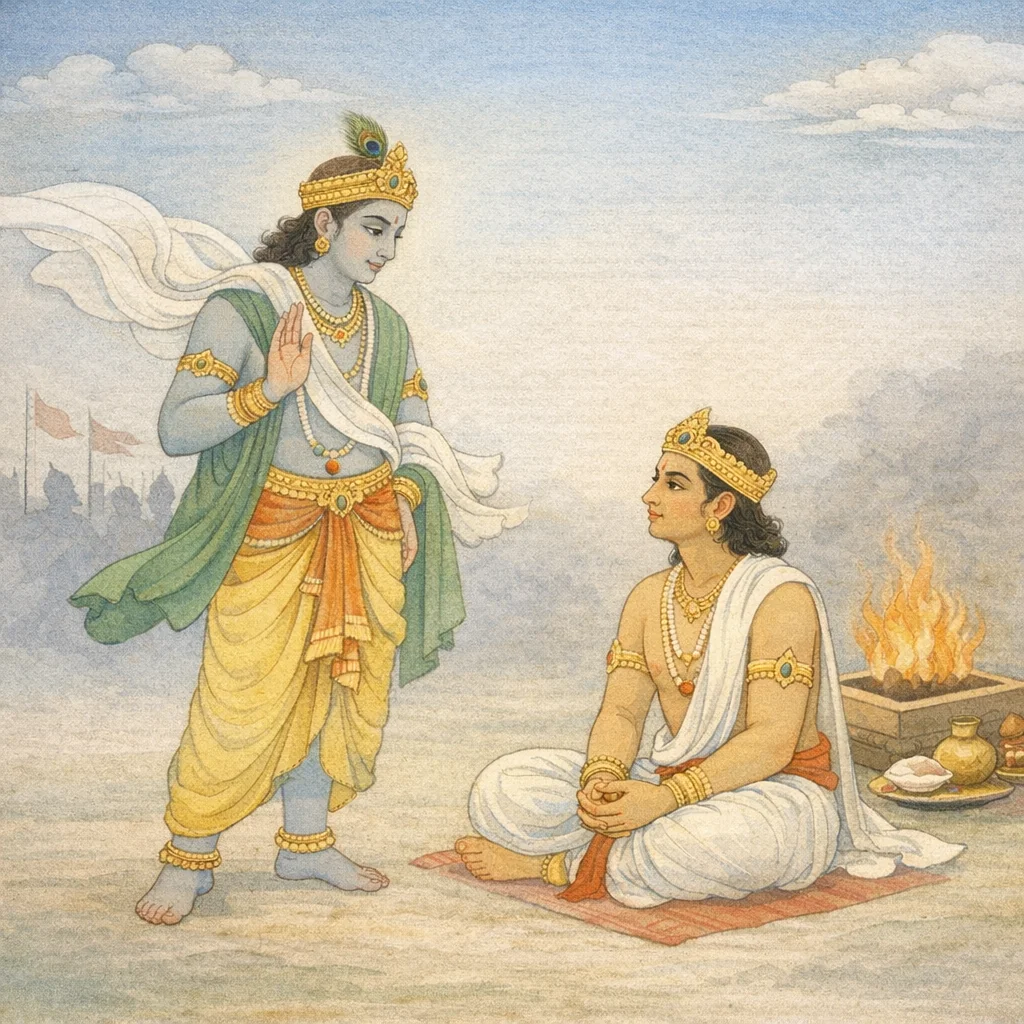
Adhyaya 13
Kāma–Mamatā–Upadeśa (Discourse on Desire, Possessiveness, and Ritual Duty)
Upa-parva: Āśvamedhika-upākhyāna (Counsel on Aśvamedha, desire, and non-attachment)
Vāsudeva instructs Yudhiṣṭhira on the relationship between external renunciation and inner disposition. He argues that abandoning external goods alone does not guarantee ‘siddhi’ (spiritual or practical accomplishment), and that fixation on the body or possessions can keep one within the orbit of fear and mortality. A compact linguistic-ethical contrast is introduced: ‘mama’ (mine) is presented as a marker of death-bound attachment, while ‘na mama’ (not mine) indicates the enduring principle aligned with brahman. The chapter then reframes kāma (intent/desire) as a driver of action: society does not praise uncontrolled desire, yet no activity proceeds without some motivating aim; even dāna, Vedic study, tapas, vows, and yogic disciplines are undertaken through purposive intention. A set of traditional gāthās illustrates the paradox that attempts to ‘destroy’ desire by various meritorious means can cause it to reappear in new forms, culminating in the claim that desire is difficult to eliminate and must be redirected rather than naively denied. The discourse closes with pragmatic instruction: perform the Aśvamedha and other rites with due dakṣiṇā, and do not repeatedly reopen grief over the dead; through great sacrifices and generosity, the king attains public renown and an elevated posthumous trajectory.
Chapter Arc: युद्धोत्तर शोक में डूबे युधिष्ठिर के सामने वायुदेव का उपदेश उतरता है—‘मम’ और ‘न मम’ के दो-तीन अक्षरों में ही मृत्यु और शाश्वत ब्रह्म का रहस्य छिपा है। → वायुदेव बाह्य-आंतरिक शत्रुओं (इन्द्रिय-विकार, आसक्ति, काम) का स्वभाव दिखाते हैं: बाह्य पदार्थों से अलग दिखते हुए भी देह-सुख में लिप्त मनुष्य धर्म का मर्म खो देता है। ‘काम-गीता’ का संकेत देकर वे बताते हैं कि व्रत, यज्ञ, नियम, ध्यान—सबका आरम्भ भी कामना से होता है; इसलिए काम को समझे बिना साधना भी भ्रम बन सकती है। → निर्णायक वाक्य गूंजता है—‘ममेति’ (मेरा) मृत्यु है, ‘न ममेति’ (मेरा नहीं) शाश्वत ब्रह्म। समूची पृथ्वी पा कर भी जिसमें ममता नहीं, उसके लिए राज्य भी बंधन नहीं; और जिसमें ममता है, उसके लिए धर्म भी स्वार्थ बन जाता है। → उपदेश का व्यावहारिक निष्कर्ष: युधिष्ठिर को विधिपूर्वक, पर्याप्त दक्षिणा सहित अश्वमेध और अन्य समृद्ध यज्ञ करने की प्रेरणा दी जाती है—राजधर्म का शुद्धिकरण और लोक-कल्याण शोक-ग्रस्त मन को भी धर्म-पथ पर स्थिर करता है। → वायुदेव शोक-निवारण करते हुए कहते हैं कि रण में मारे गए बंधु अब लौटकर देखे नहीं जा सकते—अब प्रश्न यह रह जाता है कि युधिष्ठिर इस वैराग्य-बोध को कर्म (यज्ञ) में कैसे रूपांतरित करेंगे।
Shlokas
Verse 1
ऑपन- मा बछ। अकाल त्रयोदशो<* ध्याय: श्रीकृष्णद्वारा ममताके त्यागका महत्त्व, काम-गीताका उल्लेख और युधिष्ठिरको यज्ञके लिये प्रेरणा करना वायुदेव उवाच न बाहूं द्रव्यमुत्सज्य सिद्धिर्भवति भारत । शारीर द्रव्यमुत्सृज्य सिद्धिर्भवति वा न वा,भगवान् श्रीकृष्ण कहते हैं--भारत! केवल राज्य आदि बाह्ा पदार्थोंका त्याग करनेसे ही सिद्धि नहीं प्राप्त होती। शारीरिक द्रव्यका त्याग करके भी सिद्धि प्राप्त होती है अथवा नहीं भी होती है
Vāyudeva said: “O Bhārata, perfection is not attained merely by renouncing external possessions such as kingdom and wealth. Even if one renounces what pertains to the body, perfection may arise—or it may not—depending on the inner disposition and understanding.”
Verse 2
बाहाद्रव्यविमुक्तस्य शारीरेषु च गृद्धयत: । यो धर्मो यत् सुखं चैव द्विषतामस्तु तत् तथा,बाह्य पदार्थोसे अलग होकर भी जो शारीरिक सुख-विलासमें आसक्त है, उसे जिस धर्म और सुखकी प्राप्ति होती है, वह तुम्हारे साथ द्वेष करनेवालोंको ही प्राप्त हो
Vāyu said: “Even if one is outwardly free from possessions, yet remains greedy for bodily pleasures, whatever ‘dharma’ and whatever happiness such a person attains—let that same result fall to those who bear hatred toward you.”
Verse 3
द्वयक्षरस्तु भवेन्मृत्युस्त्रयक्षरं ब्रह्म शाश्वतम् । ममेति च भवेन्मृत्युर्न ममेति च शाश्वतम्,“मम” (मेरा) ये दो अक्षर ही मृत्युरूप हैं और “न मम” (मेरा नहीं है) यह तीन अक्षरोंका पद सनातन ब्रह्मकी प्राप्तिका कारण है। ममता मृत्यु है और उसका त्याग सनातन अमृतत्व है
Vāyu said: “The two-syllabled notion ‘mine’ becomes death, while the three-syllabled ‘not mine’ is the eternal Brahman. The sense of possessiveness is death; the abandonment of ‘mine-ness’ is the timeless path to immortality.”
Verse 4
ब्रह्ममृत्यू ततो राजन्नात्मन्येव व्यवस्थितौ । अदृश्यमानौ भूतानि योधयेतामसंशयम्,राजन! इस प्रकार मृत्यु और अमृत दोनों अपने भीतर ही स्थित हैं। ये दोनों अदृश्य रहकर प्राणियोंको लड़ाते हैं अर्थात् किसीको अपना मानना और किसीको अपना न मानना यह भाव ही युद्धका कारण है, इसमें संशय नहीं है
Vāyu said: “Therefore, O king, both immortality (brahman-like deathlessness) and death are established within one’s own self. Though unseen, these two drive living beings into conflict—without doubt. It is the inner tendency to claim some as ‘mine’ and deny others as ‘not mine’ that becomes the seed of strife.”
Verse 5
अविनाशो<स्य सत्त्वस्य नियतो यदि भारत | भित्त्वा शरीरं भूतानामहिंसां प्रतिपद्यते,भरतनन्दन! यदि इस जगत्की सत्ताका विनाश न होना ही निश्चित हो, तब तो प्राणियोंके शरीरका भेदन करके भी मनुष्य अहिंसाका ही फल प्राप्त करेगा
Vāyu said: “O Bhārata, if it is held as a fixed certainty that the essential being of this world cannot be destroyed, then even by piercing the bodies of living creatures a person would, on that reasoning, attain the fruit of non-violence.”
Verse 6
लब्ध्वा हि पृथ्वीं कृत्स्नां सहस्थावरजज्भमाम् | ममत्वं यस्य नैव स्यात् कि तया स करिष्यति,चराचर प्राणियोंसहित समूची पृथ्वीको पाकर भी जिसकी उसमें ममता नहीं होती, वह उसको लेकर क्या करेगा अर्थात् उस सम्पत्तिसे उसका कोई अनर्थ नहीं हो सकता
Vāyu said: “Even if a man were to obtain the entire earth, together with all that is immovable and all that moves upon it, if no sense of ‘mine-ness’ arises in him, what would he do with it? In other words, wealth and sovereignty cannot become a cause of harm for one who is free from possessiveness.”
Verse 7
अथवा वसतः: पार्थ वने वन्येन जीवत: । ममता यस्य द्रव्येषु मृत्योरास्ये स वर्तते,किंतु कुन्तीनन्दन! जो वनमें रहकर जंगली फल-मूलोंसे ही जीवन-निर्वाह करता है, उसकी भी यदि द्रव्योंमें ममता है तो वह मौतके मुखमें ही विद्यमान है
Or again, O Partha: even if a man dwells in the forest and lives only on wild produce, if he still clings possessively to “things” as “mine,” he is already abiding in the very mouth of Death. Outward renunciation does not save; it is inner non-attachment that keeps one from ruin.
Verse 8
बाह्यान्तराणां शत्रूणां स्वभाव॑ पश्य भारत | यज्ञ पश्यति तद् भूतं मुच्यते स महाभयात्,भारत! बाहरी और भीतरी शत्रुओंके स्वभावको देखिये-समझिये (ये मायामय होनेके कारण मभिथ्या हैं, ऐसा निश्चय कीजिये)। जो मायिक पदार्थोको ममत्वकी दृष्टिसे नहीं देखता, वह महान् भयसे छुटकारा पा जाता है
Vāyu said: “O Bhārata, observe and understand the true nature of enemies both outside and within. One who sees created things as they really are—without the possessive ‘mine’-making gaze—becomes freed from great fear.”
Verse 9
कामात्मान॑ न प्रशंसन्ति लोके नेहाकामा काचिदस्ति प्रवृत्ति: । सर्वे कामा मनसोज्जप्रभूता यान् पण्डित: संहरते विचिन्त्य,जिसका मन कामनाओंमें आसक्त है, उसकी संसारके लोग प्रशंसा नहीं करते हैं। कोई भी प्रवृत्ति बिना कामनाके नहीं होती और समस्त कामनाएँ मनसे ही प्रकट होती हैं। विद्वान् पुरुष कामनाओंको दुःखका कारण मानकर उनका परित्याग कर देते हैं
Vāyu said: “People in the world do not praise one whose mind is enslaved by desire. Here, no undertaking arises without desire; and all desires spring from the mind itself. Therefore the wise, reflecting deeply and recognizing desires as a source of suffering, restrain and abandon them.”
Verse 10
भूयो भूयोजन्मनो5भ्यासयोगाद् योगी योगं सारमार्ग विचिन्त्य । दानं च वेदाध्ययनं तपश्न काम्यानि कर्माणि च वैदिकानि,योगी पुरुष अनेक जन्मोंके अभ्याससे योगको ही मोक्षका मार्ग निश्चित करके कामनाओंका नाश कर डालता है। जो इस बातको जानता है, वह दान, वेदाध्ययन, तप, वेदोक्त कर्म, व्रत, यज्ञ, नियम और ध्यान-योगादिका कामनापूर्वक अनुष्ठान नहीं करता तथा जिस कर्मसे वह कुछ कामना रखता है, वह धर्म नहीं है। वास्तवमें कामनाओंका निग्रह ही धर्म है और वही मोक्षका मूल है
Vāyu-deva said: “Through repeated births and sustained practice of yoga, the yogin reflects and discerns yoga alone as the essential path to liberation. Knowing this, he does not pursue charity, Vedic study, austerity, or other Vedic rites as desire-driven means for personal gain; for any act performed with craving for a result is not true dharma. In truth, the restraint and extinguishing of desires is dharma itself, and that very restraint is the root of liberation.”
Verse 11
व्रतं यज्ञान् नियमान् ध्यानयोगान् कामेन यो नारभते विदित्वा । यद् यच्चायं कामयते स धर्मों न यो धर्मो नियमस्तस्य मूलम्,योगी पुरुष अनेक जन्मोंके अभ्याससे योगको ही मोक्षका मार्ग निश्चित करके कामनाओंका नाश कर डालता है। जो इस बातको जानता है, वह दान, वेदाध्ययन, तप, वेदोक्त कर्म, व्रत, यज्ञ, नियम और ध्यान-योगादिका कामनापूर्वक अनुष्ठान नहीं करता तथा जिस कर्मसे वह कुछ कामना रखता है, वह धर्म नहीं है। वास्तवमें कामनाओंका निग्रह ही धर्म है और वही मोक्षका मूल है
Vāyu said: “Knowing the truth, the one who does not undertake vows, sacrifices, restraints, or meditative disciplines with desire—he alone understands. Whatever a person performs while craving some result is not truly dharma. In reality, the restraint and extinguishing of desire is dharma, and that very mastery is the root of liberation. The yogin, through practice across many births, determines yoga alone to be the path to mokṣa and destroys desires.”
Verse 12
इस प्रकार श्रीमह्याभारत आश्वमेधिकपर्वके अन्तर्गत अश्वमेधपर्वमें श्रीकृष्ण और युधिषछिरका संवादविषयक बारहवाँ अध्याय पूरा हुआ,अत्र गाथा: कामगीता: कीर्तयन्ति पुराविद: । शृणु संकीर्त्यमानास्ता अखिलेन युधिष्छिर । नाहं शक््यो<नुपायेन हन्तुं भूतेन केनचित् युधिष्ठिर! इस विषयमें प्राचीन बातोंके जानकार विद्वान् एक पुरातन गाथाका वर्णन किया करते हैं, जो कामगीता कहलाती है। उसे मैं आपको सुनाता हूँ, सुनिये। कामका कहना है कि कोई भी प्राणी वास्तविक उपाय (निर्ममता और योगाभ्यास)-का आश्रय लिये बिना मेरा नाश नहीं कर सकता है
Vāyu said: “On this matter, the learned who know the ancient traditions recite old verses called the ‘Songs of Kāma.’ Listen, Yudhiṣṭhira, as I recite them to you in full: ‘Without the true means, no being can destroy me.’” Here Kāma (desire) declares that it cannot be overcome by brute force or ordinary effort; only a disciplined method—marked by inner detachment and yogic practice—can bring mastery over it.
Verse 13
यो मां प्रयतते हन्तुं ज्ञात्वा प्रहरणे बलम् । तस्य तस्मिन् प्रहरणे पुनः प्रादुर्भवाम्पहम्,जो मनुष्य अपनेमें अस्त्रबलकी अधिकताका अनुभव करके मुझे नष्ट करनेका प्रयत्न करता है, उसके उस अस्त्रबलमें मैं अभिमानरूपसे पुनः प्रकट हो जाता हूँ इति श्रीमहाभारते आश्वमेधिके पर्वणि अश्वमेधपर्वणि कृष्णधर्मसंवादे त्रयोदशो 5 ध्याय: इस प्रकार श्रीमह्ाभारत आश्वमेधिकपर्वके अन्तर्गत अश्वमेधपर्वमें श्रीकृष्ण और धर्मराज युधिष्ठिरका संवादविषयक तेरहवाँ अध्याय पूरा हुआ
Vāyu-deva said: “When a man, recognizing the superior power of his weapon, strives to destroy me, then within that very weapon-power I manifest again—returning as the pride and overconfidence that arise from it.”
Verse 14
यो मां प्रयतते हन्तुं यजैविविधदक्षिणै: । जड़मेष्विव धर्मात्मा पुन: प्रादुर्भवाम्यहम्,जो नाना प्रकारकी दक्षिणावाले यज्ञोंद्वारा मुझे मारनेका यत्न करता है, उसके चित्तमें मैं उसी प्रकार उत्पन्न होता हूँ, जैसे उत्तम जंगम योनियोंमें धर्मात्मा
Vāyu said: “Whoever strives to ‘slay’ me through sacrifices furnished with many kinds of priestly gifts—within that person’s mind I arise again, just as a righteous being is born anew among higher, moving forms of life. Thus, attempts to bind or destroy a cosmic power by ritual only call it forth again.”
Verse 15
यो मां प्रयतते नित्यं वेदैवेदान्तसाधनै: । स्थावरेष्विव भूतात्मा तस्य प्रादुर्भवाम्यहम्,जो वेद और वेदान्तके स्वाध्यायरूप साधनोंके द्वारा मुझे मिटा देनेका सदा प्रयास करता है, उसके मनमें मैं स्थावर प्राणियोंमें जीवात्माकी भाँति प्रकट होता हूँ
Vāyu said: “Whoever continually strives to erase me by the disciplines of Vedic and Vedāntic study, within that person’s mind I manifest again, like the ātman that is present even in unmoving beings.”
Verse 16
यो मां प्रयतते हन्तुं धृत्या सत्यपराक्रम: । भावो भवामि तस्याहं स च मां नावबुध्यते,जो सत्यपराक्रमी पुरुष धैर्यके बलसे मुझे नष्ट करनेकी चेष्टा करता है, उसके मानसिक भावोंके साथ मैं इतना घुल-मिल जाता हूँ कि वह मुझे पहचान नहीं पाता
Vāyu said: “Whoever, steadfast and truly valorous, strives with firm resolve to destroy me—I so thoroughly merge with the movements of his own mind and intention that he cannot recognize me as distinct.”
Verse 17
यो मां प्रयतते हन्तुं तपसा संशितव्रत: । ततस्तपसि तस्याथ पुन: प्रादुर्भवाम्यहम्,जो कठोर व्रतका पालन करनेवाला मनुष्य तपस्याके द्वारा मेरे अस्तित्वको मिटा डालनेका प्रयास करता है, उसकी तपस्यामें ही मैं प्रकट हो जाता हूँ
Whoever, steadfast in a severe vow, strives to destroy me by austerity—within that very austerity of his I appear again.
Verse 18
यो मां प्रयतते हन्तुं मोक्षमास्थाय पण्डित: । तस्य मोक्षरतिस्थस्य नृत्यामि च हसामि च । अवध्य: सर्वभूतानामहमेक: सनातन:,जो विद्वान् पुरुष मोक्षका सहारा लेकर मेरे विनाशका प्रयत्न करता है, उसकी जो मोक्षविषयक आसक्ति है, उसीसे वह बँधा हुआ है। यह विचारकर मुझे उसपर हँसी आती है और मैं खुशीके मारे नाचने लगता हूँ। एकमात्र मैं ही समस्त प्राणियोंके लिये अवध्य एवं सदा रहनेवाला हूँ
If some learned man, taking refuge in the idea of liberation, strives to kill me, he is in fact bound by that very attachment to liberation. Seeing this, I laugh at him and, in delight, I even dance. For I alone am eternal and cannot be slain by any being.
Verse 19
तस्मात्त्वमपि तं काम॑ यज्ैविविधदक्षिणै: । धर्मे कुरु महाराज तत्र ते स भविष्यति,अतः महाराज! आप भी नाना प्रकारकी दक्षिणावाले यज्ञोंद्वारा अपनी उस कामनाको धर्ममें लगा दीजिये। वहाँ आपकी वह कामना सफल होगी
Therefore, O king, you too should channel that desire of yours into dharma—by means of sacrifices endowed with varied gifts to the officiants. There, within the path of righteousness, that wish of yours will truly be fulfilled.
Verse 20
यजस्व वाजिमेधेन विधिवद् दक्षिणावता । अन्यैश्न विविधैर्यज्जै: समृद्धैराप्तदक्षिणै:
Vāyu said: “Perform the Aśvamedha sacrifice in the proper manner, complete with the prescribed gifts to the officiants. And also undertake other varied sacrifices—well-provisioned and duly rewarded—so that your rite is both correct in form and generous in spirit.”
Verse 21
मा ते व्यथास्तु निहतान् बन्धून् वीक्ष्य पुनः पुनः । न शक्यास्ते पुनर्द्र्ट ये हता5स्मिन् रणाजिरे
Vāyu said: “Do not grieve as you look again and again upon your slain kinsmen. Those who have fallen on this battlefield cannot be seen again.”
Verse 22
विधिपूर्वक दक्षिणा देकर आप अभश्वमेधका तथा पर्याप्त दक्षिणावाले अन्यान्य समृद्धिशाली यज्ञोंका अनुष्ठान कीजिये। अपने मारे गये भाई-बन्धुओंको बारंबार याद करके आपके मनमें व्यथा नहीं होनी चाहिये। इस समरांगणमें जिनका वध हुआ है, उन्हें आप फिर नहीं देख सकते ।। स त्वमिष्टवा महायज्जै: समृद्धैराप्तदक्षिणै: । कीर्ति लोके परां प्राप्प गतिमग्रयां गमिष्यसि,इसलिये आप पर्याप्त दक्षिणावाले समृद्धिशाली महायज्ञोंका अनुष्ठान करके इस लोकमें उत्तम कीर्ति और परलोकमें श्रेष्ठ गति प्राप्त करेंगे
Vāyu said: “Having duly offered the prescribed gifts (dakṣiṇā), perform the Aśvamedha and other prosperous sacrifices endowed with ample fees. You should not let grief arise in your mind by repeatedly recalling the brothers and kinsmen who have been slain. Those who were killed on this battlefield cannot be seen again. Therefore, by conducting great, flourishing sacrifices with adequate dakṣiṇā, you will attain excellent fame in this world and the highest course in the next.”
Frequently Asked Questions
The dilemma is whether ethical and spiritual success comes from external renunciation (discarding possessions/conditions) or from transforming inner attachment and intention; the chapter argues that inner mamatā can negate outward austerity or achievement.
Desire cannot be treated as absent from action; it must be regulated and redirected toward dharmic ends. Non-possessiveness (‘na mama’) is presented as a stabilizing orientation that reduces fear and supports responsible rule and ritual efficacy.
A practical outcome statement functions as a phala-oriented closure: by performing great sacrifices with proper dakṣiṇā and maintaining mental steadiness (including restraint in grief), the king gains lasting renown (kīrti) and an elevated ‘gati’ (destiny/attainment).