Adhyaya 98
देवैर्विष्णोः शरणागमनम्—शिवलिङ्गस्थापनं, शिवसहस्रनामस्तवः, सुदर्शनचक्रप्रदानं च
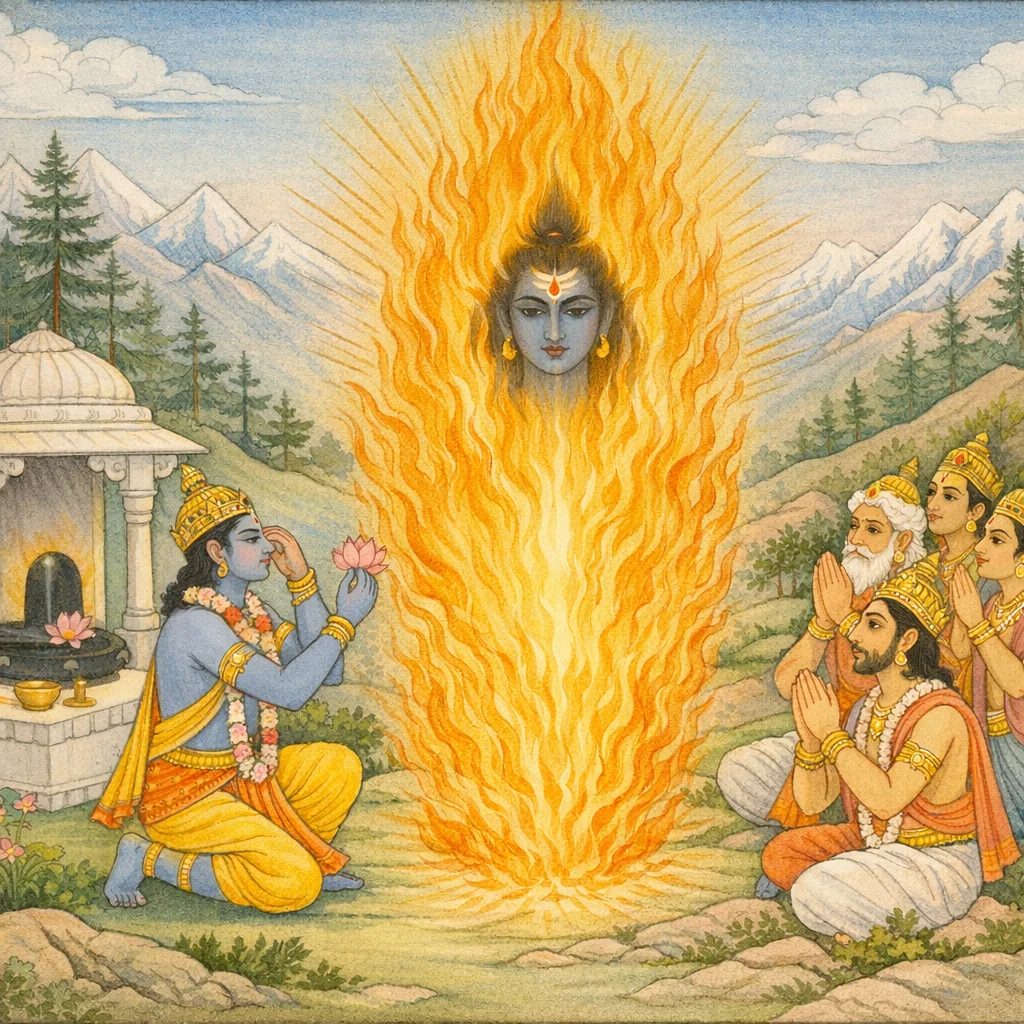
The rishis ask Suta how Vishnu obtained the Sudarshana Chakra from Maheshvara. Suta recounts a calamity: the Daityas ravage creation, and the defeated Devas take refuge in Vishnu, praising him as their sole protector. Vishnu declares that Jalandhara can be destroyed only with the dreadful rathāṅga forged by Tripurāri (Shiva), and resolves to approach Mahadeva. On a holy Himalayan peak, Vishnu installs a splendid linga made by Vishvakarma, performs fragrant abhiṣeka and offerings, conducts agni-hotra with the bhavādya names, and recites the extensive Shiva Sahasranama. Shiva tests him by hiding one lotus; unwilling to break his vow of complete offering, Vishnu plucks out his own eye to replace the missing flower, earning the name Padmākṣa. Shiva then manifests in a blazing, fearsome form, affirms the divine purpose, grants Vishnu the sun-bright Sudarshana Chakra, and teaches that aśānti and misplaced kṣamā in battle undermine dharma. Shiva bestows further boons, foretells Vishnu’s honor among gods and asuras, and predicts harmony through Uma/Haimavati. The chapter ends with a phalaśruti: hearing or reciting this sahasranama and worshiping thereby yields vast merit like great yajñas and leads to the highest goal (paramā gati), preparing the next account of empowered action against Jalandhara.
Shlokas
Verse 1
इति श्रीलिङ्गमहापुराणे पूर्वभागे जलन्धरवधो नाम सप्तनवतितमो ऽध्यायः ऋषय ऊचुः कथं देवेन वै सूत देवदेवान्महेश्वरात् सुदर्शनाख्यं वै लब्धं वक्तुमर्हसि विष्णुना
Thus, in the Śrī Liṅga Mahāpurāṇa, in the Pūrvabhāga, begins the ninety-seventh chapter called “The Slaying of Jalandhara.” The sages said: “O Sūta, please tell us—how did Lord Viṣṇu obtain the discus named Sudarśana from Maheśvara, the God of gods?”
Verse 2
सूत उवाच देवानाम् असुरेन्द्राणाम् अभवच्च सुदारुणः सर्वेषामेव भूतानां विनाशकरणो महान्
Sūta said: Between the Devas and the lords of the Asuras there arose a most dreadful conflict, a mighty cause of destruction for all beings. Yet, for the discerning, even such dissolution reveals the Lord (Pati) as the hidden governor of sṛṣṭi and pralaya, while bound souls (paśu) suffer under the force of their bonds (pāśa).
Verse 3
ते देवाः शक्तिमुशलैः सायकैर्नतपर्वभिः प्रभिद्यमानाः कुन्तैश् च दुद्रुवुर्भयविह्वलाः
Struck and pierced by javelins, clubs, and arrows whose joints were bent, and also by spears, the Devas—overwhelmed by fear—fled in confusion. Thus the bound souls (paśu), when assailed by the forces of bondage (pāśa), lose steadiness until they take refuge in the Lord (Pati), Śiva.
Verse 4
पराजितास्तदा देवा देवदेवेश्वरं हरिम् प्रणेमुस्तं सुरेशानं शोकसंविग्नमानसाः
Then the Devas, having been defeated, bowed down to Hari—the Lord of the lords of the gods, the sovereign of the Suras—their minds shaken and distressed with grief.
Verse 5
तान् समीक्ष्याथ भगवान् देवदेवेश्वरो हरिः प्रणिपत्य स्थितान्देवान् इदं वचनमब्रवीत्
Seeing them, the Blessed Lord Hari—sovereign of the gods—first bowed in reverence to the assembled Devas standing there, and then spoke these words to them.
Verse 6
वत्साः किमिति वै देवाश् च्युतालङ्कारविक्रमाः समागताः ससंतापा वक्तुमर्हथ सुव्रताः
“Dear ones, why have you gods come here, your ornaments and heroic splendor fallen away, arriving in evident distress? O you of noble vows, tell me the reason.”
Verse 7
तस्य तद्वचनं श्रुत्वा तथाभूताः सुरोत्तमाः प्रणम्याहुर्यथावृत्तं देवदेवाय विष्णवे
Hearing his words, the foremost of the gods—thus instructed—bowed down and then reported everything exactly as it had occurred to Viṣṇu, the God of gods.
Verse 8
भगवन्देवदेवेश विष्णो जिष्णो जनार्दन दानवैः पीडिताः सर्वे वयं शरणमागताः
“O Blessed Lord, Lord of the gods—O Viṣṇu, unconquered Jişṇu, Janārdana—oppressed by the Dānavas, we all have come to you for refuge.”
Verse 9
त्वमेव देवदेवेश गतिर्नः पुरुषोत्तम त्वमेव परमात्मा हि त्वं पिता जगतामपि
“You alone, O Lord of the gods, are our refuge, O Supreme Person. You alone are indeed the Supreme Self, and you are also the Father of all the worlds.”
Verse 10
त्वमेव भर्ता हर्ता च भोक्ता दाता जनार्दन हन्तुमर्हसि तस्मात्त्वं दानवान्दानवार्दन
You alone are the sustainer, the withdrawer, the enjoyer, and the giver, O Janārdana. Therefore, O crusher of the Dānavas, you are indeed fit to slay the Dānavas—do so.
Verse 11
दैत्याश् च वैष्णवैर्ब्राह्मै रौद्रैर्याम्यैः सुदारुणैः कौबेरैश्चैव सौम्यैश् च नैरृत्यैर्वारुणैर्दृढैः
And the Daityas were confronted—by the Vaiṣṇava forces, by the Brahmā-born hosts, by the Rudra-hosts, by the fiercely terrible Yama-forces, by the gentle yet mighty Kaubera hosts, and also by the steadfast Nairṛta and Vāruṇa forces.
Verse 12
वायव्यैश् च तथाग्नेयैर् ऐशानैर् वार्षिकैः शुभैः सौरै रौद्रैस् तथा भीमैः कम्पनैर् जृम्भणैर् दृढैः
And tremors arose from the quarters—of Vāyu, of Agni, and of Īśāna—along with auspicious seasonal (rain-bearing) signs, and solar and Rudra-related portents; fearful, firm convulsions and heaving upheavals—such were the omens observed.
Verse 13
अवध्या वरलाभात्ते सर्वे वारिजलोचन सूर्यमण्डलसम्भूतं त्वदीयं चक्रम् उद्यतम्
O lotus-eyed one, by the boon you have obtained they are all inviolable—incapable of being slain. Yet your discus, sprung from the solar orb, has been raised. Even so, before Pati, the Lord, and His ordinance, no weapon can overstep dharma.
Verse 14
कुण्ठितं हि दधीचेन च्यावनेन जगद्गुरो दण्डं शार्ङ्गं तवास्त्रं च लब्धं दैत्यैः प्रसादतः
O World-Teacher, by the favor once granted, the Daityas obtained your weapons—your staff, the Śārṅga bow, and other arms—after Dadhīci and Cyāvana had rendered them blunted and ineffective.
Verse 15
पुरा जलन्धरं हन्तुं निर्मितं त्रिपुरारिणा रथाङ्गं सुशितं घोरं तेन तान् हन्तुम् अर्हसि
Formerly, to slay Jalandhara, Tripurari (Lord Shiva) fashioned a dreadful, razor-sharp discus. With that very weapon, you are fit to strike down those foes.
Verse 16
तस्मात्तेन निहन्तव्या नान्यैः शस्त्रशतैरपि ततो निशम्य तेषां वै वचनं वारिजेक्षणः
“Therefore he must be slain by that very means—by no other, not even by hundreds of weapons.” Having heard those words of theirs, the lotus‑eyed one reflected and accepted the counsel.
Verse 17
वाचस्पतिमुखानाह स हरिश्चक्रभृत् स्वयम् श्रीविष्णुर् उवाच भोभो देवा महादेवं सर्वैर् देवैः सनातनैः
Then Hari, the wielder of the discus—Śrī Viṣṇu himself—addressed the gods, beginning with Bṛhaspati: “O gods! Let all the eternal deities together approach Mahādeva.”
Verse 18
सम्प्राप्य सांप्रतं सर्वं करिष्यामि दिवौकसाम् देवा जलन्धरं हन्तुं निर्मितं हि पुरारिणा
“Having now obtained full knowledge of everything, I shall accomplish what must be done for the dwellers of heaven: the Devas are to slay Jalandhara—for he has indeed been fashioned by the Enemy of the Three Cities (Śiva).”
Verse 19
लब्ध्वा रथाङ्गं तेनैव निहत्य च महासुरान् सर्वान्धुन्धुमुखान्दैत्यान् अष्टषष्टिशतान् सुरान्
Having obtained the discus (rathāṅga), and using that very weapon, he struck down the great Asuras—indeed all the Daityas of the Dhundhumukha host—amounting to eight thousand six hundred in number.
Verse 20
सबान्धवान्क्षणादेव युष्मान् संतारयाम्यहम् सूत उवाच एवम् उक्त्वा सुरश्रेष्ठान् सुरश्रेष्ठमनुस्मरन्
“Together with your kinsmen, I shall ferry you across—this very instant.” Sūta said: Having spoken thus to those foremost among the gods, he then remembered within his heart the Foremost of the gods—Śiva.
Verse 21
सुरश्रेष्ठस्तदा श्रेष्ठं पूजयामास शङ्करम् लिङ्गं स्थाप्य यथान्यायं हिमवच्छिखरे शुभे
Then the foremost among the Devas worshipped the Supreme Lord Śaṅkara in the proper ritual manner, having duly installed the Liṅga upon an auspicious peak of Himavat.
Verse 22
मेरुपर्वतसंकाशं निर्मितं विश्वकर्मणा त्वरिताख्येन रुद्रेण रौद्रेण च जनार्दनः
Resembling Mount Meru, it was fashioned by Viśvakarman; and Janārdana (Viṣṇu), together with the Rudra called Tvarita and the fierce Raudra form, brought it forth in swift potency.
Verse 23
स्नाप्य सम्पूज्य गन्धाद्यैर् ज्वालाकारं मनोरमम् तुष्टाव च तदा रुद्रं सम्पूज्याग्नौ प्रणम्य च
Having bathed the sacred emblem and worshipped it well with fragrances and other offerings, beholding the delightful flame-formed manifestation, he then praised Rudra; and after duly worshipping Agni, he bowed down in reverence.
Verse 24
देवं नाम्नां सहस्रेण भवाद्येन यथाक्रमम् पूजयामास च शिवं प्रणवाद्यं नमो ऽन्तकम्
He worshipped Lord Śiva in due order with the thousand divine Names beginning with “Bhava”; beginning with the praṇava “Oṁ”, he offered obeisance to the Ender of death.
Verse 25
देवं नाम्नां सहस्रेण भवाद्येन महेश्वरम् प्रतिनाम स पद्मेन पूजयामास शङ्करम्
With a thousand divine names—beginning with “Bhava”—he worshipped Mahādeva, the Great Lord; for each name he offered a lotus, and thus adored Śaṅkara.
Verse 26
अग्नौ च नामभिर् देवं भवाद्यैः समिदादिभिः स्वाहान्तैर्विधिवद्धुत्वा प्रत्येकमयुतं प्रभुम्
Then, into the sacred fire, one should duly offer oblations, invoking the Lord with names beginning with “Bhava”; using fuel-sticks and the proper materials, and ending each offering with “svāhā,” one should make ten thousand oblations for each name unto that sovereign Lord (Pati).
Verse 27
तुष्टाव च पुनः शंभुं भवाद्यैर्भवमीश्वरम् श्रीविष्णुरुवाच भवः शिवो हरो रुद्रः पुरुषः पद्मलोचनः
Then Śrī Viṣṇu again praised Śambhu—Bhava, the Lord—uttering His primordial names: “You are Bhava, Śiva, Hara, Rudra, the Supreme Person, the Lotus‑eyed One.”
Verse 28
अर्थितव्यः सदाचारः सर्वशंभुर्महेश्वरः ईश्वरः स्थाणुरीशानः सहस्राक्षः सहस्रपात्
He is the One to be entreated and sought with devotion; He is Right Conduct itself. He is all-auspicious Śambhu, the Great Lord—Īśvara, the immovable Pillar (Sthāṇu), and Īśāna, the sovereign ruler. He is the Thousand‑eyed and the Thousand‑footed Lord, pervading all as Pati over every paśu (bound soul).
Verse 29
वरीयान् वरदो वन्द्यः शङ्करः परमेश्वरः गङ्गाधरः शूलधरः परार्थैकप्रयोजनः
He is the Most Excellent; the Bestower of boons; worthy of all reverence—Śaṅkara, the Supreme Lord. He bears the Gaṅgā and wields the trident; his single purpose is the welfare of others—the liberation of bound souls through grace.
Verse 30
सर्वज्ञः सर्वदेवादिगिरिधन्वा जटाधरः चन्द्रापीडश्चन्द्रमौलिर् विद्वान्विश्वामरेश्वरः
He is the All-knowing (Sarvajña); the bow-bearing Lord of the primordial gods and the mountains; the matted-haired One (Jaṭādhara); He whose crest is the Moon and whose diadem is the Moon; the perfectly Wise; and the sovereign Lord of the entire cosmos and of all the immortals.
Verse 31
वेदान्तसारसंदोहः कपाली नीललोहितः ध्यानाधारोपरिच्छेद्यो गौरीभर्ता गणेश्वरः
He is the gathered essence of Vedānta; the Skull-bearer (Kapālī); the Blue-and-Ruddy Lord (Nīlalohita). He is the unbroken support of yogic contemplation, beyond limitation. He is the consort of Gaurī and the Lord of the Gaṇas.
Verse 32
अष्टमूर्तिर्विश्वमूर्तिस् त्रिवर्गः स्वर्गसाधनः ज्ञानगम्यो दृढप्रज्ञो देवदेवस्त्रिलोचनः
He is Aṣṭamūrti, Lord of the eightfold manifestations, the very form of the universe. He is the ground of the three aims of life (Trivarga) and the sure means to attain heaven. He is reached through true knowledge, steadfast in perfect wisdom—He is the God of gods, the Three‑eyed (Trilocana) who beholds all.
Verse 33
वामदेवो महादेवः पाण्डुः परिदृढो दृढः विश्वरूपो विरूपाक्षो वागीशः शुचिरन्तरः
He is Vāmadeva, the auspicious and beneficent Lord; He is Mahādeva, the Supreme Great God. He is Pāṇḍu, the pure and radiant One—perfectly steadfast and unshakable. He is Viśvarūpa, whose form is the whole universe, and also Virūpākṣa, the Three‑eyed Lord whose gaze transcends ordinary form. He is Vāgīśa, sovereign of sacred speech, ever inwardly pure, dwelling within all beings.
Verse 34
सर्वप्रणयसंवादी वृषाङ्को वृषवाहनः ईशः पिनाकी खट्वाङ्गी चित्रवेषश्चिरन्तनः
He speaks with universal affection; His emblem is the Bull and His mount is the Bull. He is Īśa, the sovereign Lord; Pinākī, bearer of the bow Pināka; Khaṭvāṅgī, wielder of the khaṭvāṅga staff. Wondrous in attire—He, the Eternal One.
Verse 35
तमोहरो महायोगी गोप्ता ब्रह्माङ्गहृज्जटी कालकालः कृत्तिवासाः सुभगः प्रणवात्मकः
He is the Remover of darkness; the Great Yogi; the Protector; the matted‑haired Lord who bears Brahmā’s mark upon His body and within His heart; the Death of Death; the One clad in skin; the Auspicious, Fortunate One; whose very essence is the sacred syllable Oṁ (Praṇava).
Verse 36
उन्मत्तवेषश् चक्षुष्यो दुर्वासाः स्मरशासनः दृढायुधः स्कन्दगुरुः परमेष्ठी परायणः
He is the One who wears the guise of divine madness; the auspicious vision itself; Durvāsā in form; the chastiser of Kāma; firm in weapon and resolve; the Guru of Skanda; the Supreme Ordainer; and the final Refuge of all.
Verse 37
अनादिमध्यनिधनो गिरिशो गिरिबान्धवः कुबेरबन्धुः श्रीकण्ठो लोकवर्णोत्तमोत्तमः
He is the One whose being is without beginning, middle, or end; the Lord of the mountains, the kinsman of the Mountain (Himālaya); the friend of Kubera; Śrīkaṇṭha, the auspicious‑throated Lord; the supreme excellence among all that the worlds praise and describe.
Verse 38
सामान्यदेवः कोदण्डी नीलकण्ठः परश्वधी विशालाक्षो मृगव्याधः सुरेशः सूर्यतापनः
He is the Deity present in all beings; the wielder of the bow Kodanda; Nīlakaṇṭha, the Blue‑throated Lord; the bearer of the axe; the Wide‑eyed One; the Hunter who subdues the wildness of beings; the Lord of the gods; and He whose splendor scorches like the sun.
Verse 39
धर्मकर्माक्षमः क्षेत्रं भगवान् भगनेत्रभित् उग्रः पशुपतिस् तार्क्ष्यः प्रियभक्तः प्रियंवदः
He is the Lord who makes Dharma and sacred action effective; He is the Kṣetra, the Field itself. He is Bhagavān, the slayer of Bhaga’s eye; the Fierce One; Paśupati, Lord of the bound souls; swift as Garuḍa; dearly loved by His devotees; and the One who speaks what is dear and gracious.
Verse 40
दाता दयाकरो दक्षः कपर्दी कामशासनः श्मशाननिलयः सूक्ष्मः श्मशानस्थो महेश्वरः
He is the Giver, compassion embodied, and the supremely capable One; Kapardī, wearer of matted locks; the Chastiser of Kāma (desire); He whose abode is the cremation-ground; the Subtle One; He who abides in the cremation-ground—Maheshvara, Mahādeva, the Great Lord (Pati) of all.
Verse 41
लोककर्ता भूतपतिर् महाकर्ता महौषधी उत्तरो गोपतिर्गोप्ता ज्ञानगम्यः पुरातनः
He is the Maker of the worlds, the Lord of beings (Bhūtapati), the Great Doer; He is the supreme healing herb itself. He is the Transcendent One, the Lord of the cows and the Protector; He is attainable through true knowledge, the Primordial Ancient (Pūrātana).
Verse 42
नीतिः सुनीतिः शुद्धात्मा सोमः सोमरतः सुखी सोमपो ऽमृतपः सोमो महानीतिर्महामतिः
He is Right Order itself and the Best of Right Order; He is the Pure-Souled. He is Soma—ever delighting in Soma—ever blissful. He is the Soma-drinker and the drinker of immortality; He is Soma indeed—of great governance and of vast, sovereign intelligence.
Verse 43
अजातशत्रुरालोकः संभाव्यो हव्यवाहनः लोककारो वेदकारः सूत्रकारः सनातनः
He is the One without any enemy; He is the very Light of awareness. He is worthy to be contemplated and relied upon; He is the carrier of the oblations (as the inner Fire). He is the Maker of the worlds, the Revealer of the Vedas, the Composer of the sacred aphorisms, and the Eternal One.
Verse 44
महर्षिः कपिलाचार्यो विश्वदीप्तिस्त्रिलोचनः पिनाकपाणिर् भूदेवः स्वस्तिदः स्वस्तिकृत्सदा
He is the Great Sage; the revered teacher Kapila; the all-illumining Light of the universe; the Three-Eyed Lord; the bearer of the bow Pināka; Bhūdeva, worshipped as the very ‘god of the earth’; the giver of auspiciousness; and ever the creator of well-being.
Verse 45
त्रिधामा सौभगः शर्वः सर्वज्ञः सर्वगोचरः ब्रह्मधृग् विश्वसृक् स्वर्गः कर्णिकारः प्रियः कविः
He is the Lord of the three abodes (Tridhāmā), the Auspicious One; Śarva, the destroyer of all impurity. He is omniscient and approachable by all. He upholds Brahman (the Veda and the supreme principle), brings forth the universe, and is Himself the heavenly state. He is Karṇikāra—radiant and in bloom; the Beloved; and the Poet-Seer who reveals sacred wisdom.
Verse 46
शाखो विशाखो गोशाखः शिवो नैकः क्रतुः समः गङ्गाप्लवोदको भावः सकलः स्थपतिः स्थिरः
He is Śākha and Viśākha, the many-branched One who spreads forth as protection; He is Gośākha, guardian of the herds. He is Śiva, the auspicious Lord, yet not confined to oneness alone. He is Kratu, the power of Vedic sacrifice, and Sama, the equal and impartial. He is the water of the Gaṅgā’s holy flood; He is Bhāva, the principle of Being; He is Sakala, the Whole; He is Sthapati, the divine Architect; and He is Sthira, the Unshakably Steady.
Verse 47
विजितात्मा विधेयात्मा भूतवाहनसारथिः सगणो गणकार्यश् च सुकीर्तिश् छिन्नसंशयः
He is the conqueror of the self (Vijitātmā), the perfectly disciplined Spirit (Vidheyātmā); the charioteer who directs the hosts of beings as His vehicle. Ever attended by His Gaṇas, He is the accomplisher of the Gaṇas’ works. Of auspicious fame, He cuts away doubt, removing the pāśa of uncertainty from the bound soul (paśu).
Verse 48
कामदेवः कामपालो भस्मोद्धूलितविग्रहः भस्मप्रियो भस्मशायी कामी कान्तः कृतागमः
He is Kāmadeva, the very divinity of desire, and Kāmapāla, the protector and governor of desire. His form is dusted with bhasma, the sacred ash; He loves ash and rests upon ash. He is the enjoyer who masters desire, the Beloved who enchants all hearts, and the Lord who established the Āgamas—authoritative Shaiva revelations guiding worship and liberation.
Verse 49
समायुक्तो निवृत्तात्मा धर्मयुक्तः सदाशिवः चतुर्मुखश्चतुर्बाहुर् दुरावासो दुरासदः
He is perfectly integrated in Yoga (Samāyukta), with the self turned back from worldly craving (Nivṛttātmā). Established in Dharma, He is Sadāśiva. Four-faced and four-armed, His abode is hard to reach, and He Himself is hard to approach—attainable only by the disciplined soul freed from bonds.
Verse 50
दुर्गमो दुर्लभो दुर्गः सर्वायुधविशारदः अध्यात्मयोगनिलयः सुतन्तुस्तन्तुवर्धनः
He is hard to approach and rarely attained; He is the very Fortress (Durgā) who bears beings beyond danger. Skilled in every divine weapon, He abides as the refuge of inner Yoga. He is the subtle thread that holds all, and the One who expands the threads of manifestation.
Verse 51
शुभाङ्गो लोकसारङ्गो जगदीशो ऽमृताशनः भस्मशुद्धिकरो मेरुर् ओजस्वी शुद्धविग्रहः
Auspicious-limbed, the antelope of the world’s essence—moving freely yet unattached within all beings; the Lord of the universe; the partaker of amṛta, the nectar of immortality. He purifies through sacred ash; like Meru, the immovable support; filled with spiritual vigor; and of perfectly pure form.
Verse 52
हिरण्यरेतास् तरणिर् मरीचिर् महिमालयः महाह्रदो महागर्भः सिद्धवृन्दारवन्दितः
He is Hiraṇyaretas, whose generative potency is golden and pure; He is Taraṇi, the inner Sun who carries beings across; He is Marīci, the radiant ray. He is Mahimālaya, the abode of supreme majesty; He is Mahāhrada, the vast sacred reservoir; He is Mahāgarbha, the great womb of manifestation. He is the One adored by hosts of Siddhas.
Verse 53
व्याघ्रचर्मधरो व्याली महाभूतो महानिधिः अमृताङ्गो ऽमृतवपुः पञ्चयज्ञः प्रभञ्जनः
He wears the tiger-skin; the Lord of serpentine power; the Great Elemental Reality and the vast Treasure of being. His limbs are deathless and His form is immortal. He is the very Fivefold Sacrifice, and the impetuous Wind that shatters all bonds.
Verse 54
पञ्चविंशतितत्त्वज्ञः पारिजातः परावरः सुलभः सुव्रतः शूरो वाङ्मयैकनिधिर्निधिः
He is the Knower of the twenty-five tattvas; the wish-fulfilling Pārijāta; the Lord who transcends both the higher and the lower. Easily attained by the devoted, steadfast in sacred vows, the heroic One—He is the single treasury of all sacred speech, and the Treasure itself.
Verse 55
वर्णाश्रमगुरुर्वर्णी शत्रुजिच्छत्रुतापनः आश्रमः क्षपणः क्षामो ज्ञानवानचलाचलः
He is the Guru who upholds and guides the disciplines of varṇa and āśrama, radiant in sacred observance. He conquers enemies and scorches hostility itself. He is the refuge of spiritual striving; He exhausts impurities, austere and lean through tapas, and is possessed of true knowledge—immovable, and yet the mover of the immovable.
Verse 56
प्रमाणभूतो दुर्ज्ञेयः सुपर्णो वायुवाहनः धनुर्धरो धनुर्वेदो गुणराशिर्गुणाकरः
He is the very ground of pramāṇa, valid knowledge itself, yet hard to comprehend; the noble Winged One, borne by the wind; the Bearer of the bow, the Knower of Dhanurveda; the totality of all qualities, and the very mine from which qualities arise.
Verse 57
अनन्तदृष्टिरानन्दो दण्डो दमयिता दमः अभिवाद्यो महाचार्यो विश्वकर्मा विशारदः
He whose vision is infinite is Bliss itself; He is the sacred Rod of discipline, the subduer, and self-restraint. He is worthy of reverent salutations, the Great Teacher; He is Viśvakarman, the All-fashioner, and the supremely skillful Master.
Verse 58
वीतरागो विनीतात्मा तपस्वी भूतभावनः उन्मत्तवेषः प्रच्छन्नो जितकामो जितप्रियः
Free from passion, humble in spirit, an austere ascetic and the sanctifier of all beings—He moves about in the guise of a madman, remaining concealed; He has conquered desire (kāma) and transcended attachment to what is dear.
Verse 59
कल्याणप्रकृतिः कल्पः सर्वलोकप्रजापतिः तपस्वी तारको धीमान् प्रधानप्रभुर् अव्ययः
He is auspicious by nature; Kalpa itself, the cosmic ordinance; Prajāpati, the Progenitor-Lord of all worlds; the supreme ascetic; Tāraka, who ferries beings across the ocean of saṃsāra; the all-wise; the Lord over Pradhāna (primordial Nature); and the Imperishable (Avyaya).
Verse 60
लोकपालो ऽन्तर्हितात्मा कल्पादिः कमलेक्षणः वेदशास्त्रार्थतत्त्वज्ञो नियमो नियमाश्रयः
He is the Protector of the worlds, whose Self is hidden beyond ordinary perception. He is the Beginning of the cosmic cycles, lotus-eyed; the knower of the true purport and reality (tattva) of the Vedas and the Śāstras. He is Discipline itself, and the very ground and refuge of all disciplines.
Verse 61
चन्द्रः सूर्यः शनिः केतुर् विरामो विद्रुमच्छविः भक्तिगम्यः परं ब्रह्म मृगबाणार्पणो ऽनघः
He is the Moon, the Sun, Saturn, and Ketu; He is Rest itself—the cessation of agitation. Coral-hued in radiance, He is attained through devotion alone. He is the Supreme Brahman, the stainless Lord, to whom even the hunter’s arrow-offering becomes an oblation.
Verse 62
अद्रिराजालयः कान्तः परमात्मा जगद्गुरुः सर्वकर्माचलस्त्वष्टा मङ्गल्यो मङ्गलावृतः
He whose abode is the lord of mountains is the Beloved; the Supreme Self and the Guru of the universe. He is the unmoving foundation of all actions, the Divine Fashioner. He is the Auspicious One, ever encompassed by auspiciousness.
Verse 63
महातपा दीर्घतपाः स्थविष्ठः स्थविरो ध्रुवः अहः संवत्सरो व्याप्तिः प्रमाणं परमं तपः
He is the Great Ascetic, whose austerity is long-enduring; the Most Massive, the Most Ancient, and the Steadfast. He is Day itself and the Year; all-pervasion, the true measure of all that is, and the supreme tapas—pure transformative power that burns bondage (pāśa) and reveals the Lord (Pati).
Verse 64
संवत्सरकरो मन्त्रः प्रत्ययः सर्वदर्शनः अजः सर्वेश्वरः स्निग्धो महारेता महाबलः
He is the maker of the cycle of years; He is the sacred Mantra itself. He is the ground of certitude and the One who beholds all. Unborn, the Lord of all, tender with grace—He is of mighty generative potency and of immeasurable strength.
Verse 65
योगी योग्यो महारेताः सिद्धः सर्वादिर् अग्निदः वसुर्वसुमनाः सत्यः सर्वपापहरो हरः
He is the Yogi, ever established in Yoga, and the One to be attained through Yoga. He is Mahāretāḥ, of inexhaustible divine potency; the Perfected One (Siddha); the First Cause of all. He bestows Agni—the sacred fire and its power—He is Vasu, the true wealth, and Vasumanas, the benevolent-minded. He is Truth itself, the remover of all sins, and Hara, the Lord who takes away bondage.
Verse 66
अमृतः शाश्वतः शान्तो बाणहस्तः प्रतापवान् कमण्डलुधरो धन्वी वेदाङ्गो वेदविन्मुनिः
He is Amṛta, the Deathless; Eternal; Peace itself. With arrows in His hand, He shines with divine prowess. Bearing the ascetic’s water-pot (kamaṇḍalu) and wielding the bow, He is Vedāṅga—the very limb of the Veda—the knower of the Veda; the supreme Sage, Pati, who frees the paśu from the pāśa of bondage.
Verse 67
भ्राजिष्णुर् भोजनं भोक्ता लोकनेता दुराधरः अतीन्द्रियो महामायः सर्वावासश्चतुष्पथः
He is the Radiant One; He is nourishment itself and also the enjoyer of it. He leads the worlds and is hard to overcome. Transcending the senses, He is Mahāmāyā, the Great Power; dwelling in all abodes, He is the Lord presiding at the fourfold crossroads of existence.
Verse 68
कालयोगी महानादो महोत्साहो महाबलः महाबुद्धिर् महावीर्यो भूतचारी पुरन्दरः
He is Kāla-yogī, the Yogi who masters Time; the Great Sound (Mahā-nāda). Of immense zeal and mighty strength, of vast intelligence and great heroism. He moves among all beings, and as Purandara, the “Destroyer of strongholds,” He shatters the fortified bonds of pāśa that confine the paśu.
Verse 69
निशाचरः प्रेतचारी महाशक्तिर् महाद्युतिः अनिर्देश्यवपुः श्रीमान् सर्वहार्यमितो गतिः
He is the Night-Wanderer and the Companion of spirits. He is of supreme Power (Mahāśakti) and vast radiance. His form is beyond definition; He is auspicious and resplendent. He is irresistible to all, and His course is immeasurable—Śiva, the Pati who transcends every limit.
Verse 70
बहुश्रुतो बहुमयो नियतात्मा भवोद्भवः ओजस्तेजो द्युतिकरो नर्तकः सर्वकामकः
He is the All-learnt One, manifold in form, and self-restrained. From Him arises bhava, the becoming of existence. He is strength and tejas, spiritual splendour, the maker of radiance; Nataraja, the Cosmic Dancer, who grants the fulfillment of all rightful desires.
Verse 71
नृत्यप्रियो नृत्यनृत्यः प्रकाशात्मा प्रतापनः बुद्धस्पष्टाक्षरो मन्त्रः सन्मानः सारसंप्लवः
He delights in the cosmic dance; He is the Dance within dance itself. His essence is pure Light; He kindles spiritual radiance. He is the Mantra whose syllables are lucidly grasped by awakened intelligence; the Giver of true honor; and the One who carries beings across the flood of samsaric existence to the very essence.
Verse 72
युगादिकृद् युगावर्तो गंभीरो वृषवाहनः इष्टो विशिष्टः शिष्टेष्टः शरभः शरभो धनुः
He is the Initiator of the yugas and the Power that turns the wheel of the ages. Profound and unfathomable, He rides the Bull, Vṛṣabha (Dharma). He is the Beloved and the Supreme Excellence, dear to the disciplined and revered by the righteous. He is Śarabha, mighty beyond measure, and He is the Bow—the force that bends and directs all energies toward the Lord, the Pati.
Verse 73
अपां निधिरधिष्ठानं विजयो जयकालवित् प्रतिष्ठितः प्रमाणज्ञो हिरण्यकवचो हरिः
He is the treasury of the waters and the very ground of support. He is Victory itself, the knower of the right moment for triumph. Ever firmly established, He knows the true measures—of reality and of rite. Clad in golden armour, Hari, dwelling as the Supreme Lord (Pati), protects all.
Verse 74
विरोचनः सुरगणो विद्येशो विबुधाश्रयः बालरूपो बलोन्माथी विवर्तो गहनो गुरुः
He is Virocana, the Radiant One; the very host of the Devas; the Lord of sacred knowledges and the refuge of the wise. He appears in youthful form, yet as the Overpowerer who shatters pride of strength. He is the mysterious Transformer and the Unfathomable—indeed, the Supreme Guru (Pati) who grants true knowledge, severing the pāśa of bondage from the paśu.
Verse 75
करणं कारणं कर्ता सर्वबन्धविमोचनः विद्वत्तमो वीतभयो विश्वभर्ता निशाकरः
He is the instrument and the supreme Cause, the Doer of all. He is the Liberator from every bondage (pāśa), the most eminent in wisdom, utterly fearless, the Sustainer of the universe, and Niśākara—the Bearer of the moon.
Verse 76
व्यवसायो व्यवस्थानः स्थानदो जगदादिजः दुन्दुभो ललितो विश्वो भवात्मात्मनि संस्थितः
He is Right Endeavour and the Power of Order; He bestows the true station (dharma and support) and is the Primal Source of the worlds. He is Dundubhi, the resonant drum of cosmic vibration, the Playful and the Beautiful; He is the Universe itself—Bhava, whose very Self stands established in the supreme Self.
Verse 77
वीरेश्वरो वीरभद्रो वीरहा वीरभृद् विराट् वीरचूडामणिर्वेत्ता तीव्रनादो नदीधरः
He is Vīreśvara, Lord of all heroic powers; Vīrabhadra, the auspicious Hero; the slayer of hostile forces; the bearer and protector of the valiant; Virāṭ, the all-pervading Cosmic Vastness. He is the crest-jewel of heroes and the Knower; His roar is intense; and He bears and governs the rivers—purifying the paśu and breaking the pāśa by His sovereign might as Pati.
Verse 78
आज्ञाधरस्त्रिशूली च शिपिविष्टः शिवालयः वालखिल्यो महाचापस् तिग्मांशुर् निधिर् अव्ययः
He is the Bearer of the divine command, the Trident-holder, the All-pervading One who has entered every form, the very Abode of auspiciousness. He is Vālakhilya, subtler than the subtle; the Great Archer; the One of sharp rays that burn away impurity; the Treasure of all perfections; and the Imperishable—Pati, ever untouched by the pāśa that bind the paśu.
Verse 79
अभिरामः सुशरणः सुब्रह्मण्यः सुधापतिः मघवान्कौशिको गोमान् विश्रामः सर्वशासनः
He is Abhirāma, the delight of all; Suśaraṇa, the sure refuge for the bound paśu; Subrahmaṇya, the benefactor of sacred wisdom and right dharma; Sudhāpati, Lord of the nectar of immortality. He is Maghavān, mighty and splendid; Kauśika, the sage-seer of inner light; Gomān, rich in the cows of dharma and abundance; Viśrāma, the resting-place where all beings find peace; and Sarvaśāsana, the sovereign ruler and ordainer of all laws.
Verse 80
ललाटाक्षो विश्वदेहः सारः संसारचक्रभृत् अमोघदण्डी मध्यस्थो हिरण्यो ब्रह्मवर्चसी
He whose brow bears the Eye—the Three‑eyed Lord; whose body is the universe; the very Essence; bearer of the wheel of saṃsāra; wielder of the unfailing rod of discipline; abiding in the midst as the inner Witness; golden in splendor; radiant with brahmanic spiritual lustre.
Verse 81
परमार्थः परमयः शम्बरो व्याघ्रको ऽनलः रुचिर् वररुचिर् वन्द्यो वाचस्पतिरहर्पतिः
He is the Supreme Truth and the Highest Reality; He is Śambara, the Tiger‑like One, and the Fire. He is the Radiant and the Most Radiant; the One worthy of reverence; the Lord of sacred speech; and the Lord of the day.
Verse 82
रविर्विरोचनः स्कन्धः शास्ता वैवस्वतो जनः युक्तिरुन्नतकीर्तिश् च शान्तरागः पराजयः
He is Ravi, the Sun who illumines; Virocana, the radiant One; Skandha, the mighty power that upholds and leads; Śāstā, the divine Ruler and Instructor; Vaivasvata, aligned with the solar order and the law of time; Jana, the Lord of beings; Yukti, the very principle of right discernment; Unnatakīrti, whose fame ever rises higher; Śāntarāga, whose passion is pacified into serenity; and Parājaya, the One for whom there is no defeat—who grants the bound soul (paśu) conquest over the fetter (pāśa).
Verse 83
कैलासपतिकामारिः सविता रविलोचनः विद्वत्तमो वीतभयो विश्वहर्ता निवारितः
He is the Lord of Kailāsa, the foe of Kāma; Savitṛ, the inner Sun, whose eyes are the Sun. He is supremely wise, utterly fearless, the withdrawer of the universe at dissolution, and the One who restrains and wards off evil and bondage.
Verse 84
नित्यो नियतकल्याणः पुण्यश्रवणकीर्तनः दूरश्रवा विश्वसहो ध्येयो दुःस्वप्ननाशनः
He is Eternal; His auspiciousness is unfailingly ordained. Hearing and chanting His holy names is itself meritorious. His fame reaches far; He bears the burden of the universe. He is to be meditated upon, and He destroys evil dreams—removing inauspicious signs and the fear they generate in the bound soul (paśu).
Verse 85
उत्तारको दुष्कृतिहा दुर्धर्षो दुःसहो ऽभयः अनादिर्भूर्भुवोलक्ष्मीः किरीटी त्रिदशाधिपः
He is the Deliverer who ferries beings beyond bondage; the Destroyer of demerit; the Unassailable and the Unendurable to the forces of ignorance; the Fearless Refuge. Beginningless is he—the very prosperity of earth and heaven—the Crowned Lord, the Sovereign of the gods.
Verse 86
विश्वगोप्ता विश्वभर्ता सुधीरो रुचिराङ्गदः जननो जनजन्मादिः प्रीतिमान्नीतिमान्नयः
He is the Protector of the universe and the Sustainer of the universe; the profoundly wise One, adorned with splendid armlets. He is the Progenitor—the very beginning of the births of beings; full of gracious love, established in dharma, and the One who leads (souls) by the right path.
Verse 87
विशिष्टः काश्यपो भानुर् भीमो भीमपराक्रमः प्रणवः सप्तधाचारो महाकायो महाधनुः
He is the Distinguished One; Kāśyapa; the radiant Sun; the Terrible One of dreadful might; Pranava (Oṁ) itself; the Lord whose conduct is sevenfold; vast-bodied; and the Wielder of the great bow—Mahādeva, the Pati who severs the pāśas binding the paśu.
Verse 88
जन्माधिपो महादेवः सकलागमपारगः तत्त्वातत्त्वविवेकात्मा विभूष्णुर् भूतिभूषणः
Mahādeva is the Lord of all birth and origination, the master who has crossed to the far shore of every Āgama. His very nature is discerning tattva from atattva, the real from the unreal. Adorned with divine powers, he is the ornament of all prosperity and sacred splendor.
Verse 89
ऋषिर्ब्राह्मणविज्जिष्णुर् जन्ममृत्युजरातिगः यज्ञो यज्ञपतिर्यज्वा यज्ञान्तो ऽमोघविक्रमः
He is the Seer and the knower of Brahman; the ever-victorious One who transcends birth, death, and decay. He is the very Sacrifice, the Lord of sacrifice and the sacrificer; the consummation of all rites—whose stride and power never fail.
Verse 90
महेन्द्रो दुर्भरः सेनी यज्ञाङ्गो यज्ञवाहनः पञ्चब्रह्मसमुत्पत्तिर् विश्वेशो विमलोदयः
He is Mahendra, the supreme lordly power; the Unassailable whom none can overcome; the Commander of hosts. He is the very limb of the sacrifice and the Bearer who carries the yajña. From Him arises the Pañcabrahma—the five sacred aspects of Śiva. He is Viśveśa, Lord of the universe, whose stainless manifestation dawns in purity.
Verse 91
आत्मयोनिर् अनाद्यन्तः षड्विंशत्सप्तलोकधृक् गायत्रीवल्लभः प्रांशुर् विश्वावासः प्रभाकरः
He is Ātmayoni, Self-born, without beginning or end; the Sustainer of the seven worlds and the twenty-six tattvas. Beloved of Gāyatrī, lofty and exalted, the very abode of the universe, He is Prabhākara, the Maker of light.
Verse 92
शिशुर्गिरिरतः सम्राट् सुषेणः सुरशत्रुहा अमोघो ऽरिष्टमथनो मुकुन्दो विगतज्वरः
He is the Ever-Young One; He who delights upon the mountain; the Sovereign Emperor; Suṣeṇa of the noble host; the Slayer of the enemies of the gods. He is Amogha, the Unfailing Lord; the Destroyer of misfortune; Mukunda, the Giver of liberation; and the One free from all fever, who removes the burning afflictions that bind the paśu.
Verse 93
स्वयंज्योतिर् अनुज्योतिर् आत्मज्योतिर् अचञ्चलः पिङ्गलः कपिलश्मश्रुः शास्त्रनेत्रस् त्रयीतनुः
He is self-luminous; the Light that illumines all other lights; the inner Light of the Self. Unwavering and immovable, tawny-hued, with tawny beard, His eyes are the śāstras and His very body is the Vedic Triad, the three Vedas. Thus Pati, the Lord beyond pāśa, is revealed to the paśu as pure consciousness.
Verse 94
ज्ञानस्कन्धो महाज्ञानी निरुत्पत्तिर् उपप्लवः भगो विवस्वानादित्यो योगाचार्यो बृहस्पतिः
He is the very mass of Knowledge, the Great Knower; unborn and untouched by upheaval. He is Bhaga, the Dispenser of divine fortune; Vivasvān, the radiant Sun, the Āditya. He is the Master of Yoga, and Bṛhaspati—the sacred wisdom that guides all.
Verse 95
उदारकीर्तिर् उद्योगी सद्योगी सदसन्मयः नक्षत्रमाली राकेशः साधिष्ठानः षडाश्रयः
He whose fame is vast and exalted; the ever-active One; the perfect Yogi; He who pervades both being and non-being. Garlanded with the stars; Lord of the night, the Moon; firmly established as the inner foundation; and the refuge of the sixfold paths of existence.
Verse 96
पवित्रपाणिः पापारिर् मणिपूरो मनोगतिः हृत्पुण्डरीकमासीनः शुक्लः शान्तो वृषाकपिः
He whose hands are pure and sanctifying; the foe of sin; the indweller of Maṇipūra, moving swifter than thought. Seated in the lotus of the heart; radiant, white with purity; perfectly tranquil—He is Vṛṣākapi, the Lord who upholds dharma and awakens the paśu toward liberation.
Verse 97
विष्णुर्ग्रहपतिः कृष्णः समर्थो ऽनर्थनाशनः अधर्मशत्रुरक्षय्यः पुरुहूतः पुरुष्टुतः
He is Viṣṇu; Lord of the planets; the Dark-hued One; all-capable and the destroyer of misfortune. Foe of adharma, imperishable, invoked by many and praised by all—thus the Supreme Pati who loosens the pāśa-bonds of the paśu.
Verse 98
ब्रह्मगर्भो बृहद्गर्भो धर्मधेनुर्धनागमः जगद्धितैषी सुगतः कुमारः कुशलागमः
He is the Womb of Brahmā and the Vast Cosmic Womb; the Cow of Dharma and the source from which wealth and right means arise. He seeks the welfare of the worlds and is of auspicious course. Ever-youthful, He brings well-being and reveals the paths of true spiritual welfare.
Verse 99
हिरण्यवर्णो ज्योतिष्मान् नानाभूतधरो ध्वनिः अरोगो नियमाध्यक्षो विश्वामित्रो द्विजोत्तमः
He is golden-hued and radiant with spiritual splendor; He bears and sustains the manifold orders of beings, and He is the primal Sound. Free from all affliction, He presides over the sacred disciplines (niyamas). He is the inner guide of seers like Viśvāmitra, and the supreme among the twice-born (dvija).
Verse 100
बृहज्ज्योतिः सुधामा च महाज्योतिरनुत्तमः मातामहो मातरिश्वा नभस्वान् नागहारधृक्
He is the Vast Light and the abode of ambrosial splendour—the supreme, unsurpassed Great Light. He is the primeval Grandsire; Mātariśvan, the life-breath moving within all; Nabhasvān, the cosmic wind; and the bearer of the serpent-garland. He is Śiva, the Pati, who loosens the pāśa that bind the paśu.
Verse 101
पुलस्त्यः पुलहो ऽगस्त्यो जातूकर्ण्यः पराशरः निरावरणधर्मज्ञो विरिञ्चो विष्टरश्रवाः
Pulastya, Pulaha, Agastya, Jātūkarṇya, and Parāśara—together with Nirāvaraṇa, knower of Dharma without obstruction, and Viriñca (Brahmā), and Viṣṭaraśravā—are counted among the venerable seers, famed for unobstructed discernment of sacred law, aligned with the Pati whose Liṅga is the mark of the supreme Reality.
Verse 102
आत्मभूर् अनिरुद्धो ऽत्रिज्ञानमूर्तिर् महायशाः लोकचूडामणिर्वीरः चण्डसत्यपराक्रमः
He is Self-born (Ātmabhū) and irresistible (Aniruddha); His very form is knowledge beyond the threefold limitation. Vast in glory, He is the crest-jewel of the worlds—heroic, fierce, and of unwavering might grounded in truth.
Verse 103
व्यालकल्पो महाकल्पो महावृक्षः कलाधरः अलंकरिष्णुस् त्वचलो रोचिष्णुर्विक्रमोत्तमः
He is Vyālakalpa, the measure of time that contains even the most formidable powers; He is the Great Aeon itself. He stands as the mighty cosmic tree, the bearer of all divine phases and energies (Kalādhara). He adorns and sanctifies all, the unmoving Absolute; ever-radiant, He is supreme in valour—the Pati who, by sovereign might, transcends every pāśa that binds the paśu.
Verse 104
आशुशब्दपतिर्वेगी प्लवनः शिखिसारथिः असंसृष्टो ऽतिथिः शक्रः प्रमाथी पापनाशनः
He is the Lord of the swift-sounding mantra, impetuous and rapid; the one who carries beings across saṃsāra; the charioteer of the Fire-born, Skanda. Untainted by contact, He is the Atithi, the ever-arriving Guest within all hearts; the mighty ruler, subduer of hostile forces, and destroyer of sin—Śiva, the Pati who loosens the pāśa binding the paśu.
Verse 105
वसुश्रवाः कव्यवाहः प्रतप्तो विश्वभोजनः जर्यो जराधिशमनो लोहितश् च तनूनपात्
He is Vasuśravā, whose renown is a treasure; Kavyavāha, bearer of offerings to the Ancestors; Pratप्तa, the One who blazes with intense heat; Viśvabhojana, the Sustainer who nourishes the whole universe. He is Jarya, the Ancient; Jarādhiśamana, the Remover of decay and senescence; Lohita, the Ruddy Lord of fiery splendor; and Tanūnapāt, the self-born Fire arising from His own being.
Verse 106
पृषदश्वो नभोयोनिः सुप्रतीकस् तमिस्रहा निदाघस्तपनो मेघः पक्षः परपुरंजयः
He is Pṛṣadaśva, swift as the dappled steed; Nabhoyoni, the womb of the sky, source of all vastness; Supratīka, of auspicious form and perfect emblem. He is the dispeller of darkness, the scorching heat of summer, the blazing Sun, and the rain-bearing cloud. He is the wing that carries beings across, and the conqueror of hostile strongholds—Śiva, the Pati who overcomes every pāśa that binds the paśu.
Verse 107
मुखानिलः सुनिष्पन्नः सुरभिः शिशिरात्मकः वसंतो माधवो ग्रीष्मो नभस्यो बीजवाहनः
He is Mukhānila, the life-breath flowing from the mouth; Suniṣpanna, perfectly manifested; Surabhi, fragrant; Śiśirātmaka, cooling in nature. He is Spring and Mādhava, Summer and Nabhasya (the rainy season/month), and Bījavāhana, the Bearer of seed—carrying within all beings the potency of creation.
Verse 108
अङ्गिरा मुनिरात्रेयो विमलो विश्ववाहनः पावनः पुरुजिच्छक्रस् त्रिविद्यो नरवाहनः
He is Aṅgiras; the Sage (Muni); Ātreya; Vimala, the Stainless One; Viśvavāhana, the Bearer of the universe; Pāvana, the Purifier; Purujicchākra, Conqueror of many, Lord of Indra-like might; Trividya, Knower of the three Vedas; and Naravāhana, the Bearer of humankind—Pati who uplifts the paśu-souls beyond pāśa-bondage.
Verse 109
मनो बुद्धिरहङ्कारः क्षेत्रज्ञः क्षेत्रपालकः तेजोनिधिर् ज्ञाननिधिर् विपाको विघ्नकारकः
He is Mind (Manas), Intellect (Buddhi), and the sense of “I” (Ahaṅkāra). He is Kṣetrajña, Knower of the field (the embodied soul), and also Kṣetrapālaka, Guardian of the field (the Lord who governs embodiment). He is Tejonidhi and Jñānanidhi—the treasury of divine radiance and the treasury of liberating knowledge. He is Vipāka, the ripening of karma into its fruits, and Vighnakāraka, the Causer of obstacles—restraining the paśu bound by pāśa and turning it toward the Pati.
Verse 110
अधरो ऽनुत्तरो ज्ञेयो ज्येष्ठो निःश्रेयसालयः शैलो नगस्तनुर्देहो दानवारिररिन्दमः
He is the Lower and yet the Unsurpassed—know Him as the Supreme; the Most Ancient, the Abode of final beatitude (niḥśreyasa). He is the Mountain and the Lord of mountains; the very Body and embodied form; the foe of the Dānavas and the subduer of enemies.
Verse 111
चारुधीर् जनकश्चारुविशल्यो लोकशल्यकृत् चतुर्वेदश्चतुर्भावश् चतुरश्चतुरप्रियः
His intellect is auspicious and radiant; the universal Progenitor; the beautiful Healer who removes pain; the One who draws forth the thorn of suffering from the worlds. He is the essence of the Four Vedas; He manifests as the fourfold states of being; He is supremely wise and skilful; and He delights in the sacred quaternity—upholding the fourfold order that leads the bound soul (paśu) toward the Lord (Pati).
Verse 112
आम्नायो ऽथ समाम्नायस् तीर्थदेवशिवालयः बहुरूपो महारूपः सर्वरूपश् चराचरः
He is the revealed sacred tradition (Āmnāya) and its complete transmission (Samāmnāya); He is the deity of the tīrthas and the very abode of Śiva (Śivālaya). Multiform and of the supreme Form, He becomes all forms—both the moving and the unmoving universe.
Verse 113
न्यायनिर्वाहको न्यायो न्यायगम्यो निरञ्जनः सहस्रमूर्धा देवेन्द्रः सर्वशस्त्रप्रभञ्जनः
He is the Upholder of justice and the very Principle of justice; He is attainable through righteousness, stainless and untouched. Thousand-headed, the Lord of the gods, He shatters the force of every weapon.
Verse 114
मुण्डो विरूपो विकृतो दण्डी दान्तो गुणोत्तमः पिङ्गलाक्षो ऽथ हर्यक्षो नीलग्रीवो निरामयः
He is Muṇḍa, the Shaven-headed One; the One of awe-inspiring form, transcendent beyond ordinary appearances; the Staff-bearer (daṇḍin), the self-restrained, the supreme among the virtuous. His eyes are tawny; then again, His gaze is green-gold; His throat is dark-blue, and He is the pure Lord who dispels disease.
Verse 115
सहस्रबाहुः सर्वेशः शरण्यः सर्वलोकभृत् पद्मासनः परं ज्योतिः परावरं परं फलम्
He is the Thousand-armed One, the Lord of all, the Refuge of all, and the Sustainer of every world. Seated upon the lotus-seat, He is the Supreme Light—beyond both the higher and the lower—and the Highest Fruit, the final liberation, for the bound soul.
Verse 116
पद्मगर्भो महागर्भो विश्वगर्भो विचक्षणः परावरज्ञो बीजेशः सुमुखः सुमहास्वनः
He is the Lotus-wombed One, the Great Womb, the Womb of the universe, and the All-discerning. He knows the higher and the lower realities, is the Lord of the Seed—the primal causal source—has an auspicious countenance, and resounds with a supremely mighty, sacred sound.
Verse 117
देवासुरगुरुर्देवो देवासुरनमस्कृतः देवासुरमहामात्रो देवासुरमहाश्रयः
He is the Deva, the divine Lord, the Guru of both gods and asuras, revered by both. He is the great ministerial power for gods and asuras alike, and the supreme refuge upon whom both depend.
Verse 118
देवादिदेवो देवर्षिदेवासुरवरप्रदः देवासुरेश्वरो दिव्यो देवासुरमहेश्वरः
He is the God of gods, the divine seer among the gods, the bestower of boons upon Devas and Asuras alike. He is the sovereign Lord of Devas and Asuras—transcendent and radiant—Mahādeva, the Great Lord. As Pati, the Lord, he alone dispenses grace and restraint, binding and liberating the paśus according to dharma.
Verse 119
सर्वदेवमयो ऽचिन्त्यो देवतात्मात्मसंभवः ईड्यो ऽनीशः सुरव्याघ्रो देवसिंहो दिवाकरः
He is the One who contains all the gods within Himself, the Unthinkable beyond mind. He is the very Self of the deities and self-born as the inner Self. He is worthy of praise—unruled by any other—lion among the gods, tiger among the celestials, and radiant like the sun.
Verse 120
विबुधाग्रवरश्रेष्ठः सर्वदेवोत्तमोत्तमः शिवज्ञानरतः श्रीमान् शिखिश्रीपर्वतप्रियः
He is the foremost among the best of the gods, the Supreme above all deities. Ever absorbed in the knowledge of Śiva-tattva, the auspicious and radiant Lord is beloved of the glorious mountain Śikhī.
Verse 121
जयस्तंभो विशिष्टम्भो नरसिंहनिपातनः ब्रह्मचारी लोकचारी धर्मचारी धनाधिपः
He is the Pillar of Victory, the peerless and unsurpassed Support; the One who brought down Narasiṃha; the brahmacārin who moves among the worlds; the One who walks the path of Dharma; and the Lord of wealth—bestowing prosperity while remaining sovereign over all possessions.
Verse 122
नन्दी नन्दीश्वरो नग्नो नग्नव्रतधरः शुचिः लिङ्गाध्यक्षः सुराध्यक्षो युगाध्यक्षो युगावहः
He is Nandī, the Lord of Nandī. He is the unclad ascetic, bearer of the vow of nakedness, and perfectly pure. He is the presiding Lord of the Liṅga, the Lord over the Devas, the overseer of the Yugas, and the One who brings the Yugas into manifestation and onward flow.
Verse 123
स्ववशः सवशः स्वर्गः स्वरः स्वरमयस्वनः बीजाध्यक्षो बीजकर्ता धनकृद् धर्मवर्धनः
He is self-ruled, ever abiding in His own power, and He brings all under His dominion. He is Heaven itself, the primordial tone, and the sound woven of all tones. He presides over the seed and is the maker of the seed; He grants prosperity and increases Dharma.
Verse 124
दंभो ऽदम्भो महादंभः सर्वभूतमहेश्वरः श्मशाननिलयस्तिष्यः सेतुरप्रतिमाकृतिः
He is Dambha and also Adambha; He is the Great Dambha. He is Maheśvara, the Supreme Lord of all beings. He abides in the cremation-ground; He is Tiṣya; and He is Setu—the Bridge of incomparable form.
Verse 125
लोकोत्तरस्फुटालोकस् त्र्यंबको नागभूषणः अन्धकारिर्मखद्वेषी विष्णुकन्धरपातनः
He is the Transcendent One, whose radiance shines as the clear light beyond all worlds; the Three‑eyed Lord Tryambaka, adorned with serpents. He is the slayer of Andhaka, the foe of arrogant sacrificial pride, and the One who brought down Vishnu’s neck—humbling even the Preserver when dharma is veiled.
Verse 126
वीतदोषो ऽक्षयगुणो दक्षारिः पूषदन्तहृत् धूर्जटिः खण्डपरशुः सकलो निष्कलो ऽनघः
He is free from all defects, endowed with imperishable excellences; the foe of Dakṣa, who tore out Pūṣan’s teeth. He is Dhūrjaṭi with matted locks, the wielder of the broken axe. He is both with form (Sakala) and beyond form (Niṣkala), the sinless Lord—Pati who frees the paśu from pāśa.
Verse 127
आधारः सकलाधारः पाण्डुराभो मृडो नटः पूर्णः पूरयिता पुण्यः सुकुमारः सुलोचनः
He is the Support, the universal Ground of all. With radiant pale splendor, he is Mr̥ḍa the benevolent One, and Naṭa the cosmic Dancer. Ever complete, he is the Fulfiller who brings all to fullness; the Holy, merit‑giving Lord—tender and gentle, with beautiful eyes.
Verse 128
सामगेयः प्रियकरः पुण्यकीर्तिरनामयः मनोजवस्तीर्थकरो जटिलो जीवितेश्वरः
He is praised through Sāman‑chants; the giver of what is dear and auspicious; of holy fame, free from affliction. Swift as the mind, he establishes tīrthas, sacred ford‑places; the matted‑haired ascetic; the Lord of life itself—Śiva, the Pati who loosens the pāśas binding the paśu.
Verse 129
जीवितान्तकरो नित्यो वसुरेता वसुप्रियः सद्गतिः सत्कृतिः सक्तः कालकण्ठः कलाधरः
He is the ender of embodied life, the Eternal; Vasuretā, whose seed is the very essence of prosperity, beloved of the Vasus. He is the true refuge and the giver of rightful honor, ever engaged in upholding the cosmic order. He is Kālakāṇṭha, the dark‑throated Lord of Time, and the bearer of all kalās—divine arts and phases.
Verse 130
मानी मान्यो महाकालः सद्भूतिः सत्परायणः चन्द्रसंजीवनः शास्ता लोकगूढो ऽमराधिपः
He is self-possessed and worthy of all honor; He is Mahākāla, Time itself. He is true prosperity and the supreme refuge of the good. He revives the Moon, the divine Governor who disciplines and guides; hidden in the depths of the worlds, He is the Lord of the immortals (the devas).
Verse 131
लोकबन्धुर्लोकनाथः कृतज्ञः कृतिभूषणः अनपाय्यक्षरः कान्तः सर्वशास्त्रभृतां वरः
He is the kinsman of the worlds and the Lord of the worlds; grateful, the ornament of the accomplished. He is the imperishable syllable that never departs, the Beloved, and the foremost among all bearers of the scriptures.
Verse 132
तेजोमयो द्युतिधरो लोकमायो ऽग्रणीर् अणुः शुचिस्मितः प्रसन्नात्मा दुर्जयो दुरतिक्रमः
He is formed of pure splendor, the bearer of radiant brilliance; through His world-enchanting māyā He leads all. Subtler than the subtlest, His smile is stainless and auspicious; His very being is serene. He is unconquerable and impossible to overstep—Pati, beyond all pāśa and beyond the reach of bound paśus.
Verse 133
ज्योतिर्मयो निराकारो जगन्नाथो जलेश्वरः तुम्बवीणी महाकायो विशोकः शोकनाशनः
He is made of pure Light, formless and unconditioned; the Lord of the universe and the Sovereign over the waters. Bearing the tumbā-vīṇā, vast in cosmic form, He is sorrowless—and the One who destroys the sorrow of bound souls (paśus).
Verse 134
त्रिलोकात्मा त्रिलोकेशः शुद्धः शुद्धी रथाक्षजः अव्यक्तलक्षणो व्यक्तो व्यक्ताव्यक्तो विशांपतिः
He is the very Self of the three worlds and the Lord of the three worlds. He is the Pure One and the Purifier. He is rathākṣaja—unshaken like the axle of a chariot. Marked by the Unmanifest, He is also the Manifest; He is both manifest-and-unmanifest, and the sovereign Lord of all peoples.
Verse 135
वरशीलो वरतुलो मानो मानधनो मयः ब्रह्मा विष्णुः प्रजापालो हंसो हंसगतिर्यमः
He is of excellent conduct and perfectly proportioned; He is Honor itself and the true wealth of the honorable. He is the wondrous Power that measures and manifests all. He is Brahmā and Viṣṇu, the Protector of creatures; He is the Haṃsa (the pure, transcendent Self), the very course of the Haṃsa, and Yama—the righteous ordainer who restrains and guides all beings.
Verse 136
वेधा धाता विधाता च अत्ता हर्ता चतुर्मुखः कैलासशिखरावासी सर्वावासी सतां गतिः
He is the Ordainer, the Sustainer, and the Disposer; the Eater and the Withdrawer; the Four-faced One. He dwells on the summit of Kailāsa, yet abides in all beings; He is the refuge and final course of the righteous.
Verse 137
हिरण्यगर्भो हरिणः पुरुषः पूर्वजः पिता भूतालयो भूतपतिर् भूतिदो भुवनेश्वरः
He is Hiraṇyagarbha, the golden-wombed source of manifestation; Hariṇa, the radiant mover; the Supreme Person; the Primordial One and Father. He is the abode of all beings, the Lord of beings, the bestower of prosperity, and the sovereign of the worlds.
Verse 138
संयोगी योगविद्ब्रह्म ब्रह्मण्यो ब्राह्मणप्रियः देवप्रियो देवनाथो देवज्ञो देवचिन्तकः
He is the Lord of sacred union (Yoga), the knower of Yoga, the Supreme Reality (Brahman) Himself; the protector of dharma and Vedic order, beloved of the Brahmanas; dear to the Devas, the Lord of the Devas, the knower of the Devas, and the one who is ever contemplated by the Devas.
Verse 139
विषमाक्षः कलाध्यक्षो वृषाङ्को वृषवर्धनः निर्मदो निरहङ्कारो निर्मोहो निरुपद्रवः
He is the Unequal-Eyed Lord (Viṣamākṣa), the Overseer of all kalās—powers and phases of manifestation. Marked with the Bull (Vṛṣāṅka), He increases dharma itself. Free from pride and ego, free from delusion, He is utterly without disturbance—ever the stainless Pati who loosens the pāśa that binds the paśu.
Verse 140
दर्पहा दर्पितो दृप्तः सर्वर्तुपरिवर्तकः सप्तजिह्वः सहस्रार्चिः स्निग्धः प्रकृतिदक्षिणः
He is the destroyer of pride; yet to His devotees of Śiva-bhakti He appears as the Giver of dignity and majesty. He is the radiant Lord who turns the wheel of all seasons. He is the seven-tongued Fire and the thousand-flamed Light; gentle and soothing in grace, rightly disposed toward Prakṛti, guiding Nature with mastery for the liberation of the bound paśu.
Verse 141
भूतभव्यभवन्नाथः प्रभवो भ्रान्तिनाशनः अर्थो ऽनर्थो महाकोशः परकार्यैकपण्डितः
He is the Lord of past, future, and present; the primordial Source who destroys delusion. He is both the true meaning and that which appears meaningless; the great treasury of all powers and knowledge; the one supremely wise in accomplishing the good of others.
Verse 142
निष्कण्टकः कृतानन्दो निर्व्याजो व्याजमर्दनः सत्त्ववान् सात्त्विकः सत्यकीर्तिस्तम्भकृतागमः
He is the Thornless One who removes all obstacles; the Bestower of accomplished bliss; free from deceit and the destroyer of hypocrisy. He is full of sattva, the very embodiment of purity, whose fame is grounded in truth; and He reveals the Āgamas through the cosmic pillar—manifest as the Liṅga—by which the path of Śaiva Siddhānta is established.
Verse 143
अकंपितो गुणग्राही नैकात्मा नैककर्मकृत् सुप्रीतः सुमुखः सूक्ष्मः सुकरो दक्षिणो ऽनलः
He is unwavering and unshaken, the discerning receiver of all virtues. He is not confined to a single form, nor limited to a single mode of action. Ever-pleased and benevolent-faced, He is subtle beyond grasp yet easily attained by the devoted; gracious and auspicious; and as the inner Fire, He consumes impurity and bondage.
Verse 144
स्कन्धः स्कन्धधरो धुर्यः प्रकटः प्रीतिवर्धनः अपराजितः सर्वसहो विदग्धः सर्ववाहनः
He is the very pillar of support, the Bearer of the cosmic burden, the foremost leader; manifest and self-revealing, the increaser of devotion’s joy; unconquered, all-enduring, supremely wise and discerning; and the One who carries and directs all vehicles—every means by which beings move through bondage toward liberation.
Verse 145
अधृतः स्वधृतः साध्यः पूर्वमूर्तिर्यशोधरः वराहशृङ्गधृग् वायुर् बलवान् एकनायकः
He is unsupported, yet self-sustained; the attainable Goal and the primordial Form. Bearer of glory; bearer of the boar’s horn; the very Wind, the life-breath itself—mighty, the sole Lord who leads all.
Verse 146
श्रुतिप्रकाशः श्रुतिमान् एकबन्धुर् अनेकधृक् श्रीवल्लभशिवारम्भः शान्तभद्रः समञ्जसः
He is the radiance of the Vedas and the knower of the Vedas; the one kinsman of all, bearing manifold forms. Beloved of Śrī, the initiator of auspiciousness in Śiva, he is peaceful and beneficent—ever harmonious and rightly measured.
Verse 147
भूशयो भूतिकृद्भूतिर् भूषणो भूतवाहनः अकायो भक्तकायस्थः कालज्ञानी कलावपुः
He lies upon the earth as its support; bestower of auspicious power and prosperity—Prosperity itself; the ornament of the worlds; the bearer and guide of all beings. Bodiless in his supreme nature, yet abiding within the devotee’s body; knower of Time; whose form is the divine Kalā, the subtle power that manifests and governs all.
Verse 148
सत्यव्रतमहात्यागी निष्ठाशान्तिपरायणः परार्थवृत्तिर् वरदो विविक्तः श्रुतिसागरः
He is the great renunciant vowed to Truth; steadfast and devoted to inner peace. Living for the welfare of others, he bestows boons—ever detached, an ocean of the Vedas, revealed wisdom.
Verse 149
अनिर्विण्णो गुणग्राही कलङ्काङ्कः कलङ्कहा स्वभावरुद्रो मध्यस्थः शत्रुघ्नो मध्यनाशकः
He is never dejected; he apprehends the truth of the guṇas. He bears the sanctifying mark, yet he destroys all taint. Rudra by his very nature, abiding in the middle as the impartial witness, he slays hostile forces and dissolves the “middle”—the intervening veil that sustains bondage.
Verse 150
शिखण्डी कवची शूली चण्डी मुण्डी च कुण्डली मेखली कवची खड्गी मायी संसारसारथिः
She is crested, armored, and trident-bearing; fierce as Caṇḍī, garlanded with skulls as Muṇḍī, and adorned with earrings as Kuṇḍalī. Girdled as Mekhalī, protected by mail, sword-bearing, and the very power of Māyā, she is the charioteer who drives the course of worldly saṃsāra.
Verse 151
अमृत्युः सर्वदृक् सिंहस् तेजोराशिर् महामणिः असंख्येयो ऽप्रमेयात्मा वीर्यवान् कार्यकोविदः
He is Deathless, the All-seeing; the Lion among beings; a mass of divine radiance, the Great Jewel. Beyond number, his very Self is immeasurable; endowed with sovereign potency, he is perfectly skilled in accomplishing every purpose.
Verse 152
वेद्यो वेदार्थविद्गोप्ता सर्वाचारो मुनीश्वरः अनुत्तमो दुराधर्षो मधुरः प्रियदर्शनः
He is the One to be known through the Vedas; the knower and protector of the Vedas’ true meaning. He embodies all right conduct, the Lord among sages—unsurpassed, unassailable, gentle in essence, and beloved to behold.
Verse 153
सुरेशः शरणं सर्वः शब्दब्रह्म सतां गतिः कालभक्षः कलङ्कारिः कङ्कणीकृतवासुकिः
He is the Lord of the Devas; the refuge of all; the all-pervading One; Brahman as sacred sound (Śabda-Brahman), and the destined goal of the righteous. He devours Time itself; he bears the sanctifying mark; and he made Vāsuki an ornament upon his body.
Verse 154
महेष्वासो महीभर्ता निष्कलङ्को विशृङ्खलः द्युमणिस् तरणिर् धन्यः सिद्धिदः सिद्धिसाधनः
He is the mighty archer; the supporter and sovereign of the earth. Stainless and unbound, he shines like a radiant jewel and like the sun. Auspicious in himself, he grants the siddhis and is the very means by which siddhi is accomplished.
Verse 155
निवृत्तः संवृतः शिल्पो व्यूढोरस्को महाभुजः एकज्योतिर् निरातङ्को नरो नारायणप्रियः
He is Nivṛtta, withdrawn beyond the world’s turning; the self-contained and veiled Lord; the master of sacred arts; broad-chested and mighty-armed. He is the single, undivided Light, free from affliction and fear; the divine Person dear to Nārāyaṇa, revealing the oneness of Pati (Śiva) with the supreme Reality revered by all.
Verse 156
निर्लेपो निष्प्रपञ्चात्मा निर्व्यग्रो व्यग्रनाशनः स्तव्यस्तवप्रियः स्तोता व्यासमूर्तिरनाकुलः
Unstained and untouched, his very Self is beyond the manifold display of the world; ever unagitated, yet the remover of agitation. Worthy of praise and delighting in hymns, he himself is the praiser; he assumes the form of Vyāsa—Pati, unconfused and ever serene, who frees the paśu from the fetters of pāśa.
Verse 157
निरवद्यपदोपायो विद्याराशिरविक्रमः प्रशान्तबुद्धिरक्षुद्रः क्षुद्रहा नित्यसुन्दरः
He is the flawless means to the Supreme State; an ocean of sacred knowledge; unwavering in his stride. His intellect is perfectly tranquil; he is never petty, and he destroys pettiness. Ever and always, he is Beauty itself.
Verse 158
धैर्याग्र्यधुर्यो धात्रीशः शाकल्यः शर्वरीपतिः परमार्थगुरुर् दृष्टिर् गुरुर् आश्रितवत्सलः
He is the foremost bearer of steadfast courage, the supreme sustainer fit to carry all burdens; the Lord of Dhātrī, the cosmic support; the all-complete One; the Lord of the Night; the Guru of the highest truth; Vision itself—right insight; the Teacher; and the tender protector of all who take refuge in him.
Verse 159
रसो रसज्ञः सर्वज्ञः सर्वसत्त्वावलंबनः सूत उवाच एवं नाम्नां सहस्रेण तुष्टाव वृषभध्वजम्
He is Rasa, the very Essence; the knower of all essence; the all-knowing; the support of all beings.” Sūta said: Thus, with a thousand names, he praised the Bull-bannered Lord, Śiva.
Verse 160
स्नापयामास च विभुः पूजयामास पङ्कजैः परीक्षार्थं हरेः पूजाकमलेषु महेश्वरः
For the sake of testing, the all-pervading Lord Maheśvara performed the sacred bathing and worshipped with lotus-flowers—using the very lotus-offerings that had been set apart for Hari’s worship.
Verse 161
गोपयामास कमलं तदैकं भुवनेश्वरः हृतपुष्पो हरिस्तत्र किमिदं त्वभ्यचिन्तयत्
Then the Lord of the worlds concealed that single lotus. Hari, finding his flower-offering taken away, reflected there: “What is this that has happened?”
Verse 162
ज्ञात्वा स्वनेत्रमुद्धृत्य सर्वसत्त्वावलम्बनम् पूजयामास भावेन नाम्ना तेन जगद्गुरुम्
Knowing the Lord’s truth, he lifted up his own eye as an offering. With heartfelt devotion he worshipped the World-Teacher—Śiva—support of all embodied beings, invoking Him by that very name.
Verse 163
ततस्तत्र विभुर्दृष्ट्वा तथाभूतं हरो हरिम् तस्मादवतताराशु मण्डलात्पावकस्य च
Then the all-pervading Lord Hara, seeing Hari in that very condition, swiftly descended from that circle of blazing fire as well—out of sovereign compassion, to restore order and guide the bound souls (paśu) toward the Lord (Pati).
Verse 164
कोटिभास्करसंकाशं जटामुकुटमण्डितम् ज्वालामालावृतं दिव्यं तीक्ष्णदंष्ट्रं भयङ्करम्
He shone with the splendor of a crore of suns, crowned with a diadem of matted locks; encircled by a garland of flames, divine—bearing sharp fangs, awe-inspiring and terrible in majesty.
Verse 165
शूलटङ्कगदाचक्रकुन्तपाशधरं हरम् वरादभयहस्तं च द्वीपिचर्मोत्तरीयकम्
Meditate on Hara, the Lord (Pati), bearing the trident, axe, mace, discus, spear, and noose; whose hands bestow boons and fearlessness; and who is clad in an upper garment of leopard-skin.
Verse 166
इत्थंभूतं तदा दृष्ट्वा भवं भस्मविभूषितम् हृष्टो नमश्चकाराशु देवदेवं जनार्दनः
Seeing Bhava (Śiva) in that very form, adorned with sacred ash, Janārdana (Viṣṇu) became filled with joy and at once bowed in reverence to the God of gods.
Verse 167
दुद्रुवुस्तं परिक्रम्य सेन्द्रा देवास्त्रिलोचनम् चचाल ब्रह्मभुवनं चकम्पे च वसुंधरा
Having circumambulated the Three‑eyed Lord, the Devas—together with Indra—fled in agitation; Brahmā’s celestial realm shook, and the very Earth trembled. Thus, before Pati (Śiva), the worlds themselves quiver, while the pashus (bound souls) recoil when overawed by His immeasurable Śiva‑tattva.
Verse 168
ददाह तेजस्तच्छंभोः प्रान्तं वै शतयोजनम् अधस्ताच्चोर्ध्वतश्चैव हाहेत्यकृत भूतले
The blazing radiance of Śambhu scorched the region for a hundred yojanas; and, from below and from above alike, on the surface of the earth beings cried out, “Alas! Alas!”—overwhelmed by that uncreated (transcendent) power.
Verse 169
तदा प्राह महादेवः प्रहसन्निव शङ्करः सम्प्रेक्ष्य प्रणयाद्विष्णुं कृताञ्जलिपुटं स्थितम्
Then Mahādeva—Śaṅkara, as though gently smiling—spoke, looking with affectionate regard upon Viṣṇu, who stood there with hands joined in reverent supplication.
Verse 170
ज्ञातं मयेदमधुना देवकार्यं जनार्दन सुदर्शनाख्यं चक्रं च ददामि तव शोभनम्
Now I have understood the divine purpose, O Janārdana. Therefore I bestow upon you the splendid discus named Sudarśana, for the fulfillment of the gods’ task.
Verse 171
यद्रूपं भवता दृष्टं सर्वलोकभयंकरम् हिताय तव यत्नेन तव भावाय सुव्रत
That form which you beheld—terrifying to all the worlds—was assumed by deliberate effort for your welfare and in accord with your inner disposition, O you of excellent vows.
Verse 172
शान्तं रणाजिरे विष्णो देवानां दुःखसाधनम् शान्तस्य चास्त्रं शान्तः स्याच् छान्तेनास्त्रेण किं फलम्
O Viṣṇu, when the battle-ground has become calm, why employ a weapon that only breeds sorrow for the Devas? For one who is pacified should remain pacified; what purpose is served by a ‘peaceful’ weapon at such a time?
Verse 173
शान्तस्य समरे चास्त्रं शान्तिरेव तपस्विनाम् योद्धुः शान्त्या बलच्छेदः परस्य बलवृद्धिदः
For one who is established in peace, even in battle the true weapon is peace alone; and for ascetics too, peace itself is their power. By peace, a warrior cuts down his own force of aggression, while increasing the strength of the other—thus conquering through the Shaiva way of inner restraint.
Verse 174
देवैरशान्तैर्यद्रूपं मदीयं भावयाव्ययम् किमायुधेन कार्यं वै योद्धुं देवारिसूदन
The unquiet Devas have contemplated that imperishable form of mine. What need is there of any weapon? O slayer of the enemies of the Devas, go forth to fight.
Verse 175
क्षमा युधि न कार्यं वै योद्धुं देवारिसूदन अनागते व्यतीते च दौर्बल्ये स्वजनोत्करे
O slayer of the enemies of the gods, in battle forgiveness is not to be employed; one must fight—whether the danger is yet to come or has already passed—especially when weakness appears and one’s own people rise amid peril and distress.
Verse 176
अकालिके त्वधर्मे च अनर्थे वारिसूदन एवमुक्त्वा ददौ चक्रं सूर्यायुतसमप्रभम्
Having thus addressed the Water-slayer (Vārisūdana) concerning untimely calamity, unrighteousness (adharma), and ruin, he bestowed a discus (cakra) radiant with the splendor of ten thousand suns, to safeguard dharma and cut down the bonds of disorder under the Lord’s ordinance.
Verse 177
नेत्रं च नेता जगतां प्रभुर्वै पद्मसन्निभम् तदाप्रभृति तं प्राहुः पद्माक्षमिति सुव्रतम्
The Lord—Ruler and Guide of the worlds—possesses an eye like a lotus. From that time onward, the steadfast sages proclaimed Him as “Padmākṣa,” the Lotus-Eyed One.
Verse 178
दत्त्वैनं नयनं चक्रं विष्णवे नीललोहितः पस्पर्श च कराभ्यां वै सुशुभाभ्यामुवाच ह
Having bestowed upon Viṣṇu this eye and the discus, Nīlalohita (Śiva) then touched him with his two resplendent hands and spoke.
Verse 179
वरदो ऽहं वरश्रेष्ठ वरान्वरय चेप्सितान् भक्त्या वशीकृतो नूनं त्वयाहं पुरुषोत्तम
I am the Bestower of boons. O best among boon-seekers, choose the desired boons. Surely, O Puruṣottama, I have been brought under your sway by your devotion (bhakti).
Verse 180
इत्युक्तो देवदेवेन देवदेवं प्रणम्य तम् त्वयि भक्तिर्महादेव प्रसीद वरमुत्तमम्
Thus addressed by the God of gods, he bowed to Devadeva and said: “In You is my bhakti, O Mahādeva. Be gracious; grant me the supreme boon.”
Verse 181
नान्यमिच्छामि भक्तानाम् आर्तयो नास्ति यत्प्रभो तच्छ्रुत्वा वचनं तस्य दयावान् सुतरां भवः
“I desire nothing else, O Lord—only that the afflictions of Your devotees may not remain.” Hearing those words, Bhava (Śiva) became all the more compassionate.
Verse 182
पस्पर्श च ददौ तस्मै श्रद्धां शीतांशुभूषणः प्राह चैवं महादेवः परमात्मानमच्युतम्
Then Śītāṃśu-bhūṣaṇa (Śiva, adorned with the moon) touched him and bestowed steadfast śraddhā—faithful intent—upon him. Thereupon Mahādeva spoke thus to Acyuta, the Supreme Self, granting the inner certainty by which the paśu (bound soul) turns toward the Pati (the Lord).
Verse 183
मयि भक्तश् च वन्द्यश् च पूज्यश्चैव सुरासुरैः भविष्यसि न संदेहो मत्प्रसादात्सुरोत्तम
Devoted to Me, you shall become worthy of reverence and worship even by devas and asuras alike—of this there is no doubt—by My grace, O best among the gods.
Verse 184
यदा सती दक्षपुत्री विनिन्द्यैव सुलोचना मातरं पितरं दक्षं भविष्यति सुरेश्वरी
When Satī—Dakṣa’s daughter, the fair-eyed Lady and sovereign of the gods—will indeed condemn her mother and her father Dakṣa,
Verse 185
दिव्या हैमवती विष्णो तदा त्वमपि सुव्रत भगिनीं तव कल्याणीं देवीं हैमवतीमुमाम्
O Viṣṇu, Haimavatī, the daughter of Himavat, is truly divine; and you too, O keeper of noble vows, should recognize and honor your auspicious sister—the Goddess Umā, Haimavatī.
Verse 186
नियोगाद् ब्रह्मणः साध्वीं प्रदास्यसि ममैव ताम् मत्संबन्धी च लोकानां मध्ये पूज्यो भविष्यसि
By Brahmā’s ordinance, you shall give that virtuous woman to me alone. And, being bound to me in relationship, you will become worthy of honor and worship among people.
Verse 187
मां दिव्येन च भावेन तदाप्रभृति शङ्करम् द्रक्ष्यसे च प्रसन्नेन मित्रभूतमिवात्मना
From that time onward, with a divine disposition, you shall behold Me as Śaṅkara—your inner self made serene—just as one sees a trusted friend. For when grace and right bhāva soften the bonds of pāśa, the Lord, Pati, becomes directly present to the paśu.
Verse 188
इत्युक्त्वान्तर्दधे रुद्रो भगवान्नीललोहितः जनार्दनो ऽपि भगवान् देवानामपि संनिधौ
Having spoken thus, Bhagavān Rudra—Nīlalohita—vanished from sight. And Bhagavān Janārdana (Viṣṇu) too, even in the presence of the Devas, withdrew from their perception—revealing that the Lord, Pati, is not bound by the senses of the bound souls (paśu), but is self-willed and transcendent.
Verse 189
अयाचत महादेवं ब्रह्माणं मुनिभिः समम् मया प्रोक्तं स्तवं दिव्यं पद्मयोने सुशोभनम्
Together with the sages, Brahmā implored Mahādeva; and to you, O Lotus-born (Padmayoni), I have declared this radiant, divine hymn, splendid in its praise.
Verse 190
यः पठेच्छृणुयाद्वापि श्रावयेद्वा द्विजोत्तमान् प्रतिनाम्नि हिरण्यस्य तत् तस्य फलम् आप्नुयात्
Whoever recites it, or hears it, or causes the best of the twice-born to recite it—such a person attains, for each Name of Hiraṇya, the corresponding fruit of merit.
Verse 191
अश्वमेधसहस्रेण फलं भवति तस्य वै घृताद्यैः स्नापयेद्रुद्रं स्थाल्या वै कलशैः शुभैः
Indeed, the fruit of this rite becomes equal to that of a thousand Aśvamedha sacrifices: one should perform abhiṣeka for Rudra, bathing Him with ghee and similar sacred substances, using auspicious pots and pitchers.
Verse 192
नाम्नां सहस्रेणानेन श्रद्धया शिवमीश्वरम् सो ऽपि यज्ञसहस्रस्य फलं लब्ध्वासुरेश्वरैः
By reciting this thousandfold litany of Names with faith, one worships Śiva, the Supreme Lord; and one attains the fruit of a thousand Vedic sacrifices—a merit sought even by the lords among the Asuras.
Verse 193
पूज्यो भवति रुद्रस्य प्रीतिर्भवति तस्य वै तथास्त्विति तथा प्राह पद्मयोनेर्जनार्दनम्
“He becomes worthy of Rudra’s worship, and indeed Rudra’s prīti—His gracious favor—arises for him.” “So be it,” Janārdana replied to the Lotus-born (Brahmā).
Verse 194
जग्मतुः प्रणिपत्यैनं देवदेवं जगद्गुरुम् तस्मान्नाम्नां सहस्रेण पूजयेद् अनघो द्विजाः
Having approached and bowed down to Him—the God of gods, the Guru of the worlds—therefore, O sinless twice-born ones, one should worship Śiva with a thousand of His Names, the Sahasranāma.
Verse 195
जपेन्नाम्नां सहस्रं च स याति परमां गतिम्
One who performs japa of the thousand Names of Lord Śiva attains the supreme state—union with Pati, the Lord, beyond the pāśa (bonds) that bind the paśu, the individual soul.
Frequently Asked Questions
Shiva conceals one lotus from Vishnu’s complete offering, prompting Vishnu to substitute his own eye as the missing ‘lotus’ (padma). The episode signifies akhaṇḍa-bhakti (unbroken devotion), vow-integrity, and the principle that sincere worship transcends material scarcity.
The chakra is granted as a divinely sanctioned instrument for restoring cosmic order—specifically for the Jalandhara conflict—earned through Vishnu’s linga-puja and self-offering. The narrative frames divine power (astra) as arising from devotion and dharmic alignment, not mere force.
Linga-sthapana, abhiṣeka (snāpana), gandha-pushpa offerings, agni-hotra with samid and svāhā, and sahasranāma-recitation—presented as a complete pūjā-krama integrating mantra, yajña, and bhakti.
The text claims immense merit comparable to major sacrifices (yajñas) and states that one who recites/japa or hears it with faith attains the highest destination (paramā gati), indicating a moksha-oriented devotional path.