Adhyaya 91
अध्याय 91: अरिष्ट-लक्षण, मृत्यु-संस्कार, पाशुपत-धारणा तथा ओङ्कार-उपासना
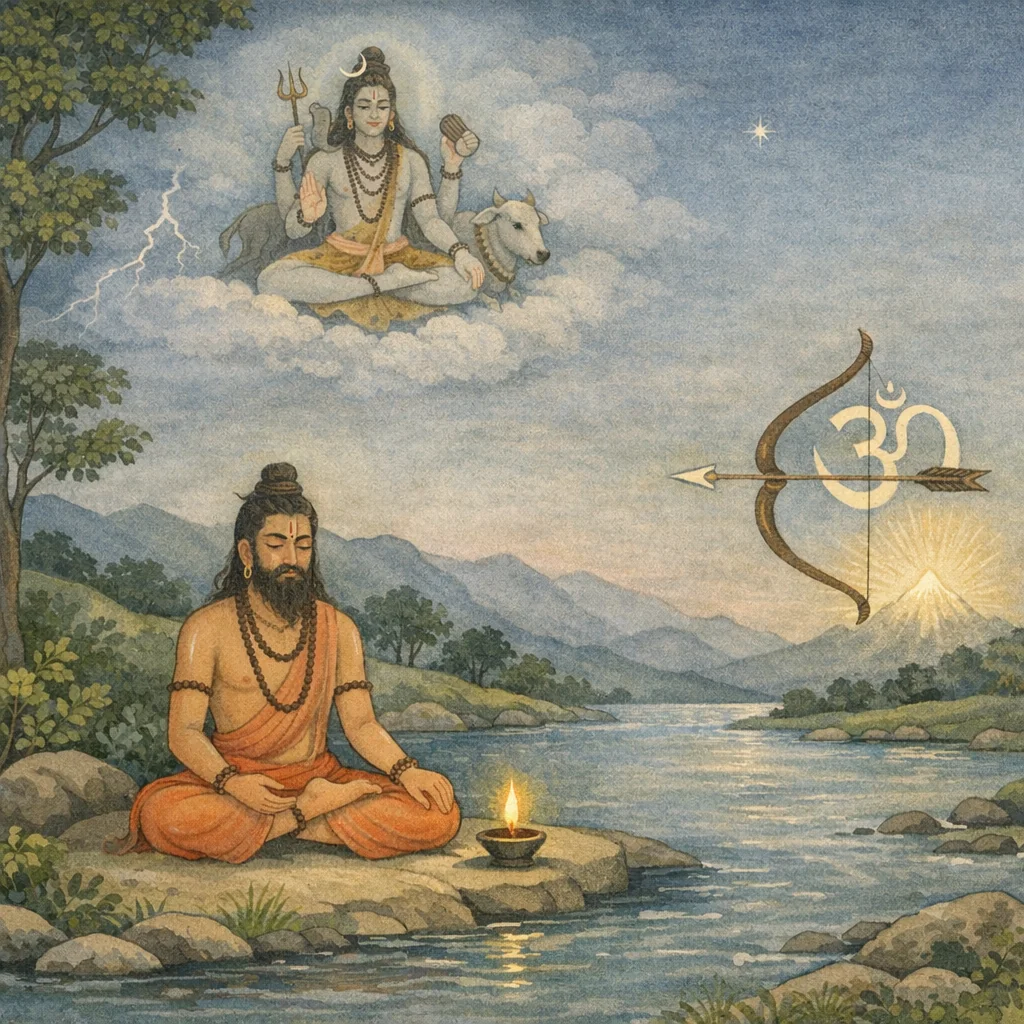
Sūta says he will now teach “ariṣṭa”—special signs by which a yogin recognizes the nearness of death. He first lists celestial and visual ill omens (Arundhatī–Dhruva not seen, stars visible by day, lightning without clouds), distortions of one’s shadow, bodily odor, decline of the senses, sudden fatness or leanness, and many dream-signs (being led south, an inauspicious woman-form, falling into a pit, a black weapon-bearing man), indicating the period of life’s waning. The instruction then turns to the “remedy”: when time is at hand, the wise should abandon grief, purify themselves, sit in a solitary level place, bow to Maheśvara, restrain the senses with the steadiness of a windless lamp, and practice pure (śukla) meditation. Next comes the doctrine of Oṃkāra-yoga: the three mātrā A-U-M, the prolonged (pluta) mātrā, and the mātrā-less “Śiva-pada”; Pranava is the bow, the ātman the arrow, and the target is Brahman/Śiva-pada. The chapter flows into Śaiva contemplation: at the moment of death, meditate on Pranava, salute Rudra, and through liberating sacred kṣetra such as Avimukta and Śrīparvata, attain the promised union with Śiva (śiva-sāyujya).
Shlokas
Verse 1
इति श्रीलिङ्गमहापुराणे पूर्वभागे यतिप्रायश्चित्तं नाम नवतितमो ऽध्यायः सूत उवाच अत ऊर्ध्वं प्रवक्ष्यामि अरिष्टानि निबोधत येन ज्ञानविशेषेण मृत्युं पश्यन्ति योगिनः
Thus, in the Śrī Liṅga Mahāpurāṇa (Pūrvabhāga), the ninety-first chapter called “Atonement for Ascetics” begins. Sūta said: “Now I shall explain the portents—understand them well—by means of that distinctive spiritual knowledge through which yogins behold Death itself and, through insight into Pati, the Lord, transcend fear.”
Verse 2
अरुन्धतीं ध्रुवं चैव सोमछायां महापथम् यो न पश्येन्न जीवेत्स नरः संवत्सरात्परम्
That man who does not behold Arundhatī, Dhruva, the Moon’s luminous track, and the Great Path of the heavens does not live beyond a year. Thus the Purāṇa points to the sacred order of the cosmos: right perception upholds dharma and steadies the bound paśu (individual soul) toward Pati (Śiva).
Verse 3
अरिश्मवन्तम् आदित्यं रश्मिवन्तं च पावकम् यः पश्यति न जीवेद्वै मासादेकादशात्परम्
Whoever beholds the Sun as “without rays” and the sacred Fire as “radiant with rays”—having met this inauspicious reversal of the cosmic order—does not live beyond eleven months.
Verse 4
वमेन्मूत्रं पुरीषं च सुवर्णं रजतं तथा प्रत्यक्षमथवा स्वप्ने दशमासान्न जीवति
If a person vomits urine or feces, or vomits gold or silver—whether it happens plainly in waking life or appears in a dream—he does not live beyond ten months. This is declared an inauspicious bond, as the pāśa tightens upon the embodied paśu when dharma and prāṇa are in decline.
Verse 5
रुक्मवर्णं द्रुमं पश्येद् गन्धर्वनगराणि च पश्येत् प्रेतपिशाचांश् च नवमासान् स जीवति
If one beholds a tree of golden hue, and also sees the cities of the Gandharvas, and further sees pretas and piśācas, that person continues to live for nine months.
Verse 6
अकस्माच्च भवेत्स्थूलो ह्य् अकस्माच्च कृशो भवेत् प्रकृतेश् च निवर्तेत चाष्टौ मासांश् च जीवति
If one suddenly becomes stout, or suddenly becomes emaciated, and departs from one’s natural constitution, one is said to live only for eight more months.
Verse 7
अग्रतः पृष्ठतो वापि खण्डं यस्य पदं भवेत् पांसुके कर्दमे वापि सप्तमासान्स जीवति
If a person’s footprint becomes broken—whether at the front or at the back—whether on dust or even in mud, he survives only for seven months. This sign is taught as a grave portend under the governance of Pati (Śiva), who loosens or tightens the pāśa (bond) according to karma.
Verse 8
काकः कपोतो गृध्रो वा निलीयेद्यस्य मूर्धनि क्रव्यादो वा खगो यस्य षण्मासान् नातिवर्तते
If a crow, a pigeon, or a vulture settles upon a man’s head—or if a flesh-eating bird lingers near him and does not depart even for six months—this is declared a most grave omen: the paśu (bound soul) draws near the end of embodied life under the force of pāśa (karmic bonds).
Verse 9
गच्छेद् वायसपङ्क्तीभिः पांसुवर्षेण वा पुनः स्वच्छायां विकृतां पश्येच् चतुःपञ्च स जीवति
If, while walking, one is struck by lines of crows, or again by a rain of dust, and then sees one’s own shadow appearing distorted, that person lives only for four or five more years.
Verse 10
अनभ्रे विद्युतं पश्येद् दक्षिणां दिशमास्थिताम् उदके धनुर् ऐन्द्रं वा त्रीणि द्वौ वा स जीवति
If one sees lightning in a cloudless sky, stationed toward the southern direction, or if one sees Indra’s rainbow in water—whether for three days or for two—he continues to live; the feared danger is averted.
Verse 11
अप्सु वा यदि वादर्शे यो ह्यात्मानं न पश्यति अशिरस्कं तथा पश्येन् मासाद् ऊर्ध्वं न जीवति
If a person does not see his own form reflected either in water or in a mirror—or if he sees himself as headless—he does not live beyond a month. This is taught as a most grave omen, urging the paśu (bound soul) to seek refuge in Pati, Śiva, through purifying discipline and worship.
Verse 12
शवगन्धि भवेद्गात्रं वसागन्धमथापि वा मृत्युर्ह्युपागतस्तस्य अर्धमासान्न जीवति
If a person’s body begins to smell like a corpse—or even like rancid fat—then Death has indeed drawn near; such a one does not live beyond half a month.
Verse 13
यस्य वै स्नातमात्रस्य हृदयं परिशुष्यति धूमं वा मस्तकात्पश्येद् दशाहान्न स जीवति
If, immediately after bathing, a person’s heart feels as though it has dried up, or if one perceives smoke rising from one’s own head, then that person does not survive beyond ten days.
Verse 14
संभिन्नो मारुतो यस्य मर्मस्थानानि कृन्तति अद्भिः स्पृष्टो न हृष्येत तस्य मृत्युरुपस्थितः
When a person’s vital inner wind (prāṇa-vāyu) becomes disturbed and seems to cut at the body’s sensitive vital points, and even the touch of water gives no feeling of refreshment or delight—know that for him Death has drawn near.
Verse 15
ऋक्षवानरयुक्तेन रथेनाशां च दक्षिणाम् गायन्नृत्यन् व्रजेत् स्वप्ने विद्यान्मृत्युरुपस्थितः
If, in a dream, one goes southward in a chariot yoked with bears and monkeys, singing and dancing, one should understand that Death has drawn near.
Verse 16
कृष्णांबरधरा श्यामा गायन्ती वाप्यथाङ्गना यं नयेद्दक्षिणामाशां स्वप्ने सो ऽपि न जीवति
If, in a dream, a dark woman clad in black—singing—leads someone toward the southern direction, that person does not survive.
Verse 17
छिद्रं वा स्वस्य कण्ठस्य स्वप्ने यो वीक्षते नरः नग्नं वा श्रमणं दृष्ट्वा विद्यान्मृत्युमुपस्थितम्
If a man, in a dream, sees a hole in his own throat, or if he sees a naked ascetic (śramaṇa), he should understand that Death has drawn near. In such an omen, the bound soul (paśu) is urged to take refuge in Pati—Śiva—through remembrance and worship, for only the Lord loosens the pāśa of fear and mortality.
Verse 18
आ मस्तकतलाद्यस् तु निमज्जेत्पङ्कसागरे दृष्ट्वा तु तादृशं स्वप्नं सद्य एव न जीवति
If one is seen, from the crown of the head downward, sinking into an ocean of mire, then on beholding such a dream that person does not live—death comes at once.
Verse 19
भस्माङ्गारांश् च केशांश् च नदीं शुष्कां भुजङ्गमान् पश्येद्यो दशरात्रं तु न स जीवति तादृशः
If a person sees ashes and live embers, scattered hair, a dried-up river, and serpents for ten consecutive nights, such a one does not continue to live—these are declared as death-portents.
Verse 20
कृष्णैश् च विकटैश्चैव पुरुषैरुद्यतायुधैः पाषाणैस्ताड्यते स्वप्ने यः सद्यो न स जीवति
If, in a dream, one is struck with stones by dark and terrifying men with weapons raised, he does not live long—death comes swiftly.
Verse 21
सूर्योदये प्रत्युषसि प्रत्यक्षं यस्य वै शिवाः क्रोशन्त्यभिमुखं प्रेत्य स गतायुर्भवेन्नरः
At sunrise, in the early dawn, if a man clearly hears the Śiva-gaṇas crying out toward him, then—after death—he is known as one whose allotted lifespan has already been exhausted.
Verse 22
यस्य वा स्नातमात्रस्य हृदयं पीड्यते भृशम् जायते दन्तहर्षश् च तं गतायुषमादिशेत्
If, immediately after bathing, a person’s heart is afflicted with intense pain and trembling of the teeth also arises, one should declare that person’s lifespan to be ended—an omen that prāṇa is departing and the bound soul (paśu) is nearing the limit set by its karma and pāśa.
Verse 23
भूयोभूयस्त्रसेद्यस्तु रात्रौ वा यदि वा दिवा दीपगन्धं च नाघ्राति विद्यान्मृत्युम् उपस्थितम्
If a person is seized again and again by sudden fear—whether by night or by day—and cannot smell the fragrance of the lamp, one should know that Death has drawn near.
Verse 24
रात्रौ चेन्द्रधनुः पश्येद् दिवा नक्षत्रमण्डलम् परनेत्रेषु चात्मानं न पश्येन्न स जीवति
If one sees a rainbow at night, or a circle of stars in the daytime, and cannot see one’s own reflection in another’s eyes—such a person does not continue to live (for death is near).
Verse 25
नेत्रमेकं स्रवेद्यस्य कर्णौ स्थानाच्च भ्रश्यतः वक्रा च नासा भवति विज्ञेयो गतजीवितः
He whose one eye begins to discharge, whose ears slip from their proper position, and whose nose becomes distorted—such a person should be understood to have departed from life.
Verse 26
यस्य कृष्णा खरा जिह्वा पद्माभासं च वै मुखम् गण्डे वा पिण्डिकारक्ते तस्य मृत्युरुपस्थितः
For one whose tongue becomes black and rough, whose face takes on a lotus-like pallor, or whose cheeks turn red like inflamed lumps—death has drawn near to him.
Verse 27
मुक्तकेशो हसंश्चैव गायन्नृत्यंश् च यो नरः याम्यामभिमुखं गच्छेत् तदन्तं तस्य जीवितम्
If a man, with hair loosened, laughing, singing, and dancing, proceeds facing the southern quarter (the realm of Yama), that very act is the limit of his lifespan—his life ends there.
Verse 28
यस्य श्वेतघनाभासा श्वेतसर्षपसंनिभा श्वेता च मूर्तिर्ह्यसकृत् तस्य मृत्युरुपस्थितः
For one who repeatedly beholds a white form—shining like a pale cloud and minute like a white mustard seed—Death has drawn near and stands before him.
Verse 29
उष्ट्रा वा रासभा वाभियुक्ताः स्वप्ने रथे शुभाः यस्य सो ऽपि न जीवेत्तु दक्षिणाभिमुखो गतः
If, in a dream, one sees camels or donkeys harnessed to a chariot—even if that chariot appears auspicious—such a person does not long survive, for it signifies a southward course (the direction of Yama), an omen of impending death.
Verse 30
द्वे वाथ परमे ऽरिष्टे एकीभूतः परं भवेत् घोषं न शृणुयात्कर्णे ज्योतिर् नेत्रे न पश्यति
When the supreme calamity (ariṣṭa) arises, the two sense-powers merge into oneness; one no longer hears any sound with the ear, and with the eyes one no longer beholds any light.
Verse 31
श्वभ्रे यो निपतेत्स्वप्ने द्वारं चापि पिधीयते न चोत्तिष्ठति यः श्वभ्रात् तदन्तं तस्य जीवितम्
If, in a dream, one falls into a pit, and even the door is shut, and one does not rise up from that pit—this is declared to be the very limit of that person’s lifespan.
Verse 32
ऊर्ध्वा च दृष्टिर्न च सम्प्रतिष्ठा रक्ता पुनः सम्परिवर्तमाना /* मुखस्य शोषः सुषिरा च नाभिरत्युष्णमूत्रो विषमस्थ एव
When one’s gaze is fixed upward and the body finds no steadiness; when the eyes redden and roll about again and again; when the mouth dries, the navel seems hollow, the urine becomes excessively hot, and one cannot remain in a balanced posture—these are declared grave portents, showing the bound soul (paśu) being overpowered by the cords of pāśa and nearing life’s crisis.
Verse 33
दिवा वा यदि वा रात्रौ प्रत्यक्षं यो निहन्यते हन्तारं न च पश्येच्च स गतायुर्न जीवति
Whether by day or by night, if a person is struck down openly yet does not even see the slayer, know that his allotted lifespan has already been exhausted—he does not continue to live.
Verse 34
अग्निप्रवेशं कुरुते स्वप्नान्ते यस्तु मानवः स्मृतिं नोपलभेच्चापि तदन्तं तस्य जीवितम्
If a man, at the end of a dream, sees himself entering fire and then does not regain clear recollection, that very point is said to be the limit of his embodied life. For the bound soul (paśu), such a sign indicates the near exhaustion of prārabdha-karma unless the Lord (Pati) is propitiated through Śiva-worship.
Verse 35
यस्तु प्रावरणं शुक्लं स्वकं पश्यति मानवः कृष्णं रक्तमपि स्वप्ने तस्य मृत्युरुपस्थितः
If a person sees his own garment as white, yet in the same dream it appears black or blood‑red, then for him death has drawn near. Such a vision is a nimitta (omen) indicating the loosening of the pāśa (bond) by Kāla, until the paśu (embodied soul) turns to Pati—Śiva—for refuge.
Verse 36
प्रेपरतिओन् फ़ोर् देअथ् अरिष्टे सूचिते देहे तस्मिन्काल उपस्थिते त्यक्त्वा खेदं विषादं च उपेक्षेद् बुद्धिमान् नरः
When the body displays the ominous ariṣṭa signs that foretell death, and that time has arrived, the wise person should abandon grief and dejection and remain detached—turning the mind toward Pati (Śiva) rather than clinging as a paśu bound by pāśa.
Verse 37
प्राचीं वा यदि वोदीचीं दिशं निष्क्रम्य वै शुचिः समे ऽतिस्थावरे देशे विविक्ते जन्तुवर्जिते
Having become purified, one should go out toward the eastern—or else the northern—direction, and in a level, firm, secluded place, free from living creatures, one should remain (for practice). Thus the sādhaka prepares a fit ground for Pati (Śiva) to be worshiped and realized, and for the paśu (the bound soul) to loosen the pāśa (bondage) through disciplined observance.
Verse 38
उदङ्मुखः प्राङ्मुखो वा स्वस्थश् चाचान्त एव च स्वस्तिकेनोपविष्टस्तु नमस्कृत्वा महेश्वरम्
Facing north or east, composed in body and having performed ācamana, one should sit in the svastika posture; then, after bowing, offer reverent homage to Mahēśvara—Pati, Śiva, the Lord who loosens the pāśas that bind the paśu (the soul).
Verse 39
समकायशिरोग्रीवो धारयन् नावलोकयेत् यथा दीपो निवातस्थो नेङ्गते सोपमा स्मृता
Keeping the body, head, and neck aligned and steady, the practitioner should fix awareness without letting it wander outward. As a lamp placed in a windless spot does not flicker, so this steadiness is remembered as the fitting simile for samādhi directed toward Pati, Śiva.
Verse 40
प्रागुदक्प्रवणे देशे तथा युञ्जीत शास्त्रवित् कामं वितर्कं प्रीतिं च सुखदुःखे उभे तथा
In a place sloping toward the east and toward water, the knower of the śāstras should undertake disciplined Yoga—bringing under control desire (kāma), discursive thought (vitarka), attachment-pleasure (prīti), and both happiness and sorrow—so that the bound paśu may loosen the pāśas and turn toward Pati, Śiva.
Verse 41
निगृह्य मनसा सर्वं शुक्लं ध्यानम् अनुस्मरेत् घ्राणे च रसने नित्यं चक्षुषी स्पर्शने तथा
Having restrained everything by the mind, one should continually recollect the pure (śukla) meditation—maintaining constant mastery over the nose (smell), the tongue (taste), the two eyes (sight), and likewise over touch. Thus, through disciplined dhyāna oriented to Śiva, the Pati, the paśu begins to loosen the pāśas.
Verse 42
श्रोत्रे मनसि बुद्धौ च तत्र वक्षसि धारयेत् कालकर्माणि विज्ञाय समूहेष्वेव नित्यशः
Let one establish (the awareness of Śiva) in the ear, in the mind, and in the intellect, and then hold it steadily in the heart. Having discerned actions governed by time (kāla), one should continually maintain this practice in all gatherings and activities, day after day.
Verse 43
द्वादशाध्यात्ममित्येवं योगधारणमुच्यते शतमर्धशतं वापि धारणां मूर्ध्नि धारयेत्
Thus this is called the yogic dhāraṇā grounded in the twelvefold inner (adhyātma) discipline. One should sustain this concentration at the crown of the head, for a hundred counts or even fifty, fixing the mind there in steady retention.
Verse 44
खिन्नस्य धारणायोगाद् वायुरूर्ध्वं प्रवर्तते ततश्चापूरयेद् देहम् ओङ्कारेण समन्वितः
When the practitioner grows fatigued, through the discipline of dhāraṇā the vital wind (prāṇa) is made to move upward. Then, united with the vibration of Oṃkāra, he should fill the body with that life-breath, loosening the bonds (pāśa) and drawing the bound soul (paśu) toward the Lord (Pati).
Verse 45
तथौंकारमयो योगी अक्षरे त्वक्षरी भवेत् ओंकार अत ऊर्ध्वं प्रवक्ष्यामि ओङ्कारप्राप्तिलक्षणम्
Thus the yogin, becoming wholly formed of Oṃkāra, becomes established in the Imperishable (Akṣara). Now, hereafter, I shall declare the signs by which the attainment of Oṃkāra is known.
Verse 46
एष त्रिमात्रो विज्ञेयो व्यञ्जनं चात्र चेश्वरः प्रथमा विद्युती मात्रा द्वितीया तामसी स्मृता
This Lord is to be known as the One of three mātrās (measures), and here He is also the vyañjana, that which makes meaning manifest. The first mātrā is remembered as vidyutī, luminous like lightning; the second is taught as tāmasī, veiling, of the nature of tamas.
Verse 47
तृतीयां निर्गुणां चैव मात्रामक्षरगामिनीम् गान्धारी चैव विज्ञेया गान्धारस्वरसंभवा
The third mātrā, too, is to be known as nirguṇā—beyond the qualities—and as the measure that moves through the imperishable syllable (akṣara). That mātrā is to be understood as Gāndhārī, arising from the Gāndhāra musical note.
Verse 48
पिपीलिकागतिस्पर्शा प्रयुक्ता मूर्ध्नि लक्ष्यते यथा प्रयुक्त ओङ्कारः प्रतिनिर्याति मूर्धनि
When rightly applied, a sensation like the touch of an ant’s movement is felt at the crown of the head; likewise, when the sacred Oṁkāra is properly uttered, it rises again and issues forth at the crown—signaling the upward course of prāṇa toward Śiva, the Pati.
Verse 49
तथौंकारमयो योगी त्व् अक्षरी त्वक्षरी भवेत् प्रणवो धनुः शरो ह्यात्मा ब्रह्मलक्षणमुच्यते
Thus, the yogin who becomes formed of the sacred syllable Oṁ becomes established in the Imperishable. The Praṇava is said to be the bow, the Self indeed the arrow—this is declared as the defining mark of Brahman.
Verse 50
अप्रमत्तेन वेद्धव्यं शरवत् तन्मयो भवेत् ओमित्येकाक्षरं ह्येतद् गुहायां निहितं पदम्
With unwavering vigilance one should pierce the inner Reality like an arrow; then one becomes of that very nature. For this single-syllabled ‘Om’ is indeed the secret state, hidden within the cave of the heart.
Verse 51
ओमित्येतत्त्रयो लोकास् त्रयो वेदास्त्रयो ऽग्नयः विष्णुक्रमास्त्रयस्त्वेते ऋक्सामानि यजूंषि च
‘Oṁ’—this single syllable comprises the three worlds, the three Vedas, and the three sacred fires. Within it are also the three strides of Viṣṇu—Ṛg, Sāma, and Yajus—gathered into one. In Shaiva understanding, this Oṁ is the supreme mark of Pati (Śiva), unifying the entire Vedic order and the cosmic triads.
Verse 52
मात्रा चार्धं च तिस्रस्तु विज्ञेयाः परमार्थतः तत्प्रयुक्तस्तु यो योगी तस्य सालोक्यमाप्नुयात्
In the highest sense, one should truly understand the three measures (mātrā-s) and the half-measure. The yogin who applies that discipline of measured sacred utterance attains sālokya—dwelling in the same divine realm as Lord Śiva, the Pati who liberates the bound paśu from pāśa.
Verse 53
अकारो ह्यक्षरो ज्ञेय उकारः सहितः स्मृतः मकारसहितौंकारस् त्रिमात्र इति संज्ञितः
Know the letter “A” as the primal syllable. United with it is remembered “U”; and when “M” is added, the sound “Oṃ” is formed—therefore it is designated as the three-mātrā, the triple measure.
Verse 54
अकारस् त्वेष भूर्लोक उकारो भुव उच्यते सव्यञ्जनो मकारस्तु स्वर्लोक इति गीयते
“A” is sung as Bhūr-loka, the earthly plane; “U” is declared to be Bhuvar-loka, the vital mid-region. And “M”—together with its resonant articulation—is sung as Svar-loka, the luminous heavenly plane.
Verse 55
ओङ्कारस्तु त्रयो लोकाः शिरस्तस्य त्रिविष्टपम् भुवनाङ्गं च तत्सर्वं ब्राह्मं तत्पदमुच्यते
Oṅkāra indeed is the three worlds. Its head is Triviṣṭapa, the heavenly realm, and all the universes are its limbs. That is called the Brahman-state—the supreme Pada, the highest abode of the Lord (Pati).
Verse 56
मात्रापादो रुद्रलोको ह्य् अमात्रं तु शिवं पदम् एवं ज्ञानविशेषेण तत्पदं समुपास्यते
Rudra-loka is the “quarter” (pāda) constituted of mātrā, measurable sound-units; but Śiva’s supreme state is the Amātra—beyond measure and beyond articulation. Thus, by a distinct discriminative knowledge (jñāna-viśeṣa), that supreme Pada is to be steadily contemplated and worshipped.
Verse 57
तस्माद्ध्यानरतिर्नित्यम् अमात्रं हि तदक्षरम् उपास्यं हि प्रयत्नेन शाश्वतं सुखमिच्छता
Therefore, one should ever delight in meditation; for that Imperishable Reality is Amātra—beyond measure and beyond syllabic parts. It must be worshipped with sustained effort by the seeker who longs for eternal bliss: union with Pati (Śiva), liberator of the paśu from pāśa.
Verse 58
ह्रस्वा तु प्रथमा मात्रा ततो दीर्घा त्वनन्तरम् ततः प्लुतवती चैव तृतीया चोपदिश्यते
The short measure is taught as the first mātrā; next comes the long measure; and then the prolonged (pluta) measure is instructed as the third.
Verse 59
एतास्तु मात्रा विज्ञेया यथावदनुपूर्वशः यावदेव तु शक्यन्ते धार्यन्ते तावदेव हि
These mātrās should be understood correctly, in proper order. Indeed, one should sustain the practice only for as long as it is truly possible—only to that extent.
Verse 60
इन्द्रियाणि मनो बुद्धिं ध्यायन्नात्मनि यः सदा अर्धं तन्मात्रम् अपि चेच् छृणु यत् फलमाप्नुयात्
Whoever, at all times, meditatively gathers the senses, the mind, and the intellect into the Self—listen to the fruit he attains, even if he accomplishes only half of that measure. Through such inward absorption, the paśu (individual soul) loosens pāśa (bondage) and turns toward Pati, Śiva, the indwelling Lord.
Verse 61
मासे मासे ऽश्वमेधेन यो यजेत शतं समाः तेन यत्प्राप्यते पुण्यं मात्रया तदवाप्नुयात्
Whatever merit is gained by one who performs the Aśvamedha sacrifice month after month for a hundred years—one attains that very merit even by a mere measure of this Śaiva act of devotion, for such is its potency.
Verse 62
न तथा तपसोग्रेण न यज्ञैर्भूरिदक्षिणैः यत्फलं प्राप्यते सम्यङ् मात्रया तदवाप्नुयात्
The fruit rightly attained through measured, well-ordered practice (mātrā) is not gained so well even by fierce austerities or by sacrifices laden with abundant priestly fees; by that proper measure alone one obtains that very result.
Verse 63
तत्र चैषा तु या मात्रा प्लुता नामोपदिश्यते एषा एव भवेत्कार्या गृहस्थानां तु योगिनाम्
Here, the mātrā taught as the “pluta” (prolonged utterance)—this alone should be practiced by yogins who live the householder’s life. Through regulated, lengthened japa it steadies the paśu (individual soul) amid worldly duties and turns the mind toward Pati, Lord Śiva.
Verse 64
एषां चैव विशेषेण ऐश्वर्ये ह्यष्टलक्षणे अणिमाद्ये तु विज्ञेया तस्माद्युञ्जीत तां द्विजाः
Among these, one should especially understand the eight marks of lordly power (aiśvarya), beginning with aṇimā and the rest. Therefore, O twice-born, yoke yourself to that discipline, for it leads to mastery through Yoga under Pati.
Verse 65
एवं हि योगसंयुक्तः शुचिर् दान्तो जितेन्द्रियः आत्मानं विद्यते यस्तु स सर्वं विन्दते द्विजाः
Thus, one united with Yoga—pure, disciplined, victorious over the senses—who truly knows the Self: he indeed attains all, O twice-born. For by Self-knowledge the paśu is released from pāśa and comes to Pati, Śiva.
Verse 66
तस्मात्पाशुपतैर्योगैर् आत्मानं चिन्तयेद्बुधः आत्मानं जानते ये तु शुचयस्ते न संशयः
Therefore, the wise should contemplate the Self through the disciplines of Pāśupata Yoga. Those who truly know the Self become purified—of this there is no doubt.
Verse 67
ऋचो यजूंषि सामानि वेदोपनिषदस् तथा योगज्ञानादवाप्नोति ब्राह्मणो ऽध्यात्मचिन्तकः
The Brahmana who contemplates the inner Self attains the essence of the Ṛg, Yajur, and Sāma Vedas, and likewise the Upaniṣads, through the wisdom of Yoga. By such yogic knowledge he draws near to the Supreme Pati, transcending the pāśa that limit the paśu.
Verse 68
सर्वदेवमयो भूत्वा अभूतः स तु जायते योनिसंक्रमणं त्यक्त्वा याति वै शाश्वतं पदम्
Having become pervaded by the essence of all the Devas—yet himself untouched by becoming—he is said to be “born” into true realization. Abandoning transmigration through wombs, he indeed attains the eternal state: the imperishable abode of Pati, Lord Śiva.
Verse 69
यथा वृक्षात् फलं पक्वं पवनेन समीरितम् नमस्कारेण रुद्रस्य तथा पापं प्रणश्यति
Just as a ripe fruit is shaken loose from a tree by the stirring wind, so too, by offering reverent salutation to Rudra, sin is cast off and destroyed.
Verse 70
यत्र रुद्रनमस्कारः सर्वकर्मफलो ध्रुवः अन्यदेवनमस्कारान् न तत्फलमवाप्नुयात्
Wherever salutation to Rudra is performed, the sure fruit of all rites and actions is obtained. But by merely bowing to other deities, one does not attain that same result.
Verse 71
तस्मात्त्रिःप्रवणं योगी उपासीत महेश्वरम् दशविस्तारकं ब्रह्म तथा च ब्रह्मविस्तरैः
Therefore, the yogin should worship Maheśvara through the Praṇava (Om) uttered threefold. He should contemplate Brahman as expanded in tenfold manifestation, and likewise through the various unfoldings of Brahman—recognizing the one Pati (Lord) as the inner reality behind all expansions.
Verse 72
एवं ध्यानसमायुक्तः स्वदेहं यः परित्यजेत् स याति शिवसायुज्यं समुद्धृत्य कुलत्रयम्
Thus, one who is absorbed in such meditation and then relinquishes the body attains sāyujya—union with Lord Śiva as Pati—having uplifted the threefold line of his family.
Verse 73
अथवारिष्टमालोक्य मरणे समुपस्थिते अविमुक्तेश्वरं गत्वा वाराणस्यां तु शोधनम्
Then, seeing the ominous portents and knowing death is near, one should go to Avimukteśvara; in Vārāṇasī there is indeed purification of the bound soul, bestowed by the Lord who is Pati.
Verse 74
येन केनापि वा देहं संत्यजेन् मुच्यते नरः श्रीपर्वते वा विप्रेन्द्राः संत्यजेत्स्वतनुं नरः
By whatever means a man casts off the body, he is released from bondage. O best of brahmins, if a man relinquishes his body at Śrīparvata, he attains liberation—his paśu-state is severed from pāśa by the grace of Pati, Śiva, in that sacred kṣetra.
Verse 75
स याति शिवसायुज्यं नात्र कार्या विचारणा अविमुक्तं परं क्षेत्रं जन्तूनां मुक्तिदं सदा
He attains sāyujya, union with Śiva—there is no need for doubt or further deliberation. Avimukta is the supreme sacred field, ever granting liberation to embodied beings.
Verse 76
सेवेत सततं धीमान् विशेषान्मरणान्तिके
The wise person should practice constant devoted service—most especially as death approaches—so that the final remembrance becomes fixed upon Pati, Lord Śiva, the Liberator of the bound paśu.
Frequently Asked Questions
The ariṣṭa list functions as a spiritual alarm: recognizing impermanence prompts immediate renunciation of fear and grief, turning the practitioner toward Shiva-centered remembrance, dhāraṇā, and pranava-upāsanā as the true preparation.
Beyond the audible A-U-M (three mātrās) is the amātra—soundless transcendence—identified here as the supreme Shiva-state (śiva-pada), the contemplative culmination where the mind rests beyond qualities (nirguṇa).
Withdraw to a clean, quiet place; sit steadily; offer namaskāra to Maheshvara; restrain senses; maintain śukla-dhyāna and dhāraṇā; contemplate Omkāra and its amātra, and, where possible, seek liberating Shiva-kṣetras like Avimukta.