Adhyaya 54
भुवनकोशविन्यासनिर्णयः (ज्योतिर्गति-वृष्टिचक्र-वर्णनम्)
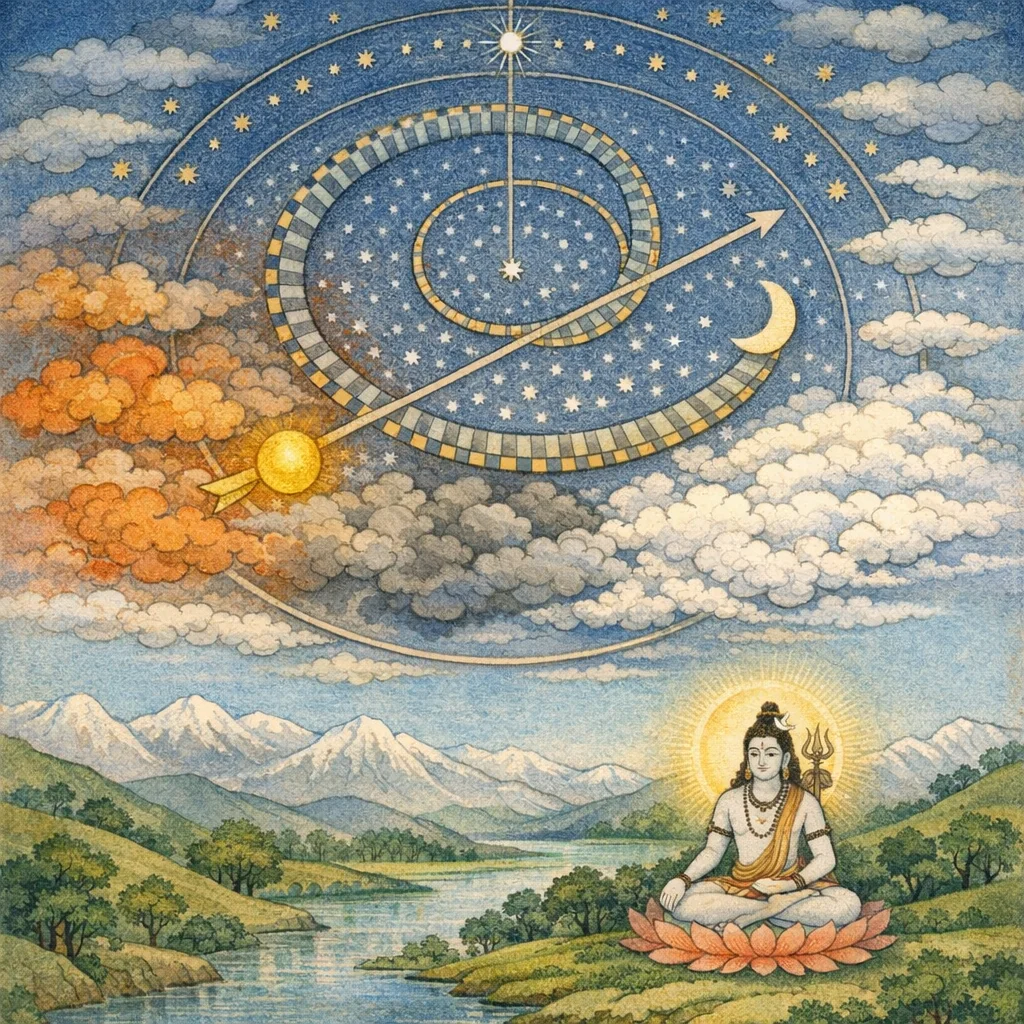
Sūta briefly explains to the sages of Naimiṣāraṇya the circulation of the luminaries within the cosmic egg: he names divine regions and cities in the directions, and describes the Sun’s southward course (dakṣiṇāyana) as swift like a loosed arrow, while its northward course (uttarāyaṇa) is gentle and slow like the hub of a potter’s wheel. He states the muhūrta-measure of day and night, the revolutions of the nakṣatras, and affirms that the planetary wheel is held steady by the grace of Dhruva (son of Uttānapāda), endowed with steadfast fixity. He then explains the Sun’s drawing up of waters, the waters’ transformation in accord with the Moon’s sequence, the formation of clouds through the conjunction of smoke, fire, and wind, and the kinds of rain—beneficial showers versus inauspicious rain arising from abhicāra-born smoke. The chapter concludes by proclaiming Śiva as “Lord of the Waters” and the ordainer of cosmic motions for the welfare of the world, grounding natural processes in Śaiva tattva and preparing for later teachings on preservation under Śiva’s sovereignty and the fruits of worship and dharma.
Shlokas
Verse 1
इति श्रीलिङ्गमहापुराणे पूर्वभागे भुवनकोशविन्यासनिर्णयो नाम त्रिपञ्चाशत्तमो ऽध्यायः सूत उवाच ज्योतिर्गणप्रचारं वै संक्षिप्याण्डे ब्रवीम्यहम् देवक्षेत्राणि चालोक्य ग्रहचारप्रसिद्धये
Thus, in the Śrī Liṅga Mahāpurāṇa, in the Pūrvabhāga, begins the chapter called “The Determination of the Arrangement of the Cosmic Spheres.” Sūta said: “I shall briefly describe, within this cosmic egg, the courses of the hosts of luminaries; and, having surveyed the divine sacred regions, I shall speak so that the motions of the planets may be rightly understood.”
Verse 2
मानसोपरि माहेन्द्री प्राच्यां मेरोः पुरी स्थिता दक्षिणे भानुपुत्रस्य वरुणस्य च वारुणी
Above (the lake) Mānasa, to the east, stands Māhendrī, the city of Meru. To the south lies Vāruṇī, belonging to Varuṇa and also to Bhānu’s son—thus indicating the divine quarters and the abodes of their lords.
Verse 3
सौम्ये सोमस्य विपुला तासु दिग्देवताः स्थिताः अमरावती संयमनी सुखा चैव विभा क्रमात्
In the auspicious northern quarter, Soma, the Moon, has a vast realm. There the deities presiding over the directions abide, and their cities—Amarāvatī, Saṃyamanī, Sukhā, and Vibhā—are situated in due order.
Verse 4
लोकपालोपरिष्टात् तु सर्वतो दक्षिणायने काष्ठां गतस्य सूर्यस्य गतिर् या तां निबोधत
Now, above the Lokapālas, the guardians of the quarters, during the southern course (dakṣiṇāyana), understand the path by which the Sun proceeds when he has reached the directional limit (kāṣṭhā).
Verse 5
दक्षिणप्रक्रमे भानुः क्षिप्तेषुरिव धावति ज्योतिषां चक्रमादाय सततं परिगच्छति
In the Sun’s southern course, Bhānu rushes on like an arrow released; bearing the wheel of the luminaries, he continually circles—upholding the ordained cosmic rhythm under the governance of Pati (Śiva).
Verse 6
पुरान्तगो यदा भानुः शक्रस्य भवति प्रभुः सर्वैः सायमनैः सौरो ह्य् उदयो दृश्यते द्विजाः
O twice-born ones, when Bhānu, the Sun, having reached the end of the “city” (the horizon), comes under the lordship of Śakra (Indra), then for all who observe the evening rite the “saura-udaya,” a seeming solar rising, is indeed perceived—an auspicious celestial sign marking time’s turning under divine governance.
Verse 7
स एव सुखवत्यां तु निशान्तस्थः प्रदृश्यते अस्तमेति पुनः सूर्यो विभायां विश्वदृग् विभुः
There, in Sukhavatī, He alone is seen abiding at the close of night. Then the Sun sets again; yet the all-pervading Lord, who beholds the whole universe, shines forth by His own radiance.
Verse 8
मया प्रोक्तो ऽमरावत्यां यथासौ वारितस्करः तथा संयमनीं प्राप्य सुखां चैव विभां खगः
As I declared in Amarāvatī—how that thief was restrained—so too, upon reaching Saṃyamanī (Yama’s ordered realm), that bird attained both ease and radiant splendor.
Verse 9
यदापराह्णस्त्वाग्नेय्यां पूर्वाह्णो नैरृते द्विजाः तदा त्वपररात्रश् च वायुभागे सुदारुणः
O twice-born ones, when the afternoon wrongly manifests in the south-east and the forenoon appears in the south-west, then even the latter part of the night turns exceedingly dreadful in the quarter of Vāyu. Such disordered time and direction are declared as fierce portents, foretelling disturbance of dharma and the tightening of pāśa (bondage) upon the paśu (the bound soul) until refuge is taken in Pati, Lord Śiva.
Verse 10
ईशान्यां पूर्वरात्रस्तु गतिरेषा च सर्वतः एवं पुष्करमध्ये तु यदा सर्पति वारिपः
In the Īśāna (north‑eastern) quarter, the course is said to belong to the first watch of the night; indeed, this movement is understood everywhere. Thus, in the midst of Puṣkara, when the lordly waters glide and flow onward, this is the ordained pattern.
Verse 11
त्रिंशांशकं तु मेदिन्यां मुहूर्तेनैव गच्छति योजनानां मुहूर्तस्य इमां संख्यां निबोधत
On the earth, one‑thirtieth (of the stated measure) is traversed in just a muhūrta. Now understand this numerical measure of yojanas corresponding to a muhūrta.
Verse 12
पूर्णा शतसहस्राणाम् एकत्रिंशत्तु सा स्मृता पञ्चाशच्च तथान्यानि सहस्राण्यधिकानि तु
That complete total is remembered as thirty‑one hundred‑thousands (3,100,000); and, in addition, there are also fifty other thousands (50,000) more.
Verse 13
मौहूर्तिकी गतिर्ह्येषा भास्करस्य महात्मनः एतेन गतियोगेन यदा काष्ठां तु दक्षिणाम्
This indeed is the muhūrta‑wise course of the great‑souled Sun. By this very principle of measured motion, when he reaches the southern ‘kāṣṭhā’ (a fixed limit of time‑division), the reckoning of time proceeds accordingly—revealing the ordered law (niyati) that governs the world under the Lord, the Pati (Śiva).
Verse 14
पर्यपृच्छेत् पतङ्गो ऽपि सौम्याशां चोत्तरे ऽहनि मध्ये तु पुष्करस्याथ भ्रमते दक्षिणायने
Even the Sun (pataṅga) seems to ‘inquire and search’: on his northern course he moves toward the gentle northern quarter; but on his southern course he is said to revolve about the midst of Puṣkara. Thus the cosmic motion itself points to the sacred center, where the Pati (Śiva) is approached through tīrtha and disciplined observance.
Verse 15
मानसोत्तरशैले तु महातेजा विभावसुः मण्डलानां शतं पूर्णं तदशीत्यधिकं विभुः
Upon Mount Mānasottara, Vibhāvasu—the Sun, mighty and radiant, the all-pervading Lord—completes a full hundred circular courses (maṇḍalas), and eighty more besides.
Verse 16
बाह्यं चाभ्यन्तरं प्रोक्तम् उत्तरायणदक्षिणे प्रत्यहं चरते तानि सूर्यो वै मण्डलानि तु
The solar courses are taught as twofold—outer and inner—corresponding to the northern and southern paths (uttarāyaṇa and dakṣiṇāyaṇa). Moving day by day, the Sun indeed traverses those circular orbits.
Verse 17
कुलालचक्रपर्यन्तो यथा शीघ्रं प्रवर्तते दक्षिणप्रक्रमे देवस् तथा शीघ्रं प्रवर्तते
Just as the potter’s wheel swiftly turns all the way around, so too, when the rite proceeds in the rightward (dakṣiṇa) course, the Deva—Śiva, the Lord (Pati)—moves swiftly, granting rapid fruition to the bound soul (paśu).
Verse 18
तस्मात्प्रकृष्टां भूमिं तु कालेनाल्पेन गच्छति सूर्यो द्वादशभिः शीघ्रं मुहूर्तैर्दक्षिणायने
Therefore, during the southern course (dakṣiṇāyana), the Sun quickly traverses the exalted region of the earth in a short time—swiftly, in twelve muhūrtas. By such measures of kāla, the embodied paśu undergoes change, while the supreme Pati, Śiva, remains the unchanging ground of all time.
Verse 19
त्रयोदशार्धमृक्षाणाम् अह्ना तु चरते रविः मुहूर्तैस्तावदृक्षाणि नक्तमष्टादशैश्चरन्
By day, Ravi (the Sun) traverses thirteen and a half lunar mansions (nakṣatras). By night, moving on, he passes through the same number of nakṣatras in eighteen muhūrtas.
Verse 20
कुलालचक्रमध्यं तु यथा मन्दं प्रसर्पति तथोदगयने सूर्यः सर्पते मन्दविक्रमः
As the hub of a potter’s wheel creeps forward slowly, so in Udāgayana—the Sun’s northern course—the Sun advances with a gentle, measured stride.
Verse 21
तस्माद्दीर्घेण कालेन भूमिमल्पां तु गच्छति स रथो धिष्ठितो भानोर् आदित्यैर्मुनिभिस् तथा
Therefore, even over a long span of time, that chariot traverses only a small portion of the earth, upheld and governed for Bhānu (the Sun) by the Ādityas and by the sages. Through this measured motion of the Sun, Kāla (Time) regulates the world.
Verse 22
गन्धर्वैरप्सरोभिश् च ग्रामणीसर्पराक्षसैः प्रदीपयन् सहस्रांशुर् अग्रतः पृष्ठतो ऽप्यधः
Accompanied by Gandharvas and Apsarases, and by chiefs, serpents, and Rākṣasas, the Thousand-rayed One blazed forth—illumining the way ahead, behind, and even below.
Verse 23
ऊर्ध्वतश् च करं त्यक्त्वा सभां ब्राह्मीमनुत्तमाम् अंभोभिर् मुनिभिस्त्यक्तैः संध्यायां तु निशाचरान्
Within Brahmā’s unsurpassed divine assembly, raising his hand aloft, he drove away the night‑rangers at Sandhyā with water sanctified and cast by the sages, so that the Sandhyā rite might remain unobstructed.
Verse 24
हत्वा हत्वा तु सम्प्राप्तान् ब्राह्मणैश्चरते रविः अष्टादश मुहूर्तं तु उत्तरायणपश्चिमम्
Having struck down again and again those who come before him, the Sun moves onward—impelled by the ordinance of the Brāhmaṇas—traversing the northern course and the western path for eighteen muhūrtas. Here the Purāṇa intimates that even cosmic motion proceeds under dharma, while the bound soul (paśu) reaps the fruits of violence until, through right observance, it turns toward the Lord (Pati).
Verse 25
अहर्भवति तच्चापि चरते मन्दविक्रमः त्रयोदशार्धम् ऋक्षाणि नक्तं द्वादशभी रविः मुहूर्तैस् तावद् ऋक्षाणि दिवाष्टादशभिश्चरन्
That indeed is a day. The Sun, moving with a gentle pace, traverses thirteen and a half lunar mansions (nakṣatras) in the night by twelve muhūrtas; and in the daytime, by eighteen muhūrtas, he traverses the same extent of lunar mansions.
Verse 26
ततो मन्दतरं नाभ्यां चक्रं भ्रमति वै यथा मृत्पिण्ड इव मध्यस्थो ध्रुवो भ्रमति वै तथा
Then, as a wheel turns more slowly around its hub, so too Dhruva at the center—fixed in the middle like a lump of clay—revolves; thus the ordered motion of the cosmic circle is established under the Lord (Pati).
Verse 27
त्रिंशन्मुहूर्तैर् एवाहुर् अहोरात्रं पुराविदः उभयोः काष्ठयोर्मध्ये भ्रमतो मण्डलानि तु
The ancient knowers declare that a day-and-night (ahorātra) consists of thirty muhūrtas; and within the interval marked by the two kāṣṭhās, the circular cycles (maṇḍalas) are said to revolve.
Verse 28
कुलालचक्रनाभिस्तु यथा तत्रैव वर्तते औत्तानपादो भ्रमति ग्रहैः सार्धं ग्रहाग्रणीः
Just as the hub of a potter’s wheel remains stationed in its own place, so does Dhruva—son of Uttānapāda, foremost among the luminaries—abide as the fixed pivot, while the planets revolve together around him.
Verse 29
गणो मुनिज्योतिषां तु मनसा तस्य सर्पति अधिष्ठितः पुनस्तेन भानुस्त्वादाय तिष्ठति
The Gaṇa—presiding over the sages (munis) and the celestial lights—moves by His will alone. Again, established and governed by Him, the Sun holds its course, taking up its appointed function and remaining in its ordained station.
Verse 30
सोन्ने-रेगेन्-क्रेइस्लौफ़् किरणैः सर्वतस्तोयं देवो वै ससमीरणः औत्तानपादस्य सदा ध्रुवत्वं वै प्रसादतः
By His rays, water is spread everywhere, together with the moving winds—thus does the Divine uphold the order of the cosmos. And by His grace, the son of Uttānapāda (Dhruva) attained everlasting fixity, becoming the steadfast pole of the worlds.
Verse 31
विष्णोरौत्तानपादेन चाप्तं तातस्य हेतुना आपः पीतास्तु सूर्येण क्रमन्ते शशिनः क्रमात्
By Viṣṇu it was obtained through Uttānapāda, for the sake of his father’s cause. The waters, though drunk up by the Sun, proceed again in due course by the Moon’s measured order—thus the cosmic rhythm continues under the higher governance of the Lord (Pati).
Verse 32
निशाकरान्निस्रवन्ते जीमूतान्प्रत्यपः क्रमात् वृन्दं जलमुचां चैव श्वसनेनाभिताडितम्
From the Moon, waters seemed to stream forth toward the clouds in due succession; and clusters of rain-bearing clouds were violently struck and driven about by fierce winds—an ominous upheaval in the ordered play of the elements.
Verse 33
क्ष्मायां सृष्टिं विसृजते ऽभासयत्तेन भास्करः तोयस्य नास्ति वै नाशः तदैव परिवर्तते
Upon the earth he projects the created order; and by that very act the Sun illumines it. For water there is truly no destruction—at that very time it only undergoes transformation.
Verse 34
हिताय सर्वजन्तूनां गतिः शर्वेण निर्मिता भूर्भुवः स्वस् तथा ह्यापो ह्य् अन्नं चामृतमेव च
For the welfare of all embodied beings (paśus), Śarva (Śiva), the Lord (Pati), has established their destined course—indeed the realms of Bhūḥ, Bhuvaḥ, and Svaḥ, as well as water, food, and even nectar (amṛta) itself.
Verse 35
प्राणा वै जगतामापो भूतानि भुवनानि च बहुनात्र किमुक्तेन चराचरमिदं जगत्
Truly, prāṇa—the life-breath—is the support of the worlds: of the waters, of beings, and of all realms. What need is there to say more? This entire universe, moving and unmoving, stands sustained by that prāṇa, and in the end depends upon Pati, Lord Śiva, the inner ruler of life.
Verse 36
अपां शिवस्य भगवान् आधिपत्ये व्यवस्थितः अपां त्वधिपतिर्देवो भव इत्येव कीर्तितः
In the dominion of the Waters, the Blessed Lord Śiva is firmly established as sovereign. Therefore the deity who presides over the waters is praised by the name Bhava.
Verse 37
भवात्मकं जगत्सर्वम् इति किं चेह चाद्भुतम् नारायणत्वं देवस्य हरेश्चाद्भिः कृतं विभोः जगतामालयो विष्णुस् त्व् आपस्तस्यालयानि तु
If the entire universe is of the nature of bhava—becoming—what wonder is there in that? The mighty Lord Hari is called Nārāyaṇa because the waters (nāra) are said to be his abode. Indeed, Viṣṇu is the dwelling-place of the worlds, while the waters are his dwelling-places.
Verse 38
दन्दह्यमानेषु चराचरेषु गोधूमभूतास् त्वथनिष्क्रमन्ति या या ऊर्ध्वं मारुतेनेरिता वै तास्तास्त्वभ्राण्यग्निना वायुना च
When all moving and unmoving beings are being scorched, they emerge as smoke-like masses. Driven upward by the force of the wind, they become clouds—shaped and borne along by fire and by air.
Verse 39
अतो धूमाग्निवातानां संयोगस्त्वभ्रमुच्यते वारीणि वर्षतीत्यभ्रम् अभ्रस्येशः सहस्रदृक्
Therefore, the conjunction of smoke, fire, and wind is called a cloud. Because it pours down waters, it is termed abhra, “cloud.” The lord presiding over the clouds is Sahasradṛk, the Thousand-Eyed one.
Verse 40
यज्ञधूमोद्भवं चापि द्विजानां हितकृत्सदा दावाग्निधूमसम्भूतम् अभ्रं वनहितं स्मृतम्
Clouds born of the smoke of sacrifice (yajña) are ever beneficent to the twice-born, for they uphold the order of rite and dharma. But the cloud that arises from the smoke of a forest-fire is remembered as serving the forest—nourishing the woodland itself.
Verse 41
मृतधूमोद्भवं त्वभ्रम् अशुभाय भविष्यति अभिचाराग्निधूमोत्थं भूतनाशाय वै द्विजाः
O twice-born ones, a cloud born from the smoke of the dead becomes an omen of inauspiciousness; and a cloud arising from the smoke of a sorcerous fire (abhicāra) portends the destruction of beings. In Shaiva understanding, such tamasic signs indicate the tightening of pāśa (bondage) over the paśu (the bound soul) when dharma and Śiva-pūjā are neglected.
Verse 42
एवं धूमविशेषेण जगतां वै हिताहितम् तस्मादाच्छादयेद्धूमम् अभिचारकृतं नरः
Thus, by the particular character of smoke, the welfare or harm of beings in the world is indicated. Therefore, a person should cover or suppress that smoke which has been produced through hostile sorcery (abhicāra), so that its harmful force does not spread as a binding pāśa upon the paśu (the embodied soul).
Verse 43
अनाछाद्य द्विजः कुर्याद् धूमं यश्चाभिचारिकम् एवमुद्दिश्य लोकस्य क्षयकृच्च भविष्यति
If a twice-born man, without the proper sacred covering, performs a smoke-offering meant for sorcery (abhicāra), then—by directing it in this manner against the world—he becomes a maker of destruction for living beings.
Verse 44
अपां निधानं जीमूताः षण्मासानिह सुव्रताः वर्षयन्त्येव जगतां हिताय पवनाज्ञया
The clouds, treasuries of water, disciplined in their sacred cycle, pour rain here for six months—indeed for the welfare of the worlds—according to the command of the Wind.
Verse 45
स्तनितं चेह वायव्यं वैद्युतं पावकोद्भवम् त्रिधा तेषामिहोत्पत्तिर् अभ्राणां मुनिपुङ्गवाः
O best of sages, the thunder here is born of the Wind-tattva, and the lightning is born of the Fire-tattva. Thus, the manifestations arising within the clouds are of three kinds.
Verse 46
न भ्रश्यन्ति यतो ऽभ्राणि मेहनान्मेघ उच्यते काष्ठावाहाश् च वैरिञ्च्याः पक्षाश्चैव पृथग्विधाः
Because the rain-clouds (abhrāṇi) do not fall away or disperse from it, it is called “megha”; and by the act of pouring forth (mehana) it is also so named. The Vairiñcya class—bearers of the “wood,” the material supports of creation—and the many kinds of wings are likewise described as distinct in their types.
Verse 47
आज्यानां काष्ठसंयोगाद् अग्नेर्धूमः प्रवर्तितः द्वितीयानां च संभूतिर् विरिञ्चोच्छ्वासवायुना
From the contact of ghee with fuel-wood, the smoke of fire is set in motion. And the next manifestations arise through the wind that is Viriñci (Brahmā)’s exhalation; thus the created order proceeds under the Lord (Pati)’s governance.
Verse 48
भूभृतां त्वथ पक्षैस्तु मघवच्छेदितैस्ततः वाह्नेयास्त्वथ जीमूतास् त्व् आवहस्थानगाः शुभाः
Then, from the wings of the mountain-bearers that were cut off by Maghavat (Indra), there arose auspicious clouds of the realm of Fire, moving in their appointed regions and serving as bearers that bring rain.
Verse 49
विरिञ्चोच्छ्वासजाः सर्वे प्रवहस्कन्धजास्ततः पक्षजाः पुष्कराद्याश् च वर्षन्ति च यदा जलम्
All these clouds are born from the out-breath of Viriñci (Brahmā). From them arise the Pravaha-class clouds; and from their branches come the winged ones—Puṣkara and the rest—who, when the time arrives, pour down water as rain.
Verse 50
मूकाः सशब्ददुष्टाशास् त्व् एतैः कृत्यं यथाक्रमम् क्षामवृष्टिप्रदा दीर्घकालं शीतसमीरिणः
Some become mute; others, though speaking, utter harsh and corrupted commands. By these disorders the ordained duties are disrupted in their proper sequence. They bring scanty rains, and for a long time cold winds prevail—signs that dharma has been wounded and the bonds of pāśa tighten upon the embodied souls (paśu).
Verse 51
जीवकाश् च तथा क्षीणा विद्युद्ध्वनिविवर्जिताः तिष्ठन्त्याक्रोशमात्रे तु धरापृष्ठादितस्ततः
The vital airs (prāṇa) too grew feeble; thunder and lightning were absent. From that time onward they remained only within a mere call’s distance, close upon the earth’s surface—signs that the world’s powers were withdrawing under the tightening pāśa, until the Lord Pati (Śiva) restores order again.
Verse 52
अर्धक्रोशे तु सर्वे वै जीमूता गिरिवासिनः मेघा योजनमात्रं तु साध्यत्वाद् बहुतोयदाः
All the cloud-beings (jīmūtas) indeed dwell among the mountains within a half-krośa range. The rain-clouds extend for a yojana, and because they are made fit for their appointed function, they become abundant with waters—serving the cosmic order upheld by Pati (Śiva).
Verse 53
धरापृष्ठाद्द्विजाः क्ष्मायां विद्युद्गुणसमन्विताः तेषां तेषां वृष्टिसर्गं त्रेधा कथितमत्र तु
From the surface of the earth, the “twice-born” forces (dvija) arise upon the ground, endowed with the quality of lightning; and here the emanation of rainfall for each of them is taught as threefold. In this ordered rain-creation, the Lord Pati governs nature’s powers so that embodied beings (paśu) may be sustained and the cosmic rite of life may continue.
Verse 54
पक्षजाः कल्पजाः सर्वे पर्वतानां महत्तमाः कल्पान्ते ते च वर्षन्ति रात्रौ नाशाय शारदाः
At the end of the kalpa, all those mighty, mountain-like clouds—born of seasons and time-cycles—pour down their rains through the night, bringing about dissolution. Thus, when Pati (Śiva) withdraws the worlds, even the ordered rhythm of nature turns into the instrument of pralaya.
Verse 55
पक्षजाः पुष्कराद्याश् च वर्षन्ति च यदा जलम् तदार्णवमभूत्सर्वं तत्र शेते निशीश्वरः
When the winged ones and the lotus-born beings begin to pour forth waters, then everything becomes an ocean; there, the Lord of the Night—Śiva, the supreme Pati beyond all bonds—reclines in yogic repose.
Verse 56
आग्नेयानां श्वासजानां पक्षजानां द्विजर्षभाः जलदानां सदा धूमो ह्य् आप्यायन इति स्मृतः
O best of the twice-born, for the fire-born beings, those generated from breath, and the wing-born creatures, it is remembered that smoke is ever the nourisher and sustainer; and for the rain-bearing clouds, smoke is likewise said to be their constant means of augmentation.
Verse 57
पौण्ड्रास्तु वृष्टयः सर्वा वैद्युताः शीतशस्यदाः पुण्ड्रदेशेषु पतिता नागानां शीकरा हिमाः
In the Pauṇḍra region, all the rains are accompanied by lightning and they yield cool-season crops; falling upon the land of Puṇḍra, they become like icy spray—like the frosty mist of nāgas.
Verse 58
गाङ्गा गङ्गाम्बुसम्भूता पर्जन्येन परावहैः नगानां च नदीनां च दिग्गजानां समाकुलम्
Born of the Gaṅgā’s own waters, that Gaṅgā—driven onward by torrential rain—became a surging flood, churning together mountains and rivers, and throwing even the mighty elephants of the quarters into turmoil.
Verse 59
मेघानां च पृथग्भूतं जलं प्रायादगादगम् परावहो यः श्वसनश् चानयत्यम्बिकागुरुम्
And the water, separated out from the clouds, moved on—flowing onward in its course. That outward-driving Wind (Śvasana) bears along Ambikā’s revered Lord—Śiva—who is the supreme Guru.
Verse 60
मेनापतिमतिक्रम्य वृष्टिशेषं द्विजाः परम् अभ्येति भारते वर्षे त्व् अपरान्तविवृद्धये
O twice-born sages, passing beyond Menāpati, the remaining stretch of the rain-bearing region extends further; it reaches into Bhārata-varṣa, increasing the growth and prosperity of the Aparānta lands.
Verse 61
वृष्टयः कथिता ह्यद्य द्विधा वस्तु विवृद्धये सस्यद्वयस्य संक्षेपात् प्रब्रवीमि यथामति
Today I have explained the rains as being of two kinds, for the increase of prosperity. Now, in brief and to the best of my understanding, I shall describe the twofold produce of the crops.
Verse 62
स्रष्टा भानुर्महातेजा वृष्टीनां विश्वदृग् विभुः सो ऽपि साक्षाद्द्विजश्रेष्ठाश् चेशानः परमः शिवः
He is the Creator; He is the Sun, radiant with great splendor; He is the giver of rains, the all-seeing, all-pervading Lord. Indeed, O best of the twice-born, He Himself is Īśāna—Paramashiva directly, the Supreme Pati who stands beyond all bonds.
Verse 63
स एव तेजस्त्वोजस्तु बलं विप्रा यशः स्वयम् चक्षुः श्रोत्रं मनो मृत्युर् आत्मा मन्युर् विदिग् दिशः
O brāhmaṇas, He alone is splendor and vital vigor; He is strength and fame itself. He is the eye and the ear, the mind, and even death; He is the Self, the power of righteous wrath, and the directions and intermediate quarters—pervading and governing all as Pati, the Lord within.
Verse 64
सत्यं ऋतं तथा वायुर् अंबरं खचरश् च सः लोकपालो हरिर्ब्रह्मा रुद्रः साक्षान्महेश्वरः
He is Truth and the cosmic Order (ṛta); He is also the Wind, the Sky, and the One who moves through the heavens. He is the Guardian of the worlds; He is Hari, He is Brahmā, He is Rudra—indeed, He is Maheśvara Himself made manifest.
Verse 65
सहस्रकिरणः श्रीमान् अष्टहस्तः सुमङ्गलः अर्धनारिवपुः साक्षात् त्रिनेत्रस् त्रिदशाधिपः
He is the thousand-rayed, radiant Lord—glorious and supremely auspicious; eight-armed; manifest as Ardhanārī itself, the unity of Śiva and Śakti; three-eyed; and sovereign of the hosts of gods. As Pati, He alone presides over all paśu (souls) and, by His grace, loosens the pāśa (bonds).
Verse 66
अस्यैवेह प्रसादात्तु वृष्टिर्नानाभवद्द्विजाः सहस्रगुणमुत्स्रष्टुम् आदत्ते किरणैर्जलम्
By his grace alone, O twice-born sages, the rainfall here becomes manifold; for the sun, drawing up water with its rays, releases it again a thousandfold. Thus the Lord (Pati) upholds the cycles of sustenance, loosening the pāśa of famine and fear for embodied paśu.
Verse 67
जलस्य नाशो वृद्धिर्वा नास्त्येवास्य विचारतः ध्रुवेणाधिष्ठितो वायुर् वृष्टिं संहरते पुनः
Upon careful reflection, water is not truly destroyed, nor does it truly increase. The Wind, governed by the fixed cosmic order, draws back the rainfall again, regulating the cycle without any real loss of the element.
Verse 68
ग्रहान् निःसृत्य सूर्यात् तु कृत्स्ने नक्षत्रमण्डले चारस्यान्ते विशत्यर्के ध्रुवेण समधिष्ठिता
After issuing forth from the Sun, the planets move through the entire sphere of the lunar mansions; and at the end of their circuit they enter again into the Sun—being firmly governed and steadied by Dhruva (the Pole Star).
Frequently Asked Questions
Dakshinayana is portrayed as a faster sweep of the sun’s circuit (likened to a swiftly spinning potter’s wheel rim), while uttarayana is comparatively slower (likened to motion near the wheel’s hub), explaining seasonal/time variation through a cosmological analogy.
It sacralizes the hydrological cycle: waters, rain, nourishment, and life-breath are treated as governed by Shiva’s ordinance, so ritual acts like abhisheka and yajna mirror a cosmic truth—Shiva’s lordship over elements sustaining dharma and moksha-oriented life.
The text differentiates smoke origins and states that smoke generated for harmful rites (abhichārāgni-dhūma) leads to inauspicious outcomes and societal/worldly harm; it advises concealing/neutralizing such smoke to prevent loka-kṣaya (public ruin).