Adhyaya 27
लिङ्गार्चनविधिक्रमः—शुद्धि, न्यास, आसनकल्पना, अभिषेक, स्तोत्र-प्रदक्षिणा (Adhyaya 27)
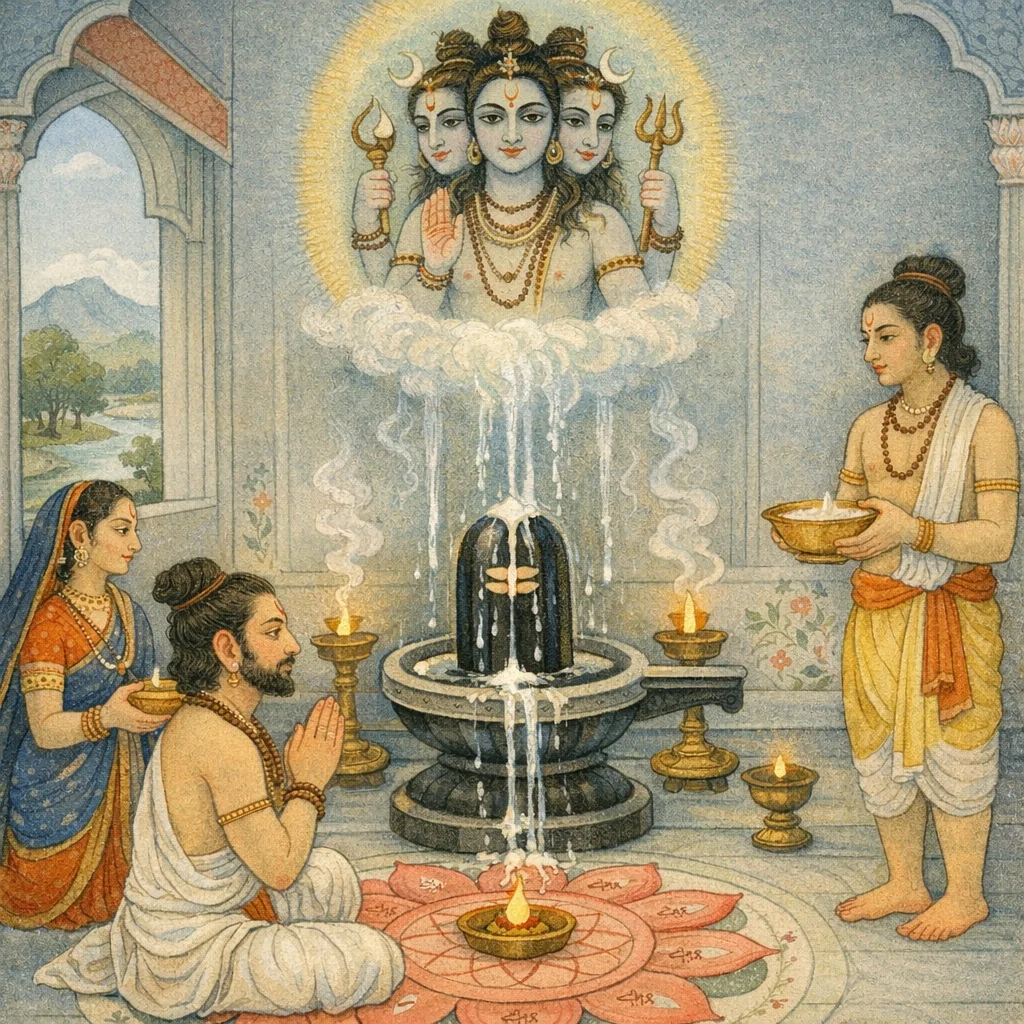
Śailādi sets out a concise liturgical order for liṅga worship: after bathing, the sādhaka enters the shrine, performs threefold prāṇāyāma, and meditates on Tryambaka in an ornamented pañcavaktra form. He then adopts the Śaiva body-conception, performs deha-śuddhi and mantra-nyāsa centered on praṇava and the pañcākṣarī, and prepares and consecrates the arcanā-sthāna and vessels (prokṣaṇī, arghya, pādya, ācamanīya) with cooled water, sandal, uśīra, camphor, flowers, grains, and bhasma. A padma-āsana is visualized with petals assigned to siddhis and cosmic placements, culminating in the Śiva-pīṭhikā; the deity is invoked and stabilized through pañcabrahma and related mantras, including Rudra-gāyatrī. Abhiṣeka is performed with scented waters, pañcagavya, ghee, honey, and sugarcane juice using purified vessels (gold/silver/copper, conch, earthen). Vedic and Śaiva sūktas for efficacious bathing are listed, followed by offerings (cloth, upavīta, gandha, dhūpa, dīpa, naivedya), circumambulation, and prostration. The chapter ends by announcing the next teaching’s shift from external (bāhya) to inner (ābhyantara) liṅgārcana, moving from ritual exactness toward inward realization of nishkala Śiva.
Shlokas
Verse 1
इति श्रीलिङ्गमहापुराणे पूर्वभागे पञ्चयज्ञविधानं नाम षड्विंशो ऽध्यायः शैलादिरुवाच वक्ष्यामि शृणु संक्षेपाल् लिङ्गार्चनाविधिक्रमम् वक्तुं वर्षशतेनापि न शक्यं विस्तरेण यत्
Thus ends, in the Pūrvabhāga of the Śrī Liṅga Mahāpurāṇa, the twenty-sixth chapter called “The Ordinance of the Five Sacrifices.” Śailādi said: “I shall declare—listen in brief—the ordered procedure of Liṅga-worship, for what cannot be fully spoken in detail even in a hundred years.”
Verse 2
एवं स्नात्वा यथान्यायं पूजास्थानं प्रविश्य च प्राणायामत्रयं कृत्वा ध्यायेद्देवं त्रियंबकम्
Thus, having bathed according to proper rule and entered the place of worship, one should perform the threefold prāṇāyāma and then meditate upon the God Tryambaka—Śiva, the Pati who, through yogic purity and worship, loosens the pāśa-bonds that bind the paśu.
Verse 3
पञ्चवक्त्रं दशभुजं शुद्धस्फटिकसन्निभम् सर्वाभरणसंयुक्तं चित्रांबरविभूषितम्
He is five-faced and ten-armed, radiant like flawless crystal—adorned with every ornament and beautified with splendid, variegated garments. Thus is Pati (Lord Śiva) to be contemplated: pure, luminous, and sovereign over all.
Verse 4
तस्य रूपं समाश्रित्य दाहनप्लावनादिभिः शैवीं तनुं समास्थाय पूजयेत्परमेश्वरम्
Taking refuge in that sacred form, and by means such as offerings to fire and ritual ablutions, assuming the Śaiva mode of being, one should worship Parameśvara—the Supreme Lord (Pati) who frees the paśu from the bonds of pāśa.
Verse 5
देहशुद्धिं च कृत्वैव मूलमन्त्रं न्यसेत् क्रमात् सर्वत्र प्रणवेनैव ब्रह्माणि च यथाक्रमम्
Having first performed bodily purification (deha-śuddhi), one should then, in due sequence, place (nyāsa) the root-mantra. Everywhere, the consecration is to be done with the Praṇava “Oṁ” alone, and the brahma-nyāsas are to be arranged in their proper order.
Verse 6
सूत्रे नमः शिवायेति छन्दांसि परमे शुभे मन्त्राणि सूक्ष्मरूपेण संस्थितानि यतस्ततः
Within the sacred thread of the mantra “Namaḥ Śivāya,” the Vedic metres (chandas) abide in the supremely auspicious Reality; and the mantras, in their subtle form, are established everywhere, arising and operating from all directions.
Verse 7
न्यग्रोधबीजे न्यग्रोधस् तथा सूत्रे तु शोभने महत्यपि महद्ब्रह्म संस्थितं सूक्ष्मवत्स्वयम्
Just as the vast nyagrodha (banyan) abides within the tiny nyagrodha-seed, and as the subtle thread exists within the shining cord, so too the Supreme Mahad-Brahman—Śiva, the Pati—remains established within the great (cosmic manifestation) itself, present by His own nature as the subtlest Reality.
Verse 8
सेचयेदर्चनस्थानं गन्धचन्दनवारिणा द्रव्याणि शोधयेत्पश्चात् क्षालनप्रोक्षणादिभिः
One should moisten the place of worship with water infused with fragrance and sandalwood; thereafter, one should purify the ritual materials by washing, sprinkling, and the other prescribed acts—so that the worship of Pati (Śiva) is performed in a state of outer and inner cleanliness that loosens the bonds (pāśa) of the pashu (the bound soul).
Verse 9
क्षालनं प्रोक्षणं चैव प्रणवेन विधीयते प्रोक्षणी चार्घ्यपात्रं च पाद्यपात्रम् अनुक्रमात्
The washing and the sprinkling are to be performed with the Pranava (Oṁ). Thereafter, in due order, one should arrange the vessel for sprinkling, the arghya vessel (offering-water), and the pādya vessel (water for the Lord’s feet).
Verse 10
तथा ह्याचमनीयार्थं कल्पितं पात्रमेव च स्थापयेद् विधिना धीमान् अवगुण्ठ्य यथाविधि
Likewise, for the purpose of sipping the sanctifying water (ācamanīya), the wise worshipper should duly place the prepared vessel, covering it in the prescribed manner, according to the ritual rule—so that the act of purification is fit for the worship of Pati (Lord Śiva).
Verse 11
दर्भैर् आच्छादयेच्चैव प्रोक्षयेच्छुद्धवारिणा तेषु तेष्वथ सर्वेषु क्षिपेत्तोयं सुशीतलम्
He should cover the ritual vessels and offerings with darbha grass and sprinkle them with pure water; thereafter, into each and every one he should pour well-cooled water, thus establishing ritual purity for the worship of Śiva’s Liṅga.
Verse 12
प्रणवेन क्षिपेत्तेषु द्रव्याण्यालोक्य बुद्धिमान् उशीरं चन्दनं चैव पाद्ये तु परिकल्पयेत्
Having sanctified the offerings with the Praṇava (Oṁ) and duly inspected them, the wise worshipper should prepare the foot-water (pādya) by mixing fragrant uśīra (vetiver) and sandalwood, making it fit for the Lord Pati in Liṅga-worship.
Verse 13
जातिकङ्कोलकर्पूरबहुमूलतमालकम् चूर्णयित्वा यथान्यायं क्षिपेदाचमनीयके
Having powdered jasmine, kankola (an aromatic berry), camphor, bahumūla (many-rooted fragrant herbs), and tamālaka according to ritual rule, one should place it into the ācamanīya water meant for sipping in the worship of Śiva.
Verse 14
एवं सर्वेषु पात्रेषु दापयेच्चन्दनं तथा कर्पूरं च यथान्यायं पुष्पाणि विविधानि च
In this manner, one should duly place sandalwood paste and camphor in all the ritual vessels, and—according to proper rule—offer flowers of various kinds as well.
Verse 15
कुशाग्रमक्षतांश्चैव यवव्रीहितिलानि च आज्यसिद्धार्थपुष्पाणि भसितं चार्घ्यपात्रके
In the arghya vessel (the offering cup), one should place the tips of kuśa grass, akṣata (unbroken rice grains), barley, rice, and sesame; also flowers together with siddhārtha (white mustard) made fit with ghee, and sacred ash—thus preparing the arghya for the worship of the Liṅga, the mark of Pati (Śiva).
Verse 16
कुशपुष्पयवव्रीहिबहुमूलतमालकम् दापयेत्प्रोक्षणीपात्रे भसितं प्रणवेन च
Into the vessel for ritual sprinkling (prokṣaṇī) one should place kuśa grass, flowers, barley, rice, many sacred roots, and tamālaka; then also place the sacred ash (bhasma), consecrating it with the Praṇava, Oṁ.
Verse 17
न्यसेत्पञ्चाक्षरं चैव गायत्रीं रुद्रदेवताम् केवलं प्रणवं वापि वेदसारमनुत्तमम्
One should perform nyāsa with the five-syllabled mantra, and also with the Gāyatrī whose deity is Rudra; or else with the Praṇava, Oṁ, alone—the unsurpassed essence of the Veda.
Verse 18
अथ संप्रोक्षयेत्पश्चाद् द्रव्याणि प्रणवेन तु प्रोक्षणीपात्रसंस्थेन ईशानाद्यैश् च पञ्चभिः
Then, afterwards, one should consecrate the ritual substances by sprinkling with the Praṇava, Oṁ, using the water set in the sprinkling vessel (prokṣaṇī), and also by employing the five (Brahma-)mantras beginning with Īśāna, thus making the offerings fit for the worship of Pati, Lord Śiva.
Verse 19
पार्श्वतो देवदेवस्य नन्दिनं मांसमर्चयेत् दीप्तानलायुतप्रख्यं त्रिनेत्रं त्रिदशेश्वरम्
At the side of the Deva of devas, Śiva, one should worship Nandin with a meat-offering—Nandin who shines like ten thousand blazing fires, the three-eyed lord of the hosts of the gods.
Verse 20
बालेन्दुमुकुटं चैव हरिवक्त्रं चतुर्भुजम् पुष्पमालाधरं सौम्यं सर्वाभरणभूषितम्
He is to be contemplated with the crescent moon as his diadem, bearing the face of Hari, four-armed, wearing a garland of flowers—gentle and auspicious—adorned with every ornament. Thus the yogin fixes the mind on Pati, the Lord who grants release to the bound paśu.
Verse 21
उत्तरे चात्मनः पुण्यां भार्यां च मरुतां शुभाम् सुयशां सुव्रतां चाम्बां पादमण्डनतत्पराम्
And to the north he had for himself a wife, meritorious and auspicious—a blessed consort connected with the Maruts—renowned, steadfast in sacred vows, revered as a mother, devoted to adorning and serving the Divine Feet.
Verse 22
एवं पूज्य प्रविश्यान्तर् भवनं परमेष्ठिनः दत्त्वा पुष्पाञ्जलिं भक्त्या पञ्चमूर्धसु पञ्चभिः
Thus having performed worship, he entered the inner mansion of Parameṣṭhin (Brahmā); and with devotion he offered a handful of flowers upon the five heads—one upon each.
Verse 23
गन्धपुष्पैस् तथा धूपैर् विविधैः पूज्य शङ्करम् स्कन्दं विनायकं देवीं लिङ्गशुद्धिं च कारयेत्
After worshipping Śaṅkara with fragrant substances, flowers, and various kinds of incense, one should also honor Skanda, Vināyaka, and the Devī, and then have the purification of the Liṅga performed.
Verse 24
जप्त्वा सर्वाणि मन्त्राणि प्रणवादिनमो ऽन्तकम् कल्पयेदासनं पश्चात् पद्माख्यं प्रणवेन तत्
Having recited all the mantras—beginning with the Praṇava (Oṃ) and concluding with the salutation—one should then arrange the seat; thereafter, by the power of the Praṇava, one should establish the lotus-named Padma āsana.
Verse 25
तस्य पूर्वदलं साक्षाद् अणिमामयम् अक्षरम् लघिमा दक्षिणं चैव महिमा पश्चिमं तथा
Of that mystic lotus (mandala), the eastern petal is verily the imperishable syllable embodying Aṇimā (the power of minuteness); the southern is Laghimā (lightness), and likewise the western is Mahimā (vastness).
Verse 26
प्राप्तिस्तथोत्तरं पत्रं प्राकाम्यं पावकस्य तु ईशित्वं नैरृतं पत्रं वशित्वं वायुगोचरे
‘Prāpti’—the power of unfailing attainment—belongs to the northern quarter; ‘Prākāmya’—the freedom to act as one wills—abides in the sphere of Fire. ‘Īśitva’, lordly mastery, pertains to the south‑western quarter, and ‘Vaśitva’, the power to subdue and bring under control, moves within the domain of Wind.
Verse 27
सर्वज्ञत्वं तथैशान्यं कर्णिका सोम उच्यते सोमस्याधस् तथा सूर्यस् तस्याधः पावकः स्वयम्
Omniscience and the Iśāna (northeast, sovereign) principle are said to abide in the karṇikā, the central core; there Soma is declared to preside. Below Soma is Sūrya, and below him indeed is Pāvaka (Agni) himself.
Verse 28
धर्मादयो विदिक्ष्वेते त्व् अनन्तं कल्पयेत्क्रमात् अव्यक्तादिचतुर्दिक्षु सोमस्यान्ते गुणत्रयम्
These principles beginning with Dharma are to be envisioned in the intermediate directions; then, in due sequence, Ananta is to be placed in the mind. In the four directions beginning with the Unmanifest (Avyakta), and at the end of Soma’s sphere, the three guṇas are to be contemplated. Thus the ordered cosmos is known as paśu, bound by prakṛti, while the Lord (Pati), Śiva, remains the transcendent ground of all placements.
Verse 29
आत्मत्रयं ततश्चोर्ध्वं तस्यान्ते शिवपीठिका सद्योजातं प्रपद्यामीत्य् आवाह्य परमेश्वरम्
Then, above the triad of the self, one should establish the Śiva‑seat; and at its end, invoking the Supreme Lord, one should call Him with the mantra, “I take refuge in Sadyojāta,” and thus invite Parameśvara (Śiva) to be present.
Verse 30
वामदेवेन मन्त्रेण स्थापयेदासनोपरि सान्निध्यं रुद्रगायत्र्या अघोरेण निरुध्य च
Using the Vāmadeva mantra, one should establish it upon the ritual seat; by the Rudra‑Gāyatrī one should invoke the Lord’s immediate presence, and by the Aghora mantra one should seal and restrain all obstacles, so the rite stands firmly secured.
Verse 31
ईशानः सर्वविद्यानाम् इति मन्त्रेण पूजयेत् पाद्यमाचमनीयं च विभोश्चार्घ्यं प्रदापयेत्
Worship the Liṅga of the all-pervading Lord with the mantra, “Īśānaḥ sarvavidyānām” (Īśāna is the source of all knowledges). Then offer water for washing the feet (pādya), water for ritual sipping (ācamanīya), and the honoring oblation (arghya) to that Mighty One.
Verse 32
स्नापयेद्विधिना रुद्रं गन्धचन्दनवारिणा पञ्चगव्यविधानेन गृह्य पात्रे ऽभिमन्त्र्य च
One should bathe Rudra in the prescribed manner with water infused with fragrance and sandalwood. And, according to the rite of pañcagavya, having taken it in a consecrated vessel, one should first sanctify it with mantras and then perform the ablution—thus honoring Pati (Śiva) and loosening the pāśa-bonds of the paśu (the soul).
Verse 33
प्रणवेनैव गव्यैस्तु स्नापयेच्च यथाविधि आज्येन मधुना चैव तथा चेक्षुरसेन च
Chanting the Praṇava (Oṁ) alone, one should bathe the Liṅga in the prescribed manner with the consecrants derived from the cow; also with ghee, with honey, and likewise with sugarcane juice. In this abhiṣeka, the paśu (bound soul) approaches Pati (Śiva) through disciplined rite, and the pāśas (bondages) are loosened by purity, devotion, and mantra.
Verse 34
पुण्यैर्द्रव्यैर्महादेवं प्रणवेनाभिषेचयेत् जलभाण्डैः पवित्रैस्तु मन्त्रैस्तोयं क्षिपेत्ततः
With sanctifying offerings one should bathe Mahādeva, consecrating the rite with the Praṇava (Oṁ). Then, using pure vessels of water, one should pour the water upon the Lord while reciting mantras.
Verse 35
शुद्धिं कृत्वा यथान्यायं सितवस्त्रेण साधकः कुशापामार्गकर्पूरजातिपुष्पकचम्पकैः
Having performed purification according to the prescribed rule, the practitioner—clad in a white garment—should proceed in worship with kuśa grass, apāmārga, camphor, jasmine blossoms, and campaka flowers.
Verse 36
करवीरैः सितैश्चैव मल्लिकाकमलोत्पलैः आपूर्य पुष्पैः सुशुभैः चन्दनाद्यैश् च तज्जलम्
That water for worship should be filled with auspicious blossoms—white karavīra, mallikā (jasmine), kamala (lotus) and utpala (blue-lotus)—and infused with sandalwood and kindred fragrances, so it becomes fit for abhiṣeka to the Liṅga of Pati, the Lord who frees the paśu from the bonds of pāśa.
Verse 37
न्यसेन्मन्त्राणि तत्तोये सद्योजातादिकानि तु सुवर्णकलशेनाथ तथा वै राजतेन वा
He should perform nyāsa, placing the mantras into that water—beginning with Sadyojāta and the others, the five Brahma-mantras—using a golden kalaśa, or indeed a silver one.
Verse 38
ताम्रेण पद्मपत्रेण पालाशेन दलेन वा शंखेन मृन्मयेनाथ शोधितेन शुभेन वा
Purification may be performed with a copper vessel, with a lotus leaf, with a palāśa leaf, with a conch-shell (śaṅkha), or with an auspicious earthen vessel that has been properly cleansed; all these are approved for the rite of Śiva’s liṅga-worship.
Verse 39
सकूर्चेन सपुष्पेण स्नापयेन्मन्त्रपूर्वकम् मन्त्राणि ते प्रवक्ष्यामि शृणु सर्वार्थसिद्धये
With a sacred kūrca of darbha-grass and with flowers, one should bathe (snāpana) the Liṅga, preceded by mantra-recitation. I shall now declare those mantras to you—listen, for the attainment of every aim (sarvārtha-siddhi).
Verse 40
यैर्लिङ्गं सकृदप्येवं स्नाप्य मुच्येत मानवः पवमानेन मन्त्रज्ञाः तथा वामीयकेन च
The knowers of mantra declare that a person is freed even by bathing the Liṅga just once in this manner—by employing the Pavamāna mantra, and likewise the Vāmīyaka mantra as well.
Verse 41
रुद्रेण नीलरुद्रेण श्रीसूक्तेन शुभेन च रजनीसूक्तकेनैव चमकेन शुभेन च
With the Rudra hymn, with the auspicious Nīlarudra, with the beneficent Śrī-sūkta, and likewise with the Rājanī-sūkta, and with the auspicious Camaka—thus should the worshipper perform the recitations in the rite of Śiva’s liṅga-worship.
Verse 42
होतारेणाथ शिरसा अथर्वेण शुभेन च शान्त्या चाथ पुनः शान्त्या भारुण्डेनारुणेन च
Then the worshipper should invoke auspiciousness through the Hotṛ, through the Śiras hymn, through the holy Atharva mantras, and through auspicious rites of pacification—again and again through Śānti—together with the Bhāruṇḍa and the Aruṇa as protective recitations, to remove obstacles and establish peace for Śiva’s worship.
Verse 43
वारुणेन च ज्येष्ठेन तथा वेदव्रतेन च तथान्तरेण पुण्येन सूक्तेन पुरुषेण च
And with the Varuṇa hymn, with the Jyeṣṭha hymn, with the observance of the Veda-vrata, and also with another holy chant—by the Puruṣa Sūkta as well—he should offer praise to the Supreme Pati, Śiva; for these Vedic utterances purify the paśu and loosen the pāśa of bondage.
Verse 44
त्वरितेनैव रुद्रेण कपिना च कपर्दिना आवोसजेति साम्ना तु बृहच्चन्द्रेण विष्णुना
Then, swiftly, Rudra—He who is Kapi, the tawny One, and Kapardin, the Lord of matted locks—was invoked through the Sāman “Āvosaje”; and likewise Viṣṇu, as Bṛhaccandra, the Great-Mooned One, praised Him by that chant.
Verse 45
विरूपाक्षेण स्कन्देन शतऋग्भिः शिवैस् तथा पञ्चब्रह्मैश् च सूत्रेण केवलप्रणवेन च
One may worship the Pati, Lord Śiva, by invoking Virūpākṣa and Skanda, by reciting the hundred Śiva-Ṛks, by the Pañcabrahma mantras, by the sacred sūtra (ritual formula/cord), and also by the Pranava “Oṁ” alone.
Verse 46
स्नापयेद्देवदेवेशं सर्वपापप्रशान्तये वस्त्रं शिवोपवीतं च तथा ह्याचमनीयकम्
For the pacification of all sins (pāpa) that bind the paśu (individual soul), one should bathe Devadeveśa, the Lord of gods, then offer cloth, the sacred thread (yajñopavīta) consecrated to Śiva, and likewise water for ācamana (ritual sipping).
Verse 47
गन्धं पुष्पं तथा धूपं दीपमन्नं क्रमेण तु तोयं सुगन्धितं चैव पुनराचमनीयकम्
In due order one should offer fragrance, flowers, incense, a lamp, and food; then fragrant water, and again water for ācamana (ritual sipping)—thus completing the sequence of worship to the Liṅga, the manifest sign of Pati (Śiva).
Verse 48
मुकुटं च शुभं छन्नं तथा वै भूषणानि च दापयेत्प्रणवेनैव मुखवासादिकानि च
He should offer a beautiful, well-covered crown, and likewise ornaments; and, with the Praṇava (Oṁ) itself, he should also present face-cloths and related articles for the Lord’s adornment.
Verse 49
ततः स्फटिकसंकाशं देवं निष्कलमक्षरम् कारणं सर्वदेवानां सर्वलोकमयं परम्
Then they beheld the Deva, crystal-like in radiance—partless, imperishable, the very Cause of all the gods—supreme, pervading and containing all worlds. He is Pati (Śiva), beyond all limiting attributes, yet present as the inner reality of the entire cosmos.
Verse 50
ब्रह्मेन्द्रविष्णुरुद्राद्यैर् ऋषिदेवैर् अगोचरम् वेदविद्भिर् हि वेदान्तैस् त्व् अगोचरमिति श्रुतिः
He is beyond the reach of Brahmā, Indra, Viṣṇu, Rudra and the rest, and also beyond the range of the Ṛṣis and the gods. Indeed, the knowers of the Veda, through the Vedānta, declare in Śruti: “That Supreme Pati is not an object of the senses—He is agocara.”
Verse 51
आदिमध्यान्तरहितं भेषजं भवरोगिणाम् शिवतत्त्वमिति ख्यातं शिवलिङ्गे व्यवस्थितम्
That Shiva-principle (Śiva-tattva)—without beginning, middle, or end—is renowned as the medicine for beings afflicted by the disease of worldly becoming; it abides established in the Śiva-liṅga.
Verse 52
प्रणवेनैव मन्त्रेण पूजयेल्लिङ्गमूर्धनि स्तोत्रं जपेच्च विधिना नमस्कारं प्रदक्षिणम्
With the Praṇava (Oṃ) alone as the mantra, one should worship the summit of the Liṅga; and, according to proper rule, recite hymns, perform prostration, and make circumambulation—thus completing the Śiva-pūjā that, through devotion to the Pati (Śiva), loosens the pāśa that binds the Paśu (soul).
Verse 53
अर्घ्यं दत्त्वाथ पुष्पाणि पादयोस्तु विकीर्य च प्रणिपत्य च देवेशम् आत्मन्यारोपयेच्छिवम्
Having offered arghya and then strewn flowers at His feet, one should bow down to the Lord of gods and, through inner contemplation, install Shiva within one’s own self—recognizing the Pati beyond all pāśa as the indwelling Reality of the Paśu (soul).
Verse 54
एवं संक्षिप्य कथितं लिङ्गार्चनमनुत्तमम् आभ्यन्तरं प्रवक्ष्यामि लिङ्गार्चनमिहाद्य ते
Thus, the unsurpassed worship of the Liṅga has been taught in brief. Now I shall declare to you, here and today, the inner (mental) worship of the Liṅga—through which the Paśu is loosened from pāśa and led toward the grace of Pati (Śiva).
Frequently Asked Questions
Praṇava (Om) is used throughout for purification and consecration; pañcākṣarī (“namaḥ śivāya”) and pañcabrahma-related mantras (with Rudra-gāyatrī) are employed for invocation, stabilization, and worship of the liṅga and Śiva’s presence.
It sacralizes the worship-seat as a cosmogram: the sādhaka situates ritual action within a graded metaphysical order, culminating in Śiva-pīṭhikā, so external worship aligns with inner ascent and integration.
By presenting abhiṣeka and mantra-recitation as pāpa-śamana and as a gateway to realizing Śiva as the nishkala, formless cause; the text explicitly transitions from outer ritual to the upcoming inner liṅgārcana, implying progressive interiorization toward mokṣa.