Adhyaya 5
Rudra’s Cosmic Dance and the Recognition of Rudra–Nārāyaṇa Unity (Īśvara-gītā Continuation)
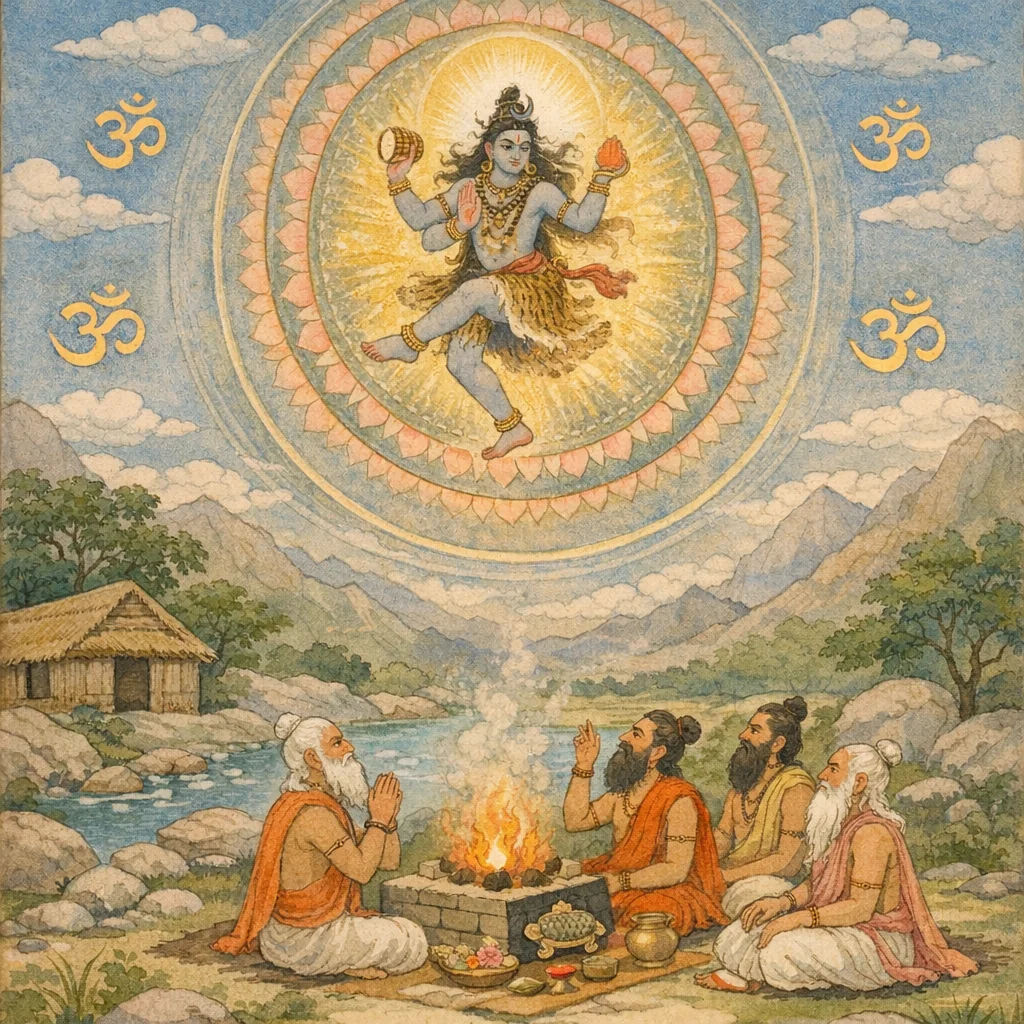
With the prior discourse explicitly brought to a close, Vyāsa relates that the Supreme Lord of yogins reveals a divine dance in the stainless sky. The brahmin sages behold Īśāna/Mahādeva with Viṣṇu present, and the vision unfolds in layered hymns: Rudra as the pure Light realized by yogins; as the awe-inspiring yet liberating cosmic form that pervades and transcends the brahmāṇḍa; and as Paśupati who dissolves fear born of ignorance. They then recognize Nārāyaṇa as faultless and identical in essence with Īśvara, feeling fulfilled as their spiritual aim is attained. A list of revered seers follows, after which they praise the Lord with Oṃ, declaring him the inner Self, the source of Brahmā (Hiraṇyagarbha), the origin and resting-place of the Vedas, and the One who appears as Rudra, Hari, Agni, Indra, Time, and Death. The Lord withdraws the transcendent form and abides in Prakṛti; astonished yet satisfied, the sages request further teaching on Śaṅkara’s greatness and eternal nature, preparing the next chapter.
Shlokas
Verse 1
इति श्रीकूर्मपुराणे षट्साहस्त्र्यां संहितायामुपरिविभागे (ईश्वरगीतासु) चतुर्थो ऽध्यायः व्यास उवाच एतावदुक्त्वा भगवान् योगिनां परमेश्वरः / ननर्त परमं भावमैश्वरं संप्रदर्शयन्
Thus, in the Śrī Kūrma Purāṇa, in the Ṣaṭsāhasrī Saṃhitā, in the latter division, within the Īśvara-gītā, the Fourth Chapter comes to its close. Vyāsa said: Having spoken thus much, the Blessed Lord—Parameśvara, the Supreme Lord of yogins—then danced the divine dance, revealing the highest, sovereign state of Lordship.
Verse 2
तं ते ददृशुरीशानं तेजसां परमं निधिम् / नृत्यमानं महादेवं विष्णुना गगने ऽमले
There they beheld Īśāna—Mahādeva, the supreme treasury of all splendors—dancing in the stainless sky, with Viṣṇu present beside him.
Verse 3
यं विदुर्योगतत्त्वज्ञा योगिनो यतमानसाः / तमीशं सर्वभूतानामाकशे ददृशुः किल
That Lord whom the yogins—knowers of Yoga’s true principle, with minds fully disciplined—realize: that very Īśvara, ruler of all beings, they indeed beheld in the sky.
Verse 4
यस्य मायामयं सर्वं येनेदं प्रेर्यते जगत् / नृत्यमानः स्वयं विप्रैर्विश्वेशः खलु दृश्यते
He to whom all this belongs as a manifestation of Māyā, and by whom this entire universe is set in motion—He, Viśveśvara, Lord of the cosmos—is indeed beheld by the brahmin sages as Himself dancing.
Verse 5
यत् पादपङ्कजं स्मृत्वा पुरुषो ऽज्ञानजं भयम् / जहति नृत्यमानं तं भूतेशं ददृशुः किल
Remembering the lotus of His feet, a person casts off the fear born of ignorance; indeed, they beheld that Bhūteśa (Śiva), Lord of beings, dancing.
Verse 6
यं विनिद्रा जितश्वासाः शान्ता भक्तिसमन्विताः / ज्योतिर्मयं प्रपश्यन्ति स योगी दृश्यते किल
He whom the yogins—free from sleep, masters of the breath, tranquil and filled with devotion—behold as the very form of pure Light: he indeed is known as the true yogin.
Verse 7
यो ऽज्ञानान्मोचयेत् क्षिप्रं प्रसन्नो भक्तवत्सलः / तमेव मोचकं रुद्रमाकाशे ददृशुः परम्
He who, gracious and tender toward his devotees, swiftly frees beings from ignorance—him alone they beheld in the sky as Rudra, the Supreme Liberator.
Verse 8
सहस्रशिरसं देवं सहस्रचरणाकृतिम् / सहस्रबाहुं जटिलं चन्द्रार्धकृतशेखरम्
I contemplate that divine Lord—of a thousand heads and the form of a thousand feet, of a thousand arms, matted-haired, and crowned with the crescent half-moon.
Verse 9
वसानं चर्म वैयाघ्रं शूलासक्तमहाकरम् / दण्डपाणिं त्रयीनेत्रं सूर्यसोमाग्निलोचनम्
Clad in a tiger-skin, bearing a mighty form with the trident set upon him, holding a staff in his hand—three-eyed, whose eyes are the Sun, the Moon, and Fire.
Verse 10
ब्रह्माण्डं तेजसा स्वेन सर्वमावृत्य च स्थितम् / दंष्ट्राकरालं दुर्धर्षं सूर्यकोटिसमप्रभम्
With his own radiance he pervaded and enveloped the entire brahmāṇḍa and stood there—terrifying with protruding fangs, unconquerable, blazing with a splendor equal to ten million suns.
Verse 11
अण्डस्थं चाण्डबाह्यस्थं बाह्यमभ्यन्तरं परम् / सृजन्तमनलज्वालं दहन्तमखिलं जगत् / नृत्यन्तं ददृशुर्देवं विश्वकर्माणमीश्वरम्
They beheld the Deva—Īśvara, Viśvakarman—abiding within the cosmic egg and also beyond it: the Supreme who is both outer and inner; who brings forth blazing tongues of fire and yet consumes the entire universe; and who, as Lord of all craft and creation, dances in sovereign power.
Verse 12
महादेवं महायोगं देवानामपि दैवतम् / पशूनां पतिमीशानं ज्योतिषां ज्योतिरव्ययम्
I bow to Mahādeva—the Great Yogi, the very divinity even of the gods; to Īśāna, the Lord of all beings, the Master of creatures (Paśupati), and the imperishable Light that is the light of all luminaries.
Verse 13
पिनाकिनं विशालाक्षं भेषजं भवरोगिणाम् / कालात्मानं कालकालं देवदेवं महेश्वरम्
I bow to Mahēśvara—the wielder of the Pināka bow, the wide‑eyed Lord—who is the medicine for those afflicted by the disease of worldly becoming; who is Time itself, the Death of Death (the conqueror of Time), the God of gods.
Verse 14
उमापतिं विरूपाक्षं योगानन्दमयं परम् / ज्ञानवैराग्यनिलयं ज्ञानयोगं सनातनम्
I worship the Lord of Umā, the three-eyed Virūpākṣa—supreme, made of the bliss of Yoga; the abiding seat of knowledge and dispassion; the eternal Yoga of wisdom itself.
Verse 15
शाश्वतैश्वर्यविभवं धर्माधारं दुरासदम् / महेन्द्रोपेन्द्रनमितं महर्षिगणवन्दितम्
He whose majesty is the manifestation of eternal sovereignty; the very support of Dharma; unassailable—bowed to by Mahendra (Indra) and Upendra (Vishnu); and revered by hosts of great sages.
Verse 16
आधारं सर्वशक्तीनां महायोगेश्वरेश्वरम् / योगिनां परमं ब्रह्म योगिनां योगवन्दितम् / योगिनां हृदि तिष्ठन्तं योगमायासमावृतम्
He is the ground of all powers, the Lord of the great Yogins and the sovereign of Yogic mastery. For Yogins, he is the Supreme Brahman—worshipped through Yoga itself. Abiding in the hearts of Yogins, he remains veiled by his own Yogamāyā.
Verse 17
क्षणेन जगतो योनिं नारायणमनामयम् / ईश्वरेणैकतापन्नमपश्यन् ब्रह्मवादिनः
In an instant, the brahma-speaking seers beheld Nārāyaṇa—faultless and free from affliction—the very womb of the universe, realized as one in essence with Īśvara.
Verse 18
दृष्ट्वा तदैश्वरं रूपं रुद्रनारायणात्मकम् / कृतार्थं मेनिरे सन्तः स्वात्मानं ब्रह्मवादिनः
Having beheld that sovereign, divine form whose very essence was Rudra and Nārāyaṇa as one, the holy sages—teachers of Brahman—felt their own Self fulfilled, as though their purpose had been accomplished.
Verse 19
सनत्कुमारः सनको भृगुश्च सनातनश्चैव सनन्दनश्च / रुद्रो ऽङ्गिरा वामदेवाथ शुक्रो महर्षिरत्रिः कपिलो मरीचिः
Sanatkumāra and Sanaka, Bhṛgu, and also Sanātana and Sanandana; Rudra, Aṅgiras, Vāmadeva, and Śukra; the great sage Atri, Kapila, and Marīci—these are counted among the revered seers.
Verse 20
दृष्ट्वाथ रुद्रं जगदीशितारं तं पद्मनाभाश्रितवामभागम् / ध्यात्वा हृदिस्थं प्रणिपत्य मूर्ध्ना बद्ध्वाञ्जलिं स्वेषु शिरःसु भूयः
Then, on beholding Rudra—the Lord who governs the worlds—whose left side was sheltered by Padmanābha (Viṣṇu), they meditated upon him as abiding within the heart; and bowing with the head, they again placed their joined palms in añjali upon their own heads in reverence.
Verse 21
ओङ्कारमुच्चार्य विलोक्य देवम् अन्तःशरीरे निहितं गुहायाम् / समस्तुवन् ब्रह्ममयैर्वचोभिर् आनन्दपूर्णायतमानसास्ते
Having uttered the syllable Oṃ and beholding the Divine—hidden within the inner body, in the cave of the heart—they praised Him with words filled with Brahman; and their minds expanded, wholly suffused with bliss.
Verse 22
मुनय ऊचुः त्वामेकमीशं पुरुषं पुराणं प्राणेश्वरं रुद्रमनन्तयोगम् / नमाम सर्वे हृदि सन्निविष्टं प्रचेतसं ब्रह्ममयं पवित्रम्
The sages said: You alone are the one Ishvara—the primeval Purusha, Lord of the life-breath, Rudra endowed with infinite Yoga. We all bow to that Pure Consciousness abiding in the heart, Pracetas, Awareness itself, constituted of Brahman and sanctifying.
Verse 23
त्वां पश्यन्ति मुनयो ब्रह्मयोनिं दान्ताः शान्ता विमलं रुक्मवर्णम् / ध्यात्वात्मस्थमचलं स्वे शरीरे कविं परेभ्यः परमं तत्परं च
The sages—self-restrained and tranquil—behold You, the womb and source of Brahman: stainless, golden-hued. Meditating on You as the inner Self, unmoving within their own body, they realize You as Kavi, the seer-poet, the Supreme beyond all others, and the final, highest goal itself.
Verse 24
त्वत्तः प्रसूता जगतः प्रसूतिः सर्वात्मभूस्त्वं परमाणुभूतः / अणोरणीयान् महतो महीयां- स्त्वामेव सर्वं प्रवदन्ति सन्तः
From You arises the very arising of the universe. You are the Self of all, present even as the subtlest atom. Smaller than the smallest and greater than the greatest—thus the wise declare that You alone are everything.
Verse 25
हिरण्यगर्भो जगदन्तरात्मा त्वत्तो ऽधिजातः पुरुषः पुराणः / संजायमानो भवता विसृष्टो यथाविधानं सकलं ससर्ज
Hiraṇyagarbha—the inner Self within the universe—was born forth from You, that primordial Purusha. Brought into being and projected by You, he then fashioned the whole of creation in accordance with the ordained order.
Verse 26
त्वत्तो वेदाः सकलाः संप्रसूता- स्त्वय्येवान्ते संस्थितिं ते लभन्ते / पश्यामस्त्वां जगतो हेतुभूतं नृत्यन्तं स्वे हृदये सन्निविष्टम्
From You all the Vedas arise in their fullness; and in You alone, at the end, they find their final resting-place. We behold You as the very cause of the universe—dancing in divine līlā, yet abiding within our own heart.
Verse 27
त्वयैवेदं भ्राम्यते ब्रह्मचक्रं मायावी त्वं जगतामेकनाथः / नमामस्त्वां शरणं संप्रपन्ना योगात्मानं चित्पतिं दिव्यनृत्यम्
By You alone the wheel of Brahmā—the revolving cycle of creation—is set in motion. You, the wielder of Māyā, are the one Lord of all worlds. We bow to You, having taken refuge in You—You whose very nature is Yoga, the Lord of Consciousness (Citpati), the Divine Dancer.
Verse 28
पश्यामस्त्वां परमाकाशमध्ये नृत्यन्तं ते महिमानं स्मरामः / सर्वात्मानं बहुधा सन्निविष्टं ब्रह्मानन्दमनुभूयानुभूय
We behold You in the supreme inner sky, where Your glory seems to dance; we contemplate it again and again. You are the Self of all, present in many ways within all beings—again and again we experience the bliss of Brahman.
Verse 29
ओङ्कारस्ते वाचको मुक्तिबीजं त्वमक्षरं प्रकृतौ गूढरूपम् / तत्त्वां सत्यं प्रवदन्तीह सन्तः स्वयंप्रभं भवतो यत्प्रकाशम्
Oṃ is Your very name-sign, the seed of liberation. You are the Imperishable (Akṣara), whose form lies hidden within Prakṛti. Here the realized saints declare You to be the Real—self-luminous—by whose radiance all things shine forth.
Verse 30
स्तुवन्ति त्वां सततं सर्ववेदा नमन्ति त्वामृषयः क्षीणदोषाः / शान्तात्मानः सत्यसंधा वरिष्ठं विशन्ति त्वां यतयो ब्रह्मनिष्ठाः
All the Vedas ceaselessly praise You; the ṛṣis, their faults worn away, bow to You. The tranquil-minded, firm in truth, enter into You—the Supreme—those disciplined ascetics (yatis) who are established in Brahman.
Verse 31
एको वेदो बहुशाखो ह्यनन्तस् त्वामेवैकं बोधयत्येकरूपम् / वेद्यं त्वां शरणं ये प्रपन्ना- स्तेषां शान्तिः शाश्वती नेतरेषाम्
The Veda is one, though it has countless branches; yet it teaches only You—the One, of a single essential nature. Those who know You as the supreme object of knowledge and take refuge in You attain eternal peace; not so the others.
Verse 32
भवानीशो ऽनादिमांस्तेजोराशिर् ब्रह्मा विश्वं परमेष्ठी वरिष्ठः / स्वात्मानन्दमनुभूयाधिशेते स्वयं ज्योतिरचलो नित्यमुक्तः
He is Bhavānī’s Lord (Śiva), beginningless and a mass of radiance—Brahmā, the universe itself, the supreme ordainer, the most excellent. Abiding in His own bliss of Self-realization, He reposes within Himself—self-luminous, unmoving, and eternally free.
Verse 33
एको रुद्रस्त्वं करोषीह विश्वं त्वं पालयस्यखिलं विश्वरूपः / त्वामेवान्ते निलयं विन्दतीदं नमामस्त्वां शरणं संप्रपन्नाः
You alone are Rudra; here you bring forth the universe, and you, of universal form, protect this entire creation. In the end, this world finds its resting-place in you alone. We bow to you—we have taken refuge in you.
Verse 34
त्वामेकमाहुः कविमेकरुद्रं प्राणं बृहन्तं हरिमग्निमीशम् / इन्द्रं मृत्युमनिलं चेकितानं धातारमादित्यमनेकरूपम्
You alone are proclaimed as the one Sage, the one Rudra; as the life-breath, the Vast One, Hari, Agni, and the Lord. You are Indra, Death, and the Wind; the all-knowing Intelligence; the Sustainer (Dhātṛ) and the Sun (Āditya)—the One who appears in countless forms.
Verse 35
त्वमक्षरं परमं वेदितव्यं त्वमस्य विश्वस्य परं निधानम् / त्वमव्ययः शाश्वतधर्मगोप्ता सनातनस्त्वं पुरुषोत्तमो ऽसि
You are the Imperishable—supreme and to be truly known. You are the highest refuge and final repository of this entire universe. You are the undecaying One, the guardian of the eternal Dharma; you are the Ancient (Beginningless) One—indeed, you are the Supreme Person (Puruṣottama).
Verse 36
त्वमेव विष्णुश्चतुराननस्त्वं त्वमेव रुद्रो भगवानधीशः / त्वं विश्वनाभिः प्रकृतिः प्रतिष्ठा सर्वेश्वरस्त्वं परमेश्वरो ऽसि
You alone are Viṣṇu; You are the four-faced Brahmā. You alone are Rudra—the Blessed Lord, the supreme ruler. You are the navel of the universe, the very ground of Prakṛti and its support. You are the Lord of all; indeed, You are the Supreme Lord (Parameśvara).
Verse 37
त्वामेकमाहुः पुरुषं पुराण- मादित्यवर्णं तमसः परस्तात् / चिन्मात्रमव्यक्तमचिन्त्यरूपं खं ब्रह्म शून्यं प्रकृतिं निर्गुणं च
You alone are proclaimed as the primordial Puruṣa—radiant like the sun, beyond the darkness of ignorance. You are pure consciousness itself: unmanifest, inconceivable in form. You are called “space,” “Brahman,” “the Void,” “Prakṛti,” and also “Nirguṇa,” beyond all qualities.
Verse 38
यदन्तरा सर्वमिदं विभाति यदव्ययं निर्मलमेकरूपम् / किमप्यचिन्त्यं तव रूपमेतत् तदन्तरा यत्प्रतिभाति तत्त्वम्
That within which all this universe shines forth—imperishable, stainless, and of one undivided form—this is Your form, truly inconceivable. Apart from That, no reality whatsoever is found to shine as the truth.
Verse 39
योगेश्वरं रुद्रमनन्तशक्तिं परायणं ब्रह्मतनुं पवित्रम् / नमाम सर्वे शरणार्थिनस्त्वां प्रसीद भूताधिपते महेश
We bow to Rudra, the Lord of Yoga, of endless power—our supreme refuge—whose very body is Brahman, the Pure. We all, seeking shelter, bow to You; be gracious, O Mahādeva, Lord and Master of beings.
Verse 40
त्वत्पादपद्मस्मरणादशेष- संसारबीजं विलयं प्रयाति / मनो नियम्य प्रणिधाय कायं प्रसादयामो वयमेकमीशम्
By remembering Your lotus-feet, the entire seed of worldly bondage is dissolved. Restraining the mind and steadying the body in devoted concentration, we seek to propitiate the one Lord alone, praying for Your grace (prasāda).
Verse 41
नमो भवायास्तु भवोद्भवाय कालाय सर्वाय हराय तुभ्यम् / नमो ऽस्तु रुद्राय कपर्दिने ते नमो ऽग्नये देव नमः शिवाय
Salutations to You as Bhava; salutations to the Source from whom beings arise; to Time itself; to the All; and to Hara, the Remover. Salutations to You as Rudra, the Lord of matted locks; salutations to You as Agni, O Deva—salutations again and again to Śiva.
Verse 42
ततः स भगवान् देवः कपर्दी वृषवाहनः / संहृत्य परमं रूपं प्रकृतिस्थो ऽभवद् भवः
Then that Blessed Lord—the matted-haired god who rides the Bull—having withdrawn His supreme (transcendent) form, became established in Prakṛti; thus Bhava (Śiva) remained in His natural, immanent state.
Verse 43
ते भवं भूतभव्येशं पूर्ववत् समवस्थितम् / दृष्ट्वा नारायणं देवं विस्मिता वाक्यमब्रुवन्
Seeing Nārāyaṇa—the divine Lord—standing as Bhava (Śiva), the Master of past and future, just as before, they were astonished and spoke these words.
Verse 44
भगवन् भूतभव्येश गोवृषाङ्कितशासन / दृष्ट्वा ते परमं रूपं निर्वृताः स्म सनातन
O Blessed Lord, Sovereign of past and future, whose command is marked by the cow and the bull—having beheld Your supreme form, we are utterly appeased and fulfilled, O Eternal One.
Verse 45
भवत्प्रसादादमले परस्मिन् परमेश्वरे / अस्माकं जायते भक्तिस्त्वय्येवाव्यभिचारिणी
By Your grace, O stainless Supreme Lord—O Parameśvara—there arises in us unwavering devotion directed to You alone, never straying elsewhere.
Verse 46
इदानीं श्रोतुमिच्छामो माहात्म्यं तव शङ्कर / भूयो ऽपि तव यन्नित्यं याथात्म्यं परमेष्ठिनः
Now we wish to hear of your greatness, O Śaṅkara; and again of your eternal, true nature—the very reality of the Supreme Lord, Parameṣṭhin.
Verse 47
स तेषां वाक्यमाकर्ण्य योगिनां योगसिद्धिदः / प्राहः गम्भीरया वाचा समालोक्य च माधवम्
Hearing the words of those yogins, the bestower of yogic attainments spoke in a deep, solemn voice; and all looked upon Mādhava, the Lord.
Frequently Asked Questions
It frames true yogins as wakeful, breath-mastering, tranquil, and devoted; through inner concentration and remembrance of the Lord’s lotus-feet, ignorance-born fear and the seed of bondage are dissolved, culminating in realization of the self-luminous Brahman as the inner Self.
The sages praise the Lord as pure Consciousness abiding in the heart-cave as the inner Self (antaryāmin); realization is described as entering into the Supreme, indicating a Vedāntic identity/grounding of the self in Brahman while retaining devotional surrender as the means of purification and approach.