Adhyaya 4
Īśvara-gītā: Bhakti as the Supreme Means; the Three Śaktis; Non-compelled Lordship
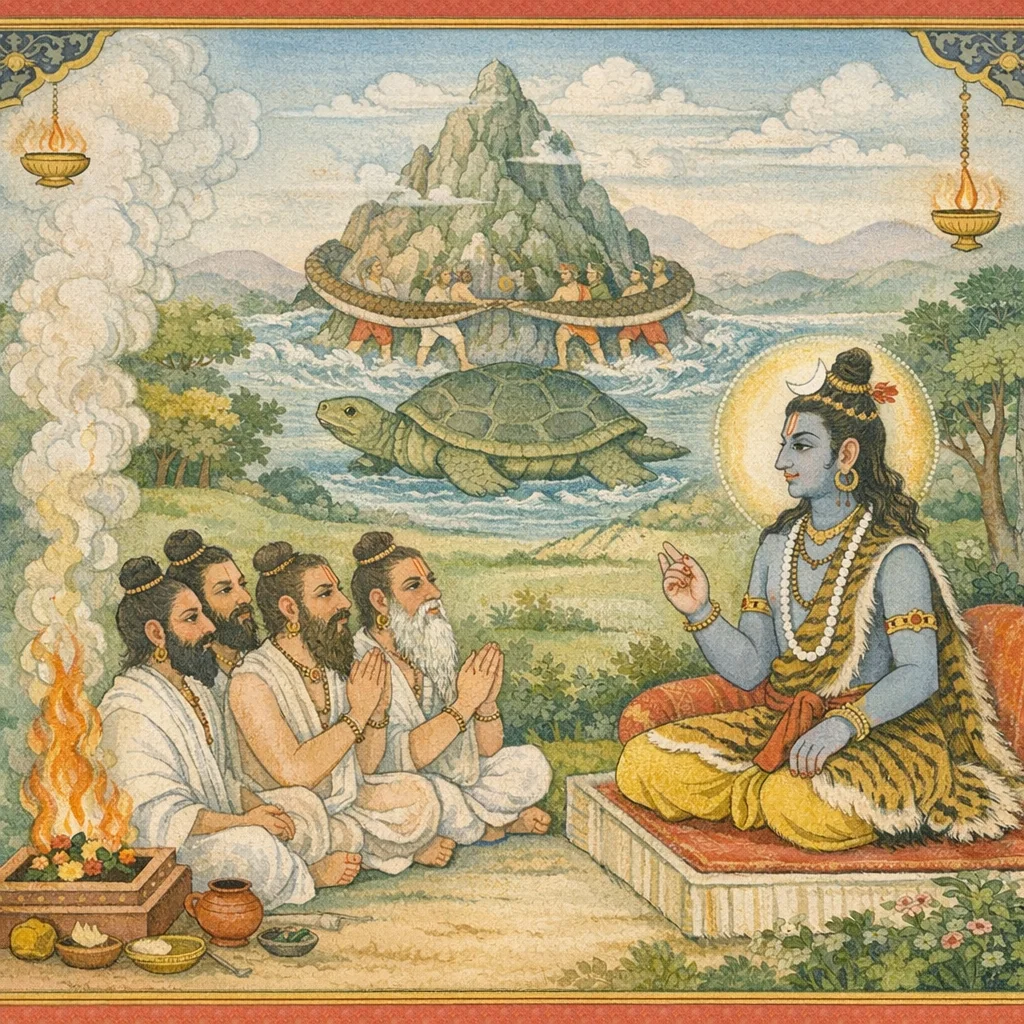
Closing the previous adhyāya, the Lord resumes His teaching, proclaiming the greatness of the God of gods from whom dharma and cosmic order arise. He declares that without unsurpassed bhakti His essence cannot be known through tapas, dāna, or ritual, though He is all-pervading and the inner Witness unseen by the world. Vedic praise and yajña are affirmed, yet their fruits are re-centered in the Lord alone as the sole enjoyer and giver of results. A decisive assurance is granted—“My devotee never comes to ruin”—and bhakti is made saving beyond social boundaries, even for those of wrong conduct, when devotion becomes steady. The Lord then describes Himself as guru, protector, and transcendent cause untouched by saṃsāra, introducing Māyā and the liberating Vidyā that destroys delusion in yogins’ hearts. A triadic śakti teaching follows—Brahmā for creation, Nārāyaṇa for sustenance, Rudra/Kāla for dissolution—preparing the Īśvara-gītā’s next movement toward higher yoga: nirvikalpa union, the Lord as inner impeller, and the guarded transmission of this Veda-rooted secret to qualified practitioners.
Shlokas
Verse 1
इति श्रीकूर्मपुराणे षट्साहस्त्र्यां संहितायामुपरिविभागे (ईश्वरगीतासु) तृतीयो ऽध्यायः ईश्वर उवाच वक्ष्ये समाहिता यूयं शृणुध्वं ब्रह्मवादिनः / माहात्म्यं देवदेवस्य येनेदं संप्रवर्तते
Thus, in the Śrī Kūrma Purāṇa, in the six-thousand-verse compendium, in the latter division—within the Īśvara-gītā—(this marks the close of the previous chapter). The Lord said: “Be composed and listen, O expounders of Brahman. I shall declare the greatness of the God of gods, by which this teaching and ordinance of dharma is set in motion.”
Verse 2
नाहं तपोभिर्विविधैर्न दानेन न चेज्यया / शक्यो हि पुरुषैर्ज्ञातुमृते भक्तिमनुत्तमाम्
I am not truly knowable by men through diverse austerities, nor by gifts, nor even by sacrificial worship; for without unsurpassed devotion (bhakti), I cannot be known.
Verse 3
अहं हि सर्वभावानामन्तस्तिष्ठामि सर्वगः / मां सर्वसाक्षिणं लोको न जानाति मुनीश्वराः
For I, all-pervading, abide within all states of being. Yet the world does not recognize Me—the Witness of all—O lords among sages.
Verse 4
यस्यान्तरा सर्वमिदं यो हि सर्वान्तरः परः / सो ऽहन्धाता विधाता च कालो ऽग्निर्विश्वतोमुखः
He within whom all this universe abides—He who is the supreme Inner Ruler dwelling within all—He alone is the establisher and the ordainer; He is Time itself, and the cosmic Fire, the One whose faces are turned in every direction.
Verse 5
न मां पश्यन्ति मुनयः सर्वे ऽपि त्रिदिवौकसः / ब्रह्मा च मनवः शक्रो ये चान्ये प्रथितौजसः
The sages do not behold Me—nor do all the dwellers of the three heavens; neither Brahmā, nor the Manus, nor Śakra (Indra), nor any other beings famed for their might.
Verse 6
गृणन्ति सततं वेदा मामेकं परमेश्वरम् / यजन्ति विविधैरग्निं ब्राह्मणा वैदिकैर्मखैः
The Vedas continually hymn Me alone as the one Supreme Lord; and the Brahmanas, through Veda-ordained sacrifices, worship the sacred fire in its many forms.
Verse 7
सर्वे लोका नमस्यन्ति ब्रह्मा लोकपितामहः / ध्यायन्ति योगिनो देवं भूताधिपतिमीश्वरम्
All the worlds bow down to Him; even Brahmā, the grandsire and progenitor of the worlds, pays homage. The yogins meditate upon that God—the Lord, the sovereign ruler of all beings.
Verse 8
अहं हि सर्वहविषां भोक्ता चैव फलप्रदः / सर्वदेवतनुर्भूत्वा सर्वात्मा सर्वसंस्थितः
For I alone am the enjoyer of all oblations and the bestower of their fruits. Having become the very body of all the gods, I am the Self of all beings and the One established in everything.
Verse 9
मां पश्यन्तीह विद्वांशो धार्मिका वेदवादिनः / तेषां सन्निहितो नित्यं ये भक्त्या मामुपासते
Here, the learned—righteous and devoted to the Veda—behold Me. I am ever present close to those who worship Me with devotion.
Verse 10
ब्राह्मणाः क्षत्रिया वैश्या धार्मिका मामुपासते / तेषां ददामि तत् स्थानमानन्दं परमं पदम्
Righteous Brāhmaṇas, Kṣatriyas, and Vaiśyas worship Me; to them I grant that abode—the supreme station of bliss, the highest goal.
Verse 11
अन्ये ऽपि ये विकर्मस्थाः शूद्राद्या नीचजातयः / भक्तिमन्तः प्रमुच्यन्ते कालेन मयि संगताः
Even those others who stand in wrong conduct—Śūdras and the like, people of low birth—if they are endowed with devotion, are in time released, having come into communion with Me.
Verse 12
न मद्भक्ता विनश्यन्ति मद्भक्ता वीतकल्मषाः / आदावेतत् प्रतिज्ञातं न मे भक्तः प्रणश्यति
My devotees do not perish; My devotees are free from sin. From the very beginning this has been declared as My vow: ‘My devotee never comes to ruin.’
Verse 13
यो वै निन्दति तं मूढो देवदेवं स निन्दति / यो हि तं पूजयेद् भक्त्या स पूजयति मां सदा
Whoever, in delusion, reviles Him—he truly reviles the Lord of gods. But whoever worships Him with devotion, he worships Me always.
Verse 14
पत्रं पुष्पं फलं तोयं मदाराधनकारणात् / यो मे ददाति नियतः स मे भक्तः प्रियो मतः
Whoever, with disciplined devotion and for the sake of worshipping Me, offers Me a leaf, a flower, a fruit, or water—such a person is regarded by Me as My devotee, dear to Me.
Verse 15
अहं हि जगतामादौ ब्रह्माणं परमेष्ठिनम् / विधाय दत्तवान् वेदानशेषानात्मनिः सृतान्
At the very dawn of the worlds, I appointed Brahmā, the Supreme Ordainer; and I bestowed upon him the entire Vedas, which had issued forth from within Myself.
Verse 16
अहमेव हि सर्वेषां योगिनां गुरुरव्ययः / धार्मिकाणां च गोप्ताहं निहन्ता वेदविद्विषाम्
I alone am the imperishable Guru of all yogins; I am the protector of the righteous, and the destroyer of those who hate the Veda.
Verse 17
अहं वै सर्वसंसारान्मोचको योगिनामिह / संसारहेतुरेवाहं सर्वसंसारवर्जितः
I alone am the liberator of yogins from every form of worldly bondage here. And I alone am called the cause of saṃsāra—yet I remain utterly untouched by all saṃsāra.
Verse 18
अहमेव हि संहर्ता स्त्रष्टाहं परिपालकः / मायावी मामीका शक्तिर्माया लोकविमोहिनी
I alone am the dissolver; I am the creator, and I am the protector. Endowed with wondrous power, Mine is that Shakti called Māyā, which deludes the worlds.
Verse 19
ममैव च परा शक्तिर्या सा विद्येति गीयते / नाशयामि तया मायां योगिनां हृदि संस्थितः
That supreme Power of Mine—praised as ‘Vidyā’ (saving Knowledge)—by that very Power, dwelling within the hearts of yogins, I destroy (their) māyā.
Verse 20
अहं हि सर्वशक्तीनां प्रवर्तकनिवर्तकः / आधारभूतः सर्वासां निधानममृतस्य च
I indeed am the one who sets all Śaktis into operation and who withdraws them again. I am the foundational support of them all, and I am also the treasury—the abiding repository—of immortality (Amṛta).
Verse 21
एका सर्वान्तरा शक्तिः करोति विविधं जगत् / आस्थाय ब्रह्माणो रूपं मन्मयी मदधिष्ठिता
One single, all-indwelling Power brings forth this manifold universe; assuming the form of Brahmā, She—composed of Me and established in Me—acts under My sovereign presiding presence.
Verse 22
अन्या च शक्तिर्विपुला संस्थापयति मे जगत् / भूत्वा नारायणो ऽनन्तो जगन्नाथो जगन्मयः
And another vast Power of Mine upholds and stabilizes the universe—becoming Nārāyaṇa, the Endless One, the Lord of the world, pervading the world as its very essence.
Verse 23
तृतीया महती शक्तिर्निहन्ति सकलं जगत् / तामसी मे समाख्याता कालाख्या रुद्ररूपिणी
The third, mighty Power dissolves the entire universe. She is declared by Me to be the tamasic Śakti—known as Kāla (Time), assuming the form of Rudra.
Verse 24
ध्यानेन मां प्रपश्यन्ति केचिज्ज्ञानेन चापरे / अपरे भक्तियोगेन कर्मयोगेन चापरे
Some behold Me through meditation (dhyāna); others through discriminative knowledge (jñāna). Yet others realize Me through the yoga of devotion (bhakti-yoga), and still others through the yoga of action (karma-yoga).
Verse 25
सर्वेषामेव भक्तानामिष्टः प्रियतरो मम / यो हि ज्ञानेन मां नित्यमाराधयति नान्यथा
Among all My devotees, dearest to Me is the one who worships Me continually through true knowledge—steadfast, unwavering, and not by any other way.
Verse 26
अन्ये च ये त्रयो भक्ता मदाराधनकाङ्क्षिणः / ते ऽपि मां प्राप्नुवन्त्येव नावर्तन्ते च वै पुनः
And those other three kinds of devotees who long to worship Me— they too surely attain Me, and indeed they do not return again (to repeated worldly birth).
Verse 27
मया ततमिदं कृत्सनं प्रधानपुरुषात्मकम् / मय्येव संस्थितं विश्वं मया संप्रेर्यते जगत्
By Me this entire universe—whose nature is Pradhāna (primordial matter) and Puruṣa (conscious spirit)—is pervaded. In Me alone the cosmos is established, and by Me the world is impelled into activity.
Verse 28
नाहं प्रेरयिता विप्राः परमं योगमाश्रितः / प्रेरयामि जगत्कृत्स्नमेतद्यो वेद सो ऽमृतः
O brāhmaṇa sages, established in the highest Yoga, I am not a compelled agent; rather, I impel this entire universe. Whoever truly knows this becomes deathless.
Verse 29
पश्याम्यशेषमेवेदं वर्तमानं स्वभावतः / करोति कालो भगवान् महायोगेश्वरः स्वयम्
I behold this entire universe as it proceeds according to its own inherent nature; yet it is Time—Bhagavān Himself, the great Lord of Yoga—who, of His own accord, brings it all to pass.
Verse 30
योगः संप्रोच्यते योगी माया शास्त्रेषु सूरिभिः / योगेश्वरो ऽसौ भगवान् महादेवो महान् प्रभुः
In the authoritative scriptures, the sages proclaim that Yoga itself is the Yogin, the wondrous Power called Māyā. He is the Lord of Yoga—Bhagavān Mahādeva, the Great Sovereign.
Verse 31
महत्त्वं सर्वतत्त्वानां परत्वात् परमेष्ठिनः / प्रोच्यते भगवान् ब्रह्मा महान् ब्रह्ममयो ऽमलः
Because Parameṣṭhin, the Cosmic Lord, stands as the supreme principle, the pre-eminence of all the tattvas is proclaimed. Thus Bhagavān Brahmā is spoken of as “Mahān,” formed of Brahman and stainless.
Verse 32
यो मामेवं विजानाति महायोगेश्वरेश्वरम् / सो ऽविकल्पेन योगेन युज्यते नात्र संशयः
Whoever thus knows Me as the Supreme Lord of the great Yogins becomes united with Me through nirvikalpa yoga; of this there is no doubt.
Verse 33
सो ऽहं प्रेरयिता देवः परमानन्दमाश्रितः / नृत्यामि योगी सततं यस्तद् वेद स वेदवित्
I am that very Deva—the inner Impeller—abiding in supreme bliss. Ever as a yogin I “dance,” that is, I sport in divine consciousness; whoever truly knows this is the real knower of the Veda.
Verse 34
इति गुह्यतमं ज्ञानं सर्ववेदेषु निष्ठितम् / प्रसन्नचेतसे देयं धार्मिकायाहिताग्नये
Thus this most secret knowledge—firmly grounded in all the Vedas—should be imparted only to one whose mind is serene, who is righteous in dharma, and who maintains the sacred fires.
Frequently Asked Questions
It prioritizes anuttamā bhakti (unsurpassed devotion) as indispensable; tapas, dāna, and yajña are declared insufficient by themselves without devotion, though Vedic worship remains affirmed as meaningful when oriented to the Lord.
Īśvara is presented as all-pervading inner ruler and Witness in whom the universe abides; He impels cosmic activity without being a compelled agent, remaining untouched by saṃsāra even while being named its causal ground through Māyā.
Māyā is the wondrous deluding śakti that projects worldly experience, while Vidyā is the praised saving power by which the Lord, dwelling in yogins’ hearts, destroys delusion and leads to liberation.
They are presented as forms assumed by the Lord’s powers: the creative śakti acts as Brahmā, the sustaining śakti becomes Nārāyaṇa pervading the world, and the dissolving tamasic śakti becomes Rudra as Kāla governing pralaya.