Adhyaya 6
Īśvara-gītā: Antaryāmin, Kāla, and the Divine Ordinance Governing Creation, Preservation, and Pralaya
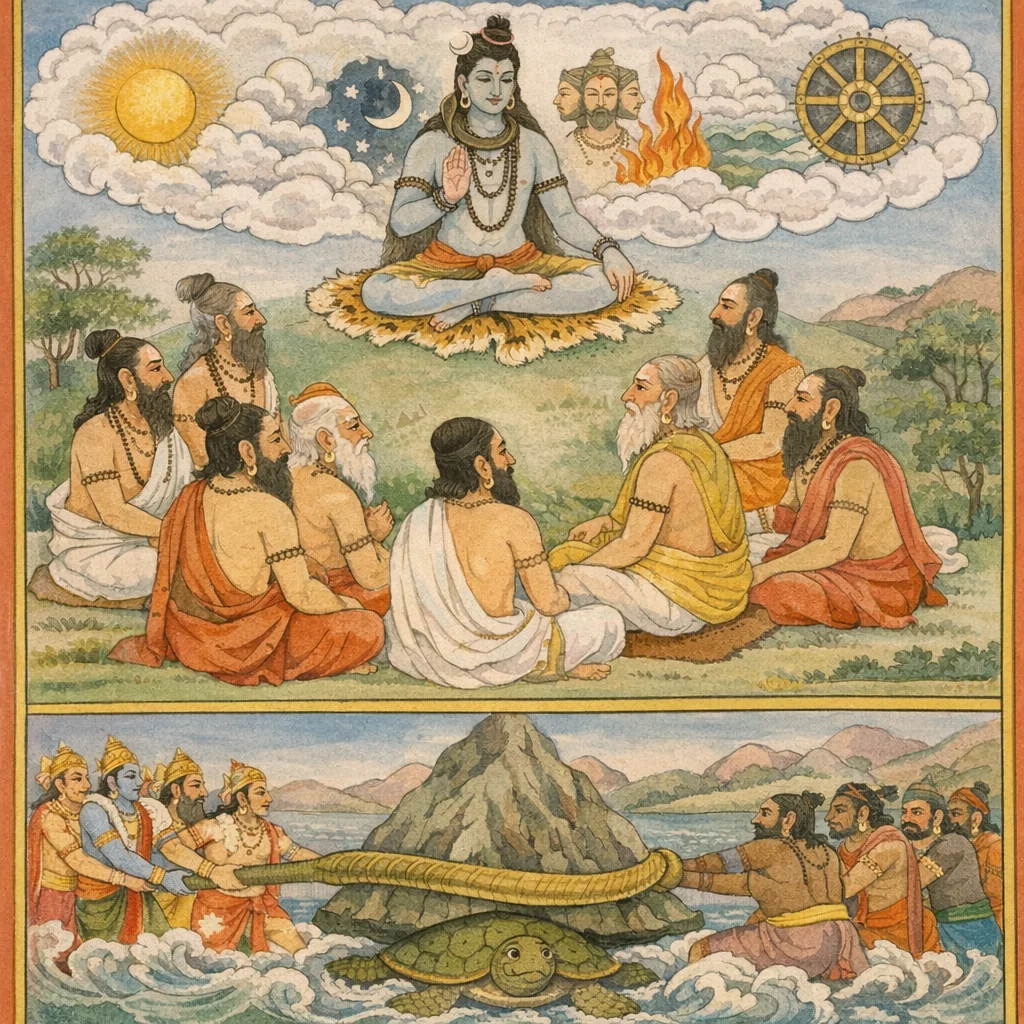
Continuing the Īśvara-gītā in the Uttara-bhāga, Īśvara addresses the assembled sages and proclaims the Veda-known truth that the Supreme Lord alone creates, protects, and dissolves all worlds. He explains that His manifest theophany is only an illustrative display wrought through Māyā, while in reality He abides as the antaryāmin—present at the very center of all beings without material diffusion. The chapter then sets forth a cosmological-theological sequence: the Lord’s kriyā-śakti drives all activity; kāla (Time) is His operative mode, moving the universe through its kalā-s. Creation begins when Māyā is set in motion and Pradhāna and Puruṣa are conjoined, unfolding the tattvas from Mahat onward. From the Lord arise Hiraṇyagarbha and Brahmā’s cosmic functions; by divine command Nārāyaṇa sustains and Rudra dissolves, establishing samanvaya between Vaiṣṇava and Śaiva roles. A long catalogue places deities, Manus, divisions of time, worlds, and countless brahmāṇḍas under the Lord’s ordinance, culminating in the declaration that all is His Śakti and that liberating knowledge, under Maheśa’s governance, frees the jīva from saṃsāra—preparing the next chapter to unfold the practical and contemplative implications of this supreme knowledge.
Shlokas
Verse 1
इति श्रीकूर्मपुराणे षट्साहस्त्र्यां संहितायामुपरिविभागे (ईश्वरगीतासु) पञ्चमो ऽध्यायः ईश्वर उवाच शृणुध्वमृषयः सर्वे यथावत् परमेष्ठिनः / वक्ष्यामीशस्य माहात्म्यं यत्तद्वेदविदो विदुः
Thus, in the Śrī Kūrma Purāṇa, in the six-thousand-verse compilation, in the latter division (within the Īśvara-gītā), the Fifth Chapter. Īśvara said: “Hear, all you sages, in the proper manner. I shall declare the greatness of the Lord—that reality which the knowers of the Veda truly know.”
Verse 2
सर्वलोकैकनिर्माता सर्वलोकैकरक्षिता / सर्वलोकैकसंहर्ता सर्वात्माहं सनातनः
I alone am the maker of all worlds, the sole protector of all worlds, and the sole dissolver of all worlds. I am the eternal Supreme Self, the inner Self of all.
Verse 3
सर्वेषामेव वस्तूनामन्तर्यामी पिता ह्यहम् / मध्ये चान्तः स्थितं सर्वं नाहं सर्वत्र संस्थितः
I am indeed the Antaryāmin, the inner ruler, and the father of all beings and all things. All this abides within Me—at the center and inwardly—yet I am not to be understood as merely dispersed everywhere like a material object.
Verse 4
भवद्भिरद्भुतं दृष्टं यत्स्वरूपं तु मामकम् / ममैषा ह्युपमा विप्रा मायया दर्शिता मया
O brahmins, the wondrous form of Mine that you have beheld is but an illustration of My own nature—an example that I Myself have shown you through My Māyā.
Verse 5
सर्वेषामेव भावानामन्तरा समवस्थितः / प्रेरयामि जगत् कृत्स्नं क्रियाशाक्तिरियं मम
Abiding in the very midst of all beings and all states of existence, I impel the entire universe into activity—this is My power of action (kriyā-śakti).
Verse 6
ययेदं चेष्टते विश्वं तत्स्वभावानुवर्ति च / सो ऽहं कालो जगत् कृत्स्नं प्रेरयामि कलात्मकम्
That by which this entire universe acts and moves, and by which it follows its own inherent nature—this I am: Time (Kāla). I impel the whole world, which is constituted of parts and powers (kalā-s).
Verse 7
एकांशेन जगत् कृत्स्नं करोमि मुनिपुङ्गवाः / संहराम्येकरूपेण द्विधावस्था ममैव तु
O best of sages, with but a single portion of Myself I bring forth this entire universe; and again, in My one undivided form I withdraw it. Thus My own state is twofold—manifestation and reabsorption.
Verse 8
आदिमध्यान्तनिर्मुक्तो मायातत्त्वप्रवर्तकः / क्षोभयामि च सर्गादौ प्रधानपुरुषावुभौ
Free from beginning, middle, and end, I set the principle of Māyā into motion; and at the very start of creation I stir both Pradhāna (primordial Nature) and Puruṣa (Consciousness).
Verse 9
ताभ्यां संजायते विश्वं संयुक्ताभ्यां परस्परम् / महदादिक्रमेणैव मम तेजो विजृम्भते
From those two—mutually conjoined with one another—this entire universe is born; and in the very sequence beginning with Mahat and the other tattvas, My divine radiance (tejas) unfolds and expands.
Verse 10
यो हि सर्वजगत्साक्षी कालचक्रप्रवर्तकः / हिरण्यगर्भो मार्तण्डः सो ऽपि मद्देहसंभवः
He who is the witness of the entire universe and the impeller of the wheel of Time—Hiraṇyagarbha and even Mārtaṇḍa, the Sun—even he arises from My own body.
Verse 11
तस्मै दिव्यं स्वमैश्वर्यं ज्ञानयोगं सनातनम् / दत्तवानात्मजान् वेदान् कल्पादौ चतुरो द्विजाः
To him He granted His own divine sovereignty and the eternal Yoga of knowledge; and at the beginning of the aeon He bestowed the four Vedas—born from Himself—upon the four twice-born sages.
Verse 12
स मन्नियोगतो देवो ब्रह्मा मद्भावभावितः / दिव्यं तन्मामकैश्वर्यं सर्वदा वहति स्वयम्
That god Brahmā—acting under My commission and imbued with My own being—ever bears by himself that divine sovereignty which is Mine.
Verse 13
स सर्वलोकनिर्माता मन्नियोगेन सर्ववित् / भूत्वा चतुर्मुखः सर्गं सृजत्येवात्मसंभवः
By My commission, the all-knowing Self-born One becomes the maker of all worlds; assuming the four-faced form, he indeed brings forth the creation.
Verse 14
यो ऽपि नारायणो ऽनन्तो लोकानां प्रभवाव्ययः / ममैव परमा मूर्तिः करोति परिपालनम्
Even that Nārāyaṇa—Ananta, the imperishable source of the worlds—is truly My own supreme manifestation, and it is He who carries out the protection and sustenance of creation.
Verse 15
यो ऽन्तकः सर्वभूतानां रुद्रः कालात्मकः प्रभुः / मदाज्ञयासौ सततं संहरिष्यति मे तनुः
Rudra—who is the Ender of all beings, the Lord whose very nature is Time—will, by My command, continuously withdraw (dissolve) My manifested form.
Verse 16
हव्यं वहति देवानां कव्यं कव्याशिनामपि / पाकं च कुरुते वह्निः सो ऽपि मच्छक्तिचोदितः
Agni carries the oblations meant for the gods, and he also conveys the offerings meant for the ancestors; he likewise performs the act of cooking—yet even that Fire is impelled only by My power.
Verse 17
भुक्तमाहारजातं च पचते तदहर्निशम् / वैश्वानरो ऽग्निर्भगवानीश्वरस्य नियोगतः
The blessed Vaiśvānara Fire digests the food that has been eaten, day and night—acting under the ordinance of the Lord (Īśvara).
Verse 18
यो ऽपि सर्वाम्भसां योनिर्वरुणो देवपुङ्गवः / सो ऽपि संजीवयेत् कृत्स्नमीशस्यैव नियोगतः
Even Varuṇa—the noble chief among the gods, the very source of all waters—can restore the whole world to life only by the command of the Supreme Lord (Īśa) alone.
Verse 19
यो ऽन्तस्तिष्ठति भूतानां बहिर्देवः प्रभञ्जनः / मदाज्ञयासौ भूतानां शरीराणि बिभर्ति हि
He who abides within all beings—and who, outside as well, moves as the divine Prabhañjana (Vāyu, the Wind)—by My command indeed sustains the bodies of living creatures.
Verse 20
यो ऽपि संजीवनो नॄणां देवानाममृताकरः / सोमः स मन्नियोगेन चोदितः किल वर्तते
Even Soma—who revives human beings and is, for the gods, a very mine of immortality—acts, it is said, only when impelled by My ordinance.
Verse 21
यः स्वभासा जगत् कृत्स्नं प्रकाशयति सर्वदा / सूर्यो वृष्टिं वितनुते शास्त्रेणैव स्वयंभुवः
He who, by His own innate radiance, ever illumines the entire universe—He, as the Sun, spreads the rains; and as the Self-born Lord, He ordains all by the authority of Śāstra alone.
Verse 22
यो ऽप्यशेषजगच्छास्ता शक्रः सर्वामरेश्वरः / यज्वनां फलदो देवो वर्तते ऽसौ मदाज्ञया
Even Śakra (Indra)—the ruler who governs the entire world and the lord of all the immortals—who grants the fruits of sacrifice to the sacrificers, acts only under My command.
Verse 23
यः प्रशास्ता ह्यसाधूनां वर्तते नियमादिह / यमो वैवस्वतो देवो देवदेवनियोगतः
He who, here in this world, acts as the chastiser of the unrighteous and enforces restraint through ordained rule—he is Yama, the god Vaivasvata, appointed to his office by the Lord of gods.
Verse 24
यो ऽपि सर्वधनाध्यक्षो धनानां संप्रदायकः / सो ऽपीश्वरनियोगेन कुबेरो वर्तते सदा
Even he who presides over all wealth and dispenses riches—Kubera—functions perpetually only by the Supreme Lord’s appointment.
Verse 25
यः सर्वरक्षसां नाथस्तामसानां फलप्रदः / मन्नियोगादसौ देवो वर्तते निरृतिः सदा
He who is the lord of all the Rākṣasas and the dispenser of results to those governed by tamas—by My appointment that very deity ever functions as Nirṛti.
Verse 26
वेतालगणभूतानां स्वामी भोगफलप्रदः / ईशानः किल भक्तानां सो ऽपि तिष्ठन्ममाज्ञया
He is the lord of the hosts of Vetālas, Gaṇas, and Bhūtas, and the giver of the fruits of enjoyment; he is indeed Īśāna to his devotees—yet even he abides, standing, by My command.
Verse 27
यो वामदेवो ऽङ्गिरसः शिष्यो रुद्रगणाग्रणीः / रक्षको योगिनां नित्यं वर्तते ऽसौ मदाज्ञया
That Vāmadeva—disciple of Aṅgiras and foremost among Rudra’s hosts—abides ever as the protector of yogins, acting according to My command.
Verse 28
यश्च सर्वजगत्पूज्यो वर्तते विघ्नकारकः / विनायको धर्मनेता सो ऽपि मद्वचनात् किल
Even he who is worshipped by the whole world, who functions as the maker of obstacles—Vināyaka, the guide of Dharma—does so, indeed, by My command.
Verse 29
यो ऽपि ब्रह्मविदां श्रेष्ठो देवसेनापतिः प्रभुः / स्कन्दो ऽसौ वर्तते नित्यं स्वयंभूर्विधिचोदितः
Even that Skanda—supreme among the knowers of Brahman, the mighty Lord and commander of the hosts of the gods—abides eternally, appointed and impelled to his office by the Self-born (Brahmā) according to divine ordinance.
Verse 30
ये च प्रजानां पतयो मरीच्याद्या महर्षयः / सृजन्ति विविधं लोकं परस्यैव नियोगतः
And those great seers—Marīci and the others—who are the lords and progenitors of creatures, bring forth the manifold worlds only by the command of the Supreme Lord.
Verse 31
या च श्रीः सर्वभूतानां ददाति विपुलां श्रियम् / पत्नी नारायणस्यासौ वर्तते मदनुग्रहात्
And that very Śrī (Lakṣmī) who bestows abundant prosperity upon all beings—she abides as the consort of Nārāyaṇa through My grace.
Verse 32
वाचं ददाति विपुलां या च देवी सरस्वती / सापीश्वरनियोगेन चोदिता संप्रवर्तते
That Goddess Sarasvatī—who bestows expansive, abundant speech—also proceeds into action when impelled by the Lord’s commission (niyoga) of Īśvara.
Verse 33
याशेषपुरुषान् घोरान्नरकात् तारयिष्यति / सावित्री संस्मृता देवी देवाज्ञानुविधायिनी
She who will deliver all beings—even the most dreadful—from hell: that Goddess Sāvitrī, when remembered, acts in accordance with the command of the gods.
Verse 34
पार्वती परमा देवी ब्रह्मविद्याप्रदायिनी / यापि ध्याता विशेषेण सापि मद्वचनानुगा
Pārvatī is the supreme Goddess, bestower of the knowledge of Brahman. Even she—though meditated upon in a distinctive and exalted way—acts in accordance with my word.
Verse 35
यो ऽनन्तमहिमानन्तः शेषो ऽशेषामरप्रभुः / दधाति शिरसा लोकं सो ऽपि देवनियोगतः
That Ananta—of endless glory, the infinite Śeṣa, lord of all the gods—bears the worlds upon his head; yet even he does so only by the ordinance of the Divine.
Verse 36
यो ऽग्निः संवर्तको नित्यं वडवारूपसंस्थितः / पिबत्यखिलमम्भोधिमीश्वरस्य नियोगतः
That fire which is ever the saṃvartaka (world-dissolving flame), abiding in the form of the Vaḍavā (the submarine mare-fire), drinks up the entire ocean by the command of Īśvara (the Supreme Lord).
Verse 37
ये चतुर्दश लोके ऽस्मिन् मनवः प्रथितौजसः / पालयन्ति प्रजाः सर्वास्ते ऽपि तस्य नियोगतः
And those fourteen Manus in this world—renowned for their mighty splendor—who protect all beings: they too do so only by His command and appointment.
Verse 38
आदित्या वसवो रुद्रा मरुतश्च तथाश्विनौ / अन्याश्च देवताः सर्वा मच्छास्त्रेणैव धिष्ठिताः
The Ādityas, the Vasus, the Rudras, the Maruts, and likewise the Aśvins—and all other deities as well—are established and governed solely by My Śāstra (divine ordinance).
Verse 39
गन्धर्वा गरुडा ऋक्षाः सिद्धाः साध्याश्चचारणाः / यक्षरक्षः पिशाचाश्च स्थिताः शास्त्रे स्वयंभुवः
Gandharvas, Garuḍas, Ṛkṣas, Siddhas, Sādhyas, and Cāraṇas—together with Yakṣas, Rākṣasas, and Piśācas—are each established in their proper stations by the sacred ordinance of Svayambhū, the Self-born Creator.
Verse 40
कलाकाष्ठानिमेषाश्च मुहूर्ता दिवसाः क्षपाः / ऋतवः पक्षमासाश्च स्थिताः शास्त्रे प्रजापतेः
Kalā, kāṣṭhā, nimeṣa, muhūrta, day and night; likewise the seasons, the fortnights (pakṣas), and the months—these divisions are established in the śāstra by the ordinance of Prajāpati.
Verse 41
युगमन्वन्तराण्येव मम तिष्ठन्ति शासने / पराश्चैव परार्धाश्च कालभेदास्तथा परे
The yugas and the manvantaras abide under My ordinance; likewise the higher measures and the half-of-the-higher—indeed all other divisions of time—exist in accordance with that rule.
Verse 42
चतुर्विधानि भूतानि स्थावराणि चराणि च / नियोगादेव वर्तन्ते देवस्य परमात्मनः
All beings—of fourfold kinds, both immobile and mobile—act and continue in their courses solely by the ordinance of the Divine Lord, the Supreme Self (Paramātman).
Verse 43
पातालानि च सर्वाणि भुवनानि च शासनात् / ब्रह्माण्डानि च वर्तन्ते सर्वाण्येव स्वयंभुवः
By the ordinance of Svayambhū, the Self-born, all the pātālas and all the bhuvanas—indeed all the brahmāṇḍas, the cosmic eggs—continue to function and remain in ordered motion.
Verse 44
अतीतान्यप्यसंख्यानि ब्रह्माण्डानि ममाज्ञया / प्रवृत्तानि पदार्थौघैः सहितानि समन्ततः
By My command, countless brahmāṇḍas—even those of former ages—have arisen into manifestation, filled on every side with torrents of created beings and the categories of existence.
Verse 45
ब्रह्माण्डानि भविष्यन्ति सह वस्तुभिरात्मगैः / वहिष्यन्ति सदैवाज्ञां परस्य परमात्मनः
The brahmāṇḍas shall come into being together with all their inherent constituents, and they shall forever bear and uphold the command of the Supreme Paramātman.
Verse 46
भूमिरापो ऽनलो वायुः खं मनो बुद्धिरेव च / भूतादिरादिप्रकृतिर्नियोगे मम वर्तते
Earth, water, fire, wind, space, mind, and intellect—together with the primordial source of beings, the first Prakṛti—all function under My ordinance.
Verse 47
याशेषजगतां योनिर्मोहिनी सर्वदेहिनाम् / माया विवर्तते नित्यं सापीश्वरनियोगतः
That Māyā—womb of the whole universe and deluder of all embodied beings—ever transforms and casts forth appearances, and she does so only under the ordinance of Īśvara, the Lord.
Verse 48
यो वै देहभृतां देवः पुरुषः पठ्यते परः / आत्मासौ वर्तते नित्यमीश्वरस्य नियोगतः
That Supreme Person—praised as the divine Lord within all embodied beings—abides eternally as the Self (Ātman), functioning in accordance with the ordinance of Īśvara.
Verse 49
विधूय मोहकलिलं यया पश्यति तत् पदम् / सापि विद्या महेशस्य नियोगवशवर्तिनी
That knowledge by which—shaking off the mire of delusion—one beholds the Supreme Abode: even that liberating Knowledge stands under the ordinance and governance of Mahādeva (Maheśa).
Verse 50
बहुनात्र किमुक्तेन मम शक्त्यात्मकं जगत् / मयैव प्रेर्यते कृत्स्नं मय्येव प्रलयं व्रजेत्
What is the use of saying much here? This entire universe is of the nature of My Śakti. By Me alone it is wholly impelled; and into Me alone it goes at the time of dissolution.
Verse 51
अहं हि भगवानीशः स्वयं ज्योतिः सनातनः / परमात्मा परं ब्रह्म मत्तो ह्यन्यन्न विद्यते
I alone am the Blessed Lord, the Sovereign; I am the eternal Light itself. I am the Supreme Self, the Supreme Brahman—apart from Me, nothing else exists.
Verse 52
इत्येतत् परमं ज्ञानं युष्माकं कथितं मया / ज्ञात्वा विमुच्यते जन्तुर्जन्मसंसारबन्धनात्
Thus I have declared to you this supreme knowledge. Having known it, a living being is released from the bondage of birth and worldly transmigration.
Frequently Asked Questions
Kāla is presented as the Lord Himself in an operative mode: the power by which the universe moves, acts according to svabhāva, and cycles through manifestation and reabsorption—governing kalā-s, yugas, and manvantaras under divine ordinance.
The Supreme is declared the inner Self (antaryāmin) of all beings; the cosmos is His Śakti and functions by His command. Liberation occurs when delusion is removed and the Supreme Abode is known through the liberating knowledge said to stand under Maheśa’s governance—implying a Vedāntic identity of the Self with the Supreme, expressed in devotional-theistic language.
It portrays Nārāyaṇa (Ananta) as the Lord’s supreme manifestation responsible for protection, while Rudra—whose nature is Time—performs dissolution by the same Lord’s command; Brahmā creates under commission. This integrates sectarian functions into a single supreme sovereignty.