Adhyaya 18
Daily Duties of Brāhmaṇas: Snāna, Sandhyā, Sūrya-hṛdaya, Japa, Tarpaṇa, and the Pañca-mahāyajñas
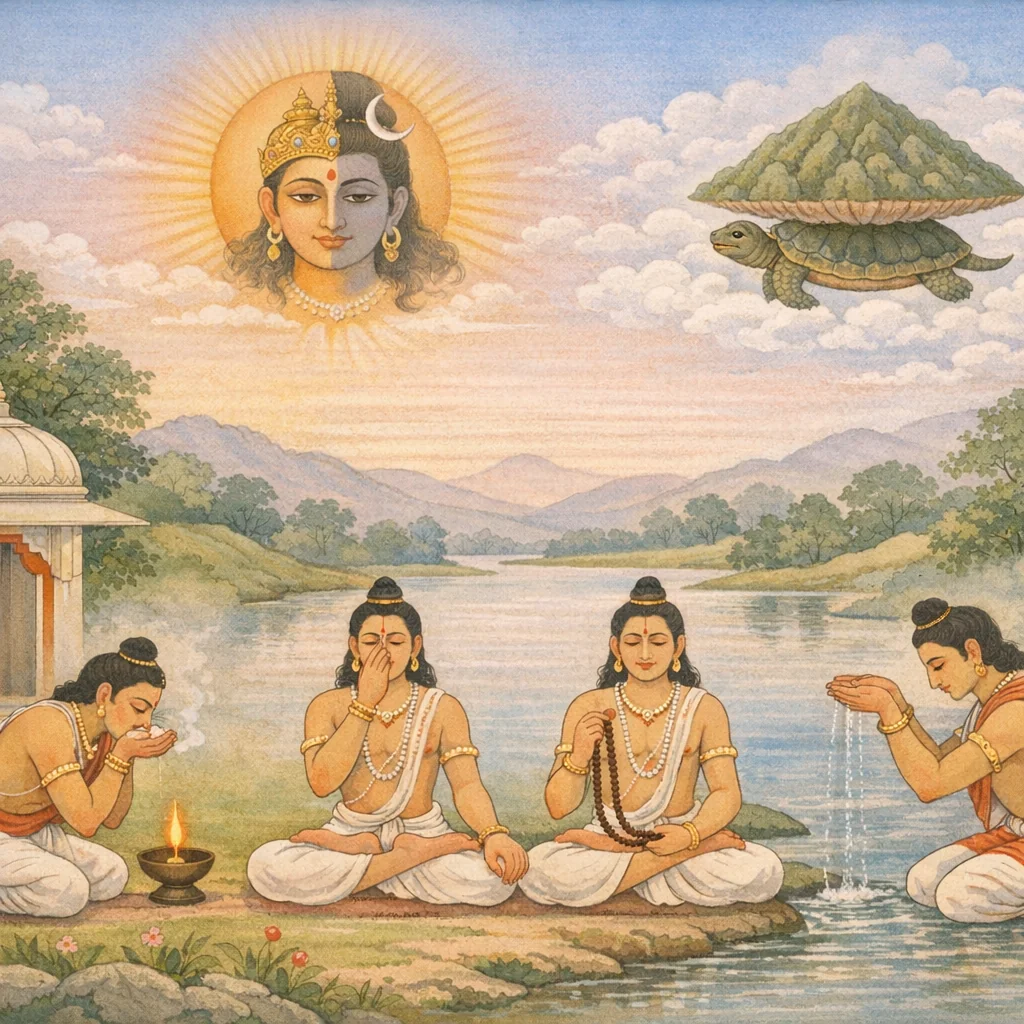
Continuing the sages’ inquiry into liberation through disciplined conduct, Vyāsa sets out the brāhmaṇa’s daily obligatory rites (nitya-karman) in a full day’s sequence. Beginning at brahma-muhūrta with contemplation, he moves through śauca and the primacy of morning bathing, teaching six forms of snāna—Brāhma, Āgneya, Vāyavya, Daiva, Vāruṇa, and the inner/yogic bath as Viṣṇu-contemplation and Self-realization. He then prescribes dental cleansing, repeated ācamana, mantra-consecration of water (Āpo hi ṣṭhā, the vyāhṛtis, Sāvitrī), and above all sandhyā-upāsanā, identifying Sandhyā metaphysically as Parā-Śakti beyond māyā and ritually detailing prāṇāyāma, japa counts, and solar attendance. A long Sūrya-hṛdaya hymn praises Sūrya as Brahman and also as Rudra, affirming Hari–Hara unity. The regimen continues with homa, guru-sevā, svādhyāya, midday bath rules (clay measures, Varuṇa-mantras, Aghamarṣaṇa), japa discipline (seclusion, impurity protocols, mālā materials), and tarpaṇa with sacred-thread positions (upavīta/nivīta/prācīnāvīta). It culminates in household worship and the pañca-mahāyajñas (deva, pitṛ, bhūta, manuṣya, brahma), warning that eating without these observances brings spiritual and karmic decline, thus linking daily dharma to yogic purity and sustained sādhanā.
Shlokas
Verse 1
इति श्रीकूर्मपुराणे षट्साहस्त्र्यां संहितायामुपरिविभागे सप्तदशो ऽध्यायः ऋषय ऊचुः अहन्यहनि कर्तव्यं ब्राह्मणानां महामुने / तदाचक्ष्वाखिलं कर्म येन मुच्येत बन्धनात्
Thus, in the Śrī Kūrma Purāṇa, in the Ṣaṭsāhasrī Saṃhitā of the Upari-bhāga, the Seventeenth Chapter begins. The sages said: “O great sage, declare in full the duties that Brahmins should perform day after day, by which one may be released from bondage.”
Verse 2
व्यास उवाच वक्ष्ये समाहिता यूयं शृणुध्वं गदतो मम / अहन्यहनि कर्तव्यं ब्राह्मणानां क्रमाद् विधिम्
Vyāsa said: “You who are composed and attentive—listen to my words as I speak. I shall declare, in due sequence, the daily rule of conduct that Brahmins are to perform day after day.”
Verse 3
ब्राह्मे मुहूर्ते तूत्थाय धर्ममर्थं च चिन्तयेत् / कायक्लेशं तदुद्भूतं ध्यायीत मनसेश्वरम्
Rising at Brahma-muhūrta, one should contemplate dharma and artha; and, reflecting on the bodily strain that arises therefrom, one should meditate upon the Lord who is the ruler of the mind.
Verse 4
उषः काले ऽथ संप्राप्ते कृत्वा चावश्यकं बुधः / स्नायान्नदीषु सुद्धासु शौचं कृत्वा यथाविधि
When the time of dawn has arrived, the wise person—having performed the necessary obligatory acts—should bathe in pure rivers and, according to rule, complete the prescribed purification (śauca).
Verse 5
प्रातः स्नानेन पूयन्ते ये ऽपि पापकृतो जनाः / तस्मात् सर्वप्रयत्नेन प्रातः स्नानं समाचरेत्
Even those people who have committed sins are purified by bathing in the early morning; therefore, with every effort one should regularly practice the morning bath.
Verse 6
प्रातः स्नानं प्रशंसन्ति दृष्टादृष्टकरं शुभम् / ऋषीणामृषिता नित्यं प्रातः स्नानान्न संशयः
The sages praise the morning bath as auspicious, bestowing benefits both seen and unseen. For the ṛṣis it is a constant, well-established observance—about the morning bath there is no doubt.
Verse 7
मुखे सुप्तस्य सततं लाला याः संस्त्रवन्ति हि / ततो नैवाचरेत् कर्म अकृत्वा स्नानमादितः
When one sleeps, saliva continually flows in the mouth; therefore one should not undertake any action—especially ritual duty—without first performing a purifying bath.
Verse 8
अलक्ष्मीः कालकर्णो च दुः स्वप्नं दुर्विचिन्तितम् / प्रातः स्नानेन पापानि पूयन्ते नात्र संशयः
Misfortune (Alakṣmī), the inauspicious spirit Kālakārṇa, bad dreams, and harmful or impure thoughts—by the morning bath, sins are cleansed away; of this there is no doubt.
Verse 9
न च स्नानं विना पुंसां पावनं कर्म सुस्मृतम् / होमे जप्ये विशेषेण तस्मात् स्नानं समाचरेत्
For men, no purificatory act is held to be truly purifying without bathing. Especially in fire-offerings (homa) and in the recitation of mantras, therefore one should duly perform bathing.
Verse 10
अशक्तावशिरस्कं वा स्नानमस्य विधीयते / आर्द्रेण वाससा वाथ मार्जनं कापिलं स्मृतम्
If one is unable (to perform the full rite) or is without hair on the head, bathing is prescribed for him; alternatively, wiping the body with a wet cloth is also remembered as the ‘Kāpila’ form of cleansing.
Verse 11
असामर्थ्ये समुत्पन्ने स्नानमेवं समाचरेत् / ब्राह्मादीनि यथाशक्तौ स्नानान्याहुर्मनीषिणः
When incapacity arises, one should perform the purificatory bath in this manner. The wise declare that the higher baths—beginning with the Brāhma-bath and the rest—are to be undertaken according to one’s ability.
Verse 12
ब्राह्ममाग्नेयमुद्दिष्टं वायव्यं दिव्यमेव च / वारुणं यौगिकं तद्वत् षोढा स्नानं प्रकीर्तितम्
The Brāhma-bath and the Āgneya-bath are taught; likewise the Vāyavya-bath, the Divine bath, the Vāruṇa-bath, and in the same way the Yogic bath—thus the bath is proclaimed to be sixfold.
Verse 13
ब्राह्मं तु मार्जनं मन्त्रैः कुशैः सोदकबिन्दुभिः / आग्नेयं भस्मना पादमस्तकाद्देहधूलनम्
The ‘Brāhma’ purification is the sprinkling (mārjana) performed with mantras, using kuśa grass together with drops of water; the ‘Āgneya’ purification is the cleansing of the body with sacred ash, from the feet up to the head.
Verse 14
गवां हि रजसा प्रोक्तं वायव्यं स्नानमुत्तमम् / यत्तु सातपवर्षेण स्नानं तद् दिव्यमुच्यते
The dust raised by cows is declared to be the finest ‘Vāyavya’ (wind-related) bath. But bathing by means of sun and rain—exposure to sunshine and rainfall—is called the ‘Divine’ bath.
Verse 15
वारुणं चावगाहस्तु मानसं त्वात्मवेदनम् / यौगिकं स्नानमाख्यातं योगो विष्णुविचिन्तनम्
Immersion in water is called the ‘Varuṇa-bath’; the ‘mental bath’ is the direct realization of the Self. The ‘yogic bath’ is declared to be Yoga—constant contemplation of Viṣṇu.
Verse 16
आत्मतीर्थमिति ख्यातं सेवितं ब्रह्मवादिभिः / मनः शुचिकरं पुंसां नित्यं तत् स्नानमाचरेत्
It is renowned as the “tīrtha of the Self” (ātma-tīrtha), revered and practiced by the knowers of Brahman. Since it purifies a person’s mind, one should constantly perform that inner bathing.
Verse 17
शक्तश्चेद् वारुणं विद्वान् प्राजापत्यं तथैव च / प्रक्षाल्य दन्तकाष्ठं वै भक्षयित्वा विधानतः
If a learned man is able, he should duly perform the Vāruṇa rite and likewise the Prājāpatya expiation; then, having washed the tooth-stick, he should chew/use it in accordance with the prescribed rule.
Verse 18
आचम्य प्रयतो नित्यं स्नानं प्रातः समाचरेत् / मध्याङ्गुलिसमस्थौल्यं द्वादशाङ्गुलसंमितम्
Having sipped water for purification (ācamana) and being self-controlled, one should regularly perform the morning bath. (The proper bathing place or water-depth is prescribed as) having a thickness equal to the middle finger and a measure of twelve finger-breadths.
Verse 19
सत्वचं दन्तकाष्ठं स्यात् तदग्रेण तु धावयेत् / क्षीरवृक्षसमुद्भूतं मालतीसंभवं शुभम् / अपामार्गं च बिल्वं च करवीरं विशेषतः
For cleaning the teeth, one should use a twig that has bark; with its tip one should brush. Auspicious twigs are those obtained from milky trees, as well as those from the mālatī (jasmine); and especially from apāmārga, bilva, and karavīra.
Verse 20
वर्जयित्वा निन्दितानि गृहीत्वैकं यथोदितम् / परिहृत्य दिनं पापं भक्षयेद् वै विधानवित्
Having avoided what is censured, one should accept only that single (permitted) item as prescribed; and, having set aside the sinful day, the knower of proper procedure should indeed eat according to rule.
Verse 21
नोत्पाटयेद्दन्तकाष्टंनाङ्गुल्या धावयेत् क्वचित् / प्रक्षाल्य भङ्क्त्वा तज्जह्याच्छुचौदेशे समाहितः
One should not yank out the tooth-stick, nor ever scrub the teeth with a finger. Having rinsed it, one should break it and discard it in a clean place, with the mind composed and collected.
Verse 22
स्नात्वा संतर्पयेद् देवानृषीन् पितृगणांस्तथा / आचम्य मन्त्रवन्नित्यं पुनराचम्य वाग्यतः
After bathing, one should duly satisfy the gods, the seers, and likewise the hosts of ancestors through offerings. Having performed ācamana with mantras each day, one should again perform ācamana and then restrain one’s speech.
Verse 23
संमार्ज्य मन्त्रैरात्मानं कुशैः सोदकबिन्दुभिः / आपो हिष्ठा व्याहृतिभिः सावित्र्या वारुणैः शुभैः
Having cleansed oneself with mantras—using kuśa grass sprinkled with drops of water—one should perform purification with the hymn “Āpo hi ṣṭhā,” with the vyāhṛtis, with the Sāvitrī (Gāyatrī), and with auspicious Varuṇa-mantras.
Verse 24
ओङ्कारव्याहृतियुतां गायत्रीं वेदमातरम् / जप्त्वा जलाञ्जलिं दद्याद् भास्करं प्रति तन्मनाः
Having recited the Gāyatrī—the Mother of the Vedas—joined with Oṁ and the vyāhṛtis, one should then offer an añjali of water to Bhāskara, the Sun, with the mind fixed upon him.
Verse 25
प्राक्कूलेषु समासीनो दर्भेषु सुसमाहितः / प्राणायामत्रयं कृत्वा ध्यायेत् संध्यामिति श्रुतिः
Seated on darbha grass upon the riverbank facing east, with the mind well-composed, one should perform the threefold prāṇāyāma and then meditate upon the Sandhyā—so declares the śruti.
Verse 26
या संध्या सा जगत्सूतिर्मायातीता हि निष्कला / ऐश्वरी तु पराशक्तिस्तत्त्वत्रयसमुद्भवा
That “Sandhyā” is the very womb of the universe—beyond Māyā, partless and without limit. She is the sovereign supreme Power, Parā-Śakti, from whom the triad of fundamental principles arises.
Verse 27
ध्यात्वार्ऽकमण्डलगतां सावित्रीं वै जपन् बुधः / प्राङ्मुखः सततं विप्रः संध्योपासनमाचरेत्
Having meditated on Sāvitrī as abiding within the orb of the Sun, the wise Brahmin—constantly facing east—should perform the worship of Sandhyā through japa.
Verse 28
संध्याहीनो ऽशुचिर्नित्यमनर्हः सर्वकर्मसु / यदन्यत् कुरुते किञ्चिन्न तस्य फलमाप्नुयात्
One who neglects the Sandhyā rites remains perpetually impure and becomes unfit for all sacred duties; whatever other act he may perform, he does not obtain its fruit.
Verse 29
अनन्यचेतसः शान्ता ब्राह्मणा वेदपारगाः / उपास्य विधिवत् संध्यां प्राप्ताः पूर्वं परां गतिम्
Single-minded and tranquil, the Brahmanas—masters of the Vedas—having duly worshipped Sandhyā according to rule, formerly attained the supreme state.
Verse 30
यो ऽन्यत्र कुरुते यत्नं धर्मकार्ये द्विजोत्तमः / विहाय संध्याप्रणतिं स याति नरकायुतम्
That foremost of the twice-born who strives elsewhere in religious duties while abandoning reverent worship at Sandhyā goes to the multitude of hells.
Verse 31
तस्मात् सर्वप्रयत्नेन संध्योपासनमाचरेत् / उपासितो भवेत् तेन देवो योगतनुः परः
Therefore, with every possible effort, one should perform the worship of Sandhyā (the twilight rites). By that practice the Supreme Deity—whose very form is Yoga—is truly worshipped.
Verse 32
सहस्रपरमां नित्यं शतमध्यां दशावराम् / सावित्ररिं वै जपेद् विद्वान् प्राङ्मुखः प्रयतः स्थितः
A learned person should regularly recite the Sāvitrī (Gāyatrī) mantra—ideally a thousand times, moderately a hundred times, or at minimum ten times—while standing purified and disciplined, facing east.
Verse 33
अथोपतिष्ठेदादित्यमुदयन्तं समाहितः / मन्त्रैस्तु विविधैः सौरेरृग्यजुः सामसंभवैः
Then, with a collected mind, one should stand in reverent attendance upon the rising Sun (Āditya), worshipping him with diverse solar mantras drawn from the Ṛg-, Yajur-, and Sāma-veda traditions.
Verse 34
उपस्थाय महायोगं देवदेवं दिवाकरम् / कुर्वोत प्रणतिं भूमौ मूर्ध्ना तेनैव मन्त्रतः
Having approached Divākara, the Sun—supreme in Yoga and the God of gods—one should perform a full prostration upon the earth, placing the head down, and do so with that very mantra.
Verse 35
ॐ खखोल्काय शान्ताय कारणत्रयहेतवे / निवेदयामि चात्मानं नमस्ते ज्ञानरूपिणे / नमस्ते घृणिने तुभ्यं सूर्याय ब्रह्मरूपिणे
Om. Salutations to You, the all-encompassing One, the Peaceful, the cause behind the threefold causal principles. I offer my very self to You—obeisance to You whose form is pure knowledge. Salutations to You, the compassionate Radiant One—to You, the Sun (Sūrya), whose very nature is Brahman.
Verse 36
त्वमेव ब्रह्म परममापो ज्योती रसो ऽमृतम् / भूर्भुवः स्वस्त्वमोङ्कारः सर्वे रुद्राः सनातनाः / पुरुषः सन्महो ऽतस्त्वां प्रणमामि कपर्दिनम्
You alone are the Supreme Brahman—water, light, essence, and the deathless amṛta. You are Bhūḥ, Bhuvaḥ, and Svaḥ; You are the syllable Oṃ. All the eternal Rudras are truly You. You are the Puruṣa, the Real, the Great; therefore I bow to You, O Kapardin, Lord of matted locks.
Verse 37
त्वमेव विश्वं बहुधा सदसत् सूयते च यत् / नमो रुद्राय सूर्याय त्वामहं शरणं गतः
You alone are the universe—manifesting in many ways as being and non-being, and as whatever is brought forth. Salutations to You as Rudra, as Sūrya; to You I have come for refuge.
Verse 38
प्रचेतसे नमस्तुभ्यं नमो मीढुष्टमाय ते / नमो नमस्ते रुद्राय त्वामहं शरणं गतः
Salutations to You, O Pracetas; salutations to You, the most bountiful Bestower. Again and again I bow to Rudra—unto You I have come for refuge.
Verse 39
हिरण्यबाहवे तुभ्यं हिरण्यपतये नमः / अम्बिकापतये तुभ्यमुमायाः पतये नमः
Salutations to You, O Golden-armed One; salutations to You, Lord of gold and prosperity. Salutations to You, consort of Ambikā; salutations to You, the husband of Umā.
Verse 40
नमो ऽस्तु नीलग्रीवाय नमस्तुभ्यं पिनाकिने / विलोहिताय भर्गाय सहस्राक्षाय ते नमः
Salutations to the Blue-necked One; salutations to You, bearer of the Pināka bow. Salutations to the Ruddy One, to Bharga—the Radiant destroyer of sin—and salutations to You, the thousand-eyed Lord.
Verse 41
नमो हंसाय ते नित्यमादित्याय नमो ऽस्तु ते / नमस्ते वज्रहस्ताय त्र्यम्बकाय नमो ऽस्तु ते
Everlasting salutations to You as Haṃsa; salutations to You as Āditya, the Sun. Salutations to You whose hand bears the vajra; salutations to You as Tryambaka, the Three‑eyed Lord.
Verse 42
प्रपद्ये त्वां विरूपाक्षं महान्तं परमेश्वरम् / हिरण्मयं गृहे गुप्तमात्मानं सर्वदेहिनाम्
I take refuge in You—Virūpākṣa, the many‑eyed (all‑seeing) One, the Great Lord, the Supreme Ruler, Parameśvara—who, golden in essence, abides hidden within the body as the Self of all embodied beings.
Verse 43
नमस्यामि परं ज्योतिर्ब्रह्माणं त्वां परां गतिम् / विश्वं पशुपतिं भीमं नरनारीशरीरिणम्
I bow to You—the Supreme Light, Brahman, the highest refuge and final goal. You are the universe itself; You are Paśupati, the awe‑inspiring Lord of all beings, whose form is both male and female.
Verse 44
नमः सूर्याय रुद्राय भास्वते परमेष्ठिने / उग्राय सर्वभक्ताय त्वां प्रपद्ये सदैव हि
Salutations to Sūrya—who is Rudra—radiant and supreme. To the fierce Lord, devoted to all (and compassionate to all), I take refuge in You indeed, always.
Verse 45
एतद् वै सूर्यहृदयं जप्त्वा स्तवमनुत्तमम् / प्रातः काले ऽथ मध्याह्ने नमस्कुर्याद् दिवाकरम्
Having recited this unsurpassed hymn called the Sun’s Heart (Sūrya‑hṛdaya), one should bow in reverence to Divākara, the Sun, at dawn and again at midday.
Verse 46
इदं पुत्राय शिष्याय धार्मिकाय द्विजातये / प्रदेयं सूर्यहृदयं ब्रह्मणा तु प्रदर्शितम्
This Sūryahṛdaya, revealed by Brahmā, should be bestowed upon one’s son or one’s disciple—upon a righteous twice-born— and not otherwise.
Verse 47
सर्वपापप्रशमनं वेदसारसमुद्भवम् / ब्राह्मणानां हितं पुण्यमृषिसङ्घैर्निषेवितम्
It pacifies all sins, born from the very essence of the Vedas; auspicious and holy, it promotes the welfare of the Brāhmaṇas and is practiced and upheld by assemblies of sages.
Verse 48
अथागम्य गृहं विप्रः समाचम्य यथाविधि / प्रज्वाल्य विह्निं विधिवज्जुहुयाज्जातवेदसम्
Then, having returned home, the brāhmaṇa should perform ācamana according to rule; and, kindling the sacred fire, he should duly offer oblations into Jātavedas (Agni), in the prescribed manner.
Verse 49
ऋत्विक्पुत्रो ऽथ पत्नी वा शिष्यो वापि सहोदरः / प्राप्यानुज्ञां विशेषेण जुहुयुर्वा यताविधि
With special authorization duly obtained, the officiating priest’s son—or else the wife, the disciple, or even a brother—may perform the oblations in accordance with the prescribed rite.
Verse 50
पवित्रपाणिः पूतात्मा शुक्लाम्बरधरोत्तरः / अनन्यमानसो वह्निं जुहुयात् संयतेन्द्रियः
With hands ritually purified and the inner self made pure, wearing a clean white garment and steady in the prescribed posture, one should offer oblations into the sacred fire with an undistracted mind and restrained senses.
Verse 51
विना दर्भेण यत्कर्म विना सूत्रेण वा पुनः / राक्षसं तद्भवेत् सर्वं नामुत्रेह फलप्रदम्
Any rite performed without darbha-grass, or again without the sacred thread (yajñopavīta), becomes wholly “rākṣasa” in character and yields no fruit—neither in this world nor in the next.
Verse 52
दैवतानि नमस्कुर्याद् देयसारान्निवेदयेत् / दद्यात् पुष्पादिकं तेषां वृद्धांश्चैवाभिवादयेत्
One should bow to the deities, present to them the finest of what is fit to be offered, offer flowers and the like, and likewise pay reverent salutations to elders.
Verse 53
गुरुं चैवाप्युपासीत हितं चास्य समाचरेत् / वेदाभ्यासं ततः कुर्यात् प्रयत्नाच्छक्तितो द्विजः
A twice-born should attend upon the guru with reverent service and do what is beneficial for him; thereafter, with earnest effort and according to his capacity, he should engage in the study and recitation of the Veda.
Verse 54
जपेदध्यापयेच्छिष्यान् धारयेच्च विचारयेत् / अवेक्षेत च शास्त्राणि धर्मादीनि द्विजोत्तमः / वैदिकांश्चैव निगमान् वेदाङ्गानि वेशिषतः
The best of the twice-born should practice sacred recitation (japa), teach his disciples, commit the teachings to memory, and reflect upon them. He should also examine the śāstras—beginning with Dharma—and, in particular, the Vedic Nigamas and the Vedāṅgas.
Verse 55
उपेयादीश्वरं चाथ योगक्षेमप्रसिद्धये / साधयेद् विविधानर्थान् कुटुम्बार्थे ततो द्विजः
Then, for the assured attainment of yoga and kṣema—welfare and security—the twice-born should approach the Lord (Īśvara) and thereafter pursue various lawful means of livelihood for the maintenance of the family.
Verse 56
ततो मध्याह्नसमये स्नानार्थं मृदमाहरेत् / पुष्पाक्षतान् कुशतिलान् गोमयं शुद्धमेव च
Then, at midday, for the sake of bathing, one should procure purifying earth (clay), together with flowers, akṣata (unbroken rice), kuśa grass and sesame, and also perfectly pure cow-dung.
Verse 57
नदीषु देवखातेषु तडागेषु सरःसु च / स्नानं समाचरेन्नित्यं गर्तप्रस्त्रवणेषु च
One should perform bathing daily in rivers, in sacred channels cut by the devas (deva-khāta), in ponds and lakes, and also in water-filled pits and in natural runnels or springs.
Verse 58
परकीयनिपानेषु न स्नायाद् वै कदाचन / पञ्चपिण्डान् समुद्धृत्य स्नायाद् वासंभवे पुनः
One should never bathe in watering-places that belong to others. If one must bathe again after touching a place of impurity, one should first lift out five lumps of earth and then bathe once more.
Verse 59
मृदैकया शिरः क्षाल्यं द्वाभ्यां नाभेस्तथोपरि / अधश्च तिसृभिः कायं पादौ षड्भिस्तथैव च
With one application of cleansing clay one should wash the head; with two, the region above the navel; with three, the body below the navel; and likewise with six, the feet.
Verse 60
मृत्तिका च समुद्दिष्टा त्वार्द्रामलकमात्रिका / गोमयस्य प्रमाणं तत् तेनाङ्गं लेपयेत् ततः
Clay is also prescribed—an amount equal to a moist āmalaka (Indian gooseberry). The same is the measure for cow-dung; with that one should then smear the body.
Verse 61
लेपयित्वा तु तीरस्थस्तल्लिङ्गैरेव मन्त्रतः / प्रक्षाल्याचम्य विधिवत् ततः स्नायात् समाहितः
Standing on the bank of the sacred ford, having applied the purificatory paste with those very liṅga-signs while reciting the mantras, one should rinse it off, perform ācamana according to rule, and thereafter bathe with a collected and steady mind.
Verse 62
अभिमन्त्र्य जलं मन्त्रैस्तल्लिङ्गैर्वारुणैः शुभैः / भावपूतस्तदव्यक्तं ध्यायन् वै विष्णुमव्ययम्
Having consecrated the water with auspicious Varuṇa-mantras, marked with their proper ritual signs, one whose inner disposition is purified should meditate upon that Unmanifest Reality—upon Viṣṇu, the imperishable.
Verse 63
आपो नारायणोद्भूतास्ता एवास्यायनं पुनः / तस्मान्नारायणं देवं स्नानकाले स्मरेद् बुधः
The waters arose from Nārāyaṇa, and those very waters are again His āyana, His resting-place. Therefore, at the time of bathing, the wise should remember the Lord Nārāyaṇa.
Verse 64
प्रोच्य सोंकारमादित्यं त्रिर्निमज्जेज्जलाशये / आचान्तः पुनराचामेन्मन्त्रेणानेन मन्त्रवित्
Having uttered the sacred syllable Oṁ together with the Sun as its divine support, one should immerse three times in a body of water. After performing ācamana, the knower of mantras should again perform ācamana with this very mantra.
Verse 65
अन्तश्चरसि भूतेषु गुहायां विश्वतो मुखः / त्वं यज्ञस्त्वं वषट्कार आपो ज्योती रसो ऽमृतम्
You move within all beings, dwelling in the heart-cave, facing everywhere. You are the yajña and you are the vaṣaṭ-call; you are the waters, the light, the essence, and amṛta—the nectar of immortality.
Verse 66
द्रुपदां वा त्रिरभ्यस्येद् व्याहृतिप्रणवान्विताम् / सावित्रीं वा जपेद् विद्वान् तथा चैवाघमर्षणम्
Alternatively, one should recite three times the three-footed Gāyatrī hymn, joined with the vyāhṛtis “bhūḥ, bhuvaḥ, svaḥ” and the Praṇava “Oṁ”. Or the learned should repeat in japa the Sāvitrī (Gāyatrī-mantra), and likewise the Aghamarṣaṇa, the sin-dispelling hymn.
Verse 67
ततः संमार्जनं कुर्यादापो हि ष्ठा मयोभुवः / इदमापः प्रवहत व्याहृतिभिस्तथैव च
Then one should perform the cleansing rite (by sprinkling and wiping), for the waters are indeed life-giving and bliss-bestowing. Saying, “These waters—flow forth!”, one should likewise perform it together with the vyāhṛtis.
Verse 68
ततो ऽभिमन्त्र्य तत् तीर्थमापो हिष्ठादिमन्त्रकैः / अन्तर्जलगतो मग्नो जपेत् त्रिरघमर्षणम्
Then, having ritually empowered that tīrtha with the water-mantras beginning with “Āpo hiṣṭhā…” and the like, one should submerge in the water. While immersed, one should recite the Aghamarṣaṇa three times to dispel sin.
Verse 69
त्रिपदां वाथ सावित्रीं तद्विष्णोः परमं पदम् / आवर्तयेद् वा प्रणवं देवं वा संस्मरेद्धरिम्
Or else, one should recite the three-footed Sāvitrī—“tad viṣṇoḥ paramaṃ padam,” the supreme station of Viṣṇu; or repeat the Praṇava “Oṁ”; or meditate upon the Lord, remembering Hari.
Verse 70
द्रुपदादिव यो मन्त्रो यजुर्वेदे प्रतिष्ठितः / अन्तर्जले त्रिरावर्त्य सर्वपापैः प्रमुच्यते
That mantra, established in the Yajurveda and beginning with “drupadā…”, when recited three times while immersed in water, frees one from all sins.
Verse 71
अपः पाणौ समादाय जप्त्वा वै मार्जने कृते / विन्यस्य मूर्ध्नि तत् तोयं मुच्यते सर्वपातकैः
Taking water into the hand and reciting the mantra prescribed for the rite of purificatory sprinkling (mārjana), then placing that sanctified water upon the crown of the head—one is freed from all sins.
Verse 72
यथाश्वमेधः क्रतुराट् सर्वपापापनोदनः / तथाघमर्षणं सूक्तं सर्वपापापनोदनम्
Just as the Aśvamedha—the imperial sacrifice, king among rites—removes all sins, so too the Aghamarṣaṇa hymn removes all sins.
Verse 73
अथोपतिष्ठेदादित्यं मूर्ध्नि पुष्पान्विताञ्जलिम् / प्रक्षिप्यालोकयेद् देवमुद्वयं तमसस्परि
Then one should stand in reverent attendance upon Āditya (the Sun), holding an añjali filled with flowers above the head; having offered them, one should gaze upon the rising Deity, who is beyond darkness.
Verse 74
उदुत्यं चित्रमित्येते तच्चक्षुरिति मन्त्रतः / हंसः शुचिषदेतेन सावित्र्या च विशेषतः
“Ud utyaṃ citram…” and likewise “Tac cakṣur…”—these are the mantras. By these, and most especially by the Sāvitrī (Gāyatrī), one should contemplate the Haṃsa—the Pure One abiding in the realm of light (the inner Self as ‘so’ham’).
Verse 75
अन्यैश्च वैदिकैर्मन्त्रैः सौरैः पापप्रणाशनैः / सावित्रीं वै जपेत् पश्चाज्जपयज्ञः स वै स्मृतः
And with other Vedic mantras—solar (Sūrya-related) and destructive of sin—one should thereafter recite the Sāvitrī (Gāyatrī). That, indeed, is remembered as the sacrifice performed through mantra-recitation (japa-yajña).
Verse 76
विविधानि पवित्राणि गुह्यविद्यास्तथैव च / शतरुद्रीयमथर्वशिरः सौरांश्च शक्तितः
(He teaches) various sacred purificatory rites, as well as the secret sciences of mantra; and, according to one’s capacity, the Śatarudrīya, the Atharvaśiras, and the solar (Saurā) hymns too.
Verse 77
प्राक्कूलेषु समासीनः कुशेषु प्राङ्मुखः शुचिः / तिष्ठंश्चेदीक्षमाणोर्ऽकं जप्यं कुर्यात् समाहितः
Seated on kuśa grass upon an eastward bank, facing east and purified—standing if required and gazing upon the Sun—one should perform the prescribed japa with a collected mind.
Verse 78
स्फाटिकेन्द्राक्षरुद्राक्षैः पुत्रजीवसमुद्भवः / कर्तव्या त्वक्षमाला स्यादुत्तरादुत्तमा स्मृता
An akṣamālā (rosary) should be made of crystal (sphāṭika), indrakṣa, and rudrākṣa beads, with a putrajīva bead as its source or leading bead. Such a rosary is remembered as superior—indeed, the best among the best.
Verse 79
जपकाले न भाषेत नान्यानि प्रेक्षयेद् बुधः / न कम्पयेच्छिरोग्रीवां दन्तान्नैव प्रकाशयेत्
At the time of mantra-japa, the wise practitioner should not speak and should not look about at other things. He should not shake his head or neck, and he should not display his teeth.
Verse 80
गुह्यका राक्षसा सिद्धा हरन्ति प्रसभं यतः / एकान्ते सुशुभे देशे तस्माज्जप्यं समाचरेत्
Because guhyakas, rākṣasas, and certain siddhas can forcibly disturb or even ‘carry away’ the fruit of one’s practice, therefore one should undertake mantra-japa in a secluded and auspicious place.
Verse 81
चण्डालाशौचपतितान् दृष्ट्वाचम्य पुनर्जपेत् / तैरेव भाषणं कृत्वा स्नात्वा चैव जपेत् पुनः
On seeing a caṇḍāla, an impure person, or one fallen from dharma, one should perform ācamana and then resume mantra-japa. But if one has spoken with them, one should bathe first, and only then recite again.
Verse 82
आचम्य प्रयतो नित्यं जपेदशुचिदर्शने / सौरान् मन्त्रान् शक्तितो वै पावमानीस्तु कामतः
Having performed ācamana and remaining disciplined, one should regularly do japa when encountering impurity. According to one’s capacity, one should recite the Saura (solar) mantras, and, as one wishes, the purificatory Pāvamānī verses as well.
Verse 83
यदि स्यात् क्लिन्नवासा वै वारिमध्यगतो जपेत् / अन्यथा तु शुचौ भूम्यां दर्भेषु सुसमाहितः
If one’s garments are wet, one should do japa while standing in the midst of water. Otherwise, one should do japa on clean ground, seated upon darbha grass, with the mind well-collected.
Verse 84
प्रदक्षिणं समावृत्य नमस्कृत्वा ततः क्षितौ / आचम्य च यथाशास्त्रं शक्त्या स्वाध्यायमाचरेत्
Having completed the circumambulation (pradakṣiṇā), one should bow down upon the ground. Then, after performing ācamana according to the śāstra’s injunctions, one should undertake recitation and study (svādhyāya) to the best of one’s capacity.
Verse 85
ततः संतर्पयेद् देवानृषीन् पितृगणांस्तथा / अदावोङ्कारमुच्चार्य नमो ऽन्ते तर्पयामि वः
Thereafter, one should offer tarpana—libations of water—to the gods, the ṛṣis, and likewise to the hosts of ancestors. Utter “Oṃ” at the beginning, and at the end say, “Namo; I satisfy you.”
Verse 86
देवान् ब्रह्मःऋषींश्चैव तर्पयेदक्षतोदकैः / तिलोदकैः पितॄन् भक्त्या स्वसूत्रोक्तविधानतः
He should offer tarpaṇa (water-libations) to the Devas and to the Brahman-sages with water containing unbroken grains of rice; and, with devotion, he should satisfy the Ancestors (pitṛs) with water mixed with sesame—exactly according to the rite taught in his own Gṛhya-sūtra.
Verse 87
अन्वारब्धेन सव्येन पाणिना दक्षिणेन तु / देवर्षोस्तर्पयेद् धीमानुदकाञ्जलिभिः पितन्
With the left hand set as support and the right hand employed, the wise should offer water-libations in joined handfuls, thereby satisfying the divine sages (deva-ṛṣis) and the Fathers (pitṛs).
Verse 88
यज्ञोपवीती देवानां निवीती ऋषीतर्पणे / प्राचीनावीती पित्र्ये तु स्वेन तीर्थेन भावतः
For offerings to the Devas one should wear the sacred thread (yajñopavīta) in the upavīta manner; for tarpaṇa to the Ṛṣis one should wear it in the nivīta manner; but for the ancestral (pitṛ) rite one should wear it in the prācīnāvīta manner—performing each act with its own prescribed tīrtha and with proper devotional intent.
Verse 89
निष्पीड्य स्नानवस्त्रं तु समाचम्य च वाग्यतः / स्वैर्मन्त्रैरर्चयेद् देवान् पुष्पैः पत्रैरथाम्बुभिः
After wringing out the bathing cloth and then performing ācamana while restraining speech, one should worship the deities with one’s own mantras—using flowers, leaves, or even water.
Verse 90
ब्रह्माणं शङ्करं सूर्यं तथैव मधुसूदनम् / अन्यांश्चाभिमतान् देवान् भक्त्या चाक्रोधनो ऽत्वरः
With devotion—free from anger and without haste—one should worship Brahmā, Śaṅkara, the Sun, and Madhusūdana (Viṣṇu), and likewise any other deities one reveres.
Verse 91
प्रदद्याद् वाथ पुष्पाणि सूक्तेन पौरुषेण तु / आपो वा देवताः सर्वास्तेन सम्यक् समर्चिताः
Or else, one should offer flowers while reciting the Puruṣa-sūkta. Truly, the Waters (Āpaḥ) are all the deities; by that hymn and rite they are worshipped rightly and in full.
Verse 92
ध्यात्वा प्रणवपूर्वं वै दैवतानि समाहितः / नमस्कारेण पुष्पाणि विन्यसेद् वै पृथक् पृथक्
Having first meditated—preceded by the sacred Praṇava (Oṁ)—upon the deities with a collected mind, one should place flowers as offerings with reverent salutations, separately for each deity.
Verse 93
न विष्ण्वाराधनात् पुण्यं विद्यते कर्म वैदिकम् / तस्मादनादिमध्यान्तं नित्यमाराधयेद्धरिम्
No Vedic rite yields merit equal to the worship of Viṣṇu. Therefore one should ever adore Hari—He who is without beginning, middle, or end.
Verse 94
तद्विष्णोरिति मन्त्रेण सूक्तेन पुरुषेण तु / नैताभ्यां सदृशो मन्त्रो सूक्तेन पुरुषेण तु / नैताभ्यां सदृशो मन्त्रो वेदेषूक्तश्चतुर्ष्वपि
By the mantra beginning “tad viṣṇoḥ” and by the hymn known as the Puruṣa-sūkta—within the four Vedas there is no mantra equal to these two. Indeed, among all Vedic utterances, none is comparable to the “tad viṣṇoḥ” mantra and the Puruṣa-sūkta.
Verse 95
निवेदयेत स्वात्मानं विष्णावमलतेजसि / तदात्मा तन्मनाः शान्तस्तद्विष्णोरिति मन्त्रतः
One should surrender one’s own self into Viṣṇu, whose radiance is stainless. With self and mind absorbed in Him, becoming tranquil, one should do so by the mantra “tad viṣṇoḥ”—“This belongs to Viṣṇu.”
Verse 96
अथवा देवमीशानं भगवन्तं सनातनम् / आराधयेन्महादेवं भावपूतो महेश्वरम्
Or else, with the mind purified by sincere devotion, one should worship the Lord—Īśāna, the Blessed and Eternal One—Mahādeva, Maheśvara.
Verse 97
मन्त्रेण रुद्रागायत्र्या प्रणवेनाथ वा पुनः / ईशानेनाथ वा रुद्रैस्त्र्यम्बकेन समाहितः
Becoming inwardly collected, one should enter meditative absorption by japa of the Rudra-Gāyatrī mantra, or by the Praṇava (Oṁ), or by the Īśāna mantra, or by the Rudra names/mantras—especially by the Tryambaka mantra.
Verse 98
पुष्पैः पत्रैरथाद्भिर्वा चन्दनाद्यैर्महेश्वरम् / उक्त्वा नमः शिवायेति मन्त्रेणानेन योजयेत्
With flowers, leaves, or even with water—using sandalwood and the like—one should worship Maheśvara; and, uttering “namaḥ śivāya,” one should offer each item accompanied by this mantra.
Verse 99
नमस्कुर्यान्महादेवं ऋतं सत्यमितिश्वरम् / निवेदयीत स्वात्मानं यो ब्रह्माणमितीश्वरम्
Let one bow to Mahādeva, the Lord declared to be Ṛta (cosmic order) and Satya (truth); and let the devotee offer up his very self, recognizing the Lord as Brahman.
Verse 100
प्रदक्षिणं द्विजः कुर्यात् पञ्च ब्रह्माणि वै जपन् / ध्यायीत देवमीशानं व्योममध्यगतं शिवम्
Let the twice-born perform circumambulation, indeed reciting the five Brahma-mantras; and let him meditate on the Lord Īśāna—Śiva—abiding in the midst of the sky, in the all-pervading ether.
Verse 101
अथावलोकयेदर्कं हंसः सुचिषदित्यृचा / कुर्यात् पञ्च महायज्ञान् गृहं गत्वा समाहितः
Then, with the mind made steady, he should gaze upon the Sun and recite the Aditya-verse beginning with “Haṃsaḥ, suciṣad…”. Thereafter, having returned home, he should duly perform the five great sacrifices (pañca‑mahāyajñas).
Verse 102
देवयज्ञं पितृयज्ञं भूतयज्ञं तथैव च / मानुष्यं ब्रह्मयज्ञं च पञ्च यज्ञान् प्रचक्षते
They declare five sacred duties (the five great sacrifices): the offering to the gods, the offering to the ancestors, the offering to living beings, the offering to human guests, and the offering to Brahman—svādhyāya, the study and reverent transmission of the Veda.
Verse 103
यदि स्यात् तर्पणादर्वाक् ब्रह्मयज्ञः कृतो न हि / कृत्वा मनुष्ययज्ञं वै ततः स्वाध्यायमाचरेत्
If, before the rite of tarpaṇa, the Brahma-yajña (the study/recitation of sacred knowledge) has not in fact been performed, then—having first completed the manuṣya-yajña (service to human beings and guests)—one should thereafter undertake svādhyāya (scriptural self-study).
Verse 104
अग्नेः पश्चिमतो देशे भूतयज्ञान्त एव वा / कुशपुञ्जे समासीनः कुशपाणिः समाहितः
Seated on a heap of kuśa grass, holding kuśa in his hand and composed in mind, he should sit either to the west of the sacred fire, or else at the conclusion of the bhūta-yajña (the offering to beings).
Verse 105
शालाग्नौ लौकिके वाग्नौ जले भूभ्यामथापिवा / वैश्वदेवं ततः कुर्याद् देवयज्ञः स वै स्मृतः
Then, in the household fire, or in an ordinary fire, or even in water or upon the ground, one should perform the Vaiśvadeva offering; that is indeed remembered as the Deva-yajña, the sacrifice offered to the gods.
Verse 106
यदि स्याल्लौकिके पक्वं ततो ऽन्नं तत्र हूयते / शालाग्नौ तत्र देवान्नं विधिरेष सनातनः
If the food has been cooked on the ordinary household fire, then that very cooked rice/food should be offered there; in the hall-fire (śālāgni) it becomes the gods’ portion—this is the eternal rule of ritual procedure.
Verse 107
देवेभ्यस्तु हुतादन्नाच्छेषाद् भूतबलिं हरेत् / भूतयज्ञः स वै ज्ञेयो भूतिदः सर्वदेहिनाम्
After offering the food into the sacred fire for the gods, one should set aside from the remaining portion an offering (bali) for living beings. This is indeed known as the Bhūta-yajña, for it bestows welfare upon all embodied creatures.
Verse 108
श्वभ्यश्च श्वपचेभ्यश्च पतितादिभ्य एव च / दद्याद् भूमौ बलिं त्वन्नं पक्षिभ्यो ऽथ द्विजोत्तमः
And the best of the twice-born should place on the ground a portion of the food as a bali-offering—giving it to dogs, to outcastes (dog-eaters), and also to the fallen and the like; and then (he should offer) food to the birds as well.
Verse 109
सायं चान्नस्य सिद्धस्य पत्न्यमन्त्रं बलिं हरेत् / भूतयज्ञस्त्वयं नित्यं सायं प्रातर्विधीयते
In the evening, after the food has been cooked, one should offer a bali (portion of food) with the wife’s mantra. This offering is the Bhūta-yajña, and it is to be performed daily—both in the evening and in the morning.
Verse 110
एकं तु भोजयेद् विप्रं पितॄनुद्दिश्य सत्तमम् / नित्यश्राद्धं तदुद्दिष्टं पितृयज्ञो गतिप्रदः
But one should feed even a single excellent brāhmaṇa, dedicating it to the Pitṛs (ancestors). That is declared to be the ‘daily śrāddha’; it is a Pitṛ-yajña that grants auspicious passage (gati).
Verse 111
उद्धृत्य वा यथाशक्ति किञ्चिदन्नं समाहितः / वेदतत्त्वार्थविदुषे द्विजायैवोपपादयेत्
Or else, with the mind composed, he should, according to his ability, set aside a small portion of food and duly offer it to a twice-born Brāhmaṇa who knows the true meaning and purport of the Veda.
Verse 112
पूजयेदतिथिं नित्यं नमस्येदर्चयेद् द्विजम् / मनोवाक्कर्मभिः शान्तमागतं स्वगृह ततः
One should always honor the guest, and bow and worship the twice-born Brāhmaṇa. Then, having received the peaceful one who has come to one’s home, one should serve him with calmness of mind, speech, and action.
Verse 113
हन्तकारमथाग्रं वा भिक्षां वा शक्तितो द्विजः / दद्यादतिथये नित्यं बुध्येत परमेश्वरम्
A twice-born man should, according to his ability, regularly give to a guest either food prepared in his household or alms; and in doing so he should recognize and contemplate the Supreme Lord (Parameśvara) as present in that guest.
Verse 114
भिक्षामाहुर्ग्रासमात्रमग्रं तस्याश्चतुर्गुणम् / पुष्कलं हन्तकारं तु तच्चतुर्गुणमुच्यते
They declare that the foremost measure of alms is a single mouthful; a “full” portion is said to be four times that. But the “abundant” gift—excessive to the point of becoming harmful—is described as four times even that full portion.
Verse 115
गोदोहमात्रं कालं वै प्रतीक्ष्यो ह्यतिथिः स्वयम् / अभ्यागतान् यथाशक्ति पूजयेदतिथिं यथा
An atithi (unexpected guest) should, of his own accord, wait only for the time it takes to milk a cow; and the householder, according to his capacity, should honor and worship the guest who has arrived.
Verse 116
भिक्षां वै भिक्षवे दद्याद् विधिवद् ब्रह्मचारिणे / दद्यादन्नं यथाशक्ति त्वर्थिभ्यो लोभवर्जितः
One should duly give alms to a mendicant, and according to proper rule to a brahmacārin; and, free from greed, one should give food to supplicants in accordance with one’s capacity.
Verse 117
सर्वेषामप्यलाभे तु अन्नं गोभ्यो निवेदयेत् / भुञ्जीत बन्धुभिः सार्धं वाग्यतो ऽन्नमकुत्सयन्
But if none of them are available, one should offer the food to cows. Then, restraining one’s speech and without disparaging the food, one should eat together with one’s kinsmen.
Verse 118
अकृत्वा तु द्विजः पञ्च महायज्ञान् द्विजोत्तमाः / भृञ्जीत चेत् स मूढात्मा तिर्यग्योनिं सगच्छति
O best of the twice-born: if a twice-born man, without performing the five great sacrifices, nevertheless partakes of his food, that deluded soul goes to an animal womb (a subhuman birth).
Verse 119
वेदाभ्यासो ऽन्वहं शक्त्या महायज्ञक्रिया क्षमा / नाशयत्याशु पापानि देवानामर्चनं तथा
Daily recitation and study of the Veda, according to one’s capacity, and the duly performed rites of the great sacrifices—likewise the worship of the gods—quickly destroy sins.
Verse 120
यो मोहादथवालस्यादकृत्वा देवतार्चनम् / भुङ्क्ते स याति नरकान् शूकरेष्वभिजायते
He who, out of delusion or laziness, eats without first performing worship of the deity, goes to the hells and is reborn among swine.
Verse 121
तस्मात् सर्वप्रयत्नेन कृत्वा कर्माणि वै द्विजाः / भुञ्जीत स्वजनैः सार्धं सयाति परमां गतिम्
Therefore, O twice-born, having with all effort performed the duties enjoined, one should partake of lawful enjoyments together with one’s own kin; thus one attains the supreme state.
Frequently Asked Questions
The ‘mental bath’ is direct realization of the Self (ātma-sākṣātkāra), and the ‘yogic bath’ is Yoga understood as constant contemplation of Viṣṇu (Hari-smaraṇa). Together they are treated as an inner tīrtha (ātma-tīrtha) that purifies the mind continuously.
The hymn praises Sūrya as Supreme Brahman (Oṁ; Bhūḥ-Bhuvaḥ-Svaḥ; nectar of immortality) while repeatedly identifying him with Rudra/Śiva epithets (Tryambaka, Nīlakaṇṭha, Pinākin, Pāśupati, Kapardin). This functions as sāmanvaya—devotion to the Sun as a non-sectarian doorway into the one Īśvara.